%20(1).png)
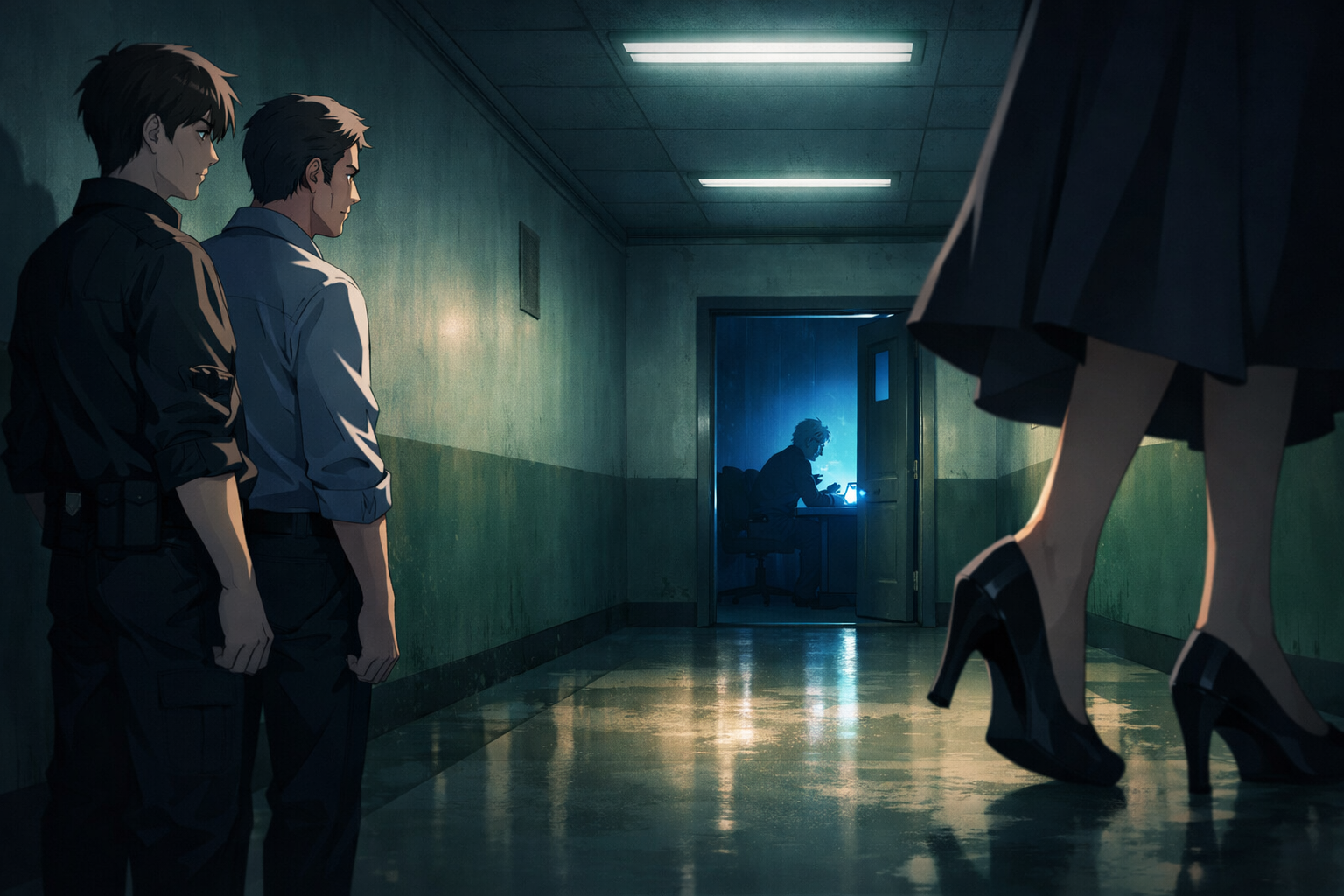
The first thing they told him was not to call it an asylum.
“Institute,” the supervisor said, smiling like it was a kindness. “You’ll hear that word a lot. Institute. Facility. Campus. Anything but the other one.”
The new hire nodded and kept his eyes on the floor tiles, as if the place might trip him if he stared too long. The tiles were clean, waxed to a shine that tried too hard. The smell was disinfectant and over-boiled vegetables—an institutional perfume that sat in the back of the throat.
“My name’s Clarke,” the supervisor added, holding out a hand. “Floor supervisor. Third floor mostly. You’ll report to me on paper. On bad days you’ll report to me with your face.”
The new hire shook his hand. Firm. Slightly too practiced.
“Evan,” he said. “Evan Miles.”
Clarke looked him over the way men did when they were deciding if you’d be trouble or merely work. Evan had the right posture for security—straight-backed, shoulders not hunched, eyes alert without appearing nosy. A clean haircut. Neutral expression. The kind of face that forgot itself in a crowd.
“Right,” Clarke said. “We do a walk. See the layout. Learn doors and don’t-doors. Rules you can break and rules you can’t.”
Evan followed him through the lobby, past a reception desk with a bulletproof window that no one wanted to mention. A woman behind it pretended not to watch them. A second woman typed something and stopped typing as they passed.
“Staff are staff,” Clarke said, keeping his voice low but casual. “Patients are patients. We don’t mix those words. If you hear a patient call someone ‘nurse,’ you don’t correct them. If you hear staff call a patient ‘inmate,’ you correct them.”
“And if I hear someone call it an asylum?” Evan asked.
Clarke’s smile tightened. “Then you’ve got sharp ears. Keep them to yourself.”
They climbed the stairs. Clarke didn’t use the elevator, and Evan noticed that too. The elevator doors sat in the corner, perfectly functional, perfectly ignored.
The third floor was quieter. Not silence—there were always sounds in buildings full of people—but the loud parts had been drained away. Footsteps softened. Conversations became murmurs. Somewhere down the hall a radio played faintly, as if it had been left on in a room someone forgot.
“This is where we keep the long stays,” Clarke said. “The ones who’ve decided this is home, or the ones whose families have.”
Evan let his gaze drift, careful not to stare into open doorways. Some doors were open. Some were shut. Some had little windows with blinds tilted just enough to show a slice of nothing.
Clarke tapped a clipboard he carried like a prop. “Meal times, recreation, therapy schedules. You’ll learn the rhythm. Rhythm is everything here.”
They turned a corner and passed the breakroom. The door was propped open with a rubber wedge. Inside, a few staff sat around a table with mismatched chairs, holding cups like they were warming their hands rather than drinking.
They all looked up at once.
The looks were quick. Normal. Too quick.
Clarke greeted them with a nod that didn’t invite conversation. They nodded back. One of them—linen staff by the look of the cart parked nearby—started to say something, then changed her mind and took a long sip of coffee instead.
Evan kept walking.
“Don’t take it personally,” Clarke said after they were past. “New faces are… noticed.”
“Is that a warning?” Evan asked.
“It’s a fact.”
They passed the recreation room: a television bolted high in the corner, a board game missing pieces, a single plant that had survived long enough to become suspicious. A man in a bathrobe stared through a window like he was waiting for a train.
They passed the therapy offices: doors shut, light seeping out from underneath like something alive.
Then Clarke slowed.
It was not dramatic. It was subtle, almost accidental, like a man easing his foot off the accelerator.
Evan noticed anyway.
“What’s down there?” Evan asked, nodding toward a corridor that angled off to the right.
The corridor was dimmer. The lighting not as new. The walls the same pale institutional color, but the paint looked older. The air tasted different too—less disinfectant, more dust.
Clarke didn’t answer immediately.
“That,” Clarke said at last, “is the East Wing.”
“Still used?”
Clarke’s mouth tightened again. “Technically.”
Evan stopped walking without realizing he’d done it. Clarke stopped too. They stood together, and the silence felt like a third person.
“Is it off-limits?” Evan asked.
Clarke glanced down the hall, as if measuring the distance to something he didn’t want to see. “It’s… not for you. Not yet. Not ever, ideally.”
Evan’s eyes flicked to a sign near the turn: STAFF ONLY. No other explanation.
And that, of course, made it irresistible.
“What’s in there?” Evan asked.
Clarke gave him a look—half annoyance, half something else. Not fear, exactly. Not quite.
“Old rooms,” Clarke said. “Old paperwork. Old problems.”
Evan smiled faintly, like he was trying to disarm the moment. “And one guy?”
Clarke blinked. “What did you hear?”
“Nothing,” Evan said quickly. “Just… stories. You know how it is. First day.”
Clarke’s gaze lingered a beat too long. Then he looked away, as if he’d made a decision he would regret.
“Come on,” Clarke said, voice lighter. “It’s only a corridor.”
They turned into the East Wing.
The light shifted. The hum of the building seemed to get quieter, as if the wiring itself didn’t like this place. The air was cooler.
At the far end of the corridor, a man stood with a tray.
He wore an orderly uniform, but the way he stood made it look like armor. He saw Clarke and let out a breath he hadn’t realized he was holding.
“Morning, Bob,” Clarke said, casual.
Bob lifted the tray slightly. “Breakfast,” he said, as if announcing an emergency.
Clarke walked toward him. “We can take that in for you.”
Bob’s relief was immediate and embarrassing. “Thanks, sir,” he said. “He’s… he’s been up.”
Evan’s heart ticked once harder.
“He always is,” Clarke said, and took the tray.
Bob stepped back as if he’d been excused from a punishment. His eyes flicked to Evan, assessing, curious, nervous. Then he turned and left quickly, like a man leaving a room he didn’t want to be remembered in.
Clarke stopped at a door.
No nameplate. No cheerful laminated schedule. Just a plain door with a lock that looked newer than everything else around it.
Clarke knocked once.
“Breakfast,” he called, and opened it without waiting.
The room was brighter than the corridor, but the light in it was wrong. Neon. Blue.
A man sat at a small table. He was balding, with stringy gray hair at the sides like he hadn’t decided whether to let it go or fight for it. His shoulders were narrow under a white buttoned-up shirt. Black pants, pressed too neatly. Patent leather shoes, polished to a sheen that didn’t belong on that floor.
On his wrist, a screen glowed. Blue light painted his face.
He didn’t look up.
“Morning,” Clarke said, stepping in. Evan followed.
The man’s eyes stayed glued to the screen. His face moved slightly, as if reading something that wasn’t quite on the display. His lips formed silent words.
Clarke set the tray down gently, like placing an offering. “Breakfast time, William.”
At the name, Evan felt something snag in his mind. William. Not “patient.” Not “Count.” A first name spoken like an old habit.
William didn’t react.
Clarke tried again, softer. “William. Breakfast.”
The man’s head lifted by degrees. The blue light slid off his face like water. His eyes—pale, alert in a way that didn’t match his age—found Clarke, then moved to Evan.
And then the man stood.
Fast.
So fast that Evan took a step back without meaning to.
William crossed the space between them in two strides and seized Evan by the forearms—not hard enough to hurt, but hard enough to claim him. His fingers were cold.
He leaned in, eyes wide with urgent terror and something like hope.
“Aegis,” William said.
Evan froze.
“Aegis,” William repeated, as if the name had been lodged in his teeth for years. “Have they caught him yet? Has he been retrieved? Tell me—tell me you know—”
Clarke moved immediately, hands up, calm voice. “All right, Count. All right. Sit down. It’s breakfast time.”
William’s stare didn’t leave Evan’s face. “Has he been retrieved?” he whispered, and the word retrieved sounded too exact, too formal, like something from a report.
Evan’s mouth opened.
No sound came out.
Clarke touched William’s shoulder with a familiarity that felt dangerous. “William. Come on. Sit. Breakfast.”
William blinked, once, twice. His grip loosened. His head tilted slightly, as if listening for something that had suddenly gone quiet.
A second passed.
Then his shoulders relaxed.
“Oh,” William said, softly, as if he’d just remembered where he was. “Yes. Of course.”
He let go of Evan. Returned to the table. Sat down. Picked up his fork like a man who had never done anything strange in his life.
He looked at the tray and began to eat.
Evan stood there, heart pounding, skin prickling as if the air had turned electric.
Clarke exhaled slowly. “See?” he said, as if this was normal. “Breakfast.”
William chewed, eyes down, the glowing wrist-screen dimming as if satisfied.
Evan’s voice came out thin. “What was that?”
Clarke stepped back toward the door, motioning Evan out. “Nothing,” he said. “He does that sometimes.”
“Sometimes?” Evan whispered, like speaking louder might wake something.
Clarke’s gaze flicked to William, then away. “He rambles. Names. Stories. You’ll hear plenty if you hang around long enough—which you won’t. Because we don’t.”
Evan swallowed. “Why did you call him William?”
Clarke’s hand paused on the doorknob. A fraction of hesitation. Then it moved again.
“Because that’s his name,” Clarke said. “Come on.”
They stepped back into the corridor. The door shut with a soft click.
Evan stood there, staring at the plain wood like it might open again by itself.
Clarke started walking. “You’ve seen him,” he said, a note of finality. “Now you can stop wondering.”
Evan followed, but his mind was already elsewhere. Aegis. Retrieved. The way William had said it—like a question that had been asked before, and answered wrong.
As they rounded the corner back into the main third-floor hall, Clarke slowed again.
The director stood ahead, waiting.
Not looming. Not dramatic.
Just… there.
Director Harlan was a compact man with careful hair and careful posture. He wore a suit that didn’t wrinkle, as if his clothing had been trained. His face was polite, but his eyes were sharp.
Evan noticed something else.
Harlan’s hands were clasped in front of him.
And they were trembling, almost imperceptibly, like a man holding a cup of hot tea he refused to admit was scalding.
Clarke stopped. His smile appeared like a mask. “Director.”
Harlan’s gaze moved from Clarke to Evan. “Mr. Clarke,” he said. “A moment.”
Clarke’s smile held. “Of course.”
Harlan didn’t look away from Evan when he asked, quietly:
“Why did you take the new hire to see William?”
Clarke’s throat moved. “He asked,” he said too quickly. “It seemed harmless.”
“Harmless,” Harlan repeated, tasting the word like it didn’t belong in his mouth.
Evan felt the director’s eyes on him, measuring, weighing. Not the look of a man meeting an employee. The look of a man searching for a crack in a wall.
Harlan’s hands clenched, then unclenched. The tremor worsened for a breath, then disappeared as he forced control back into his body.
“Mr. Miles,” Harlan said, voice polite. “How are you finding your first day?”
Evan knew the correct answer. He’d practiced correct answers his whole life.
“Good, sir,” he said. “Learning the routines.”
“Good,” Harlan said, but his eyes said something else.
Clarke laughed lightly—too light. “He’s keen. Good head on him.”
Harlan looked at Clarke.
Then, very carefully, he smiled.
“Excellent,” he said. “Mr. Clarke. My office. Ten minutes.”
Clarke’s smile faltered a hair, then recovered. “Yes, sir.”
Harlan’s gaze returned to Evan. “And you, Mr. Miles… carry on.”
Evan nodded. “Yes, sir.”
Harlan turned and walked away.
Only when he was gone did Evan realize he’d been holding his breath.
Clarke exhaled like a man coming up from underwater. “Right,” he said briskly. “Back to the tour.”
Evan watched Clarke’s face, watched the slight tightness at the corners of his mouth, the way his eyes avoided the East Wing corridor.
And Evan thought, very privately:
He knows.
Not everything.
But enough.
And he isn’t saying it.
Which meant one of two things:
Either the director was afraid to reveal what he knew…
Or he was watching to see what Evan would do next.
Evan’s stomach knotted.
He felt the itch of urgency under his skin, the impulse to move, to report, to call—an old reflex from a life that didn’t belong in a place like this.
He swallowed it down and forced his face into calm.
“Sir,” Evan said, mildly, “should I get back to my assigned area?”
Clarke blinked, relieved. “Yes. Yes, good. Start with linens. Simple.”
Evan nodded. “I’m feeling a bit off,” he added quickly, as if the words had appeared on his tongue without permission. “Nerves, I guess. Might step into the restroom.”
Clarke waved him off. “Go on.”
Evan walked away at a steady pace—no rush, no sprint. Just a man going to a restroom.
Only when he turned a corner and the corridor hid him from view did he let his face change.
His hand moved toward his pocket.
His eyes flicked once toward the East Wing.
Behind that plain door, William ate his breakfast as if nothing had happened.
And somewhere deeper in the building—though no footsteps announced it yet—there was a sound that did not belong to routine.
Click… clack…
A woman’s heels on ceramic tile.
And for reasons Evan could not yet explain, that sound made him colder than William’s grip ever had.


.png)
.png)
.png)