%20(1).png)
He woke beneath the cracked ceiling again, and for the first time in longer than he could measure, he didn't reach for anything.
He lay there for a while, looking at the water stain shaped like nothing, the hairline crack toward the window, and felt none of the old machinery start up behind his eyes — no calculation of timing, no mental review of what had worked and what hadn't, no quiet, exhausted resolve to get it right this time. He simply lay there, tired in a way that had stopped being about any single loss and started being about all of them at once, and let himself feel that tiredness without immediately turning it into a plan.
He went to the bookstore three days later, not because he'd finally settled on a strategy, but because he missed her, plainly, the way you miss a person rather than a project. He left the notebook in a drawer he didn't open before he left the apartment. He didn't check the date against a calendar. He simply went, on whatever Tuesday it happened to be, and let the rain or the lack of it be whatever it was going to be.
---
It rained anyway. She came in a little after four, shaking water from a pale yellow raincoat, and Ren felt the old ache of seeing her again land in his chest the same way it always did, undiminished by however many times he'd already felt it.
He didn't lead her toward the shelf he knew held what she was looking for. He let her wander, let her ask, and when she did, he walked with her without any particular hurry, and their conversation that first afternoon meandered in directions he hadn't rehearsed and couldn't have predicted, because for once he wasn't trying to predict anything at all.
The courtship that followed was, by any careful measure, less polished than several of the ones he remembered.
He misjudged a joke badly on their second date, some offhand comment about her university that landed as condescending rather than playful, and watched her face close slightly before he'd even finished the sentence. In another life, he might have caught himself mid-joke, adjusted, recovered smoothly using some remembered read of her mood. This time he simply felt the mistake happen in real time, apologized plainly — "That came out wrong, I didn't mean it that way" — and let the moment be awkward rather than salvaging it with practiced ease. She accepted the apology, a little stiffly at first, and the date continued in a slightly cooler register than it had started in, and neither of them pretended otherwise.
She canceled their third planned outing at the last minute, a message sent twenty minutes before he was set to leave his apartment, distracted by a paper due the next morning. He felt the old flicker of panic — *this is where it starts, this is the first crack, I should have scheduled it differently, I should have known her exam schedule* — and made himself sit with the panic instead of acting on it, resisting the urge to reassure her too quickly or offer to help with the paper in a way that might read as overreach. She rescheduled two days later without any explanation beyond having simply been swamped, and nothing about the relationship suffered for it at all. He noted, privately, how strange it felt to let an ordinary disappointment simply be ordinary, without immediately assigning it weight it hadn't earned.
They disagreed, more than once, about things that didn't resolve neatly. He told her, one evening over dinner, that he thought a friend of hers — not Emi, but a newer acquaintance from her tutoring job — was taking advantage of her kindness, borrowing money she never saw returned, and Hana told him, flatly, that it wasn't his place to have an opinion about her friendships.
"I wasn't trying to tell you what to do," he said. "I just don't like watching someone use you."
"Then trust me to notice that myself, if it's actually happening. I don't need you keeping score on my behalf."
They didn't speak for two days afterward, both of them stewing over a disagreement that felt, at the time, larger than it probably was, until she called him first and said she'd thought about it and maybe he'd had a point, though she still didn't love how he'd said it. He apologized for the delivery without retracting the substance, and something about that small, imperfect resolution — neither of them fully winning, both of them a little annoyed and a little relieved to be talking again — felt more durable to him than any of the smoothly executed evenings he remembered engineering in other lives.
There was a night, three months in, when he showed up to meet her having had an unexpectedly difficult day of his own, distracted and short-tempered in a way he usually worked hard to hide from her. He snapped at her over something trivial — she'd been ten minutes late, he'd been standing in the cold, and he said something sharper than the situation warranted. She didn't let it go the way a more anxious version of herself, worn down by outside doubt, might have.
"That's not fair," she said, immediately, no hesitation. "I was ten minutes late because the bus was delayed. You don't get to talk to me like that just because you had a bad day."
"You're right. I'm sorry." He meant it, plainly, without the elaborate self-correction he might once have performed. "I had a hard shift. That's not an excuse."
"No, it's not. But I accept the apology." She softened, taking his arm as they started walking. "Just don't do it again."
"I won't."
He didn't, not in any way that mattered, though the relationship carried its share of smaller frictions after that — a forgotten anniversary of the exact day they'd first spoken, remembered a full week late and apologized for sincerely rather than dressed up with an elaborate gesture; a stretch of two weeks where they barely saw each other because of conflicting schedules and both admitted, afterward, to feeling a little neglected without either of them making it into a crisis.
He stopped treating every rough patch as evidence of an ending. That, more than anything else, was the thing that had actually changed in him, though he couldn't have named the exact morning it happened. A missed text was simply a missed text. A flat joke was simply a joke that hadn't landed. He let the relationship be uneven, because real things were uneven, and he had spent an unbearable number of lives mistaking smoothness for proof of anything at all.
---
He met her parents four months in, at a lunch that started warmly enough and cooled, by its second hour, into something considerably more measured.
Yuriko was kind to him, in the easy, curious way he half remembered from other versions of this exact table. Takeshi was not unkind, but he asked questions with a precision that felt, almost immediately, like an examination rather than a conversation.
"What does your father do," Takeshi asked, early on, over the first course.
"He passed a few years ago," Ren said, which was true in the broadest sense, though the specific years in question belonged to a life this Takeshi had no way of knowing anything about. "Before that, he worked in logistics. Nothing very interesting."
"And your plans, once you finish your studies. Where do you see yourself in five years."
Ren felt the familiar tightening in his chest that this exact question always produced, the impossible arithmetic of trying to answer honestly about a future he had already lived through more versions of than he could count, none of which he could reference without sounding unwell. "I'm not entirely sure yet," he said, careful, vague. "I want to build something that's actually mine. I haven't settled on the shape of it."
"That's not really an answer."
"It's the honest one I have right now."
Takeshi studied him for a long moment, something assessing and not entirely satisfied in his expression. "You're evasive," he said, plainly, not unkindly, simply stating an observation he seemed to have been building toward for the better part of an hour. "Every question I ask you that touches on your past or your plans, you find a way to answer without actually answering. I've met men your age who don't know what they want yet. That's normal. This feels like something else."
"I don't mean to be evasive."
"Maybe not on purpose. But my daughter deserves someone whose life she can actually see the shape of, not someone who keeps the important rooms locked." Takeshi said it without cruelty, the plain, unhappy conclusion of a man who trusted his own read of people and didn't enjoy being right about this particular one. "I'll be honest with you, since you've clearly decided honesty isn't required of you. I don't think you're ready for what she'd need from you. I think there's something underneath all that careful vagueness, and I don't know what it is, and neither, I suspect, does she."
Ren had no answer that wouldn't have sounded, to any reasonable man across that table, like the beginning of a diagnosis rather than an explanation. He said nothing further, and the lunch concluded politely enough on its surface, though something in the temperature of the room had shifted permanently by the time he left.
---
Hana told him, a week later, that her parents had voiced their concerns to her directly, in a conversation she relayed with visible reluctance.
"They think you're hiding something," she said, watching him carefully. "My father especially. He said it wasn't the answers themselves, it was how carefully you seemed to be choosing them."
"He's not wrong that I'm careful," Ren said, which was as close to the truth as he could offer her.
"Are you hiding something?"
He held her gaze for a long moment, aware of exactly how much he wanted to tell her everything and exactly how impossible that remained. "Everyone has things they're still working out how to say," he said, finally. "I'm not hiding anything that would hurt you. I promise you that much is true."
She studied him a moment longer, and whatever doubt had briefly surfaced in her seemed, for now, to settle back down, though he understood it hadn't fully disappeared.
It was that same week, lying awake beside her, replaying her father's words, that Ren found himself considering something he hadn't seriously entertained in any previous version of this life.
"Maybe I should step back," he said, quietly, into the dark. "Just for a while. Let things cool down with your parents. I don't want to be the reason you and your family end up at war with each other."
Hana went very still beside him. "Don't do that."
"I'm not trying to give up on us. I'm trying to protect you from having to choose."
"That's exactly the problem." She sat up, turning to look at him properly, something sharp and immediate in her voice. "You deciding, on your own, what's best for me, without asking me what I actually want — that's not protection, Ren. That's just a different version of my father deciding what's best for me. I don't need either of you managing my life on my behalf, even when you both think you're doing it out of love."
"I didn't mean it like that."
"I know you didn't mean it like that. That doesn't mean it isn't exactly what it is." Her voice softened slightly, though the firmness underneath it didn't. "If this ends, I want it to end because I decided it should, not because you quietly removed yourself to spare me a hard conversation. Let me have the hard conversation. That's mine to have, not yours to prevent."
He didn't offer to step back again after that.
---
The confrontation, when it came, happened at her parents' house on an evening Ren wasn't present for at all, relayed to him afterward in careful, exact detail because Hana wanted him to understand precisely what had been said and precisely what it had cost her to say it.
Her parents had sat her down deliberately, Yuriko's warmth replaced by something more serious, Takeshi direct as always.
"We're not trying to control you," Takeshi had said, according to Hana's account, "but you're our daughter, and we've watched you long enough to trust our instincts about people. This one doesn't add up. I want you to really think about that before you get in any deeper."
"I have thought about it," Hana said. "I've thought about almost nothing else for a week."
"And?"
"And I still choose him." She said it plainly, without performing anger, though the steadiness in her voice had clearly cost her something to hold onto. "I'm not asking either of you to approve. I know you love me, and I know you think this concern comes from that love, and I believe you. But I'm not a girl anymore who needs your permission for who I let myself love. I'm telling you what I've decided, not asking you to help me decide it."
"Hana—" Yuriko started, gentler, trying a different angle.
"Mom. I heard everything Dad said. I've sat with it. I don't have a clean answer for the things that worry him, because I don't fully understand them myself yet. But not understanding something isn't the same as it being wrong. I've watched him carefully for months. I trust what I've actually seen more than I trust a feeling neither of you can fully explain either."
"We just don't want to watch you get hurt," Takeshi said, and for the first time, something in his voice carried more grief than authority.
"I know. And if I get hurt, I'll come to you, and you can be as right as you want to be about it then. But I need to be the one who finds that out. Not you, deciding it for me in advance because you're afraid of what might happen." Hana looked between them, steady. "I love you both. I'm not choosing him instead of you. I'm just not going to let either of you choose for me, even out of love. Especially not out of love. That's the kind of choosing that costs the most, because it's the hardest to argue with."
Nobody had a clean response to that. The evening ended quietly, unresolved in the sense that her parents' worry didn't simply evaporate, resolved in the sense that nothing about their worry had actually managed to move her.
Ren, hearing the account afterward, understood that he had contributed nothing to the outcome at all. The entire weight of it had rested on her, and she had carried it herself, and won or lost nothing on his behalf, only on her own terms.
---
He expected, in the weeks that followed, to feel the old collapse begin — the slow withdrawal, the quiet, unnamed doubt creeping in the way it always had whenever outside pressure pressed hard enough against the relationship.
It didn't come. Her parents remained cool toward him for a long while, polite rather than warm — Takeshi's questions at subsequent dinners grew shorter, more perfunctory, the careful cross-examination replaced by a kind of wary, watchful silence that was its own form of judgment. Yuriko tried harder than her husband did to bridge the distance, asking Ren about small things, his work, a book he was reading, though even her warmth carried a faint reserve it hadn't before. Hana didn't waver through any of it. She visited her parents regularly, brought Ren along when it made sense and went alone when it didn't, and never once let the tension at home bleed into doubt about her own choice.
The coolness thawed slowly, month by month, into something less hostile if never quite as easy as it might have been under better circumstances. Takeshi began asking Ren real questions again around the six-month mark, the kind that expected genuine answers rather than testing for evasion, and by the time a year had passed since that difficult lunch, he had stopped watching Ren like a man waiting to be proven right about something and started, instead, simply treating him like a fixture in his daughter's life whether he fully approved of it or not.
"I still don't fully understand you," Takeshi admitted to him once, nearly a year and a half in, the two of them alone on the same garden bench where the original interrogation had taken place. "But I've watched you with her for long enough now to trust that whatever I don't understand isn't hurting her. That's going to have to be enough."
"Thank you," Ren said, and meant it, understanding that this qualified, coming from Takeshi, as something close to a blessing.
They moved in together the following spring, into a small apartment neither of them could quite afford and both of them loved anyway — a narrow kitchen, a window that looked out onto a neighbor's persistent, opinionated cat, a bedroom just large enough for the bed and not much else. Unpacking boxes on the first weekend, surrounded by half-labeled cardboard and Hana's increasingly creative system for deciding what went where, Ren found the old notebook near the bottom of a box of things he'd meant to sort through months earlier and never had.
He sat on the floor amid half-unpacked boxes and opened it, flipping through pages of cramped, increasingly desperate handwriting — *Hana likes Coke. Hana doesn't drink soda. Told her about my father, month three, she pulled away. Month four, she cried and held my hand.* He read a few pages in silence, feeling, at a distance, the shape of the man who had written them, exhausted and afraid and trying so hard to engineer his way back to something that had never once responded to engineering.
He closed it, without ceremony, and set it in the bottom drawer of a desk they'd bought secondhand, and didn't take it out again. He didn't need it anymore. There was nothing left in its pages that this actual, ordinary, unpolished relationship required him to remember.
---
They passed the seven-month mark on an unremarkable evening, arguing cheerfully about whether a couch they'd seen online was worth the delivery fee, and Ren noticed the date pass with a small, private ache that had nothing to do with dread. They passed the fourteen-month mark during a stretch when Hana was buried in exam preparation and barely home before midnight most nights, and Ren noticed that one too, quietly, without saying anything to her about why it mattered.
He married her the following autumn, in a small ceremony neither of them treated as any kind of finish line — her parents attended, Takeshi's toast careful and understated but genuine, Yuriko crying more than she probably intended to, Emi standing beside Hana in a dress she complained about for weeks beforehand and loved, in the end, entirely. Nozomi came, and brought a gift so impractical and specific to an old joke between her and Hana that half the guests didn't understand why the bride was laughing so hard at a coffee mug.
It felt, standing there, less like an ending than like a single ordinary day among many that happened to be marked with slightly more ceremony than the rest.
---
The first year of marriage arrived in pieces, none of them remarkable on their own, all of them accumulating into something Ren hadn't let himself fully trust in longer than he could measure.
There were boxes still unpacked in a spare room eight months in, both of them too tired most evenings to deal with them, an ongoing joke between them about whether the boxes had achieved permanent residency. "We should just build the apartment around them at this point," Hana said once, stepping over the same box for the third week running. "Let future archaeologists figure out what we valued."
There were arguments about groceries — Hana's insistence on a particular brand of rice Ren found indistinguishable from any other, his own stubborn preference for a soy sauce she claimed tasted identical to the cheaper one, an argument that recurred every few weeks with the same tired affection, neither of them actually caring enough to change the other's mind, both of them apparently enjoying the argument itself more than its resolution.
"You know they're the same rice," he told her, holding up two bags in the store one Saturday.
"They are not the same rice, and I resent the implication."
"I've done the taste test."
"You've done a bad taste test."
They bought her brand, the way they always did, and he pretended to sulk about it the whole walk home, and she laughed at him the entire time, and neither of them meant a word of the argument at all.
There were quiet dinners where neither of them spoke much, comfortable in a silence that had nothing anxious in it — evenings after long days when they simply ate side by side, occasionally trading a tired smile, the specific ease of two people who no longer needed conversation to prove anything to each other. There were bad moods, hers after a difficult day at the tutoring center where a particularly frustrating student had reduced her to something close to tears of pure exasperation, his after a long shift at a job he'd taken to help cover the apartment's rent, evenings where they simply gave each other space rather than performing warmth neither of them currently had to offer, trusting that the warmth would still be there once the mood passed.
There was laughter, more of it than he'd let himself expect. A running joke about the neighbor's cat, an imperious gray creature who had adopted their windowsill as sovereign territory and regarded both of them with open disdain whenever they dared open the window without permission. A disastrous attempt at cooking a dish from a recipe Hana found online, something involving a sauce that separated badly and a smoke alarm that went off twice, the two of them eventually giving up and ordering noodles instead, laughing too hard to be properly disappointed about the wasted ingredients. A habit Hana had of narrating the plots of terrible dramas to him in exhaustive, delighted detail while he pretended not to be as invested as he clearly was, occasionally forgetting himself enough to ask what happened next before she'd gotten there herself.
There were ordinary repairs — a leaking faucet Ren fixed badly on his first attempt, flooding the small bathroom floor and requiring an emergency trip for towels at eleven at night, then fixed properly a week later with a video tutorial and Hana narrating unhelpful commentary from the doorway; a door that stuck badly in humid weather that they simply learned to shoulder open together rather than ever getting around to planing down, a small shared ritual that became, oddly, one of the things Ren looked forward to on the worst days. There were nights they fell asleep before finishing a conversation, picking it back up unprompted the next morning over breakfast as though no time had passed at all, both of them remembering exactly where they'd left off without needing to ask.
He noticed himself, somewhere in the accumulation of all these unremarkable evenings, waiting for the cracked ceiling less and less. The fear never entirely left him — some part of him still woke, occasionally, in the gray hour before dawn, heart pounding for no reason he could name until he'd confirmed, blinking up into the dark, that the ceiling above him was smooth and unfamiliar and entirely his own, the one he'd chosen rather than the one that had once chosen him back. But the waiting grew quieter, month over month, less an active dread and more a distant weather system he no longer checked the forecast for every single day.
He understood, without ever fully articulating it to himself, that Hana's choice — hers alone, made and defended entirely on her own terms, against her own parents, without anything he'd engineered or earned through memory — was the thing that had actually changed the shape of this life. It felt, some days, like the whole and complete answer to everything he'd spent this looping existence trying to understand.
It did not feel, on other days, entirely complete. Something in him sensed, without knowing why, that the shape of this life was still reaching toward something neither of them had named yet.
---
The evening it finally arrived offered no ceremony at all.
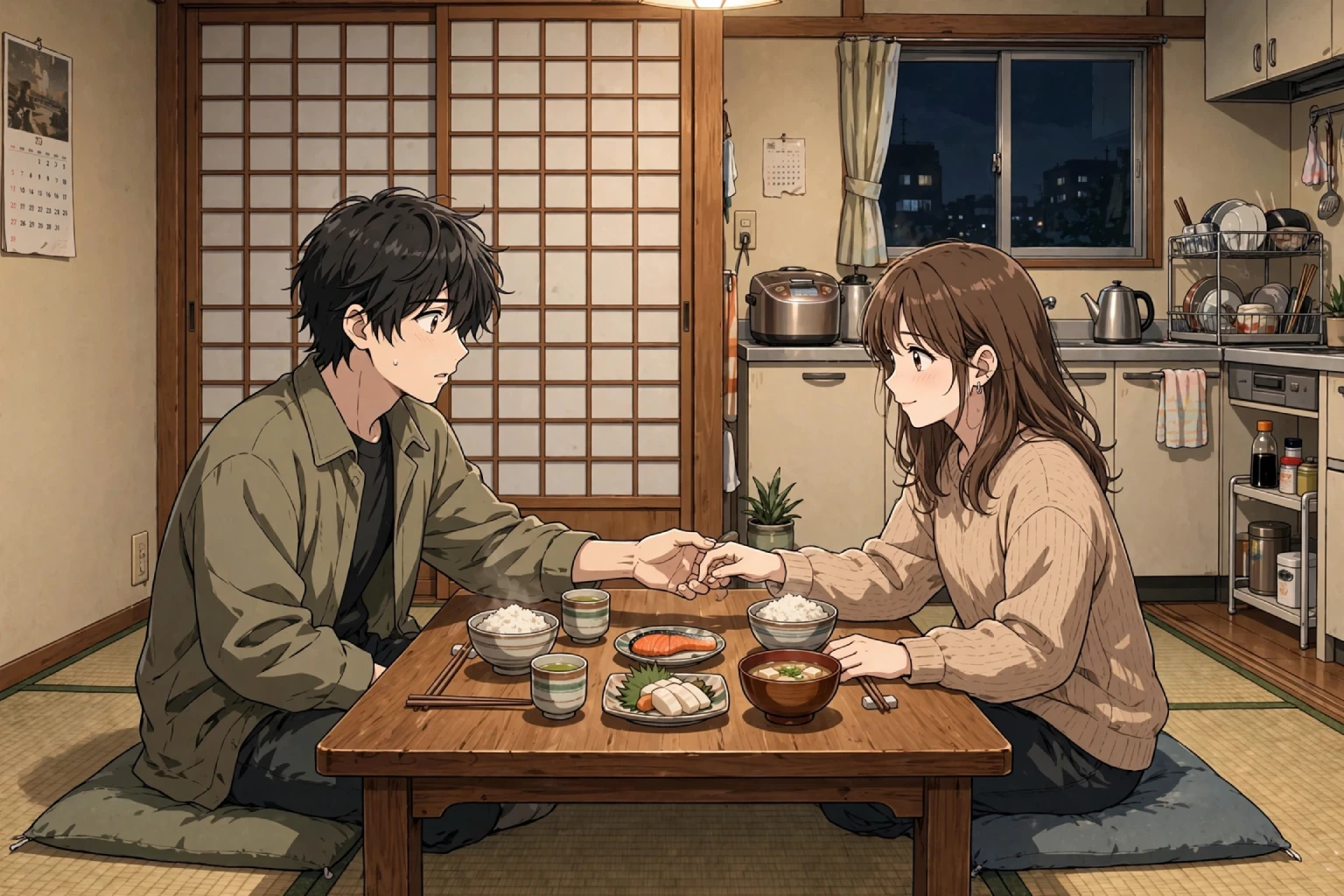
It was an ordinary Tuesday, a year and two months into the marriage, dinner cooling slightly on the table because Hana had been unusually quiet since he'd gotten home, picking at her food rather than eating it, turning her chopsticks over in her hands more than she was using them.
"You've been quiet," Ren said, watching her. "Rough day?"
"Not exactly." She set the chopsticks down, folding her hands instead, turning something invisible over between her fingers the way she did when she was working up to a sentence she'd already rehearsed several times without managing to say out loud. "I've been trying to figure out how to tell you something all day, and I keep starting the sentence wrong in my head."
His chest tightened, old instinct rearing up despite everything. "You can just say it."
She looked up at him, and something in her face — nervous, luminous, entirely unguarded — undid whatever brief fear had gathered in his chest before she'd even spoken.
"Ren," she said, quiet, her voice catching slightly on his name the way it hadn't in longer than he could remember. "We're having a baby."
For a long moment, he didn’t move at all.
Across hundreds of loops—probably far more than he could still count—through courtships that lasted days, months, and years, through marriages, quiet endings, and mornings beneath the cracked ceiling, he had never once reached this moment.
Someday, they had said in that first life. Then not yet. And somewhere along the way, without either of them ever deciding it, not yet had quietly become never.
But Hana was sitting across from him now, nervous and radiant, waiting for his answer, and the future no longer felt like something always retreating beyond their reach.
He reached across the table, his hand trembling slightly as it found hers. Words would come later. For now, he held on.


.png)
.png)
.png)