%20(1).png)
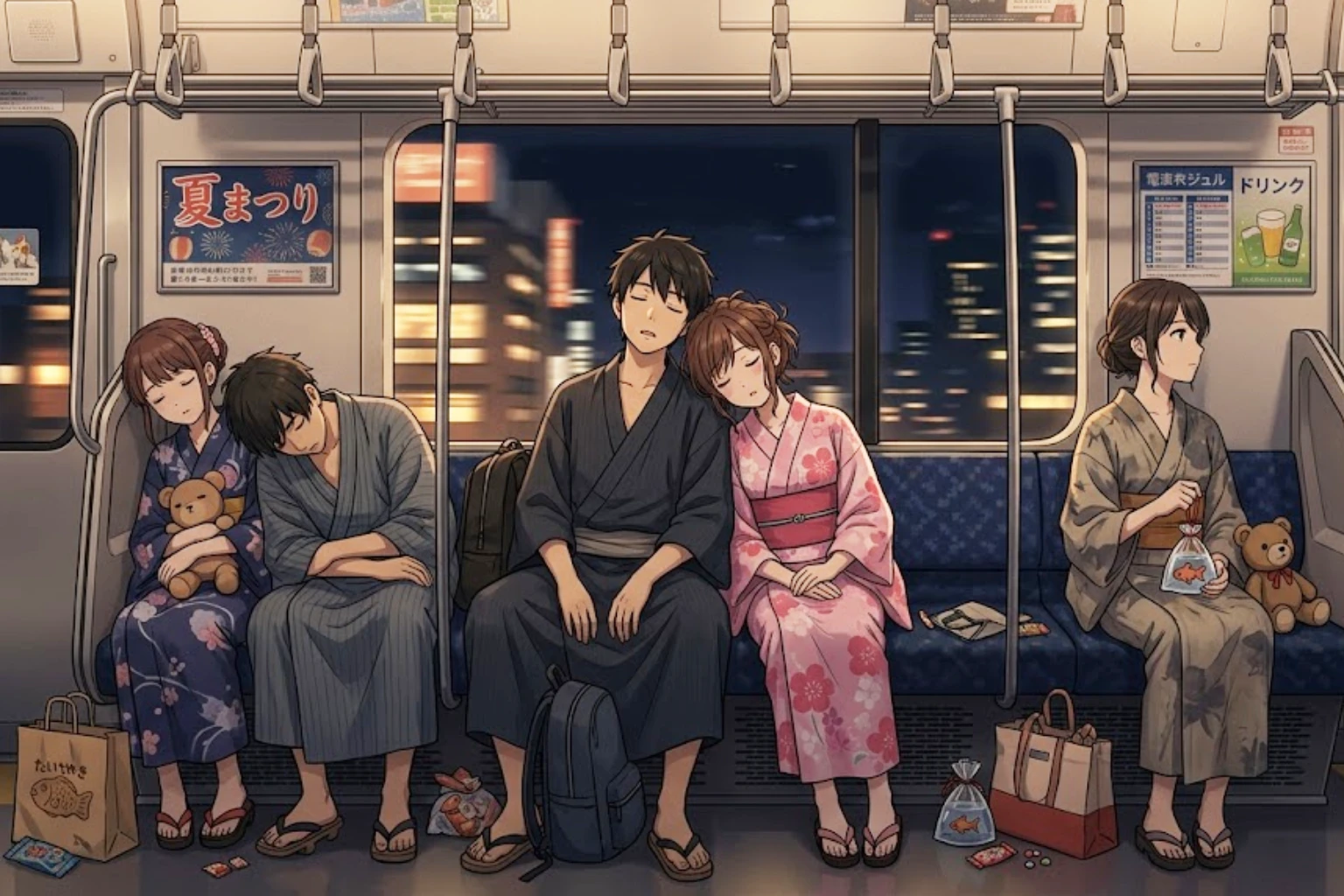
The last train departed at 11:58, and they made it by four seconds.
Kei knew this because the platform clock was large and digital and directly in his eyeline as he ran, and because some part of his brain had apparently decided that counting was more useful than panicking. Sora came through the gate last, as always, and the doors closed behind her with a soft mechanical finality, as if the train had been willing to wait exactly that long and no longer.
They stood just inside the doors, breathing hard, the five of them arranged in various stages of collapse.
"That," Daiki said, hands on his knees, "was too close."
"We had time," Sora said. She didn't sound out of breath at all, which Kei found faintly insulting given that she'd been carrying a stuffed bear roughly the size of a second grader.
"We had four seconds."
"Four seconds is time."
"Four seconds is not time." Daiki straightened up, gesturing for emphasis. "Four seconds is the absence of disaster. Those are different categories."
Sora considered this with the seriousness of someone weighing a genuine philosophical claim, and appeared, after a moment, to accept it.
"Whose fault was that, anyway," Hana said, dropping into the nearest row of seats and immediately easing her sandals off her heels without removing them fully. "We were fine until someone stopped to look at a shrine."
"It was a nice shrine," Sora said.
"It's midnight."
"Shrines don't close."
"We closed," Daiki said. "We almost closed permanently, as a group, on that platform."
Ren said nothing. He'd found a seat by the window and was refastening the sash of his yukata, which had come loose somewhere in the running, one sleeve sliding halfway down his arm. He tugged it back into place without much hope that it would stay.
"You're going to lose that entirely before we get home," Kei said, sitting down across from him.
"I'm aware."
"Hana tied that, didn't she?"
"She did." Ren looked down at the sash with something like betrayal. "It held for six hours. That's not nothing."
"It's not nothing," Hana agreed, not looking up from her sandal. "The running undid it. Blame the shrine."
"I already blamed the shrine," Daiki said.
The train pulled out of the station, and the platform lights slid away behind them, and for a moment nobody spoke because everyone was still catching their breath in the specific way that happens after real exertion in clothes not meant for it.
Kei looked around the car. Mostly empty — a salaryman asleep against the far window, two older women with grocery bags murmuring to each other, and the five of them taking up the block of seats nearest the doors, spread out with bags and prizes and the loose, sprawling posture of people who'd stopped caring how they looked hours ago.
"Okay," Daiki said, once his breathing had returned to something normal. "But in my defense—"
"Nobody blamed you," Kei said.
"I feel like it was implied."
"It was the shrine," Sora said patiently. "We covered this."
Daiki held up the small plastic bag he'd been carrying this entire time, inside which a single unbothered goldfish drifted in water that had definitely been sloshed around more than was ideal for a goldfish's peace of mind.
"Well, Ichiro survived the sprint," he said. "That's the important thing."
"You named it already," Kei said.
"His name has been Ichiro since the moment I won him."
"You said you weren't going to name it tonight."
"I lied. I was excited."
Hana finally got her sandal properly seated again and looked over. "How many tries did that actually take you? I lost count around six."
"Eleven," Ren said, without looking up.
"Eleven?"
"I was there for all of them," Ren said. "I counted because I was holding his drink the entire time and wanted to know exactly how much of my evening I was donating to this cause."
"It wasn't eleven," Daiki said.
"It was eleven. You spent, by my estimate, four hundred yen on a fish you could have bought at a pet store for two hundred."
"That's not the point."
"What is the point?"
"The point," Daiki said, lifting the bag slightly so Ichiro caught the light, "is that I earned him. There's a difference between buying a fish and winning a fish. This fish has narrative weight."
"He's going to die in a week," Kei said, not unkindly, more as a statement of general fact about festival goldfish as a category.
"He is not going to die."
"They always die. It's like a rule."
"Not if you take care of him properly." Daiki cradled the bag with visible tenderness. "I already looked up what he needs. A tank, a filter, the right food. I'm going tomorrow."
"You're going to spend more on the tank than you spent losing at that game," Hana said.
"That's not the point either."
"What is the point, then, currently?"
"The point is his name is Ichiro and he's coming home with me and in a month you're all going to see how well he's doing and you're going to feel bad about doubting him."
"I look forward to that," Kei said.
Sora, who had said nothing during most of this, shifted the enormous bear in her lap so it sat more like a passenger than a piece of luggage. "Ichiro's a good name," she said. "Better than what I almost named the bear."
"You have a name for the bear?"
"I was considering Kuma."
"That's just the word for bear."
"It's a classic."
"It's not a name, it's a description."
"He likes it," Sora said, patting the bear's head with the flat certainty of someone who had already decided this conversation was over.
"How did you even end up with that thing," Hana asked. "It's bigger than you."
"I won it at the ring toss."
"You didn't win it," Daiki said. "I won it. You asked for it."
"I asked nicely."
"You said, 'if you win that I'm keeping it,' before I even threw the ring."
"That's a form of asking."
"It's a form of forecasting," Kei said.
"I stand by it," Sora said. She adjusted the bear again, its head now resting against the window where hers would presumably follow before long. "He's coming home with me. He earned it by being large and comforting."
"He didn't earn anything," Daiki said. "I earned it. He's just here."
"We're basically foster parents," Hana said. "You've got the fish, she's got the bear. What did I get."
"Sore feet," Kei said.
Hana turned her head slowly toward him with an expression of profound betrayal.
"I'm just saying."
"You're not just saying anything, you're gloating."
"I'm not gloating. I'm noting, for the record, that I did in fact tell you—"
"Here we go."
"—that those sandals were going to destroy your feet by ten o'clock, and it is now almost midnight, which means you outlasted my prediction by two hours, so really you should be thanking me for underestimating your resilience."
"You told me that now," Hana said. "In this conversation. Which doesn't count."
"I told you before we left the dorm."
"You suggested it. Suggesting is not telling."
"I said, and I am quoting myself directly, 'those sandals are going to destroy your feet by ten o'clock.' That's not a suggestion. That's a forecast with a timestamp."
"A forecast isn't an instruction. If you wanted me to change shoes you should have said, 'change your shoes.'"
"I don't think I should have to be that direct with a grown adult about her own footwear."
"Apparently you did, because I'm sitting here in agony."
"You look fine."
"I am performing wellness. Internally I am screaming."
Ren, still working on his sash, glanced over. "For what it's worth, I did hear him say it. Outside the convenience store. Before we even got on the first train."
"Thank you," Kei said.
"Nobody asked you to corroborate," Hana said.
"I'm a reliable witness. I felt it was relevant."
"You're supposed to be on my side."
"I'm on the side of accuracy," Ren said, and went back to his sash, which had once again begun to slip.
Sora, eyes half closed already, added without much investment, "Your feet did look bad by the dango stall."
"Everyone's feet looked bad by the dango stall, it had been four hours."
"Mine didn't," Sora said.
"You were wearing actual shoes."
"I was wearing actual shoes," Sora agreed, in the tone of someone accepting a compliment rather than conceding a point.
The train slowed for the next station, and the doors opened onto an empty platform, and nobody got on, and after a moment the doors closed again and the train resumed.
Daiki checked on Ichiro. Hana reached into her tote and produced the paper bag of taiyaki she'd bought near the end of the night, unfolding the top with the particular care of someone protecting a resource.
"Is that the last one," Ren asked.
"It's the only one. I've been saving it."
"Since when do you save food."
"Since I got smart, apparently, because I have a taiyaki and you don't."
She took a bite. It was no longer warm, but she ate it anyway, methodically, from the tail, the way Kei had noticed she always did, though he'd never mentioned it because it hadn't seemed like the sort of thing you brought up.
"You went back for that after we already said we were leaving," Daiki said. "That's why we were almost late."
"That's not why we were almost late. We were almost late because Sora stopped at the shrine."
"I stopped at the shrine because it was there," Sora said, from somewhere near sleep already. "Beauty doesn't wait for train schedules."
"Beauty should be more considerate of train schedules," Daiki said.
"Beauty doesn't answer to you."
Kei, who had been quiet through most of this, found himself smiling slightly at the window, at nothing, at the general shape of the evening replaying itself in fragments — Daiki hunched over the goldfish stall with the fierce concentration of someone defusing a bomb, Sora's flat delighted "mine now" when the ring landed, Hana insisting her sandals were "totally fine, stop asking" three separate times before ten o'clock, Ren patiently retying the yukata sash outside the shrine gates while everyone else wandered ahead.
"What are you smiling at," Hana asked, catching him.
"Nothing. Just thinking about the shrine."
"The shrine that almost got us killed."
"Almost got us stranded. Different category, according to Daiki."
"According to facts," Daiki said.
The two older women near the far doors gathered their bags as the train slowed again, exchanging a few quiet words, and stepped off at the next stop. The doors closed behind them. The car felt a little emptier, a little quieter, the salaryman still asleep against his window, undisturbed by any of it.
"How many stops do you have," Ren asked, generally.
"Four," Kei said.
"Five," said Hana.
"Six," Daiki said. "Seven for her." He nodded at Sora, whose eyes were now fully closed, her cheek resting against the bear's head.
"I'm awake," Sora said, without opening her eyes.
"Sure."
"I am. I'm resting my eyes. There's a difference."
"What's the difference."
"The difference is I'll be offended if you assume I'm asleep."
"Duly noted," Ren said, and let it go.
The train rocked gently through the dark, past the last cluster of shopfronts still lit near the station, then out into the quieter residential stretch where the windows were fewer and further apart. Kei watched the city thin outside the glass — a convenience store sign, a shuttered bakery, an intersection with its light blinking yellow for no one.
"Can I see the photos from tonight," Hana asked Ren, who had his phone out, screen glowing faintly in the dim car.
He turned it toward her without comment. She leaned in, and Daiki leaned in from the other side, and for a moment the three of them were bent over the small screen scrolling through the evening in reverse — the fireworks, blurred and streaked because none of them had held the phone steady; Daiki's triumphant face at the goldfish stall, fist raised like he'd won something more significant than four hundred yen back in cheap prize plastic; Sora mid-stride carrying the bear like a soldier extracting the wounded from a battlefield; Hana and Kei standing in front of the shrine gate, not posed, caught mid-conversation, her gesturing at something off-frame and him half turned toward her, laughing at whatever she'd said.
"When did you take that one," Kei asked, looking at it upside down from across the aisle.
"Before the fireworks," Ren said. "You were arguing about something."
"We weren't arguing."
"You had the arguing face."
"I don't have an arguing face."
"You have several faces," Ren said. "That was one of the argument ones. I've catalogued them."
"That's unsettling."
"It's useful," Ren said. "I know exactly when to intervene and exactly when to let it run its course."
Hana laughed, taiyaki forgotten for a second, and scrolled further back, past the food stalls, past a picture of Daiki's face mid-bite into something skewered and unidentifiable, past a very blurred photo that appeared to be entirely Sora's thumb.
"Delete that one," Sora said, eyes still closed, apparently aware of the exact photo despite not looking.
"How do you know which one I'm on."
"I know my thumb when I see it."
"You can't see it, your eyes are closed."
"I have a sense for it."
Ren deleted the photo without further comment, which seemed to satisfy her, and scrolled on until the phone's screen dimmed on its own from disuse, and he set it face-down on his knee and looked instead out the window, at his own faint reflection layered over the passing dark.
Hana finished the last bite of taiyaki and folded the paper bag into a small, neat square, tucking it into her tote beside the day's accumulated debris — a folded fan, a strip of festival tickets she hadn't used, a hair tie she'd apparently abandoned wearing at some point without Kei noticing when.
"Your hair's down," he said, only just registering it.
"Since the fireworks. It kept getting in my face." She reached up self-consciously, tucking a strand behind her ear. "Does it look bad."
"No. It looks—" He stopped, recalibrated. "It looks fine."
"Convincing enthusiasm," Hana said.
"I don't do enthusiasm this late."
"Understood."
The train pulled into another station, slower this time, the announcement crackling overhead in the flat, practiced tone of every late train announcement everywhere. Nobody moved to get off. The doors opened onto an empty platform and closed again a few seconds later, and they resumed.
Daiki had drifted into a quieter study of Ichiro, tilting the bag slightly to watch him adjust, murmuring something too low to catch, which might have been baby talk directed at a goldfish and which nobody had the heart to interrupt.
"You're going to traumatize him, talking to him like that," Kei said eventually.
"I'm building trust."
"He's a goldfish. He doesn't know what trust is."
"You don't know what he knows."
"I know he has approximately four seconds of memory."
"That's a myth," Daiki said, with the air of someone who had, in fact, looked this up in the last hour on his phone while the others weren't paying attention. "Goldfish have memories that last months. They can be trained. There was a whole study."
"You looked this up already."
"I wanted to be informed."
"You're really serious about this fish."
"I won him fair," Daiki said. "Eleven tries. That's a relationship now."
"That's compulsive gambling," Kei said, "but okay."
"It's dedication."
"Sure."
Hana, watching this with quiet amusement, leaned back against the seat and let her eyes drift half shut, though she was still tracking the conversation, still present in the way that made it clear she wasn't actually tired yet, just settling.
"Remember when he tried to win one for Sora, too," she said, "and it kept escaping the net?"
"I remember that fish had a death wish," Daiki said. "Very evasive."
"You looked so betrayed."
"I was betrayed. I made eye contact with that fish and he chose violence."
"He didn't choose anything, he's a fish," Kei said.
"He chose to dodge the net four times. That's a choice."
"That's water displacement."
"That's what a fish would want you to think."
Sora, from behind the bear, added without opening her eyes, "I didn't need a fish. I have Kuma."
"You keep calling him that like it's decided."
"It is decided."
"When was it decided."
"Just now. I decided."
"That's not how naming works."
"That's exactly how naming works," Sora said. "You decide, and then it's true."
Nobody had a strong counterargument to this, and the conversation lapsed into a companionable quiet while the train took a long curve and the lit windows of a passing apartment block swept slowly across the glass.
Ren checked the time on his phone, then set it back down.
"Two more stops for you," he said to Kei.
"I know. I'm not in a hurry."
"You never are."
"Should I be?"
"No," Ren said. "I just notice things."
Hana yawned — small, involuntary, covering it with the back of her hand a second too late — and Kei glanced over without meaning to.
"Tired?"
"A little. My feet are staging a protest."
"You could take the sandals off."
"On a train floor? No."
"Suit yourself."
She shifted instead, tucking one foot up under her on the seat despite the yukata making it slightly awkward, and settled back with a small sound that was somewhere between discomfort and relief.
Daiki yawned next, contagious, and admitted, "Okay, I'm tired too. Ichiro, don't tell anyone I said that."
"He can't tell anyone anything," Kei said. "He's a fish."
"He's a very perceptive fish."
The conversation kept going in this loose, unhurried way for a while — the goldfish, the bear, somebody's feet, a stray memory of the fireworks display and the exact moment the finale had started early and caught everyone off guard, Daiki's dramatic reenactment of nearly dropping his food in surprise — but the gaps between exchanges were growing, the pauses stretching a little longer each time, nobody rushing to fill them the way they had an hour ago.
Sora had stopped responding to anything at all. Her breathing had gone slow and even, her cheek fully settled against the bear's head, and when the train swayed she swayed with it, undisturbed.
Daiki noticed and looked over. "She's out."
"She's been out for ten minutes," Ren said. "You just weren't paying attention."
"I was paying attention to Ichiro."
"Understandable priorities."
Hana smiled faintly at that, eyes still open but heavy-lidded, watching the window without really seeing it, the city outside reduced now to isolated pockets of light between long stretches of dark.
"This was a good one," she said, quiet, mostly to herself. "Tonight, I mean."
"Yeah," Kei said.
"Better than last year's."
"Was there a last year's?"
"There was. You weren't there. It rained the whole time and Daiki lost his shoe in a drain."
"I did not lose it," Daiki said, without much conviction, clearly too tired to defend the story properly. "It was recovered."
"After forty minutes."
"Recovered is recovered."
Kei found himself smiling again, this one smaller, quieter, the kind that didn't need an audience. He'd only known these four since April — since the disorienting first week of university when everyone was too polite and too anxious and nobody yet knew which small jokes would last — and somehow, four months in, this was already what a summer night was supposed to feel like.
He didn't examine that thought much further. It was late, and the train was warm, and the thought seemed like the kind of thing better left where it was, unexamined, glowing quietly at the edge of things.
The train slowed for another station. This time a couple of new passengers got on — a young man in a suit far too formal for the hour, and a woman who sat near the doors and immediately closed her eyes. The salaryman at the far end hadn't moved this entire time, his reflection ghostly and doubled in the dark window beside him.
"Three more for me," Hana murmured, checking without quite lifting her head.
"Two for me," Kei said.
"You keep saying that like it's a competition."
"It's not a competition. I'm just tracking."
"Tracking what."
"How much longer everyone has to put up with each other."
"I could put up with this forever," Daiki said, muffled, having slumped slightly against the window himself, Ichiro's bag held protectively against his chest like something precious.
Nobody answered that. It didn't need answering. The train rocked on through the dark, and the quiet settled further, the kind that comes not from anything being wrong but from everything, finally, being fine enough to stop talking about.
Kei looked at Hana, who had her eyes closed now too, though her breathing hadn't yet slowed into the deep rhythm of actual sleep. Her hair had fallen forward slightly, and there was a fine trace of festival paint still visible along her hairline, some decoration from one of the stalls that had mostly worn off by now.
He almost mentioned it. Then didn't, for no particular reason except that it seemed like a thing that could wait, like most things did, on the last train home.
The car took a long, gentle curve, the kind that pulled gradually rather than jolted, and Kei felt the whole train lean with it, a slow physical persuasion. Hana, seated close enough that her shoulder had been nearly touching his for the last twenty minutes anyway, tilted with the motion.
Her head left the seatback.
It found his shoulder instead, and stayed there.
She didn't stir. Her breathing, after a moment, deepened and steadied into the unmistakable rhythm of someone properly, fully asleep.
Kei went very still.
He didn't move his shoulder. He didn't glance down at her, not directly, though he was aware of the weight of her head, the specific warmth of it, in a way that seemed to occupy far more of his attention than it reasonably should have.
Across the aisle, Ren looked up from nothing in particular, took in the scene in about half a second, and looked back down at his phone, which had already gone dark. He didn't turn it back on. He just held it, screen blank, as though that were something to do with his hands.
Daiki noticed a beat later, glancing over when Hana's earlier sentence trailed into silence and didn't resume. He opened his mouth — Kei could see him consider saying something, the shape of a joke half forming — and then simply didn't. He looked down at Ichiro instead, tilting the bag slightly, murmuring something about water temperature that had no real content behind it.
Nobody said anything.
It wasn't the kind of silence that needed breaking. It was the kind that everyone seemed to agree, without discussing it, to leave exactly as it was.
The train kept moving. Outside, the last cluster of houses gave way to a stretch of dark trees lining the track, then to a bridge over black water, the reflected lights of somewhere else scattered across its surface, then to more houses again, single windows lit here and there against the night.
Kei watched his own reflection in the glass. The paint on his jaw was visible in it, faint but present, some green-and-gold smear from a stall he couldn't now remember, and he still didn't know it was there. He looked tired. He looked, he thought, like someone who'd had a good night, which he supposed he had.
Hana's reflection sat beside his, her head against his shoulder, undisturbed by the train's motion, by the murmured conversation two seats over, by anything at all.
He'd known her since April. Since the first week, when everyone had been too polite and too nervous, and she'd been the one to suggest, on the third day, that the whole orientation group get food together instead of going back to their rooms alone. He hadn't thought much of it at the time. He wasn't sure he needed to think much of it now, either.
It was late. The train was warm. Some things made more sense in the ordinary light of an ordinary day than they did here, at midnight, with a girl asleep on your shoulder and a stuffed bear watching you from across the aisle with painted plastic eyes.
He let it be what it was, and didn't reach for more than that.
The announcement for his station came a few minutes later, the recorded voice cutting gently through the quiet, and Kei felt something in his chest tighten slightly at the sound of it, some small reluctance he chose not to name.
He looked at Ren.
Ren looked back, understanding immediately.
"Her stop's the next one," Kei said quietly.
"I know," Ren said. "I'll wake her."
Kei nodded. He waited for the train to slow further before he moved, not wanting to shift too soon, and when it did, he carefully brought one hand up behind Hana's head — not touching her, just present, a kind of guide — and eased his shoulder away by degrees, transferring her weight gradually onto the headrest of the seat.
She made a small sound, a soft complaint at the change, and resettled without waking, her cheek finding the new surface as though it had always been there.
Kei let out a breath he hadn't noticed holding.
Daiki was already gathering himself, Ichiro's bag clutched carefully upright, moving with the exaggerated caution of someone trying not to slosh a goldfish.
"This is us," he said, mostly to Kei, glancing toward the doors.
Kei stood, picked up his bag, and looked at Hana once more — asleep against the headrest now, sandals half off, tote bag slipping slightly from her lap. He reached over without really deciding to and adjusted it back into place so it wouldn't fall when the train started moving again.
"Text me when you're home," he said to Ren.
"Will do."
"And wake her gently. She'll be disoriented."
"I know how to wake a person, Kei."
"I know. I'm just saying."
"Go," Ren said, not unkindly. "You're going to miss your own stop worrying about someone else's."
The doors opened. Kei and Daiki stepped out onto the platform, the night air rushing in warm and thick with the last traces of summer, and the doors slid shut behind them a moment later.
Through the window, Kei could see the car receding — Sora still asleep against the bear, Hana asleep against the headrest, Ren sitting across from both of them with his phone finally lit again, the small unreadable smile of someone keeping something to himself.
The train pulled away.
"Good night," Daiki said, adjusting Ichiro's bag against his chest, already turning toward his own street.
"Good night," Kei said. "Take care of the fish."
"Always."
Daiki headed off in his own direction, and Kei stood on the platform a moment longer, in the particular quiet that settles over a station once the train has gone — warm air, distant traffic, the faint sweet residue of festival smoke still somewhere in his clothes.
He walked toward the stairs, hands in his pockets, and out into the street, which was empty in the specific way that late summer streets are empty, not abandoned so much as resting, waiting for morning to reclaim it.
It was only once he was home, in the bathroom, splashing water on his face before bed, that he caught sight of himself properly in the mirror and noticed the faint smear of paint along his jaw — green and gold, dried and flaking slightly at the edges, clearly there for hours.
He stared at it for a moment.
"Nobody said anything," he said out loud, to no one, mildly offended on his own behalf.
He wiped it off, decided it wasn't worth being annoyed about, and went to bed.
Two stations further on, Ren reached over and touched Hana's arm lightly.
"Hana. This one's yours."
She surfaced slowly, blinking against the light, the particular disorientation of being pulled up from real sleep rather than drifting into wakefulness on her own. She looked at the window, at the station name sliding past, and sat up straighter, reaching automatically for her tote to check it was still there.
"Oh — right." She rubbed at one eye. "Sorry. I was out."
"You were," Ren agreed.
She looked around the car — at Sora still asleep against the bear, at the empty seat beside her — and something in her expression paused.
"Wait." She looked at the seat again, as if to confirm it was really empty. "Did Kei already get off?"
"Last stop," Ren said. "Him and Daiki both."
"Oh."
She was quiet for a second, processing this, and Ren watched her expression shift through something like reconstruction — trying to remember the last thing she'd been aware of, and finding, apparently, very little.
"Did I—" she started, and stopped, clearly unsure how to finish the question without making it larger than she wanted it to be.
Ren's face gave away nothing. It wasn't a performance so much as a decision, made instantly and without much deliberation.
"You were asleep," he said simply. "You didn't miss anything."
Hana looked at him for a moment, like she suspected there was more to that sentence than he was offering. He didn't add anything.
"Okay," she said, and let it go, because the train was already slowing and there wasn't time to pursue it further even if she'd wanted to.
She stood, gathering her tote, her sandals catching slightly as she did. Sora stirred as the train came to a stop, eyes opening halfway, the bear still clutched against her.
"You're getting off?" Sora asked, voice thick with sleep.
"This is me."
Sora looked down at the bear, then back at Hana, and with the slow, deliberate motion of someone still half in a dream, pushed it into her arms.
"Take him."
"What? No, he's yours, you won—"
"He's too big for my bag anyway," Sora said, already closing her eyes again. "He likes you. Take him."
"He's a stuffed animal, Sora, he doesn't—"
"Take him," Sora said again, more firmly this time, and there was something in her tone that suggested this was not, in fact, up for negotiation.
Hana looked at Ren, who shrugged, offering no help.
"Fine," she said, adjusting her tote and taking the bear under one arm, its head nearly as tall as her own. "Thank you, I guess."
"Welcome," Sora murmured, already gone again, tucked back into whatever half-sleep she'd surfaced from.
The doors opened. Hana stepped out onto the platform, festival clothes rumpled, feet aching, a bear the size of a small child balanced against her hip, and the doors closed behind her with their usual soft, indifferent chime.
She stood there a moment as the train pulled away, watching its lights recede down the track, then turned toward the stairs.
Outside, the air was warm and quiet, the way summer nights are once most of the city has gone to sleep. She adjusted the bear again, checked her phone out of habit, and found nothing waiting for her.
She thought about texting him. Told herself it wasn't necessary. Started typing anyway.
Did you get home okay?
She looked at it for a second, found it strange in some way she couldn't articulate, and deleted it.
Then typed it again, exactly the same, and sent it before she could reconsider a second time.
She was almost at the stairs when her phone buzzed.
Just got in. You?
Something in her chest loosened slightly, in a way she didn't examine too closely, mostly because it was late and her feet hurt and there wasn't much room left in her for examining things.
Almost home, she typed.
Good, he sent back, a few seconds later.
Good, she thought, and put her phone away, and climbed the stairs into the warm night, the bear heavy and slightly absurd against her side, the last of the festival smoke still faintly present in the air, the ordinary shape of tomorrow waiting just on the other side of a few hours' sleep.


.png)
.png)
.png)