%20(1).png)
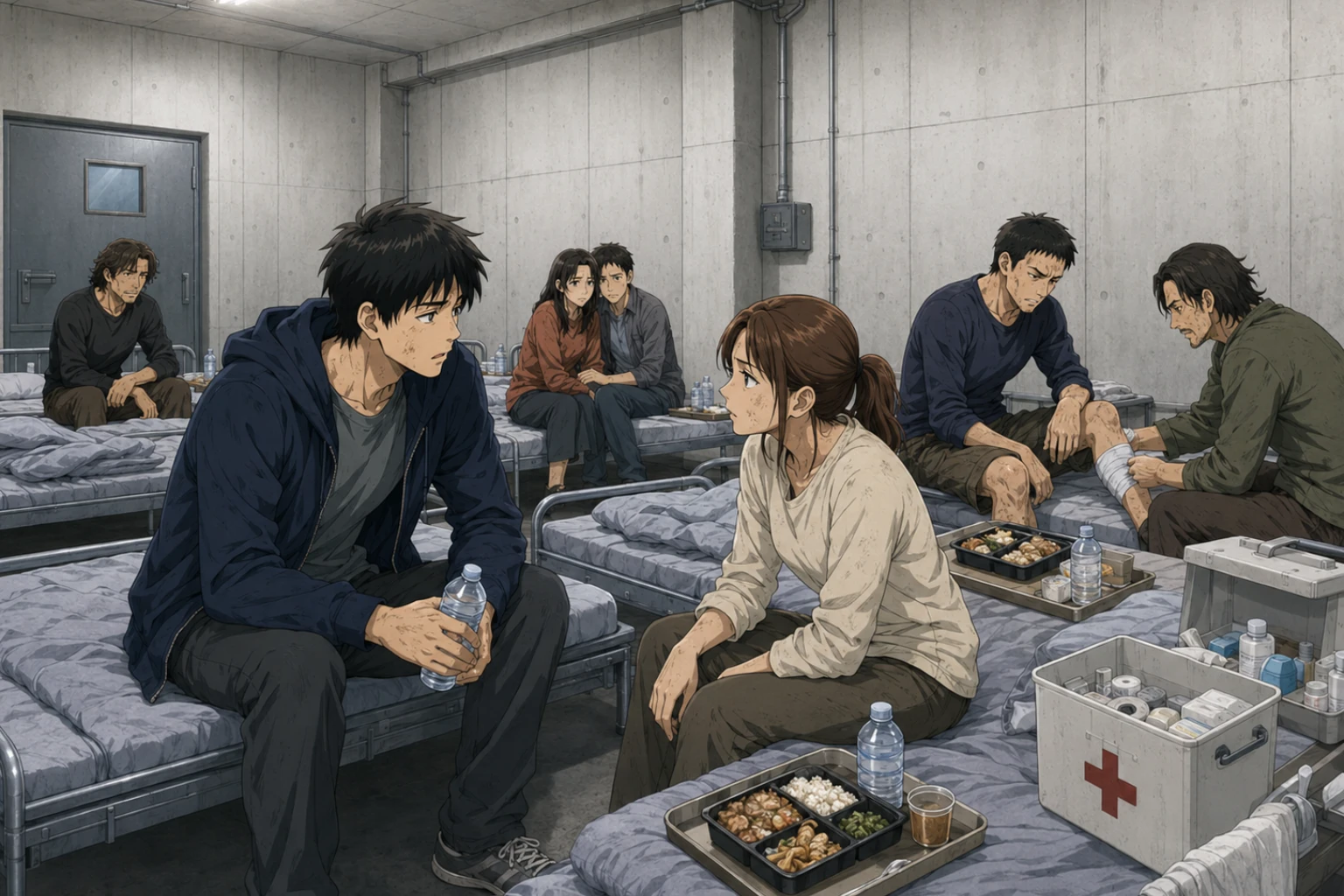
Nobody touched the food for the first ten minutes.
It sat on the trays exactly where it had been delivered — rice, grilled fish, a small dish of pickled vegetables, bottled water lined up with the same anonymous precision as everything else this place produced — and the fourteen of them sat near it without approaching, as though proximity alone might trigger something.
"They said no further activity," Junpei said, for perhaps the third time, eyes on the screen at the end of the room rather than on the tray in front of him. "Until next notice. That's what it said."
"That's what it said," Kaori agreed, in a tone that made clear she trusted the sentence exactly as much as she trusted anything else this place had told them.
"So maybe we should wait. Before eating. In case it's — I don't know. In case eating is part of something."
"Waiting could be part of something too," Aya said, without looking up from her own tray, which she hadn't touched either. "There's no version of this where doing nothing is automatically safe. You could starve yourself waiting for a trap that was never coming."
Nobody had a counter for that. Hunger, in the end, did what hunger always does, indifferent to strategy: Kenta broke first, tearing into his rice with the single-minded speed of a man who had decided, consciously or not, that if this was a trick he'd rather be caught with a full stomach than an empty one. Within a minute, most of the room had followed, and the tension in the air thinned slightly, replaced by the more ordinary, almost embarrassing sound of fourteen exhausted people eating plain food too quickly to taste it.
Not everyone ate the same way, and Haruto, picking at his own tray without much appetite, found himself watching without meaning to.
Kenta finished first, scraping the last of his rice with a kind of grim efficiency, and immediately looked, faintly ashamed, at how fast he'd done it. Junpei managed only a few bites before setting his chopsticks down, his stomach apparently as unconvinced by the food's safety as his mind was. Takumi ate slowly, methodically, and set aside a small portion of his rice, wrapped carefully in a paper napkin, tucking it into his jacket pocket without comment — the habit, Haruto thought, of a man who had spent a long time not fully trusting that the next meal would come when it was supposed to.
Mio ate with one eye on everyone else's tray, and at some point Haruto realized she was quietly comparing portions, checking whether the servings had been distributed equally, whether anyone had received noticeably less. "They're all the same," she said, mostly to herself, satisfied, and only then did she seem to relax enough to actually taste her own food.
Sachiko didn't touch her tray at all until she'd carried half of it across the room to where Kenta sat with his bandaged leg propped in front of him. "Eat this too," she said, setting it down without waiting for an argument. "You're healing. You need more than the rest of us."
"I can eat my own—"
"You already did. Eat this one too."
He didn't argue further, which told Haruto something about how tired even Kenta's usual deflections had become.
Koji refused help of a different kind. When Ryohei offered to carry his tray over so he wouldn't have to reach across his bound shoulder, Koji told him, flatly, that he could manage his own food, and did, wincing through it rather than accept an assistance that felt, to him, indistinguishable from being written off.
Near the far wall, Sota ate mechanically, eyes on the screen rather than his tray, and at one point Haruto noticed him slide half a rice ball into the pocket of his jacket when he thought nobody was looking. Mio noticed too — Haruto caught her noticing — but she said nothing, and Sota didn't seem aware that anyone had seen.
Kaori ate sitting upright against the wall, the same posture she'd held through most of the night, watching the room over the rim of her water bottle the way she might have watched weather building over a ridge line.
---
The injuries were harder to ignore once the food had settled.
Koji's shoulder had swollen further overnight despite the sling, and when Ryohei finally convinced him to let it be examined properly, the joint's instability was obvious even to people with no training at all — a looseness in the socket that made every small motion visibly cost him.
"It's not set right," Ryohei said, careful with his hands, careful with his voice. "I'm not a doctor. I've reduced a couple of dislocations on beaches with nobody around to help, that's the extent of what I actually know. But this needs to be immobilized properly, not just tied up. Otherwise you're going to keep doing more damage every time you use it."
"So immobilize it," Koji said, jaw tight.
"That means you can't use that arm at all. Not for climbing, not for lifting, not for balance. If the next game needs two working arms—"
"Then I'll find another way to do it with one."
Nobody argued the point further, though the question Koji hadn't let anyone finish — what happens if the next game needs both arms, needs full weight-bearing legs, needs a body that hadn't spent the last day being broken and dragged and bruised — sat over the room for the rest of the scene without anyone saying its ugliest version aloud.
Kenta's leg was worse than the previous night's hurried field dressing had let on. When Naoko peeled back the tape to clean it properly, using the fresh supplies from the new kits, the wound underneath was deep enough that several people looked away, and Junpei, watching from a few feet off, went visibly pale and had to sit down.
"You're going to be fine," Naoko said, to Kenta, in the same flat, unadorned voice she used for everything. "It needs stitches nobody here can give you. Until then, it needs to stay clean and it needs to stay still. Both of those things are going to be hard for you."
"Story of my life," Kenta said, and the joke landed thinner than his jokes usually did, more a reflex than an attempt at humor. "What happens if the next thing needs running."
Nobody answered that either. Masato, crouched nearby with a spool of clean bandage material he'd found among the kits, wrapped Kenta's leg with the same unhurried competence he brought to everything mechanical, securing a splint of sorts along the outside of the calf to keep the muscle from moving more than it had to.
"You did good," Kenta told Naoko quietly, once the wrap was finished, in a voice smaller than his usual register. "Last night. Grabbing me like that. I didn't say it properly before."
"You don't need to say it," Naoko said, but she didn't move away either, and something in her posture next to his cot for the rest of that conversation suggested she hadn't minded hearing it.
---
By the time the injuries had been tended, the room had already begun, without anyone announcing it, to rearrange itself.
It happened the way these things happen — not through decision, but through small physical accommodations that added up to something larger. Junpei's cot had drifted closer to Sachiko's sometime during the food and injury scene, close enough now that the gap between them barely qualified as a gap at all. Kenta's had shifted, less deliberately, toward Naoko's, though he seemed determined to pretend the distance was coincidental.
Sachiko sat with Junpei for a long stretch after Kenta’s leg had been treated. Junpei had no injury of his own, only the particular exhaustion of someone who had spent the entire second game half-convinced he was about to fail everyone. "I keep thinking about it," he admitted, quiet enough that it took Sachiko leaning slightly closer to catch it. "The freeze. In Phase Two. I knew what I was supposed to do and I still couldn't make myself do it until you told me exactly, exactly what to do instead of just — telling me it would be fine."
"That's not a failure," Sachiko said. "That's just what fear does to some people. It doesn't mean anything about you."
"It means I need someone telling me what to do or I stop working."
"Then I'll keep telling you what to do," she said, simply, and something about the plainness of the offer seemed to steady him more than reassurance would have.
Not far away, Naoko and Sachiko found, almost by accident, that they'd grown up less than forty kilometers apart — a fact that surfaced when Sachiko mentioned, in passing, a train line Naoko recognized instantly, and within a few exchanges they'd traded the names of two shopping streets and a regional dialect word for a kind of pickled radish that neither of them had heard outside their home prefecture in years. It didn't make them inseparable. It made the room, for both of them, feel very slightly less like a box built entirely out of strangers.
Across the room, Aya moved between clusters the way she'd always moved through rooms — present everywhere, attached nowhere. She sat near the fear-cluster forming around Junpei and Sachiko long enough to hear the shape of the conversation, then drifted toward where Tetsuya and Sota had begun, in low voices, re-litigating the exact moment Tetsuya's pattern-matching had gone wrong in Phase Two, and stayed there a while without contributing, simply watching two men argue about certainty with the same close attention she'd once given directors deciding whether a take had been good enough to keep.
Kaori, meanwhile, had appointed herself the room's unofficial coordinator without anyone electing her to the position, moving from group to group with brisk, practical questions — who had which supplies, whose injuries needed checking again before sleep, whether anyone had kept track of how many hours had passed since the rest period began. People answered her. Few of them sought her out first.
Masato worked quietly at the edges of all of it, sorting the newly delivered kits into some rough order, checking which supplies had been used and which remained, securing a loose panel near the wall that had rattled every time someone walked past it. Nobody organized a group around him. People simply began, without much discussion, bringing him things that needed fixing.
---
It was Mio, eventually, sitting near the second row of cots with a fresh bandage roll in her lap, who first said Yui's name out loud since the previous night.
"Do you think it would have mattered," she said, not quite to anyone, "if we hadn't moved her at all. If we'd just stayed behind that first wall until the game found some other way to force us out."
"The wall wasn't going to hold," Koji said. "You heard the tone. Staying wasn't actually an option."
"I know. I'm not saying it was a choice we had. I'm asking whether staying could have kept her alive a little longer even if it killed the rest of us slower."
Nobody had an answer for that, and the question sat in the room the way it had sat in Haruto's chest since the moment he'd set her down against the concrete.
"I still don't know if carrying her back the second time helped her or hurt her," he said, quietly, surprising himself by saying it at all. "Maybe moving her again is what finished it. Maybe leaving her the first time would have been worse. I've turned it over so many times and I don't have an answer that feels true either way."
"You didn't leave someone to die alone," Sachiko said. "That has to count for something."
"Does it," Koji said — not cruel, exactly, but not soft either. "Because from where I was standing, we nearly lost three more people trying to save one who was already gone. I get why you did it. I don't know if it was right."
"I don't either," Haruto said. It cost him something to say it plainly like that, without defending himself, but it also felt, in a way he hadn't expected, like the first honest thing he'd said about it since it happened.
Nobody resolved it. The conversation simply moved past it, the way conversations do when the truth underneath them is too large to finish in one sitting.
At some point during that stretch, Mio rose from where she was sitting and crossed to Yui's cot — still exactly as it had been left, blanket folded, untouched even by the chaos of Phase Two — and gathered the blanket carefully, folding it once more, smaller, and set it on the small shelf beneath the frame along with two of the fresh supply kits nobody had claimed yet.
She didn't say anything while she did it. Nobody asked her to explain. But the room noticeably quieted while she worked, and once the blanket was put away and the cot held ordinary, useful things instead of the ghost of a person who had slept there once, something in the room's atmosphere shifted, subtly, the way a held breath shifts when it's finally released. It wasn't closure. It was only the first small motion toward not treating the space as sacred, and it seemed to cost Mio more than she let show on her face.
---
The conversation about Game One eventually gave way, the way exhaustion always seems to nudge conversation toward whatever feels most solvable, to Game Two.
"The location tags," Takumi said, at one point, mostly working through it aloud rather than lecturing anyone. "That's what nearly cost us the whole first phase. We searched randomly because none of us thought to check where we already were before checking somewhere new."
"I nearly missed my own station entirely," Haruto admitted. "I spent most of it trying to help other people remember their numbers and almost ran out of time on mine."
"That's not a flaw," Mio said. "That's the same thing that made the confidence check useful. If everyone had only focused on their own station, we'd have lost half the information the rest of us needed to cross-check."
"The confidence ratings," Tetsuya said slowly, turning the idea over. "That was good. That was actually good, Mio. If we'd had something like that from the start of Phase One instead of improvising it halfway through, we'd have wasted less time on my mistake."
"You corrected it," Sota said. "That's more than I can say for myself. I told Ryohei a value I hadn't actually confirmed and it cost us a full minute."
"We both did the same thing," Tetsuya said. "Confused a pattern we recognized with a pattern that was actually there. I did it again in Phase Two, with the number six. I built a whole justification for a different total because it felt more elegant than the number that was actually right in front of me." He said it flatly, without much defensiveness, though something in his voice suggested the admission cost him more than the words let on. "I do that. I did it with money for years before I ever did it with a countdown. Once I believe a pattern is there, I have a very hard time believing it isn't."
Nobody pushed further into what he meant by that. The room let the sentence stand, unexamined, the way people let certain doors stay closed even when they've been shown exactly where the handle is.
"I added something that wasn't there," Junpei said, quieter, into the pause that followed. "In the chain. I said 'skip the second shelter' like it was part of the instruction when really it was just — my own guess, dressed up as something I remembered. I didn't mean to lie. It felt true when I said it."
"That's the whole lesson, though," Mio said. "It felt true. That's exactly the problem. Assumption and memory feel the same from the inside when you're scared enough."
"Takumi flagged it," Haruto said. "That's the only reason I knew not to trust it completely by the time it reached me."
"I didn't know what it meant," Takumi said. "I only knew it felt added rather than remembered. That's all I had to go on."
"That was enough," Haruto said again, the same two words he'd used once already that day, and this time nobody argued with them.
"I passed two versions instead of one," Aya said, when the conversation reached her. "Tetsuya's reconstructed number and the plain one. I wasn't sure which to trust, so I gave Koji both and let him decide. Technically I broke the rule about passing exactly one thing forward."
"It worked out," Koji said. "This time."
"This time," Aya agreed, and something in the flatness of her repetition made clear she understood exactly how much luck had been folded into that outcome.
"And I still don't know if I was right," Haruto said, when it circled back to him again. "Pulling the blue lever. I worked it out from what everyone gave me, but I wasn't certain. Not really. I was as scared as anyone else in that light. I just ran out of time to keep doubting it."
"You weren't supposed to be certain," Mio said. "None of us were, by the end. That was the whole design of it, I think. It wasn't built to reward the person who felt sure. It was built to reward whoever could tell the difference between what they actually knew and what they only wanted to believe."
That seemed to settle something in the room, at least for a while — not an answer, exactly, but a shape for the question that made it easier to set down.
"The thing that scares me more than any of that," Aya said, into the quiet that followed, "is that the countdown stopping the first time didn't mean anything. We celebrated. We actually relaxed, for those few minutes, like it was over. 'Until next notice' isn't the same sentence as 'you're safe.' I don't think it's ever going to be the same sentence in this place."
Nobody argued with her about that either.
---
It was somewhere in the loose, unhurried hours that followed — food finished, injuries dressed as well as they could be, the games themselves finally exhausted as a topic worth returning to — that the larger shape of the event itself began, in fragments, to surface.
"Fifteen of us," Kenta said, at one point, apropos of very little. "Out of how many who applied? I heard it was in the millions."
"I read that it was," Tetsuya said. "Somewhere in the application material. I read all of it, actually. Every page, twice. I wanted to understand exactly what I was agreeing to before I agreed to it."
"I skimmed most of mine," Kenta admitted. "I read the part about the prize pretty carefully. The rest I mostly trusted would be fine."
"There's no version of 'fine' in a waiver that mentions death on the same page as a housing benefit," Aya said, not unkindly, just precisely.
"It said death?" Junpei's voice climbed slightly. "I remember 'serious injury.' I don't remember it saying — actually saying—"
"It said both," Tetsuya said. "I remember exactly where on the page. It wasn't hidden. It wasn't small print. It just didn't feel real until Yui made it real."
"None of it felt real," Junpei said, and nobody corrected him.
Between them, in scattered pieces, the larger structure of the thing they'd entered continued to take shape — eight games total, someone said, though nobody could agree on where they'd first read the number; six remaining now, which put a specific, unbearable weight on a sentence that had sounded almost abstract a day earlier. Selection was strict, someone else offered — narrowed from millions to fifteen, though nobody knew exactly how the narrowing worked, only that it had happened to all of them individually, privately, without any of them meeting another finalist until they were already in the waiting room. A contestant selected once would never be selected again, win or lose, live or die; that much several people remembered clearly, because it had been printed in bold in at least one version of the material. Withdrawing meant losing the opportunity permanently — not a pause, not a chance to return later, but a door that closed the instant someone walked through it, in whichever direction it happened to close.
"Nobody promised all of us would finish together," Kaori said, at one point, flat and final in the way she said most things. "I remember that specifically. It never said fifteen would become a prize. It said the surviving contestants would be considered for the prize. Surviving. Not all of us. Whoever's left."
That sentence landed harder than most of what had come before it, and for a while nobody spoke at all.
"What is the prize," Junpei asked, eventually, quiet. "Actually. Does anyone know actually what it is."
Nobody answered with anything more concrete than the words they'd each carried in with them from outside — housing, someone said again; a placement, a way back into a life that had stopped moving; security, from Masato, who didn't elaborate further than the single word. Nobody said the phrase that mattered most to any of them, the private shape each of them had built alone, in their own apartment or train car or empty room, of what a different life might actually look like. It sat beneath the conversation the way it always had, present but unexamined, too large and too personal to hand to a room full of strangers.
---
It was Junpei, finally, who said the thing several of them had clearly already been thinking.
He said it quietly, almost as an aside, not looking at anyone in particular. "If they open a door and let us leave, I'm taking it."
The room didn't erupt. It simply went very still, the way a held breath goes still, and into that stillness, one by one, other voices began, tentatively, to answer.
"I think about it too," Kenta admitted, all his usual deflection gone from his voice for once. "I keep telling myself I don't, but I do. Every time that alarm goes off I think, if there's a door somewhere, I want to know where it is."
"There might not be a door," Kaori said. "Nothing in the material I read described an actual mechanism for leaving. It said withdrawal was permanent. It didn't say withdrawal was *available* whenever you wanted it."
"Then what happens if you refuse to play," Sota asked. "Does that count as withdrawing? Does it count as losing? Nobody's told us."
Nobody had an answer.
"I don't think I'd take the door," Koji said, into the silence that followed. "Not now. Not after everything we already went through to still be sitting here. Walking away now would make it all pointless. I didn't survive that course to leave with nothing."
"Some of us don't have much to walk back to anyway," Takumi said, quietly, not quite looking at anyone. "I don't know if that makes staying braver or just easier. I don't think it's brave. I think I just don't have anywhere better to be afraid in."
"That's not nothing," Mio said. "Wanting to stay because leaving means going back to nothing — that's still a reason. It doesn't have to be a heroic one to be real."
"I don't want to leave," Sachiko said. "But if Junpei goes, I'm not going to make him stay here alone with the rest of it. If there's a door and he wants it, I'll help him find it."
"You don't have to do that," Junpei said, startled.
"I know I don't have to. I'm telling you I would."
Nobody resolved the larger question. The door, if it existed at all, remained theoretical — a shape none of them could see clearly enough to plan around, and the conversation, having said the unsayable thing out loud, simply let it sit there, unfinished, the way most of the truest things in the room that day were left unfinished.
---
Between the larger conversations, in smaller pockets around the room, people continued revealing themselves in the particular, incomplete way exhausted strangers do when there's nothing left to perform for.
Haruto found himself, at one point, sitting near Yui's cot with Mio, neither of them quite meaning to end up there, both of them apparently drawn to the same quiet corner of the room without discussing it.
"Your parents," Mio said, at some point, gently, "do they know where you are right now?"
"They know I entered. I don't think they understand what that actually means." He turned his water bottle slowly in his hands. "They live overseas. They send money. They picked my school, my apartment, basically decided the whole shape of my life before I had an opinion about any of it. I have classmates. I don't really have anyone I'd call close." He said it plainly, without much self-pity, the way you describe a fact you've had a long time to get used to. "I wanted something that was actually mine. Even if it was dangerous. Especially, maybe, because it was dangerous — because at least the danger was something I chose."
"Do you think helping her — Yui — was part of that? Choosing something?"
"I don't know," he admitted. "I've thought about it since it happened, and some of it might have been guilt from something that happened a long time ago, and some of it might have just been that I couldn't make myself keep running while she was right there. I don't know which one it actually was. Maybe it doesn't have to be only one."
Mio, in turn, told him — not all at once, not as a speech, but scattered through the quiet minutes that followed — about growing up between homes that were never quite hers, about learning early how to read a new set of rules quickly enough to make herself useful before anyone decided she was a burden. "I check portions," she said, almost embarrassed by it, when he asked why she'd been counting everyone's food earlier. "I've done it my whole life. If the servings are equal, nobody has a reason to resent anyone else yet. It's a small thing. It's the only kind of fairness I've ever really been able to control."
"You want a place that's actually yours too," Haruto said. It wasn't a question.
"More than anything," she said. "Somewhere nobody's keeping score of how long I'm allowed to stay."
Neither of them said much more than that. It felt, somehow, like enough.
Elsewhere, Aya sat for a while near Sota and Tetsuya's ongoing argument about probability, and at some point a woman two cots over said, carefully, that she thought she recognized her — "Weren't you on that variety show, a few years back? The singing one?" — and Aya's face arranged itself, instantly, into the same warm, faintly self-deprecating smile she must have given a thousand interviewers.
"Guilty," she said lightly. "A very long time ago, by industry standards."
"What happened? If you don't mind me asking."
"The usual story. Popularity has an expiration date and mine expired." She said it smoothly, almost rehearsed, a version of the truth polished until its edges no longer cut anyone, least of all herself. She didn't mention the marriage, or the managers who stopped returning calls, or the specific, private humiliation of realizing that even cruelty from strangers online had eventually dried up because nobody cared enough anymore to be cruel. She gave the room a story that was true in its outline and carefully incomplete in its detail, and if anyone noticed the gaps, nobody pushed.
Tetsuya, for his part, deflected any direct question about his old career with the same practiced ease he'd used all night — "Engineering, mostly structural work, nothing very exciting" — and when Sota asked, innocently, why he'd stopped, Tetsuya said something vague about "circumstances" and changed the subject back to load calculations with a speed that made at least one person in earshot suspect there was considerably more to the sentence than he was offering.
Takumi, when Haruto asked him, later, what he was hoping to find on the other side of all this, went quiet for long enough that Haruto thought he might not answer at all.
"A dog," Takumi said, finally, and looked almost embarrassed the moment the word left him. "Somewhere small to live. Something like — someone noticing if I come home or not. It sounds small when I say it out loud."
"It doesn't sound small," Haruto said.
"It sounds like the whole of what I want," Takumi said. "I've had a long time to get used to how modest that is."
---
Sota, meanwhile, had drifted toward the edge of the room where Masato was still quietly sorting supplies, and after watching for a while, offered — a little stiffly, the offer of someone unused to volunteering himself for anything social — to help catalogue what remained.
"You don't have to," Masato said.
"I like knowing exactly what's where," Sota said. "It's the only part of any of this that's felt like something I actually understand."
They worked together for a while without much conversation, which seemed to suit both of them fine, and by the time they'd finished, something had shifted slightly in how Sota held himself — not quite comfortable, but less alone than he'd been an hour earlier.
Koji, still favoring his bound arm, found himself, at one point, talking with Ryohei about nothing much — warehouse logistics, an old baseball injury Ryohei asked about with more genuine curiosity than pity — and Koji, for once, didn't turn the conversation defensive. "You didn't treat me like I was already useless," he said, eventually, gruffly, not quite meeting Ryohei's eyes. "Most people look at an arm like this and start planning around a version of me that isn't there anymore."
"I've spent a lot of years being the guy nobody counted on for anything permanent," Ryohei said. "I know what it's like to be written off before you've actually failed at anything. Didn't seem right to do it to you too."
Kaori, circulating through all of it, tried at one point to gather the room into something resembling a unified strategy session — a review of what they knew, a plan for how to handle the next unknown display, contingencies for injury, contingencies for a smaller countdown, contingencies for everything she could think to name — and found, gently but unmistakably, that the room wasn't ready to be organized quite that fully yet. People listened. Fewer than she expected followed her lead all the way.
"We should have a system," she said, more than once. "We can't keep improvising every single time and hoping the right people happen to be standing in the right places."
"We survived twice improvising," Mio said, not unkindly. "I'm not against a system. I just don't think we're the kind of group that becomes one overnight because you want us to."
Kaori didn't argue the point further, but something in her expression suggested she was filing the disagreement away rather than accepting it.
---
Underneath all of it, unspoken but present in nearly every conversation that touched the games directly, sat the same unresolved contradiction.
Game One had taught them, in the clearest possible terms, that helping an injured person could cost everyone their lives. Game Two had proven, just as clearly, that they had all survived only because every single person's contribution — even the flawed ones, even the ones that needed correcting — had mattered.
"I don't know if this place wants us cooperating or wants us learning how to abandon each other," Aya said, at one point, into a lull that had settled over several of the nearby cots. "Because it's taught us both lessons already, and they don't fit together."
"Maybe it doesn't care which lesson we learn," Tetsuya said. "Maybe it's just testing which one we're capable of, under enough pressure."
"Then we should decide now, while we still can," Kaori said, "that we stay one group. Fourteen. However many games are left."
"That's easy to promise sitting here with food in our stomachs," Koji said. "I don't know if it's easy to keep once something's actually forcing a choice."
"Nothing's promised the games will stay cooperative," Sota said, quiet, almost to himself. "Phase One and Phase Two happened to reward it. That doesn't mean the next one will."
"Then giving up on it before it's forced on us guarantees we lose anyway," Mio said. "I'd rather fail trying to stay together than succeed at abandoning people early because I assumed I'd have to eventually."
Nobody reached an agreement. The conversation simply thinned, the way most of that day's conversations eventually thinned, into silence and the private business of each person deciding, individually, which of those positions felt truest to them.
---
Exhaustion won, eventually, the way it always does.
Kenta was asleep within minutes of lying down, the particular deep, sudden sleep of a body that had simply run out of the capacity to stay conscious any longer. Kaori didn't lie down at all for a long while, sitting upright against the wall near the door, watching the room the way she'd watched it all night, until finally, sometime past whatever hour the room's clockless walls refused to disclose, she allowed herself to slide down into something closer to rest without ever quite closing her eyes all the way.
Junpei checked the screen three separate times before finally settling, each time returning to his cot a little more convinced, a little more exhausted, that nothing was about to change. "Wake me if the lights do anything," he said quietly to Sachiko, whose cot had drifted close enough now that the request barely needed to travel any distance at all. "Please. I don't want to wake up already in the middle of it."
"I'll wake you," she said, and didn't ask why he trusted her to be the one still awake to do it.
Kenta's cot had ended up close enough to Naoko's that when he shifted in his sleep, mumbling something none of them could make out, she reached over without fully waking and adjusted his blanket where it had slipped off his bandaged leg, an act so unconscious it barely registered as an act at all.
Masato kept his shoes on. Nobody asked him why. Takumi lay very still, listening to the unfamiliar rhythm of thirteen other people's breathing, and didn't sleep for a long time, though eventually, sometime near the edge of exhaustion strong enough to overrule even his own watchfulness, he did.
Sota had tucked the rice ball he'd taken earlier beneath the edge of his cot, and if anyone had checked, they'd have found he hadn't eaten it — only kept it there, close, the way a person keeps something small and controllable in a place that has taken almost everything else away from them.
Haruto lay awake longer than most, his eyes tracing the same path they kept returning to without his permission — Yui's cot, no longer bare, no longer entirely empty, holding folded supplies now instead of an untouched blanket, and somehow that felt like both a mercy and a small, quiet loss all at once.
No alarm came. No lights snapped on. The silence, this time, didn't build toward anything. It simply continued, minute after minute, until minutes became something closer to an hour, and the not-happening of anything became, in its own strange way, one of the more unsettling things that had happened to any of them all day.
Haruto let his eyes drift across the room one last time before sleep finally took him.
They had entered this room as fourteen strangers occupying the same space out of necessity. Somewhere in the hours since, without anyone declaring it, without any vote or agreement, the room had quietly redrawn itself. Junpei's cot sat close against Sachiko's. Kenta's had drifted toward Naoko's. Two women who'd discovered, almost by accident, that they'd grown up forty kilometers apart now slept within arm's reach of each other. Kaori held her post near the door, apart from everyone, the way she seemed to prefer it. Aya lay somewhere in the middle distance between every cluster and none of them. Sota kept something small and uneaten within reach beneath his cot. Koji and Ryohei's beds had ended up nearer each other than either of them had probably noticed doing on purpose.
None of it had been decided formally. All of it had been decided anyway, in the particular, wordless way exhausted people decide who they want nearby when the next alarm comes.
It might not last. Haruto understood that even as his eyes finally closed. Whatever this was — these small, unspoken lines of fear and familiarity and gratitude drawn between fourteen people who had, until yesterday, been complete strangers to one another — might not survive whatever the next game asked of them.
For tonight, it was enough to let them sleep.


.png)
.png)
.png)