%20(1).png)
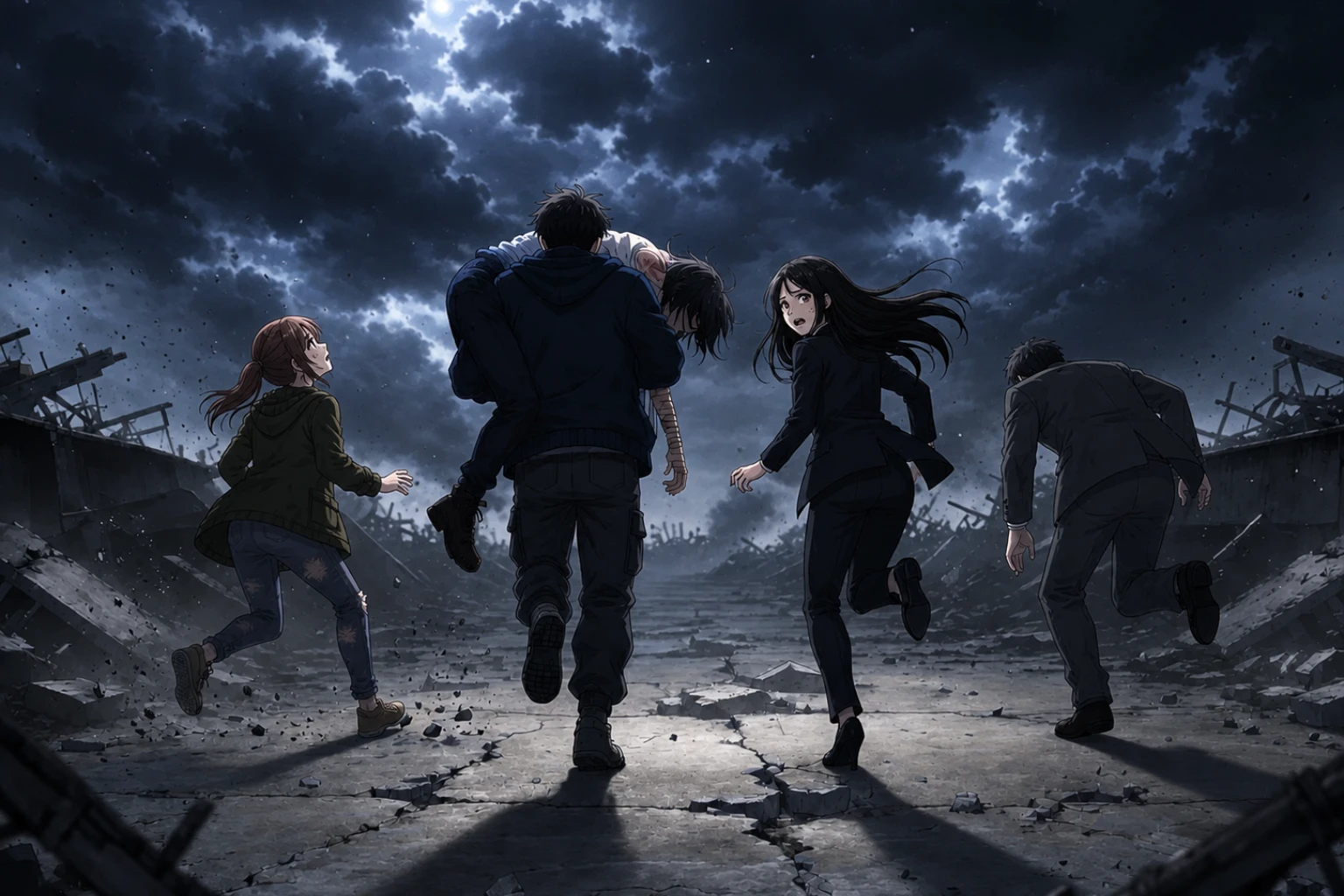
The explosion came from somewhere behind them and turned the whole course white.
For half a second Haruto could see everything — the broken ground ahead, the black shapes of the others running beside him, a curtain of dust rising against the floodlit sky — and then the light died and left a green afterimage floating in the dark, and his legs kept moving because stopping had never been a decision he was allowed to make.
Yui Tanabe hung across his arms and shoulder, one hand loosely fisted in his shirt, not gripping, just resting there the way a hand rests when the person it belongs to is somewhere far away. She had been lighter when he picked her up. He was almost sure of that. Now she seemed to gain weight with every stride, the way a bag of rice gets heavier the longer you carry it up a flight of stairs, except there was no top of the stairs here, only more ground, more dark, more of the high metallic whine that meant something was about to happen and he didn't know what.
"Left," someone said, or maybe shouted, it was hard to tell over his own breathing. "Left, the marker's changed—"
He went left because Mio had said it and Mio was usually right about small things like which way a marker had changed, and his shoulder clipped something — a barrel, a block, he never found out — and Yui made a sound against his collarbone that wasn't a word, just air pushed out wrong, and his stomach dropped because it was the first sound she'd made in almost a minute.
"Yui." He didn't recognize his own voice. "Yui, stay with me, okay, we're almost there."
He had no idea if they were almost there. He had no idea where *there* was. There was only the next patch of dark that looked marginally safer than the patch they were standing in, and the five of them moving toward it in a ragged clump because none of them had the breath left to organize anything better.
Koji Senda was on his right, close enough that Haruto could hear him breathing through his teeth, a hard rhythmic sound like a man running through the last minutes of a race he intended to win. "Wall," Koji said. "There's a wall, forty meters, maybe less—"
"How do you know it's safe," someone else said. Takumi. His voice had none of Koji's certainty in it, just a flat, careful worry, the voice of a man doing arithmetic he didn't trust.
"I don't," Koji said. "Go anyway."
They went anyway.
Behind them the whine climbed half a register, the sound the course made in the seconds before another section lit up, and Haruto felt every muscle in his back scream at him to run faster while his legs told him, flatly, that faster wasn't available anymore. Yui's weight had stopped feeling like weight and started feeling like a fact, like gravity itself had personally decided to double for as long as it took him to reach whatever was on the other side of forty meters of open ground.
Somewhere to his left, Mio was talking. He caught fragments of it — *almost there, Yui, almost there, stay with us* — the words less important than the fact that she kept saying them, steady, unbroken, like a hand on a shoulder made out of sound. She hadn't looked away from Yui's face since they started running. He didn't know when she'd started doing that. He only knew that every time he glanced sideways, her eyes were fixed on the same slack, half-open face he was trying not to look at directly.
A shape rose out of the ground in front of them — low, square, real — and Koji's hand closed on Haruto's arm and physically turned him toward it. "There. Move."
They didn't so much run to the wall as fall against it, and Haruto's knees buckled the second the weight came off his arms, Yui sliding down with him rather than being set down, until she was slumped against the concrete and he was on his knees in front of her with his hands shaking too hard to make a fist.
For a moment nobody spoke. There was only the five of them and the wall and the sound of the world trying to breathe.
Takumi bent double and made a thin retching sound and then actually was sick, quietly, off to one side, apologizing to no one in a whisper between heaves. Koji sat with his back against the block and his head tipped up toward the sky, watching it the way a man watches a dog he doesn't trust not to bite. Mio was already on her knees next to Yui, one hand hovering over her collarbone, not quite touching, like she was afraid contact might break something that hadn't broken yet.
"Yui." Mio's voice had lost its steadiness now that they'd stopped moving. "Yui, can you hear me?"
Yui's eyes opened partway. Her lips moved. Nothing came out that any of them could understand.
"Kit," Haruto said. "There's supposed to be a kit, they said there'd be—"
"There." Takumi, straightening up, wiping his mouth with the back of his hand, already moving toward a pale rectangle bolted into a recess in the wall. His hands found the latch before his mind seemed to catch up with what he was doing. "It's here. It's here, I've got it."
The case came open on a thin tray of gauze, tape, a foil packet of something that might have been disinfectant, a folded silver blanket, a short splint still in its plastic sleeve, and a blister pack of pills none of them recognized. It looked, Haruto thought with a kind of distant horror, like the contents of a first aid kit from a school infirmary. It looked like something meant for a scraped knee.
"That's it?" Koji's voice cracked upward. "That's all there is?"
"That's all there is," Takumi said, and something in the flatness of it made it worse than if he'd shouted.
Mio was already working, hands quick and sure in a way that made Haruto wonder, distantly, where she'd learned to move like that — pressing gauze against Yui's side where the fabric had gone dark and wet, murmuring instructions to herself, to Yui, to no one. "Pressure, just — hold here, Haruto, hold here, I need both hands—"
He held. His hands were shaking so badly the pressure came out uneven, and Mio's fingers closed over his to steady them without either of them saying anything about it.
"Is she—" Koji didn't finish the question. Nobody wanted him to.
"I don't know," Mio said. "I don't know, I'm not — I don't know what I'm looking at."
Yui's hand found Haruto's sleeve again and gripped it, weak but real, and her eyes opened further, focused somewhere near his face without quite landing on it.
"Did they—" A breath, wet and effortful. "Did everyone else make it?"
"Yes," Haruto lied, because he didn't know, because there was no answer that wasn't a lie right now, because the truth was he had no idea where the other eleven contestants were or whether the course had already taken more from them than it had taken from Yui. "Yes, everyone's fine."
Her mouth made a shape that might have been the beginning of a smile.
*Don't let go.*
The words arrived without warning, sharp and clear, in a voice that belonged to a gymnasium ten years gone — a teacher's voice, or a coach's, shouting across a crowded sports field while a boy in a red team shirt went down at the final turn and the pack surged past him without slowing. Haruto had stopped. He remembered that much clearly: he had stopped, and turned back, and by the time he reached the boy someone had already called it a disqualifying delay, and in the locker room afterward nobody had thanked him. They had asked him why he hadn't just kept running like everyone else.
He didn't remember the boy's name. He remembered the shape of the moment — the half-second where his body chose to turn back before his mind had finished deciding whether it was the right thing to do — and how long the guilt of the wrong choice, or the right one, whichever it had been, had followed him afterward.
Yui was so much heavier than a fallen boy on a school field. The consequences here were not symbolic. They were red, and warm, going through the gauze under his hands.
He was back in the present before the memory had properly finished arriving.
A tone sounded from somewhere along the top of the wall — three short pulses, evenly spaced, and a strip of light along its edge that had been glowing a dull green flickered, held, and dropped to amber.
"That's not good," Takumi said quietly. "That's — I don't think that's good."
"How long," Koji said. "How long do we have?"
"I don't know. I don't know the pattern yet. Nobody's explained the pattern."
"We move her," Koji said. "Now. Before that light does whatever it's about to do."
"She can't be moved." Mio's hand didn't leave the wound. "Look at her, she can't — moving her could kill her faster than staying could."
"Staying here is going to kill all four of us." Koji's voice had gone hard, flat, the voice of a man arguing with a fact rather than a person. "This wall isn't going to hold. You heard the tone. We move, or we die behind a piece of concrete waiting for a light to turn green."
"So we just — drag her." Mio's voice cracked upward, disbelieving. "Is that the plan? Drag a woman who's bleeding out because a light changed color?"
"The plan is we don't all die for one—"
"Don't." Haruto's voice came out rougher than he meant it to. "Don't finish that sentence."
Koji looked at him for a long moment, jaw working, and didn't finish it.
"Is he thinking straight," Koji said instead, to Mio, tipping his chin at Haruto without quite looking at him. "Because I get it, he carried her, that means something, but if he's about to get all of us killed because he can't put her down—"
"I can hear you," Haruto said.
"Good. Then answer the question."
He didn't have an answer. He had a hand full of Yui's blood and a memory of a boy on a school field and no idea, none at all, whether the thing telling him not to let go was wisdom or guilt wearing wisdom's clothes.
The amber light along the wall's edge began, almost imperceptibly, to pulse faster.
---
Nine hours earlier, none of them had known each other's names.
The room they'd been brought to was long and plain, poured concrete under fluorescent light, rows of folding tables set with paper trays of food nobody had much appetite for. There had been no welcome speech. A screen mounted at the far end of the room had displayed, in white text on black, a countdown to something none of them had been told the name of yet, and beneath the fifteen of them had done what strangers always do in a room with nowhere else to be: found seats near people who looked marginally less frightening than everyone else, and waited.
Haruto had picked a table near the wall, angled so he could see the door, and said almost nothing for the first twenty minutes. He was aware, in the specific and exhausting way he was always aware of it, that he looked younger than most of the room and that people's eyes slid past him the way eyes slide past furniture. It didn't bother him exactly. It was simply a fact he had learned to plan around.
Mio had noticed him anyway. She'd noticed most of them — moved along the tables early, before anyone had really settled, asking small questions that weren't really about anything: was this seat taken, did anyone know if the water was in the case by the door, had anyone figured out how the meal trays opened. Within an hour she knew eleven names. She said them back correctly, once, unprompted, and watched something loosen in each person's shoulders when she did it.
"You're good at this," Haruto had said, when she reached his table.
"At what?"
"Making people feel like the room isn't as bad as it is."
She'd smiled at that, a small, practiced thing. "I've had practice."
She didn't say what kind. He didn't ask.
Two tables over, a woman with long dark hair and a face that seemed constructed rather than simply grown sat very straight, aware — Haruto could tell, even from a distance — of exactly which angle of the room a camera might prefer. Aya Fujimoto. He recognized her, distantly, the way you recognize a face from a poster that used to be somewhere and now wasn't. She'd caught someone else recognizing her too, across the room, and had looked away first, a small, deliberate correction, as if she'd decided in that instant how warm she intended to be and had chosen: not very.
Near the far wall, a tall man in glasses had spent most of the waiting hour with his eyes on the room itself rather than the people in it — the seams in the concrete, the hinges on a supply cabinet, a panel near the ceiling that looked, if you looked at it twice, subtly newer than the wall around it. Tetsuya Kurokawa moved like a man auditing a building he suspected of lying to him. When a woman at his table dropped a water bottle and it rolled, he caught it with his foot without appearing to have been watching for it at all.
Across from him, a stooped, unremarkable man had been quietly, unconsciously counting things. Water bottles per table. Chairs against the east wall against the number of place settings. He noticed, at some point in the second hour, that there were fifteen contestants and sixteen chairs, and mentioned it to no one, because it seemed like the kind of detail nobody else would care about. Takumi Hasegawa had spent so many years noticing what other people overlooked that it no longer occurred to him it might be worth saying out loud.
A thin, pale young man near the supply cabinet had spent the whole hour with his attention on the wiring conduit running along the baseboard, tracing it with his eyes to where it disappeared into the wall, more at ease with the visible circuitry than with the fourteen strangers around him. Sota Ishikawa hadn't spoken to anyone yet. He didn't dislike people. He simply understood machines faster.
A broad, sun-browned man had made himself comfortable on the floor near the door within the first ten minutes, back against the wall, ankles crossed, looking as settled as if he'd slept in worse rooms than this — which, Ryohei Matsuda reflected, he probably had. He talked easily to whoever sat near him and told no one where he was from.
Near the center of the room, a big man with cropped hair had spent the hour sizing up the others the way a coach sizes up a bench — quick, assessing glances, cataloguing who looked strong, who looked slow, who looked like they'd be useful and who looked like dead weight. Koji Senda had already decided, privately, that he was probably the strongest person in the room, and had not yet had reason to doubt it.
A sturdy man with calloused hands had gotten up twice during the waiting hour to look at a loose hinge on the supply cabinet door, and once to check the give in a floor panel near the east wall, without being asked to and without explaining why. Masato Endo fixed things reflexively, the way other people cleared their throats.
And near the back, a tall woman with short dark hair and a controlled, watchful posture had spent the hour studying the room's two exits, the terrain visible through a high slit window, and the footwear of everyone at her table, filing it all away before anyone had said a word about leadership. Kaori Nishimura had already decided several things about several people. She hadn't shared any of them yet.
The five who would matter less, in the story other people would tell about this night, had mattered plenty in the room itself. Yui Tanabe, small and neatly dressed, sat near the window with her hands folded, and at some point in the second hour had noticed the young man across from her — Kenta, restless, joking too much, clearly trying to convince himself he wasn't as frightened as he was — hadn't taken any of the food, and had quietly slid half of her own tray across the table without a word. When Mio thanked her, by name, for handing her a water bottle, Yui had looked briefly, disproportionately pleased, as though it had been a long time since anyone bothered.
Kenta himself filled silences the way some people fill wounds — automatically, before they could start hurting. Naoko Hara said almost nothing and helped a man three tables over shift a bench that had gotten wedged against a wall, lifting her end without visible effort while he strained at his. Junpei Arakawa kept a low, steady patter of customer-service reassurance going under his breath — *it'll be fine, it's probably fine, they wouldn't have brought us here if it wasn't going to be fine* — the words repeating like a man checking a lock he didn't trust. Sachiko Ueda made a slow circuit of the tables near the end of the hour, asking quietly whether anyone hadn't eaten, and noticing, without comment, that two people hadn't.
Then the screen changed.
---
The instructions were shorter than any of them expected.
*GAME ONE: THE SHELTER LINE.*
*The course ahead is divided into marked zones. Some are exposed. Some are protected. Warning signals indicate safe intervals for crossing exposed ground. Explosive charges will detonate in patterned sections of the course according to a fixed sequence. You may move alone or in groups. Reach the final zone before course closure to complete the game. Contestants remaining on the course at closure will not complete the game.*
That was all. No explanation of what happened to someone who didn't complete it. No mention of medical support, of rescue, of what "not completing" might cost beyond a technicality on a scoreboard none of them had seen yet.
"It's a video game," Sota had said, almost to himself, studying the projected diagram of the course with something close to relief. "Timing gates. If the intervals are fixed, you just — learn the rhythm."
"It's not a video game," Kaori said. "Look at the terrain markings. That elevation change alone will slow half this group to a crawl."
"The charges are patterned," Tetsuya said, more to the diagram than to anyone in the room. "Patterned means calculable. Give me two crossings and I'll have the sequence."
"And if you're wrong?" Takumi asked, quietly.
Nobody answered that.
They had entered the course together, fifteen bodies moving into the dark under floodlights spaced too far apart to banish it properly, and for the first several minutes the game had felt, almost embarrassingly, like exactly what Sota had called it. A light flared amber at the mouth of the first exposed stretch. It held. It dropped to green. They crossed. On the other side, someone — Kenta, delighted with himself — had laughed, high and thin, and said something about how this wasn't so bad, and for one unbroken minute in the dark it had genuinely seemed like it might not be.
Sota's confidence climbed. Tetsuya began murmuring interval counts under his breath, nodding to himself when they matched. Kaori tried, with limited success, to keep the group moving in a loose, disciplined cluster instead of scattering. Koji wanted decisive movement and said so, twice, loudly, urging people forward the instant a light so much as flickered. Aya watched, carefully, who the others instinctively followed — not Koji, she noted, despite his volume; more often Kaori, and, oddly, the quiet young man who hadn't said much of anything yet.
Mio walked close to Junpei through the second crossing, murmuring the timing back to him one more time after the group instruction had already been given twice, and he nodded, and repeated it back correctly, word for word, in a voice gone thin with the effort of appearing calm.
By the third shelter, the group had begun, almost imperceptibly, to come apart. Relief after two clean crossings had done what relief always does: made the room's earlier warnings feel abstract, feel like they belonged to a different, more dangerous version of the game than the one they were actually playing. People stopped listening quite as closely. The shelters grew farther apart. The windows to cross grew shorter. Somewhere in the dark, a section of ground they hadn't yet reached lit orange and then white, and the boom that followed arrived late enough that several people flinched twice — once at the light, once at the sound trailing behind it — and Haruto understood, in the animal part of his brain that had stopped trusting his eyes, that the two were no longer arriving together the way they had at the start.
At the fourth marked line, the instruction was explicit: wait behind the painted boundary until the second tone. Tetsuya had already identified the sequence and said so. Sota agreed. The instruction was repeated over the course speakers, twice, in the same flat mechanical voice.
Junpei nodded along to it. Kenta nodded along to it.
The first tone sounded.
It should have meant nothing. It should have meant *wait*. But a secondary charge went off nearer than any of the previous ones, close enough that the shockwave arrived as a physical shove rather than a sound, and in the half-second of pure animal panic that followed, someone moved. Nobody afterward could agree on who. The movement caught like something catching fire — one body surging forward pulling two more with it by simple proximity, a shoulder catching another shoulder, feet finding no ground where ground had been a moment before.
Yui was near the front of that surge, not because she'd chosen to be, but because Mio had been walking beside her and the crowd's motion had simply carried her there. She was pushed, or she stumbled, or the ground under the marked line simply wasn't where the paint said it was — none of it would ever be entirely clear, not even to the people standing closest to her — and she went down at the edge of the protected lane just as the second charge, the real one, the one the tone had actually been warning them about, detonated in the section beyond.
She didn't scream. That was the detail that would stay with Haruto longest: how quiet it was, how the debris and the concrete edge she was thrown against made a sound duller and smaller than anything in the previous hour of explosions, and how by the time he reached her — turning back instead of continuing, the same half-second decision his body had made once before on a school field years ago — she was conscious, and looking up at him, and bleeding in a way that made the marked shelter thirty meters ahead feel like a different country.
He lifted her because there was nothing else to do with his arms.
Mio reached them first, already talking, already steady. Koji arrived a breath later and took some of the weight without being asked. And together, badly, the four of them began to run.
---
The blast landed closer than Tetsuya's count had said it would.
He felt it before he understood it — a wrongness in the rhythm his own head had built, half a beat early — and by the time the sound caught up with the light, the ground under all four of them had already tilted sideways. They went down in a heap that could have killed any of them on its own, Yui sliding half out of Haruto's arms into the dirt, and for two or three seconds nobody moved because nobody could tell yet whether moving was still possible.
"Up," Koji said, hauling himself upright first, voice raw. "Up, now, there's a gap, go—"
They reached the next shelter more by luck than judgment, Takumi's voice cutting through the chaos at the last second — *left, left, the marker's clean on the left* — and it was only once they were down behind it, chests heaving, that Mio's hands found Yui's throat, her wrist, searching for something none of them had the training to properly measure.
"Yui." Her voice had gone very careful. "Yui, stay with me. Say something. Anything."
Nothing came.
"She's still—" Haruto didn't finish. He didn't know how to finish it in either direction.
"Check again," Koji said.
Mio checked again. Her hand didn't move from Yui's wrist for a long moment, and when she finally looked up, her face had the particular stillness of someone trying very hard not to be the one who said it first.
"I don't—" She stopped. Started again. "I think—"
"She's breathing," Takumi said, too fast, too certain. "I saw her chest move."
"Say her name again," Koji said.
"Yui." Haruto's voice cracked on it. "Yui, come on."
The warning tone along the shelter's edge kept counting through all of it, indifferent, exact, and somewhere in the second or third repetition of her name it stopped mattering whether the chest that may or may not have moved actually had, because there was no more time being offered to find out. No voice came over the course speakers to pause anything. No door opened. Nobody arrived. The mechanism that ran the game had no comment on the four people crouched behind a wall discovering, in real time, what it felt like to lose someone without anyone official ever agreeing that it had happened.
"We have to go," Koji said. He said it like it cost him something. "We have to go, right now."
"No." Haruto's hand was still on her shoulder.
"Look at her. *Look at her*, Haruto—"
"I'm not leaving her on the ground."
It was Mio, in the end, who pulled his hand away — not roughly, but firmly enough that it couldn't be resisted, her own face wet and unashamed of it — and it was Koji who physically got him moving, an arm around his shoulders shoving him toward the next line of exposed ground because staying any longer meant three more deaths instead of one.
They left her there. The body stayed behind the wall, small in the floodlit dark, and none of them looked back a second time because none of them could afford to know what a second look would show.
---
Nobody spoke for the first hundred meters. There was nothing to say that the ground beneath them hadn't already said.
Koji's arm found Haruto's back again, not gently, a flat hard shove between the shoulder blades that kept his feet moving when his mind had stopped issuing the instruction on its own. Every time Koji reached to redirect him, though, something in his own shoulder caught — a small, involuntary hitch, quickly swallowed — and Haruto noticed it even through the fog he was moving in, the way you notice a single wrong note in a song you're not really listening to.
"You're hurt," he said. It came out flat, almost accusing, like a fact he resented having to carry along with everything else.
"I'm fine."
"You're not lifting with that arm."
"I said I'm fine." Koji's jaw was tight enough to whiten. Somewhere in the fall behind the second wall, the joint had wrenched wrong, and he hadn't told anyone, because telling anyone would mean admitting there was a version of tonight in which he wasn't the strongest person left standing.
They reached a gap between two concrete pilings just as a tone sounded overhead — three short pulses, a warning they'd learned to fear rather than trust — and folded into it alongside two shapes already crouched there: Ryohei, breathing hard but steady, and Aya, who had lost the careful posture she'd worn in the waiting room hours ago and now simply looked like a frightened woman in expensive clothes that had never been meant for this.
"Where's everyone else," Ryohei asked, scanning the dark beyond the pilings.
"Ahead somewhere. Or behind." Takumi's voice had none of its usual precision in it. "I don't know anymore."
They found the rest of the group at the next junction, funneled there by the narrowing shape of the course itself — Kaori had gathered six of them into a tight cluster against a low retaining wall, and something in the set of her shoulders said she had appointed herself to the job without asking anyone's permission.
"Single file," she was saying, already moving people into position with a hand on an arm, a hand on a shoulder. "Nobody crosses until I say. I've watched three intervals now, the gap's not as regular as it looks—"
"We don't have time to watch a fourth," Tetsuya said. It should have carried some of its earlier authority. It didn't. His last calculation had put four people in the path of a charge that arrived early, and the miscalculation sat behind his eyes now like a stone he couldn't put down. When the group turned to him automatically, the way they had all night, expecting a count, an interval, a number to hold onto, he found himself unable to give one with any conviction at all. "The pattern shifted once already. I don't— I'm not certain anymore."
"Then we go with what I can see," Kaori said, "instead of what you can calculate."
Nobody argued with that either, though a few faces suggested some of them wanted to.
Sota sat with his back against the wall, knees drawn up, and said nothing. Two hours ago he had been the one explaining intervals to anyone who'd listen, delighted at how cleanly the mechanics of the course had revealed themselves to him. He understood the pattern better than almost anyone left standing. It hadn't mattered. Understanding a rhythm and being able to make your legs obey it while your whole body screamed to run were, he now knew with a certainty that felt like grief, two entirely different skills, and only one of them had ever been his.
"Junpei." Sachiko's voice, steady, close. "It's your turn on the count. Can you hear me?"
Junpei nodded. His lips were already moving — *wait for the second tone, wait for the second tone* — the instruction perfect and complete and entirely useless, because when the first tone sounded a moment later his legs simply refused the order his mind had already correctly given them. He stood frozen at the edge of the exposed ground, eyes open, breathing fast and shallow, understanding exactly what he was supposed to do and unable, for the length of three unbearable seconds, to do any part of it.
"Junpei." Sachiko's tone changed. The reassurance dropped out of it entirely, replaced by something shorter, harder, almost military. "Left foot. Now."
He didn't move.
"Left foot." She said it again, exactly the same, no comfort in it at all, because comfort wasn't what was reaching him. "Left. Foot. Go."
Something in the bluntness of it finally cut through, and his left foot came down, and then the right, and Sachiko kept pace beside him the whole way across, repeating the same two words in the same flat rhythm — *left, right, left* — like a woman walking someone home in the dark by the sound of her own voice alone.
They weren't the last ones through.
Kenta had been watching the tone with the particular over-alertness of a man who had already made one wrong move that night and could not stand the thought of making a second, and it was that overcorrection, in the end, that undid him — a flicker in the light that might have been the first tone or might have been nothing at all, and he was moving before anyone could tell him not to, out past the marked line a full beat before the second signal, his own momentum carrying him three strides into open ground.
"Kenta—"
Naoko didn't shout it. She simply went after him, closing the distance in four strides that shouldn't have been possible for a woman her size, and got a fist into the back of his collar and hauled, hard, the two of them going down together just inside the shelter line as the section he'd been standing in lit white behind them. Debris rained down past the edge of the wall. A fragment caught Kenta's calf hard enough to tear fabric and skin both, and he made a high, thin sound of pain that had nothing performative left in it.
Naoko didn't say anything about what she'd done. She released his collar, checked once that he was breathing, and moved back into position at the wall as though she had done nothing more remarkable than pick up a dropped tray. Kenta lay where he'd fallen for a long moment, staring at the sky, his jokes — all of them, every single one he might have made about it — entirely gone.
"That's the last long stretch," Masato said, studying the terrain ahead with the flat, practical focus he'd been applying to latches and hinges all night. "After that it's the final approach."
"Assuming the sequence holds," Tetsuya said, and did not sound like a man reassured by his own words.
It didn't hold. Or rather — it held almost exactly, closely enough that only one person in the group noticed the difference in time to matter.
Takumi had spent the whole night quietly counting things nobody else thought worth counting: intervals between tones, the gap between a flash and the sound that followed it, the rhythm of a system he had no reason to understand better than the man who'd built half a career around exactly this kind of structural logic. As the group readied itself for the final crossing, following Tetsuya's called count without much confidence left in anyone's face, Takumi found himself doing the arithmetic anyway, half without meaning to, and the numbers didn't match.
"Wait." His voice barely carried. He said it again, louder, surprising himself. "*Wait.* That's not the same gap. It's short. By — I don't know, a second, maybe two, but it's short."
"We don't have time to recheck—" Kaori began.
"We don't have time *not* to." It was the most forceful thing Takumi had said all night, and something in the flat certainty of it made three people hesitate mid-stride, weight already shifted forward, and hold.
The section ahead lit two seconds earlier than Tetsuya's count had promised. Had they moved on his mark instead of Takumi's, at least three of them would have been standing in it.
Nobody thanked him properly. There wasn't room, in the moment, for anything but relief that came out as a single shared breath and then immediate, ragged motion, because the true gap opened a heartbeat later and closing behind them, and this time there was no room left for hesitation of any kind.
Haruto crossed it because Mio's hand was locked around his wrist and would not let go, and because Koji, favoring his ruined shoulder, still found the strength to plant a hand flat against his back one final time and push. He did not remember deciding to run. He simply found himself on the other side of it, upright, breathing, and could not have said afterward what the ground beneath his feet during those seconds had looked like at all.
The last exposed stretch ended without ceremony. One moment there was ground that could kill them; the next there was a marked line, and past it, an absence of light so total it took a moment to understand it as safety rather than another kind of danger.
The mechanisms simply stopped.
For a long time — longer than any of them could have measured, because none of them trusted their own sense of time anymore — nobody moved. Nobody spoke. They stood in the sudden, total absence of sound, and the silence itself felt like a trap, a held breath before some final and worse thing arrived to punish them for believing it was over.
"Is that it," someone said, very quietly, as if raising his voice might undo it. "Is it actually—"
Nobody answered, because nobody was willing to be wrong out loud.
They waited. A minute. Longer. The floodlights along the course behind them stayed dark. No warning tone sounded. No mechanical rumble stirred anywhere in the terrain they'd just crossed. Slowly, the stillness began to feel less like a trap and more like what it actually was, and even then nobody quite let their guard down, the way a hand doesn't fully unclench even once it knows the thing it was braced against has already happened.
Someone's knees finally gave out — Aya, sliding down against a low barrier with no attempt at composure left in her at all. Someone else began, quietly and without much dignity, to laugh, the sound closer to crying than either, and once it started it seemed to move through two or three more of them before it stopped again.
They counted themselves without meaning to. It happened the way headcounts always happen after something goes wrong — not a decision, just an instinct, eyes moving from face to face, silently confirming who was breathing.
Fourteen.
Someone looked back at the dark they'd come from, toward the wall they could no longer see, and said her name once, quietly, as if there were still some chance of an answer arriving late. There wasn't. The number sat among them, small and exact, and it took a long moment before it stopped feeling like an error and started feeling like the truth.
Haruto sat down where he stood. He didn't remember choosing to. His legs had simply decided the decision-making portion of the night was finished.
---
The recovery area was as plain as the room they'd started the night in — long tables, paper trays, blankets stacked near the door — except now most of the fourteen were bleeding through torn clothing they hadn't yet had a chance to examine properly, and there was no one waiting to examine it for them.
There was a medical kit on every table. There was no one to open them for anyone but themselves.
Koji sat with his ruined shoulder held rigid against his side, refusing help until Ryohei simply crouched in front of him and said, in a tone that left no room for pride, "Let me look at it or it'll set wrong and you'll be useless in the next game." Koji let him. The joint had slipped forward out of its socket and back in on its own sometime during the last crossing, badly, and what remained was inflamed and unstable enough that Ryohei bound the arm across his chest with a torn strip of blanket and the elastic bandage from the kit, improvising a sling that would have to do because nothing better existed in the room.
Junpei sat very still while Sachiko examined the bruising along his forearm and the raw place on his elbow from being dragged, cleaning it with the same brisk, blunt efficiency she'd used to get his feet moving earlier. He flinched once, apologized for flinching, and she told him, without unkindness, to stop apologizing and hold still.
Kenta's calf wound needed more than either of them had. The gash was deep enough to need stitches neither the kit nor anyone in the room could provide, and Naoko — quiet again, unassuming again, as though the last hour's rescue had cost her nothing — pressed a folded gauze pad hard against it and taped it down as tightly as she dared, murmuring that it would have to hold until someone with actual training looked at it, if anyone ever did.
Aya had a shallow burn along one forearm she hadn't mentioned to anyone until Mio noticed the singed sleeve and asked. She let Mio dress it without comment, without performance, her face for once entirely unguarded, too exhausted to remember there might be a camera anywhere in the room at all.
Haruto's back had locked into a single, continuous ache from collarbone to hip, and his hands, when he finally looked at them under the fluorescent light, were dark to the wrist with blood that wasn't his. He washed them at a sink near the wall for longer than the washing required.
"They can't just let someone die." Junpei's voice climbed toward something brittle, not for the first time. "There has to be — someone has to answer for that. The waiver said serious injury, it didn't say—"
"It said death." Kaori's voice was flat, final. "We all read it. We all signed it."
"Nobody thought it meant *actually*," Kenta said, from where he sat with his leg propped and bandaged.
"That's not the same as it not meaning it."
Nobody argued that a second time, but the silence that followed wasn't agreement either. It was the particular quiet of people deciding, individually, how much of what had just happened they were willing to say out loud.
"I moved too early," Kenta said eventually, to no one and everyone, staring at his own bandaged leg. "At the fourth line. Before Yui. I know I did. I felt the tone go and I just — went."
"The tone was ambiguous," Sachiko said. "I heard it too. It wasn't clean."
"It doesn't matter if it was clean, I still—"
"You didn't push her," Naoko said. It was the most she'd said all night, and it landed with more weight for how rarely her voice appeared at all. "I was closer than you were. Nobody pushed her. People moved together, all at once, because the whole line went at the same time. That's not the same as one person doing it."
"I thought I was certain about the sequence," Tetsuya said quietly, from a chair pulled slightly apart from the others. "At the fourth line. I told them to wait for the second tone because I was sure that was the interval. If I'd been less sure. If I'd said we should wait longer—"
"You weren't wrong about the interval," Sota said. "The interval was right. It was the crowd that broke it, not your count. I've been running the numbers in my head since it happened and they hold. It wasn't the sequence. It was — everyone moving at once because everyone was afraid at once. I didn't think fear could break a pattern that clean. I was wrong about that, not about the timing."
"Someone thought the boundary line was marked wrong," Masato said. "I looked at it, after. Before we left. The paint was intact. It wasn't the line."
"Then it was just—" Junpei's voice cracked. "It was just all of us. At the same time. For no reason."
"It was fear," Kaori said. "That's the reason. It doesn't need to be better than that."
A woman near the end of the table — one of the others, someone Haruto didn't know well enough yet to be sure whose voice it was — said, carefully, that she thought Haruto had risked all three of the people with him by turning back for Yui instead of continuing, that his hesitation had put more of them in danger for longer than the situation required.
"I'd have done the same thing," Mio said, before Haruto could decide whether he had an answer. "If it had been anyone. I'd have turned back too."
"That's not an answer to whether it was the right call."
"No," Mio agreed. "It isn't. I don't think there is one."
Haruto said nothing. He didn't know, even now, whether the half-second his body had spent turning around was courage or the same old failure to simply keep running that had followed him out of a school gymnasium a decade ago. Nobody in the room could tell him. The argument circled a while longer — Kenta's early movement, the ambiguous tone, the surge, the marked line, the half-dozen small failures that had briefly aligned into something none of them had chosen and all of them had been part of — and slowly, the way arguments do when everyone in the room is too exhausted to keep holding onto their own version of events, it cooled rather than resolved. No one was cleared. No one was convicted. They simply, eventually, stopped saying it out loud, because saying it again wasn't bringing anyone back and all of them still had to sit in the same room together until morning.
Haruto didn't join the last of it. He sat with a blanket around his shoulders and didn't taste the food someone had put in front of him, and it was Mio, some time later, who noticed the empty chair.
It was near the end of the second table — Yui's chair, from before the game, still angled slightly the way she'd left it. Nobody had moved it. Nobody had thought to.
"She offered me part of her breakfast," Mio said quietly, to no one in particular. "This morning. Before any of this. I don't even remember what I said back to her."
"She thanked you," Haruto said. "For remembering her name."
Nobody said anything else about it for a while. The chair did the work a speech would have done badly.
Later, once most of the food trays had gone untouched and cold, a screen at the end of the room came on without preamble. It did not announce a winner. It did not offer condolences. It displayed, in the same flat white text as before, a single line: *REMAINING CONTESTANTS: 14.* Beneath it, a time, several hours from now, for the next set of instructions.
Fifteen had become fourteen. The number made it feel smaller than it was.
Haruto looked at the screen, then down at his hands, where the blood had begun to dry dark along the creases of his knuckles.
"Can we leave," someone asked — Junpei, or maybe Kenta, it hardly mattered who — and the question sat in the room without an answer for a long moment.
"You can ask," Kaori said finally. "I don't think anyone's going to say yes."
"Leaving now means walking away from the only reason any of us came," Koji said, and though his voice had none of its earlier certainty in it, nobody in the room disagreed with him either.
The screen held its count. Fourteen.
Nobody moved to turn it off. Nobody suggested it. They sat instead among the opened kits and the blood-marked clothing and the food none of them had finished, waiting, in the particular silence of people who have just learned exactly how real a thing they agreed to actually was — and who are still, despite everything, considering whether to stay.


.png)
.png)
.png)