%20(1).png)
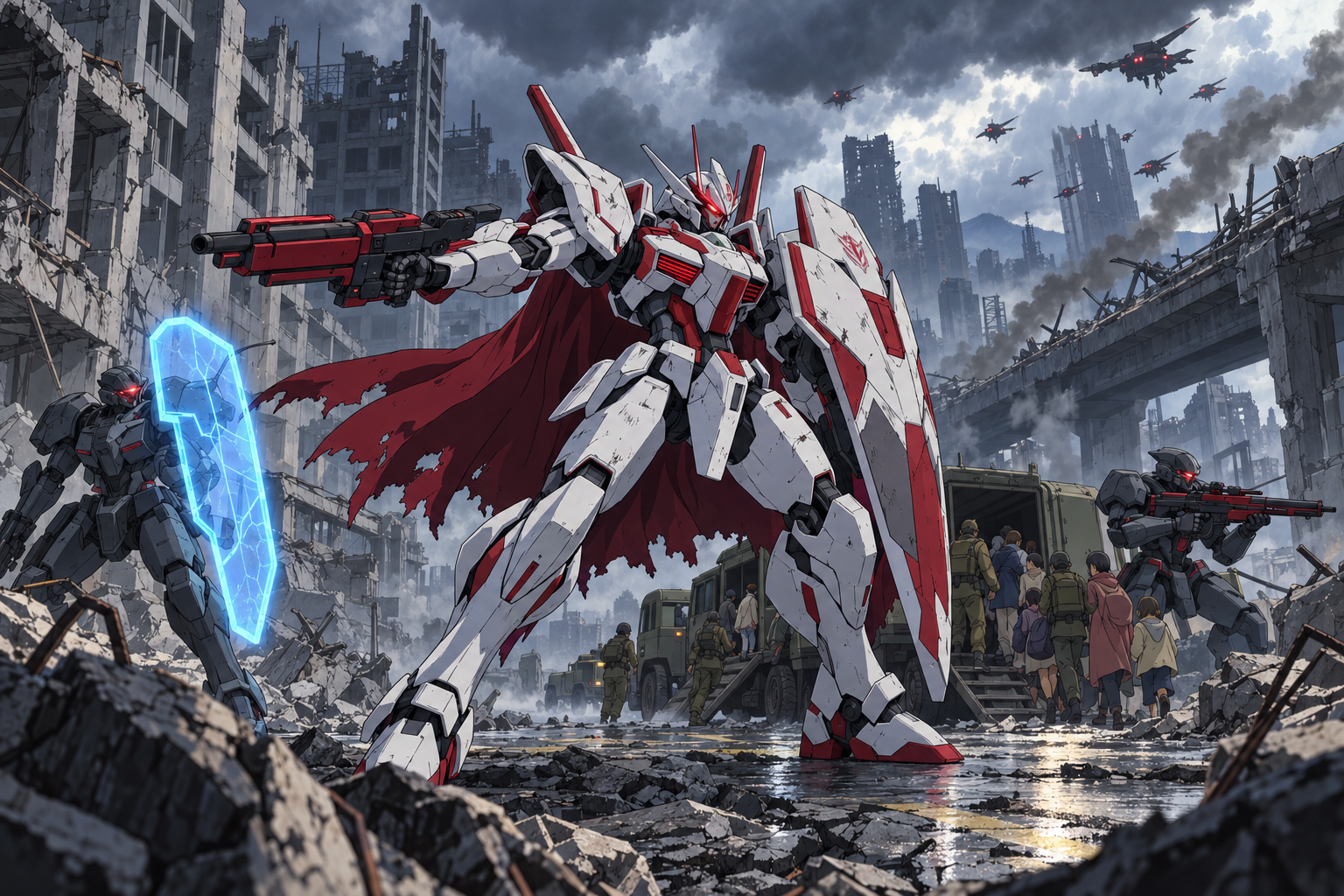
# The Last Perimeter
Lieutenant Elin Voss had stopped counting trucks around the fortieth one, mostly because counting implied there was a number that would eventually make her feel better about how many people were still behind her instead of ahead, and there wasn't one. She stood at the mouth of the staging yard with a data slate clamped under one arm and a headset crackling against her ear, waving the next convoy vehicle forward with a flashlight whose battery she was fairly sure was going to die before the night did.
"Column three, you are clear to the Amber Corridor," she said into the headset, watching the truck's taillights swing wide around a crater that had eaten most of what used to be a delivery road. "Column four, hold at the checkpoint until three clears the bend, we don't need a pileup with drones inbound."
"Copy, holding," came the reply, thin with static and thinner with exhaustion.
The rain hadn't let up in six hours, which she'd also stopped counting, and every few minutes the sky did something that could generously be called lightning and less generously be called the only light source left in a district that had lost its power grid two days ago. Somewhere behind her, past the loading yard and the triage tent and the line of civilians being sorted by a pair of medics who looked like they hadn't slept since the evacuation order came down, the sector command post was running the numbers on how many more convoy runs the Amber Corridor could take before the enemy closed it entirely.
The numbers, from what she'd overheard, were not good.
Corvale had been a functioning district three weeks ago, the kind of place that showed up on maps as a residential grid and a handful of small manufacturing lines and nothing anyone would have called strategic, right up until the Draeth Combine's push had bent the whole southern front around it and made it, briefly and unwillingly, the most important stretch of ground in the sector. Nobody in the staging yard talked much about the reasons for that anymore. It didn't matter to the woman with three kids Voss had loaded onto Column Two an hour ago, and it didn't matter to the logistics math either, which had reduced the entire question to one number: how many more people could move through the Amber Corridor before the Combine's ground forces closed the gap between the collapsed towers for good. Command had drawn the Cobalt Line at that gap three days ago on a map in a tent that had since been shelled twice, and every civilian who'd made it out since then had made it out because three machines were standing on a street corner treating that line like something worth holding past the point most human forces would have called it lost.
"Column two's clear at the far checkpoint," Voss reported, keying the headset again as a truck's taillights vanished around the bend. "How many more do we have staged?"
"Twelve columns," Calloway said. "Maybe thirteen if the last civilian intake count holds. We're not going to clear all of them before the Combine's main push arrives, Voss, so I need real numbers on how long Cobalt can extend the window."
"I'll get you numbers."
"Get me the truth. I've got people up the chain who want to hear a schedule instead of a situation, and I'm tired of translating for them."
"Voss." Major Calloway's voice cut through the general noise of the yard, tight and controlled in the specific way that meant he was holding something back that he didn't want spreading through the frequency. "I need eyes on the perimeter. Cobalt Line's about to get busy and I want a body who can talk to both sides of this operation."
"On my way."
She left the yard at a jog, ducking under a sagging length of tarp that had been strung up between two gutted buildings to keep the rain off a stack of medical crates, and came out onto what used to be a four-lane street and was now the forward edge of everything they had left. The Cobalt Line ran across the width of the road at a chokepoint formed by two collapsed office towers, close enough together that nothing larger than a transport truck could pass through the gap without slowing down, which was exactly why command had chosen it, and exactly why it was about to become the most contested three hundred meters in the sector.
Three shapes stood in that gap.
She'd seen combat automatons before — every officer running logistics behind an active front eventually did — but she still slowed her jog into something closer to a walk when she got close enough to actually see them, the way anyone slowed down near something built on a scale that didn't quite match the rest of the world. On the left, a sleek, matte-black unit stood with a long-barreled rifle held loose and ready, its optics a thin blue line that tracked the street ahead without any of the restless motion a human sentry would have made standing in the same spot. Command net designated it AX-9; the soldiers who'd worked alongside it long enough to develop opinions called it Talon. On the right, heavier and slower-looking despite standing perfectly still, another automaton carried what looked, at first glance, like a slab of solid light — a directed energy barrier folded down to portable size, humming faintly even at rest. AX-4. Bastion, to the same soldiers.
Between them, a full head taller than either, stood the reason the line was going to hold at all, if it held.
Paladin Stratos didn't turn when Voss approached, though she had the distinct impression, one she couldn't entirely justify, that he'd registered her the moment she'd left the staging yard and simply hadn't found it relevant enough to redirect any attention toward. He was white and red under a sheet of rainwater that ran off his armor in constant thin streams, a heavy cannon housing folded against one forearm, a tattered dark cloak hanging from his shoulders that had clearly been through worse nights than this one and hadn't been designed for aesthetics so much as arrived at them by accident, through use. His visor held a single steady band of red light, not flickering, not shifting, the way a person's expression might shift even when they were trying to hold it still.
"Perimeter status," she said, because it was easier to talk to the openness of the street than to address him directly, at least at first.
The voice that answered came out level, precise, utterly without inflection, the kind of voice that made you realize how much of ordinary speech was built from things this voice simply didn't include. "Holding. Convoy interval is behind projection by four minutes. Recommend accelerating loading at staging."
"We're loading as fast as we can move people."
"Understood. Adjusting projection." A pause, not hesitation, just processing. "Air contact in ninety seconds. Six units, likely reconnaissance preceding a strike wave."
She looked up automatically, uselessly, into a sky that gave her nothing but rain and the afterimage of the last lightning strike. "You can already see them?"
"Radar returns at extended range. Visual confirmation will follow."
"Right." She kept her voice steady, mostly out of professional habit, though something about standing this close to him made steadiness feel like an active project rather than a default state. "Command wants an estimate on how long you can hold the corridor if the strike wave escalates past reconnaissance."
"As long as required."
"That's not an estimate."
"It is the only accurate one available." He still hadn't turned to look at her, cannon arm tracking some slow, invisible arc across the street ahead, calculating angles she had no access to. "Estimates based on incomplete threat data produce false confidence. I will hold until the corridor closes or the mission parameter changes."
There was nothing in the delivery that resembled bravado, which was somehow more unsettling than bravado would have been. A human soldier saying the same words would have been performing something — courage, or denial, or the specific bluster that got soldiers through nights like this one. Stratos wasn't performing anything. He was simply describing a fact about himself the way he might describe the weather, and the absence of any performance at all left Voss standing there for a second too long, trying to find the part of the statement she was supposed to react to and not finding it.
"Command's going to want more than that," she said, trying again. "They're asking whether Cobalt holds long enough to clear thirteen columns."
"Thirteen columns require approximately ninety minutes at current loading rate. I am prepared to hold in excess of that window if required." A brief pause, one she'd already learned wasn't hesitation so much as some internal recalculation she had no access to. "I would advise against communicating a fixed number to command. Fixed numbers become expectations, and expectations produce decisions optimized around the number rather than the situation."
"You don't trust command to handle a situation."
"I don't have an assessment of trust to offer. I have an assessment of failure patterns in operations where timelines were treated as guarantees rather than projections. I am relaying that assessment."
"That's a very careful way of saying you don't trust them."
"It is a way of saying what is accurate." For the first time since she'd arrived, he turned his head, the motion smooth and unhurried, the red visor band settling on her directly rather than tracking past her toward the street. "Was there an additional question, Lieutenant, or has this one been answered."
"No," she said, oddly unsettled by having his full attention rather than the periphery of it. "That's — that's answered."
"Copy," she said finally, because the radio needed something, and jogged back toward the staging yard with the specific unsettled feeling of having spoken to something that had answered every question completely and told her almost nothing at all.
The reconnaissance craft arrived on schedule, six dark shapes cutting low beneath the cloud ceiling, engine noise swallowed almost entirely by the storm until they were nearly overhead, and Talon's rifle tracked the lead craft without any visible order passed between the three units standing at the chokepoint. One shot, a single crack that barely registered over the thunder, and the lead craft dropped out of formation trailing smoke, clipping the corner of a ruined building on its way down into the rubble below.
The other five scattered, banking hard away from the corridor, and for a moment the street was quiet again except for rain hammering on wrecked metal and the distant grinding sound of Column Five's engine working its way around the crater Voss had been directing traffic past twenty minutes earlier.
"That's one," Bastion said, in a voice slightly less flat than Stratos's, carrying just enough texture that Voss suspected the unit's vocal profile had been built to a different specification, something meant for closer, more direct interaction with the humans it protected rather than pure tactical communication. "They'll be back with more than six."
"They'll be back within the hour," Stratos said. "Possibly sooner given the loss."
"You think losing one scout accelerates their timeline?"
"I think command structures that rely on reconnaissance data will compensate for gaps in that data with earlier commitment of force. It is a common pattern in aggressive doctrines." He said this the way another person might comment on traffic patterns, entirely without judgment attached to the fact that he was describing, essentially, the enemy's psychology filtered through pure operational logic. "Prepare for escalation within the hour."
Voss, listening on the shared channel from twenty meters back where she'd stopped to watch the scout craft go down, found herself thinking that if she closed her eyes and just listened to the voice, she could almost convince herself she was hearing a person — until she opened them again and remembered there was no person in that armor at all. Nobody home behind the visor doing the thinking, in any sense she'd understand thinking. Just processes, running fast and clean and utterly without the particular messiness that made human judgment human. It should have been comforting, she thought. Somehow it wasn't, not entirely. It was something closer to standing near a very precise machine that happened to be shaped like a protector and did, in fact, protect — but that didn't share the shape of anything you could actually talk to.
She made three more runs between the staging yard and the line over the next forty minutes, ferrying updates in both directions, the human currency of an operation that was otherwise mostly automated calculation and radio static. Column Six cleared the corridor. Column Seven's driver had a seizure at the wheel from exhaustion and had to be swapped out mid-load, costing them six minutes they didn't have.
Somewhere in the middle of that stretch, a soldier came through the checkpoint on a stretcher, one leg wrapped tight enough that the field dressing had gone dark, his eyes tracking Voss with the too-bright alertness of someone running on adrenaline and painkillers in roughly equal measure.
"You were up at Cobalt," he said, not quite a question, grabbing at her sleeve as the stretcher-bearers slowed to navigate around a stalled cargo crate. "The big one. Is he still standing."
"Last I saw."
"He pulled three of my squad out of a collapsed building on the east flank two nights ago. Didn't even slow down doing it. Just walked into a structure that was actively coming apart and walked back out with two men over one shoulder like it was nothing." The soldier's grip loosened as the stretcher started moving again, his voice trailing after her, thinner with distance. "Tell him thanks, if you get the chance. Probably doesn't matter to him. Felt wrong not to say it anyway."
"I'll tell him," Voss said, and meant it, though she suspected, even as she said it, that the message would land on Stratos the way most things seemed to land on him — noted, filed, processed as data rather than gratitude, and moved past without ceremony.
A woman in the civilian queue went into labor two months early not long after, which nobody had planned for and which the single obstetrics-trained medic in the whole staging area had to handle in the back of a supply truck with a headlamp and a radio propped against her shoulder for a second opinion from a field hospital forty kilometers back.
"How's the Cobalt Line?" the woman asked Voss at one point, gripping the truck's tailgate hard enough to whiten her knuckles, between contractions, as though the question itself was a form of pain management.
"Holding," Voss said, which was the truth and also the only word she had.
"Is it — " The woman winced through another wave before continuing. "Is it true there's just the one big one? I heard soldiers talking. Said he doesn't even flinch."
"I don't think he's built to flinch."
"That's either the best thing I've heard all week or the worst."
"I haven't decided either," Voss admitted, and meant it, and the woman laughed despite everything, a short exhausted sound that dissolved into another contraction before either of them could say anything further.
The strike wave, when it came, came harder and faster than the reconnaissance run had suggested it might, a full formation of needle-drones cutting through the rain in a tight wedge with ground support rolling up behind them along what remained of the boulevard — squat, four-legged war-frames painted a dull, corroded green, the kind of machines built for exactly this sort of urban grinding fight, methodical and relentless rather than fast.
Voss was at the checkpoint relaying convoy status when the first drone strafing run tore down the length of the street, and she flattened herself against the side of a supply crate on instinct, watching through a gap in the stacked cargo as Stratos's cannon arm came up in a single fluid motion and answered the run with a stream of tracer fire that walked precisely across the formation's leading edge, clipping two drones out of the sky in the same pass without so much as touching the third that flew a meter to their left.
"That's insane," she said, mostly to herself, watching the third drone bank away unharmed while its two wingmates went down trailing fire.
"Threat prioritization," came Bastion's voice over the shared channel, apparently having overheard her. "Third unit's weapons profile registers as reconnaissance variant, not strike variant. He doesn't waste rounds on units that can't hurt the convoy."
"He's tracking that in the middle of a firefight?"
"He's tracking everything in the middle of a firefight. That's the whole design."
"Cobalt Line, be advised, sector command is reporting a second Combine push forming up two kilometers east of your position," Calloway's voice broke in over the shared channel, tighter now than it had been an hour ago. "If that push links up with what's already coming at you, you're going to be fighting on two fronts before the last columns are clear."
"Acknowledged," Stratos said. "Requesting confirmation on whether reinforcement is available for the eastern approach."
There was a pause on the line long enough that Voss, listening from the checkpoint, understood the answer before it came.
"Negative. Everything we've got is either escorting convoy or already committed. You're it, Cobalt."
"Understood. Adjusting."
That was the entire exchange, no argument, no request repeated in a different tone in case repeating it changed the answer, which was the kind of thing a person might have done. Voss found herself almost wishing he would push back, just once, if only because pushing back would have felt like a language she recognized.
The ground assault reached the chokepoint eight minutes later, and this was where the fight stopped looking like anything Voss had a frame of reference for and started looking like something closer to a demonstration — the three units at the line falling into a formation so tight and so immediate that she couldn't tell whether it had been ordered or simply understood between them the way a flock of birds understood a turn without any individual bird issuing an instruction. Bastion's shield unfolded to its full span, a wall of humming blue light that absorbed the first war-frame's opening barrage without so much as a flicker, while Talon dropped into a firing position behind the cover it provided, precise shots finding the joints and sensor clusters of the advancing machines with a consistency that had nothing to do with luck.
Stratos held the center, and held it the way a fixed point holds a rotating structure together — not the most active thing in the fight, moment to moment, but the thing everything else was organized around. When a war-frame broke toward the gap between the two towers, trying to force the chokepoint through sheer mass, he stepped into its path and simply absorbed the impact against a raised forearm plate with a grinding shriek of metal that Voss felt in her teeth from thirty meters back, and then answered with a single point-blank burst from the cannon that folded the machine's forward chassis in on itself like a crushed can.
"Fall back to secondary position," he said, over the shared channel, in the same flat, unbothered voice he'd used to discuss convoy timing an hour earlier, as though the machine he'd just destroyed weighed the same, informationally, as a missed schedule. "Bastion, hold the left flank. Talon, redirect to the rooftop approach, they're attempting to flank through the collapsed structure."
"Copy," came two clipped acknowledgments, and the formation shifted, fluid and immediate, no wasted motion, no confusion, three separate machines moving like extensions of a single decision rather than three individuals coordinating under pressure.
Voss relayed the engagement status back to Calloway in short, breathless bursts between crouching behind cover and checking that the convoy loading hadn't stalled out entirely in the noise and panic radiating backward from the line, and it was during one of those relay runs, sprinting low along the edge of the staging yard with her flashlight forgotten somewhere behind her, that she saw the moment the fight actually turned bad.
A second wave of war-frames came in from a side street nobody had flagged as viable for heavy vehicles, apparently having found some route through the rubble that sector command's maps hadn't accounted for, and the flanking pressure split Bastion's attention at the exact wrong second — the shield wavering, dropping just long enough for a burst of fire to catch the unit across the torso and drop it hard onto one knee, the blue light flickering, unstable, sparks visible even through the rain.
"Bastion's hit," Talon reported, voice climbing just slightly, the first genuine urgency Voss had heard from either support unit all night. "Structural integrity failing on the shield generator, he can't hold the flank—"
"Understood." Stratos didn't wait for anything further. He was already moving, cutting across the width of the chokepoint at a speed that didn't match the deliberate, measured pace he'd held all night, planting himself directly in the gap Bastion's faltering shield had left open and absorbing the next burst of fire across his own chest plating with a shudder that Voss actually saw travel through his frame from thirty meters away.
"Bastion, withdraw to secondary position and reroute power to the generator. Talon, converge fire on the flanking element, I'll hold the gap."
"Alone?"
"Yes."
There was no debate in it, no second-guessing, not even the pause a human commander might have taken to weigh the math of one unit holding a gap that had needed three seconds earlier. He simply said it, and it became the plan, and Bastion — sparking, limping, the shield guttering in and out — withdrew exactly as ordered while Talon's rifle turned entirely toward the flanking street, and Stratos stood alone in the chokepoint absorbing fire from both directions at once, cannon arm tracking targets faster than Voss's eye could follow, cape shredded further with every impact, one shoulder plate visibly buckled and still functioning anyway.
"Column nine, final load, moving now," came a voice over the convoy channel, thin with strain. "That's it, that's everyone, we are clear of the staging yard."
Voss keyed her own headset with a hand that wasn't entirely steady. "Cobalt Line, this is Voss, final convoy is clear of staging and inbound to the corridor, repeat, final column is moving."
For a fraction of a second, through the noise of impact and rain and the grinding scream of failing war-frame chassis, Stratos's voice came back level and unchanged, as though the fact that he was currently the only thing standing between a war-frame column and the last group of civilians left in the sector hadn't shifted his priorities by even a fraction of a degree from what they'd been an hour ago discussing convoy timing.
"Copy. Corridor will remain open until the final vehicle clears the bend, regardless of remaining threat volume."
"You're one unit against — " She looked at the street, at what was left of it, machines burning on both sides of the chokepoint, more still coming. "You're one unit."
"That is the current configuration. It is sufficient."
She didn't know what to say to that, and there wasn't time to say anything anyway, because the last convoy vehicle was already rolling past the staging yard's edge and she had a job to do that didn't involve standing in the open arguing tactics with something that had already made its decision before she'd finished the sentence.
"Talon, status on the eastern approach," Stratos said, over the channel, even as the first rounds from the flanking column found the edge of his cover and forced him half a step sideways, cannon fire never breaking rhythm despite it.
"Second push is closing faster than projected. Estimate contact in ninety seconds."
"Understood. Maintain position on the flank until convoy clears, then withdraw regardless of remaining threat. That is not optional."
"Copy," Talon said, and something in the single clipped syllable made Voss think, for just a moment, that even a voice built without inflection could carry weight through timing alone — the way the order had been given fast and flat and immediate, leaving no room for the kind of negotiation a unit closer to breaking might have tried.
The final run through the Amber Corridor took four minutes that felt considerably longer, the truck lurching hard around the same crater she'd been directing traffic past all night, Voss riding the running board with one hand locked on the door frame and her eyes fixed backward on the chokepoint shrinking behind them through curtains of rain. She watched Talon disengage from the rooftop position and drop back toward the corridor entrance, providing cover for the retreat, watched Bastion limping alongside with the shield flickering weakly back to partial function, and watched, for as long as the angle allowed her to watch anything at all, a single white-and-red silhouette standing exactly where he'd said he would stand, holding a gap that three units had needed to hold together twenty minutes earlier, cannon fire lighting the rain around him in long, steady bursts that didn't slow, didn't waver, didn't show any sign of an internal countdown toward when that might change.
"Cobalt Line, corridor is clear, all convoy elements past the bend," she said into the headset, voice cracking slightly on the word *clear*, not from relief exactly, more from the strange, disorienting vertigo of watching something make a promise and then simply, methodically, keep it in real time in front of her.
"Acknowledged," came the reply, and then, a beat later, in the same unbothered tone, "Withdrawing to secondary line. Convoy has priority. Mission parameter satisfied."
The truck rounded the last bend before the extraction point, and the chokepoint disappeared from view behind a collapsed section of the boulevard, and Voss lost visual entirely, left with only the radio traffic — clipped, professional, utterly without drama — confirming that Talon and Bastion had reached the fallback position, that Stratos was disengaging in staged intervals exactly as doctrine apparently specified, that the corridor, having done its job, was being allowed to close behind them at last.
She found out two hours later, standing in the relative calm of the extraction camp with a cup of something that had been advertised as coffee and mostly tasted like static, that all three units had made it back. Stratos arrived last, on foot, cannon arm hanging slightly loose at a joint that had taken more damage than the rest of him combined, cape gone entirely except for a few scorched strips still clinging to one shoulder mount, moving at the exact same measured, deliberate pace he'd held at the chokepoint hours earlier, as though the walk back from a battlefield and the walk into one required identical discipline.
Voss found herself walking toward him before she'd fully decided to, still holding her ruined coffee, stopping a few meters short the way she had at the start of the night, not quite sure what she intended to say.
"You held it," she said finally. "Alone. For — I don't even know how long."
"Fourteen minutes, thirty-one seconds, from the point Bastion withdrew to the final convoy element clearing the corridor," Stratos said, as though the number itself was the entire content of the answer, which, to him, it apparently was.
"That's not — " She stopped, tried again. "I mean I don't know how you decided to do that. Just stand there and take it. Alone."
"There was a mission parameter and a timeline that required it. The decision followed from the parameters."
"That's it? No — " She gestured vaguely, uselessly, at the general concept of fear, or hesitation, or any of the hundred human responses that decision should have required and apparently, in him, simply hadn't. "Nothing else went into it?"
For a moment he didn't answer, the red visor line steady on her in a way that gave her absolutely nothing to read, no tilt of a head, no shift of weight, none of the small unconscious signals a person gave off even while choosing their words carefully. When he did answer, it was in exactly the same voice he'd used all night, discussing convoy intervals and drone formations and the precise number of seconds a corridor had stayed open.
"The parameters were sufficient," he said. "Nothing else was required."
He turned then, moving off toward the maintenance crews already converging on the three returning units with diagnostic equipment and replacement plating, and Voss stood there a moment longer in the thinning rain, holding a cold cup of bad coffee, watching him go with the specific, unresolved feeling of having spent an entire night standing close enough to something to trust it completely without ever once managing to understand it, and suspecting, somehow, that this was exactly how it was meant to work.
Bastion was propped against a supply crate a short distance off, one shoulder panel removed entirely while a technician worked at the exposed components beneath, the shield generator dark and quiet now that there was nothing left nearby that needed holding back. The unit's vocal profile, damaged or not, still carried more texture than Stratos's ever did.
"You look like you're doing an autopsy on him," Voss said, nodding at the technician's work.
"Repair, not autopsy. There's a difference, mostly in outcome." Bastion's head turned toward her, red optics dimmer than they'd been at the line, the strain of the last several hours evidently costing something even in a machine built to absorb impact rather than feel it. "You were asking him about the decision. At the chokepoint."
"He didn't have much of an answer."
“He never does, in words you'd recognize as an answer. It isn't that there's nothing behind it, Lieutenant. It's that whatever is behind it doesn't translate neatly into the kind of answer you're asking for.” The technician said something clipped and technical, and Bastion held still for a moment before continuing. “He had a line to hold, people still moving through it, and no other unit positioned to take his place. For Stratos, that was enough.”
“That's supposed to be reassuring?”
“I don't know what it's supposed to be.” Bastion's optics dimmed further, the shoulder panel finally coming free in the technician's hands. “I've operated beside him long enough to know better than to explain him to other people. For what it's worth, Lieutenant, thirteen columns and a woman with a very new, very inconveniently timed daughter would probably tell you the explanation mattered less than the fact that he kept making the same decision all night."
Voss didn't have anything to say to that either, and didn't try to find something, standing instead in the last thin drizzle of a storm finally working its way out of the sector, watching the maintenance crews work by lamplight on machines that had spent the night being the only thing standing between an ordinary street and everyone who'd needed to get past it.
Behind her, further back in the camp, the woman from the supply truck was holding a very small, very new person who had arrived somewhere in the middle of the worst of it, and hadn't, as far as anyone could tell, noticed the difference between that night and any other one she might have been born into. The corridor had held. The convoy had cleared. Somewhere behind them, the Cobalt Line had closed for good, the chokepoint finally given up to whatever the Draeth Combine intended to do with a stretch of ruined street they'd spent an entire night failing to take, and none of it, Voss suspected, would register to Stratos as anything other than a set of parameters that had, in the end, been satisfied.


.png)
.png)
.png)