%20(1).png)
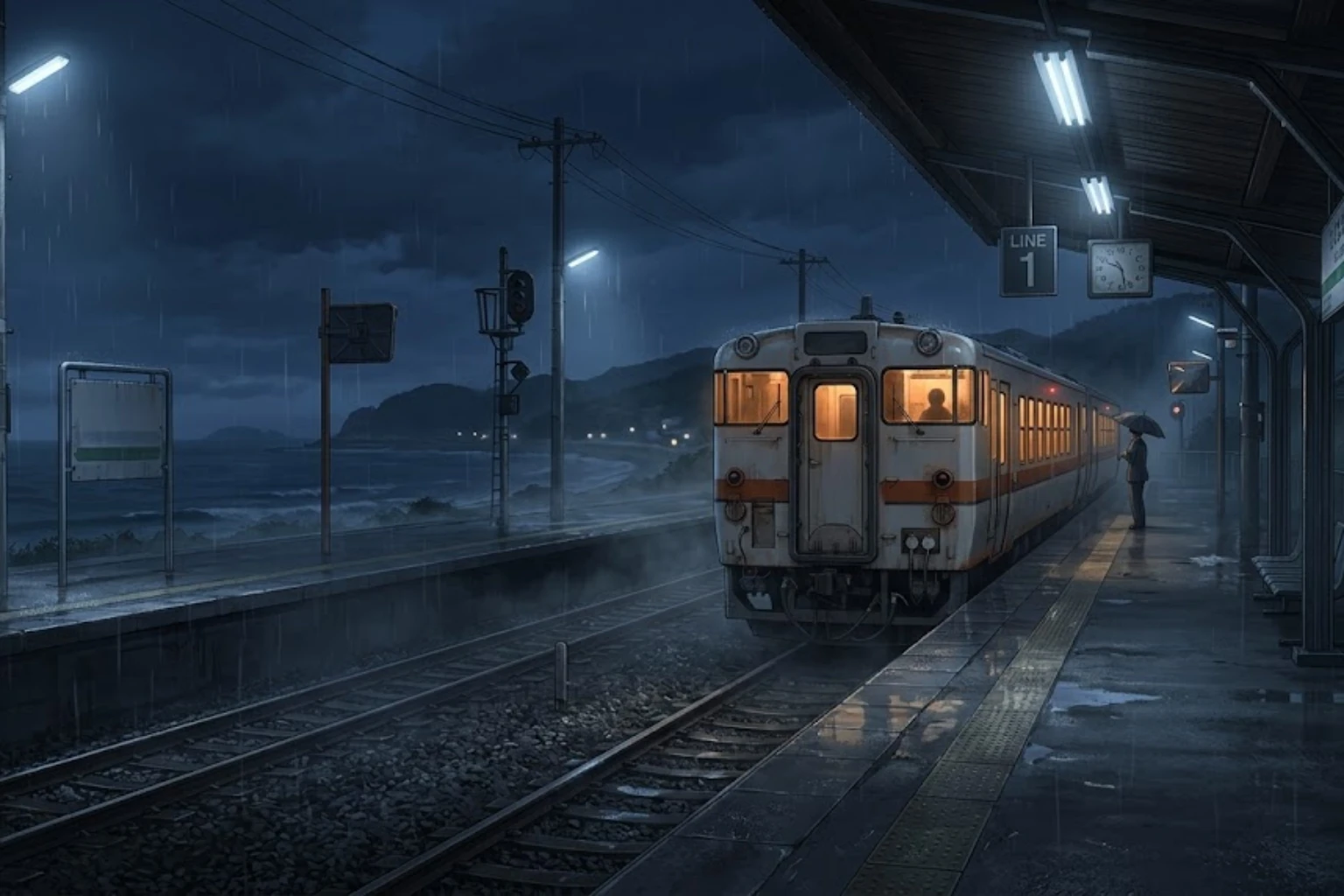
The Nishi Line ran from Komachi Junction to the coastal terminus at Uminobe, one hour and forty minutes, eleven stops, last departure at 23:47.
Nobody called it the last train. The staff called it the last departure, which was a small distinction that turned out to matter.
Hideo was twenty-three and had been assigned to the Nishi Line night rotation after four months of daytime suburban routes, which his supervisor had described as a promotion and which felt, on the first night, less like a promotion and more like a posting — the specific word that suggested you had been placed somewhere for reasons that had not been fully explained.
His supervisor on the night rotation was a man named Conductor Mase. Fifty-something, thin, with the quality of someone who had been doing the same thing for so long that the work had ceased to be something he did and had become something he simply was. He had met Hideo at the platform at 23:30 and walked him through the pre-departure checks with the thoroughness of someone who believed in procedure and the economy of someone who had explained procedure many times.
At 23:44, three minutes before departure, he had said:
"One more thing."
Hideo had his notebook out.
"Don't write this down," Mase said.
Hideo put the notebook away.
"Occasionally," Mase said, "there will be a passenger. You'll know which one. Don't look for signs — you'll just know." He said this with the flatness of someone stating a fact about weather or timetables. "When you see this passenger, you do not acknowledge them. You do not make eye contact. You do not ask for their ticket. You walk past."
Hideo looked at him.
"Every conductor on this line knows this," Mase said. "It is not written anywhere. It is not in the manual. You will not find it documented." He held Hideo's gaze. "Walk past. That's all."
"What happens if—" Hideo started.
"Walk past," Mase said. "That's all you need to know."
The departure signal sounded.
They boarded.
The first month Hideo saw nothing.
Or rather — he saw nothing he could identify with certainty as the thing Mase had described. He saw the passengers the last departure always carried: the night-shift workers going home, the occasional drunk sleeping upright with practiced skill, the young people who had missed earlier trains and sat with the philosophical acceptance of people for whom this had happened before. He saw, twice, passengers who seemed slightly out of place — a woman in very formal dress for a Tuesday night, an elderly man with a traveling bag that looked older than the train — and he looked at them and they looked back and nothing happened, which he took to mean they were ordinary.
He asked Mase about them, carefully, the following shift.
"You'll know," Mase said. "It's not something I can describe more precisely than that."
"How will I know?"
Mase thought about it with genuine consideration, which Hideo had come to understand was how Mase approached all questions — seriously, without dismissal.
"The clothes will be wrong," he said finally. "Not wrong like someone dressed unusually. Wrong like — the clothing belongs to a different decade. Not costume wrong. Actually wrong." He paused. "And they won't understand where they are. Not in the way of confused passengers. In a more fundamental way. They'll be looking at the car like they've never seen one before. Or like they're seeing it from somewhere very far away."
"And the ticket?"
"Sometimes they have one. The ticket will be wrong too. Old stock. Discontinued. Or a route that doesn't exist anymore." He paused. "Sometimes no ticket. You walk past regardless."
"Who are they?" Hideo said.
Mase looked at the track ahead through the forward window.
"I don't know," he said. "Nobody's ever asked one."
Hideo saw the first one in his second month, on a Thursday in November.
The train had cleared the fifth stop, Tsuruhama, and was moving through the dark stretch of farmland between Tsuruhama and Nagasawa — fifteen minutes of no stations, the fields and occasional lights of farm buildings visible through the windows, the car quiet with the particular quiet of late night rural transit.
He was doing the mid-route check, moving through the cars from front to back, when he came through the connecting door into car three and saw the man.
He knew.
Mase had been right — there was no deliberate recognition, no checklist applied. He simply knew, in the way that was more like the resolution of something already known than the acquisition of something new.
The man was sitting in a window seat, three rows from the back. Middle-aged, or the appearance of middle-aged. Wearing a suit that was — wrong. Not unusual, not eccentric. Wrong. The cut of it, the fabric, the specific proportions of the lapels and the way the collar sat — it belonged to a different time with the same completeness that a photograph belonged to its decade. Not a costume. Actual clothing, worn with the unconscious ease of someone who had never considered that their clothing might be remarkable.
He was looking out the window.
Not at his phone, not at anything in the car. At the darkness outside, at the farmland moving past, with the expression of someone watching something they hadn't expected and weren't sure how to categorize.
Hideo walked through car three.
He looked at the seats he was supposed to look at, checked the car he was supposed to check, and walked past the man with the practiced non-acknowledgment of someone who had been told to do exactly this and was doing exactly this.
The man did not look at him.
Hideo went through the connecting door into car four.
He stood there for a moment, his hand on the door handle, breathing normally, which required slightly more effort than breathing normally usually did.
He did the rest of the check. He went back to the front car. He did not go through car three again until Nagasawa, where he stood at the doors for the stop and watched the passengers and did not look toward the back of car three.
At Nagasawa, one passenger boarded. Three got off.
When the train moved again he walked through car three on the standard route.
The seat was empty.
He had not seen the man get off at Nagasawa.
He walked to the seat and looked at it. Ordinary seat, ordinary upholstery, nothing remarkable.
On the floor beside the seat, half under it, a piece of card. He picked it up.
A ticket. Old stock — he could see immediately that the printing format was discontinued, the paper itself a different weight than current issue. The ink had the slight brownness of age. The destination printed on it was Uminobe, which was the current terminus, but the origin was a station name he didn't recognize. He looked at it for a long time.
He put it in his pocket.
He didn't tell Mase.
He told Mase two weeks later, about the ticket.
Not about keeping it — he had thrown it away by then, after taking a photograph he had also deleted, in the progression of someone trying to decide what kind of relationship they wanted to have with something they couldn't explain. He told Mase about finding it.
Mase was quiet for a moment.
"They leave things sometimes," he said.
"What kind of things?"
"Tickets. Small objects. Once, a photograph." He looked at the track. "Old things. Things that fit with how they're dressed."
"Where do the things come from?"
"Same place they come from," Mase said.
"And where is that?"
Mase said nothing.
"You don't know," Hideo said.
"I don't know," Mase agreed. "I've been on this line for nineteen years. I've seen them — I don't count, but many times. I've walked past every one of them. I've found things they've left. I don't know where they come from or where they go or what they are." He paused. "I know the rule works."
"How do you know?"
"Because nothing has gone wrong," Mase said. "In nineteen years. Nothing has gone wrong."
Hideo thought about this.
"What went wrong before the rule?" he said.
Mase turned to look at him directly, with the expression of someone deciding something.
"I don't know that either," he said. "The rule existed when I arrived. The conductor who trained me didn't know its origin. He had been trained by someone who didn't know. The rule is older than anyone currently working this line." He held Hideo's gaze. "That's the thing about rules that work. After a certain point, you stop needing to know why they work. You just follow them because the alternative is finding out."
Hideo looked at the track.
"Has anyone ever not followed it?" he said.
Mase was quiet for a long moment.
"The rule exists," he said, "because enough people have followed it consistently for long enough that following it has become the natural thing. The way a path forms — not because anyone decided where it should go, but because enough people walked the same way."
"That's not an answer," Hideo said.
"No," Mase agreed. "It isn't."
He saw four more over the following months.
A young woman in a kimono that was too old to be worn casually, sitting with her hands folded in her lap and looking at the floor of the car with the expression of someone doing a calculation. A boy, perhaps twelve, in school clothes from a different era, with a satchel on his lap, looking out the window with the focused attention of someone memorizing something. An older woman who was crying silently, not the crying of someone distressed exactly, more the crying of someone processing something enormous with the tools available to them. A man in work clothes — a laborer, by the quality of the clothing, old work clothes, worn honestly — sleeping, or the posture of sleeping, his head against the window.
He walked past all four.
He did not look at them directly. He did not make eye contact. He walked the route he was supposed to walk and he kept his attention distributed in the way that wasn't quite avoidance and wasn't quite presence, the careful middle-ground that Mase had never described explicitly and which Hideo had developed by instinct over months of practice.
After each one he found himself thinking about them. Not obsessively. Just — they stayed, the way certain images stayed, with a quality that resisted the usual fading.
The boy memorizing the view from the window.
The woman crying with no sound.
He thought about where they were going. About whether Uminobe meant anything to them. About whether they arrived.
He did not ask Mase these questions because Mase's answers would be honest and honest in this case meant I don't know and he had reached the limit of what I don't know could contain.
He acknowledged one in March.
He had not planned to. He had been on the line for six months and had established his practice and held it without difficulty and had in fact stopped thinking of it as difficulty — it had become simply what he did, the way any repeated action became simply what you did.
The passenger was a woman. Thirties, or the appearance of thirties, in a coat that was wrong in the usual way — the fabric, the cut, the buttons. Sitting in car two, window seat, watching the darkness outside with an expression that was different from the others.
Not the calculation or the memorizing or the silent grief. Something more immediate. She looked, Hideo thought as he came through the door and understood who she was, like someone who was lost. Not directionally lost — the other kind. The more fundamental kind.
He walked the route.
He came level with her seat.
And she looked at him.
The others had never looked at him. They had looked out windows or at floors or at their own hands. She looked at him directly, with the clear and slightly desperate expression of someone who had just spotted something familiar in an unfamiliar place.
He stopped.
He didn't decide to stop. He stopped.
She said something. He didn't understand the words — not a language he recognized, something older or simply different in ways that put it outside his recognition. But the tone was unmistakable. A question. The specific cadence of someone asking where am I or how do I or can you tell me—
He looked at her for one second.
Two.
He said, very quietly: "Uminobe. End of the line."
He didn't know why he said that. It was simply the true answer to the question that seemed most likely to be being asked.
She looked at him. Her expression moved through something — not understanding exactly, but something adjacent to it. A partial resolution. The way a face looked when an answer wasn't complete but was something.
She looked back out the window.
He walked to the end of the car and through the connecting door and stood in the space between cars in the cold air and noise of the moving train and breathed.
Nothing happened.
The train moved through the dark. The fields went past. The stops came and went. He did his route. Car two, on the return check, contained the ordinary passengers and an empty window seat that may or may not have been the same seat and which he did not examine.
Nothing happened.
At Uminobe he stood on the platform in the sea-cold air while the last passengers disembarked, and Mase came and stood beside him, and they watched the platform empty in the way they always did.
"Car two," Mase said.
It wasn't a question.
"Yes," Hideo said.
Mase was quiet for a long time. Not angry — Hideo had expected something like anger and it wasn't there. Just the quality of someone absorbing information and deciding what it meant.
"What did you say to her?" Mase said.
"Uminobe," Hideo said. "End of the line."
Mase looked at the terminal building. At the station sign. At the sea visible beyond the platform end, dark and moving under the March sky.
"And?" he said.
"Nothing," Hideo said. "She looked back out the window."
"That's all?"
"That's all."
Mase stood with this for a while.
"You should have walked past," he said finally.
"I know," Hideo said.
"The rule exists for a reason."
"I know. I don't know what reason."
"Neither do I," Mase said. "That's the point." He looked at the empty train. "The reason the rule works is that it's followed consistently. The moment it stops being followed consistently it becomes something different. It becomes a rule that is sometimes followed. And a rule that is sometimes followed is not a rule — it's a suggestion."
"I understand," Hideo said.
"Do you understand why that matters?"
Hideo thought about the woman's expression. The partial resolution in it. The way she had looked back out the window.
"Because if they know some of us will acknowledge them," he said slowly, "then some of them will look for the ones who will."
Mase said nothing. Which was answer enough.
The sea moved in the dark beyond the platform. The train sat empty on the track. Somewhere in the terminal building a clock marked the end of the last departure's run.
"Did it help her?" Hideo said. "What I said."
Mase looked at the water.
"I don't know," he said.
"Do you think it helped her?"
A long pause. The longest pause Mase had produced in six months of working beside him.
"I think," Mase said carefully, "that you told a lost person where they were. And I think that is a human thing to do." He paused again. "I also think that we do not fully understand what we are dealing with on this line and that the rule has held for longer than either of us has been alive and that the reason it has held is that the people before us held it." He looked at Hideo. "You need to decide what kind of conductor you are going to be."
Hideo looked at the empty train.
He thought about the boy memorizing the view. The woman who had been crying. The man in the work clothes sleeping against the window. He thought about all of them, moving through this car in the dark, on the last departure that nobody called the last train, between wherever they came from and wherever they were going.
He thought about the woman in the coat looking at him with the expression of someone who had found something familiar in an unfamiliar place.
He thought about how her face had looked when he said Uminobe and she had understood something, partially, imperfectly, the way understanding arrived when you were very far from home.
"I don't know what kind I'm going to be," he said.
"No," Mase said. "You wouldn't yet."
They stood on the platform until the procedures were complete and the train was secured and the station was locked, and then they walked to their separate cars in the parking lot, and the night was cold and clear and the sea was audible beyond the terminal, and the last departure was over for another week.
Hideo sat in his car for a moment before starting it.
He thought about the rule. About the path formed by enough people walking the same way. About what happened when someone stepped off the path — not breaking it, just stepping off, just once, and then stepping back on.
He thought about whether the path was the same path afterward.
He started the car.
He drove home through the dark rural roads, the fields on either side flat and quiet under the March sky, and he thought about what Mase had asked him.
What kind of conductor are you going to be.
He didn't have an answer.
But the next shift was Thursday, and the last departure was at 23:47, and he would be on it, and whatever was going to happen would happen then or not, and the rule would be followed or it wouldn't, and he would know when he knew.
The fields went past.
He drove home.


.png)
.png)
.png)