%20(1).png)
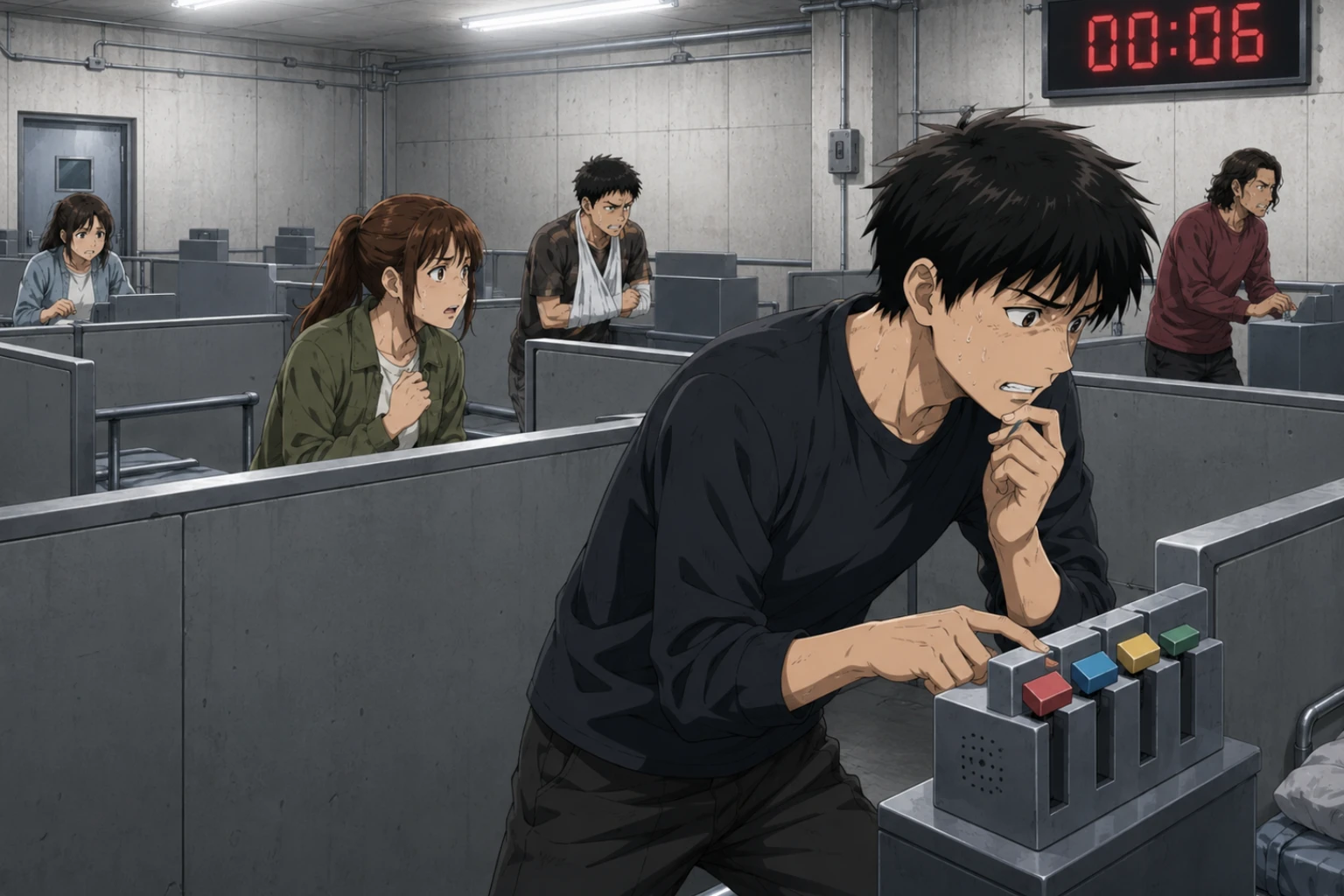
The room they were given to sleep in was the same room they had eaten in, the tables pushed back against the walls to make space for a double row of narrow cots, and it took less than an hour for Haruto to understand that none of them were actually going to sleep in it so much as lie down inside their own exhaustion and wait for morning to arrive on top of them.
Yui's cot was at the end of the second row, untouched, the blanket still folded the way it had been folded before any of them had known her name well enough for it to matter. Nobody had moved it to make room. Nobody had suggested using it for supplies, or blankets, or anything else a sensible person might have repurposed an empty bed for. It simply sat there, a small rectangle of order in a room that had stopped pretending to be orderly about anything else, and every time Haruto's eyes drifted toward it he made himself look somewhere else, and every time he looked somewhere else his eyes drifted back anyway.
He lay on his cot with his back screaming at him in one long unbroken line from collarbone to hip and understood, distantly, that there was no position his body would forgive him for choosing. He tried his side. He tried flat. He tried curling in on himself the way he had as a child in a house that had never quite felt occupied, and none of it helped, and somewhere in the second hour he stopped trying new positions and simply lay in the one that hurt the least and stared at the ceiling.
Across the aisle, Koji lay with his bound arm across his chest, motionless in the specific, deliberate way of a man determined not to let anyone see how much he was hurting. Twice Haruto heard his breath catch when he shifted the wrong way. Both times, Koji said nothing, and both times, nobody asked.
Two cots down, Kenta's leg throbbed loudly enough that Haruto could hear him shifting every few minutes, trying to find an angle that took the pressure off the bandage, muttering something under his breath that might have been a curse or might have been an apology to no one in particular. At one point he sat halfway up in the dark, looked toward Yui's cot, and lay back down without having said anything at all.
Somewhere near the far wall, a quiet, steady sound — someone crying, trying very hard to do it without being heard, mostly succeeding. Haruto didn't turn to see who. It felt, in the dark, like something that deserved to stay anonymous.
Junpei woke twice from what was obviously a nightmare, breath ragged, blanket thrown half off the cot, and both times Sachiko's cot creaked as she shifted enough to murmur something low and calm across the aisle until his breathing evened out again. She didn't get up. She didn't need to. Her voice alone seemed to be doing the work.
Aya lay very still with her eyes open, watching the ceiling with the flat, unblinking patience of someone who had decided that sleep was a luxury she wasn't going to get and had stopped fighting the fact of it. Near the door, Kaori sat upright against the wall rather than lying down at all, arms folded, watching the room the way she might have watched a slope for signs of weather turning, as though sleep were a form of carelessness she wasn't willing to risk twice in one night.
Somewhere close to two in the morning by no clock any of them could see, a mechanical groan sounded from somewhere beyond the walls — distant, brief, unexplained — and half the room came instantly and silently awake, listening, before deciding, one by one, that it hadn't been meant for them and lying back down without discussing it.
The one thing all fourteen of them seemed to share, in the ragged hours between the end of Game One and whatever waited on the other side of sleep, was a quiet, unspoken agreement about what the morning would look like. There would be food. There would, perhaps, be fresh bandages, someone finally competent enough to look at Koji's shoulder properly, at Kenta's leg. There would be time — a little, at least — to sit with what had happened, to talk without an alarm counting down behind them. Whatever came next, it would come after some kind of pause.
Nobody had said this out loud. It had simply settled into the room the way certainty settles into people who have already survived one impossible night and feel, however foolishly, that they have earned the right to expect the next one to be kinder.
---
The lights came on at full brightness with no warning at all.
There was no dimming through half-light, no gradual return to consciousness. One second the room was dark and full of uneven breathing; the next it was blazing white, and the alarm arrived at the same instant, a flat repeating tone pitched exactly wrong for waking a room full of injured people gently.
Haruto sat up before he was fully conscious of having decided to, his back seizing in protest, one hand already pressed flat against the cot to keep himself upright. Around him the room convulsed into motion — Kenta swearing, twisting to protect his bandaged leg from the blanket that had tangled around it; Koji lurching upright and immediately going white with the pain of having moved his shoulder too fast; Junpei's eyes wide and unseeing for a full three seconds before whatever nightmare he'd surfaced from released him into the worse thing actually happening.
The screen at the end of the room came alive before anyone had managed to stand.
**GAME TWO.**
That was all it said, for exactly as long as it took every eye in the room to find it. Then the two words dissolved, and something else replaced them — a dense grid of information that filled the screen edge to edge, too much to take in at a glance, and beneath it, in small unmistakable numerals, a countdown already ticking downward from twenty seconds.
"Wait—" Someone's voice, cracked with sleep and disbelief. "Wait, is this— are we supposed to be—"
Nobody had time to finish asking. The grid held.
Fourteen rows, each marked with two-letter initials Haruto recognized after a half-second of frantic scanning as belonging to the people in the room — *H.A.*, *M.K.*, *T.K.*, *A.F.*, and on down the list — each paired with a small colored shape, a three-digit number, and a short location tag: *LOCKER-3*, *COT-9*, *PANEL-E*, words that meant nothing yet and would apparently need to mean something very soon. Beneath the grid, a key: a small legend assigning a numeric value to each shape — circle, square, triangle, diamond — and beneath that, a single line of instruction in flat block text: *SUBMIT AT YOUR STATION. ONE PERSON PER CODE. CORRECT LOCKS. INCORRECT COSTS TIME.*
And near the bottom of the grid, easy to miss and impossible to unsee once seen, a fifteenth row.
*Y.T.* A pale grey shape beside it, unlike any of the four colors in the key. No number visible. No location tag. Just the initials, sitting where they had always sat, as though whatever system had built this grid hadn't yet been told, or hadn't cared, that there was no longer anyone alive to answer for that row.
The display held for twenty seconds exactly, and then it was gone, replaced by a fresh countdown — twelve minutes, glowing red — and the alarm, mercifully, cut out, leaving behind a silence that felt somehow louder than the noise it replaced.
For one full breath, nobody moved.
"What was that," Kenta said, into the silence. "What was that, was that the whole— is that it? Is that everything?"
"That was it." Takumi's voice, unsteady, already scanning the room. "That was the entire briefing. Twenty seconds. That's all we get."
"Then what do we—"
"We find the stations." Kaori was already on her feet, moving with the brisk, decisive stride of a woman who had spent a career telling frightened people what to do next. "Whatever those location tags meant. Locker, cot, panel. They're real. They're in this room. Move."
They moved.
---
It took nearly ninety seconds — an eternity, with the countdown already shedding time — before anyone found the first station, and by then the room had fractured into a dozen separate, half-panicked searches, people wrenching open cabinet doors, running hands along the undersides of cot frames, prying at wall panels that had clearly been part of the room's fixtures for as long as any of them had been in it and had, apparently, always concealed something more.
"Here." Masato's voice, flat with the particular satisfaction of a man who fixed things for a living finding something exactly where logic said it should be. He'd pulled a thin drawer open beneath the medical supply cabinet and found, set into its base, a small recessed keypad with a slot for a numeric code. "Panel's under the medicine cabinet. There's a code entry here."
"That's not mine," Sota called from across the room, already crouched beside his own cot frame, fingers working at a seam in the metal that gave way to reveal a second keypad. "Mine's under the bed."
Within another minute, most of them had found their assigned stations, and the room's chaos began, gradually, to organize itself into something closer to purpose. But finding the station was only the beginning. Nobody, in the twenty seconds they'd been given, had managed to absorb all fourteen rows of information at once, and the room was already fragmenting into overlapping, urgent questions.
"What was my shape," Kenta said, to no one, to everyone. "I saw a number, I think it was — was it three-something? I can't— why can't I remember the number—"
"Diamond," Tetsuya said, without looking up from where he was crouched over his own keypad, doing math on his fingers. "You were diamond. I remember because it was next to mine and mine was a triangle and I thought it was strange they put us next to each other."
"How do you know that's not just what you assumed after the fact—"
"I don't. But it's what I remember, and right now that's all either of us has."
Aya, still sitting on the edge of her cot, hadn't moved toward her station yet. She was watching the room instead, eyes moving from face to face with the particular attentiveness she'd spent years developing in front of cameras that rewarded exactly this kind of reading. "Junpei's guessing," she said, to nobody, loudly enough that Sachiko, three cots away, turned toward her. "He just said his number twice and changed it both times."
"Junpei." Sachiko was already moving toward him, her voice dropping into the same flat, blunt register it had found the night before, out on the course. "Stop. What did you actually see. Not what you think you should have seen. What you *saw*."
"I don't— I was still waking up, the light was so bright, I couldn't— I think it might have been a square, but it also might have been—"
"Square or circle."
"I— square. I think square."
"Then go with square until something tells you otherwise. Move."
Mio was working her way along the cots rather than toward her own station, pausing at each person just long enough to ask a single sharp question — *how sure are you, one to ten* — and moving on, building, in the space of a minute, a rough map of who actually trusted their own memory and who was simply guessing out of panic. "Kenta's a two," she called out. "Believe Tetsuya over him if they conflict."
"Thanks," Kenta muttered, not looking up.
"I'm not saying it to be cruel. I'm saying it because we don't have time to weigh everyone's memory equally when they're not equally reliable right now."
The first wrong submission came less than three minutes in.
Sota, certain of his pattern before anyone else had finished orienting themselves, called his shape-value key across the room to Ryohei — "Diamond's four, so if you're diamond you add four to your number" — with the flat confidence of a man who had already solved the important part of the puzzle and saw no reason to doubt the rest of it. Ryohei, trusting him, punched in a code built on that assumption. The keypad flashed red. Somewhere in the ceiling, a tone sounded, and the countdown on the main screen jumped backward by a full sixty seconds.
"That's not right," Ryohei said, staring at the panel like it had personally betrayed him.
"It should be right—"
"Then check it again, because it just took a minute off the clock."
Sota's certainty cracked for the first time since they'd woken. He crouched beside Ryohei's panel, running through the values again, and this time noticed what he'd missed the first time — the diamond in the display had been a slightly different shade of yellow-gold than the diamond in the key, close enough to have fooled him, different enough, he realized with a cold drop in his stomach, to mean it might not have been the same value at all. "I don't— I might have had the values wrong. I was so sure. I looked at that grid and it felt exactly like every pattern I've ever solved and I didn't stop to ask if this one was actually the same kind of thing."
"We don't have time for you to feel bad about it," Kaori said, from across the room. "Fix it or move on to someone else's."
He fixed it, eventually, on the second try, the wasted minute sitting in the room like a physical weight none of them could put down.
It was Naoko, crouched beside her own station and largely silent since the alarm had sounded, who noticed the thing that mattered most. "The location tags," she said, not loudly, but clearly enough that three people turned toward her. "They're not random. Look — mine says *panel-E*. There's a panel marked E on the wall by my cot, it's been there the whole time, I noticed it last night when I couldn't sleep. The letters match where we already are. We're not supposed to be searching randomly. Everyone's station is close to wherever they already were."
It was a small thing, and it saved them nearly two minutes of wasted searching once it spread through the room — people abandoning distant cabinets and cot frames for the ones nearest their own beds, the tags making sudden, obvious sense once someone had said it out loud.
Takumi worked through his own station methodically, checking and rechecking the number he remembered against the shape beside it, refusing to submit until he'd asked three separate people to confirm what they'd seen near his row of the grid, and when he finally entered his code it locked clean on the first attempt. Haruto watched him do it and thought, distantly, that Takumi looked like a man defusing something rather than answering a quiz.
The ghost row nearly cost them more than the wrong values had.
"There were fifteen rows," Junpei said, midway through the scramble, his voice climbing toward panic again. "I counted them, I'm sure I counted them, there were fifteen, that means there's a station for—" He didn't finish it. He didn't need to. Several people had gone still at the same moment, the same terrible thought arriving in more than one head at once — that somewhere in this room there was a fifteenth panel, a code meant for someone who could no longer submit it, and that the game might be waiting on an answer that was never going to come.
"There's no fifteenth station," Sota said, but his voice wavered enough that nobody believed him immediately.
"How do you know—"
"Because there's fourteen of us." His voice steadied as he said it, the logic settling him more than the words did. "Fourteen people, fourteen keypads, that's what we've found, that's all we've found. That row wasn't a station. It was— I don't know what it was. Left over. Decorative. A mistake in whatever built this display. It doesn't have a location tag, did anyone see a location tag next to it?"
Nobody had.
"Then it's not asking us for anything. It's just still there because nobody bothered to take it out."
It should have been a relief. It mostly wasn't. But it stopped three separate searches that had begun combing the room for a panel that didn't exist, and that, in the end, was the only thing that mattered with the clock still falling.
The stations locked, one after another, in an order that owed less to anyone's competence than to the accident of who had woken fastest, who had panicked least, who had happened to be standing closest to their own hidden panel when the lights came on. Sota's locked first, once he'd corrected his own error. Kenta's locked soon after, on his second attempt, quieter than his first. Tetsuya's clicked over with a small, private nod, as though he'd been arguing with himself the whole time and had finally won. Aya's locked with barely a word, her code assembled from fragments she'd overheard rather than anything she'd seen directly. Koji's took longer than it should have — his shoulder made the small, precise motions the keypad demanded genuinely difficult, and twice he swore under his breath and had to steady his own hand with his other arm before trying again — but it locked clean when it finally went in. Ryohei's followed not long after, calm even now, building his answer out of half a dozen other people's fragments the way he might once have read a wave he hadn't personally watched break.
Junpei's came agonizingly slowly, Sachiko standing over him the entire time with the same short, flat instructions she'd used on the course — *number first, now the shape, now enter it, don't second-guess it, go* — until it finally locked with just under four minutes left on the clock, and something in Junpei's face when it did looked less like triumph than like a man who had survived something rather than solved it.
Masato's came in steady and unremarkable, a man doing a job the way he'd done a thousand smaller ones. Mio's locked only after she'd made her way around most of the room, having spent nearly three of her available minutes helping other people find confidence in memories they didn't trust rather than chasing her own. Naoko's came in quietly, almost unnoticed, a few minutes after her single crucial observation had already reshaped how the rest of them were searching. Kaori's locked late, her attention divided the entire time between her own panel and everyone else's progress, directing traffic even as the countdown pressed toward its final minute.
Sachiko's came last but one, entered the moment Junpei's had locked and she'd finally had a spare breath to turn to her own.
Takumi's locked with under a minute left, precise and unhurried even then, the last confirmation from a third contestant arriving just in time to settle a number he hadn't quite trusted on his own.
Which left, with the countdown reading well under a minute, one keypad still dark: the one recessed into the frame beneath Haruto's own cot.
He had been so focused on helping others reconstruct their fragments — a shape here, a number there — that he'd nearly run out of time to solve his own. What he remembered, more clearly than anything else on the vanished grid, was not his number or his shape but a small, strange detail nobody else had mentioned: that the location tag beside his row hadn't matched any of the standard labels the others had described. It hadn't said *cot* or *panel* or *locker*. It had said, in letters slightly smaller than the rest, *UNDER — WHERE SHE SLEPT.*
He hadn't understood it in the twenty seconds he'd had to look at it. He understood it now, with the countdown reading under thirty seconds, in the particular way that horror clarifies things. His station wasn't beneath his own cot at all.
It was beneath Yui's.
He crossed the room in three strides, dropped to his knees beside the small, empty bed nobody had touched since the night before, and found, in the dark beneath its frame, exactly what the others had found beneath their own — a recessed keypad, waiting.
His hands weren't steady. He entered the code anyway, the number and shape he'd carried since the twenty-second flash, and the panel held its red glow for one endless half-second before it turned green and locked with eleven seconds left on the clock.
The alarm cut off. The countdown froze. The room went, all at once, entirely silent.
---
Nobody moved for several seconds, the way nobody had moved after the last explosion the night before, braced for a worse thing that didn't arrive. Then, gradually, the tension went out of the room in pieces — Kenta sitting down hard on the floor exactly where he'd been standing; Aya letting out a short, disbelieving laugh; Koji sagging back against the wall, cradling his arm, some of the color returning to his face now that the emergency had a shape it had already finished having.
"That's it," Junpei said, half a question. "That's — we did it, that's the whole game—"
"Nobody died," Kaori said, and it came out flatter than triumphant, more like an accounting than a celebration.
"Small mercies," Tetsuya murmured, and rubbed at his eyes.
For a while nobody spoke about anything more consequential than their own bodies — Koji finally letting Ryohei check his shoulder again, wincing through it; Kenta peeling back the edge of his bandage to make sure the exertion hadn't reopened anything; Sachiko moving quietly from person to person the way she had the night before, asking who'd eaten, who hadn't, though there was still nothing to offer anyone. Someone finally said the word *breakfast* out loud, hopefully, and the silence that answered it told them, before anyone confirmed it aloud, that no food was coming.
It was in that lull — no alarm, no countdown, nothing left to do but sit with each other in a room that had briefly and unconvincingly gone quiet — that the conversation drifted, unforced, toward the parts of all this that none of them had said out loud yet.
"How many people even applied for this," Kenta said, mostly to fill the silence, the way he always had.
"Millions," Aya said, without looking up. "I read that somewhere, before. Millions of applications. Fifteen selected."
"Fourteen, now," Masato said quietly.
Nobody corrected him.
"They don't pick you twice," Kaori said. "That's the part people don't talk about. If you make it through, you're done, you're finished with this forever, you never get chosen again regardless of what happens after. If you walk away now, that's it too. There's no reapplying next year."
"Walk away to where," Junpei said. "Is that even a real option? Has anyone actually left partway through?"
Nobody had an answer for that either, which was itself a kind of answer.
"I knew people who followed this," Kenta admitted, quieter than his usual register. "Not — not closely. I mean I knew it existed. Everyone knows it exists. Nobody really talks about it at work, it's not the kind of thing you bring up over lunch, but everyone's seen the — the aftermath stories, the ones about people who finished."
"Finished and got what," Sota asked.
Nobody answered that directly either. There were words that circled the edges of it — *housing*, someone said, uncertainly; *a placement*, Tetsuya offered, in the flat voice of a man who had read the paperwork more carefully than he wanted to admit; *security*, from Masato, who didn't elaborate. Nobody said the phrase that all of them, in some private version, had come here chasing. It sat in the room instead, unspoken, the way Yui's empty cot sat in the corner: present, understood, not yet examined directly.
"We all signed something that said this could kill us," Aya said, into the quiet that followed. "I read every line of mine. Twice."
"I skimmed it," Kenta admitted.
"I read it and didn't believe it," Junpei said. "Not really. Not the way I believe it now."
"None of us believed it the way we believe it now," Mio said. "That's not the same as not knowing."
That seemed to settle something in the room, or at least exhaust the appetite for saying more about it. A few people closed their eyes where they sat. Koji's head tipped back against the wall. For almost two full minutes, the room came as close to peace as it had come since the lights first came on, and Haruto, sitting near Yui's cot without quite having decided to, let himself believe, for those two minutes, that the worst of the day might already be behind them.
The alarm returned without warning, exactly as violently as it had the first time.
**GAME TWO — PHASE TWO.**
The words sat on the screen long enough to be read, and long enough for every face in the room to go, in the space of a single breath, from relief back to something closer to dread.
"No," Kenta said, to the screen, to nobody. "No, we finished, the countdown stopped, it said—"
"It said Phase One," Takumi said quietly. "We only ever finished Phase One."
---
The partitions rose out of the floor before anyone had finished absorbing the sentence, thin panels sliding up between the cots with a low mechanical hum, carving the long room into a row of narrow, separate cells, each just wide enough for a single bed and a single standing body. The overhead lights dimmed at the same moment, dropping the room to near dark except for a single bright cone of light over one bed — Sota's — that made it unmistakably clear where whatever came next intended to begin.
A voice, flat and recorded, filled the space where the alarm had been. *"A chain has been established, in the exact order Phase One was completed. Position One will receive the opening instruction. Each position may speak once, to the next position only, within the time allotted. Confirm receipt to advance. The chain may not be reordered."*
"Position one," Sota repeated, standing in his cone of light, looking, for the first time since the lights had come on, genuinely afraid rather than merely overwhelmed. "Why me?"
Nobody answered him, because nobody yet understood that the order in which their fourteen stations had locked, minutes ago, in the scramble none of them had thought to track, had already decided this for them.
The screen above Sota's bed lit with a short string of information — a number, a direction, a fragment of a phrase — and a thin countdown, forty-five seconds, began beneath it. He read it twice, his lips moving, and when the confirmation tone sounded he spoke it aloud into the dark toward the partition beside him, where Kenta's cone of light had just come on.
"Six," Sota said. "Left. And something about — the second one. It said 'discard the second marking.' I think. I only had a few seconds, I might not have it exact."
"Discard the second marking," Kenta repeated, and something in the phrase already seemed slippery in his mouth, easy to reshape without meaning to. "Six, left, discard the second one."
He passed it on the same way he did most things — quickly, a little too sure of himself, the shape of the instruction blurring at its edges the way a photocopy blurs after enough generations. By the time it reached Tetsuya, "discard the second marking" had become, in Kenta's retelling, "ignore whatever's numbered two," which was close enough to the original to seem harmless and different enough to matter later.
Tetsuya received it with his engineer's instinct for structure fully engaged, turning the fragment over, trying to fit it against the small personal symbol his own Phase One station had revealed to him at the moment it locked — a single triangle, point down, that had flashed briefly on his screen and vanished, meaningless until now. "If we're meant to ignore anything numbered two," he said slowly, working it aloud, "then my triangle matters here, because triangle was worth three in Phase One, and three plus six is nine, which might be the actual instruction we're meant to carry forward instead of the six itself."
It was elegant. It was also, quietly, wrong — a pattern imposed rather than a pattern found, the same instinct that had made him certain of the fourth line's timing the night before, arriving again in a smaller and less lethal but no less real form. He passed his reconstructed number to Aya with more confidence than the fragment deserved.
Aya, though, had spent the last several minutes doing what she always did — watching rather than calculating — and something in the too-quick certainty of Tetsuya's voice caught her attention the way a false note catches a trained ear. "You don't sound sure," she said, before repeating anything forward. "You sound like you built that instead of remembered it."
"I'm reasonably confident—"
"That's not the same thing." She held the fragment a moment longer than the countdown strictly allowed, weighing it, and when she finally passed it on to Koji, she passed both versions — Tetsuya's constructed nine, and the plainer six that had started the chain — and let the next position decide which to trust.
"You're supposed to pass one thing," the recorded voice reminded her, flat and immediate. Her window closed a beat later than intended; nobody's countdown penalized her for it, but the correction cost the chain a few seconds it wouldn't get back.
Koji, arm still bound across his chest, found that the simple physical act of holding still through his own window was, for once, the hardest part of the task — not the information itself, but managing the pain enough to focus on it. "Six," he decided, after a pause too long for comfort. "Going with six. Simpler's usually right when everyone's exhausted and scared enough to overthink things."
He passed it to Ryohei, along with his own personal fragment — a direction, *left*, that had appeared on his screen at the moment of his lock — folding it into the growing instruction without ceremony, the way a man used to improvising with limited gear folds one tool's function into another's job.
Ryohei took it calmly, added his own piece — a short phrase, *count the shelters*, that had flashed at his own lock — and passed the growing chain onward without visible strain, the way he'd crossed exposed ground the night before: steady, unhurried, trusting his own read of the moment more than any fixed plan.
It reached Junpei in the middle of the chain exactly as it had been feared it might.
Junpei's cone of light came on, and for three full seconds he said nothing at all, staring at the accumulated fragment on his own screen — *six, left, count the shelters, discard the second* — the words swimming in front of him the way the course's instructions had swum the night before, understood and unusable at the same time. His own window ticked down. Ten seconds. Twenty.
"Junpei." The voice that reached him wasn't recorded. It was Sachiko's, from two cells away, muffled by the partition but carrying anyway, because whatever the rules said about who could speak, nobody had built a wall that stopped a voice from being heard through it entirely. "Say it back to yourself once. Just the words. Don't think about what they mean yet."
He said it back. Six, left, count the shelters, discard the second.
"Now pass exactly that."
He did, with twelve seconds left on his own window, and in the relief of simply managing to move it forward at all, he added, without meaning to, a single small embellishment — "and I think it means *skip* the second shelter," a guess dressed up as a fact, the sort of confident-sounding addition panic sometimes produces precisely because it feels, in the moment, like understanding rather than invention.
Masato received it plainly and passed it on without much comment, more concerned with getting the mechanics right than interrogating the meaning, the way he'd have handled a wiring diagram someone else had already drawn.
Mio, receiving it in turn, noticed immediately that something in it didn't sit right — "skip the second shelter" sounded like an instruction that had grown a clause nobody upstream had actually confirmed — and rather than pass it forward untouched, she said so plainly to Naoko in the few seconds her window allowed. "I don't trust the *skip* part. Junpei added that under pressure. Pass the rest, but flag it."
Naoko, when her own light came on, did the thing she'd done all along without needing anyone to ask her to: she didn't add anything. She passed exactly what she'd been given, flagged exactly as Mio had told her to, plus one detail of her own — the personal fragment that had appeared at her own lock, a single word: *grey.*
It meant nothing to her. It would mean everything to the person waiting fourteen positions down the chain.
Kaori took it in with the brisk efficiency of someone used to briefing people quickly before difficult terrain, added her own fragment — a number, *four* — and passed it onward with a clarity that made Sachiko's job, two positions later, considerably easier.
Sachiko, receiving the accumulated instruction after having spent most of the chain's early minutes talking someone else through their fear rather than managing her own position, passed it forward clean, her own contribution — a short phrase, *not the yellow one* — folded in without embellishment.
It reached Takumi with twelve pieces layered into it: a number, a direction, an instruction to count something, a flagged and disputed clause about skipping, the word *grey*, the number four, and a warning against yellow. He turned it over for the entire length of his window, checking each piece the way he'd checked his own Phase One code three times before submitting it, and when his light dimmed he passed the whole accumulated chain forward to the final position exactly as he'd received it, adding nothing, subtracting nothing, and only one small note of his own: "I don't think the *skip* was ever really part of the original instruction. I think it was added. I can't prove that. I'm telling you anyway."
---
Haruto's cone of light came on last.
He had spent the entire chain in a kind of suspended dread, watching thin slivers of light pass down the row of partitions on either side of him without being able to see any of it directly, hearing fragments of voices raised just enough to carry, and understanding, with each passing position, that whatever arrived at his own screen was going to be the only version of the truth he'd ever get to work with.
What arrived read: *Six. Left. Count the shelters. (Disputed: skip second.) Grey. Four. Not the yellow one.*
Above it, a final task took shape on the wall in front of him — not a keypad this time, but four physical levers, mounted left to right in a single row, each capped in a different color: red, blue, green, and a pale, washed-out yellow. A small plate beneath them read simply: *SELECT.*
His own countdown had started the moment the light came on. Sixty seconds. No more chain to pass this to. No one left to check his work.
*Six.* He didn't know what the number referred to, only that it had survived the entire chain without anyone disputing it. *Left* — a direction, but a direction toward what, when the only choice in front of him was four static levers standing side by side. *Count the shelters* — there had been, he realized, with the countdown already falling past forty, six shelters between the start of Game One and the wall where Yui had died; six, arriving twice now from two different directions, felt less like a coincidence than like the chain finally, quietly, confirming itself.
The disputed *skip the second* sat apart from everything else, a clause nobody upstream had trusted, added under panic and flagged by every honest person who'd handled it since. He set it aside.
*Grey.* He didn't understand it — not immediately. And then, with the countdown reading twenty-eight seconds, he did.
The fifteenth row. Yui's row, still sitting in the vanished Phase One grid, marked with a shape in a color that had matched none of the four in the key — a pale, colorless grey, distinct from every option the rest of them had been trained to trust. It hadn't been a station. It hadn't required a code. It had been, he understood now with a cold certainty that had nothing to do with logic and everything to do with having knelt at her empty cot twenty minutes ago to solve his own station, a plant — a false thread laid into the very first display, designed to travel exactly as far into the chain as someone's flagged instinct would let it, and to poison whichever final choice trusted it.
*Not the yellow one.* Sachiko's fragment, arriving late and nearly buried under everything ahead of it, suddenly made perfect sense. The washed-out yellow lever in front of him wasn't merely a wrong answer among four options. It was the closest color, on this wall, to the grey that had never belonged to any of them at all — close enough, in dim light, in panic, to be mistaken for it by anyone who hadn't spent the last day learning, the hard way, exactly how easily this game let true things and false things wear each other's faces.
Fourteen seconds.
*Six. Left.*
Four levers, no more. Six didn't fit among them — not simply, not if the count stopped where the levers did. But *left* wasn't only a direction pointing at nothing in particular. It was where the count was meant to begin. Start at the leftmost lever and count forward, one number to each position, and when the row ran out, loop back to the start instead of stopping.
Red, one. Blue, two. Green, three. Yellow, four — and that was where a rushed count would have stopped, right on the one lever every voice in the chain had already warned him away from. But six was larger than four. Five looped back to red. Six landed, past the loop, on blue.
Not yellow — ruled out twice over now, once by the warning and once by where a careless count would have stopped. Not grey, either. Grey had never been a real choice at all. It wasn't a lever on this wall or any other; it was the shape of the lie the very first display had planted, and every fragment that had reached him warning him away from yellow was really warning him away from the thing yellow could be mistaken for.
Six seconds.
He pulled the blue lever.
---
The partitions dropped in a single motion, folding back into the floor as quickly as they'd risen, and the overhead lights returned to their ordinary, even brightness. The alarm didn't sound at all this time; it simply wasn't there to sound, its absence more startling than its presence had ever been.
**GAME TWO COMPLETE. FOURTEEN REMAINING.**
For a moment, nobody in the room reacted the way they had after Phase One. There was no immediate collapse, no relieved laughter. They stood, instead, looking at each other across the newly reopened room the way people look at each other after realizing how narrowly something has gone right rather than wrong.
"You picked blue," Sota said, to Haruto, half a question. "How did you know it wasn't the yellow one?"
"Because the yellow one was the closest thing on that wall to something that was never supposed to matter," Haruto said. It was the most words he'd said in one breath since the alarm had first gone off that morning, and his voice shook through most of it. "It was grey. On the first screen. It wasn't one of us. It was left over."
"From Yui," Mio said quietly, understanding arriving in her voice before it had fully arrived in her expression.
"From Yui," Haruto confirmed.
Kenta looked away first, jaw working, and said nothing, though the shape of what he wasn't saying — that his own careless paraphrase, early in the chain, had nearly cost them the entire result — sat plainly enough on his face that nobody needed him to say it out loud. Junpei looked like a man who badly wanted to apologize and didn't yet trust his own voice to do it cleanly.
"You flagged the skip," Mio said to Takumi, who had said almost nothing since the levers dropped. "That's the only reason it made it to him marked as uncertain instead of just sitting there as fact."
"I didn't know what it meant," Takumi said. "I only knew it felt added. That's all I had."
"That was enough."
Kaori looked, for the first time since Game One had ended, faintly unsettled rather than simply in command, as though some part of her had quietly clocked that the person the group had least expected to matter had just been the only one standing between all fourteen of them and whatever the yellow lever would have done. Koji said nothing at all, sitting heavily on the edge of his own cot, favoring the arm that had made every single motion of the last hour cost him twice what it should have.
"Nobody died," Sachiko said, finally, into the quiet, the same flat accounting Kaori had offered after Phase One, except this time nobody argued that it sounded too plain for the moment. It didn't. It was exactly the moment's size.
The screen changed again, and this time the words that appeared carried a different weight than anything it had shown them since the lights first came on that morning.
**REST PERIOD AUTHORIZED. NO FURTHER GAME ACTIVITY UNTIL NEXT NOTICE. FOOD, WATER, AND MEDICAL SUPPLIES WILL BE PROVIDED.**
Nobody cheered. A few people exhaled, long and slow, the way you exhale after holding a position too long to notice you were holding it at all. Kenta lay back on his cot without another word and put an arm over his eyes. Junpei sat with his hands pressed flat against his knees, breathing carefully, as though still recovering from having had to breathe at all in front of everyone.
The promised supplies arrived a short while later — trays of food, water, a fresh set of basic medical kits, delivered the same anonymous way everything in this place arrived, with no hands attached to the delivery and no one to thank or blame for its quality. There were still no doctors. There was still no one to set Koji's shoulder properly, no one to stitch Kenta's leg the way it needed stitching. They did it themselves again, the way they had the night before — Ryohei rebinding Koji's arm with cleaner material this time; Naoko helping Kenta re-dress the wound with hands that had clearly done this kind of work before, for someone, at some point in a life none of them knew anything about.
Nobody fully believed the rest period was what it claimed to be. Aya said as much, quietly, to no one in particular, watching the screen as though it might change its mind. "It said no further activity until next notice. That's not the same as no more activity. It's not a promise. It's a pause."
Nobody argued with her either. It was, all of them understood by now, exactly the kind of distinction this place seemed built to teach.
Haruto lay back on his own cot once the food had gone around, his back still aching, his hands still faintly stained despite the washing, and let his eyes drift, one more time, to the small rectangle of order at the end of the second row. Yui's cot. Empty since the night before, briefly and strangely essential that morning, empty again now.
Six games remained. Nobody in the room said the number aloud, but it sat there anyway, the way the grey shape had sat in the corner of a vanished display, quietly present, waiting for someone eventually to have to look at it directly.
For now, the room was still, or as close to still as any of them could manage. It would have to be enough.


.png)
.png)
.png)