%20(1).png)
Winning did not feel like winning.
They sat together on the cold ground outside the burning building for longer than any of them could have measured, the structure's collapse slowing gradually behind them until the roar settled into something closer to a low, exhausted groan, and still none of them moved to stand, to speak, to acknowledge in any real way that the thing they had spent eleven days surviving had apparently, finally, stopped asking anything more of them.
Eventually a low door opened along the edge of the lot, warm light spilling out from whatever waited beyond it, and they went inside because there was nowhere else left to go and because their bodies, if not their minds, had run out of reasons to keep sitting in the ash and the cold.
The room beyond held food and water and a low, quiet hum of ventilation that none of them had heard in days, and for a long moment all five of them simply stood at its threshold, unmoving, the way animals hesitate at the edge of a clearing that looks too open to be safe.
"There's no clock," Sota said, finally, scanning the walls. "No countdown. No screen counting anything down at all."
"That doesn't mean there isn't one," Aya said, though she said it out of habit more than real suspicion, and crossed into the room anyway.
They ate because their bodies needed it, not because any of them had an appetite left to spend on tasting anything. Haruto found himself watching the door the entire time, waiting for it to seal, for an alarm to cut through the quiet, for some new instruction to arrive and explain that the meal itself had been another kind of test. Nothing happened. The food simply sat in front of them, plain and warm, offered without any further demand attached to it, and eating it anyway felt, in its own strange way, like the hardest thing any of them had done all day.
Mio tended to Aya's arm properly this time, the wound finally cleaned with more than a torn sleeve and cold water, wrapped in real gauze from a kit that hadn't been picked over and rationed down to nothing. Aya let her do it without protest, watching Mio's hands work with the same close attention she gave most things, though neither of them said much while it happened. Tetsuya passed water down the table without being asked, refilling cups before anyone had to request it, the small, practical motion the only thing he seemed able to offer anyone right now. Sota sat with his own hands wrapped around a cup he wasn't drinking from, warmth alone doing more to steady him than the liquid inside it.
"Kaori would have hated this," Aya said, at one point, quiet, not really to anyone. "Sitting here doing nothing. She'd have already been asking what came next, organizing us into some kind of plan for a threat none of us have even confirmed exists yet."
"Junpei would have wanted to know if it was actually over," Haruto said. "He never quite believed anything was over until someone told him twice, and even then he'd have kept checking."
Nobody added anything further. There was no long accounting of what had been lost — that accounting had already happened, in fragments, on the cold ground outside a burning building, and none of them had the strength left to do it again now. But the empty places at the table were impossible not to notice, two gaps among the five of them where two more people should have been sitting, tired and soot-streaked and arguing gently about something none of the rest of them could name anymore. The grief simply sat there with them, familiar by now, present without needing to be spoken, filling the space two absent bodies would have occupied more completely than any words could have.
They rested afterward, on low cots set along one wall, though none of them slept in any way that deserved the word. Haruto lay with his eyes closed and his mind circling the same handful of images it had circled for days — a chair, a cot, a floor, a doorway, a shaft with no visible bottom — unable to convince the rest of him that none of it was still actively happening. Somewhere nearby, he heard Sota shift position every few minutes, the particular restless stillness of someone waiting, without meaning to, for an alarm that never came. Nobody spoke about whether the games were truly finished. Nobody felt entitled, yet, to say out loud that they had won.
---
The attendant arrived without warning, the way everything in this place had always arrived.
He wore clothing none of them recognized — a plain, close-fitted uniform in unmarked gray, high-collared, giving no clue to rank or purpose — and said nothing at all, gesturing instead with a single economical motion toward a door that hadn't been there a moment earlier.
They followed him because there was nothing left to do but follow.
The space beyond opened into something vast, a room with a ceiling so high it disappeared into shadow, its floor bare and polished and entirely empty except for five doors spaced evenly along the distant far wall. The attendant led them across it at an unhurried pace, and the walk itself, stretched out across so much open, echoing space, took considerably longer than any of them expected a walk across an empty room to take.
Their footsteps rang out against the polished floor, five distinct rhythms slowly falling into an uneven, uncoordinated unison, and nobody spoke. Haruto found his eyes drifting sideways more than once — to Mio, walking close enough that their shoulders nearly brushed; to Aya, composed as always, though her eyes moved constantly across the room's featureless walls, searching for some detail that might explain what waited on the other side of it; to Tetsuya, glasses catching the room's flat white light, his expression unreadable; to Sota, hands shoved deep into his pockets, staring straight ahead as though looking anywhere else might cost him whatever composure he had left.
This was the last time all five of them would ever stand in the same room together, though none of them had been told that yet, and something in the weight of the crossing — slow, silent, stretched out far longer than the room's actual size required — made Haruto wonder, distantly, whether some part of the space itself already knew it.
Aya opened her mouth once, midway across, as though she meant to say something, and closed it again without a word. Whatever she'd been about to offer, nothing available to any of them felt adequate to the size of what they were walking toward, and the silence swallowed the attempt before it could properly begin.
Mio's hand found Haruto's for a moment, brief, unremarked upon, and let go again before they reached the far wall.
The attendant stopped them before the five doors and, for the first time, made a small gesture indicating that each of them should choose their own — no numbers, no names, no order imposed from outside. They separated without discussion, each finding a door that felt, for reasons none of them could have explained, like the one meant for them, and stepped through it, one at a time, into rooms that closed behind them with the same soft, final click each time.
---
Haruto's room held a shower, a change of clothes folded neatly on a low bench, and a basic kit for treating whatever the fire had left on his skin.
He stood under the water longer than he needed to, watching soot and ash swirl away down the drain in slow gray ribbons, his own reflection in the small mirror across from him growing steadily more familiar again as the grime lifted away from it. The water ran clear eventually. His skin looked, more or less, like his own skin again. None of it changed what was underneath it.
He understood, standing there, that this was the closest thing to erasure the room could actually offer him — the physical evidence of the last eleven days rinsed away, the marks and the soot and the dried blood that wasn't his own. The memories didn't go anywhere. He could feel them sitting exactly where they'd been the whole time, unaffected by clean water and warm air, and something in that realization felt, oddly, like relief rather than disappointment. Whatever came next, it wasn't going to ask him to pretend none of this had happened. It was only ever going to ask him what he wanted to do with the fact that it had.
He dressed in the clothes provided — plain, well-fitted, nothing that marked him as anything in particular — and sat down on the room's single chair to wait.
The screen activated without warning, the way every screen in this place had always activated.
**FINAL CHOICE.**
**ACCEPT: A new identity. A secure life — housing, financial support, employment placement, all debts and obligations cleared. This decision is irreversible. Your former identity and life will be permanently closed. You may never contact, visit, message, search for, or reconnect with any former friend, relative, partner, coworker, or acquaintance.**
**DECLINE: Return to your former identity and former life. No new housing, no financial support, no debt relief, no employment placement. You remain permanently forbidden from revealing what occurred here.**
He read it twice. Then a third time, though nothing about it changed on a third reading.
He thought about his parents first — the money that arrived on schedule, the apartment they'd chosen without asking him, the schools, the expectations, a whole life assembled around him like furniture in a room he'd never been invited to help decorate. He had entered this event wanting something that belonged to him. He understood now, sitting in a small gray room with a choice in front of him, that ACCEPT was the most literal possible answer to that want — a life built from nothing, owned by no one else, answerable to nobody who had ever decided who he should become before he'd had the chance to decide it himself.
And then, turning the offer over again, he caught the flaw in his own reasoning, the way he might once have caught a step he hadn't noticed shift beneath him. A new identity. New housing, arranged by strangers. New employment, placed by strangers. A life built to specification and handed to him fully assembled, no different in its basic architecture from the one his parents had built and handed to him at nineteen. He would simply be trading one set of unseen hands for another, one design he hadn't chosen for a second design he also hadn't chosen, dressed up as freedom because it arrived with his own name gone from it.
He sat with that discomfort for a long time rather than push past it.
What made it different, he decided eventually, wasn't the beginning. The beginning would always be provided — that was simply the nature of the offer, the same way the beginning of his old life had been provided by people who loved him without ever quite seeing him. What made it different was what happened after the beginning, once the housing and the employment and the cleared debts had settled into the ordinary texture of an actual life. Nobody could hand him what he did with that life once it started belonging, in fact rather than only in name, to him alone.
He thought of Yui's empty chair. Of Koji's face in the half-second before the floor took him. Of Masato's cot, gone entirely, and Takumi's tray, untouched, and Ryohei standing at a barrier that had already stopped mattering. Of Sachiko forcing Junpei through a hatch too narrow for two, and Junpei, in the end, refusing to leave someone behind a second time, and paying for it anyway. Of Kaori's arm hooking around Junpei's chest on a collapsing catwalk, steady even then, even with everything already falling apart around her.
So many of them had wanted, in the end, exactly what this screen was offering. So many of them weren't here anymore to choose it.
He thought, last of all, of Mio — sitting somewhere behind one of the other four doors, facing this same impossible sentence, and he found himself hoping, uselessly, that whatever she chose, it turned out to be the thing that actually gave her what she'd spent her whole life wanting.
His hand found the screen before he'd fully finished deciding to move it, though by then, in truth, the deciding was already behind him.
---
Mio's room held the same shower, the same folded clothes, the same small kit, and she stood in front of the bench for a long moment before she made herself begin.
Removing the clothes she'd worn through all of it cost her more than she expected. They were ruined beyond any real use — torn, soot-stained, marked in places with blood that belonged to more than one person — and there was no sensible reason to keep them, no version of practicality that argued for holding onto fabric this far gone. She folded them anyway, before she let herself set them aside, smoothing out creases that weren't going to matter to anyone, because they were, she understood with a clarity that surprised her, among the last physical things still connecting her to eleven days she wasn't ready to let become only memory.
The water ran hot, and she stood under it without moving for a long time, watching the last of the ash and the fear-sweat and the smoke smell finally give way to something like her own skin again. It should have felt like relief. It felt, instead, like watching evidence disappear — proof, however small, that any of it had actually happened to her rather than to some version of herself she'd have to take entirely on faith once the marks were gone.
She dressed in the clean clothes slowly, deliberately, and sat down to wait.
**FINAL CHOICE.**
**ACCEPT: A new identity. A secure life — housing, financial support, employment placement, all debts and obligations cleared. This decision is irreversible. Your former identity and life will be permanently closed. You may never contact, visit, message, search for, or reconnect with any former friend, relative, partner, coworker, or acquaintance.**
**DECLINE: Return to your former identity and former life. No new housing, no financial support, no debt relief, no employment placement. You remain permanently forbidden from revealing what occurred here.**
She read it three times before she let herself think about anything at all.
She had spent her entire life learning exactly this kind of arithmetic — what a room wanted, what it would cost to become that, how quickly a place could be made to feel safe before it inevitably, predictably, stopped being hers to stay in. She had never once, in twenty-four years, lived somewhere without an expiration date attached to it, quietly, in the fine print of every arrangement anyone had ever offered her.
ACCEPT offered permanence. A home that wasn't a placement. Debts cleared, obligations closed, a life assembled specifically for her rather than borrowed, temporarily, from someone else's patience. It was, on its surface, everything she had ever said she wanted, spoken aloud in a room two days ago to a man who had sat beside her and listened without trying to fix it.
She made herself look at the second half of the sentence anyway, the part that mattered more than the promise did. *Permanently closed. You may never contact, visit, message, search for, or reconnect with any former friend, relative, partner, coworker, or acquaintance.*
Former. She turned the word over, testing its edges the way she tested everything, and found that she couldn't tell, from where she sat, whether the four other doors in that vast, empty room counted as *former* or as something the rule hadn't quite anticipated. She had known these people for eleven days. She had also, in those eleven days, been trusted, argued with, sat beside, disagreed with, and chosen — freely, without anyone assigning the relationship to her — more completely than she had been in any of the arrangements that had filled the rest of her life put together.
That was the thing the offer couldn't actually promise her, she understood, turning it over one final time. A provided identity. A provided home. A provided life, built to specification, comfortable and secure and entirely without the one variable she had never once been able to manufacture for herself: people who chose her because they wanted to, not because a system had assigned them to. She sat with the terrible, obvious possibility that ACCEPT might simply be one more placement wearing a kinder name — a home she'd been given rather than one she'd built, permanent only in the sense that nobody would be legally required to eventually let her go.
She thought of Haruto's hand finding hers, briefly, in the empty room they'd just crossed, and did not know whether his own hand had already moved toward this same screen, or whether it was about to. She thought of Ryohei steadying her at the edge of a shaft, of a small piece of fish set wordlessly on a stranger's tray because it hadn't really been about hunger. She thought of every foster placement that had ever ended precisely on schedule, and of eleven days that had ended, instead, in something closer to being genuinely, unpredictably wanted.
DECLINE meant going back to exactly the kind of uncertain, unassigned life she had always lived — nobody waiting for her, nothing guaranteed, every future connection still entirely her own to build or fail to build, with no permanent floor beneath any of it, but also no rule severing her, forever, from whatever fragile thread might still exist to find these people again someday, if any of them ever wanted to be found.
ACCEPT meant safety that might, in the end, turn out to be just another kind of temporary — a home provided rather than chosen, comfortable and hollow in exactly the way every other provided thing in her life had eventually revealed itself to be. It also meant certainty, of a kind she had never once been offered before: a floor that would not move beneath her regardless of whether anyone ever chose to stand on it with her.
She did not know, even as her hand finally rose toward the screen, which fear she was actually choosing to live with. She only knew that returning to nothing, to no one, to a life that had never once freely chosen her, felt like a certainty she could no longer bear to accept on purpose — and that the unknown, whatever it actually turned out to hold, was still, at least, unknown, and still, at least, hers to shape rather than simply endure.
Her hand found the screen, slower than either of the others', trembling faintly in a way she made no effort to hide from a room that wasn't watching her anyway.
---
Aya's room offered her a mirror before it offered her anything else, and she stood in front of it for a long moment before she let herself move toward the shower at all.
The reflection looking back at her was streaked with soot and exhaustion, barely recognizable as the woman who had once known exactly which angle a camera preferred, exactly how to arrange her own face into whatever a room required of it. There was something almost merciful in how little that woman resembled her right now.
The mercy didn't last. Once the water had done its work, once she stood clean and dressed in front of the same mirror, hair damp and neatly pushed back, the face staring back at her had reassembled itself into something uncomfortably familiar — polished, composed, camera-ready in a way she hadn't consciously arranged and couldn't seem to undo. She stared at it longer than she wanted to, unsettled by how easily the old performance had reasserted itself the instant the visible evidence of the last eleven days had been washed away.
*Is this who I actually am,* she thought, *or only the version I default to whenever nothing is currently forcing me to be anyone else?*
She sat down to wait without answering herself.
**FINAL CHOICE.**
**ACCEPT: A new identity. A secure life — housing, financial support, employment placement, all debts and obligations cleared. This decision is irreversible. Your former identity and life will be permanently closed. You may never contact, visit, message, search for, or reconnect with any former friend, relative, partner, coworker, or acquaintance.**
**DECLINE: Return to your former identity and former life. No new housing, no financial support, no debt relief, no employment placement. You remain permanently forbidden from revealing what occurred here.**
She thought, first, of cameras.
She had spent most of her adult life performing a version of herself calibrated for an audience — desirable, then difficult, then simply forgotten, each version constructed with the same careful attention she'd once given a costume change. She understood performance the way Tetsuya understood structural loads: instinctively, completely, and not always usefully. She wondered, now, sitting in front of a mirror that had already proven how easily the old habits returned, whether ACCEPT was actually an escape from that performance or simply its most complete expression yet — one final, total reinvention, executed with the same practiced skill she'd once brought to every smaller one.
A new name might erase the shame attached to the old one. She understood, turning the thought over honestly, that it could not automatically erase the person she had actually become underneath all those earlier versions — the woman who had been cruel when she was frightened, dismissive when she felt unseen, competitive in ways that had cost her every friendship fame had ever handed her. A clean identity did not guarantee a clean person occupying it. She might simply arrive in her new life exactly as she'd left this one, only with nobody left who remembered enough to call her on it.
She thought about the room after Game Two, reading confidence and hesitation off frightened faces because it was the only skill she trusted herself to use safely. About Sachiko, refusing to move until Aya finally, wordlessly, let her set the pace instead of dictating it. About the corridor where a wall closed exactly where she'd have stepped, and Sachiko's warning, and the slow, grudging respect that had followed. Sachiko was gone now too, and Aya found she could not, sitting in this small gray room, remember a single thing she'd actually told Sachiko about herself that hadn't been curated first.
DECLINE meant going back to a life that already knew every version of her, the flattering ones and the ugly ones both, a life with no cameras left pointed at her but plenty of memory still attached to her name.
She realized, turning the choice over one more time, that she was tired — genuinely, completely tired — of being someone people had opinions about. ACCEPT didn't promise her love, and she made herself hold that absence clearly in mind rather than pretend it might arrive anyway. It promised her, instead, the considerably rarer thing of simply not being known at all, by anyone, for anything, and after a lifetime of being watched, that emptiness felt less like a loss than like the first real rest she'd been offered in years. If it turned out to be one final performance rather than a genuine escape, she decided, at least it would be a performance for an audience of nobody, and there was something almost peaceful in that thought that she hadn't expected to find.
Her hand moved before she'd fully finished the thought, some part of her already certain in a way the rest of her hadn't quite caught up to yet.
---
Tetsuya studied his own reflection longer than he studied anything else in the room.
The man looking back at him was older than the one who'd walked into this event eleven days ago, though eleven days shouldn't have been enough time to earn the lines now visible at the corners of his eyes, the particular tiredness that had settled into his face and looked unlikely to fully lift again. He examined the burns along one forearm with the same clinical detachment he brought to any structural failure, cataloguing the damage the way he might have assessed a load-bearing wall, and found, underneath the assessment, something closer to grief than he expected a burn to produce.
He showered efficiently, without lingering, and dressed in the provided clothes with the same economy of motion he'd once brought to a job site — a man used to preparing himself quickly for whatever the day required next, whether or not he currently believed the preparation would matter.
He sat down to wait, and read the instruction with the same close, careful attention he gave every structural problem, searching, out of old habit, for the load-bearing flaw hidden somewhere inside its clean architecture.
**FINAL CHOICE.**
**ACCEPT: A new identity. A secure life — housing, financial support, employment placement, all debts and obligations cleared. This decision is irreversible. Your former identity and life will be permanently closed. You may never contact, visit, message, search for, or reconnect with any former friend, relative, partner, coworker, or acquaintance.**
**DECLINE: Return to your former identity and former life. No new housing, no financial support, no debt relief, no employment placement. You remain permanently forbidden from revealing what occurred here.**
He found the flaw almost immediately, because he recognized the shape of it. He had spent years chasing exactly this kind of offer — one final calculated risk, one decisive move that would erase every mistake that came before it, wipe the ledger clean, let him start again as though the damage had never happened. He had believed it every single time, right up until the moment the debt collectors' letters piled up on a counter his wife stopped clearing, right up until she finally stopped coming home to a life he'd quietly wrecked while promising, each time, that this next thing would fix it.
ACCEPT was that same promise, dressed in cleaner clothes. A debt cleared. A ledger wiped. A version of himself built from nothing, unencumbered by anything he'd broken. The temptation of it was not small. He let himself feel the full pull of it rather than dismiss it too quickly — the genuine, seductive relief of simply not having to carry any of it forward, of becoming, by decree rather than by the impossible slow work of repair, a man without a ruined marriage, without a family who no longer answered his calls, without a career he'd talked himself out of years before anyone else had formally ended it.
He thought about his wife, who hadn't spoken to him in years. About family who'd stopped answering calls somewhere around the third or fourth broken promise. He knew, with a clarity that had nothing to do with sentiment and everything to do with the same cold arithmetic he'd once applied to structural loads, that declining wouldn't fix any of that on its own. Nothing on this screen offered repair, not on either side of the choice. It only offered him a decision between erasing the wreckage entirely or going back to stand in the middle of it, with no guarantee that standing there would ever amount to anything better than it already had.
He thought of the mechanism he'd built badly in Game Four, the plate he'd second-guessed correctly the first time and wrongly the second. Of the pattern he'd imposed in the chain that hadn't actually been there. Of the way Sota, days later, had needed him to talk instead of merely calculate, and how he'd learned, too late for some things, that precision without communication had never once been enough by itself.
He had spent a lifetime believing one final win would fix what he'd broken. He recognized, now, with something that felt almost like relief once he'd finally named it, that this was the same bet dressed up as a certainty instead of a gamble, and that the only way to stop making that particular bet was to refuse it, once, deliberately, even knowing the alternative offered him nothing but the same wreckage he'd left behind and no promise at all that he'd ever manage to clear a single piece of it.
His hand found the screen, slow and steady, the way a man moves when he has finally decided something rather than merely hoped it.
---
Sota sat with the silence longer than he sat with anything else in the room.
There was no machinery here. No alarm. No countdown, no light demanding a receiver, no vent-muffled voice waiting for his instructions to land correctly or not at all. After days spent inside a structure that never once stopped asking something of him, the sheer absence of demand felt, disorientingly, like its own kind of pressure — a silence so complete it seemed to be waiting for him to fill it with something, though he had no idea, sitting there, what that something was supposed to be.
He showered mechanically, dressed in the clothes provided, and found himself, once he'd finished, simply standing in the middle of the small room, unsure what a body was meant to do with itself once nobody's survival depended on its next movement.
He sat down eventually, because sitting was at least a decision, and the screen activated without warning, the way every screen in this place had always activated.
**FINAL CHOICE.**
**ACCEPT: A new identity. A secure life — housing, financial support, employment placement, all debts and obligations cleared. This decision is irreversible. Your former identity and life will be permanently closed. You may never contact, visit, message, search for, or reconnect with any former friend, relative, partner, coworker, or acquaintance.**
**DECLINE: Return to your former identity and former life. No new housing, no financial support, no debt relief, no employment placement. You remain permanently forbidden from revealing what occurred here.**
He thought about the apartment he'd barely left in years, the aunt who sent money and nothing else, the online friends who knew a version of him built entirely out of usernames and shared interests, none of whom would notice, probably, for weeks, if he simply stopped logging in one day.
He thought about believing, once, that this event was the first place his strange collection of abilities might finally make him matter. He had been right, in a narrow, technical sense — he'd solved things, contributed, mattered exactly as much as a working circuit matters to the machine it's part of. He had also learned, the hard way, in a chamber full of steam and alarms, that mattering to a system and mattering to a person were not the same thing at all, and that he had spent so long optimizing for the first that he'd nearly forgotten the second existed.
Naoko had asked him to listen better. He had promised her he would. He hadn't gotten the chance to prove it to her, but he'd gotten a chance to prove it to Kenta instead, guiding him blind through a room full of pressure plates with a care he hadn't known he had in him until he'd needed it.
ACCEPT offered him a clean system — a new life, engineered and secure, every variable controlled in advance. It was, he understood, sitting there with his thumb hovering over the screen, exactly the kind of solution he would have chosen without hesitation eleven days ago. A problem solved through architecture rather than through the messy, unreliable work of actually letting people in. He made himself sit with how genuinely appealing that still felt, even now — no risk of being forgotten because nobody had ever really known him in the first place, no risk of failing at connection because the entire premise of ACCEPT quietly removed the need to try.
But DECLINE offered him nothing better waiting on the other side, and he made himself look at that honestly too. Going back meant the same apartment, probably. The same aunt, sending money instead of calling. No guarantee that anyone from these eleven days would ever choose to find him again, no promise that he'd manage to become, on his own, the kind of person capable of finding them first. Declining wasn't a solution. It was only a refusal to let a system solve the problem for him, and he understood, weighing it, that the difference mattered even if the outcome remained just as uncertain either way.
He thought about the corner of blanket Junpei had offered him, uninvited, days ago. About Aya, catching herself mid-performance and choosing honesty instead. About the strange, awkward warmth of cataloguing supplies beside Masato, who was gone now, who he'd never gotten the chance to properly thank for treating him like someone worth teaching.
He didn't want another engineered solution. He wanted, for the first time in longer than he could clearly remember, the unpredictable, uncontrolled, entirely unguaranteed work of being known by people who hadn't been assigned to know him — even with no evidence at all that he'd actually manage it once nobody was left to force the attempt.
His hand moved.
---
The private routes that followed gave none of them a clear view of where they were going, each corridor turning and doubling back in ways that made it impossible to guess how close any other door might be. Whatever design had built this final stretch of the structure had clearly been built for exactly this purpose — to ensure that no one who chose differently would ever cross paths with anyone who hadn't chosen the same thing.
Haruto walked his corridor alone, footsteps echoing against bare walls, and stepped, eventually, through a plain door into a small waiting alcove.
Aya was already there.
Neither of them spoke. There was nothing left to confirm between them that the simple fact of standing in the same small space hadn't already confirmed on its own. They waited together, and after a moment, a second door along the alcove's far wall opened, and Mio stepped through it.
She stopped just past the threshold, her eyes finding Haruto's for a long moment, and something passed between them that needed no explanation. Ahead of them, a final door stood open onto a corridor of pale, even light, offering no clue at all about what waited beyond it.
Haruto crossed first, and Aya followed close behind him, both of them stepping through without hesitation, the choice already fully settled somewhere behind them.
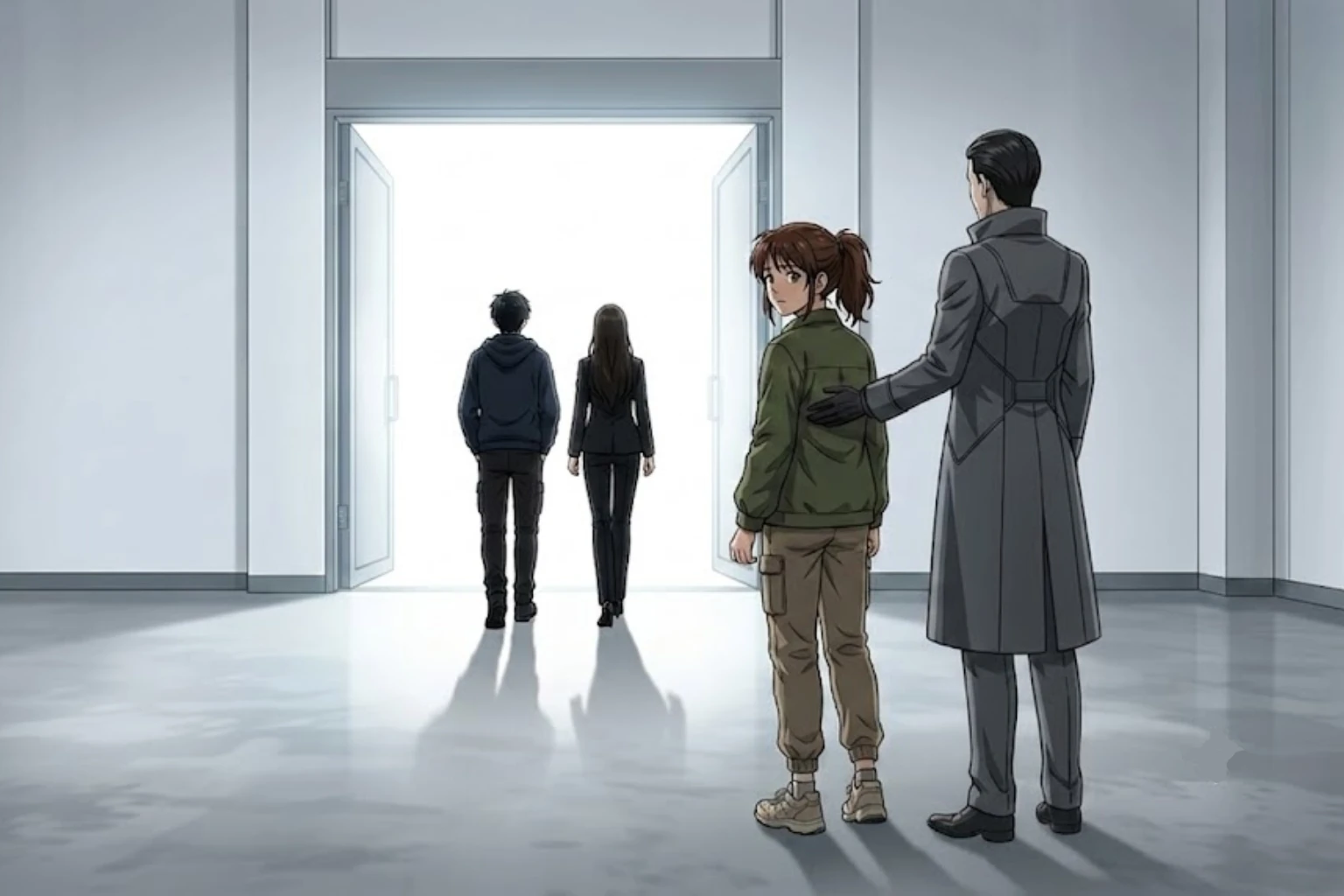
Mio approached the threshold and stopped.
She stood there for a long moment, looking not forward, into whatever waited past the door, but back — back down the corridor she'd just walked, back toward the vast, empty room they'd all crossed together only a short while ago, back toward the last physical space that still, however faintly, connected her to a life and an identity and four other people she was about to close the door on forever. She wasn't looking for Tetsuya or Sota. She couldn't have seen them even if she'd wanted to; their route lay somewhere else entirely, sealed off from hers as completely as this final door was about to be. She was only looking at the emptiness itself, the last visible thread of everything she was choosing, right now, to let go.
A hand settled against her back, steady, unhurried, not pushing her forward so much as simply letting her know it was there.
Haruto's.
He didn't say anything. He didn't need to. The gesture said everything that mattered — that whatever waited on the other side of this door, she wasn't going to have to face the first steps of it entirely alone.
Mio drew a breath, and stepped through, and the door closed behind the three of them with a soft, final sound that offered no further explanation of what came next.
---
Some distance away, in a corridor that would never once intersect with the one the other three had just crossed, Tetsuya and Sota reached their own door together, having found each other in a waiting alcove that held, this time, only the two of them.
Neither of them knew, standing there, exactly who had chosen what beyond their own small pairing. They only knew that they had arrived at the same door, and that whatever the other three had decided somewhere on the far side of this structure, it hadn't been this.
"I don't know what's waiting for either of us," Tetsuya said, quietly, the first words either of them had spoken since the private rooms.
"I don't either," Sota admitted. "I don't think that's new."
They didn't say anything further. There was nothing left that needed saying. The door in front of them opened onto its own corridor, its own uncertain light, and the two of them stepped through it together, side by side, and the door closed behind them the same way every door in this place had ever closed — quietly, completely, with no further sound at all.


.png)
.png)
.png)