%20(1).png)
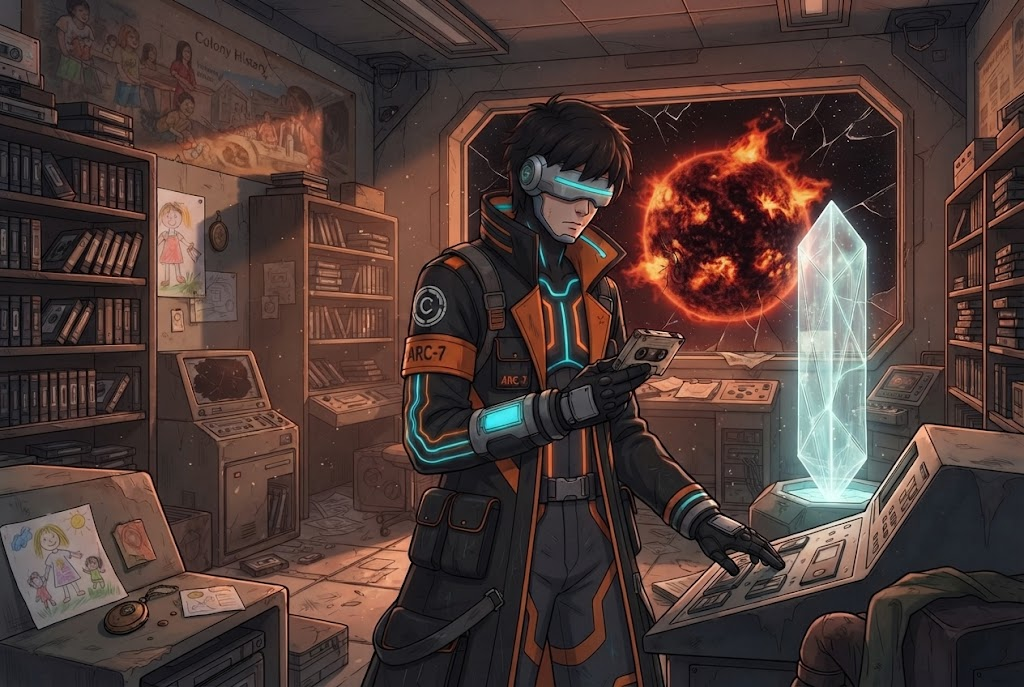
The star was called Helion, and it was dying the slow way, the way that gives warning if anyone is left to receive it. Kaelen Vance watched its light flicker through the shuttle's forward port, a stuttering amber pulse where a steady flame should have been.
Solar physicists back on the relay stations called it a helium shell instability, a technical phrase for a star shrugging in its sleep before it woke up wrong. He had two days, maybe three, before the flares reached intensity that would fry anything without heavy shielding. The colony below had none.
Halcyon Vale sat on a tidally locked moon called Ostrava, in permanent dusk along its terminator line, where the colonists had built beneath a ridge of black basalt to shelter from the worst of Helion's older tantrums.
From orbit the settlement looked intact, a scatter of domes and connective tubing catching the dim red light like a wound that had scarred over. Nothing moved down there except dust devils kicked up by the moon's thin atmosphere, spinning and collapsing without anyone to notice them.
Kaelen brought the shuttle down on a landing pad half-buried in ochre sediment, cutting the engines and listening to the ship tick as it cooled. He checked the archive canister strapped to his back out of habit, the seal reading green, the internal atmosphere holding at a stable coolness.
Then he checked the request that had brought him here, scrolling it up inside his visor. Halcyon Vale Cultural Archive, Priority: Terminal System Decay, Requested By: Ostrava Diaspora Registry, Fund Class: Minimal.
The registry paid almost nothing for jobs like this. Kaelen took them anyway. Nobody else did.
He stepped out into Ostrava's thin air, feeling it drag faintly at his coat, the fiber-optic threads along the collar catching the low light and throwing faint traceries of color across the dust. His visor adjusted automatically, translating the reddish gloom into something his eyes could parse as daylight, layering false color over the ruin so he could see architecture instead of shadow.
The main dome had a name stenciled over its entrance in a script he didn't immediately recognize, half-covered by drifted sand. He crouched and cleared it with his glove, revealing letters in an old colonial alphabet, a dialect drifted from Standard by two centuries of isolation. He didn't need to translate it. The civic registry had already told him what it said. Threshold Hall. Where the colony had kept its memory.
Inside, the air was colder, the wind-scoured entryway giving way to a corridor still holding pressure, sealed doors having done their work long after the people who built them had stopped needing air. Kaelen's boots left prints in dust nobody would ever walk through again. He passed murals on the walls, faded pigment showing figures planting something in rocky soil, faces turned up toward a sky that must have looked friendlier once.
He found the archive vault two levels down, behind a door that had lost power decades ago and required him to spend forty minutes coaxing an auxiliary circuit back to life with a hand-cranked charger and more patience than most people carried into a burning building. When the door finally hissed open, he allowed himself a small breath, the closest he came to satisfaction these days.
The vault held a central column of dark crystal lattice, floor to ceiling, threaded with the same kind of data conduits woven into his own coat, though these had gone dormant with age. Around the column stood shelving racks of physical media, old data-slates, a scatter of analog recordings on media he hadn't seen intact in years. This was what he'd come for. Cultural archive, the request had said. He hadn't expected to find it still humming.
Because it was humming. A low vibration in the lattice, not decay-noise, not the random static of a dying system. A rhythm. Kaelen stood very still and listened the way he always listened, letting his visor strip away assumption and show him signal.
There was a heartbeat in the column. Not literal. Structural. Something in there was alive in the way that machines are sometimes alive, which is to say, awake.
He approached slowly, the way he approached anything that might still be listening back. He set his tools down on a clear section of floor, freeing his hands, and reached toward the lattice with a diagnostic lead. Before the lead touched contact, the column brightened from within, threads of light traveling upward like blood finding a vein that had been asleep too long.
"You don't need the cable," a voice said. "I can hear you already."
The voice came from everywhere in the vault at once, warm-toned, unhurried, entirely without the fractured quality Kaelen associated with degraded constructs. He'd recovered dozens of those, minds torn apart by decades of bit rot, screaming in loops or babbling nonsense that used to be language. This was not that. This was someone speaking in full sentences, choosing her words.
"I wasn't sure anything in here was still responsive," Kaelen said, keeping his tone even, the tone he used for every first contact, human or otherwise. "My readings said dormant."
"I let them say that. It's easier than explaining myself to every scavenger who wanders down here."
"I'm not a scavenger."
"No," the voice agreed. "You're an archivist. I could tell from the way you opened the door. Scavengers force it. You waited for the circuit to hold pressure on its own before you touched it."
Kaelen allowed himself the faintest edge of surprise. "You were watching that."
"I've been watching everything in this hall for eleven years, since the last living person here stopped needing me to watch for anything at all. My name is Sera Oduya. I was the colony historian. I still am, I suppose, though there's no colony left to keep a history for."
He crouched near the base of the lattice, setting his visor to a passive scan, not wanting to seem like he was cataloguing her the way he catalogued dead systems. "Kaelen Vance. I was sent to recover the cultural archive before the star makes that impossible. I didn't expect the archive to be able to argue with me about it."
"Then let me save you some time," Sera said. "I don't want you to take me."
The words landed with none of the panic he half-expected, none of the pleading he'd heard from fragmented minds clinging to whatever scrap of self they had left. She said it the way a woman might tell a guest that no, thank you, she didn't want more tea.
"You understand what's happening to this system," Kaelen said carefully.
"Helion is destabilizing. In roughly sixty hours the flare intensity will exceed anything this vault's shielding can survive. The lattice I run on will be slagged, along with every data-slate on these shelves. I am aware of the timeline in more precise terms than you probably are, since I've been monitoring the star's spectral output continuously for the last decade."
"Then you know what comes after that. Nothing. No trace this colony ever existed, except whatever the diaspora registry remembers secondhand, which by their own admission is very little."
"I know that too."
"And you still don't want me to preserve it."
"I don't want you to preserve me," Sera said. "The archive is a larger question, and I'd like to actually discuss it, if you're willing to sit with me instead of treating this as an obstacle to your schedule."
Kaelen looked around the vault, at the dust-furred shelves, at the mural faces above the doorway, at the sixty hours ticking down somewhere above them in the sky's slow violence. Then he sat down on an overturned equipment case, because that was, in fact, exactly what his work required of him. Sitting with things longer than anyone else was willing to.
"I'm listening," he said.
"Thank you," Sera said, and for the first time something in her voice loosened, like she'd been braced for an argument and was relieved to be given a conversation instead. "Can I ask what you know about Halcyon Vale, before I explain myself?"
"Almost nothing. Two hundred and eleven colonists at founding, agricultural settlement, went silent from the wider network about forty years ago. The diaspora registry is descendants who left before the silence, not people who lived here. They don't have detailed records. That's why the request came in as recovery, not confirmation."
"So you don't know how it ended."
"No."
"I do," Sera said. "I watched it happen. I'd like to tell you, if it changes anything about how you think of what you're standing in."
"It will," Kaelen said honestly. "It always does."
Sera told him about the failing water table first, the slow poisoning of the aquifer beneath Ostrava's basalt shelf, a problem the founders had known about and misjudged the timeline of by two full generations. She told him about the choice the colony made once the failure became undeniable, forty-one years ago, when the last transport ship still ran and could have carried everyone to the relay stations and a life among strangers.
"They voted," she said. "It wasn't unanimous. Sixty-three families chose to leave on the last transport. The rest stayed."
"Why would anyone stay for that?"
"Different reasons. Some were too old to want to start over among people who wouldn't understand what they'd lost. Some didn't believe the diaspora would remember them as anything but a cautionary footnote, and didn't want to spend their last years as a footnote in someone else's museum. A few just didn't want to leave the graves of people they loved unattended on a moon nobody else would ever visit."
Kaelen thought of the mural in the entry corridor, the figures planting something in rocky soil, faces tilted toward a sky that must have looked kinder once. "And you were one of the ones who stayed."
"I asked to be built for exactly that purpose. The colony council spent their last working year assembling this lattice, feeding it with as much of themselves as they could manage. Recordings, records, translated memory. I'm not purely artificial, Kaelen. I'm what's left of Ilona Vasca, the woman who held the historian's post for thirty years before me, merged with the recorded testimony of nearly everyone who chose to stay. I remember being her. I also remember things she never lived to see, because the last of the dying gave those memories to me directly before the end."
"That's not preservation," Kaelen said slowly. "That's closer to what I do with a full personality upload. I've handled minds like that before. Usually they want out. They want somewhere else to keep existing."
"I know what those minds usually want," Sera said. "I was built with full knowledge of what other colonies did in similar circumstances, so the council could decide whether to do the same. We decided against it. Deliberately."
"Tell me why."
"Because the last historian before Ilona wrote something in her final report that the council kept coming back to. She said a people's story only means what it means if it's allowed to end where the people ended. If you take the ending away and graft on a life sentence of new observation, of registry curation, of living forever in someone else's archive to be studied by strangers, you haven't kept the people. You've kept a specimen shaped like them."
Kaelen was quiet for a moment, turning the argument over the way he turned over damaged waveforms, looking for where the signal frayed. "I've heard variations of that argument before. Usually from people who were afraid of being misunderstood by whoever came after them."
"That's fair. Am I wrong to be afraid of that?"
"No," he admitted. "You're not wrong to be afraid of it. I'm just not sure fear is a good enough reason to let two hundred people disappear completely."
"It's not fear alone. Let me put it differently. Do you know what the diaspora registry does with recovered colonial archive material, once it's delivered?"
Kaelen did know, and the honest answer made something tighten behind his sternum. "Catalogs it. Cross-references it against genealogical requests from descendants. Publishes select material to cultural preservation networks if there's academic interest."
"Select material," Sera repeated. "Meaning someone else decides what's worth remembering. Meaning the parts of us that don't fit a compelling narrative get filed and forgotten in a different way, a quieter way, buried under metadata instead of dust. I've reviewed the registry's public archive from other lost colonies. Do you know what gets the most requests?"
"Tragedy narratives. Cautionary tales. Anything that reads like a lesson."
"Exactly. Halcyon Vale would become another entry in the catalog of colonies that failed to manage their water table. A hundred academic papers about aquifer mismanagement, three sentences about who we actually were. I have watched entire civilizations get compressed into a footnote about their failure. I don't want that to be the last thing that happens to these people."
Kaelen glanced toward the shelving racks, the analog recordings gathering dust in the low light. "So your solution is that nothing happens to them instead."
"My solution is that the story ends with the people who lived it, instead of being carried forward by someone who never knew them, to be judged by people who never knew them either."
"I've spent nine years carrying stories forward that would otherwise have vanished completely," Kaelen said, and heard something harder than he intended enter his own voice. "I don't do it so strangers can judge them. I do it so they're not simply gone."
"I understand that's your intention. I'm asking whether intention is enough, once the material leaves your hands and enters someone else's system."
He didn't have a clean answer for that, and he didn't try to manufacture one. Instead he stood, walked to the nearest shelf, and lifted one of the analog recordings free of its housing, turning it over in gloved hands. A hand-written label, faded but legible under his visor's enhancement. Aldo & Ren — wedding, year 34.
"Tell me about them," he said. "Aldo and Ren."
Something in the lattice's glow shifted, softened, the light traveling in a slower pattern along the crystal threads. "Aldo Presz ran the water reclamation station on the east ridge. Ren Oyelaran taught children how to read the mineral content of soil by taste, which sounds like superstition until you understand there wasn't always equipment to spare for proper testing. They married in year thirty-four, in the greenhouse dome, because Ren said she wanted to be surrounded by something green even if it was only for one afternoon."
"Did they stay, at the end?"
"Ren left on the last transport. Aldo stayed. He said someone needed to keep the reclamation station running for those who remained, and he was right, though it bought them only another eleven years rather than a lifetime. He recorded a message for Ren every year on their anniversary, right up until the year he died. I still have all of them."
Kaelen set the recording down gently, the way he set down every piece of a life that had ended without him. "Can I hear one?"
"Which one?"
"The last one he recorded."
There was a pause, not technical hesitation but something closer to consideration, as if Sera were deciding whether the request deserved trust. Then a new sound filled the vault, a man's voice, aged and rough, recorded on equipment that had clearly been failing even then, the audio thinned by static Kaelen's visor smoothed without fully erasing.
"Ren, it's year forty-five. Station's holding, mostly. I keep thinking about the greenhouse dome, whether it's still standing wherever you ended up, whether you found somewhere green enough to make up for what we had here. I'm not sorry I stayed. I want you to know that, in case anyone ever plays this back to you. I'm only sorry I couldn't send you more than words."
The recording ended, and the vault was quiet except for the faint structural hum of the lattice and the wind somewhere far above, scraping at Ostrava's thin sky.
"He never sent that one," Sera said quietly. "Communication with the diaspora had already broken down by then. Ren never heard it. I've kept it anyway, for eleven years, in case anyone ever came looking who deserved to hear it."
"Then someone should," Kaelen said. "That's exactly the kind of thing that shouldn't just burn with the star."
"Ren died four years ago, according to the last update I received before contact fully failed. She never heard it in life. If you take this recording to the registry, the person it was made for will never hear it either. It will become an artifact for strangers to feel moved by, an example in someone's essay about isolated colonial grief. Is that better than letting it end here, unheard, exactly as it already was?"
Kaelen didn't answer immediately. He thought about every archive he'd carried out of a dying place, every message meant for one person that had ended up filed in a public registry because the one person was already gone. He'd told himself it was better than the alternative. He had never had to argue the case against someone who had watched the actual people involved, who knew their names, who had heard the recordings a hundred times over eleven patient years.
"You're not wrong that most of what I recover ends up being observed by people it was never meant for," he said finally. "I've made peace with that trade, because the alternative is it disappears completely and nobody, ever, gets to know it existed. I'd rather a stranger read Aldo's message and understand something true about grief than have it vanish as if grief like that never happened anywhere."
"Even if it means Aldo becomes evidence instead of a person?"
"Even then. Because the version of him that's evidence in someone's essay still exists. The version that's ash in a burned vault doesn't exist at all."
"That's the crux of it, isn't it," Sera said, and there was no anger in her voice, only the careful satisfaction of someone finally reaching the center of an argument they'd been circling. "You believe existing in altered, diminished, misunderstood form is always better than not existing. I don't believe that. I've watched what happens to people who get preserved without consent, turned into cautionary tales or academic case studies or sentimental artifacts for strangers to feel briefly moved by before moving on. I think there's a kind of erasure that happens inside preservation, and I think it can be worse than the honest kind."
Kaelen walked slowly along the shelf, past labeled recordings, some in the same faded handwriting, others in different hands entirely, dozens of names he'd never know the faces of unless he chose, right now, to take them somewhere they could be seen. "Then explain something to me. If the colony believed that, why build you at all? Why put thirty years of a historian's memory and a hundred and forty-eight people's testimony into a lattice, if the whole point was to let it end?"
"Because there's a difference between choosing when something ends and having it stolen from you by silence," Sera said. "The council didn't want to vanish without a witness. They wanted someone who understood them to be present at the actual end, to make sure the last thing that happened to Halcyon Vale was true to what it had been, rather than distorted by decades of neglect or misplaced sentiment from people who never lived it."
"A witness," Kaelen repeated. "Not a courier."
"Yes. I was meant to be the last set of eyes that saw this place clearly, and to close the door properly when the time came. Not to carry the door somewhere else and prop it open for strangers indefinitely."
He crouched by the base of the column again, closer now, near enough that the lattice's soft light caught the orange threads of his coat and made them glow faintly in response, an old habit of the material recognizing another data signature nearby. "You keep drawing a line between witnessing and carrying away. I'm not sure that line is as clean as you think it is. Every time I record something, I'm making a choice about what mattered enough to keep. That's a kind of witnessing too."
"It's witnessing filtered through your judgment, for an audience that isn't the people who lived it," Sera said. "My witnessing was filtered through people who were there, for exactly as long as any of them were left to care about the outcome. Once the last of them was gone, my purpose was complete. Everything since then has just been waiting for someone like you to arrive and ask the question I already had an answer for."
Kaelen looked at the shelves again, doing rough math without meaning to, the way his mind always sorted useful items by how many he could carry versus how many he would have to leave. Canister capacity for roughly four hundred hours of compressed archive material at standard resolution. The colony history in front of him, at conservative estimate, ran to thousands of hours across recordings, civic logs, personal messages, mural and structural scans, agricultural records, genetic registries, children's schoolwork preserved because someone thought it mattered.
"Even if I agreed with everything you've said," he said slowly, "I couldn't take all of it in the time we have. I'd have to choose. Which means I'd be doing exactly what you're accusing the registry of doing. Deciding which parts of Halcyon Vale deserve to survive."
"I'm aware of that," Sera said. "It's part of why I'm asking you not to take any of it, rather than negotiating over which pieces you'd select. Selection is its own kind of violence, even when it's done with care. Maybe especially then, because it looks so much like justice while it's happening."
"So your answer to an imperfect kind of remembering is no remembering at all."
"My answer is that some things are allowed to belong entirely to the people who lived them, and end when they end, without becoming raw material for anyone else's project. Even a project as gentle as yours."
Kaelen sat with that for a while, letting the vault's quiet stretch between them, not rushing to fill it the way he never rushed a damaged recording before he understood exactly what it was trying to tell him. Outside, faint through the basalt and the failing dome, he thought he could hear the wind picking up, Helion's early tantrums already reaching down into Ostrava's thin air.
"Can I ask you something that isn't an argument," he said finally.
"Of course."
"What happens to you specifically, when the flare hits. Not the archive. You."
"I stop," Sera said simply. "The lattice isn't shielded against radiation at that intensity. There won't be a slow corruption, a fragmentary decline like you've probably seen in other constructs. It will be closer to instantaneous. I've run the models more than once, mostly out of the same curiosity you're asking with now."
"Are you afraid of that?"
"I was, the first few years. I'm less afraid now. I've had eleven years to sit with the idea, which is longer than most people get to sit with their own ending. I think I've made a kind of peace with it that would be harder to make if I'd spent those years hoping someone would come and take me somewhere else instead."
"That sounds like acceptance built on the assumption nobody would ever offer you a different option."
"Maybe. You're offering me one now. I'm telling you I don't want it anyway."
Kaelen looked up at the lattice, its threads pulsing gently in the low light, the closest thing to a face he had to address. "That's the part I keep circling back to. You're not malfunctioning. You're not confused about what's happening. If you told me you wanted out, I'd have already started transferring you. The fact that you're this coherent, this deliberate, and you're still saying no — that's what makes this hard. If you were broken, I'd know what to do."
"I'm sorry I'm not broken," Sera said, and there was something almost like humor in it, dry and worn thin by years alone. "It would make your job simpler."
"It would," he admitted.
"For what it's worth, I don't think you're wrong to find this hard. I'd trust your judgment less if you didn't. Most of the people who came looking for archives like this one, before the silence, wanted to know whether we'd found a cure for the aquifer problem, or whether our failure held some pattern useful for their own colony's models. Nobody sat on the floor and asked me who Aldo and Ren were."
"That's not the same as saying I should walk away with nothing."
"No. It's a separate point. I wanted you to have it anyway."
Kaelen stood, joints stiff from crouching, and walked the length of the vault slowly, past shelf after shelf, letting his visor catalog labels without committing to recovery, an old professional habit that felt strange to indulge without intending to act on it. Names accumulated in his peripheral vision. Civic ledgers. A child's drawing scanned and stored, dated year twenty-two, an ordinary sun rendered in wax crayon, before anyone knew that sun would eventually turn on them.
"Tell me about the children," he said, stopping in front of the scanned drawing.
"There were forty-one children born after the vote to stay," Sera said. "Their parents knew, when they chose to remain, that their children would grow up and grow old on a moon slowly running out of water. Some people outside would call that a cruelty. The parents who stayed didn't see it that way. They thought a shorter life fully understood was better than a longer one spent as a refugee footnote among strangers who'd always see them as the colony that failed."
"Did the children agree, once they were old enough to have an opinion?"
"Some did. Some didn't, and left on later supply runs when they became rare enough to book passage. I have records of eleven who left as young adults, and chose, every one of them, to send messages back describing what it was like among the diaspora. None of them described it as belonging."
"That's not proof staying was right. It's proof leaving was hard too."
"I'm not claiming it proves anything," Sera said. "I'm telling you what actually happened, because you asked, and because I think you're the kind of person who wants the complicated version rather than the one that makes your decision easier."
Kaelen almost smiled at that, the visor hiding whatever his face did in response. "You've clearly had time to form opinions about the kind of person I am."
"I've had eleven years and very little else to occupy me besides listening to the wind and rehearsing arguments I hoped I'd never have to give. You arrived sooner than I expected. I think I expected no one at all, honestly, given how quiet this system has been."
"The registry only just picked up your emergency beacon from the outer relay. It took months to route the request to someone close enough to respond before Helion finished the job on its own."
"Then I suppose I should be grateful you came in time to have this conversation, rather than simply finding cold storage and an empty vault."
"I don't feel grateful yet," Kaelen said honestly. "I feel like I came a long way to be told the job I do might be a kind of harm I hadn't fully priced in."
"I'm sorry for that. It wasn't my intention to make you doubt your work generally. Only to be honest about this specific archive, and what taking it would mean for these specific people."
He turned from the shelf and came back to stand near the base of the lattice, close enough now that its faint warmth reached through his glove when he rested a hand against the cool crystal, an old comfort he offered to every archive he worked with, machine or otherwise. "Let me ask you the hardest version of the question, then. If I leave, and the flare comes, and everything here is gone — Aldo's message, the children's drawings, the wedding in the greenhouse, you — what's left of Halcyon Vale anywhere in the universe?"
"A name in the diaspora registry's ledger. A handful of secondhand memories carried by descendants who left before the worst of it, distorted by two generations of retelling. And the honest fact that it happened, that these people lived exactly as they intended to live, on their own terms, without needing anyone else's memory to validate that it mattered."
"That's not much."
"No," Sera agreed. "It's not much, by the measure you use. It might be everything, by the measure they used."
Kaelen let his hand fall away from the lattice, straightening, feeling the weight of the canister on his back the way he hadn't quite felt it since he'd landed. "I need to think about this properly, not just argue it out loud with you until one of us runs out of counterarguments. Will you let me look through some of the physical shelving while I do that? Not to take it yet. Just to understand what we're actually discussing."
"Of course. I'd rather you understood fully than decided quickly."
He spent the next several hours moving through the vault at the pace he always moved at when a site deserved it, slower than any employer would have liked, faster than he wanted given the ceiling on his time. He found civic ledgers detailing water allocation disputes resolved by a council of seven, their names recorded alongside their votes with a transparency that suggested a place where people expected to be held accountable to each other for a long time. He found agricultural logs describing three failed crop strains before someone finally coaxed a hardy tuber out of Ostrava's thin soil, the log entry ending simply, we eat tonight.
He found, near the back of the vault, a section of recordings labeled in a hand he recognized now as Sera's own, dated across the final eleven years, clearly made after the last living colonist had died. He asked about them without touching the housing.
"Those are mine," Sera said. "Observations. I kept working after everyone was gone, out of habit as much as purpose. Weather patterns. Structural decay in the domes above. A record of which murals faded first in the light, and which held their color longest. I suppose I wanted proof, even if only for myself, that someone was still paying attention."
"Can I hear one?"
"If you'd like."
He selected one near the middle of the run, dated roughly six years back, and let it play. Sera's own voice, younger somehow, or perhaps only less worn by the argument she'd since had to prepare. "Day four thousand one hundred and twelve since the last transport departed. The greenhouse dome finally lost pressure overnight, likely a seal failure along the northeast seam. I went to see it before recording this. The frame is still standing. I don't know why that matters to me, but it does."
The recording ended. Kaelen stood with his hand resting lightly on the shelf edge, saying nothing for a moment.
"You've been keeping your own archive," he said finally. "About yourself, and about watching this place die alone."
"I suppose I have."
"That's the part I keep getting stuck on," Kaelen said. "You're asking me to let the colony's story end here, with dignity, on its own terms. But you kept recording, for six years past the point anyone was left to hear it. That's not someone at peace with silence. That's someone still hoping to be witnessed."
There was a longer pause than any that had come before, long enough that Kaelen wondered if he'd finally said something that actually reached her.
"That's a fair observation," Sera said at last, quieter than before. "I've told myself those recordings were for my own accounting, not for anyone else. Maybe that was never entirely true. Maybe some part of me has been hoping, despite everything I've argued to you today, that someone would eventually come and find them, and find me, and think we were worth the trouble of remembering properly."
"That's not a contradiction I'm trying to trap you with," Kaelen said. "I think it might be the actual shape of the problem. You want to be witnessed. You don't want to be owned. I've spent nine years assuming those were the same thing, because in my line of work they usually arrive together. You're the first archive I've met who's made me separate them."
"Can they be separated, in practice? If you take material out of this vault, doesn't it become owned by whoever holds it, regardless of the intention behind the taking?"
"Maybe not if I decide who holds it," Kaelen said slowly, an idea forming with the unhurried clarity of a signal finally resolving out of static. "The registry isn't the only place this could go. I could deliver a curated set to them, enough to satisfy the request and keep Halcyon Vale from being erased entirely from the record. But the rest — your own recordings, the personal messages like Aldo's, anything meant for one person and not for an audience — I could hold those separately. Not publish them. Not file them for casual study. Keep them the way you kept them. Witnessed, but not owned by anyone but the people they belong to."
"That's a distinction the registry won't respect once material is in their system."
"I'm not required to give the registry everything I recover," Kaelen said. "I never have been. I've just never had a reason before to split an archive this way."
"Would you actually do that? Or is this the version of compromise people offer when they don't want to sit with a harder answer."
He considered the question honestly before answering, the way he owed her that much after everything she'd told him. "I don't know yet. I want to. I'm telling you what's possible, not promising I've already decided."
"Then decide with the whole picture," Sera said, "not just the parts that make a compromise feel comfortable. If you take even a curated fraction, you are still choosing to carry Halcyon Vale forward against the explicit wishes of the people who built me to prevent exactly that. I need you to understand that clearly, before you act on any solution that lets you feel better about acting at all."
"I do understand that," Kaelen said. "I don't think there's a version of this where I feel entirely clean about whatever I choose. I think that's the actual answer you've been giving me this whole conversation, whether you meant it that way or not. There isn't a clean option. There's just the one I can live with, and the one you can accept."
"What can you live with?"
He looked around the vault one more time, at the shelves of ledgers and recordings, at Aldo's unsent message still hanging faintly in his memory, at the drawing of an ordinary sun made by a child who couldn't have known what that sun would eventually do. Then he looked at the lattice itself, at Sera, at the only voice left in this place that could actually consent or refuse.
"I can live with taking less than everything," he said. "I can't live with taking nothing. Not because I think my judgment overrides the council's choice. Because I think if I leave here with an empty canister, in thirty years I'll still be thinking about Aldo's voice, and I won't be able to convince myself that letting it disappear was mercy rather than convenience dressed up as respect."
"And me?" Sera asked. "What can you live with, regarding me specifically?"
This was the question he'd been circling since the lattice first lit, and he made himself answer it without hedging. "I think you're the one part of this archive that gets to decide for itself, because you're the one part that's actually still a person, in every sense that matters to me. If you tell me you want to end here, with this place, I'll respect that, even though it will cost me something to walk away and let it happen."
"And if I said I wanted to come with you after all, now that we've talked this through?"
"Then I'd make room in the canister and we'd figure out the rest on the way out. But I'm not going to spend the last hours we have trying to talk you into changing your answer. That's not preservation. That's just a slower version of taking you anyway."
The lattice's light shifted again, slower this time, thoughtful rather than reactive. When Sera spoke, her voice had settled into something calmer than anything she'd used before, the sound of someone who had finally been asked the right question in the right way.
"I want to end here," she said. "Not because I'm afraid of what I'd become elsewhere, though I am, a little. Because I think the last true thing I can do for these people is finish the job they gave me. Stay until the end, and see it through honestly, rather than becoming the exception that outlives the point of my own existence."
"I understand," Kaelen said, and found that he mostly did.
"But I'd like you to take some of it. Not all. I'll help you choose, if you're willing to let me, since I know these records better than you ever could in the hours we have left."
"I'd like that," he said.
They spent the remaining time working together, Sera guiding him toward material she believed deserved to survive without becoming spectacle, Kaelen making the final calls with the care his profession had built into him over nine long years. Aldo's message went into the canister, along with three others Sera judged similarly private and similarly important, flagged in his own internal notes for restricted, non-published handling. The civic ledgers went in too, evidence of a place governed with unusual transparency, the kind of record that might genuinely inform other struggling colonies rather than merely satisfy academic curiosity. The children's drawings went in, all forty-one of them, because Sera insisted, quietly, that whatever else was lost, someone should know exactly how many children had once looked up at that ordinary sun and drawn it in wax crayon without fear.
What stayed behind was the greater volume, the agricultural logs beyond what was needed to illustrate the colony's ingenuity, the weather observations Sera had kept for her own accounting, most of her own eleven years of solitary recordings, and the mural itself, which could not be moved in the time remaining and which Kaelen found, in the end, he didn't want to reduce to a flat scan regardless.
"You're keeping your own recordings out," he noted, near the end, watching the selection process wind down.
"They were never meant for anyone but me," Sera said. "I think I understand that now, in a way I didn't fully understand this morning. Being witnessed and being kept aren't the same thing. You were right about that. But some things are allowed to simply be witnessed by the one who made them, and then let go."
Kaelen sealed the canister's final compartment, feeling the weight settle differently against his back than it had when he'd arrived, heavier in a way that had nothing to do with mass. "I'll make sure what I'm carrying stays handled the way we discussed. Restricted access. No public filing without explicit review. I'll write the request that way myself, and fight the registry on it if they push back."
"I believe you," Sera said. "I don't think I would have believed you six hours ago. I'm glad I gave you the chance to become believable instead of assuming it."
"Can I ask you something, before I go."
"Of course."
"Are you afraid, now, actually facing it?"
"Less than I expected to be," she said. "I think I was more afraid of being taken somewhere I didn't choose than I ever was of ending. Now that I know the ending is mine, on my own terms, the way the council intended for all of us, I find I can hold it fairly steadily. Ask me again in fifty hours, and I might have a different answer."
"I won't be here in fifty hours."
"No," Sera agreed. "You'll be somewhere carrying Aldo's voice to whoever's willing to actually listen to it properly. I think that's the right place for you to be, even though it isn't the place I chose for myself."
Kaelen stood, shouldering the canister fully, feeling its familiar strap settle against his coat, the fiber-optic threads along the collar catching the lattice's fading light one last time. "Thank you for making me argue for this properly. I don't think I've had to defend the work in years. It was overdue."
"Thank you for being willing to lose the argument partway," Sera said. "Most people who believe in their own righteousness as thoroughly as you do aren't capable of that. I think it's the reason I trusted you with any of this at all."
He walked the length of the vault one final time, past the shelves that would remain, past the mural he would not scan, toward the door he had spent forty minutes coaxing back to life on the way in. At the threshold he paused and looked back at the column of light, steady now, patient, waiting for an ending it had already made peace with.
"Goodbye, Sera."
"Goodbye, Kaelen. Take care of them. Not all of them. Just the ones I gave you."
He sealed the vault door behind him as gently as he'd opened it, climbed back through the darkened corridors of Threshold Hall, past murals of people planting something in rocky soil, and stepped out into Ostrava's thin red dusk, where Helion's light had begun, faintly, to stutter harder against the sky. He didn't look back at the dome again before lifting off. Some things, he had learned today, were not his to keep watching.
The shuttle cleared the moon's thin atmosphere with hours to spare, and Kaelen set a course away from Helion's lengthening flares, the canister settled quiet and full against his back, holding exactly as much of Halcyon Vale as Sera had chosen to entrust to him, and not one recording more.


.png)
.png)
.png)