%20(1).png)
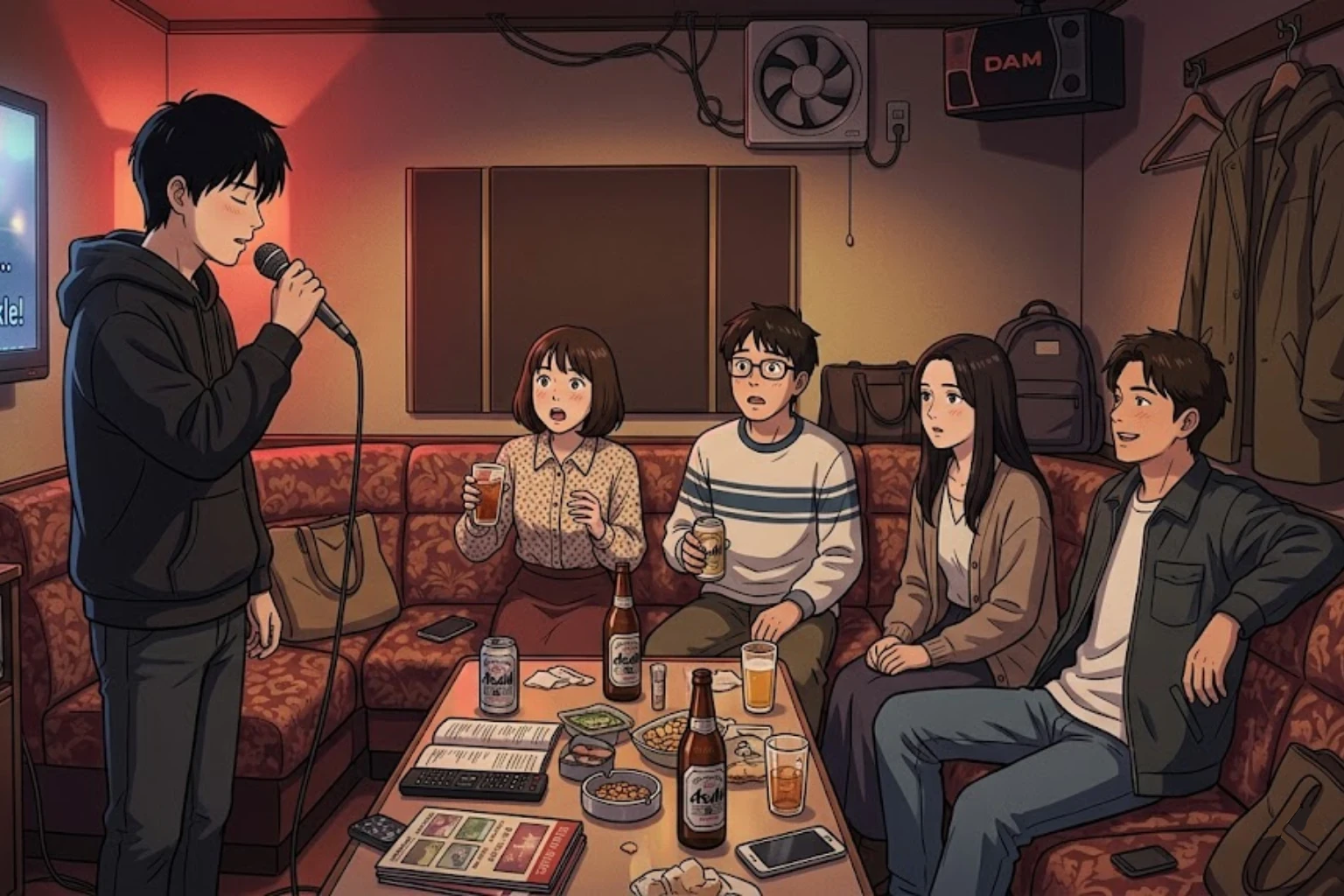
The karaoke place was Jiro's idea, which meant nobody walked in with particularly high expectations. This was not really a criticism of Jiro so much as an honest accounting of his track record. There had been the hiking trip where he'd misread the trail map so thoroughly that they'd ended up on what Nami still referred to, months later, as "the wrong mountain." There had been the cooking night where his confident substitution of cups for tablespoons had produced a curry that Daichi, valuing the friendship more than his own palate, had diplomatically called "an experience."
There had also been the board game evening that ended with Nami refusing to speak to him for forty full minutes over a rules dispute he had, by any reasonable reading of the manual, been unambiguously wrong about. Jiro's ideas were enthusiastic rather than practical, generous rather than well-researched. Somehow, against all logic, they kept producing nights everyone remembered fondly, regardless of how badly the execution had gone.
It was a Thursday in October. The five of them had been camped in the university library since nine that morning, working through readings that felt less like coursework and more like a slow siege. By early evening, the collective will to make any further decisions had worn down to nothing.
"Someone needs to pick something," Nami said, closing her laptop with the finality of a woman who had read the word "epistemology" too many times in one day. "I don't care what it is. I just can't be the one who decides."
"Karaoke," Jiro said immediately, as though he'd been holding the word in reserve for hours.
"Absolutely not," Nami said, and then, ten minutes later, was putting her coat on anyway, because it was a Thursday in October and nobody had the energy left to argue with momentum.
Daichi came along on the condition that there be a drink package involved. Hana came because she liked karaoke more than she usually admitted. Koji came because he came to most things, quietly, without needing to be asked twice, and said nothing about whether he wanted to or not.
The building was three streets from the station, with a neon sign promising two hours and a drink package for a price that made Daichi visibly relax when he read it. The room they were given was small and fully committed to its theming — red walls, gold trim, a couch with the specific worn plush of upholstery. It had hosted several hundred parties and would host several hundred more before its cushions gave up entirely. Two microphones sat in their stand like an offering. The song catalogue was a thick tablet, soft at the corners, containing what felt like the accumulated musical history of several nations.
On the wall-mounted screen, a demo reel played on a loop for reasons nobody had ever bothered to question. There was a salaryman delivering an almost frighteningly serious ballad and a group of women in their thirties annihilating a pop anthem with visible joy. There was also a small child who had somehow gained possession of a microphone and was using it to narrate the events of his day in a tone of complete seriousness.
"This is great," Jiro said, dropping onto the couch with the satisfaction of a man whose idea had, so far, not gone wrong.
"Ask me again in two hours," Nami said, already scrolling through the catalogue.
The order established itself the way it always did among people who'd spent enough time together to have unspoken rules nobody had formally agreed to.
Daichi went first, because Daichi always went first at anything that could remotely be called performative, and karaoke, in his estimation, qualified. He picked an upbeat city pop track from the eighties, something about summer and a car and a girl who was, according to the lyrics, extremely difficult to forget. He committed to it fully, hitting most of the notes and missing the rest with such conviction that the misses barely registered.
"Solid," Jiro said, clapping with both hands raised over his head.
"It was loud," Nami said, which from her counted as high praise. Daichi took it as such, bowing slightly before dropping back onto the couch.
Jiro went next, choosing something recent and needlessly difficult, with a bridge that demanded a range he did not, strictly speaking, possess. He got through it anyway, treating the highest notes as optional suggestions rather than requirements, which turned out to be more entertaining than actually hitting them would have been.
"That was two different songs happening at once," Daichi said afterward, with real admiration.
"Thank you," Jiro said, taking it as a compliment, which — he insisted — it clearly had been.
Nami and Daichi did a duet next, an old ballad about longing and rain, performed with the deadpan seriousness of two people who had silently agreed that total commitment to the bit was the funniest possible choice. Jiro gave them a standing ovation, which he gave for everything, without exception. Nami and Daichi accepted it with the restrained satisfaction of people who knew exactly how absurd they'd just been.
Hana went fourth, taking the microphone with the easy confidence of someone who knew precisely what she could and couldn't do. She was genuinely competent — years of school chorus rather than any showmanship — pleasant, controlled, accurate without being flashy. She sang a mid-tempo pop song cleanly from start to finish and sat back down to warm, unsurprised applause, the kind that comes from people who expected exactly that and were happy to get it.
"Ninety-one," Daichi read off the screen, impressed. "That's the best score tonight."
"It won't be," Nami said, though nobody understood yet what she meant by it.
"Koji," Jiro said, holding the second microphone out. "Your turn."
Koji looked at it the way a person looks at a form they're being asked to sign without having read all the fine print.
He was the quiet one — this was not a novel observation, and every person in the room had arrived independently at some version of it over the six months they'd known him. He listened more than he spoke, and when he did speak it tended to land with more weight for the scarcity of it. He noticed things: the way Nami got tense before exams she wouldn't admit worrying about, the way Daichi went quiet after losing at anything, the way Jiro sometimes just needed someone to laugh at a joke that wasn't very good. Koji was reliably the one who laughed. In six months, he had not done a single thing anyone would have described as showing off.
"I'll go last," he said.
"You are last," Nami said, gesturing at the empty space on the couch where the microphone was clearly meant to go next.
"Oh," Koji said, as though this arithmetic had genuinely escaped him, and took it.
He stood in front of the screen scrolling through the catalogue with the same unhurried focus he gave most things, which the others watched with mild curiosity but no particular anticipation.
"Take your time," Daichi said, meaning precisely the opposite.
"I'm looking," Koji said, without turning around.
"We can see that."
"There it is," he said, and selected a song.
The opening bars filled the room — a slow build of piano over a bed of strings, the kind of introduction that belonged to a song from about fifteen years back. It was one that had embedded itself into a whole generation's memory without anyone quite able to say when they'd first heard it. Hana recognized it within three notes, something shifting behind her eyes. Nami placed it a beat later. Daichi and Jiro got there together, exchanging a brief glance that had less to do with the song and more to do with calibrating how seriously Koji intended to take this.
Koji held the microphone loosely, almost carelessly, the way you hold something you're not thinking about because your attention is elsewhere. The intro ran its course. Without any visible gathering of nerve, without the small preparatory breath most people take before committing to a note in front of an audience, he simply began to sing.
The first thing that happened was silence — not the polite, expectant kind people offer while waiting to be entertained, but the other kind, the sort that falls when something has occurred that the mind needs an extra beat to process. All four of them went still at once. Drinks stopped halfway to mouths.
Koji kept singing, and the longer he sang, the clearer it became that this was no fluke of the opening lines. He sang the way people sing when singing has always been part of them, learned so long ago it no longer requires conscious thought. His voice was a clear, warm tenor, rich and unforced low, precise and unstrained when the melody climbed. The gap between what they'd expected and what was happening in front of them was wide enough that nobody quite knew where to put their reaction yet.
Jiro's mouth had fallen open somewhere in the first verse and simply stayed that way. Daichi set his drink down without seeming to notice his own hand doing it, eyes fixed on Koji with the sharp, assessing focus of someone recalculating an entire profile in real time. Nami sat with her arms crossed, head tilted, quietly revising a mental file she'd genuinely believed was already finished. Hana watched him too, but differently — not the easy attention you give a friend's performance, but the sharper kind you give something that has caught you off guard.
By the chorus, Koji was fully inside the song, his voice opening just enough to fill every corner of the small room without tipping into strain. The room seemed to expand slightly, the way rooms sometimes do around one good sound, the walls quietly stepping back to offer more space than they actually had.
When it ended, the screen delivered its verdict: ninety-four, rendered by a machine that seemed almost startled by its own readout.
Koji lowered the microphone and looked at the four of them. The four of them looked back with an intensity that made him shift his weight slightly — the closest thing to visible discomfort he'd shown all evening.
"Koji," Jiro finally managed.
"Yeah."
"What."
"What what."
"WHAT," Jiro said again, louder, gesturing at the microphone, the screen, the entire preceding three and a half minutes as though it were a crime scene requiring explanation.
Koji looked down at the microphone with the mild, faintly apologetic expression of someone who wasn't sure what response the situation called for. "I like this song," he offered.
"You—" Jiro pointed at the screen. "Ninety-four."
"The machine's generous."
"Koji."
"I sang a song."
"You didn't just sing a song," Daichi said, with the careful precision of a man determined to be accurate even in mild shock. "That was — you can sing."
"I know," Koji said, and there was nothing performative in it, just a plain fact he'd apparently carried around for years without much ceremony.
A pause settled, the kind right before a delayed reaction lands.
"You know," Nami repeated, flat.
"I've always been able to sing."
"And you didn't think to mention this. Ever. In six months."
"It didn't come up."
"We've known you for six months, Koji."
"Nobody asked."
Jiro made a sound between a laugh and a small existential crisis and dropped his head back against the cushion.
"Sit down," Nami told him, though she was looking at Koji. "You're making me feel things and I need a minute to process that."
"Okay," Jiro said, sitting up again almost immediately, "you have to go again."
"I just went."
"You have to go again. That doesn't count as using up your turn, that was — that was a different category of turn." Jiro was already scrolling through the catalogue with both hands, as though speed might make his case for him. "Pick literally anything. I don't care what it is. I want to hear it."
"I can sing something else later," Koji said, holding the microphone out toward Nami. "Someone else should go."
"Absolutely not," Nami said, not taking it. "You don't get to discover you've been sitting on that for six months and then hand off the mic like it's someone's turn to do the dishes."
"Did you take lessons?" Daichi asked, leaning forward with the focused curiosity he usually reserved for problem sets. "Because there's a difference between natural range and trained control, and you have both, which is — statistically, that's unusual."
"No lessons."
"None? Ever?"
"I sang a lot as a kid. That's it."
"That can't be it," Daichi said, though he said it the way you say something you already suspect is wrong, already turning the new information over for a better angle. "Nobody just has that. There has to be a mechanism."
"Maybe I'm the mechanism," Koji said, and Jiro laughed so suddenly he nearly dropped the tablet.
"Do the folk one," Hana said, before Daichi could pursue the mechanism any further. "The one with the lower part. I bet your voice sits well down there."
"You don't know what I'm about to pick."
"I know your voice for about four minutes and I already have opinions," Hana said, and Koji, after a moment, almost smiled — the kind of near-smile that arrived and vanished so quickly most people would have missed it.
He found the song. It was older than the first, something with a plainer melody and a lower, steadier register. It was the kind of song that didn't ask for much until you actually tried to sing it, and discovered how much control it demanded to sound effortless. He sang it the way he'd sung the first one — without visible strain, without performing the emotion so much as simply letting it exist. It was, if anything, more impressive than the ballad, because there was nowhere in a song that plain to hide.
"Ninety-six," Daichi announced, before anyone else could look. "That's higher."
"The machine likes lower registers," Nami said. "It's not that impressive."
"It's a little impressive."
"It's a little impressive," Nami allowed.
Jiro, meanwhile, had gone very quiet, staring at the tablet like a man plotting something.
"I want to try the eighties one again," Daichi said, standing. "I was nervous the first time. I want a real number."
"You want a rematch against your own first attempt," Nami said.
"I want a real number."
He sang it again, and it was, unmistakably, better — not because the notes were suddenly more accurate, but because something in him had relaxed. The pressure of being the evening's most impressive performer had been lifted entirely off his shoulders. He wasn't trying to win anymore. He was just enjoying being decent at something in a room where somebody else had already claimed the ceiling.
"Better," Hana said.
"Not better," Daichi said, checking the score. "The same. Eighty-eight both times. That's remarkably consistent, actually."
"You sounded happier," Koji said, and Daichi looked at him for a second like that observation had landed somewhere he hadn't expected.
"Yeah," he admitted. "I think I was."
Somewhere past the hour mark, a tray of food arrived — fries, some skewers, a plate of something fried that nobody could definitively name but that disappeared within minutes regardless. Jiro ate with one hand while scrolling the catalogue with the other, occasionally holding up the tablet and announcing songs to no one in particular.
"What about this one."
"No," Nami said, without looking.
"You didn't even see it."
"I know your taste. No."
Hana, meanwhile, had drifted closer to Koji on the couch. The two of them traded the tablet back and forth, occasionally landing on the same song at once and laughing about it. That was how they discovered, almost by accident, that they both knew the words to the same duet — an old pop ballad neither of them had mentioned liking before. It was the kind of song that had clearly meant something to each of them separately, without either one knowing the other carried it too.
"You know this one?" Hana asked, surprised.
"I know this one," Koji said.
"Since when?"
"Since it came out, probably. I don't know. It's a good song."
"We're doing it," Hana said, already standing, already reaching for the second microphone.
They sang it together, trading verses at first and then letting them overlap into harmony on the chorus. The sound that came out of that pairing was different from anything else the room had produced that night. It wasn't because either of them was doing anything new — it was because Hana's clean, reliable voice and Koji's effortless control fit together in a way neither performance alone had suggested was possible. Jiro, without any apparent plan to do so, stood straight up off the couch in the middle of the second chorus.
Everyone looked at him.
"I don't know why I did that," he said, and sat back down, and nobody could argue with the impulse even though nobody could explain it either.
The song ended to genuine applause, warmer than anything the machine's score could account for, though the machine gave them a ninety-one anyway.
"That was good," Daichi said, looking between them. "That was — you two should do that again sometime."
"Maybe," Hana said, glancing at Koji, who was busy setting the microphone down and didn't quite meet her eyes, though something in the set of his shoulders looked pleased.
It was Nami's turn not long after, and she took the microphone with none of her usual dry commentary, which in itself was the first sign that something different was coming. She scrolled through the catalogue for a long moment, longer than she usually needed, and selected a song none of them recognized her ever mentioning — an older, quieter track, more melancholy than anything she'd chosen all night.
"Since when do you know this?" Jiro asked.
"Since always," Nami said, and didn't elaborate.
She sang it plainly, without any of the ironic distance she usually put between herself and anything emotional, and it cut through her usual deadpan in a way that surprised everyone in the room except, possibly, herself. It wasn't a dramatic performance. It didn't need to be. There was just something steadier and more open in her voice than any of them had heard from her before. It was gone again almost as soon as the song ended, tucked back behind her normal flatness the moment she set the microphone down.
Koji had listened to the whole thing with the same complete, uncritical attention he gave to nearly everyone who sang that night — no visible judgment, no comparison to his own performances, just quiet focus. It was the same way he listened to Jiro's disasters and Daichi's overconfident runs. Nami noticed. She filed it away without comment, the same way she'd filed away everything else about him that night, and said nothing about it, though the corner of her mouth moved slightly when she sat back down.
"Seventy-nine," Daichi reported.
"I don't care what the machine says," Nami said, and for once, she seemed to mean it.
Later, while Daichi and Jiro huddled over the tablet in what had become an extremely serious negotiation over what Jiro should attempt next, Hana settled onto the couch beside Koji, close enough that their shoulders nearly touched. She let a comfortable quiet stretch out for a moment, watching the demo reel loop back around to the small child narrating his day with unwavering seriousness, before she finally asked the question she'd apparently been sitting on all evening.
"Why didn't you ever say anything?"
Koji considered it with the same unhurried care he gave most things worth answering properly. "People treat you differently once they know you're good at something," he said. "They start watching you differently. They build expectations around it, even without meaning to."
He turned the microphone over once in his hands, deciding how much further to go.
"I like just being here," he said. "One of five people having a night. Not the one who has to be good at the thing."
"You're still one of five people," Hana said. "That doesn't change just because we know now."
"I know," he said, and something in his voice loosened, like a held breath finally let go. "I just — sometimes you need to remember you have something. Even if nobody else knows about it."
He looked down at his hands for a moment.
"It's been a hard few months," he said, quieter now. "I needed tonight more than I probably let on."
Hana didn't ask for specifics. Something in her understood, without needing it spelled out, that specifics weren't the point. Six months of knowing him, and this was more words strung together at once than she could remember him offering her before. It wasn't because he didn't trust her, she was fairly sure. It was because he was the kind of person who said things only once they were ready to be said, and never a moment before that.
"I'm glad you came tonight," she said simply.
He looked over at her. "Me too," he said.
Before either of them could say anything further, Jiro appeared in front of the couch holding both microphones aloft like trophies. He wore the expression of a man who had located something on the catalogue he considered, in his own words, "unmissable."
"Koji," he announced. "I found something."
"What."
"It's a duet."
"With who."
Jiro pointed proudly at his own chest.
Koji studied him for a long, assessing moment — the kind of pause that seemed to weigh several years of friendship, considerable evidence of Jiro's musical limitations, and the fundamental impossibility of saying no to him about anything.
"Okay," Koji said finally, and took the microphone.
The resulting performance was, by any objective measure, an unmitigated disaster. Jiro missed roughly every other note, lost the thread of the second verse entirely somewhere around the bridge, and responded to each new failure by singing louder, as though volume might retroactively correct pitch. It did not. It was delivered with such complete conviction, though, that it almost seemed like it might.
"You're going flat," Daichi called out helpfully, which did not help.
"I KNOW," Jiro shouted back, mid-note, and kept going anyway.
Koji, rather than trying to correct or overpower him, simply harmonized around the chaos, finding notes that bent Jiro's wrong ones into something that sounded, against all reasonable expectation, almost like an intentional artistic choice. When Jiro lost the verse entirely, Koji quietly filled the gap without making it obvious he was doing so, so that the song never quite fell apart even as it never came close to being right.
The machine gave them a sixty-one. The four people watching gave them a full standing ovation, Nami included, delivered without a flicker of visible expression but with total, unmistakable sincerity.
"That," Jiro said, breathless, dropping back onto the couch, "might be the best thing I've ever done."
"It was sixty-one," Daichi said.
"The number doesn't capture it."
"The number is specifically designed to capture it."
"Some things are beyond numbers, Daichi."
"No, they're not. That's the entire premise of the machine."
They left a little after midnight, spilling out onto a street that had gone cool and bright in the particular way autumn nights in the city sometimes did. It was lit by convenience store windows and the low hum of a city that never fully stopped moving. The five of them walked toward the station together in the loose, easy quiet that follows a genuinely good night.
"Ninety-four," Daichi said, apropos of nothing, somewhere around the second crosswalk.
"You're still on that," Nami said.
"I'm just saying. That's a real number. That's not a fluke number."
"He sang two songs in the nineties," Hana said. "It wasn't a fluke either time."
"I'm aware," Daichi said. "That's what I'm saying. I'm agreeing with myself out loud."
"You do that a lot."
"It's efficient."
Jiro, several paces ahead, was recounting the duet to no one in particular with the enthusiasm of a man describing a career highlight. "The way it just — came together at the end. Did you see that? It came together."
"It came together because Koji fixed it," Nami said.
"We fixed it together."
"He fixed it. You provided volume."
"That's a form of contribution."
Hana walked beside Koji without either of them needing to fill the space between them with conversation, the kind of quiet that only exists between people who've stopped needing to prove anything to each other. Koji had his hands in his pockets, watching the street go by, looking more at ease than he had in weeks, though nobody but Hana would have known to notice the difference.
At the station gates, the group began to split toward their separate lines, the natural unraveling that happens at the end of every night out, five threads pulling gently apart toward five different homes.
"Koji," Daichi said, turning back before they parted.
"Yeah."
"Next time we go — you're opening."
"I'll think about it."
"That's a yes."
"It's a maybe."
"It's a yes," Nami said, not even glancing up from her phone, with the flat certainty of someone who had already filed the matter as settled.
Something flickered across Koji's face — the almost-smile that always arrived a beat before the real one, quick and private, usually gone before anyone caught it in time.
Hana caught it.
She tucked the moment away carefully, the way you keep something you suspect might matter more later than it seems to now, and didn't say anything about it, though the corner of her own mouth curved up in response.
The gates opened and they filtered through toward their separate platforms, the city taking them back in with its usual warm indifference. Trains pulled away in every direction, toward every corner of a place that would forget this particular Thursday the moment it ended, the way cities always did. But each of them carried some piece of the night home anyway — the ninety-four glowing on the screen, the gloriously terrible duet that had somehow worked despite every reasonable prediction against it. There was also the quiet discovery that someone you'd known for six months could hold something unexpected inside them the whole time, waiting for an ordinary Thursday to finally bring it out.
Jiro sent a voice message to the group chat at twelve thirty-seven that was almost entirely incoherent and completely, unmistakably affectionate. It was the kind of message that only makes sense in the specific emotional logic of having just had a very good night with people you love.
Koji listened to it on the train home, alone in a mostly empty carriage, the city lights sliding past the window in long smeared streaks of color.
He smiled.
The real one, this time. The one that stayed.


.png)
.png)
.png)