%20(1).png)
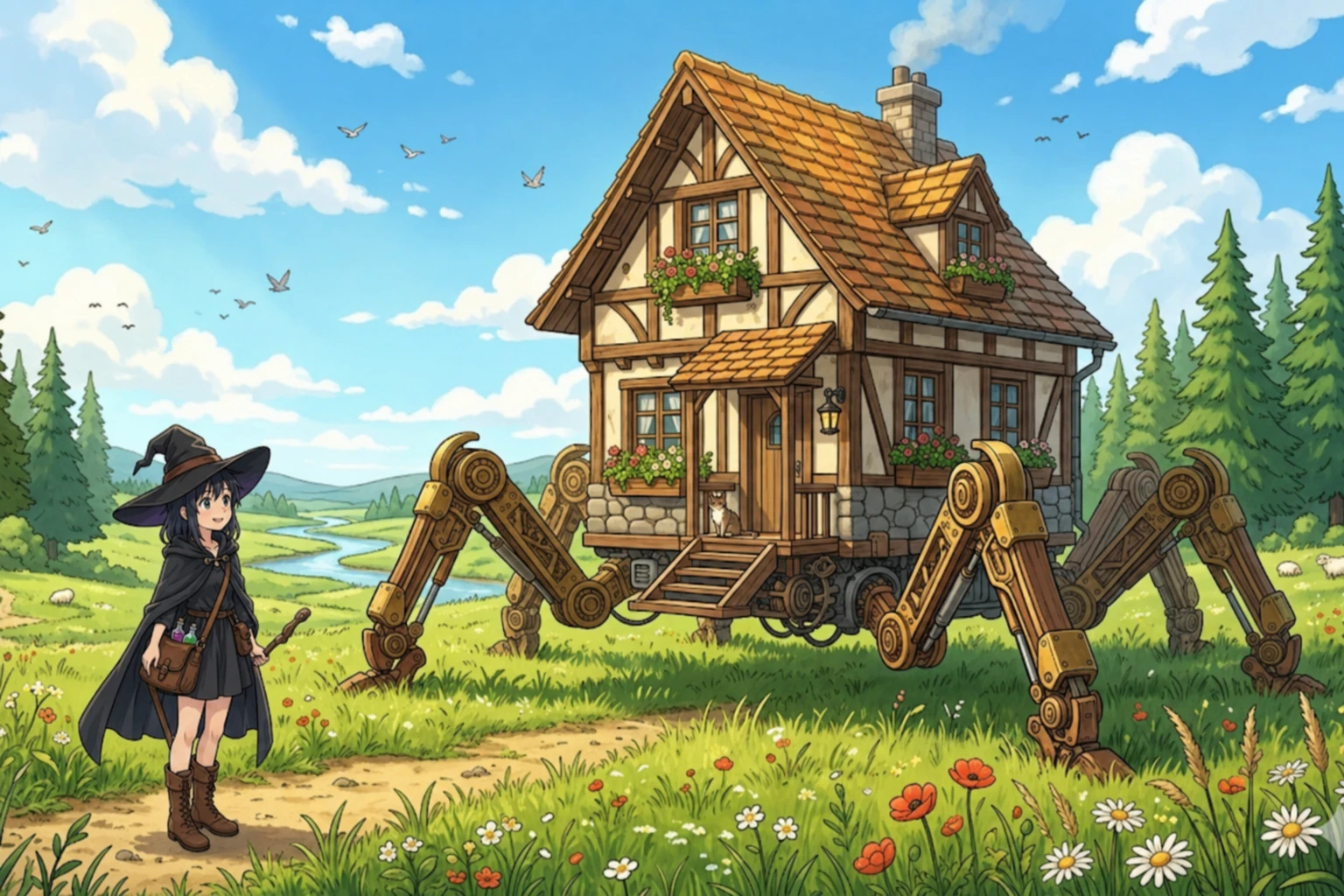
The town of Kusakabe had a haunted house problem, except the house was never in the same place twice.
This was the detail that separated it from ordinary haunted house situations, which were troubling enough but at least had the courtesy to stay put. The Kusakabe house — referred to locally as the wandering house, the ghost cottage, and, by the man who ran the notice board, that blasted thing — had been appearing and disappearing in the surrounding countryside for as long as anyone could reliably remember. It showed up near the river in spring, in the meadow past the mill in summer, at the forest edge in autumn. It had once appeared overnight in the middle of a wheat field, causing considerable distress to the farmer who owned the field and remarkable inconvenience to the wheat.
Nobody lived in it. Nobody had ever seen anyone enter or leave it. It appeared, sat for a few days or a week, and then vanished between one evening and the next morning, leaving behind a flattened circle of grass and, occasionally, small mechanical parts that nobody could identify.
The current theory — favored by the notice board man, a retired schoolteacher named Wada — was that it was the restless spirit of a house that had burned down on the same land three generations ago, unable to find its original foundation and wandering in perpetual search.
Kuroha had arrived in Kusakabe two days ago and had heard this theory four times from four different people, each of whom had added their own elaborations until the spirit house had acquired a full biography, a probable cause of grievance, and at least two alleged victims, none of whom had actually been harmed in any documented way.
She had listened to all four versions with genuine interest.
Then she had gone to look at the mechanical parts.
The parts were kept by a woman named Etsuko, who ran the dry goods shop on the main street and had the collecting habit of someone who found interesting objects irresistible regardless of their origin or utility. She had three of them on a shelf behind her counter — small, precise, made of a dark metal that had the quality of old bronze but wasn't quite — and she brought them down for Kuroha without being asked, in the way of someone who had been waiting for a person who would look at them correctly.
Kuroha turned the largest one over in her hands.
A gear. Exceptionally well-made — the teeth were even to a precision that should not have been achievable by hand, the metal surface smooth and unmarked by rust despite its apparent age. On the flat face, barely visible, a small stamped mark: a bird in flight, stylized, with three lines beneath it suggesting motion.
"How long have you been collecting these?" Kuroha said.
"Twenty years," Etsuko said. "I find one or two every time the house appears. Always near where it was sitting. Never inside any kind of mechanism — just loose, like it shed them." She looked at the gear in Kuroha's hand. "My husband thinks I should throw them out. I think they're the most interesting things in this town."
"He's wrong," Kuroha said.
Etsuko smiled with the satisfaction of someone who had known this for twenty years and was glad to have it confirmed.
Kuroha set the gear down and looked at the three pieces together. A gear. A small coiled spring. A length of fine chain with a specific link pattern she had seen somewhere before — in a book, she thought, a very old book about mechanical theory she had found in a library in a city she had passed through six years ago.
Not a haunting.
A machine.
A very old, very large, very complicated machine that was apparently in the habit of losing small parts as it moved, the way a traveler might leave bootprints or a fire might leave ash. Evidence not of a ghost but of a mechanism — ongoing, operational, and apparently not done going anywhere.
"Where is it now?" Kuroha said.
"Appeared two days ago," Etsuko said. "East meadow, past the old mill. Wada-san went to look at it from a distance and came back very pale." She paused. "He's been pale before about this house. He's been pale about it for thirty years. At some point you'd think he'd adjust."
"Some people prefer the ghost theory," Kuroha said.
"Some people prefer any theory that doesn't require them to go closer," Etsuko said.
The east meadow was twenty minutes from town on a flat road that followed the river before cutting inland through a stand of cedar. The morning was cool and clear and smelled of river water and turned grass, the kind of morning that made walking feel like the correct activity for the human body.
She heard the house before she saw it.
A sound — faint, rhythmic, the kind of sound that took a moment to identify because it didn't belong to any category of outdoor noise. Not animal, not wind, not water. Something mechanical, slow and steady, with the unhurried quality of something that had been running for a very long time and had settled into its rhythm.
She came through the cedar stand and into the meadow and stopped.
The house was real.
She had known it would be, but there was still something about seeing it that required a moment of adjustment. It was a cottage — genuinely a cottage, with a tiled roof and shuttered windows and flower boxes under the sills and a small covered porch, the kind of modest, well-kept house that would have looked completely ordinary on any village street. Except that it was sitting in the middle of a meadow where no house had been yesterday, and it was not sitting on a foundation but on eight enormous mechanical legs, each one the height of a grown man, arranged in two rows of four beneath the cottage's floor like the legs of some vast and extremely domestic insect.
The legs were still at the moment — folded, resting, the house settled into the meadow grass with the comfort of something that had found a satisfactory spot and decided to stop for a while. But the sound was coming from them — that slow rhythmic tick, the sound of a mechanism keeping time even at rest, like a clock that had no intention of stopping.
Kuroha walked toward it.
On the porch, she knocked.
From inside: a crash, a muffled exclamation, the sound of several things falling over in sequence, a pause, and then footsteps — slow but deliberate — approaching the door.
It opened.
The inventor was perhaps eighty, perhaps older — the kind of age where the precise number stopped mattering and what remained was a quality of accumulated time, worn comfortably rather than heavily. He was small and thin, with white hair that had given up on any particular direction and the bright, slightly unfocused eyes of someone whose attention was always partially elsewhere, occupied with whatever was currently most interesting to them.
He was wearing an apron with at least four different kinds of stains on it and holding a wrench in one hand and a teacup in the other, and he looked at Kuroha on his porch with the expression of someone who received visitors so rarely that the category had become theoretical.
"Oh," he said.
"Good morning," Kuroha said.
"Is it morning?" He looked at the sky with genuine inquiry. "Yes, I suppose it is. I've been working." He looked at her hat. "Witch?"
"Traveling through."
"Hm." He looked at the wrench in his hand, apparently surprised to find it there. "Tea?"
"Please," Kuroha said.
Inside the house was the most completely occupied space Kuroha had been in since a library she had visited in her apprentice years that had run out of shelf room and begun stacking books on the floor, the windowsills, the stairs, and eventually the ceiling via a system of hooks that had seemed precarious and turned out to be fine.
Every surface held something. Notebooks — hundreds of them, stacked and shelved and piled in towers of varying structural confidence, their spines labeled in a handwriting that had developed its own orthography over the decades. Mechanical parts in various states of assembly or disassembly, sorted into trays with the focused organization of someone who knew exactly where everything was despite all evidence to the contrary. Drawings pinned to every wall — technical diagrams, landscapes, mechanical schematics, and occasionally what appeared to be portraits of the mechanical chickens, three of which were visible through the kitchen doorway, pecking at the floor with the methodical persistence of chickens that had been doing this for a very long time.
One of the chickens looked up at Kuroha and made a sound — a small, precise, metallic sound that was almost but not quite a cluck.
"That's Fumiko," the inventor said, appearing from the kitchen with two cups of tea. "She's the suspicious one. The other two are Hana and Beni. Hana will come to you if you hold still. Beni doesn't interact."
"How long have you had them?" Kuroha said.
"I built them." He handed her a cup. "Forty years ago. They needed some maintenance around year twenty but they've been fine since." He settled into a chair that appeared to have been built specifically for someone to settle into for long periods, surrounded by a strategic arrangement of notebooks within arm's reach. "Sit, sit."
She sat on a stool that was the only other seating option not covered in something, and looked around the cottage, and drank her tea.
"You built the legs," she said.
"I built the house," he said, with gentle correction. "The legs are part of the house. You wouldn't say someone built their feet separately from themselves."
"Fair point," Kuroha said. "Why?"
He looked at her over his teacup.
"Why what?"
"Why build a house that walks."
He appeared to consider whether this was a genuine question or a social one, and having determined it was genuine, gave it the full consideration it deserved.
"The view gets boring," he said. "If you stay in one place."
Kuroha drank her tea.
"That's it?" she said.
"That's the primary reason," he said. "There are secondary reasons. The mechanical challenge was interesting. My wife thought I was ridiculous, which made me want to prove it was possible. I was forty-three and had just finished a project that had taken eight years and I wanted to do something that nobody had done before." He looked at the window, through which the east meadow was visible in the morning light. "And I wanted to see things. I've always wanted to see things. I just didn't want to leave home to do it."
"So you brought home with you."
"Exactly," he said, with the satisfaction of someone whose logic had been correctly understood.
Hana the mechanical chicken had made her way across the floor and was now standing beside Kuroha's stool, looking up at her with the bright fixed gaze of something that had decided to trust her. Kuroha held her hand out flat and the chicken stepped onto it with the careful precision of small feet that had been built to navigate exactly this kind of situation.
She was warm. Not body-warm — mechanically warm, the warmth of a small engine running steadily, transferred through the delicate articulation of metal feet.
"She likes you," the inventor said. "She doesn't do that with everyone."
"I have a way with mechanisms," Kuroha said.
He looked at her with renewed interest. "Do you. What kind of magic is it?"
"The quiet kind," she said. "Mostly I just pay attention."
He nodded as if this were a completely satisfactory answer.
"I've been watching the town," he said. "From the meadow. It looks like a good town."
"It is," Kuroha said. "They think you're a haunting."
"I know," he said. "I've heard them shouting sometimes when I settle nearby. I try to choose spots that don't disturb anyone but the house has its own preferences and I've learned not to fight them." He paused. "The legs have a route they like. The river bend. The meadow. The forest edge. I've been mapping it for sixty years and I still don't fully understand the preference. The house knows something I don't."
"What's your name?" Kuroha said.
"Sono," he said. "Sono Takeshi. Retired. Formerly of — well, a town that isn't there anymore. The house walked past where it used to be last autumn and there was nothing. Just grass." He said it matter-of-factly, which was either equanimity or the particular peace of someone who had been carrying something for long enough that they had found its weight manageable. "That's the other reason for the walking. You can't go back to places that are gone. But you can go near them."
The mechanical chicken stepped off Kuroha's hand and returned to the floor with the same precise care.
The tea was good. The notebooks covered the walls. Outside the meadow was green and wide in the morning light.
She stayed for three hours, which was longer than she had planned and exactly as long as it needed to be.
Sono showed her the notebooks — not all of them, that would have taken weeks, but a selection that illustrated the progression of the leg mechanism from first sketch to current operation, sixty years of refinement captured in handwriting that had grown smaller and more efficient over time as the ideas had grown larger and more complex. He showed her the route map — a massive sheet of paper covered in lines and notations, the house's preferred paths marked in one color, his own observations in another, question marks scattered throughout where the house had done something he still hadn't explained.
She told him about Grum and the bridge, which he found genuinely delightful. She told him about the lantern festival in Aomachi, which he found interesting. She did not tell him about the other things — the ones she handled at night — because they were not relevant and because Sono was a man who dealt in curiosity and wonder and she saw no reason to introduce a different register.
He gave her three notebooks.
"They're duplicates," he said. "I copy the important ones. In case." He looked at the stacks around them. "In case what, I've never fully decided. But it seemed important to have copies somewhere other than here."
She put them carefully in her bag.
"You should let the town know," she said. "That you're not a haunting."
He looked thoughtful. "How would one do that."
"You could knock on a door," she said. "Introduce yourself."
"I haven't knocked on a door in—" he calculated "—a very long time. My wife used to handle that." He looked at his hands. "I'm not sure I remember how people work."
"You remembered how to make tea," Kuroha said.
"Tea is straightforward," he said. "People are considerably more variable."
She looked at him — at the bright unfocused eyes and the stained apron and the wrench still sitting on the table where he had set it when he made tea and not picked up again. At the windows with their flower boxes, tended carefully despite the fact that the view outside them changed every few weeks. At the three notebooks he had given her because he wanted the things he knew to outlast the knowing of them.
"The town has been telling stories about your house for thirty years," she said. "Ghost stories. Haunting stories. They're afraid of something they don't understand." She paused. "You could give them something better to understand."
He was quiet for a long time.
Beni the mechanical chicken, who didn't interact, was sitting in the corner facing the wall with the focused intensity of something engaged in a private project. Hana was back at her methodical pecking. Fumiko was watching Kuroha with the suspicious attention she had maintained since the beginning.
"Perhaps," Sono said. "When the house settles near town again."
"It will," Kuroha said. "Etsuko at the dry goods shop has been collecting your shed parts for twenty years. She thinks they're the most interesting things in town."
Something moved in his expression. Slow, like the house — taking its time, finding its position.
"Twenty years," he said.
"She has a gear with your mark on it," Kuroha said. "The bird."
He looked at his apron, where the same mark was embroidered in faded thread near the pocket — old enough that she had almost missed it, worn to near-invisibility by decades of use.
"My wife put that there," he said. "So I wouldn't lose things."
Kuroha stood and picked up her bag.
"Safe roads," Sono said.
"The view doesn't get boring?" she said.
He looked at her with the bright eyes that had been looking at things for eighty years and still found them interesting.
"Not yet," he said.
She left the meadow on the north road, which was the direction she had been going before the house had required a detour, and walked for an hour before the sound reached her — distant, rhythmic, the slow mechanical tick of something very large beginning to move.
She stopped and looked back.
The house was walking.
Not fast — nothing about it was fast, the legs moving with the unhurried deliberation of something that understood it had been doing this for sixty years and would continue doing it until it decided otherwise. It moved south along the meadow's edge in the morning light, the flower boxes in the windows catching the sun, the mechanical chickens presumably continuing their interior activities undisturbed.
It was heading toward town.
Kuroha watched it for a moment.
Then she turned back to the north road and kept walking.
Three days later, in Kusakabe, Wada the notice board man came to Etsuko's shop with the expression of someone whose entire theoretical framework had been recently restructured.
"It knocked," he said.
Etsuko set down her inventory. "What knocked."
"The house. It came to the edge of town yesterday evening and one of the legs — just knocked. On the ground. Three times. Like—" He demonstrated, tapping the counter three times. "And then a window opened and an old man leaned out and said good evening."
Etsuko looked at him.
"Good evening," she repeated.
"Good evening," Wada confirmed. "And then he asked if anyone wanted tea."
A silence.
"Did anyone go?" Etsuko said.
Wada looked at the counter. "I went," he said, in the tone of someone admitting to something surprising about themselves. "I've been telling ghost stories about that house for thirty years and I — went."
"And?"
"He has mechanical chickens," Wada said. "And notebooks. Hundreds of notebooks. And he showed me the legs — the mechanism, the way they work, the gear system—" He stopped. His expression was doing something complicated. "He's been coming near this town for sixty years because he likes the view from the east meadow. That's it. That's the whole thing."
Etsuko reached under the counter and brought out the gear — the one with the bird mark, worn smooth from twenty years of handling.
"I know," she said.
Wada stared at her.
"You knew?"
"I suspected," she said. "For about twenty years." She turned the gear in her hands. "Some things aren't hauntings. They're just things nobody went close enough to understand."
Wada looked at the gear for a long moment.
"He wants to know," he said slowly, "if anyone in town does bookbinding. His notebooks need rebinding. The old ones are falling apart."
Etsuko thought about this.
"Tanaka-san does bookbinding," she said. "On the south street."
"That's what I told him," Wada said.
Outside, at the edge of the east meadow, the house settled into its preferred spot with the quiet satisfaction of something that had found a good view and intended to stay for a while.
The mechanical tick of its resting legs was audible from the edge of town — steady and rhythmic and, once you knew what it was, not frightening at all.
Just the sound of something old and well-made, still working exactly as intended.


.png)
.png)
.png)