%20(1).png)
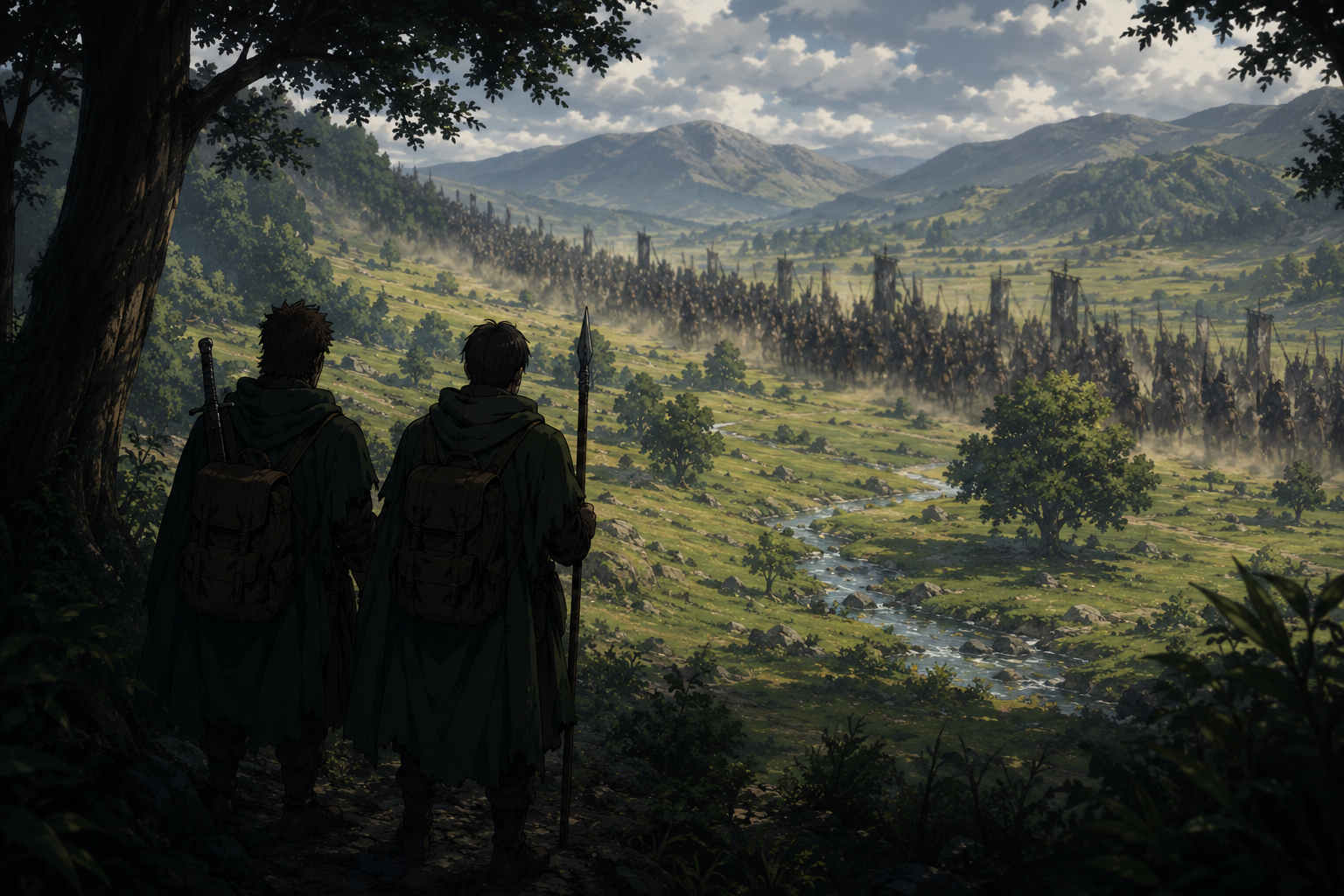
By the fifth week after the passing through Caer Dannon, the fear had begun moving faster than the army itself.
That realization unsettled the western kingdoms more deeply than invasion ever could have.
Ordinary war possessed structure. Armies crossed borders for reasons men understood. Cities became targets. Roads carried soldiers toward fortresses, river crossings, supply routes, and ports. Even fear behaved properly during ordinary war. People fled in predictable directions. Lords gathered troops. Messengers carried warnings with enough certainty attached to them that rulers could still make decisions.
But the Horned Queen’s procession continued inland without following any pattern the kingdoms recognized.
That was what slowly began poisoning the roads.
Not violence.
Not conquest.
Uncertainty.
In Stonewatch, Commander Halric stood over the largest map in the western command chamber while rain battered the tower windows hard enough to drown portions of the discussion taking place behind him. The chamber smelled of wet wool, candle smoke, and exhaustion. Riders tracked mud across the stone floors at all hours now, while clerks struggled to keep written reports organized beneath the endless arrival of contradictory sightings.
The maps had become almost unreadable.
Ink markings crossed over one another in thick clusters around Blackpine, Harrow’s Ford, and the ridge valleys west of Northridge. Red circles marked settlements believed threatened only days earlier before new reports shifted the procession elsewhere entirely. Arrows pointing north crossed arrows pointing west. Entire routes had been scratched out and redrawn repeatedly until the parchment itself looked wounded.
Halric stared at the latest report in silence.
“They crossed south of Blackpine yesterday evening,” one tracker insisted from near the central table.
“No,” another replied immediately. “That sighting came from frightened farmers.”
“The roadwardens confirmed it.”
“The roadwardens lost them in the fog.”
“They found signs again before dawn.”
“There are no roads there.”
The argument threatened to spiral again before Halric finally raised a hand for silence.
The chamber quieted reluctantly.
He studied the western ridges another moment before speaking.
“If the Blackpine reports are accurate,” he said carefully, “then the procession should have approached Northridge already.”
No one answered him.
That silence had become increasingly common in every council chamber west of the riverlands.
Because every prediction failed.
Every assumption collapsed.
The procession ignored crossings any ordinary army would require. It bypassed vulnerable settlements without even slowing. It vanished into rough country no sane commander would willingly move through while leading a force that size inland.
A younger officer standing near the rear of the chamber finally spoke.
“Perhaps they changed direction again.”
“Toward what?” Halric asked without turning.
The officer hesitated.
No answer followed.
The commander closed his eyes briefly.
That had become the true horror infecting the western kingdoms. Not merely that the procession existed, but that no one could explain its movement anymore. The kingdoms possessed armies. They possessed walls, roads, signal towers, cavalry, scouts, and fortified crossings. They understood siege warfare. They understood invasion.
What they did not understand was an army that appeared entirely indifferent to the things ordinary armies valued.
One exhausted tracker rubbed both hands slowly across his face before speaking quietly into the silence.
“I think they know exactly where they’re going.”
No one in the chamber answered him.
Outside, thunder rolled across the distant western hills.
—
Farther south, Ashenford had nearly transformed itself into a city under siege despite the procession never approaching within several miles of the settlement.
Fear arrived there long before the army ever could have.
First came the riders from Dunmere carrying reports of movement through the northern valleys. Then merchants from Bell Hollow arrived insisting the procession had turned south during the previous week. After that came roadwardens claiming dark banners had been seen west of the river crossings after sunset.
Within days the town no longer resembled itself.
Farm wagons blocked portions of the outer roads. Livestock crowded temporary barriers inside the walls while frightened families packed belongings into crates kept near doors in case evacuation became necessary. Men carrying old militia spears walked the streets at night trying unsuccessfully to look confident beneath torchlight and rain.
No one trusted the roads after dark anymore.
At the chapel near the eastern gate, Father Merrow struggled nightly to calm fears that even he no longer fully controlled. The building remained crowded long after evening prayers ended, filled with exhausted townsfolk unwilling to return home while rumors still traveled through the streets outside.
“The bells rang in Northridge three nights ago,” one woman whispered quietly near the altar. “My cousin heard them himself.”
“That does not mean the procession approaches Ashenford,” the priest answered carefully.
“But they’re moving south again.”
“So some reports claim.”
The woman looked toward the chapel doors where rainwater shimmered beneath torchlight outside.
“That’s what frightens me,” she admitted softly. “No one knows which reports are true anymore.”
Father Merrow had no comforting answer for her.
Because he feared the same thing himself.
Late on the fourth evening after the first barricades appeared, another rider arrived through Ashenford’s western gate beneath heavy rain. The reeve brought him directly into the meeting hall where several militia captains argued quietly over supply stores beside the fire.
“Well?” the reeve demanded immediately.
The rider removed soaked gloves slowly.
“They turned west.”
The room fell silent.
“West?” one captain repeated.
“That’s what the trackers reported.”
“Toward where?”
The rider hesitated visibly.
“We don’t know.”
For several long seconds no one spoke.
Outside, frightened townsfolk still worked beneath torchlight reinforcing barriers against an attack that now might never come at all.
The reeve finally laughed quietly.
Not from relief.
From exhaustion.
—
Across the western roads, uncertainty continued spreading faster than the procession itself.
Trade slowed first.
Merchants abandoned familiar routes after rumors of sightings spread nearby. Wagon trains delayed departure repeatedly while waiting for safer reports that never arrived. Inns along the inland roads filled nightly with stranded travelers exchanging contradictory stories beside crowded hearths and smoking lanterns.
At one roadside tavern near Rookbend, a merchant from Lyonesse argued openly that the procession searched for something hidden somewhere inland.
“What else explains it?” he demanded while rain hammered the shutters outside. “They pass towns. They avoid crossings. They move through wilderness no ordinary army would choose.”
“No army marches this long without supply lines,” a farmer replied immediately.
“Then how are they surviving?”
No one answered.
Another traveler quietly claimed the procession had crossed abandoned hill roads west of Blackpine where portions of the paths had collapsed generations earlier.
“That’s impossible,” someone muttered automatically.
The traveler stared into his untouched cup before replying.
“That word’s losing meaning lately.”
No one laughed.
The room had grown too tired for laughter.
Everywhere the same questions repeated endlessly beneath tavern smoke and sleepless candlelight.
What are they searching for?
Why ignore the cities?
Why continue inland?
No answers followed the questions anymore.
Only more reports.
More sightings.
More uncertainty.
—
The larger kingdoms reacted cautiously at first, though that caution slowly began eroding beneath political pressure and spreading fear.
Lyonesse dispatched organized cavalry patrols westward beneath direct royal authority. Veridor established signal stations along the inland roads leading toward Northridge and Eastwatch. Additional roadwardens appeared near the crossings while fortified settlements increased night watches along walls and towers overlooking the western approaches.
Still, neither kingdom committed fully to war.
That hesitation angered many local rulers.
At Northridge, Lord Carrow openly demanded mobilization during a late council gathering attended by nobles, commanders, and several envoys from nearby territories. Rain battered the high windows while servants carried fresh candles into the chamber already thick with argument and exhaustion.
“We continue reacting blindly,” Carrow snapped while pacing before the long table. “Every day the procession moves deeper inland while we sit debating reports.”
“And deploy where?” another lord countered immediately.
“Anywhere west of the ridge valleys.”
“You would scatter half the western armies across forests chasing shadows?”
“They are not shadows.”
“Then identify the objective.”
Carrow stopped speaking.
Because he could not.
No one could.
The chamber slowly quieted.
One older military advisor who had remained silent most of the evening finally leaned forward over the cluttered maps spread across the council table.
“They march,” he said quietly, “as though the cities do not matter.”
The silence afterward felt heavier than the argument had.
Because the statement sounded dangerously close to truth.
—
Near Blackpine, three royal trackers from Veridor vanished briefly while attempting to follow the procession through old timber roads west of the ridge valleys.
Their horses returned first.
The animals stumbled onto the northern road shortly before dawn lathered with sweat and streaked heavily with mud. One saddle hung partly torn loose while another horse still carried an unlit lantern striking softly against its flank with each uneven step.
Search parties rode immediately.
The trackers returned late the following evening exhausted, soaked, and visibly shaken.
“What happened?” the Veridor captain demanded.
The oldest tracker stared into the fire before answering.
“We lost them.”
“You lost an entire army?”
“No,” the tracker replied quietly. “We lost the roads.”
The captain’s expression darkened immediately.
“What does that mean?”
The tracker struggled to explain afterward.
The procession entered dense woodland shortly before dusk. The trackers followed carefully at distance while attempting to maintain position along the ridge paths. Then the terrain stopped matching the maps they carried.
Roads curved incorrectly.
Streams appeared where none should have existed.
Valleys seemed farther apart than they should have been.
“At first we thought we’d become turned around,” one tracker admitted quietly. “But the stars were wrong too.”
Silence settled heavily across the chamber after that.
The captain looked openly irritated now.
“You expect me to send this nonsense to Stonewatch?”
The tracker finally looked up from the fire.
“No,” he answered tiredly. “But it happened anyway.”
No one spoke afterward.
Because beneath the frustration and disbelief, another fear had begun spreading quietly through the western kingdoms.
Not fear of invasion.
Fear of misunderstanding something far older than themselves.
—
Near the end of the week, Commander Halric stood alone within Stonewatch’s upper chamber while storms rolled endlessly across the western interior beyond the tower windows.
Rain hammered the glass.
Thunder rolled across distant hills.
Watchfires flickered below along roads now nearly empty after dark.
The maps before him had become chaos.
Every attempt to predict the procession failed.
Every military assumption collapsed beneath new reports.
Slowly, unwillingly, Halric began realizing something he did not wish to admit aloud.
The Horned Queen’s army was not behaving like an invading force because invasion may never have been its purpose at all.
Somewhere far beyond Stonewatch, hidden among rain-dark forests, forgotten roads, and silent valleys, the procession continued inland without hesitation.
And across the western kingdoms, the uncertainty spread farther each night than the army itself.
Near midnight, after most of Ashenford had finally gone quiet beneath steady rain, Reeve Talren remained awake inside the meeting hall staring at the western road through warped glass darkened by stormwater and torch smoke.
The room smelled of damp parchment and dying firewood. Three unopened supply ledgers still sat beside his elbow where he had left them hours earlier. He had spent the better part of the evening listening to frightened townsfolk, arguing militia captains, and exhausted riders who all carried different versions of the same terrible truth.
No one knew where the procession was going.
That uncertainty had begun hollowing the town from the inside.
The barricades remained in place along the outer roads. Half the livestock still crowded temporary pens inside the walls. Families continued sleeping in shifts, fearful bells might ring before dawn warning that the army had finally appeared somewhere beyond the valley.
And still no word had returned from the larger kingdoms.
Talren rubbed both hands slowly across his face before looking toward the young messenger waiting near the doorway. The boy could not have been older than sixteen. Rainwater still dripped steadily from the hem of his cloak onto the stone floor.
“This will be the third envoy,” the boy said quietly.
Talren nodded without looking up from the table.
“I know.”
“They answered the second?”
“No.”
The boy hesitated. “Do you think they will answer this one?”
Talren finally leaned back in the chair and stared toward the low fire burning beside the opposite wall. For several long seconds only rain filled the hall between them.
“I think,” he said carefully, “that the larger kingdoms are just as frightened as we are.”
The boy said nothing after that.
Because they both understood what the statement meant.
If Lyonesse and Veridor truly understood the procession, orders would already be moving across the western roads. Armies would be gathering. Riders would carry instructions instead of rumors. Someone somewhere would appear certain.
Instead every report arriving from inland carried the same confusion infecting the smaller towns.
The procession moved.
The procession changed direction.
The procession ignored settlements.
The procession continued inland.
Nothing more.
Talren lowered his eyes back toward the unfinished letter resting beside the candle.
Ashenford requests clarification regarding western troop movements and confirmed procession sightings near the ridge valleys...
He stopped reading there.
The words suddenly felt pathetic.
Clarification.
As though anyone west of the riverlands still possessed clarity.
Outside, thunder rolled faintly across distant hills. Somewhere along the walls a watch bell sounded once before falling silent again.
The reeve dipped the quill slowly into ink.
“Take the south road through Eastwatch,” he said quietly. “Avoid the Blackpine routes entirely if the weather worsens.”
The messenger nodded.
“And if the roads close?”
Talren hesitated.
“Then keep riding anyway.”
The boy swallowed hard but said nothing further.
A few moments later he disappeared back into the rain carrying Ashenford’s third unanswered envoy toward kingdoms that no longer seemed much less afraid than the towns asking them for help.


.png)
.png)
.png)