%20(1).png)
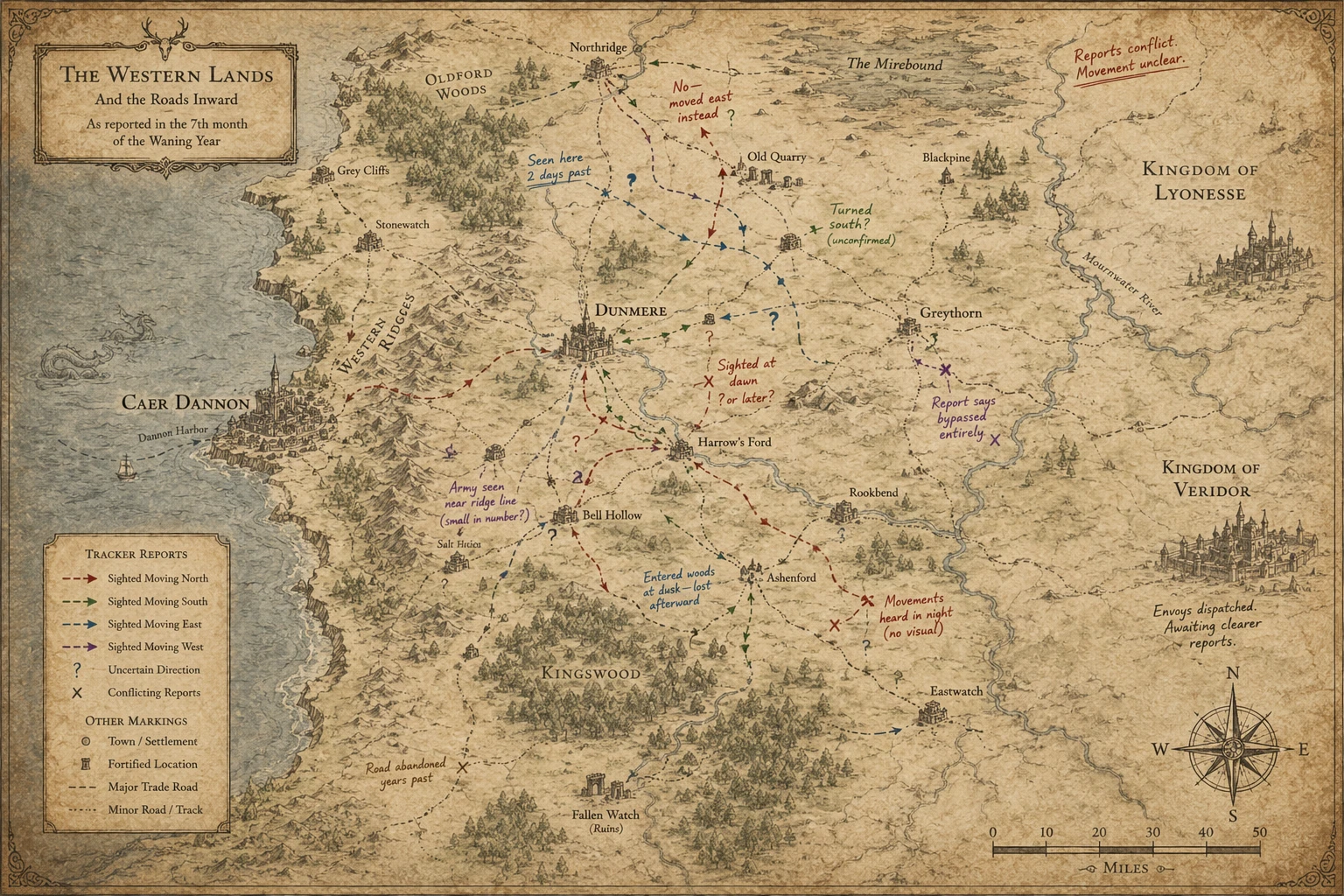
The first town to ring its bells had fewer than four hundred people in it.
Most maps did not bother naming it.
It sat along a narrow trade road west of Caer Dannon, little more than a cluster of stone homes gathered around a shallow stream and a weather-darkened shrine whose saint had long since lost part of its face to rain and moss. Traders stopped there on occasion during fair weather. Fishermen passed through during harsher seasons when the sea became unreliable. Once, years ago, soldiers had camped nearby during a border dispute no one remembered clearly anymore.
Now the town existed mostly as places like it always had—quietly.
That changed when the first rider arrived.
He came shortly before dusk, horse streaked with mud and foam, cloak soaked through from hard travel. The guards at the gate barely had time to question him before he demanded to see the reeve.
“The army’s moving inland,” he said.
That alone would have been enough.
But it was the uncertainty in the man’s voice that spread through the town faster than the words themselves.
Not confidence.
Not warning.
Uncertainty.
“How far?” the reeve asked.
The rider shook his head. “Depends which report you believe.”
Within the hour, bells began ringing across the settlement.
Doors closed. Lamps were lit early. Men were pulled from supper tables and sent toward the old wall at the northern edge of town—a wall built generations earlier when raiders still crossed the hills in winter. Half the stones had shifted over time. Moss grew thick between them. No one living had ever expected to use it again.
Yet by nightfall torches burned there.
Women carried sacks of grain into the chapel cellar. A pair of boys hauled water buckets from the stream until their shoulders trembled. Three hunters were sent east along the road to watch for movement. The blacksmith worked late into the night sharpening tools no one in town truly believed would matter against what was coming.
No one slept well.
And nothing happened.
Morning came pale and cold beneath low cloud.
The road remained empty.
The reeve stood along the wall beside two men carrying old hunting spears and watched mist drift across the fields beyond the stream.
“You sure the rider wasn’t drunk?” one muttered.
The reeve did not answer.
Below them, the town moved cautiously through ordinary tasks. Smoke rose from chimneys. A cart creaked across the square. Someone argued over flour outside the baker’s shop.
The normality of it all felt wrong somehow.
By midday another rider arrived.
Different horse.
Different cloak.
Different story.
“They turned south,” he said. “Toward the river crossings.”
The reeve stared at him. “The last report said west.”
“That was yesterday.”
“They changed direction?”
“I don’t know.”
That answer became increasingly common over the next several days.
I don’t know.
The reports spread faster than certainty ever could.
A procession of dark banners had crossed near the old quarry road.
No—north of it.
No—they’d vanished into the forest entirely.
No army could move through those woods.
Someone claimed they marched all night without torches.
Someone else swore they only moved at dawn.
None of it fit together cleanly.
Yet every report carried the same truth beneath the contradictions:
The Horned Queen’s army continued inland.
And no one understood where it was going.
—
Two days later the fear reached Dunmere.
Dunmere was larger than the first town and better defended, though only slightly. Stone watchtowers overlooked the southern approach, and the market square remained busy even during poor seasons. The people there initially dismissed the stories arriving from the coast.
Travelers exaggerated.
Harbor folk panicked easily.
But then the trackers began arriving.
Not frightened villagers.
Professionals.
Border riders.
Roadwardens.
Hunters familiar with the surrounding country.
Men who knew how to observe movement and report it clearly.
And even they disagreed.
“They bypassed Harrow’s Ford entirely.”
“That’s impossible.”
“I watched them do it.”
“Then how’d they cross the river?”
“I don’t know.”
The captain of Dunmere’s guard listened with growing irritation.
“How large is this force actually?”
Silence answered him.
That frightened him more than the rumors themselves.
No one seemed able to provide a number.
Some described thousands.
Others claimed only a few hundred could ever be seen at once.
“They’re spread out,” one tracker finally said.
“Across how much ground?”
Another silence.
The captain rubbed a hand across his beard. “You people are supposed to observe things.”
“We did.”
“Then why can none of you agree?”
The tracker looked exhausted.
“Because they don’t move like armies.”
That statement lingered in the room long after the man finished speaking.
—
Word traveled farther.
Nearby settlements began sending messages almost constantly.
Church bells rang at odd hours.
Militias assembled and dispersed repeatedly.
Roads became crowded with nervous travelers carrying conflicting stories from neighboring villages.
One town prepared for siege after receiving reports the procession had been spotted less than ten miles away.
They reinforced gates through the night.
Archers took position along rooftops.
Priests filled the chapel with candle smoke and frightened prayers.
Morning came.
The army never appeared.
Instead another rider arrived near noon with different news.
The procession had turned east sometime before dawn.
No explanation.
No attack.
Just movement.
The mayor reportedly laughed when he heard the news.
Not from relief.
From exhaustion.
—
Farther inland, local lords began sending their own men to watch the roads.
Some still believed the movement represented strategy.
A feint.
A test.
Reconnaissance before assault.
That at least made sense.
But every day made those explanations harder to maintain.
The army repeatedly ignored opportunities no commander should ignore.
Poorly defended towns remained untouched.
Supply depots went unraided.
River crossings of obvious military value were bypassed entirely.
One steward studying the reports finally slammed a fist against the table hard enough to upset an ink bottle.
“What do they want?”
Nobody answered.
Because nobody knew.
—
Three trackers from the western roads vanished briefly near the old pine valleys north of Dunmere.
Their horses returned first.
The animals stumbled onto the road near dusk riderless and lathered with sweat. One carried a snapped rein trailing through the mud behind it.
Search parties went out immediately.
The men returned the next morning.
Alive.
Cold.
Exhausted.
And deeply unsettled.
“We lost them,” one said quietly while warming his hands near the watchfire.
“You lost an army?”
The tracker shook his head. “No.”
“What then?”
He stared into the flames for a long moment before answering.
“The road.”
No one understood what he meant.
He struggled to explain it afterward.
The procession had entered dense woodland shortly before dusk. The trackers followed at distance, careful not to expose themselves. Then the terrain stopped matching the maps they carried.
Paths curved incorrectly.
Streams appeared where none should have been.
Ridges seemed farther apart than they ought to have been.
“You got turned around,” someone said.
“Maybe.”
But the man did not sound convinced.
Another tracker finally spoke.
“We heard them moving ahead of us.”
“The army?”
He nodded.
“But every time we rode toward the sound… it was somewhere else.”
Silence settled heavily around the fire.
No one wanted to admit how little sense that made.
—
The panic had not yet reached the great kingdoms.
Not fully.
But concern had begun spreading beyond the local roads.
Merchants carried stories inland.
Messengers rode farther than before.
Small rulers exchanged letters increasingly filled with uncertainty instead of confidence.
Most still assumed the threat could eventually be understood through ordinary means.
That assumption weakened with every new report.
A fortified settlement near the southern hills spent three days preparing for attack after receiving warnings from two separate trackers.
Barricades erected.
Fields abandoned.
Livestock brought inside the walls.
Then a fourth rider arrived with different news.
The procession had marched northwest instead.
Straight through abandoned grazing land where no settlement larger than a shepherd’s camp existed for miles.
“Why?” the steward demanded after hearing the report.
The rider only shook his head.
“There’s nothing out there.”
Yet that was where the army had gone.
—
The town of Bell Hollow began preparing before any confirmed sighting reached them.
That alone frightened people.
The fear now traveled ahead of the army itself.
Bell Hollow sat beside an old mining road between two ridges of dark stone. The mines had closed years earlier after flooding claimed part of the lower tunnels, but the town remained because roads still passed through it.
By the second evening after the first rumors arrived, wagons clogged the square.
Families packed belongings.
Shopkeepers boarded windows.
Farmers drove livestock inside crude barricades hastily erected from timber carts and fence posts.
At the meeting hall, the town elders argued deep into the night.
“We should evacuate.”
“And go where?”
“South.”
“South where?”
“They’re moving west now.”
“That was yesterday.”
“They cannot be everywhere.”
“How do you know?”
No one answered that.
Outside, rain drifted steadily through torchlight while frightened men practiced spear formations they barely remembered from old militia drills.
One boy could not stop shaking badly enough to hold his shield straight.
His father finally lowered it gently.
“It’s all right,” the man whispered.
But he did not sound convinced himself.
Near midnight another rider arrived.
The hall doors opened immediately.
Every face turned toward him.
“Well?” the elder demanded.
The rider removed wet gloves slowly, exhaustion visible in every movement.
“They turned again.”
The room fell silent.
“Toward Bell Hollow?”
“I don’t know.”
The elder’s face tightened. “What do you mean you don’t know?”
“We tracked them north of the ridge trail until fog rolled in.” The rider swallowed. “When it cleared they were moving east instead.”
“That’s impossible.”
The rider laughed softly then.
Not from amusement.
From fatigue.
“That’s what everyone keeps saying.”
—
In taverns and roadside inns, people began drawing maps across tabletops with nervous fingers.
Speculation spread like illness.
“They’re searching for something.”
“No army marches this long without objective.”
“Maybe they’re lost.”
“An army that size?”
“Maybe they want us afraid.”
That explanation became popular briefly.
Until people began asking the obvious question:
Afraid of what?
No demands had come.
No cities attacked.
No envoys sent.
Only the movement remained constant.
Steady.
Measured.
Purposeful.
And impossible to understand.
—
Late one evening, a roadwarden named Edrin stood watch from a hilltop overlooking a narrow valley road west of the riverlands.
Below him torches moved slowly through darkness.
Not many.
A handful at most.
But beyond the torchlight came the deeper shape of movement—the quiet progression of an army crossing land that no longer seemed to belong to the current age.
No shouted commands.
No drunken soldiers.
No wagon noise.
Only marching.
Ordered.
Steady.
Cold.
Edrin watched nearly an hour.
At one point he thought he saw mounted figures farther back among the procession, armor reflecting pale firelight beneath long antler-shaped standards shifting slowly in windless dark.
Then the torches disappeared behind the trees.
The silence afterward felt worse.
Beside him, another watcher swallowed hard.
“They’re heading toward Bell Hollow,” the younger man whispered.
Edrin kept staring into the dark valley.
“No,” he said quietly.
“How can you tell?”
A long pause followed.
Finally Edrin answered with the honesty now infecting nearly every report across the western roads.
“I can’t.”
Far below them, unseen beyond the trees, the procession continued onward.
And somewhere ahead of it, another town was already ringing its bells.


.png)
.png)
.png)