%20(1).png)
The bells did not ring.
That, more than anything, unsettled the town.
Morning came as it always had, pale light spilling over the eastern roofs and down into the narrow streets, but it arrived without instruction. No alarm. No call to arms. No declaration of safety. The sea beyond the harbor lay calm, its surface unbroken save for the slow rise and fall of the tide—and farther out, just past the break of the cliffs, the ships remained.
They had not moved.
From the watchtower at Bellwatch Point, the fleet still sat offshore, black shapes against the horizon, neither advancing nor retreating. No sails unfurled. No boats launched. They existed in a way that felt deliberate, as though the sea itself had been asked to hold them there.
Caer Dannon woke beneath that knowledge and did not know what to do with it.
The steward stood at his desk long before the first petitioners arrived.
Scrolls lay open before him—reports from the watch, supply tallies, a careful transcription of the envoy’s return. He read them slowly, then read them again, as if repetition might produce meaning where none had been given.
No response received.
No hostile action observed.
Distance maintained.
Each line said the same thing in different words: nothing had changed.
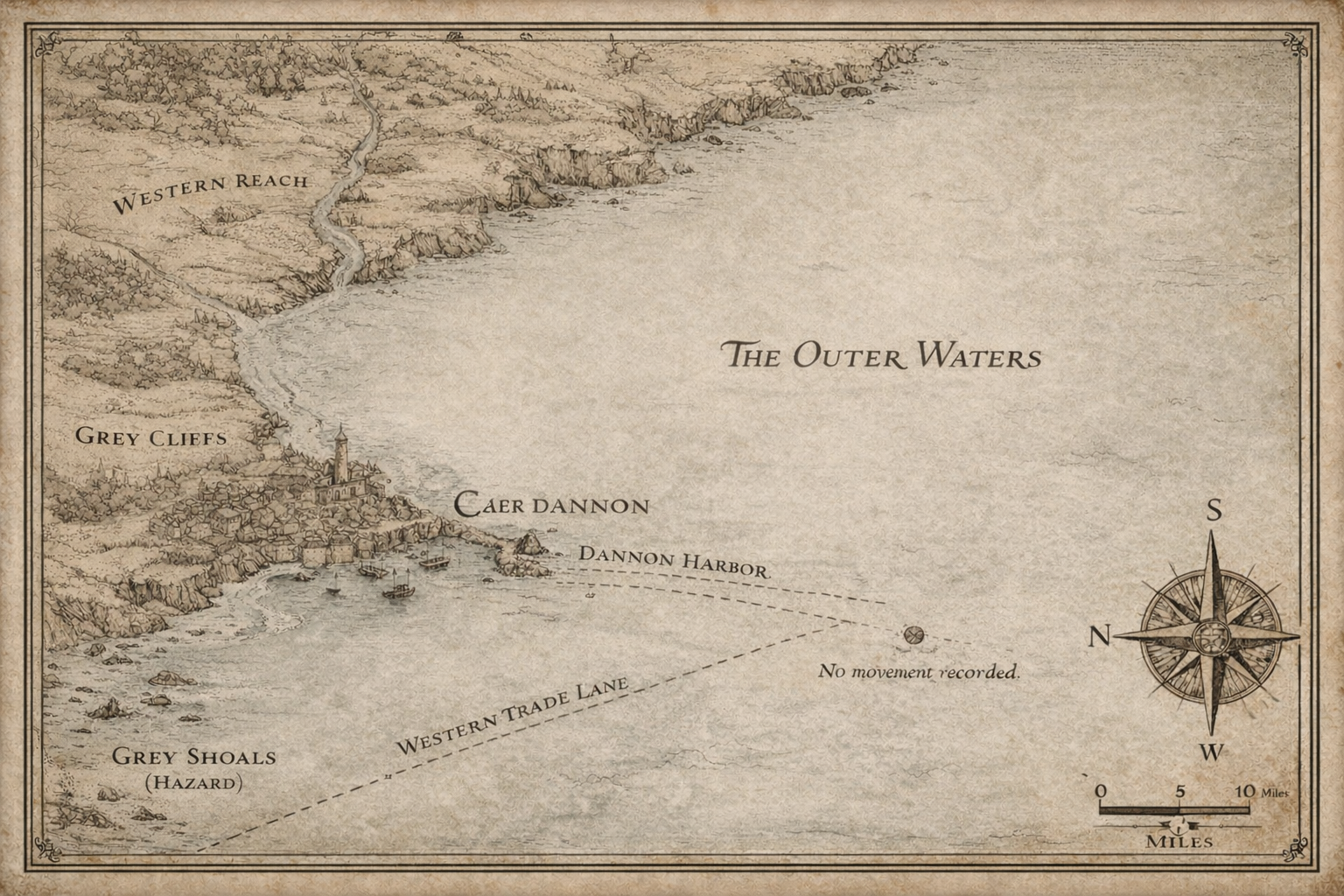
Behind him, the map hung on the wall, its parchment surface faintly rippled with age. The coastline of Caer Dannon was drawn in confident strokes, the harbor carefully marked, the trade lanes sketched thin and practical. And offshore, a small ink circle remained where it had been placed days ago.
Observed Position.
The steward did not look at it directly. He had learned, already, that staring too long invited questions he could not answer.
Instead, he made decisions that felt safer for being small.
He approved extended watch rotations. He signed off on additional supply checks. He delayed a proclamation that several council members had pressed him for the night before. Words, he knew, had weight—and once spoken, they could not be gathered again.
Silence, for now, was lighter.
Captain Halvar of the watch hated silence.
He stood in the courtyard as the morning shift assembled, armor catching the light in dull flashes. The men moved with discipline, but not ease. They were alert, too alert, the way soldiers became when readiness outlasted reason.
“Rotations remain extended,” Halvar said, keeping his voice level. “No one leaves post without relief.”
A murmur passed through the ranks. Not dissent—fatigue.
Later, alone with his lieutenants, Halvar reviewed the patrol routes again. He had already adjusted them twice, bringing more eyes to the harbor approaches, fewer to the inland roads. It felt wrong to leave any direction unguarded, but there were only so many men, and all of them were tired.
“They’ll start making mistakes,” one lieutenant said quietly.
“I know,” Halvar replied.
“What are we waiting for, then?”
Halvar looked toward the sea, though the fleet was not visible from here.
“For something to happen,” he said. “Or for nothing to.”
Neither answer satisfied him.
In the lower halls near the storehouses, the quartermaster counted.
He worked by lamplight though the sun was already up, habit guiding his hands as much as necessity. Barrels were marked, sacks weighed, tallies updated with careful ink strokes.
Grain for thirty days at heightened consumption. Salt fish for twenty-two. Lamp oil adequate—for now.
He paused, quill hovering.
For how long?
No one had asked him that.
The quartermaster had been trained for shortages, for sieges, for emergencies that arrived with horns and banners. He knew how to stretch supplies, how to ration without causing panic. But this—this waiting—was different. Readiness burned resources faster than war ever had, and with no endpoint, every calculation felt hollow.
He scratched a note in the margin, then crossed it out.
At some point, he realized, he would need to sleep in the storehouse again. He pictured his wife at home, their children already old enough to sense when something was wrong, and felt the familiar, dull acceptance settle in his chest.
Someone had to keep counting.
The blacksmith’s hammer rang out long after it should have stopped.
Steel met anvil in steady rhythm, sparks leaping and dying in the air. The blade he worked did not need reforging. He knew that. He had known it before he began. But his hands moved anyway, muscle memory carrying him through motions that kept thought at bay.
People passed his forge more often than usual, lingering longer than necessary. They spoke in half-questions and rumors stripped of certainty.
“They say the ships are cursed.”
“They say the envoy was ignored.”
“They say—”
The blacksmith nodded, grunted, offered nothing in return. He had learned long ago that words were a poor substitute for work.
Between strikes, he noticed the street beyond his forge. No children running. No games of chase. Parents kept them close, hands resting on shoulders as if afraid they might wander too far.
He struck harder, the sound echoing down the street.
At the inn near the square, business continued—technically.
The doors were open. The hearth was lit. But laughter had thinned, replaced by murmurs that never quite rose into conversation. Patrons drank more slowly, cups left half-full as eyes drifted, again and again, toward the windows.
The innkeeper wiped the same section of counter twice, then a third time, before realizing what he was doing.
A fisherman sat near the door, boots still damp, arguing quietly with a trader about whether the tide would hold through the afternoon. The argument had less to do with weather than with permission—whether it was acceptable, now, to pretend the sea was still theirs.
No one decided.
By midday, the harbor had become a place of motion without movement.
Boats were loaded, unloaded, loaded again. Nets were mended, then checked, then set aside. Men stood in small clusters, hands on hips, gazes fixed on the horizon as if expecting the fleet to respond to being watched.
It did not.
The ships remained exactly where they had been.
In the steward’s hall, voices rose—not in anger, but urgency.
“How long can we keep this up?”
“What if they’re waiting for us to act?”
“We should reassure the people.”
“We should not provoke them.”
The steward listened, fingers steepled, letting the arguments exhaust themselves. When the room quieted, he spoke only once.
“We do nothing,” he said. “Until we know more.”
Afterward, alone again, he glanced at the map. The ink circle offshore seemed darker than he remembered, though he knew that was impossible.
He left it untouched.
As evening fell, Caer Dannon settled into a rhythm that felt wrong but workable.
Guards took their posts. Lamps were lit earlier than usual. Doors were barred not in fear, but habit. The town did not panic.
It adapted.
And offshore, beyond the reach of bells and voices, the fleet remained—silent, distant, unmoving.
Nothing had happened.
And somehow, that was worse.


.png)
.png)
.png)