%20(1).png)
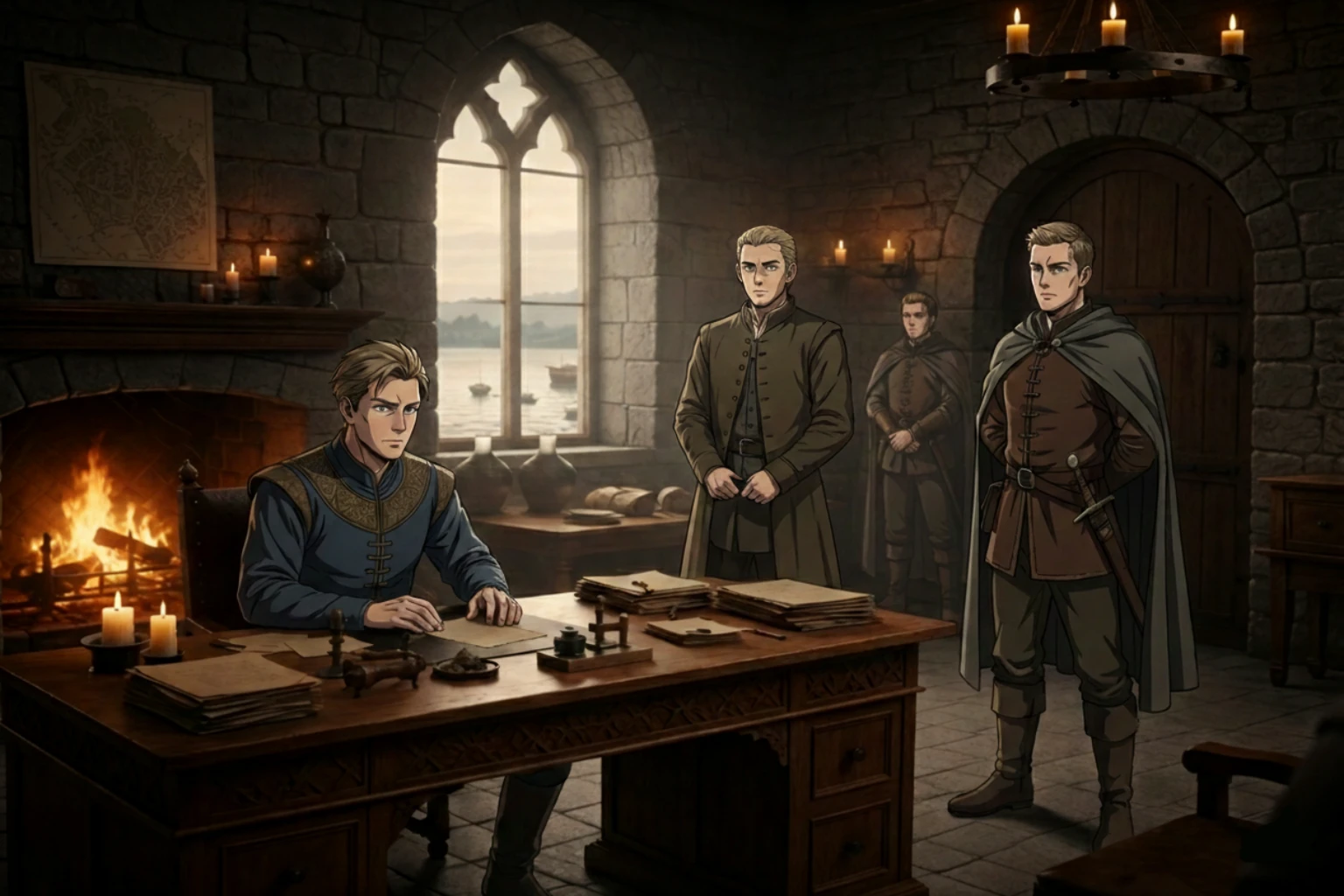
By morning, the sea looked ordinary again.
That was the first thing that unsettled Tomas Breythe, Town Steward of Caer Dannon. From the upper windows of the hall, the harbor lay calm, fishing boats bobbing gently against their moorings, gulls crying as if nothing had changed. The storm had passed cleanly. No wreckage. No scorched earth. No proof that anything extraordinary had occurred at all.
And yet the town did not move the way it had yesterday.
People gathered in clusters instead of lines. Conversations stopped when others approached. Shop doors opened late. Bells rang out of habit, not certainty.
Tomas pressed his seal ring into the soft wax of yet another notice, then set it aside without stamping it.
Words felt dangerous now.
They had argued through most of the night—he and the council—over what should be said, what should be acknowledged, what should be ignored. Every suggestion carried risk. To confirm rumors gave them weight. To deny them invited disbelief. To remain silent suggested weakness.
“What people fear most,” Tomas had said quietly, “is being left out of the story.”
He wasn’t sure anyone had listened.
Down by the eastern gate, Captain Alwen Rook stood with his hands clasped behind his back, watching the tide drift a fraction too far in before receding. He had measured tides his entire adult life. He knew how they behaved. This one was wrong—not dramatically, not dangerously—but consistently, as if the sea had accepted a new margin and refused to explain it.
Behind him, two watchmen murmured to each other, voices low.
“They say the ships never touched water,” one said.
“They say they were already anchored when the storm came,” said the other.
Alwen didn’t correct them.
He’d learned early that certainty offered too quickly was worse than doubt. What mattered was not what the men believed, but what they might do when fear sharpened into curiosity.
“Keep the patrols wide,” he said instead. “No one goes near the docks alone.”
“And if they ask why?” one of them ventured.
Alwen paused. He chose his words carefully.
“Tell them it’s safer that way.”
That wasn’t a lie. It just wasn’t the whole truth.
In the storage hall beneath the old granary, Edrin Holt counted sacks of grain by lantern light, his fingers tracing the chalk marks on the floor as he went. He had trained for this kind of accounting—not invasion or catastrophe, but uncertainty. How long stores would last. How much could be spared. Which supplies could be moved quickly if needed.
He hadn’t gone home.
He’d meant to. He’d thought of his wife, already asleep by the hearth, of the way his youngest always waited up even when he promised not to. But the numbers had kept him here. They always did.
If the harbor closed, shipments would stop. If people panicked, consumption would spike. If nothing happened at all, time would stretch thin and unforgiving.
He adjusted a tally, then stopped, staring at the mark as if it might change on its own.
Days, he thought. Not hours.
He folded a scrap of paper, wrote a brief note—Working late. Don’t wait.—and tucked it into his coat. He would leave it with the guard on his way out, if he went out at all.
By midmorning, the rumors had taken shape.
They moved faster than the truth, faster than Tomas could counter them. Some said the fleet had come to claim old debts. Others whispered of omens, of ancient pacts broken and remembered. A woman near the docks swore she had heard chanting long after the ships vanished. A fisherman insisted there had been no sound at all.
“What do they want?” someone demanded in the square.
No one answered.
That, more than anything, frightened them.
The council decided to send an envoy shortly after noon. Not as a gesture of submission, Tomas insisted, but as a matter of record. A way to say they had tried. The man chosen was careful, well-spoken, and unremarkable enough not to provoke offense by presence alone.
Alwen watched him depart from the docks, posture stiff, eyes forward. The boats sat idle behind him, crews gathered but silent. No one cheered. No one jeered.
They just watched.
Edrin paused his counting when the envoy returned hours later, the sound of footsteps echoing through the hall above. He waited, breath held, until the murmur of voices filtered down. There was no raised tone. No urgency. Just confusion, carried on measured words.
He climbed the steps slowly.
The envoy stood before the council table, hat in hand, face drawn not with fear but with something harder to place.
“They did not receive me,” the man said. “Not formally.”
Tomas leaned forward. “But you were acknowledged?”
The envoy hesitated. “I was… not addressed.”
A murmur rippled through the room.
“What did they say?” someone pressed.
The envoy shook his head once. “There was no answer.”
“To which question?” Alwen asked from the doorway.
The envoy met his gaze. “Any of them.”
Silence followed. Heavy. Unwilling.
Then, quietly, the envoy continued. “There were markers placed along the waterline. Notices, I suppose. Not for us. Just there.”
Tomas swallowed. “And?”
The envoy repeated the words exactly as he had seen them, voice flat, almost procedural.
“ATTEMPT NO LANDING THERE.
THERE WILL BE NO BOARDING ALLOWED.”
No signature.
No seal.
No explanation.
Just fact.
No one spoke.
Edrin felt it then—not fear, not panic—but a sudden compression of space, as if the town itself had shrunk around him. He thought of the sacks below, of the careful counts, of the days he’d measured without knowing what they were being measured for.
Alwen broke the silence at last. “Were those words addressed to you?”
The envoy shook his head. “They were not addressed at all.”
That was worse.
By evening, the harbor was empty of curiosity. People stayed back from the water as if from a drop too deep to judge. Tomas issued notices without explanation. Alwen doubled patrols without incident. Edrin moved supplies without orders.
Life continued.
Incorrectly.
And somewhere beyond the horizon—whether watching or not—something remained, indifferent to questions, unmoved by attention, unconcerned with being understood.
The town had asked.
The world had not answered.
And now the only thing left to decide was what people did next, when being ignored proved more frightening than being opposed.


.png)
.png)
.png)