%20(1).png)
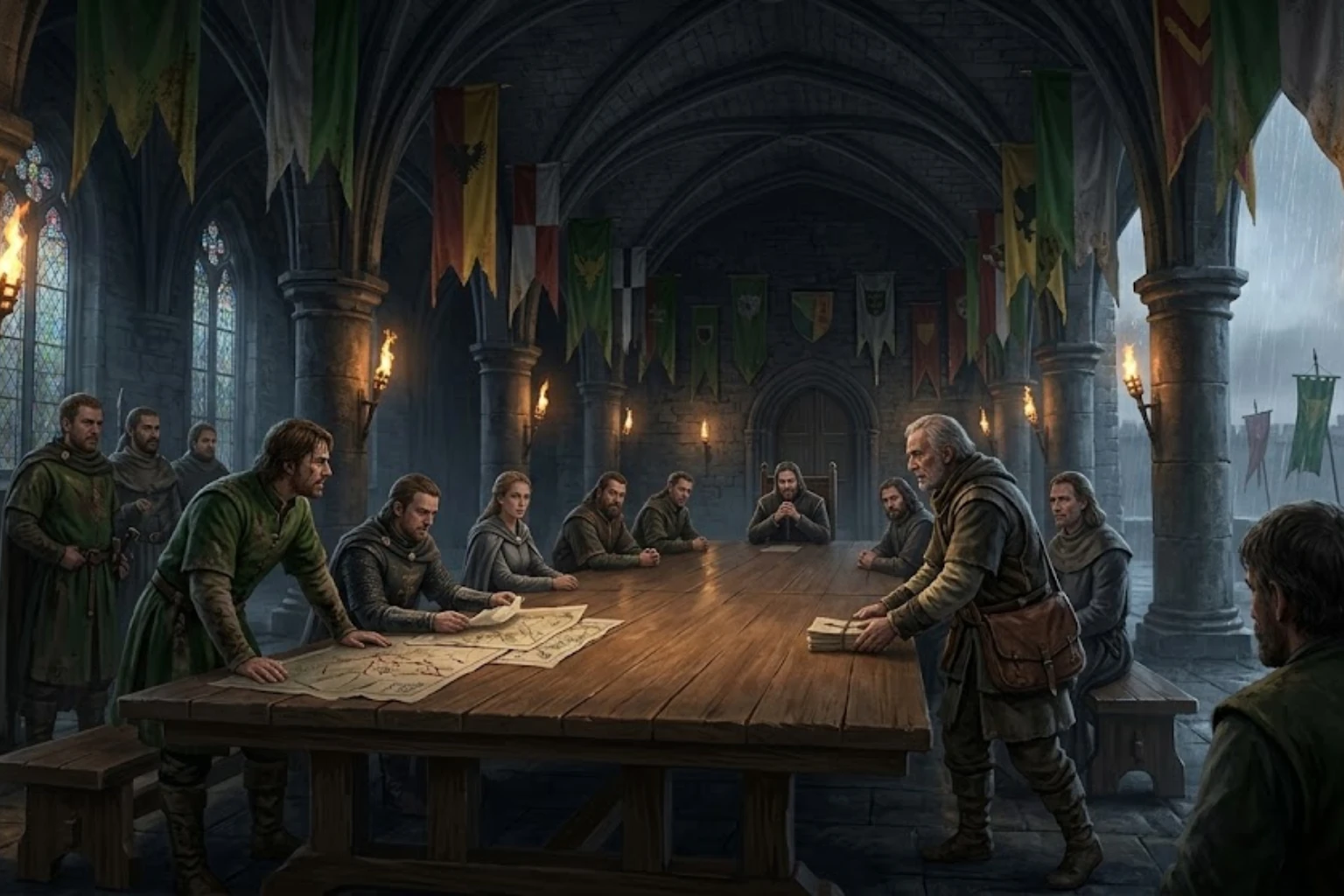
The great hall at Stonewatch had not held this many banners in one place in living memory.
Servants had spent the better part of two days clearing the chamber for the gathering — moving tables, hanging additional torches, arranging seating according to a precedence that nearly caused three separate arguments before a single word of substance had been spoken. By the time the doors opened on the third morning, the hall held representatives from eleven territories, four clergy houses, two independent military commands, and a scattering of lesser nobles, archivists, and observers who had attached themselves to larger delegations through means nobody had fully tracked.
Rain continued against the high windows. It had not stopped in six days.
King Aldren took his place at the head of the long table without ceremony — no herald, no formal address, simply a man sitting down because there was work to do and announcing it would have wasted time everyone had stopped having.
"We are not here," he said, "to assign blame or determine whose territory bears responsibility for what has or has not been reported accurately." His eyes moved along the table. "We are here because no single kingdom possesses enough information to understand what is happening, and the not-understanding has become as dangerous as the procession itself."
Lord Carrow, seated near the center of the table with his retainers arranged behind him in their mud-streaked green, did not wait for an invitation.
"With respect, Your Majesty, Northridge has been requesting clarity for weeks while the procession crosses our borders at will. We did not travel three days through flooded roads to hear that no one understands anything. We came for a plan."
"A plan requires a target," Aldren said evenly. "Do you have one to propose?"
Carrow's jaw tightened. "The procession moves. We track it. When it commits to a direction, we commit forces to intercept."
"It has not committed to a direction in five weeks," Commander Halric said, without looking up from the maps spread before him. "That is the entire substance of every report Northridge itself has submitted."
"Then we force a direction. Block the obvious routes. Eventually it must go somewhere predictable."
"Must it?" The question came from further down the table — one of the Veridor representatives, an older woman in grey robes whose name, according to the seating chart, was Lady Theris. She had not spoken until now. "Lord Carrow, with respect — what evidence do you have that this procession is constrained by the same logic as an ordinary force? Every report describes it moving through terrain that does not match existing maps. Roads that should not exist. Valleys in the wrong positions. Your trackers vanished and returned describing stars in wrong configurations."
"Trackers panic," Carrow said. "Men lost in unfamiliar woodland at night will report all manner of things."
"Three separate tracking parties," Halric said quietly. "From three different commands. Describing the same impossibilities independently, days apart, without contact with one another."
The chamber was quiet for a moment.
"Then what do you propose, Commander?" Carrow said, and the edge in his voice had sharpened. "That we simply wait? Let it continue inland indefinitely while the western roads empty themselves of trade and half our smaller settlements barricade themselves against an enemy that may never arrive?"
"I propose," Halric said, "that before we commit forces to a strategy, we attempt to understand what kind of thing we are responding to. Because every assumption built on the premise that this is an army has failed. And I would rather waste a week in this hall than waste an army on the wrong premise."
"A week," Carrow repeated. "While Ashenford sends its third envoy and the roads continue to empty."
"The roads are emptying because of fear, not because of the procession itself," Lady Theris said. "No settlement directly in its path has actually been attacked. Caer Dannon was — visited. Briefly. And left largely intact, beyond losses that, while real, do not constitute the behavior of a conquering force." She looked at Carrow. "I am not suggesting there is no danger. I am suggesting the danger may not be the one we are organizing against."
The discussion continued in this fashion for the better part of two hours — circling, fracturing into smaller arguments, occasionally returning to the central table when Aldren raised his hand for quiet. Reports were read aloud. Maps were consulted, disputed, redrawn. The same questions surfaced repeatedly in slightly different forms, and none of them produced answers that satisfied anyone.
It was during a lull — the kind that settled over a room when everyone had said their piece at least once and was now waiting for someone else to say something new — that a voice spoke from near the back of the hall, where the lesser attendees and unaffiliated observers had been seated.
"May I address the council?"
The voice belonged to a man Aldren did not immediately recognize — older, travel-worn, dressed in the kind of layered, practical clothing favored by people who spent more time on roads than in any single place. He had arrived, according to the steward's hurried notes, with one of the river convoys two days prior, claiming to be an archivist with no formal attachment to any of the represented territories.
Several of the larger delegations exchanged glances. An unaffiliated archivist addressing a council of kings was, by any normal measure, an irregularity.
Aldren considered the man for a moment. Then he said: "Your name?"
"Ossian," the man said. "Formerly of the eastern monastery archives at Velmora. I have spent the last eleven years cataloguing trade records and border histories that predate the current kingdoms — records most of the present territories no longer maintain, because the borders they describe no longer exist."
"And you believe these records are relevant to the current matter?"
"I believe," Ossian said, "that I have read this before."
The hall went very quiet.
"Explain," Aldren said.
Ossian moved forward — slowly, with the careful gait of a man whose joints had spent decades arguing with travel — until he stood near enough to the central table that he did not need to raise his voice.
"The records I catalogue are old," he said. "Older than most of the territories represented here. Some predate the founding of Veridor itself. Among them are trade logs, border agreements, and — occasionally — accounts of events the kingdoms that wrote them clearly did not fully understand, and recorded anyway, because the alternative was to record nothing at all."
He reached into a worn leather satchel and produced a small, careful bundle of papers — not originals, by the look of them, but copies, made in a neat and patient hand.
"Two hundred and forty years ago," he said, "a trade convoy moving between what was then the eastern river territories and a coastal settlement that no longer exists recorded an encounter. Not an attack. An encounter. The convoy described a procession — ships without sails, moving against the current, accompanied by what the record describes as 'a low chant that moved through the body rather than the ear.'"
Several people at the table shifted.
"The convoy survived," Ossian continued. "Largely intact. They described the procession as having 'passed through' rather than 'arrived.' And they described — this is the part I believe matters most — the roads afterward."
"What about the roads?" Aldren asked.
"The convoy's return route did not match their outbound route. Not because they took a different path — because the path itself had changed. Streams in new positions. A valley they had crossed twice before now sat, by their account, 'a half-day's travel further than it had ever been.'" Ossian looked up. "The record's author attributes this to 'the Queen's passing leaving the land uncertain of itself for a time afterward.'"
The silence that followed was different from the silences that had come before.
"You're suggesting," Lady Theris said slowly, "that this has happened before."
"I am suggesting it has happened repeatedly," Ossian said. "I found four separate accounts across different archives, different territories, different centuries — each describing similar events in similar language, each treated by its own time as an isolated curiosity rather than part of a pattern, because no single archive held more than one account and therefore no one could see the pattern." He set the papers on the table. "Until eleven years of cataloguing put them in the same room."
Carrow leaned forward. "And what do these records say happens after? When the procession has passed?"
"That is the part I cannot answer," Ossian said. "Because none of the four accounts describe an ending. Each one simply — stops. The procession passes through. The land settles back into something resembling its previous shape, though never quite identical. And the record's author moves on to other matters, as though the event, however strange, had concluded and required no further attention."
"That's not an ending," Halric said. "That's an account that stopped being written."
"Yes," Ossian agreed.
"Which means," Lady Theris said carefully, "either the procession concluded its purpose and departed, leaving nothing more to record—"
"Or the author did not survive to record it," Carrow finished.
Ossian did not answer this directly.
"There is one more detail," he said instead, "common to all four accounts, which I think is the most important detail of all." He looked around the table, and for the first time since he had begun speaking, something in his careful, archivist's composure shifted — not into fear, exactly, but into the specific weariness of a man who had been carrying something heavy for a long time and was finally setting it down in front of people who might understand its weight.
"In each account," he said, "the procession is described as searching."
The word landed in the hall the way a stone lands in still water — a small sound, and then a silence that spread outward from it.
"Searching for what?" Aldren asked quietly.
"None of the accounts say," Ossian said. "But in three of the four, the procession's path — once mapped afterward, once the roads had settled back into something close to their original shape — formed a line. Not a wandering path. A line. Toward a single point."
"What point?" Carrow demanded.
Ossian was quiet for a moment.
"In each case," he said, "a different point. But in each case—" he hesitated "—a place that, by the time anyone thought to look for it afterward, no longer existed. A settlement abandoned generations earlier. A keep fallen to ruin before the procession ever arrived near it. A monastery the records describe as having been 'emptied' decades before — though emptied of what, the records do not say."
The hall was utterly silent now. Even the rain against the high windows seemed, for a moment, to recede into background.
"You're saying," Lady Theris said slowly, "that the procession is not searching for a place that exists now."
"I am saying," Ossian said, "that in every account I have found, by the time the procession's path could be understood as a line pointing somewhere — the place it pointed to had already, for unrelated reasons, stopped being there." He looked at the assembled rulers, commanders, and clergy with the steady, exhausted directness of a man who had spent eleven years arriving at a conclusion he had hoped never to need. "Which means either the procession does not know this. Or it does not matter to the procession whether the place still exists."
"Why would that not matter?" Carrow asked. His voice had lost its earlier edge entirely.
Ossian looked at him.
"I don't know," he said. "But I know what the fourth account says, the most recent one, written almost ninety years ago, in the final entry before the author — for reasons the archive does not explain — stopped writing entirely."
He picked up the last page from his small bundle and read it aloud, in the flat, careful voice of someone reading words they had read many times before and had never grown comfortable with.
"'The procession does not search as a hunter searches, for prey that flees and may be lost. It searches as the tide searches a shoreline — patient, certain, returning to the same places across however much time is required, because the tide does not consider time the way the shore does.'"
He set the page down.
"'It will find what it is looking for,'" he read, "'whether or not anything remains there to be found.'"
For a long moment, nobody at the table spoke.
Outside, the rain continued — steady, indifferent, the same rain that had fallen on Ashenford's barricades and Stonewatch's crowded roads and the dense western woodland where, somewhere, the procession continued its slow and patient line toward a destination that might not exist anymore, if it ever had.
It was Aldren who finally broke the silence.
"Master Ossian," he said. "These four accounts. Do they describe the procession's appearance? Its — composition. Anything that might help us understand what we are dealing with, beyond its direction."
"Some details," Ossian said. "Fragmentary. The chanting is mentioned in all four. The ships — or in two accounts, simply 'vessels,' without further description — appear in three. And in two of the four—" he paused "—there is a figure. Described differently each time. A crown of antlers in one. A crown of 'bare branches, black against the storm' in another. Always at the front of the procession. Always — and this is consistent across both accounts — described as not aging between the centuries separating them, despite the accounts themselves being separated by over a hundred years."
"The same figure," Halric said. "Across a century."
"That is what the records suggest," Ossian said. "Though I would caution against certainty. A century is a long time, and crowns can be inherited, titles can persist beyond the people who first held them. It is possible the figure described in each account is not the same individual, but rather the same position — a role passed down, the way a crown passes between rulers who are not the same person but occupy the same place in the records."
"And if it is the same individual?" Lady Theris asked quietly.
Ossian looked at her for a long moment.
"Then I do not know what we are dealing with," he said. "And I suspect that not knowing is the most honest answer anyone in this hall is going to give you today."
The session continued for another hour after that, though something in the room's energy had changed — the earlier arguments, the demands for plans and intercepts and troop movements, had quieted into something more careful. Not resolved. Simply — recontextualized, the way an argument about which direction to run changed once everyone understood that the thing chasing them might not be running at all.
Near the end of the session, as servants began the slow work of bringing food and wine to a council that showed no sign of concluding for the day, Commander Halric found himself standing near one of the tall windows, looking out at the rain-soaked city below, where the gathered banners of eleven territories hung heavy and sodden in the wet air.
Lord Carrow joined him. For a while, neither man spoke.
"I owe you something of an apology," Carrow said eventually. "For this morning."
"You don't," Halric said.
"I came here wanting an enemy," Carrow said. "Something with a position on a map. Something that could be fought." He looked out at the rain. "I'm not certain that's what we have."
"No," Halric agreed.
"Then what do we do with eleven kingdoms' worth of soldiers, if there's nothing to fight?"
Halric was quiet for a moment, watching the rain move across the rooftops of Stonewatch — a city that had stood, in one form or another, for longer than any of the kingdoms currently arguing within its walls, and which would likely stand, in some form, after all of them were gone too.
"I think," he said slowly, "that the question Ossian raised is the one that matters. Not where the procession is going. Why it doesn't matter to them whether the destination still exists." He turned from the window. "An army marches toward a target because the target is real, and reaching it accomplishes something. This — doesn't seem to require that. Which means whatever the procession is for, it isn't the kind of thing that ends when it arrives."
"Then what does it accomplish?"
Halric didn't answer immediately.
"I think," he said finally, "we should ask Master Ossian whether any of his four accounts describe what happened to the places the procession was searching for — before the procession arrived. Not after. Before." He looked back out at the rain. "Because if the procession's path only forms a line after the destination is already gone — then maybe the destination didn't stop existing by accident."
Carrow looked at him.
Neither man said anything further.
Below, in the rain-soaked streets of Stonewatch, the gathered delegations continued their slow work of trying to understand something that, by every account anyone could find, had never been fully understood by anyone who lived long enough afterward to write it down.
And somewhere west, beyond the ridges, beyond the woodland that no longer matched its maps, the procession continued — patient, certain, indifferent to the gathering kingdoms behind it — toward a point that none of them, yet, could name.


.png)
.png)
.png)