%20(1).png)
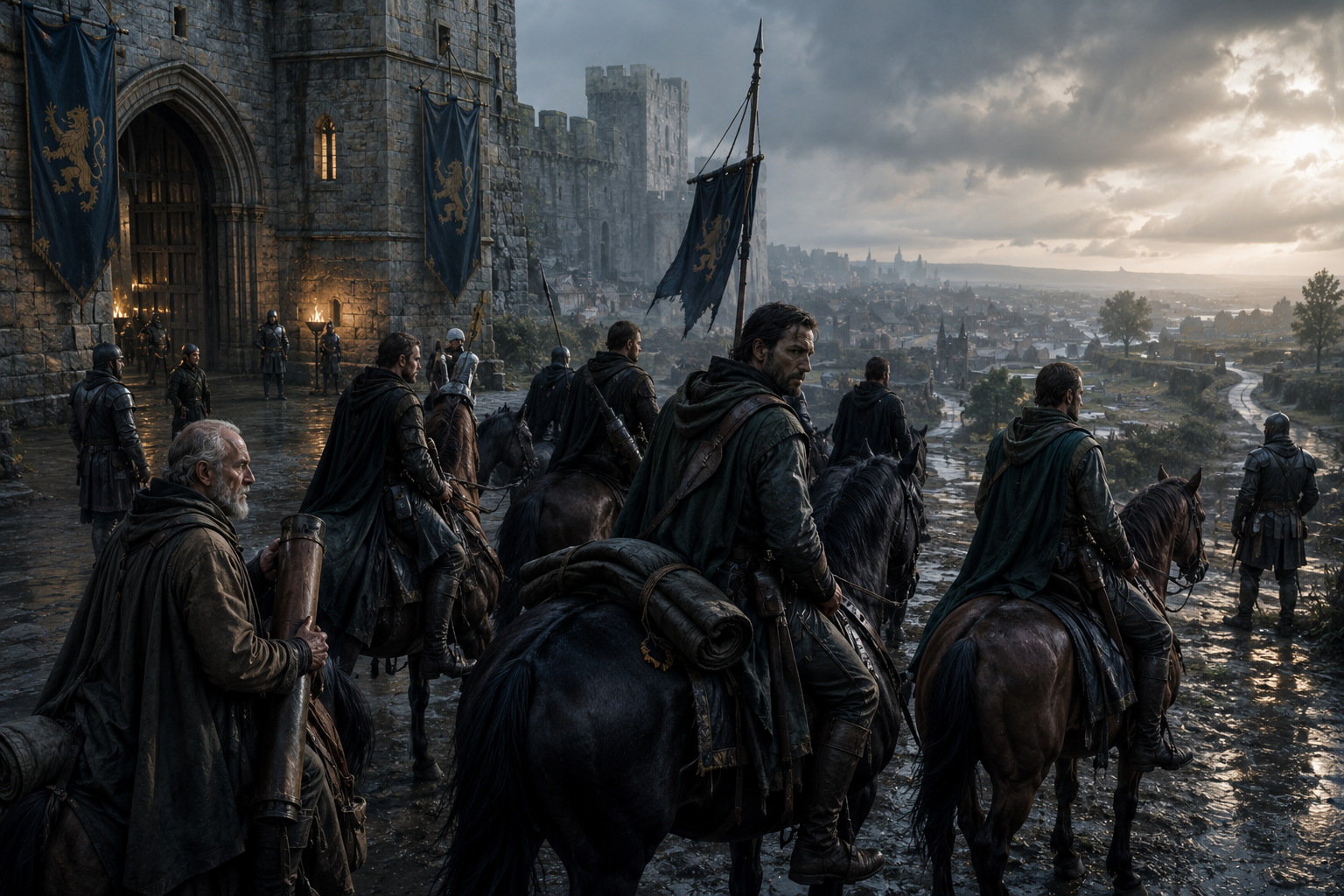
The third envoy from Ashenford arrived shortly before dawn beneath cold rain and hard western wind.
By the time the rider reached the outer gates of Stonewatch, both horse and messenger looked near collapse. Mud covered the lower half of the animal almost to the saddle straps, while the envoy himself struggled to dismount without assistance from the gate wardens waiting beneath torchlight.
The captain overseeing the gate recognized the seal immediately.
“Ashenford again,” he muttered quietly.
The envoy only nodded.
Within the hour, the message sat opened upon the king’s council table.
The chamber remained unusually quiet while the royal steward finished reading aloud.
“…trackers report the procession continuing inland beyond the western ridges. Conflicting sightings persist near Blackpine and the abandoned valley roads. Panic spreads among nearby settlements. We request guidance regarding defensive preparation and troop movement should the procession alter direction again…”
The steward lowered the parchment slowly.
For several moments no one spoke.
This was the third envoy from Ashenford in as many weeks.
Not the first frightened request from a distant township.
Not rumor.
Not drunken road stories brought by merchants.
Repeated reports.
Repeated uncertainty.
Repeated movement inland.
King Aldren stood near the western windows overlooking rain-dark rooftops and the harbor towers beyond the city walls. He had listened to arguments surrounding the procession for nearly two weeks now. Every military advisor offered different predictions. Every tracker returned with contradictory sightings. Each town believed itself threatened until the procession passed elsewhere.
And still the army marched.
“Has Northridge responded?” the king finally asked.
“Not directly,” the steward answered carefully. “Additional reports arrived from Bell Hollow and Dunmere during the night. Similar concerns.”
“Meaning?”
The steward hesitated.
“They no longer believe the procession follows military logic.”
A few councilors shifted uneasily at those words.
One older lord scoffed immediately. “Everything follows logic. We simply lack sufficient information.”
“Perhaps,” another replied quietly, “that is the problem.”
The king turned from the window.
“No,” he said. “The problem is silence.”
The room fell still.
“For weeks,” Aldren continued, “we have received reports, sightings, warnings, and contradictions from every western road while the kingdoms argue separately over rumors.” His eyes moved across the council table slowly. “That ends now.”
The royal steward straightened slightly.
“Your Majesty?”
“Send notices.”
Several councilors exchanged uncertain glances.
“To whom?” one finally asked.
The king answered without hesitation.
“Northridge. Veridor. Eastwatch. The river courts. The western clergy houses.” He paused briefly. “Any ruler, commander, or archivist possessing knowledge relevant to these events.”
The older lord near the end of the table frowned immediately. “You intend to gather them here?”
“I intend,” Aldren replied calmly, “to force the kingdoms to stop whispering separately while the roads collapse beneath panic.”
The steward moved quickly after that.
By midday, royal envoys departed Stonewatch beneath sealed authority carrying formal summons westward and inland through rain and worsening road conditions. Riders traveled toward fortified cities, monastery archives, military houses, and neighboring kingdoms already unsettled by the spreading uncertainty infecting the western roads.
The notices themselves remained carefully worded.
No declaration of war.
No formal alliance.
Only acknowledgment that the kingdoms faced a matter no longer contained within local borders.
An emergency gathering would be held at Stonewatch regarding the inland procession and the destabilization spreading across the western territories.
Attendance strongly requested.
That wording alone caused arguments almost immediately.
At Northridge, Lord Carrow reportedly laughed after hearing the summons read aloud.
“So now they panic properly,” he muttered.
Still, he agreed to attend.
Veridor responded more cautiously. Their court returned word three days later stating representatives would appear under specific conditions, including military neutrality during proceedings and limited armed escort within city walls.
Some rulers refused outright.
One southern lord dismissed the reports entirely as “northern superstition inflated by frightened roadwardens and weak local governance.”
Others hesitated longer.
Several clergy houses debated whether attendance implied political alignment rather than spiritual concern. One monastery agreed to send archivists but no military observers. Another refused participation entirely while quietly requesting copies of all tracker reports gathered so far.
Then there were those who arrived without invitation.
A historian from the eastern valleys appeared at Stonewatch claiming possession of older trade maps no longer recognized by the current kingdoms. A wandering archivist attached himself to a river convoy after hearing rumors of abandoned roads resurfacing west of Blackpine. Two lesser nobles from the border territories arrived early simply because they feared decisions might be made without them present.
And through all of it, beyond the roads crowded with envoys and frightened messengers, the procession continued inland.
Steady.
Silent.
Uninterrupted.
As though the gathering kingdoms meant nothing to it at all.
The first arrivals reached Stonewatch beneath gray skies and cold wind blowing inland from the western sea.
For nearly two days the roads approaching the city remained crowded with riders, supply wagons, armed escorts, clergy processions, and smaller delegations from surrounding territories hoping to reach the gathering before formal discussion began. Inns filled quickly. Stablehouses overflowed with horses and soaked travel gear. By the second evening, temporary fire pits burned throughout the lower districts where guards and retainers crowded beneath canvas shelters speaking quietly about the procession moving somewhere far beyond the western ridges.
The city itself had changed during the previous week.
People watched the arrivals carefully now.
Not with celebration.
With expectation.
Every banner entering the gates seemed to carry possibility with it. Perhaps this ruler possessed answers. Perhaps this commander understood the movement inland. Perhaps the clergy knew something hidden within older records.
But the conversations spreading through taverns and crowded streets rarely carried confidence for long.
Most of the arriving dignitaries looked tired.
And worried.
Lord Carrow of Northridge arrived first among the larger regional rulers, entering the city beside nearly forty mounted retainers wearing dark green cloaks streaked with road mud from hard travel through the western valleys. He wasted little time with formalities after entering Stonewatch, demanding updated tracker reports before even requesting chambers for the night.
“The procession crossed north again?” he asked sharply while studying the latest maps inside the western command hall.
“That is the most recent report,” Commander Halric answered.
Carrow stared down at the parchment.
“That route leads nowhere.”
“So we believed.”
The Northridge lord looked visibly irritated by that answer.
Every report seemed to end the same way now.
So we believed.
The representatives from Veridor arrived the following morning beneath heavier escort than most considered necessary. Nearly sixty mounted guards accompanied their delegation through Stonewatch’s eastern gate, their captain refusing at first to quarter troops outside the inner walls until King Aldren himself reaffirmed the neutrality terms agreed upon in earlier correspondence.
That disagreement alone delayed proceedings for hours.
Several western lords viewed Veridor’s precautions as insult.
Veridor considered them common sense.
The tension spread quickly through the gathering.
Some rulers already feared the kingdoms might fracture politically before the procession itself ever forced conflict upon them.
Clergy delegations arrived more quietly.
The western monastery houses sent archivists, scribes, and senior priests carrying sealed cases filled with copied manuscripts and damaged historical records retrieved from old vaults rarely opened except during matters considered regionally significant. Most traveled with minimal escort and spoke little after entering the city.
One elderly archivist reportedly requested immediate access to the western tracker maps before even removing his travel cloak.
Others came without formal invitation at all.
A gray-haired historian from the eastern riverlands appeared carrying rolled parchment maps tied carefully against rainwater beneath layers of waxed cloth. A lesser noble from the southern territories arrived claiming direct military experience against eastern raiding forces and insisted the kingdoms underestimated the danger entirely. Several smaller township leaders traveled independently after hearing rumors that decisions regarding western troop movement might soon be discussed within the council chambers.
By the third evening, Stonewatch no longer felt like a normal city.
It felt like a place waiting for something.
The meeting itself began beneath heavy rain.
King Aldren entered the western chamber shortly after midday while servants moved additional candles onto the long council tables crowded with maps, copied reports, and sealed correspondence gathered from nearly every western territory during the previous weeks.
For several moments no one spoke.
The room contained too many different kinds of power.
Rulers.
Military commanders.
Roadwardens.
Clergy.
Archivists.
Regional lords.
Historians.
Men and women who rarely occupied the same chamber peacefully now sat shoulder to shoulder listening to rain hammer against the high windows overlooking the city below.
Aldren allowed the silence to settle before speaking.
“For five weeks,” he said calmly, “the western kingdoms have received conflicting reports regarding the inland procession first sighted at Caer Dannon.” His eyes moved slowly across the chamber. “Settlements prepare for siege only to be bypassed entirely. Trade routes deteriorate beneath rumor and uncertainty. Tracker reports contradict one another almost daily.” He paused briefly. “Yet despite this confusion, one fact remains consistent.”
The king rested a hand lightly against the western map spread across the central table.
“The procession continues inland.”
No one argued.
Because every kingdom represented in the chamber had confirmed that much independently.
A military commander from Veridor finally spoke first.
“Then the solution appears obvious,” he said bluntly. “We intercept them before they move farther east.”
Several voices answered immediately.
“With what certainty?”
“Where?”
“You cannot even predict their next route.”
“And if confrontation provokes attack?”
The chamber quickly descended into overlapping argument.
Some demanded mobilization.
Others urged caution.
One southern lord insisted the kingdoms already appeared weak through hesitation alone. A monastery archivist countered sharply that no army should commit itself against a force whose objective remained entirely unknown.
“They have ignored every major settlement so far,” one clergy representative reminded the room.
“Until now,” another ruler replied.
Commander Halric finally struck the table hard enough to quiet several nearby arguments.
“That,” he said grimly, “is precisely the problem.”
Silence slowly returned.
Halric looked across the chamber carefully before continuing.
“We continue discussing the procession as though it behaves according to ordinary military strategy.” His hand moved toward the western ridge maps. “But every attempt to predict movement using conventional logic has failed.”
“That proves nothing supernatural,” Lord Carrow interrupted sharply.
“No,” Halric answered. “But it proves we do not understand what they are doing.”
An older archivist seated near the far end of the chamber slowly opened one of the weathered manuscript cases beside him.
Several nearby rulers exchanged visible irritation immediately.
“Ancient stories will not stop an army,” one muttered.
“Perhaps not,” the archivist replied calmly. “But they may explain why no one can predict where it marches.”
The room quieted again despite itself.
The old man carefully unfolded several damaged parchment pages covered in faded script and incomplete illustrations darkened by age.
“These records were recovered generations ago from monastery vaults near the western cliffs,” he explained. “Most historians dismissed them as fragmented folklore copied repeatedly over centuries.”
“And now?” King Aldren asked.
The archivist hesitated.
“Now I am less certain.”
He placed one brittle page carefully upon the table.
The drawing barely remained visible beneath age and water damage, but several figures near the chamber leaned forward immediately after recognizing what appeared to be roads or processional lines crossing beneath symbols no current kingdom used.
“There are references,” the archivist continued carefully, “to roads older than the western kingdoms themselves.” His finger moved slowly across faded script. “And repeated mention of a returning court.”
Several rulers scoffed openly.
“A myth.”
“Religious symbolism.”
“Ancient nonsense copied by frightened monks.”
“Perhaps,” the archivist admitted quietly. “But the records also describe settlements abandoned without siege and processions moving through territories while ignoring the cities of the age.”
The room fell uneasy after that.
Not convinced.
Disturbed.
Because even those dismissing the manuscripts could not entirely ignore how closely portions resembled the reports spreading across the western roads now.
One military advisor leaned forward slowly.
“You believe these writings describe the same force?”
“No,” the archivist answered honestly. “I believe they describe fear of something similar.”
That answer unsettled the chamber more than certainty would have.
And somewhere far beyond Stonewatch, beyond the flooded valleys and dark western forests, the procession continued marching inland beneath rain and silence while the kingdoms argued desperately over what they believed they had seen.
The arguments within the western chamber continued long after nightfall.
Servants replaced dying candles twice while rain battered the high windows overlooking Stonewatch below. Maps remained spread across nearly every table in the room now, cluttered with markings, rewritten reports, conflicting tracker routes, and notes copied hurriedly from older manuscripts brought by the monastery archivists.
Still no agreement formed.
Some rulers demanded immediate military response before the procession moved deeper inland. Others argued that committing armies blindly against an unknown force risked disaster. The clergy disagreed among themselves regarding whether the events carried political, historical, or spiritual meaning. Even the military commanders could not settle on basic strategy because no one could confidently predict where the procession would appear next.
That uncertainty infected every conversation.
“If they continue eastward,” one Veridor commander argued, “the river crossings must eventually matter.”
“And if they do not?” another replied immediately.
“They cannot march forever.”
“Why not?”
The question silenced several nearby voices.
Because no one truly knew anymore what limits applied to the procession moving through the western kingdoms.
Near midnight, King Aldren finally rose from his chair beside the council table. The chamber gradually quieted beneath the movement.
“We will not resolve this tonight,” he said calmly.
Several rulers looked irritated by that statement.
Others merely exhausted.
The king’s eyes moved across the gathered chamber slowly.
“But neither can we continue waiting for certainty while fear spreads unchecked across the western roads.” His gaze shifted briefly toward the maps covering the table. “The reports continue. The procession continues. And every kingdom represented here now understands that these events are no longer isolated to the smaller settlements.”
No one argued.
Even those dismissing the older manuscripts no longer denied the scale of the disruption spreading inland.
Aldren rested one hand against the edge of the table.
“So we begin with observation.”
Several commanders exchanged glances immediately.
The king continued.
“At dawn, a trusted royal detail will depart Stonewatch under direct authority of the crown.” He paused briefly. “Their purpose is not engagement.”
That statement came sharply enough to stop several military objections before they began.
“They will observe the procession directly,” Aldren said. “Track its movement. Confirm its routes. And determine whether these reports concerning abandoned roads and impossible crossings hold truth beyond frightened rumor.”
Lord Carrow frowned slightly.
“A small force?”
“A careful one,” the king answered.
Commander Halric remained silent for several moments before finally speaking.
“You understand the risks.”
“I do.”
“And if the detail fails to return?”
The king’s expression did not change.
“Then at least we will finally possess certainty about something.”
The chamber fell quiet after that.
Not because anyone felt reassured.
Because no one did.
The older archivist seated near the manuscript cases slowly lowered his eyes toward the damaged pages spread before him.
“They should avoid the western ridge forests after dark,” he said quietly.
Several nearby rulers looked visibly irritated again.
“You truly expect the crown to organize military movement around half-destroyed folklore?” one southern lord asked.
The archivist met his eyes calmly.
“No,” he replied. “I expect the forests to behave however they choose regardless of whether we believe the stories.”
That answer unsettled the chamber more than the manuscripts themselves.
King Aldren finally turned toward the royal steward standing near the rear doors.
“Send replies to the western settlements,” he ordered. “Ashenford. Bell Hollow. Dunmere. Harrow’s Ford. Inform them the kingdoms have begun coordinated action.”
The steward bowed immediately.
“And what exactly shall we tell them?” he asked carefully.
The king hesitated.
That hesitation did not go unnoticed within the chamber.
Because for all the arguments, maps, manuscripts, and gathered rulers now filling Stonewatch, no one present possessed true answers.
At last Aldren spoke quietly.
“Tell them their reports were heard.”
The steward lowered his head once more before departing the chamber with several scribes already gathering sealed correspondence from the tables nearby.
Outside, rain continued falling across Stonewatch while fresh riders prepared within the lower courtyards for hard travel through flooded western roads by morning.
Some carried messages toward frightened towns still waiting desperately for guidance from kingdoms no longer certain of themselves.
Others prepared to follow the procession itself into the dark western interior.
And somewhere beyond the ridges, valleys, and forgotten roads of the old country, the silent army continued marching inland beneath rain and darkness without changing pace even once.


.png)
.png)
.png)