%20(1).png)

Michiru was a woman who lived in the Soon. Her apartment in the Setagaya ward was less of a living space and more of a staging area for a version of her life that had never actually rendered — a clean, quiet apartment that nonetheless felt temporary, as if the walls were made of paper that might be folded up and packed away at any moment, the moment the real version of her life finally arrived to claim the space.
In the corner of her living room sat three large cardboard boxes, their seams sealed with heavy packing tape that had begun to yellow and curl at the edges, resembling the skin of something long dead. They contained a full set of dishes — the good kind, hand-glazed, purchased two years ago during a sale she had told herself she couldn't afford to miss — for the dinner parties she would host soon, in a house she hadn't yet bought, for friends whose faces had grown steadily blurrier in her imagination the longer the house failed to materialize. She had unpacked exactly one bowl from the top box, once, to check the glaze color against her kitchen light, and had never gotten around to unpacking the rest.
Her closet held its own quiet museum of intentions. A designer dress hung near the back, tags still attached, purchased for a promotion that remained perpetually one quarter away, always about to be announced at the next review cycle, then the one after that. Beside it, wrapped in tissue paper she refreshed twice a year out of some private sense of duty, sat a pressed lace handkerchief that had belonged to her grandmother, set aside for a wedding that had been postponed indefinitely because the timing wasn't quite right yet — not called off, never called off, simply held in a kind of suspended animation alongside everything else she was saving for a version of herself that hadn't arrived.
There was a stack of unopened invitations on the small table by her door, three of them now, each one a friend's birthday or a colleague's housewarming she had declined with the same polite, well-worn excuse — she would socialize more, soon, once things settled down, once the promotion came through, once she had the energy she kept expecting to have and never quite did. There was a message from her mother, four days old now, that she had read and then deliberately marked unread again, not because she didn't want to answer it but because answering it properly required an emotional effort she kept promising herself she would have available tomorrow.
There was a cabinet door in the kitchen that had come slightly loose on its hinge eight months ago, which she had meant to tighten with the small screwdriver sitting in her utility drawer, and which she still, every single morning, opened with the same practiced, careful angle that avoided the wobble entirely rather than simply fixing it.
None of this made her foolish, and she would have resented anyone who suggested it did. She was not lazy. She got up on time. She did her work well. She kept her apartment clean and her plants watered and her small daily obligations met with real competence. Her failure, if it could even be called that, was quieter and more structural than laziness — she had simply, somewhere along the way, trained herself to believe that her real life was a thing that began later, after the next milestone, once the conditions were finally right, and in the meantime the days themselves were something to be endured, a necessary and slightly dull rehearsal for a performance that hadn't started yet.
She didn't realize that a life spent entirely in rehearsal eventually stops counting as a performance in progress and starts counting as something else. She didn't realize that somewhere, in whatever accounting kept track of such things, her hesitation was being noted, tallied, weighed against some threshold she had never been told existed. She didn't realize that when you spend long enough waiting, you eventually become a permanent fixture of the waiting itself — an unindexed file sitting in a system that would, sooner or later, decide to clear its cache.
The Skip did not arrive with the dramatic flourish of a horror film. It arrived on a Tuesday evening, at 6:14 p.m., in the unremarkable silence of her kitchen, during that particular hour when the sun has finished its descent but the streetlights haven't yet reached their full amber glow, leaving the world in a hazy, low-resolution gray that made everything look slightly unfinished, slightly provisional — appropriately, though she couldn't have known that yet.
Michiru stood at the counter, the low hum of the refrigerator the only soundtrack to her routine, holding a heavy glass pitcher and pouring water into a tall tumbler, a mindless, mechanical act she had performed thousands of times without ever once really watching it happen. This time, for no reason she could name, she watched. She watched the liquid strike the bottom of the glass. She watched the bubbles rise and cling to the sides, catching what little light the kitchen offered.
A split second before the water reached the rim, the world blinked.
She found herself standing by the refrigerator again, holding the full pitcher. The glass in front of her was empty and dry, exactly as it had been minutes ago, before any of this had started.
She frowned, a small vertical line appearing between her brows, and told herself it was a lapse in concentration — a micro-nap, exhaustion catching up to her at the end of a long day. She tipped the pitcher again. The water splashed against the bottom of the glass. The world jolted, sharp and electric, a sensation that felt like a seizure behind the eyes, vibrating through her molars and down into her jaw. She was back at the fridge. Splash. Reset. Back at the fridge. Splash. Reset.
It was not a lapse in memory. It was a physical stutter in the rendering of reality itself, a needle skipping across a scratched record, a video file hanging on a single corrupted frame and refusing to advance past it no matter how many times it was pressed to try. She tried to drop the pitcher — tried to simply let it fall and shatter against the floor and break whatever this was through sheer physical disruption — but her fingers had locked into something that felt less like paralysis and more like a rendering state, muscles firing and retracting in a rhythmic, mechanical spasm that had nothing to do with her actual will.
She was a frame of animation the world refused to let play past. The sensation settled into a dull, vibrating ache deep in her bones, as though her own skeleton were trying to shake itself loose from her skin in order to escape the cycle her flesh was trapped in.
The anomalies did not stop at the pitcher. The kitchen clock above the stove, digital, reliable, jumped backward four minutes and then sat there, refusing to move forward again for what felt like an unbearably long stretch of frozen seconds. Her phone, resting screen-up on the counter, lit briefly with her mother's four-day-old message — the one she had read and quietly marked unread again — and as she watched, the little indicator blinked from read back to unread on its own, as if some invisible hand had reached in and undone the small, private lie she'd told the message.
She turned toward the hallway, meaning to walk to the bathroom and splash water on her face, certain that would clear whatever this was, and found herself, three steps later, standing beside the refrigerator again, no memory of turning around, no sense of having retraced her steps at all.
Her reflection in the dark window above the sink began lagging half a second behind her own movements — she raised a hand and watched the reflected hand rise a beat too late, a delay just long enough to feel deeply, physically wrong, the kind of wrongness that lived somewhere below conscious thought and simply screamed at the body to run. Sounds began repeating without warning: the refrigerator's hum catching on itself and looping, a single bar of it playing over and over like a scratch in a recording; the drip of the kitchen faucet, which she hadn't noticed dripping before tonight, repeating in a perfect, mechanical rhythm that never quite resolved into silence.
Her own breathing began to catch in the same loop, the exhale never fully completing before some invisible reset dragged her back to the start of the inhale, over and over, until she understood with a rising, suffocating panic that she was not merely witnessing malfunction anymore. She had lost ownership of her own body's basic continuity in space and time.
Then came the Tell.
The air in the kitchen turned heavy and ancient all at once, a change so total it was almost a physical pressure against her skin. The scent of the lavender cleaner she'd used that morning vanished instantly, replaced by a suffocating odor of wet ash, scorched silver, and the sharp ozone tang of a short-circuiting hard drive — the smell, she would think later, of a tomb sealed while its occupant was still breathing.
She tried to scream. Her throat caught in the Skip along with everything else, and every time she drew breath to cry out, the world snapped back to the very beginning of the inhalation, over and over, so that she was suffocating on her own silence, trapped in the middle of a sentence the world refused to let her finish.
The walls of her kitchen didn't collapse or fall away. They began to shred, slowly, like wet paper pulling apart under its own weight. The floral wallpaper her landlord had never bothered replacing peeled back in long, jagged strips, revealing beneath it not wood or insulation or wiring, but the skeletal, rib-like arches of a cathedral stretching upward into an impossible dark. The linoleum beneath her bare feet softened and grayed, texture shifting until she was standing on cracked, moss-veined stone instead. The refrigerator's hum thinned and vanished, swallowed by a silence so vast it had its own weight, a silence with the specific gravity of an enormous enclosed space rather than the comfortable quiet of an empty apartment.
She understood, in stages, the way you come to understand something too large to accept all at once, that she was no longer standing in her kitchen in Setagaya. And then, when the Skip finally broke — shattering around her like a sheet of black glass falling in slow motion — she wasn't.
She stood instead at the edge of an impossibly long stone nave, the floor beneath her ankle-deep in fine gray ash that shifted like sand and smelled faintly of the same scorched-silver odor that had first announced itself back in her kitchen.
Pillars rose on either side of her at intervals that made no architectural sense, each one carved with images she couldn't quite bring into focus no matter how directly she looked at them — she caught fragments only, an outline that might have been a wedding invitation fused directly into the stone, its wax seal still intact and unbroken after however long it had been sitting there; a shape further along that resolved, as she drew closer against her own will, into a set of luggage, packed and buckled and never carried anywhere, its handle worn smooth by a grip that had reached for it and, for whatever reason, never actually lifted it.
She passed what might have been a crib, still wrapped in the crinkled plastic it had shipped in, and did not let herself look at it for longer than a single unwilling glance. She passed a violin case, closed, dust thick enough on its latches to suggest decades rather than years. She passed shelves of books, each one marked with a bookmark sitting improbably close to its first chapter, as though every reader had set every book down at almost exactly the same early page and simply never picked any of them back up.
None of it was explained to her. None of it needed to be. She understood, the way you understand the rules of a nightmare without anyone stating them aloud, that she was walking through the physical residue of a thousand lives spent exactly the way she had spent her own — waiting for a door that had never actually been built, promising themselves a beginning that kept receding one horizon further every time they nearly reached it.
The ceiling, when she finally forced herself to look up, was lost entirely in a swirling violet-black vortex of thunderheads that produced no rain and no thunder, only a slow, silent churn that made the whole structure feel like it was breathing at a scale too large for her mind to properly hold. The arches groaned faintly under some invisible pressure, as though the entire cathedral existed under the accumulated weight of everything it contained.
She heard the chains before she saw anything else.
A dry, metallic slither, distant at first, resonating not quite in the air around her but somewhere deeper — in her teeth, in the bones of her jaw, an intimate and unwelcome kind of sound that felt less like hearing and more like being touched. Beneath it, fainter, came the click of small metal clasps opening and shutting somewhere far down the nave, rhythmic, patient, wet in a way that had no business belonging to metal, a sound like a heartbeat translated into hardware.
Then, at the very far end of the endless hall, she saw white.
Lace, pale and voluminous, visible against the black stone of a distant altar, and though the distance between them had to be enormous — thirty meters, perhaps more, the scale of the place refused to resolve cleanly in her eyes — she understood immediately, with a certainty that arrived in her stomach before it arrived in her thoughts, that whatever wore that lace was aware of her.
It did not walk toward her. It appeared closer. One heartbeat it stood at the distant altar; the next, without any visible crossing of the space between, it stood perhaps ten meters away, as though a section of film between those two positions had been cut cleanly out and discarded. Then five meters, arriving in the same abrupt, frameless way, the white lace suddenly simply present where empty air and ash had been a moment before.
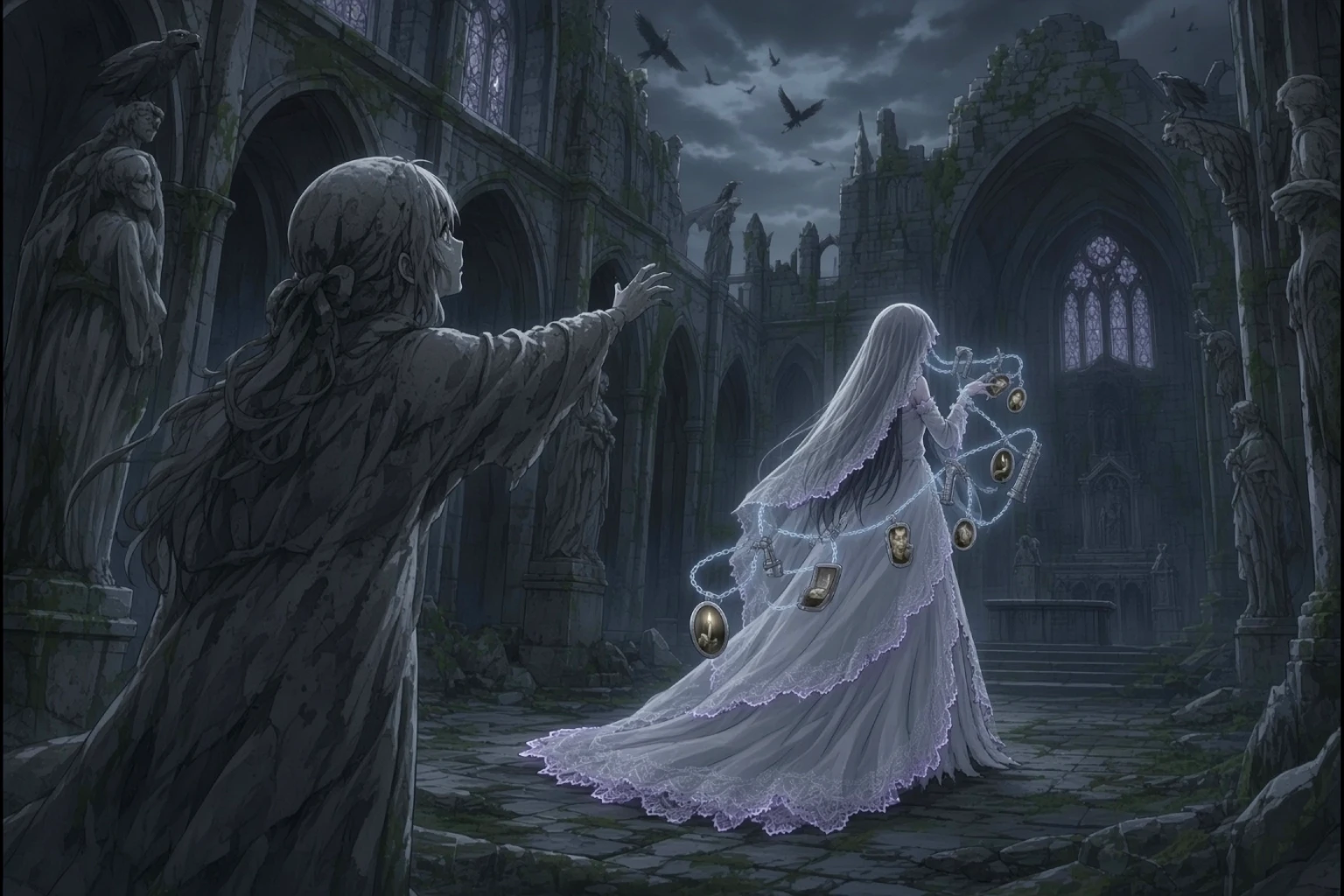
Up close, the scale of it became fully, horribly clear. The Vowkeeper stood nearly nine feet tall, draped in a voluminous, many-layered veil of white lace that fell around her like something frozen mid-pour, water caught in the instant before it could finish falling. The lace itself, on closer and entirely unwilling inspection, resolved into something far more intricate than fabric — every thread a microscopic chain, every repeating pattern a record, impossibly detailed, of some lost and specific moment belonging to someone who was, presumably, filed somewhere in this cathedral already.
Beneath the veil, where a face should have been, there was nothing at all — a blue-black vacuum that seemed to actively pull warmth out of the air, out of Michiru's skin, out of the marrow of her bones. Her breath began to frost as it left her, and the frost didn't fall or drift the way frost should; it simply hung suspended in the stagnant air, held in place by whatever law of stillness governed this place instead of ordinary physics.
Thin silver chains spilled from the darkness beneath the veil, and they too refused to fall — they floated instead, buoyed by some invisible pressure, drifting in slow loops around the Vowkeeper's still, silent form. Hanging from them were the smaller relics of a thousand stagnant lives: miniature stone altars that had never once hosted a ceremony, rusted wedding rings that had never touched a finger, silver lockets that clicked open and shut on their own in that same rhythmic, wet, organic pulse Michiru had heard from a distance and now had to stand and listen to up close, each click landing somewhere behind her sternum like a second, borrowed heartbeat.
The Vowkeeper did not speak. There was no declaration, no accusation, no whispered explanation of what Michiru had done to deserve this or what she might do to escape it. There was only the sound of the chains — dry, patient, endless — and the silence underneath that sound, which was somehow louder than anything Michiru had ever actually heard in her life.
That silence was the most aggressive thing in the entire cathedral. It carried the particular, total indifference of a deleted file, a closed case, a line quietly struck through in a ledger no living person would ever be permitted to read. To the Vowkeeper, Michiru understood with a clarity that felt like drowning, she was not a woman standing before a judge, was not someone to be pitied or condemned or given one final chance to explain herself. She was an error. A half-millimeter discrepancy that needed to be filed correctly so the rest of the system could keep running smoothly around the gap she'd leave behind.
She tried to run.
The ash beneath her feet swallowed her steps up to the ankle with every stride, each one costing her more effort than the last, as though she were wading through the accumulated remains of a billion burned, unmailed letters. The faster she pushed herself, the more the Skip reasserted its grip — her legs drove forward and then snapped back to where they'd started, forward and snapped back, running in place inside a world that had apparently forgotten, or simply refused, to calculate her new position.
She tried to drop to the ground and crawl instead, thinking absurdly that a lower target might move faster than a body fighting to stay upright, and found her hands sinking into ash that hardened around her fingers the instant she tried to push off it, holding her in place like something already half-set in stone. She grabbed for one of the floating silver chains nearest her, some desperate instinct telling her that breaking even one link might unravel the whole mechanism, and the chain didn't break — it simply passed through her closing fingers like something that existed one layer further away from her than the rest of the world, untouchable, indifferent to her grip.
"I'll do it now," she said, or tried to say, the words tearing loose from somewhere far more honest and desperate than anywhere she usually let herself speak from. "I'll go back. I'll open the boxes. I'll call him — I'll call my mother back, I'll answer everything, I'll stop waiting, I promise, I'll stop—"
The Vowkeeper did not turn toward her. Did not pause. Did not, in any way Michiru could detect, register that a bargain had been offered at all.
That was the worst part, worse than the cold or the ash or the chains. It wasn't cruelty. Cruelty would have required the Vowkeeper to care enough to refuse her. This was something colder than refusal — the simple, absolute absence of a listener on the other end of the promise, the way an unplugged machine doesn't reject the signal you send it, because there's no circuit left for the signal to travel along at all.
The chains found her wrists a moment later, wrapping around them with a gentleness that was somehow more horrifying than force would have been. They didn't feel like cold metal against her skin. They felt like duration itself, like the physical weight of every "I'll do it tomorrow" and every "just one more month" and every "I'm not ready yet" she had ever quietly told herself, compressed down into something with actual mass, and it was so much heavier than she would ever have guessed those small, ordinary excuses could add up to.
The Vowkeeper leaned down toward her then, the void beneath the veil drawing close enough that Michiru could feel its cold pressing directly against her face, and in that darkness she began, gradually, to see.
Faces. Thousands of them, layered impossibly deep, extending back further than any single void should have been able to contain, each one blurred and low-resolution, like footage compressed past the point of clarity, partially rendered, features smoothing into approximation rather than detail. They were not screaming.
That, somehow, was worse than screaming would have been. They wore expressions of anticipation, patient and open, faces still angled toward futures that had never arrived and now never would, caught in the specific, permanent posture of people who had genuinely believed, right up until the very last recorded moment of their belief, that there would still be time. Michiru understood, without being told, without needing to be told, that every one of those blurred faces belonged to someone who had once stood exactly where she was standing now, saying some version of the same desperate promise she had just tried to offer.
The Vowkeeper straightened and drew a locket from the folds of her veil — small, silver, polished to a mirror shine so complete it seemed to actively reject the ash and gloom of the cathedral around it, a perfect, empty surface waiting to be filled.
She held it up, and for one unbearable second Michiru saw her own reflection in it with a clarity sharper than any mirror had ever offered her. She saw a woman who was always about to start. Always about to change. Always about to actually, finally begin living the life she'd spent years carefully arranging the props for.
As their eyes met in that small silver surface, something in her began to drain.
Her name came first — she reached for it and found the letters slower to arrive than they should have been, a half-second lag before *Michiru* assembled itself in her own mind, the same unnatural delay she'd watched in her own reflection back in the kitchen, except now it was happening inside her instead of outside. Her face went next, or her sense of it — she tried to picture herself and got only a general shape, an approximation, features she couldn't quite hold steady long enough to be certain they were hers.
The wedding that had been postponed indefinitely receded from something that had once ached with specific, personal weight into something abstract and distant, a concept that had happened to someone whose life she was only now remembering she'd once been asked to summarize. Every memory she reached for came back thinner than the last, converted from something lived into something merely recorded, filed, archived — the emotional charge bled out of each one until all that remained was the bare fact of it, stripped of everything that had once made it hers.
Her body began to change last, and by then she had almost stopped being present enough inside it to fully register the change as it happened. Her skin cooled and hardened by degrees, grain rising through it the way grain rises through stone, gray spreading outward from her fingertips, up through her wrists where the chains still held her, toward her shoulders, her throat, her face.
She did not die in any sense she would have recognized as dying. She simply stopped being separate from the architecture around her, her outstretched hand freezing mid-reach toward a future that had, somewhere in the space of a single locket closing, been quietly redacted from the master script entirely.
The Vowkeeper snapped the locket shut. The sound was small and clean and absolute — a single definitive period at the end of a sentence that would now never be finished by anyone, least of all the woman it had belonged to.
The entity turned without ceremony, her massive lace train sweeping a wide arc through the ash behind her, and drifted back toward the darkness surrounding the distant altar in the same frameless, impossible way she had arrived — appearing further away each time Michiru's stone eyes, if they could still be called eyes, managed to track her, until the white had folded itself entirely back into the black beyond the altar and the cathedral returned to its enormous, breathing silence.
She was not a villain who needed her actions justified to anyone, least of all to the fixture she had just added to the collection. She was the sentinel of the stagnant, the quiet curator of the Hollow Echo, and she required no audience, no confession, no final understanding from the people she filed away. She simply was, in the way that gravity simply is, indifferent to whether anything caught in it had ever meant to fall.
In the apartment in Setagaya, the glass of water sat on the kitchen counter, perfectly full, exactly as it had been in the instant before the first Skip. The three cardboard boxes remained stacked in the corner of the living room, seams still sealed with their yellowing tape. The designer dress hung in the closet, tag still attached, waiting for a promotion that would now genuinely never come, in any sense of the word. The lace handkerchief sat folded in its tissue paper, waiting for a wedding that had quietly, finally, become permanent in its postponement. The unopened invitations still sat on the small table by the door. Her mother's message sat unread, and would remain unread now for a reason far more complete than the small daily avoidance that had marked it that way before.
The only thing missing from the apartment was the woman who had once promised, in a hundred small and ordinary ways, that she would get to all of it soon.
The district maps of Setagaya recorded no cathedral. The city's census recorded no gap where Michiru's name had been, no formal notice of anything having changed at all, because nothing in the official record ever would. She had not died, not in any sense the city's systems were built to track. She had simply been redacted — quietly removed from the active, ongoing version of the world and filed, permanently, into the archive of the Un-Place, where the only sound that remained was the perfect, terrible silence of a promise that would now never be kept.


.png)
.png)
.png)