%20(1).png)

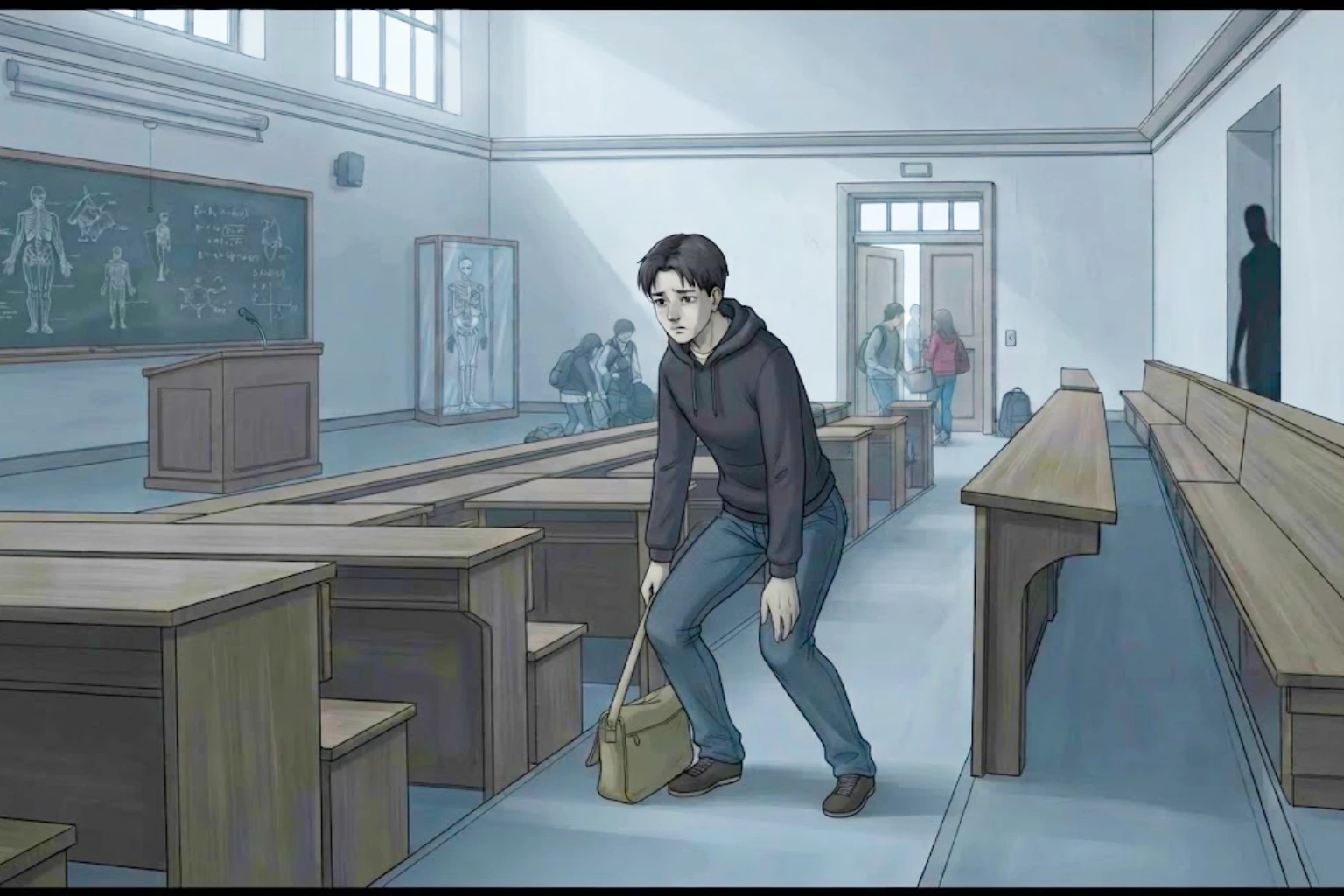
The lecture hall smelled the way it always did on Tuesday afternoons in late October: old radiator heat, coffee going cold in paper cups, the faint mustiness of textbooks that had passed through too many hands. Theo had claimed his usual seat near the middle of the room, close enough to see the slides without craning his neck, far enough back that Professor Alvarez wouldn't call on him if he happened to be scrolling through his phone under the desk. It was a decent arrangement, one he'd worked out over the first few weeks of the semester through a process of trial and error that had more to do with sightlines and escape routes than any real academic ambition.
The chairs in that hall were a special kind of miserable. They were bolted to long wooden benches in tiered rows, the kind of furniture that had probably been installed sometime in the 1970s and never once reconsidered, and after fifty minutes of sitting in one, Theo's lower back would begin to complain in the specific, nagging way it always did. He'd had the problem for years now, ever since high school, when a combination of bad posture, a backpack too heavy for its own good, and a habit of studying hunched over his desk until two in the morning had settled into his spine like sediment. His mother liked to say he sat like a question mark. His last visit to a doctor, over a year ago now, had produced a shrug and a recommendation to stretch more, sit up straighter, maybe look into a standing desk. He hadn't done any of those things. He'd simply learned to live with the low, persistent ache that flared up whenever he sat too long in one position, the same way a person learns to live with a squeaky floorboard or a car that pulls slightly to the left.
Today the ache had shown up around the twenty-minute mark, a tightness gathering low across his lumbar spine, spreading upward in a slow crawl toward his shoulder blades. He shifted in his seat, trying to find some angle that would relieve the pressure without drawing attention, and it was somewhere in the middle of that shifting that he first noticed the sound.
It was small. That was the first thing about it. Small and dry, a short percussive click that could have belonged to almost anything. A pen being tapped against a desk. A retractable mechanism being pressed and released. The particular creak of an old wooden bench settling under someone's weight. He didn't think about it at all the first few times he heard it. It was simply part of the room's ambient noise, folded in with the low hum of the projector fan and the occasional cough from somewhere near the front.
It was only when the sound repeated with a strange, deliberate evenness that some small, unconscious part of his attention snagged on it.
A click. A pause just long enough to make him wonder if he'd imagined it. Then two more in quick succession.
He glanced up from his notes, more out of habit than genuine curiosity, and scanned the rows around him. Nothing unusual presented itself. A girl two seats to his left was chewing the end of her pen, occasionally scribbling something in her notebook. A guy near the aisle had his phone angled low in his lap, thumb moving in the practiced rhythm of someone scrolling through something he wasn't supposed to be looking at during class. Farther up, someone yawned. The professor's voice continued its steady drone about supply elasticity, unbroken, unbothered.
None of it explained the sound. But none of it seemed particularly strange either, and after a few seconds Theo returned his attention to his notes, chalking the noise up to some minor mechanical annoyance he'd probably never identify and would forget about by the time he left the building.
The ache in his back, however, had not gone anywhere, and a few minutes later he found himself shifting again, rolling his shoulders back in a slow arc, trying to work some of the stiffness loose without looking like he was doing calisthenics in the middle of a lecture. There was a soft, satisfying crack somewhere between his shoulder blades, the kind of release that offered maybe thirty seconds of relief before the tightness began creeping back in.
And in that thirty seconds, right on the tail of the crack, the sound came again.
Two short clicks, close together, then a pause.
He went still.
It wasn't that the sound itself had changed. It was that its timing had lined up so neatly with his own movement that for a strange, suspended moment it felt less like coincidence and more like response, as though something in the room had been listening for the crack of his spine and had answered it in kind. He sat with his pen hovering over his notebook, waiting to see if it would happen again, half expecting the sensation to dissolve the way half-formed suspicions usually did once you looked at them directly.
The lecture went on. Someone near the front laughed quietly at some aside the professor had made. A phone buzzed against a desk and was hastily silenced.
Nothing else happened for a while, and Theo told himself, with the particular confidence of someone eager to stop thinking about something faintly unsettling, that he'd simply strung together two unrelated sounds into a pattern that didn't actually exist. People did that constantly. It was the same instinct that let you see a face in a power outlet or hear your name in the static of a fan. He went back to copying down the professor's bullet points about price ceilings, and for the better part of ten minutes, he mostly succeeded in forgetting about it.
Then his lower back tightened again, sharper this time, and without quite thinking about it he pressed himself back against the hard wooden slats of the chair, arching slightly to stretch out the muscle before it locked up entirely.
The click came instantly. Not delayed. Not overlapping with some ambient noise he could point to as its more mundane origin. It arrived in the same breath as his movement, precise and small, like a key turning cleanly in a well-oiled lock.
He straightened slowly, an odd prickle moving up the back of his neck.
"Okay," he murmured, mostly to himself, the word barely audible over the hum of the projector. He glanced sideways at the girl still absorbed in her notebook. She hadn't looked up. Nobody had looked up. Whatever he was hearing did not seem to exist for anyone else in the room, which was either a testament to how quiet it was or a sign that something was wrong in a way he didn't yet have the vocabulary to describe.
He turned in his seat this time, more deliberately, scanning the rows behind him under the pretense of checking the clock mounted near the back wall. Rows of familiar backs and bent necks greeted him, nothing out of place, nothing that could account for the sound. His eyes swept toward the far corner of the hall, near where the tiered seating ended and the wall dropped into shadow beneath the emergency exit sign, one of the few spots in the room the fluorescent lighting never quite reached.
It took his brain a moment to process what his eyes had already found.
Someone was there. Low to the ground. Crouched in the dim wedge of space between the last row of seats and the wall, in a position that made no immediate sense for a lecture hall. Not sitting on a chair. Not leaning against the wall the way a student might while waiting for a friend. Crouched, one knee bent beneath him, the other leg extended out for balance, hunched over something on the floor with the total, absorbed focus of a person examining an intricate piece of machinery.
Theo's first assumption, offered up quickly by the part of his brain that preferred boring explanations, was that it was a janitor. Someone fixing a loose floor panel, maybe, or retrieving something that had rolled beneath the seats. But the man's coat didn't match that assumption. It was long, dark, extending almost to the floor around him in loose, heavy folds that didn't seem to catch the light the way normal fabric did. And his posture, even crouched, held an unnatural evenness to it, a kind of balance that didn't wobble or shift the way a person's naturally does when they're bent over something on a hard floor.
His hands were moving.
Theo could see that much even from a distance, the faint motion of fingers working at something below the line of the last row of seats, out of full view. And every so often, in time with some motion Theo couldn't quite see, the sound came again. That same dry click, small and exact, drifting across the room and settling into the air like it had been placed there rather than produced by anything as ordinary as friction or metal.
He leaned slightly to his left, trying to get a better angle without being obvious about it, aware on some instinctive level that he did not particularly want to draw the attention of whoever was crouched in that shadow. Between the gaps of the seats ahead of him, he caught a glimpse of pale, curved shapes cradled in the man's hands. Long. Segmented. Each piece fitted to the next in a way that looked almost architectural, like vertebrae strung along some invisible thread, if vertebrae could be plucked whole from a body and arranged with the fastidious care of someone assembling a puzzle.
The thought arrived and then immediately felt absurd, the kind of image his tired brain might conjure at the end of a long day, half real and half invention. He blinked, trying to clear it, and the shape in the man's hands remained exactly what it had first appeared to be.
Bone.
Not scattered. Not disordered the way you'd expect debris to be. Arranged with obvious intention, each segment measured against its neighbor, adjusted, set back into place. The man tilted one piece, held it up as though inspecting the curve of it against some invisible standard, then brought it down again to tap lightly against the segment beside it.
Click.
The sound that had been haunting the edges of Theo's attention for the last fifteen minutes now had a clear and undeniable source, and understanding that did nothing to make it less strange. If anything, watching the man work made the sound worse, transforming it from an ambient irritation into something closer to a heartbeat, small and steady and entirely too deliberate.
"That's..." Theo started to say, not really addressing anyone, his voice trailing off before he could commit to a word that might explain what he was looking at. He glanced quickly toward the guy on his right, the one who'd been scrolling through his phone earlier, hoping for some shared reaction, some confirmation that he wasn't the only person in the room registering this. The guy didn't look up. His thumb kept moving across the screen in its steady, indifferent rhythm.
Theo turned back toward the corner.
The man had stopped moving.
His head, previously angled down toward the object in his hands, had lifted. Slowly. Not with any sudden motion, nothing that would have drawn the eye of anyone not already watching closely, but with the unhurried certainty of someone who had simply finished one task and was now beginning another. And though the shadows in that corner of the room made it difficult to see any real detail of his face, Theo had the distinct, uncomfortable sense that whatever gaze existed there was no longer pointed down at the floor.
It was pointed at him.
He told himself it could have been anyone's attention, could have been directed at some point beyond him, at the clock, at the wall, at nothing in particular. But the sensation crawling up the back of his neck did not agree with that interpretation, and after a few seconds of watching that unmoving silhouette, Theo found he could not look away either, caught in the strange, suspended stillness of being observed by something that had not yet decided to move.
The lecture continued behind him, Professor Alvarez's voice rolling steadily through a point about market equilibrium, entirely unbroken by whatever was happening in the shadowed corner of the room. Someone a few rows up shifted in their seat. A page turned. All of it sounded, suddenly, very far away, as though the ordinary business of the classroom were happening on the other side of a pane of glass.
Then the man stood.
He unfolded upward with none of the awkwardness a crouched position should have produced, no stiff unbending of knees, no bracing hand against the wall. He simply rose, smoothly, continuing to rise slightly past the point where Theo expected him to stop, until it became clear that he was taller than any reasonable estimate Theo might have made from his crouched position. Not grotesquely so. Not in the exaggerated way of nightmare, but with a kind of elongation that made his proportions feel subtly, deliberately wrong, as though he had been built according to a slightly different, more efficient set of measurements than the rest of the room's occupants.
His posture, once upright, was flawless. Not stiff in the way a soldier stands at attention, not artificially straightened, but aligned with an evenness that made Theo abruptly, uncomfortably aware of his own crooked shoulders, the slight forward tilt of his neck that years of hunching over laptops and textbooks had carved into permanence.
The coat settled around the man's frame as he stood, brushing the tops of what might have been boots, and in his hands, held loosely at his side now, the pale segmented structure curved gently with his movement, docile as a sleeping snake.
He began to walk.
There was nothing predatory in the pace. No stalking crouch, no sudden burst of speed. He walked the way a craftsman might walk across a workshop floor toward a tool he intended to use, unhurried because there was no reason to hurry, certain because the outcome had already been decided somewhere beyond argument. And with each step his shoes met the floor, a thin pale line bloomed outward from the point of contact, spreading in delicate branching patterns across the old wood, like frost except paler, denser, structured in fine interlocking ridges that resembled nothing so much as bone knitting itself into existence along the grain of the floor.
Theo's pulse had picked up somewhere in the last several seconds without his fully noticing, and it was only now, watching those white spirals spread and settle in the man's wake, that the fear fully arrived, cold and immediate, cutting through the fog of curiosity that had carried him this far.
"Hey," he said, louder this time, twisting in his seat to look at the people around him. "Do you guys not—"
The girl beside him didn't look up. The guy with the phone didn't look up. Somewhere near the front, the professor's voice continued without interruption, as steady and untouched as if nothing at all were happening thirty feet behind her.
The room hadn't vanished. He could still see it all: the rows of bent heads, the dull fluorescent lighting, the whiteboard scrawled with graphs. But it had gone slightly soft at the edges, muffled, distant, the way a television left on in another room sounds when you're trying to focus on something closer. He was still in the lecture hall. He was also, somehow, entirely alone in it.
The man closed the distance steadily, each footfall leaving another pale bloom of bone-pattern behind him, the spirals from his earlier steps still faintly visible, fading now like breath on glass.
Theo pushed his chair back, the legs scraping loudly against the floor, and this time someone did glance over. A guy near the aisle turned his head briefly at the sound before returning his attention to his notes with the mild, incurious indifference of someone who'd registered a noise and immediately decided it wasn't worth thinking about further.
"This isn't funny," Theo said, though there was no one nearby who seemed to be finding it funny, no one at all, really, except the tall shape closing the last several feet of distance between them with unhurried, deliberate steps.
Up close, the details resolved with a clarity that made his stomach drop. What he had taken for gloves in the dim corner of the hall were not gloves at all. The hands were long, far longer than human proportion allowed, each finger jointed in what looked like twice the usual number of places, moving with the fluid, layered articulation of something built rather than born. They were bone. Not covered in bone, not wearing some approximation of bone. They were the thing itself, pale and dry and faintly luminous under the classroom's fluorescent lights, clicking softly against each other with every small adjustment.
He tried to take a step back.
His body responded, but slowly, as though the signal traveling from his mind to his legs had to pass through some new and unfamiliar delay, some brief hesitation where his intention and his motion no longer aligned as cleanly as they once had. He managed half a step before the man stopped in front of him, close enough now that Theo could see the utter stillness of his face, a face that held no anger, no hunger, no cruelty of any recognizable kind. Only attention. A quiet, thorough attention that moved from Theo's eyes down along the line of his shoulders, and settled, finally, at the small of his back.
He felt it the moment the man's gaze arrived there. A tightening, sudden and sharp, as though the ache he'd been nursing all class had been picked out of the general hum of his body and isolated, spotlighted, made suddenly, unbearably specific. He straightened without meaning to, some old reflex trying to correct decades of bad posture in a single instinctive motion, and the man's head tilted very slightly at the sight of it, as though confirming something he had already suspected.
The bone fingers lifted. One long digit tapped once against the segmented structure still held loosely at his side.
Click.
Theo's breath came shallow and quick now. He was aware, in a way he had never quite been before, of every small imperfection in his own posture: the way his neck jutted forward when he read for too long, the faint unevenness between his shoulders that had been there since he was seventeen, the persistent, low twist in his lower back that no amount of stretching had ever fully corrected. It was as though the man's attention had illuminated each flaw individually, laid them out for inspection the way you might lay out tools on a workbench, and there was something deeply, unbearably violating about being known that specifically by something that had never spoken a single word to him.
"This is stupid," Theo said, mostly to steady his own voice rather than out of any real conviction. The word came out thinner than he intended.
The man did not respond. He simply studied him a moment longer, and then, with the same unhurried certainty as before, took the final step that closed the distance between them entirely.
His hand rose.
Not toward Theo's face, not in any gesture of aggression. It simply lifted, fingers extending, and paused in the air a few inches from his chest, adjusting minutely, as though measuring some invisible distance, calibrating an angle that only the man himself could perceive. It was, Theo would think much later, the single most frightening moment of the entire encounter, more frightening even than what followed, because in that small hovering pause he understood with total clarity that whatever was about to happen had already been decided, planned, accounted for. There would be no negotiating with it. There would be no reasoning. He had already been measured and found to require correction, and what came next was simply the execution of that finding.
The hand settled against his back.
The contact was cold, colder than he expected, but gentle in a way that felt almost clinical, the kind of touch a doctor might use when checking for tenderness along an old injury. He felt the individual fingers press lightly at specific points along his spine, one after another, moving downward in a slow, careful sequence, as though counting vertebrae, confirming their position, verifying something against an internal standard he had no access to.
Then the pressure increased.
Not violently. Not with any sudden force. It simply deepened, steady and unrelenting, and somewhere beneath that pressure Theo felt something shift.
It was not pain, not in the way he understood pain. There was no tearing, no burning, no sharp announcement of damage. What he felt instead was a strange, internal loosening, as though some long-fixed structure inside him had quietly given up its tension and begun, very slowly, to separate. His knees weakened. He did not fall. Some part of him understood, with a clarity that felt almost clinical in its own right, that he was not being permitted to fall, that his body was being held in careful alignment even as it was disassembled from within.
The sensation moved upward, vertebra by vertebra, a slow unwinding that traveled the length of his spine with mechanical precision. He felt each segment disengage in turn, not torn free but released, as though it had always been designed to come apart this way, joints that had simply been waiting all his life for the correct hand to know how to unlock them. His vision blurred at the edges, not into darkness but into a strange, momentary misalignment, the room tilting fractionally out of true before snapping back into place.
He looked down, though he was not entirely certain his body was still following his instructions to do so, and saw it emerging from behind him, curving into the space between himself and the man in a long, pale arc.
His spine.
Intact. Segmented. Flexible in a way that seemed, absurdly, almost beautiful, each vertebra catching the fluorescent light as it extended outward, still faintly connected to some part of him he could no longer clearly identify, coiling gently the way a length of rope coils when it is laid down with care rather than dropped.
The man held it up, turning it slightly, examining the curve of it the way a jeweler might examine a chain for flaws. One finger tapped lightly against a segment near the base, then moved higher, tapping again, listening for some quality only he could perceive in the sound it produced. He adjusted the angle, testing its give, its resistance, its yield, treating the whole structure with a care that felt, horrifyingly, like the care of a craftsman rather than the carelessness of a predator.
Theo did not collapse. He remained upright, swaying only slightly, held together by whatever unnatural logic governed the moment, watching a piece of himself be evaluated in the open air a few inches from his own chest.
There should have been more horror in it than there was. He understood that, even as it was happening, some detached corner of his mind noting with a kind of clinical dismay how calm the rest of him remained, how the absence of pain made the whole experience feel less like violation and more like a procedure he had, on some unconscious level, already agreed to undergo.
The man lowered the spine gently, coiling it against his side where the earlier structure had rested, and reached again, seemingly into nothing, into the pale spirals still faintly glowing across the floorboards, or perhaps into some space that did not correspond to the room at all. What emerged in his hand this time was different. A single unbroken column of white, seamless from end to end, without joints, without segments, without any of the natural articulation that had defined the thing he'd just removed. It looked less like an organ and more like an object, something manufactured rather than grown, flawless in the particular way that only things without flexibility can be flawless.
He brought it forward and pressed it gently against the space where Theo's spine had been.
It aligned instantly.
There was no searching, no adjustment, no trial and error. The column settled into place as though the space had been shaped for it in advance, and the moment it made contact, something in Theo's chest locked into position with a soft, internal click that he felt more than heard, a sensation of absolute, final fit.
His breath left him in a sharp, involuntary rush.
His spine straightened.
Not by any effort of his own. His shoulders drew back, his neck aligned itself over the center of his body, the low, persistent ache that had lived in his lower back for the better part of a decade simply ceased to exist, vanishing so completely that for one disorienting moment he could not remember what it had felt like to carry it.
And beneath the shock, beneath the fear that still had not fully caught up with what had happened to him, there was something else. A small, unwelcome flicker of relief. Of rightness. As though some old, nagging problem he'd carried without ever fully addressing had finally, quietly, been resolved. He hated that he felt it. He hated it more because some part of him agreed with it, recognized the correction as a correction, understood on some bodily level that the ache was gone and that the absence of it felt, for one brief and terrible instant, like being fixed.
The man stepped back, studying him the way he might study a completed piece of work, head tilting slightly, one final soft click of bone against bone as he adjusted something in his own posture and seemed, in whatever manner such a thing could be read on a face like his, satisfied.
Then he turned and walked away, his steps once again leaving faint pale spirals in their wake, spirals that spread only a moment before slowing, fading, dissolving back into the ordinary grain of the wood as though they had never been there at all.
The room reasserted itself around Theo in stages. The professor's voice returned first, mid-sentence, discussing some point about consumer surplus that had apparently been continuing the entire time. Then the ordinary shuffle of the classroom folded back in: pages turning, a chair creaking, someone quietly laughing at something on their phone.
"You okay?" The girl beside him was looking at him now, brow furrowed slightly, though there was nothing alarmed in her expression, only the mild concern you might offer someone who had stood up abruptly for no clear reason.
He opened his mouth to answer and found the motion of speaking came easily enough, his voice steady, oddly calm.
"I'm fine," he said, though it didn't feel entirely true, not yet, not until he tried to sit back down and discovered that his body would not fold at the middle the way it needed to. His hips bent slightly, an old habitual motion, but his spine remained locked in its new, perfect line, refusing the downward curve required to lower himself into the chair. He stopped halfway, suspended in an awkward crouch that clearly looked, to anyone watching, like hesitation rather than inability.
"Dude, sit down," the guy near the aisle said without looking up, some faint note of amusement in his voice, as though Theo were performing some kind of bit for an audience that had already lost interest.
"I'm trying," Theo said, and heard how strange that sounded even as it left his mouth.
He tried again, attempting to angle his hips forward, to let his back curve into the shape the chair demanded, and again his spine held firm, an unmoving column running from the base of his skull to somewhere below his waist, permitting no compromise, no flexion, no negotiation with gravity or furniture design. He managed, finally, by bending almost entirely from the knees, to lower himself into something like a seated position, though his back remained rigidly upright the entire time, refusing to rest against the chair's angled support the way it always had before.
He reached down for his bag, intending to retrieve a pen he'd dropped sometime in the last several minutes, and found that his arm extended only so far before the immobility of his torso stopped him short, unable to bend forward the necessary few inches to close the distance. He had to slide the chair back, stand, crouch fully at the knees, and retrieve it from that position instead, aware the entire time of how strange the movement must look, mechanical and deliberate in a way that had nothing to do with normal human clumsiness.
Someone a few rows back said something to a friend, and when Theo turned to see who, his neck rotated only partway before stopping, some new limit reached that his body had never possessed before, and he found himself pivoting his entire upper body, shoulders and torso together, as one solid, unbending unit, just to bring the source of the sound into view.
The ache was gone. He kept returning to that fact, testing it the way you test a bruise, pressing at the space where it should have lived and finding nothing there at all, no tightness, no complaint, no small betrayal of years of poor posture and long hours hunched over books. His back had never, in his entire adult life, felt so free of pain.
It had also never felt so thoroughly, permanently sealed shut.
He sat through the remainder of the lecture upright in a way he had never managed before, spine perfectly straight, shoulders perfectly level, neck aligned exactly over the center of his body, and understood, somewhere in the quiet horror settling beneath his ribs, that this was not a temporary side effect of shock or adrenaline. This was simply what his body was now. Corrected. Aligned. Improved by whatever measure the man in the long coat used to judge such things, and entirely, irreversibly incapable of the small daily bendings that a human spine exists to perform.
He thought, as the lecture finally ended and students began gathering their things around him, rising and stretching and twisting in the easy, thoughtless way that healthy backs allow, that there was no one he could tell this to who would understand what had actually happened. He could say his back didn't hurt anymore, and people would be pleased for him, would ask what he'd done differently, whether he'd started stretching, whether he'd finally bought that ergonomic chair he'd complained about for years. He could not say that the ache had been surgically evaluated and replaced by something that had never been born, something built instead, in the same unhurried, exacting way a craftsman finishes a piece of furniture he intends to last far longer than the person using it.
He rose from his seat with the same awkward, knee-bent maneuver as before, aware of the strange, effortful economy of his own movements now, and made his way up the aisle toward the door, back perfectly straight, each step landing with an evenness that would have looked, to anyone watching closely, almost graceful.
For the first time in his life, his back did not ache.
It did not move, either, and as he stepped out into the gray afternoon light beyond the lecture hall doors, he understood, with a calm that frightened him more than any panic could have, that the two facts were now, and would likely remain, permanently and unbreakably the same thing.


.png)
.png)
.png)