%20(1).png)

The National Library kept its oldest holdings four floors beneath the street, in a climate-controlled basement where the air was always eighteen degrees and faintly metallic with the smell of aging paper. Kenji had worked there for eleven years, long enough that his body had learned the rhythms of the place the way a plant learns to lean toward light. He liked the cold. He liked the hush, broken only by the hum of dehumidifiers and the occasional soft creak of a settling shelf. Above him, the city went on forgetting things by the hour. Down here, nothing was permitted to be forgotten, and that suited him.
He was a senior restorer, trusted with materials too fragile for careless hands. Vellum that had survived three centuries of fire and flood. Silk scrolls so brittle they had to be humidified before they could be unrolled. Census ledgers listing the names of farmers and merchants who had died so long ago that nothing of them remained except ink and fiber and the patient attention of men like Kenji, who believed a name written down was a kind of afterlife.
His philosophy was simple, and he had built his whole life around it. Paper could burn. Memory could rot inside a living skull far faster than ink could fade on a page. But a name, properly preserved, was patient. It held its ground against forgetting long after the person who bore it had turned to dust. Kenji had made it his life's work to be the hand that kept that current from washing everything away.
It was why, at twenty-four, grieving and unmoored after his mother's death, he had gone to a small studio in Asakusa and asked a woman with steady hands to write her name on his arm in kanji so precise it might have been lifted from a woodblock print. Paper could be lost to fire or flood, he had told himself, even in an archive as careful as his own. But his skin—that he could keep with him always. That, he thought, he would never let out of his sight.
Ten years later, his right arm from wrist to shoulder had become a dense, layered record of everything he refused to lose. His mother's name sat just below the crook of his elbow, the strokes gone soft with age to the color of a night sky before dawn. Above it, curling toward his bicep, was a crane in flight, drawn in the same sparse, angular style his father used to sketch on the backs of receipts—his father, who had died the year Kenji turned nineteen, whose last real words to him had been a joking request that he not let his life turn into paperwork. Kenji had gotten the crane not long after, a private joke and a private promise folded into a single image only he understood.
Near his shoulder, half-hidden by his sleeve most days, sat a small cluster of cherry blossoms, five petals scattered as though caught mid-fall. Those belonged to Yuki, the woman he had loved at twenty-two, whose laugh he could still hear if he let himself, whose hair had smelled faintly of old paperbacks. It hadn't lasted between them. Almost nothing did. But he had wanted proof that for eighteen months of his life, he had been unreasonably happy.
Lower on his forearm, wrapped in a narrow band of script too small to read from a distance, was the date he'd accepted his first restoration post at the library—the day he had stopped drifting and become, for the first time, a man with a purpose worth keeping. He liked to trace it sometimes with his thumb while thinking, the way another man might turn a wedding ring.
Each mark had its reason. Together they formed an archive no fire could touch, no flood could dissolve, nothing could scatter after his death into the hands of strangers who wouldn't understand what they held. He was, in his own quiet way, both the restorer and the restored.
On the Thursday it began, Kenji was three hours into stabilizing a seventeenth-century census ledger, a project he had grown fond of over the previous month. The paper was soft mulberry fiber, its ink faded to weak tea brown where old damp had crept in before the archive had proper climate control. His task was delicate work: reinforcing a merchant's signature that was flaking away letter by letter, a name belonging to a man who had been dead for four hundred years and yet still existed, in some small way, because of the page in front of him.
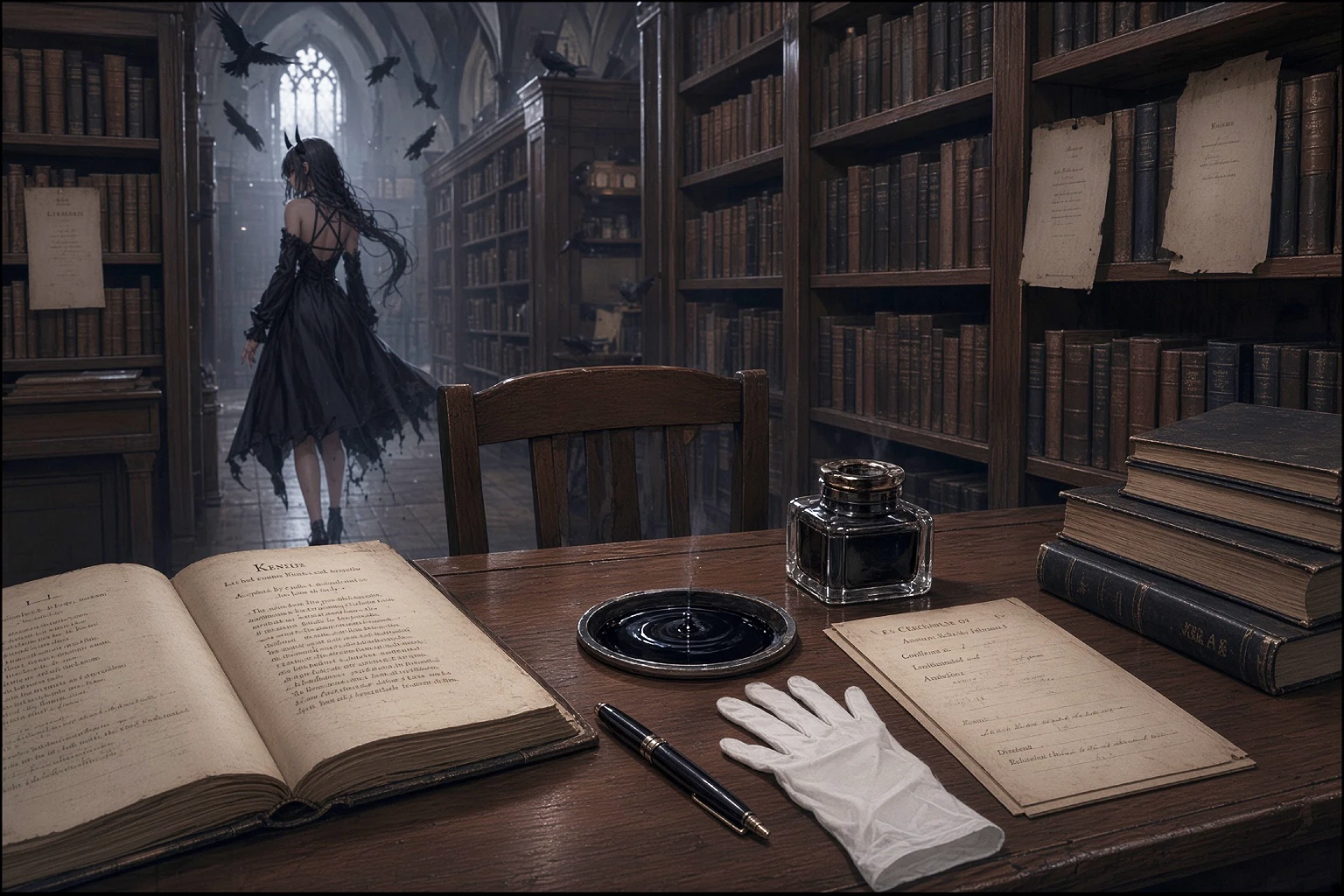
He reached for his fountain pen, an old habit from his training years, and dipped the nib into the small crystal well of iron gall ink he kept for touch-up work. The ink did not behave the way liquid should. It gave a faint resistance against the nib, like skin over muscle, and a slow ripple spread outward from the point of contact and circled the rim of the well before settling.
Kenji frowned and lifted the pen an inch away. The ripple did not stop.
He watched with the same professional curiosity he brought to any strange material problem—a fungal bloom on old vellum, an unexpected reaction between inks from different centuries. He leaned closer, and the ink pulsed again, a slow contraction and release, like something breathing at the bottom of the well.
A thin black filament rose from the surface, not dripping but climbing, as though gravity had briefly excused itself from the room. It arced over the lip of the well, touched the desk, and began to move, tracing the grain of the old wood with a fluid, searching motion.
Kenji's first instinct was not fear. It was closer to the alarm he felt when mold crept across parchment he had spent months restoring, the reflex to protect the work before anything else. He reached for a cloth, meaning to blot the strange ink away before it could stain the ledger beside it.
The moment the cloth touched the black thread, it kept moving, indifferent, and reached the edge of his sleeve. He felt the cold pressure of it against his skin a half second before the pain arrived, sharp and chemical, as if something were scrubbing the inside of his arm with acid-soaked wire.
Kenji cried out and yanked his sleeve back. His mother's name was moving.
The kanji strokes, still and permanent for a decade, dissolved from the edges inward, the deep indigo pigment turning to a loose black sludge that beaded on his skin like sweat. It wasn't smearing. It was leaving—lifting out of the dermis in fine threads that joined the larger black vein still crawling up from the desk, feeding itself back toward the well.
He clawed at his own arm as if he could hold the ink in place by force. Beneath his palm, the shape of the name blurred further, the vertical stroke thinning, the horizontal lines softening like a photograph left too long in developer.
He tried to picture his mother's face and found, for one long suspended second, that he could not.
It came back, barely—a flicker of her at the stove, steam rising around her, an expression somewhere between concentration and contentment. But when he reached for the sound of her voice, the way she used to draw out the second syllable of his name, he found only a soft gray static where the memory should have lived. He understood, with the sick clarity of a man watching his own hands from a great distance, that something essential had been taken and would not be returned.
The last curling stroke lifted from his skin and rejoined the thread, and where the tattoo had been there was now only smooth, unmarked flesh, no scar, no shadow, nothing to suggest ink had ever lived there at all.
He sat frozen for a moment, his chest tight, his mind scrabbling for the shape of the loss the way a tongue probes the socket of a missing tooth. He knew, in the abstract, that he had loved his mother deeply. He knew he had gotten the tattoo to honor her. But the specific, irreplaceable texture of her—the exact pitch of her laugh, the smell of ginger and soy that clung to her sleeves—had gone soft, half-dissolved, no longer fully his to hold.
He did what any restorer does when something begins to fail: he tried to document it before more could be lost.
He pulled a blank archival card from the drawer and, hand shaking, wrote his mother's name in the same kanji that had, minutes before, lived on his arm. Beneath it he wrote steam, ginger, the sound of her slippers on the kitchen tile, working fast, desperate to pin down what remained before it thinned further, the way he might rush to photograph a manuscript before it crumbled past saving.
The words sat on the card, legible and correct. But even as he wrote them, he felt a cold certainty settle in his chest. They were only words now. He could read them and confirm they were true, but the felt weight that should have accompanied his mother's name had gone distant, like a story about someone else's mother rather than his own.
He reached for his phone, thinking to photograph the bare patch of skin, to record his own voice describing what had happened while the details were still sharp enough to matter. His hands moved through the familiar mechanics of preservation, the same instincts that had saved four centuries of other people's histories, and for a moment the routine of it steadied him.
That steadiness didn't last. The ink on the desk hadn't finished. The thread thickened, drawing more of itself up out of the well as though something on the other side had decided the first sample was worth returning for. It slid across the desk and found his arm again, higher this time, near the crane curling toward his shoulder.
Kenji pulled back so hard he knocked the ledger to the floor, and some deep trained part of him flinched at the sound of centuries-old paper striking stone. He didn't have time to check the damage. The black thread had already reached his father's crane, and the wing tips began to blur, the crisp angular lines his father had once scratched onto a grocery receipt softening into an indistinct smear.
He thought of his father's voice, the joke about paperwork, and found the memory holding a moment longer than his mother's had, thinner but intact, as though the tattoo were resisting before it gave way. He grabbed his pen and tried to sketch the crane onto an archival card before it vanished from his arm entirely. His hand wasn't steady. The wings came out lopsided, a child's rendering of a bird that had once meant everything.
The tattoo finished dissolving before he finished the sketch. Even the half-formed crane on the card went slack around its edges, the fresh ink there thinning too, as if the paper had caught the same disease as his skin. He stared at it and understood, with the flat horror of a man watching two fires burn at once, that writing the memory down would not save it. Whatever this was did not care where the ink lived. It wanted the ink itself, and it wanted whatever the ink had been asked to hold.
He remembered that his father had died. He remembered a hospital room, fluorescent and too bright. But when he reached for the specific weight of that day—what his father had said, whether he had said anything at all in those last hours—the memory offered him only an empty room and the hum of machines. He knew there had been a promise between them. He could no longer say what it was, only that its absence sat behind his sternum like a swallowed stone.
The ink did not pause to let him grieve. It split into three threads, then five, branching from the well like the black roots of some inverted tree, and found the cherry blossoms near his shoulder next.
For one merciful second he heard Yuki's laugh clearly, bright, a little too loud for the small rooms they used to share. Then the petals on his skin ran like wet ink on newsprint, and the sound thinned into something abstract, a shape of joy with all its specific edges sanded away. He knew he had loved someone. He no longer knew, with any confidence, what her face had looked like when she smiled at him.
He was on his feet now, though he couldn't remember standing, his chair scraped back and toppled behind him. The overhead lights had taken on a strange flatness, the warm glow he'd known for eleven years replaced by something dimmer and grayer, as if dust had settled directly onto the bulbs. The familiar smell of old paper thinned into something closer to wet cardboard and hot copper, and beneath it, faint but unmistakable, the smell of ink drying too fast.
He turned toward the door and found the room longer than it should have been. The aisle between his workstation and the exit stretched on past where the wall should have stood, the shelves lining it receding into a dim distance the basement had no space to contain. He blinked, certain his eyes were adjusting badly to the failing light, and looked again. The aisle had not shortened.
Kenji moved forward anyway, one hand pressed to the smooth, unmarked skin where his mother's name used to be, and the shelves on either side blurred past him with a wrongness he couldn't name until he really looked at them. The spines were blank. Every book, every bound ledger, every archival box that should have carried a neatly typed label now showed nothing but smooth, uninterrupted cloth or leather, as though every title in the National Library had been quietly lifted away.
He passed a bank of catalog drawers he didn't recognize, though the room had never held catalog drawers before, and one of them slid open on its own with a soft wooden groan. Inside, the index cards were blank, rows and rows of white rectangles with nothing written on them at all, waiting the way archival cards wait before anyone thinks to give them a name.
He kept walking, telling himself he only needed to find the stairwell, the elevator, the emergency exit sign that always glowed faintly red near the east corridor. He found instead another aisle, and beyond it another, the shelves multiplying the way error multiplies in an uncorrected proof, each row identical to the last, each one a little dimmer than the one before.
Somewhere above him, out of sight among the impossible height of the shelving, he heard the first cry—dry, rasping, like a nib dragged too hard across brittle paper. He froze and looked up, and in the gloom between two shelves he saw something black shift and resettle, folding itself the way a bird folds its wings.
He kept moving, faster now, and the ledger he had been restoring at the start of the evening drifted past him at eye level, unsupported by any hand, its pages turning slowly though there was no wind to turn them. He caught a glimpse of the merchant's signature, still intact on the page, still legible after four hundred years, and felt a strange stab of relief that at least one name in this place had not yet been touched.
He reached toward the drifting ledger, some instinct insisting he could still save it, still complete the restoration he had begun, and his fingers passed through the paper as though it were made of smoke. It reformed a moment later a few feet farther on, still turning its own pages, indifferent to him entirely.
He tried the notebook in his coat pocket next, the one where he sometimes jotted stray observations about a document's condition. He wrote, in a hand that barely held steady, my name is Kenji. I restore what is written. I am not supposed to disappear. He read the words back and found them accurate and strangely hollow, technically true the way a caption is true beneath a photograph of someone else's grief.
The paper in the notebook had gone slightly translucent by the time he finished the sentence, the ink sinking backward into the fibers as though the page itself were drinking it in reverse. He watched his own handwriting thin from black to gray to nothing, the words dissolving from the page the same way his mother's name had dissolved from his arm, and understood that no page in this place would hold anything longer than his skin had.
The crows found him properly then, three of them dropping from somewhere far above onto the top of the nearest shelf, their wings settling with a papery rustle. Up close, he could see they were not birds so much as arrangements of text given wings—each feather a narrow strip of dense characters, many of them blacked out beneath heavy redaction bars, their beaks thin steel nibs split at the tip.
One tilted its head at him, and its eye was a single dark period with no white around it at all. It made the sound again, that dry scraping cry, and two more answered it from somewhere deeper in the stacks.
He backed away and felt the narrow band of script near his wrist grow warm, the date of his first restoration post prickling faintly beneath the skin as though it understood it might be next. He pressed his other hand over it instinctively, a foolish, protective gesture, the same one he might have used to shield an old document from a spill.
A fourth crow dropped onto a low shelf directly in his path, and when it opened its beak, a thin thread of black ink spilled from between the nib-halves and pooled on the wood, spreading with the same unnatural, gravity-defying crawl he had first seen in the well. He understood, watching it, that these creatures were not hunting him in any way he recognized. They were gathering, the way he himself had once gathered fragments of burned letters and pieced them back into readable wholes, except that what they gathered here was memory, and what they left behind was blank paper.
He turned down another aisle to avoid them and found himself in a wide, open reading room he did not recognize, its long tables lit by identical brass lamps stretching farther than any room in the actual library could hold. At each table sat a stack of documents in some stage of restoration—torn scrolls, half-cleaned parchment, ledgers with their spines cracked open—each one abandoned mid-repair, as though a hundred other restorers had been interrupted at the exact same moment he had.
He walked between the tables, unable to stop himself from noticing the details of the unfinished work, the habit of eleven years refusing to switch off even now. On one table, a signature had been reinforced halfway down, the second half left to fade into illegibility. On another, a name in an old census had been circled in red pencil and then abandoned, the circle trailing off into a thin, uncertain line.
At the far end of the room, ink had pooled beneath one of the tables and was creeping slowly upward along the table leg, defying gravity the way it had in his own workstation hours before, or minutes before, he could no longer be certain how much time had passed. He felt, more than saw, that something in the room had noticed him crossing it.
The crows went quiet all at once, their dry cries cutting off mid-breath, and in the sudden stillness Kenji heard his own pulse loud in his ears. He turned slowly and saw a shape standing between two distant shelves, tall and narrow and utterly still, silhouetted against the glow of a reading lamp that had no visible source.
She did not move at first. She only stood, letting him understand what he was looking at before she allowed herself to be seen clearly.
When she did step forward, it was not a smooth motion. She seemed to close the distance between them in increments, appearing several strides nearer each time he blinked, as though the moments in between had simply been removed. Twenty feet became ten. Ten became four.
She was nearly nine feet tall, her silhouette narrow and impossibly straight-backed, her dress a slow, viscous black that never quite touched the floor, its hem fraying into ribbons that drifted faintly upward instead of down. Her hair hung in tangled ropes of shadow, and from her skull rose two dark, curved shapes like the split nib of some vast, impossible pen, angled as though held ready to write.
Her face, when she was close enough for him to see it, had no eyes in any ordinary sense. Only two soft coals of dim red light sat where eyes belonged, and when she looked at him he felt it the way one feels a hand pressed flat against the sternum, not painful, only absolute.
He tried to speak and found his voice thinner than he expected, as though some of it had already been spent. "What do you want with me."
She did not answer aloud. Instead, a thought arrived inside him fully formed, pressed into his mind the way a seal presses into wax. The ink returns. No mark is kept. Only borrowed.
He wanted to argue with her. He wanted to tell her about the ledger downstairs, about the merchant's name he had spent three hours reinforcing, about every name he had ever pulled back from the edge of disappearing with steady hands and patient chemistry. He wanted to tell her that some things deserved to last, that the work he'd given his whole life to had to mean something more than a temporary loan.
But even as the thought rose in him, he felt how thin his conviction had already become, how much of it the crows and the well had already carried off. He was, he understood with a distant kind of grief, arguing with less and less of himself behind the argument.
She raised one hand toward him, her fingers ending not in nails but in fine steel points, each one worn smooth like a nib that had written a great many pages. He understood that what was about to happen was not violence in any way he recognized. It was closer to correction, the way an editor's pen moves through a manuscript that has outlived its usefulness.
He looked down at his arm and saw that only the narrow band of script near his wrist remained now, the date of his first day at the library, the last mark of the archive he had built into his own skin. He knelt where he stood, some instinct insisting there was still time for one final act of preservation, and pressed his fingertip to a blank archival card that had drifted to rest against his knee.
He wrote his own name, the strokes careful and precise even now, the habit of a restorer's hand outlasting almost everything else in him. He meant to write more, some sentence that would explain who he had been, why any of it mattered, but when he tried to continue, he found he could no longer remember why the name in front of him deserved to be saved at all. It sat on the card, technically true, emotionally empty, the way his mother's name had gone hollow on paper hours before.
The Scrivener's hand closed the distance and touched his forehead, and the sensation was not violent. It was closer to the turning of a final page, deliberate and complete.
The last band of script unraveled from his wrist in thin black threads that lifted and drifted toward her, joining the slow black fabric of her dress. The skin beneath it went pale and smooth, entirely unmarked, the way vellum looks before anyone has thought to write on it. He felt the specific pride he'd once carried for his profession thin and slacken, the reason he had chosen this life going soft and formless, until he could recall only that he had once believed preserving names was important, without being able to say why.
His heartbeat did not stop so much as thin, the way ink thins when too much water has been added, still moving but barely dark enough to leave a mark. The reading room, the long tables, the abandoned restorations, and the tall woman made of ink folded together into a single, flat, silent black, the way a manuscript closes at the end of a long day's work.
Down in the third basement of the National Library, a junior clerk named Aiko came looking for the senior restorer, sent to ask about the progress of a seventeenth-century census. She found the workstation exactly as it should have been, the humidity gauge steady, the reading lamp still warm, the ledger open to a page bearing a merchant's signature, half-reinforced, the fresh ink not quite dry.
The chair behind the desk stood empty. A single white cotton glove lay beside the small crystal ink well, its twin nowhere to be found. She checked the staff roster pinned to the corridor wall and noticed, with a small frown she couldn't quite explain, that one line near the middle had been left blank, the shift assigned to no one in particular.
She felt, standing there in the cool hush of the archive, a brief and inexplicable weight settle into her chest, something like grief arriving without a name to carry it. She tried to think what might have caused it and found nothing, and after a moment the feeling drained away as quietly as it had come, the way water settles once it has found its level.
On the desk, beside the half-restored signature of a man dead four hundred years, sat the small crystal well of iron gall ink. Aiko glanced at it out of habit before turning to leave.
The surface of the ink gave one slow, deliberate pulse, like something breathing, and then went still.


.png)
.png)
.png)