%20(1).png)
He didn't feel sad when he left, and that surprised him more than any grief could have. He had expected the doorway to hold some final weight, some last image that would need carrying out with the boxes, but there was only the ordinary business of leaving: keys on the counter, blinds half-drawn, the hollow sound of his own footsteps on floors that no longer had rugs to soften them. He stood in the doorway for a moment longer than the moment required, waiting to feel something specific enough to name. Nothing arrived. Not relief, not sorrow, not the ache he had braced for on the drive over that morning. Just a clean, quiet absence where something heavier used to sit, the way a room feels different after a piece of furniture has been removed, before you've adjusted to where the light falls now. He closed the door without looking back, mostly because there was nothing left in the apartment worth turning around for, and partly because he was afraid that if he did turn, he might discover that wasn't true.
The new place was smaller. He'd chosen it that way on purpose, though he told himself it was about the rent, the location, the practical math of a life being reassembled from fewer pieces. It was the kind of apartment that didn't ask anything of him — white walls, a narrow galley kitchen, a single window that looked out onto a parking lot and, past it, a strip of trees that turned gold and then bare with the seasons. He brought a couch, a table, a bed frame he assembled himself with the wrong-sized screws included in the box. He unpacked only what he thought he'd need and left the rest stacked in neat cardboard towers along the far wall, telling himself he'd get to them eventually, knowing somewhere underneath that thought that he probably wouldn't. The air in the apartment felt lighter than the air in the old one had, thinner somehow, easier to move through. He told himself that was a good sign. That night he slept without dreaming, and in the morning he noted that fact the way you'd note the weather: mild, unremarkable, fine.
For the first few days he settled into a rhythm that felt almost peaceful. He learned which cabinet stuck, which burner ran hot, the particular hush of the building at night once the neighbors upstairs went quiet. He ate dinner standing at the counter some nights, sitting at the table with a book on others. He did not think much about the old apartment, or if he did, the thoughts were brief and unspecific, more like passing weather than storms — a flicker of a hallway, a half-formed sense of someone's laugh, gone before he could ask himself what it belonged to. He assumed this was simply what moving on looked like. He assumed there would be no cost to it.
It was on the fourth or fifth evening that he first noticed the light.
He was on the couch, half-watching something he wasn't really watching, when a thin, unsteady glow bloomed across the far wall of the living room. His first assumption was headlights from the parking lot, some car pulling in at an angle that caught the window just so, but the more he watched it the less that explanation held. Headlights swept. This didn't sweep. It moved with a slowness that felt deliberate, almost searching, drifting along the wall's surface as though feeling for the right place to land before it settled and steadied, gathering itself into something with edges.
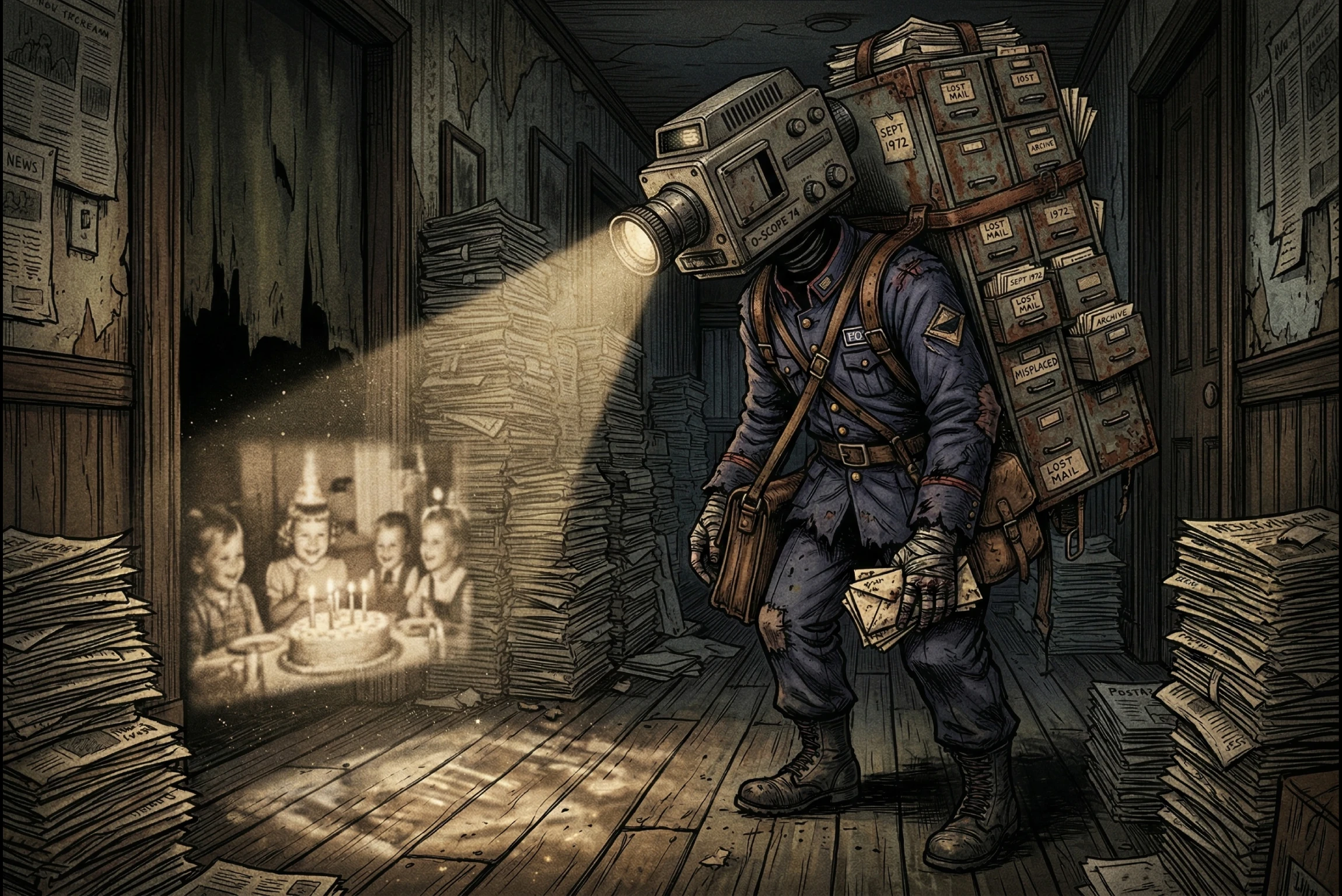
An image formed. It was grainy and pale, washed at the corners the way old home movies washed out near the reel's end, the color bleeding faintly into itself. Four children sat around a cake, candles guttering in some unfelt draft. One of them — a girl, though he couldn't have said how he knew that with any certainty — leaned forward with her cheeks already puffed, caught in the half-second before she blew the candles out, and the others watched her with a kind of communal delight that felt, even in its degraded clarity, entirely real. He sat forward without meaning to. He blinked, and the wall was empty again, blank and white as it had been an hour before.
He stayed there a long moment, waiting to feel foolish, waiting for the obvious explanation to present itself — a reflection, a trick of the streetlight, a dream he'd carried half-awake from the couch cushions. None of those explanations arrived either. What arrived instead was a strange, itching familiarity, the sense that he was supposed to recognize the scene, that it belonged somewhere in the architecture of his own life and not to a movie or a memory of someone else's photo album. He tried to reach for it directly and found the reaching itself difficult, like trying to recall the specific words of a conversation you know happened but can no longer quote. "Probably just tired," he said out loud, mostly to hear a voice in the apartment, and went to bed without much conviction behind the words.
In the morning he tried again, not the details this time but the feeling underneath them — whose birthday, whose kitchen, whose kids. The question sat in him longer than it should have. He knew, in the abstract, generic way you know anything you've seen a thousand times, what a birthday looked like: the cake, the candles, the ritual holding of breath before the wish. But the specific memory, the one that should have been attached to that image like a name to a face, refused to surface. It hovered at the very edge of him, close enough that he kept almost catching it, the way a word sits on the tip of your tongue right up until the moment you need it. "That's weird," he said, and let it go, because letting go of small confusing things was, after all, something he'd recently gotten good at.
The light did not let it go. Over the following days it returned with a patience that he would only later recognize as method rather than coincidence. It came at the edges of things — a flicker against the baseboard while he cooked, a soft shifting glow across the floor near the window while he read. It was never bright enough to announce itself, only bright enough to catch if his eyes happened to be in the right place, and he began to suspect that this was intentional, that whatever produced it had no interest in demanding his attention and every interest in simply being available to it. Sometimes it resolved into an image and sometimes it didn't. A hallway he didn't recognize and then, a beat later, did, though the recognition came with no explanation attached, like knowing a stranger's face from a dream. A pair of shoes kicked off by a door, one lying on its side. A hand reaching across a table toward another hand, fingers spreading slightly as if in the middle of a gesture that mattered. Laughter that made no sound but was unmistakably laughter all the same, caught in the tilt of someone's head, the way their shoulders moved.
Each image arrived with the same peculiar texture — the certainty that it belonged to him, layered over the growing unease that he couldn't say why. And each one, he noticed, was a little harder to hold onto than the last, slipping out of his grasp faster than the one before it, as though something were tightening the aperture through which he was allowed to look.
He began, without quite deciding to, testing it. The next time the light gathered on the wall, he didn't glance away or let his mind wander to something easier. He watched it assemble itself, grain settling into shape the way a photograph develops in a tray of chemical, and this time the image was a woman sitting on the edge of a couch, her head tilted toward something or someone just outside the frame, listening. There was an ease in the posture, a comfort that only comes from long familiarity, the kind of stillness you only allow yourself around a person you trust completely. He leaned forward. "I know you," he said, and the words came out with a conviction that surprised him.
But even as he said it, he felt the certainty start to thin. It was there and then it was already leaving, like heat off a road on a summer afternoon, visible right up until you tried to touch it. The image flickered once, folded in on itself, and went dark. He sat in the sudden absence of light and waited for the memory to fill the space it had occupied, the way you wait for your eyes to adjust after a bright room goes black. It didn't come. He tried to force it, closing his eyes, picturing the woman's face the way you might sketch from a description — the shape of it, the color of her hair, anything — and found only a kind of soft static where the details should have been. A blur where there should have been definition. A presence with no identity attached to it, like a name tag with nothing written on it, pinned to someone standing right in front of him. Something in his chest pulled tight. "That's not right," he said, quietly, to the empty room, and the room, as it always did, said nothing back.
He didn't sleep well that night. Somewhere beneath the ordinary sounds of the building — the pipes ticking as they cooled, a car passing on the street below — he became aware of another sound, low and steady, easy to miss if you weren't listening for it. A mechanical hum, faint but constant, with a rhythm to it that suggested it wasn't struggling to keep going. It wasn't the whine of something broken or the stutter of something failing. It had the calm, even cadence of a machine doing exactly what it was built to do. He heard it once beneath the sound of the tap while he brushed his teeth, and again later, layered so faintly under the refrigerator's hum that he could almost convince himself he'd imagined it. Almost. Because it was there every time the light was, and he had started, by then, to understand that the two were not separate phenomena but two expressions of the same thing.
By the end of that week he had stopped explaining the hum away. He had started, instead, to listen for it — to walk toward it rather than around it, the way you might finally turn to face a sound you've spent days pretending was nothing.
The first time he saw him, he almost didn't understand what he was looking at, and some part of that confusion never fully left him, even after everything that came after. He'd stepped out into the hallway to take the trash to the chute at the end of the corridor, an unremarkable errand on an unremarkable evening, the overhead lights buzzing at their usual uneven intervals, one of them flickering weakly the way it had since he'd moved in. He was halfway to the chute when the hum, which had been a background presence in his apartment for days, grew suddenly louder, more defined, no longer something he had to strain to notice. He stopped walking. He turned.
At the far end of the hallway, where the light was dimmest, something was moving. Not quickly. Not with any effort at concealment. It moved the way a person moves who has walked the same path so many times that urgency has become irrelevant, a slow and deliberate procession that seemed, in the low light, almost ceremonial. As it came closer, the shape of it began to resolve, and what he saw made him press his back instinctively against the wall, though he could not have said afterward whether it was fear that made him do it or simply the need to give the thing more room than the hallway actually offered.
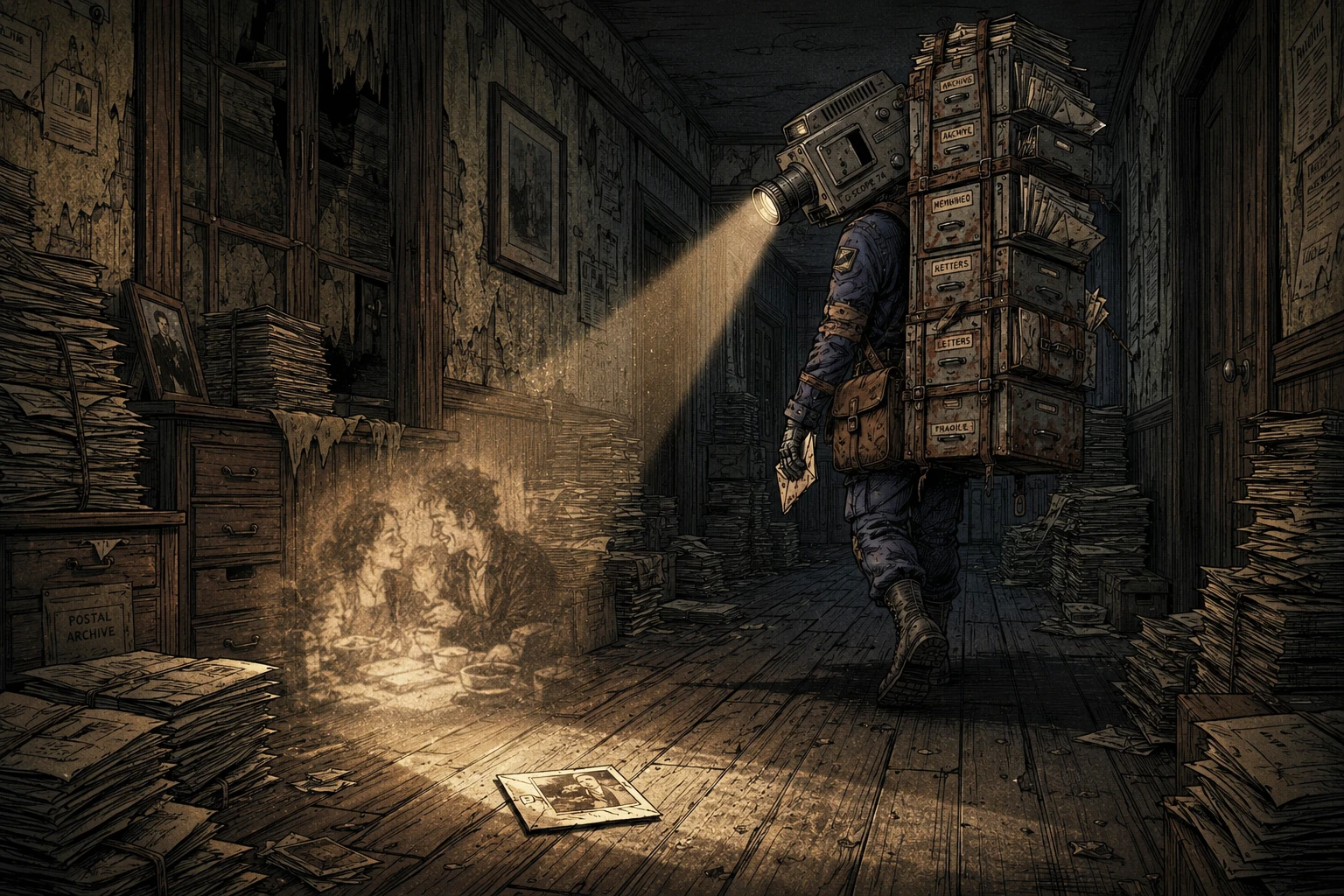
It was tall — taller than a man ought to be, though not so tall as to seem impossible — and its back rose into a structure that took a moment to understand as a structure at all. Drawers, dozens of them, stacked and interlocked in a mass that looked equal parts built and grown, as though someone had constructed a filing cabinet and then left it outside long enough for something organic to take root in the metal. Some of the drawers were small enough to hold a single photograph. Others looked deep enough to hold a whole box of them. Rust bloomed along their seams in soft orange patches. Corners were dented, bent inward as though something inside had, at some point, tried to push its way back out. Labels covered nearly every surface — typed labels curling at their edges, handwritten ones in inks of different ages, some so worn by handling that only a smear of graphite remained where words used to be.
Its head was a projector. Old, boxy, the kind that would have sat on a cart wheeled between classrooms decades ago, its housing dulled by a fine coat of dust that didn't quite manage to make it look neglected. The lens at its front held a faint, steady glow, the light behind it flickering the way a candle flickers when it's being fed unevenly, though nothing about the rhythm suggested weakness. If anything, it suggested attention. The hum came from somewhere inside that housing, low and constant, the sound of something working, not something failing.
The lens turned. It was a small motion, barely more than a shift in angle, but it was enough to make his stomach drop, because it meant the thing was aware of him in a way its posture and gait had not suggested. And then it blinked — the lens contracting and expanding once, like a held breath — and the beam extended outward from it, cutting a clean path through the dim hallway air, landing on the wall just past where he stood. An image bloomed there, pale and unsteady, though he didn't look at it. He couldn't look away from the figure long enough to.
It didn't react to him. It didn't slow, didn't turn its attention fully toward him the way a person might if startled or curious. It simply continued its slow progress down the corridor, the drawers on its back shifting with each step, a soft metallic settling sound accompanying the motion like the creak of an old house adjusting to the cold. As it passed beneath the flickering overhead light, he read what labels he could, his eyes catching on them before his mind had time to brace itself. UNSENT, one read, in typewriter font gone faint with age. MAY 12, said another, handwritten in a slant he didn't recognize but somehow expected to. HER LAUGH. LAST GOOD DAY. He felt something close around his throat reading that last one, though he couldn't have explained what it referred to, only that it referred to something, and that the something mattered enormously to someone.
The figure stopped. Not directly in front of him, but close enough now that the hum filled the space between them entirely, close enough that he could hear a faint mechanical click and whir from somewhere inside the projector head, the sound of a lens refocusing. The beam swung from the wall and settled, without hurry, onto him.
He braced for something — heat, cold, pain, some sensation dramatic enough to match the moment — and none of it came. What he felt instead was a kind of exactness, the sense of something being aligned with something else, a key finding the groove of its lock. The light moved across his shoulder, down along his chest, and paused there, and in that pause he felt a small internal motion, something shifting loose inside him the way a folder slides free from a drawer you didn't know you owned. He inhaled sharply. "Hey," he said, and the word came out far smaller than he meant it to, swallowed almost immediately by the hallway's dead air.
The figure did not answer. It never would. It simply resumed its slow walk, the beam sliding off him and dragging the pale, flickering image along the wall as it went, until both light and image slipped out of the hallway's edge and around the corner, taking the hum down with them, fading by degrees until the corridor was quiet again, the flickering overhead bulb the only light left, the only sound the distant tick of the building settling. He stood there for a long while after it was gone, the bag of trash still hanging forgotten from his hand.
The next morning he tried to remember her.
He sat on the edge of his bed for a long time before he even reached for his phone, trying the old approach first, trying to summon her the way you'd summon anyone you knew well — by starting with something small and letting the rest follow. Her voice. He reached for it and found silence where an inflection should have been. Her face. He reached for that too, and found only the general idea of a face, a placeholder shape with no features committed to it, like a sketch someone had started and then erased before finishing. He knew — in the dull, structural way you know a fact rather than feel it — that she had mattered. That knowledge sat intact, untouched, a fixed point in him that insisted on its own truth even as everything around it had been hollowed out. But the content of that importance, the texture of why, had been removed so cleanly that there was no ragged edge left behind to indicate anything had ever been there at all. "That's not possible," he said aloud, and heard how thin the words sounded even as he said them.
He grabbed his phone with something close to urgency, scrolling back through months of messages, searching for anchor points, for names, for anything that might snag the memory and drag it back up into the light. There were gaps he hadn't noticed before, conversations that trailed off mid-thread with no context to explain why, photographs with captions that referenced jokes he no longer understood. He found one photo eventually — the two of them together, clearly taken on some ordinary evening, both of them laughing at something outside the frame — and he stared at it for a long time, waiting.
He recognized himself instantly. That much hadn't been touched. His own face, his own posture, the particular way he tended to tilt his head when he laughed — all of it was exactly as he expected, familiar in the effortless way your own reflection is familiar. But the person beside him was a stranger wearing the shape of someone he was supposed to know. He understood, intellectually, that this person had been important to him — the photo itself proved it, the ease between their bodies proved it, the fact that he had kept the photo at all proved it — but none of that understanding translated into feeling. It was like reading a stranger's diary and being told, this was your life. He lowered the phone slowly. "No," he said, to no one, and the single syllable felt like the only honest thing he'd said all morning.
He spent the rest of that day in a kind of suspended unease, doing ordinary things with the specific, deliberate attention of someone trying to prove to himself that the ordinary still worked. He made coffee. He answered an email. He noticed, twice, that he had stopped in the middle of a task to stare at nothing, trying again to force the shape of her face into focus, and failing again in the same soft, frictionless way. By evening the apartment felt different to him than it had that morning — not threatening exactly, but attentive, as though the walls themselves were waiting for something to happen in them.
The light returned that evening stronger than it had been before, and the hum arrived with it almost immediately, no longer content to stay at the edge of hearing. He didn't wait for it to fade this time. He got up from the couch and followed it, out through his door and into the hallway, toward the sound, which was coming, unmistakably now, from around the corner near the trash chute where he'd first seen the figure days before.
It was there again, standing in a widened pool of light that seemed to emanate from nowhere but its own presence, one of the drawers on its back pulled open. The projector head was angled downward, its beam directed into the drawer's interior, and inside, images were shifting and flickering too quickly to properly resolve — dozens of them, layered over one another like photographs shuffled in a fast deck, organized in a way he couldn't decipher but that clearly meant something to whatever had arranged them.
He stepped closer. The old floor beneath the hallway carpet creaked under his weight, and the figure went still, then turned. The lens contracted, refocused, found him.
The beam left the open drawer and settled on him again, and this time there was no ambiguity in what he felt: something loosening, deeper this time, more deliberate, as though whatever had merely tested its alignment before was now committing fully to the work. He felt a memory come unmoored somewhere behind his sternum, felt it drift, felt the space it left behind close over smoothly, without scarring. "Stop," he said, and this time his voice held, steady in a way it hadn't been in the earlier hallway. The figure did not stop. It didn't quicken either. It simply continued at its own unhurried pace, reaching one long articulated arm back toward the mass of drawers on its spine, searching among them with a certainty that suggested it already knew exactly which one it wanted.
A drawer near the center slid open with a soft final click, the sound of something settling into a groove worn smooth by long use. He could see, even from where he stood, the label affixed to its front, and the sight of it dried his mouth entirely.
HIM.
Not a date. Not a fragment of a moment. A name — if you could call it that — that could only refer to the whole of him, not a memory he had lost but the ongoing fact of his being cataloged, the same way the woman he could no longer picture had apparently once been. He stared at that single word and felt something colder than fear settle into him, a recognition that whatever this figure was doing to him was not new, was not sudden, but was instead a process that had been quietly ongoing, prepared for, waiting on a shelf with his name on it long before he had ever noticed the light on his living room wall.
The figure did not open the drawer further, or rather, it did, but only enough to retrieve something resting near the front of it. An envelope. Plain, unmarked on the front and back, except for a single word written across its face in a careful, deliberate script that looked almost tender in its precision.
KEEP.
The figure extended it toward him, holding it out in that same unhurried, uninsistent way it did everything, an offering rather than a command. He hesitated, aware, distantly, that accepting it meant something, though he couldn't have said what. Eventually he took it. The paper was heavier than he expected, slightly worn at the corners as though it had been handled before, by other hands or the same ones, he couldn't tell. He opened it slowly, folding back the flap, and drew out a single photograph.
It was him, again — younger, maybe, or maybe just lighter in some way that had nothing to do with age. And beside him, someone else. He studied the second figure the way you'd study a word in a language you used to speak fluently and had somehow entirely lost, searching for the shape of understanding in features that offered him nothing back. He waited for the recognition to arrive the way it always eventually had before, delayed but present. It didn't come. There was no delay this time, no near-miss, no sense of something almost surfacing. There was only the photograph, and the two people in it, and the certainty, cold and complete, that one of them was a stranger to him now in every way that mattered.
"Who is that?" he asked, and his voice, in the empty hallway, sounded very young.
The question hung there, unanswered, exactly as he suspected it would be. The figure tilted its head very slightly, the projector's lens flickering once, and for a moment he thought — though he could never afterward be sure it wasn't simply his own need projecting meaning onto a machine — that there was something almost like acknowledgment in the gesture. Then it turned away. The open drawer slid shut with the same soft click it had opened with, sealing whatever remained inside it, sealing his name back into the dark. The hum, which had grown loud enough to fill the hallway entirely, began to recede as the figure resumed its slow walk, the drawers on its back settling and shifting with each step, until it turned the corner and the light went with it, and then the sound, degree by degree, until the hallway was only a hallway again, dim and quiet, the overhead bulb still flickering its uneven rhythm as if nothing at all had happened beneath it.
He stood there for a long time, the envelope in his hand, the photograph inside it a small, solid weight against his palm, the only proof he now possessed of an entire life he had once lived and could no longer feel. He tried, one more time, to force the recognition — closed his eyes, pictured the photograph, willed some fragment of feeling to surface and attach itself to the stranger standing beside his younger self. Nothing moved. Nothing came back. The hallway, and the apartment beyond it, felt emptier than either had felt an hour before, though nothing physical about either place had changed.
He looked down at the photograph again. Himself, unmistakably. And beside him, someone whose importance he understood the way you understand a translated sentence — accurately, but without any of the original's warmth intact. He knew it mattered. He no longer knew why. He folded the photograph carefully back into its envelope and carried it inside with him, setting it on the kitchen counter where he would see it again in the morning, not because he expected it to help, but because some quieter, more honest part of him understood that setting it aside entirely would be its own kind of loss, and he wasn't ready, even now, to lose it twice.
Even that certainty, he suspected, would not last. He could already feel it thinning at the edges, the same soft erosion he'd watched claim everything else the figure had touched, and he understood, with a clarity that arrived without drama or panic, that there was nothing he could do to stop it. Somewhere down the hall, faint now but unmistakably still present, the hum continued its patient, steady work, moving further away, cataloging something else, someone else, or perhaps only continuing what it had already begun with him, methodically, without malice, without haste.
He sat down at his kitchen table and looked around the apartment — the clean walls, the sparse furniture, the boxes still stacked untouched against the far wall — and understood, for the first time, that its emptiness had never been the peace he'd mistaken it for. It had simply been the room, quietly, patiently, becoming ready to hold nothing at all.
He thought of the drawer marked HIM, and the ease with which it had opened, as though it had been waiting for him far longer than he had been aware of its existence. He thought of the envelope marked KEEP, and the strange mercy or procedure or indifference that had made the figure hand it back to him rather than filing it away with everything else. He would never know which of those it had been, and some nights, later, he would lie awake turning the question over without ever finding its underside.
What he understood instead, sitting there with the photograph on the counter and the apartment gone quiet around him, was something both smaller and far more unsettling than the existence of the figure itself. It had not broken into his life and stolen what it found there. It had simply followed the path he'd already cleared for it — every box left unopened, every conversation left to trail into silence, every quiet decision to let something go rather than carry it forward. He had been leaving pieces of himself behind long before the light ever touched his wall, and the figure, whatever it was, had only ever done what its nature required. It had gathered what had already been set down. It had not taken anything from him.
It had simply been the first thing patient enough to notice that he was already giving it away.


.png)
.png)
.png)