%20(1).png)

The fluorescent lights in the Tanaka Technical Publishing office buzzed at a frequency Arata had long since stopped noticing, except on days like this one, when every sound in the building seemed to press directly against his skull. He sat hunched over his monitor, a diagram of an industrial pressure valve glowing in front of him, and he stared at the number in the corner of the schematic until the digits blurred: 40.5 mm. It should have been 40.0. Somewhere between the engineer's original drawing and his own redraft, a decimal had crept sideways, and the valve housing in his version was five-tenths of a millimeter too wide.
It did not sound like much. Arata had tried to explain this once to a friend outside the industry, how half a millimeter was thinner than a fingernail, thinner than the space between two grains of rice, and how nobody, not one person in the entire supply chain, would ever notice it with their naked eye. But Tanaka had noticed. Tanaka always noticed. He had slapped the printout down on Arata's desk that morning with the flat of his hand, hard enough to make the pencil cup rattle, and had said, in the particular hiss he reserved for these occasions, that the world rested on these lines. If the drawing was wrong, he said, the reality built from it would be dangerous. A valve that didn't seat correctly could mean a boiler that failed, a pipe that burst, a factory floor slick with scalding water. Arata had bowed low enough that his forehead nearly touched the desk, apologized with the practiced cadence of a man who had apologized many times before, and spent the remaining six hours of his shift redrawing the housing, checking it against the tolerance table, checking it again, until the number read 40.0 and stayed there.
It was the kind of job that trained a particular kind of eye. Arata had not been born noticing things. He had been made to notice them, the way a lens is ground and polished until it can no longer see anything except in focus. Fonts had to be the correct point size or the eye would skip over a critical warning. Labels had to be centered, because an off-center label suggested, to the unconscious mind of a factory worker skimming a manual before flipping a switch, that the diagram itself could not be trusted. Margins had to be exact, kerning even, dimension lines terminated with arrows of precisely uniform weight. Arata had spent five years learning that the eye, even an untrained eye, could feel wrongness before it could name it. A drawing slightly out of true made people uneasy in a way they couldn't articulate. It was the same feeling, he sometimes thought, walking home through the city at night, that a badly aligned tile on a sidewalk gave him, or a shop sign hung a few degrees off level, or two neon characters in a storefront window burning at slightly different intensities so that the whole sign seemed to flicker with a private, arrhythmic pulse. He didn't go looking for these things. They found him. His eyes had become magnets for imperfection, and Tokyo, dense and vast and constructed in a thousand incompatible decades, offered no shortage of material.
That evening, walking from the station toward his apartment, the city gave him its usual assortment of small offenses. A construction barrier had been set at a slight cant, so that its painted stripes no longer aligned with the ones on the barrier beside it. A vending machine's backlit panel buzzed with a color temperature just a few hundred kelvin warmer than the panel beside it, so that the two machines, meant to be identical, looked like twins raised in different climates. Arata noticed these things the way another man might notice a familiar smell, absently, without particular alarm, filing them away in the enormous mental ledger he had never asked to keep. The air was thick with the wet-cotton humidity of the rainy season, and somewhere behind the apartment blocks a pachinko parlor was bleeding its tinny electronic song into the evening. He walked with his head down, his bag heavy on his shoulder, thinking mostly of dinner, of the leftover curry in his refrigerator, of the pleasant nothing of a night alone.
It was only when he reached the entrance to his building that the ledger in his head began to fill faster than he could comfortably ignore.
The lobby smelled wrong. Not unpleasant — in fact it smelled of almost nothing at all, a sterile blankness like the inside of a new refrigerator or a car fresh off a dealership lot, the smell of materials that had never been touched by human hands before this exact moment. Usually the lobby carried the mingled scent of his neighbors' lives: the ghost of somebody's grilled fish, the mildew that crept into the carpet every June, the particular mustiness of the mailboxes. Tonight there was none of it, and the absence itself felt loud, the way a held breath is louder than a sigh. He told himself it was the season. Maybe the building's air conditioning had finally been serviced. Maybe the super had scrubbed the lobby with something industrial. He pressed the call button for the elevator and waited, and the doors opened with their usual soft chime, and he stepped inside, and it was only as the doors closed behind him that he noticed the buttons for the fourth floor and the twelfth floor were exactly the same shade of yellowed plastic, when he was fairly certain — no, he was certain — that the twelve button had always been slightly more worn, the number rubbed pale by years of thumbs. Tonight both buttons gleamed with the same unblemished finish, as if someone had gone through the panel replacing the parts one at a time, matching them so closely that only a man trained to see a font two points too large would notice the difference.
The elevator rose. Arata watched the floor numbers light up in sequence above the door, and he was almost sure the light for the third floor did not illuminate at all, that the number simply appeared, fully lit, between the flash of two and the flash of four, without the half-second bloom that a bulb makes when its filament catches. He blinked and told himself he'd imagined it. The doors opened onto the fourth floor hallway, and he stepped out into air that was, again, too clean, too still, and too quiet, the hallway lit by fluorescent tubes that hummed at a single flat pitch instead of their usual erratic flicker.
He noticed the carpet next. It was the same industrial beige it had always been, worn thin along the center from years of foot traffic, except that tonight the wear pattern looked identical in every direction, as though it had been printed onto the fabric rather than earned by years of shoes. He noticed the exit sign at the end of the hall, its red characters glowing with a light that cast no shadow on the wall behind it. He noticed, walking toward his own door, that the numbers on each apartment were very slightly different from each other in a way that had nothing to do with wear or age. The brass 409 on his neighbor's door canted a degree to the left. The 411 beside it stood perfectly vertical, but its digits were spaced with a fraction too much air between them, as if someone laying them out had measured the gap with a ruler that read in the wrong units.
He reached his own door and looked up at the number before he even reached for his keys, because some part of him — the part that had spent five years hunting for 0.5 millimeter errors — already expected to find something wrong, and he was not disappointed. The 4 stood a full centimeter taller than the 2 beside it, as if it had been ordered from a different catalog entirely. The 1 between them leaned at a small, precise angle, three degrees by Arata's practiced eye, not enough to be an accident of installation and not enough to be a deliberate design choice either. It was the kind of error that a person only makes when they are copying something without quite understanding what it is they're copying.
He told himself, again, that he was tired. He'd had a difficult day. Tanaka's voice was still needling around the inside of his skull, and after eight hours spent hunting fractions of a millimeter across other people's blueprints, it made a certain grim sense that his eyes would start hunting them in his own hallway, manufacturing flaws where none existed. He reached into his coat pocket, drew out his keys, and moved to fit the correct one into the lock without needing to look, the way he had done every evening for the three years he'd lived in this apartment.
The key met flat metal.
Arata frowned and looked down. Where the lock should have been — the small brass cylinder he had touched every day of his adult life in this building — there was nothing. Not a broken lock, not a jammed one, but a smooth, seamless depression in the door's surface, as though the slate-gray material had simply grown over the place where a keyhole belonged, the way skin closes over a wound. He pressed his fingers against it. It was cool, faintly textured, and entirely unbroken.
"Wrong floor," he said aloud, mostly to hear his own voice in the too-quiet hallway. He turned to retrace his steps to the elevator, already composing the small, private embarrassment of having walked to the wrong door on the wrong floor after a long day, already anticipating the relief of finding the doors, pressing the button, riding one floor further and laughing at himself.
The elevator was gone.
Not out of order. Not closed. Gone, in the specific and total way that a thing is gone when it has never existed in a particular place: no doors, no frame, no call button, no seam in the wall to suggest that an elevator shaft had ever been there. Just a smooth continuation of the same slate-gray surface that made up his door, running unbroken from floor to ceiling.
For a moment Arata simply stood there, his mind performing the small, useless calculations of a man trying to rationalize an impossibility. Perhaps he'd taken a service stairwell by mistake and wandered into some maintenance corridor. Perhaps the building was mid-renovation and he'd somehow missed the notice. He turned in a slow circle, and it was only then, with his back to where the elevator should have been, that he registered how much larger the hallway had become. The corridor he remembered was perhaps thirty meters from the elevator to the fire stairs at the far end, lined by six doors on either side. Counting the doors now, in the sourceless hum of the fluorescent light, he counted past six, past eight, past ten, the numbers on the doors climbing and then, strangely, repeating: 405, 407, 409, 411, then 405 again, in the same brass font, at the same height, as though a single unit of hallway had been copied and pasted along an axis that should not have permitted the repetition.
His footsteps, when he began walking, made no sound.
He walked for what felt like thirty paces, the number he associated with the distance to the north stairwell, and did not reach it. He walked for what felt like sixty, and the corridor extended in front of him with the same patient, endless regularity, the same doors, the same numbers looping back on themselves like a corrupted file replaying its own data. The ceiling, which should have sat a standard two and a half meters above him, seemed to be drifting upward the longer he walked, so gradually that he could not point to the moment it changed, only recognize, looking up, that the fluorescent tubes now hung at a height that made the hallway feel less like a place people lived and more like the nave of some vast, sterile cathedral built for a congregation that did not require sitting.
And then the hallway opened.
There was no door, no threshold, no perceptible seam between the corridor and the space it emptied into; the walls simply drew apart, the way the edges of a photograph might stretch if the image beneath them were scaled larger than its frame, and Arata found himself standing at the edge of a room whose size defied the entire architecture of the building he had lived in for three years. It was warehouse-vast, gray-lit by the same flat fluorescent hum, and it took him a long moment to understand what he was looking at, because his eye, trained to hunt for the wrongness in finished things, had no immediate vocabulary for a room that had never been finished at all.
Furniture stood scattered across the concrete floor in various states of incompletion. A sofa near the center of the room had no upholstery, no fabric, no cushions — only the rusted skeleton of its internal springs, coiled and bare, arranged in the shape a sofa's contours would eventually take, waiting for a covering that would never arrive. Beside it stood the hollow shell of a television, its screen a blank sheet of frosted plastic with no glass beneath, no wiring inside its cabinet, an object that referenced the idea of a television without possessing any of its functioning parts. Bookshelves stood against one wall bearing rows of rectangular blocks the approximate size and shape of books, uniform gray, spineless, without a single printed word on any of them. It was a drafting room, Arata realized, in the same sense that his own desk at the office held drafts: rooms and objects sketched out at the correct dimensions, blocked in at the correct proportions, awaiting a final pass of detail that had simply never been applied.
The occupants were worse.
There were perhaps a dozen of them, standing at odd, unhurried intervals throughout the room, and Arata recognized their postures before he recognized anything else about them, because they stood the way people he knew stood. One, tall and slightly stooped, occupied a corner near the false bookshelf in a posture that belonged, unmistakably, to the salaryman from 409, who Arata had passed in the elevator perhaps a hundred times, always in a slightly rumpled suit, always checking his phone with the particular hunched urgency of a man perpetually late. This figure wore the suit — or the suggestion of one, a single block of matte charcoal fabric with no visible seams, no buttons, no texture of weave — but where its face should have been there was only a smooth plane of gray, featureless as an unpainted mask, and where its hand should have held a phone there was only a fused, undifferentiated lump of the same gray material, fingers barely suggested by shallow grooves that had never been carved deep enough to separate them.
Near the sofa stood a shorter figure Arata knew, with a terrible, sinking certainty, to be some rendering of the old woman from 405, who fed the neighborhood cats from a chipped ceramic bowl every morning at six and complained, loudly and often, about the volume of her neighbors' televisions. This figure stood with its arms crossed in her exact, familiar posture, its head tilted at the precise angle she used when delivering a complaint, but its face held no wrinkles, no white hair, no anything — only that same smooth clay-gray blankness, waiting, Arata thought with a species of horror he had no name for, for detail that would never come.
None of them moved. None of them turned toward him. They stood in their private tableaux like figures abandoned mid-sculpture, and the longer Arata looked at them the more he understood, with the trained eye of a man who spent his days matching drafts to finished products, that this was not a room full of monsters. It was a room full of drafts. Rough passes. First and only versions of people who, somewhere else, had never been rendered into anything more finished than this.
He backed away from them, his shoulder blades finding the wall he'd entered through, and it was in that moment, with his palms flat against the cool gray surface, that the room began to fold.
There was no sound to the folding, or if there was, it registered not as sound but as pressure, a squeezing sensation behind his ears such as one feels descending too quickly in an airplane. The floor beneath him tilted, not gradually but all at once, and Arata felt his balance abandon him entirely, his body swinging toward a wall that was no longer vertical. He struck the surface hard enough to knock the air from his lungs, and when he opened his eyes he understood, with a nausea that had nothing to do with pain, that the wall had become the floor. Gravity itself had reoriented around some axis he could not locate, and the room he had just fled now hung above him at an angle, its unfinished furniture and unfinished occupants clinging, somehow, to a surface that his body now recognized as a ceiling.
A door was opening in that ceiling. It had not been there a moment before; Arata was certain of this in the same instinctive way he was certain of a font size or a margin width, some deep and undeniable visual memory insisting that the space above him had been unbroken gray moments ago. Now it drew apart in the same seamless manner the hallway had, and beyond it Arata saw not a room, not a sky, but a vast dark expanse scored through with lines of pale, scrolling white light — thousands of them, moving at a slow and constant velocity across the blackness, resolving, the longer he stared, into shapes he almost recognized. They were blueprints. Not of any single building, but of something far larger: the outlines of streets, the cross-sections of pipes, the schematic bones of elevator shafts and stairwells and apartment units stacked in grids that extended, as far as Arata could tell, forever, each unit marked with tiny coordinate numbers too small and too fast-moving to read. It was, he understood with the particular clarity of a man who had spent five years staring at exactly this kind of document, a technical drawing of a city. Perhaps the city. Perhaps every version of it that had ever been drafted, superimposed and scrolling past like the credits of some vast and silent film.
And that was when he heard the jingling.
It was not the sound keys usually make. There was no metallic clatter, no dull scrape of one key against another. Instead it rang out with the clean, struck-glass clarity of wind chimes, a sound too precise, too resonant, to belong to any ordinary ring of house keys. Clink. A pause, long enough that Arata began to hope the sound would not repeat. Hum. Clink again.
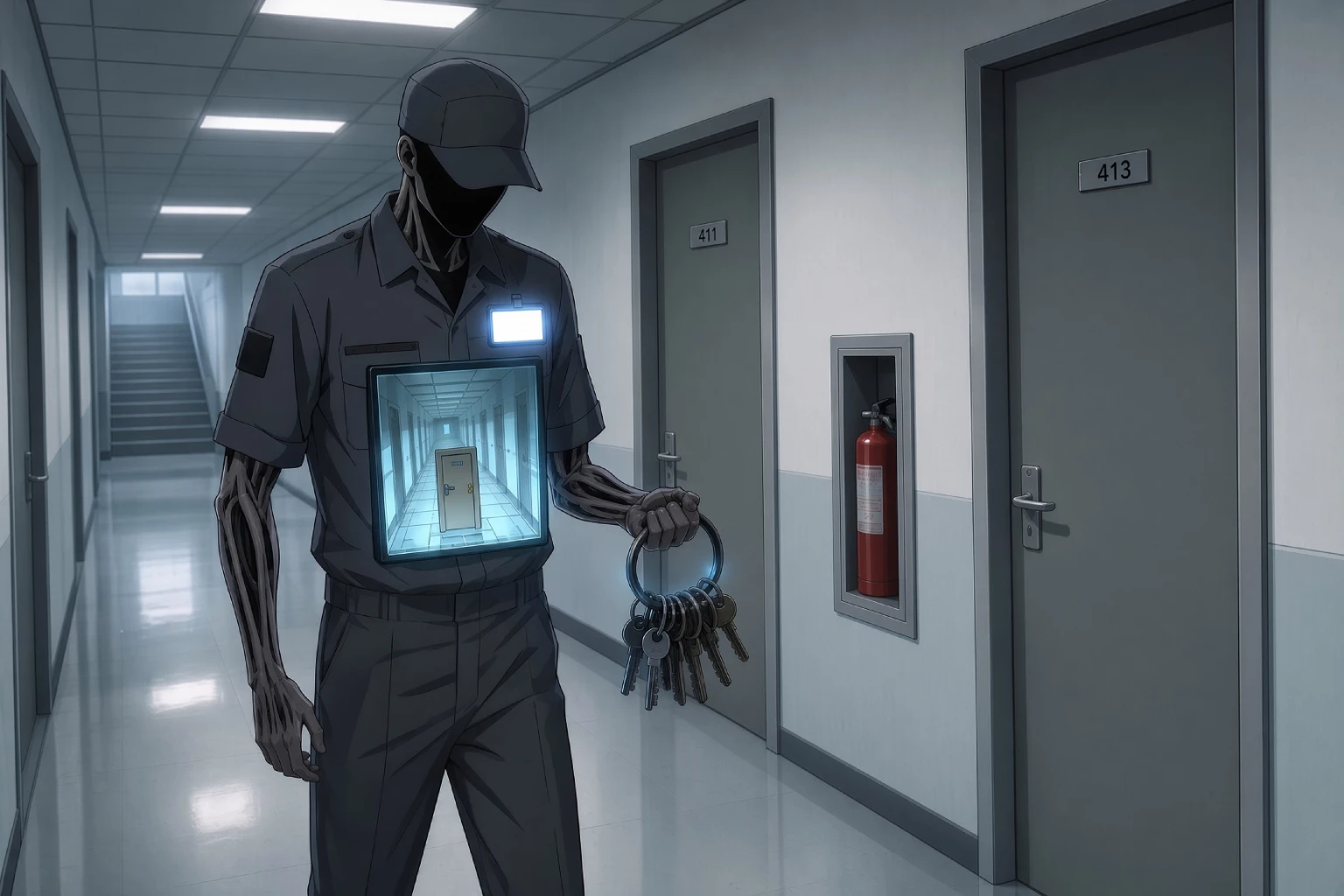
A door opened where no door had been, in the wall — or the floor, or whichever surface it now was — behind the hanging ceiling full of drafts. The figure who stepped through it did not hurry. He moved with the unhurried certainty of someone for whom the strange geometry of the room posed no inconvenience at all, walking as easily across what should have been a vertical surface as Arata might walk down a level street. He was tall in a way that immediately registered as wrong, taller than any doorway ought to have permitted, though he passed through the frame without stooping, as if the door itself had briefly reconsidered its own dimensions to accommodate him. He wore a jumpsuit the color of wet slate, heavy-looking, the fabric suggesting the weight and texture of industrial canvas, and yet it held no wrinkle at the elbow, no crease at the knee, no smear of grease or grime anywhere across its surface, as though it had been put on for the first time in this very instant and would be discarded, unworn, the moment this errand concluded. Across his chest hung a rectangular badge that gave off a steady, sourceless white light, too bright to look at directly, though Arata found he could not look away from it either.
The man's face was hidden beneath the shadow cast by the brim of a gray cap, a shadow that seemed to fall regardless of the light's actual angle, deep and absolute, so that all Arata could make out beneath it was a long pale line where a mouth should be, perfectly still, betraying no expression at all. In one hand he carried a ring of keys unlike any Arata had ever seen: dozens of them, carved from some translucent blue material that glowed faintly from within, casting soft cyan light across the strange floor with every small movement of his wrist.
"Help," Arata managed, his voice thin and raw in the too-quiet air. "Please. I'm trapped. There's a room back there, the people in it, they aren't — they aren't finished."
The figure stopped. For a long moment he said nothing at all, and Arata had the unsettling sense of being examined, though the shadowed face gave no outward sign of scrutiny.
"Occupant Arata." The voice, when it came, did not issue from the pale slit of a mouth. It arrived from everywhere at once — from the walls, from the hum of the unseen fluorescent fixtures, from the very air around him — layered with what sounded like a thousand identical whispers speaking in perfect unison, flattened into a single clinical tone that carried no anger, no malice, only the patient monotone of a man reading from a form he had filled out many times before. "You are experiencing a structural conflict. Your residency has expired."
"Expired?" Arata pushed himself upright against the tilted wall, his palms sliding on its unnervingly smooth surface. "I paid my rent this month. I have a job. I have a life. I've lived in that apartment for three years—"
"Your life was an entry in a ledger that has since been overwritten," the voice replied, with the same even patience, as though correcting a minor clerical error. "The current draft of this structure does not include a Room 412. You are an artifact of a previous revision. A margin of error that has persisted longer than tolerance allows."
Arata felt the words land somewhere behind his sternum with a familiarity that turned his stomach. Margin of error. Tolerance. He had used those exact terms himself, that very morning, apologizing to Tanaka over a valve housing five-tenths of a millimeter too wide. "You're saying I'm a mistake," he said. "Like the valve."
"An apt comparison," the Superintendent said, and Arata could not tell if the layered voice held approval or simple confirmation. "For the structure to stand, its errors must be corrected. You are the smudge on the lens, Arata. You are the half a millimeter that collapses the seal."
He raised one long, bandaged hand and pressed it flat against the center of his own chest. There was no sound of a zipper, no visible seam, but the fabric there parted as easily as water closing around a stone withdrawn from a pond, revealing beneath it not muscle or bone but a rectangular cavity fitted with glass, lit from within by a soft and even blue light. Arata's breath caught. Inside the cavity, rendered in flawless miniature, was the hallway of the fourth floor exactly as it should have looked before any of this had begun — the beige carpet, the brass numbers on each door, the humming fluorescent tubes no larger than grains of rice. And there, at a scale of perhaps one to twelve, stood a tiny figure that Arata recognized, with a lurch of vertigo, as himself: a small huddled shape pressed against a miniature wall, its face tilted upward in an expression of frozen terror, gazing at an equally tiny figure in a gray cap and jumpsuit that stood over it with keys glowing faintly at its hip.
"You keep it in there," Arata whispered. "The whole hallway. Me."
"Maintenance must be precise," the Superintendent said, and reached one long finger into the glass cavity.
He did not touch the miniature Arata. His fingers moved past the small huddled figure with what felt, absurdly, like deliberate indifference, and closed instead around the tiny door marked 412. There was a sound as he drew it free — a small, wet, tearing sound, like a tooth pulled loose from a socket — and in the real hallway behind him, the door to Arata's apartment vanished. Not merely the door, but its frame, its hinges, the strip of brass numbers he had stood beneath not twenty minutes before. The wall simply smoothed itself closed, gray and seamless, indistinguishable from every other stretch of unbroken surface around it.
"No," Arata said, and lunged toward the place where his home had been, his fingers scraping uselessly against cold metal that had never held a door at all. "My things are in there. My photographs. My mother's letters — she wrote to me every month since I moved to the city, I kept every one of them in a box under the bed. My degree is framed on the wall. There's a mug I've had since university, it's chipped on the handle, I don't care, I like it—"
"They have been archived," the Superintendent said.
"Archived where?"
"Archiving," the voice replied, with the same terrible, even patience, "is the polite term for deletion."
The Superintendent reached again into the glass cavity in his chest, this time lifting free a miniature chair no larger than a fingernail, one of the small rendered furnishings of the tiny apartment Arata could no longer reach. He turned it slowly upside down between two fingers. Somewhere behind the wall where 412 had stood, Arata heard it: a heavy, grinding compression, like a great weight settling onto something built to hold far less, and beneath it, threading through the grind, the specific and unbearable sounds of small things breaking — glass shattering in a single clean note that might have been his mug, paper tearing in long ragged pulls that might have been every letter his mother had ever sent him, folded and unfolded so many times the creases had gone soft. The sounds did not last long. They did not need to. A life compresses quickly when there is no longer any space allotted for it to occupy.
The floor beneath Arata's feet had already begun to change. He looked down and saw the beige carpet losing its color, its texture, going translucent by degrees until he was staring directly through it into the same scrolling void of white blueprint lines he had glimpsed through the ceiling. He felt his weight shift, not suddenly, but slowly, the way a body sinks in water rather than falls through air, and he understood, distantly, that he was descending into that vast drafted darkness even as the world above him — the hanging Drafting Room, its unfinished furniture, its unfinished occupants with their smooth gray faces — tilted further out of reach. The occupants did not move to help him. They did not move at all. They only watched, if watching was the correct word for whatever their blank faces were capable of, their featureless heads angled downward as Arata sank past them into the light.
The Superintendent stood at the border between floor and void, unbothered by the tilting geometry around him, and selected from his glowing ring a single key larger than the rest, cut into the shape of a stylized X. He lifted it into the empty air above where Arata continued his slow, syrup-thick descent, and turned it, as though fitting it into a lock that existed only in the space between one moment and the next.
The sound that followed was unlike anything Arata had heard before, and yet it was immediately, sickeningly familiar: the particular rasp of a large sheet of drafting paper being rolled from its edges toward its center, over and over, the paper compressing on itself in tightening loops. The walls of the void began to curl inward around him. The scrolling blueprint lines bent at their corners like the edges of a page catching fire in slow motion. He felt the sensation first in his hands, a flattening, as though his fingers were being pressed between two panes of glass squeezed steadily together; then in his arms, his chest, the whole architecture of his body losing the dimension that had always separated the front of him from the back. He tried to scream and found that his mouth had already lost the capacity for the shape a scream required, his voice reduced to a single flat line of sound with no room left inside it for breath. His thoughts, too, seemed to be losing their thickness, compressing from the sprawling, associative tangle of a living mind into something closer to notation — a single continuous stroke, thinning, darkening, becoming ink.
In the last instant in which he could be called a person, Arata understood, with a terrible and total clarity, that he was not being destroyed so much as filed. He was being reduced to the correct format for a thing that no longer had a place in three dimensions. He felt no pain, only a diminishing, a narrowing, until the entire span of his height and his weight and the twenty-six years he had lived collapsed into a single thin plane of gray and white, and then into nothing more than a mark upon that plane.
The Superintendent knelt at the edge of the settled void and drew out from it a thin slip of paper, no larger than a postcard, upon which was rendered in high, stark contrast a young man with wide and terrified eyes, one hand outstretched toward a door that no longer existed anywhere in the structure above him. He studied it for a moment with what might, in a face capable of expression, have been read as satisfaction, or perhaps only confirmation that the work had been carried out correctly. Then he opened a small drawer set flush into his own leg, slid the paper inside among others just like it, and closed it with a soft, final click.
"Audit complete," said the walls.
The Superintendent rose. The blue light along his ring of keys dimmed to a low, resting glow, and he crossed the tilted floor toward a wall that had, until that moment, shown no seam at all. He pressed two fingers against a point only he seemed able to locate, and the wall opened onto an ordinary hallway: beige carpet worn thin along its center in the honest, uneven way of years of foot traffic, the mingled evening smells of someone's burnt dashi and the tinny, distant murmur of a television turned up too loud for the elderly ears watching it. He stepped through, and the door closed behind him without a mark to show where it had been.
He walked past Apartment 411, from behind whose door the old woman's voice could be heard complaining, as she did most evenings, about the volume of her neighbor's news program. He walked past the space beside it, where a small red fire extinguisher cabinet sat recessed into the wall, centered with an unremarkable, unconsidered precision between one door and the next, as if it had always occupied exactly that position and had never needed to occupy any other. Beyond it stood Apartment 413, its brass numbers hanging level and true, its light spilling warm and ordinary from beneath the door.
There was no Apartment 412. There had never been an assistant editor who noticed crooked signs and uneven margins, who apologized to his employer over half a millimeter, who carried his mother's letters in a box beneath his bed. The corridor held only the doors it had always held, the numbers it had always carried, its architecture whole and accounted for from one end to the other.
The Superintendent checked the badge upon his chest. Its light burned steady and white. He adjusted the brim of his cap, and his shadow, long and thin, slid ahead of him down the beige carpet and folded itself into the dark mouth of the stairwell as he descended, leaving behind only the flat, patient hum of the fluorescent tubes to mark that he had passed this way at all. Somewhere beneath the ordinary floors of the ordinary building, the blueprints continued their slow, endless scroll through the dark, coordinates shifting, lines redrawing themselves without hurry, waiting, as they always waited, for the next small error to declare itself against the tolerance of the structure.


.png)
.png)
.png)