%20(1).png)
The courtroom on the fourth floor of the Chiyoda District Court smelled the way it always did on humid mornings—old paper, floor wax, and the faint mineral tang of the air conditioning struggling against July. Kaito had sat at his station beneath the judge's bench for eleven years, and in that time he had learned to love the particular silence of a room where every word was being weighed. He believed, with the quiet conviction of a man who had built his life on it, that language was the one thing that could be trusted to hold still. Testimony could be recanted. Memory could be unreliable. But once a word was captured correctly on the record, struck cleanly through the keys of his stenotype and rendered into transcript, it became fixed. Permanent. An anchor driven into the shifting ground of human affairs.
That morning's case was unremarkable—a property dispute between two elderly brothers over a strip of land behind their late father's house. The kind of case that produced testimony thick with mundane, specific nouns: property lines, surveys, deeds, fences. Kaito's fingers rested on the keys the way a pianist's rest before the first note, weightless, ready.
The younger brother, a stooped man in a gray cardigan, was describing the boundary as it had existed for forty years. "The fence," he said, "was always there. My father built the fence himself, in Showa forty-one."
Kaito's fingers moved toward the chord for fence—a simple combination, one he had struck perhaps ten thousand times in his career. But his hand hesitated over the keys, a fraction of a second, the way a foot hesitates on a stair that isn't quite where memory says it should be. He pressed the chord anyway. The stenotype's small screen, which normally resolved his shorthand into readable text almost instantly, produced nothing. Then, after a beat, it produced a short black rectangle where the word should have appeared.
He blinked at it. A glitch, he thought. The machine had never failed him before, but machines failed; that was simply the nature of machines. He deleted the line and typed the word out again, letter by letter this time, deliberately, the way he might type a word he wasn't sure how to spell. F. E. N. C. E.
The black rectangle appeared again, sitting in the transcript like a wound.
The witness kept speaking, oblivious. "The fence ran along the eastern edge, from the persimmon tree to the drainage ditch."
Kaito looked up at the man's mouth, watching the shape of the syllables. He had done this before, in his early years, when his hearing had been imperfect and he'd needed to lip-read testimony that got lost in the room's poor acoustics. He watched the witness's lips part and close, and he heard sound come out—a real sound, not silence, not static—but it no longer resolved into anything he recognized as a word. It was there and not there at once, the way a word looks wrong if you stare at it too long, except this was happening to something spoken, something that should have simply existed in the air and entered his ear the way it had ten thousand times before.
He told himself it was fatigue. He had been averaging five hours of sleep a night for a month, ever since his apartment building's water heater had started clanking through the night. He rubbed his eyes, cleared the offending line from the transcript with the practiced motion of a man erasing a typo, and returned his hands to the keys.
The proceeding continued. The judge asked a clarifying question. The older brother's attorney rose to object. Kaito's fingers found their rhythm again, and for a while—perhaps ten minutes—everything resolved normally. Names. Dates. The word plaintiff. The word survey. He began to relax, chalking the incident up to a momentary neurological hiccup, the kind of thing a doctor would nod at and prescribe more sleep for.
Then the presiding judge, a heavyset man named Judge Ishikawa whom Kaito had transcribed for perhaps two hundred times over the years, said the older brother's name in the course of a ruling, and Kaito's fingers did not move at all.
He knew the name. He had typed it forty times already that morning. Nakamura. He had grown up two streets from a Nakamura Grocery. His college roommate's girlfriend had been a Nakamura. It was one of the most common surnames in the country, unremarkable, ordinary as rain. And yet, in that instant, staring at the judge's moving mouth, Kaito found that the sound arriving in his ears carried no weight at all. It was there, a collection of phonemes, but it no longer pointed at anything. It no longer meant this specific man, seated at the plaintiff's table, wearing a brown suit. It was noise wearing the shape of a name.
He looked down at the transcript. Where he had typed the name three lines earlier, the word was still there, still legible: Nakamura. He stared at the two characters until they began to look foreign to him, the way any word does if you repeat it enough times in your head, sound abraded from sense through sheer repetition. He had heard of this phenomenon—semantic satiation, they called it in linguistics texts he'd read years ago in preparation for a deposition involving expert testimony. A word loses its meaning temporarily if you focus on it too intensely. It was a documented curiosity, harmless, reversible within seconds.
He waited for the reversal. It did not come.
The court clerk beside him, a young woman named Emi who had been transcribing exhibits into the record, glanced over at his idle hands. "Everything all right, Kaito-san?"
He wanted to ask her if the word Nakamura meant anything to her, if the sound still had teeth, but the question felt absurd even forming in his throat, and more than that, he was afraid of what her answer would tell him. So he simply nodded, said something about a cramp in his wrist, and resumed his work with the mechanical persistence of a man determined not to notice the floor tilting beneath him.
The recess came at eleven. He went to the men's room and ran cold water over his wrists, an old habit from his early years when carpal fatigue had been a real threat to his career. In the mirror, his own face looked back at him, tired, unremarkable, a man in his forties with the beginnings of gray at the temples. He said his own name aloud, quietly, to the empty room. "Kaito." It came out fine. It meant something. He exhaled, and some of the tension left his shoulders.
But when he returned to his station, the transcript for the morning session was waiting on his screen, and as he scrolled up through the record to check his earlier notes, he saw that four more words had been replaced by the same flat black rectangles. Fence. Boundary. Deed. And, near the bottom, in the middle of a sentence that should have made perfect grammatical sense, the word survey had also gone dark, leaving a sentence that read: "The plaintiff commissioned a ▮▮▮▮▮▮ of the property in question." The sentence was grammatically whole and semantically gutted, a skeleton with the organs removed.
He did not tell anyone. What would he have said? That the record was rotting? That meaning itself seemed to be leaking out of certain words like air from a punctured tire? He was a stenographer, not a mystic, and he distrusted his own perception of the event even as it happened to him, because distrust was the correct professional response to an anomaly in the record. And yet beneath that professional skepticism, something colder was beginning to settle into his chest—a suspicion that this was not happening only to him, and not only inside the transcript, but in the actual fabric of the world outside the courthouse walls.
By the time the afternoon session ended and Kaito descended into the underground concourse that led to Otemachi Station, the suspicion had hardened into something closer to certainty.
The station was crowded in the way it always was at that hour, a river of dark suits moving with practiced indifference around one another. Kaito stood before the departure board that hung above the platform, the one that had told him, every weekday for a decade, when the next Marunouchi Line train would arrive and where it was bound. He looked up at it now and felt his stomach drop.
The characters were there—he could see that they were characters, could see the clean architecture of strokes and radicals that made up written Japanese—but he could not read them. It wasn't that they had become another language, or that they had scrambled into nonsense shapes. They still looked correct, still occupied the exact visual space that station names had always occupied on that board. But when his eyes tried to convert the shapes into sound, into meaning, into this is where the train is going, nothing happened. It was like trying to remember a dream an hour after waking—the shape of the thing was present, ghostly, but the content had already drained away.
He turned to the woman standing beside him, an office worker in her thirties scrolling through her phone. "Excuse me," he said. "Do you know where this train—" He gestured at the board, and the word he wanted, bound, or destination, simply refused to arrive. He found himself gesturing instead, his hand tracing a vague arc through the air.
The woman glanced up, her expression flickering with a small, polite confusion, the kind you might offer a foreigner who has asked a question in badly pronounced Japanese. "Ikebukuro," she said slowly, as if unsure why he needed to be told something so obvious. Then she returned to her phone.
The word Ikebukuro landed in Kaito's ears and meant nothing at first—another name, another set of sounds worn smooth—but then, mercifully, it clicked into place, connecting to a station, a neighborhood, a ramen shop he liked. He exhaled. Not everything was gone. Not yet. The rot, whatever it was, seemed to be moving unevenly, consuming some words entirely while leaving others intact, like mold spreading across bread in patches rather than all at once.
He boarded the train and stood gripping the overhead handle, watching the other passengers with a new and uncomfortable attention. A pair of high school girls were laughing about something, their sentences fast and overlapping, and as far as he could tell their conversation functioned normally—he could follow the shape of their exchange even if he couldn't parse every word, which was ordinary enough for a stranger's conversation. But then an announcement came over the speaker system, the automated voice reciting the standard boilerplate about doors and priority seating, and in the middle of the announcement there was a gap—not silence, but a strange smear of tone where a noun should have been, as if the recording itself had been redacted at the source. Nobody around him reacted. A businessman near the door continued reading his phone. An elderly woman continued dozing against the window. Whatever was happening to language, it was not happening to their attention. They simply did not notice the holes.
An advertisement above the row of seats caught his eye—a poster for a skincare product, its slogan rendered in clean sans-serif type. He read it three times. The grammar was intact. The sentence parsed correctly as a sentence. But it no longer promised him anything. It no longer meant to sell him a product, or to imply beauty, or youth, or any of the small aspirational lies advertising usually whispered. It was just shapes on colored paper, technically legible, semantically null. It occurred to him, with a chill that had nothing to do with the train's air conditioning, that meaning itself seemed to be draining out of the world at a rate faster than his ability to notice its absence. He was catching only the edges of the collapse, the places where something had definitely once been and now definitely wasn't.
He got off two stops early and walked the rest of the way to Ikebukuro, hoping the movement would settle his nerves. He told himself, as he walked, that this was almost certainly some kind of neurological event—a migraine aura, perhaps, or a transient ischemic attack, the sort of thing that could produce exactly these symptoms: word-finding difficulty, semantic paraphasia, a temporary short circuit between concept and language. He knew the term aphasia from a documentary he'd watched years ago about stroke patients. He clung to the term now the way a drowning man clings to a plank, because a diagnosis, even an frightening one, was better than the alternative, which was that the world itself was losing its grip on meaning and he simply happened to be standing close enough to notice.
The ramen shop was a narrow place wedged between a pachinko parlor and a shuttered bookstore, the kind of establishment that survived on regulars rather than tourists. Kaito had been coming here for five years, always ordering the same thing, always sitting at the same worn stool near the end of the counter. The owner, a heavyset man with forearms like braided rope, nodded at him as he entered, the nod of long acquaintance rather than warm friendship.
Kaito sat down and looked at the laminated menu, though he didn't need to. He never needed to. He opened his mouth to say the words he had said perhaps three hundred times in this exact seat—"miso ramen, please, extra chashu"—and found that the first word of the order had simply ceased to exist inside him.
It wasn't that he forgot the sound. He understood, in some abstract, cataloguing part of his mind, that there was a category of fermented soybean paste, that it had a name, that the name began with a particular consonant. But when he reached for it, the way one reaches for a familiar object on a shelf in the dark, his hand closed on nothing. Worse, as he sat there groping for the word, he realized that the memory attached to it was thinning as well—the specific memory of the smell of the broth rising off the bowl on a cold night, the particular saltiness he associated with the dish, the small satisfaction of watching the chashu curl at the edges under the heat. These things had always come bundled together in his mind, word and taste and memory woven into a single, seamless experience. Now the bundle was unraveling. He could recall, abstractly, that he liked something here, that he had a habit, a preference. But the specific content of that preference was becoming difficult to hold, like trying to keep a fistful of water from running between his fingers.
"The usual?" the owner asked, not unkindly, perhaps sensing Kaito's hesitation.
Kaito opened his mouth. What came out was a strange, flattened sound, half a syllable, cut off before it could resolve into anything. He tried again, and this time nothing came out at all—not silence exactly, but a kind of vocal static, a hiss with no shape.
The owner's expression shifted from mild curiosity to open concern. "Kaito-san? You feeling all right?"
He wasn't being cartoonishly blank, the way a puppet without programming might be; he simply looked at Kaito the way anyone looks at a regular customer who has suddenly started behaving strangely—worried, a little embarrassed on his behalf, uncertain whether to call attention to it or pretend nothing was wrong. Kaito raised a hand, tried to smile reassuringly, and pointed instead at the menu, at the specific line where the word should have been, hoping the gesture could stand in for language now that language had abandoned him.
The owner looked at where Kaito was pointing, then back at Kaito's face, and something in his expression told Kaito that he, too, was having trouble parsing the item being indicated—not because the menu was unclear, but because some deeper agreement about what that particular combination of characters signified had quietly dissolved between them. "I'll bring you something," the owner finally said, uncertainly, and retreated to the kitchen.
Kaito did not wait to see what arrived. He left money on the counter—he trusted numbers still, trusted them the way he trusted almost nothing else in that moment—and walked back out into the humid evening, his chest tight with a fear that had no name he could currently access, which felt, in a horrible way, entirely appropriate.
He half ran the last several blocks to his apartment, a modest one-bedroom on the third floor of an aging building near Higashi-Ikebukuro, and once inside, he did what he always did when the world felt unstable: he went looking for his books. If language was dissolving in speech, in signage, in the fragile medium of sound and memory, then surely it would hold fast in print. Ink on paper did not waver. It did not depend on a listener's attention or a speaker's failing throat. It simply was, fixed and permanent, exactly as he had always believed.
He pulled his copy of Kokoro from the shelf—a paperback he had owned since university, its spine cracked from decades of rereading—and sat down in his armchair beneath the single reading lamp. He opened it to the first page, to the opening lines he had read so many times he could recite them from memory even without the book in hand. He looked down at the text and felt something in his stomach lurch.
The characters were not gone. That was the horror of it—they were still there, black ink against cream paper, each stroke precisely where the printer had placed it decades ago. But as he watched, the ink seemed to lose its stillness. It was a subtle motion at first, almost imperceptible, like watching a photograph you suspect might be very slowly changing. The strokes of a kanji near the top of the page began to separate from one another, the way a word looks when you've stared at it too long and it starts to seem like an arbitrary arrangement of lines rather than a unified symbol. Then, impossibly, gently, the ink began to slide.
It did not drip like liquid. It crawled, the way a colony of ants moves when disturbed, individual strokes detaching from their positions and inching downward along the page, leaving faint gray afterimages where they had been. Kaito watched, unable to look away, as the opening sentence of the novel—a sentence about memory, about the narrator's reluctance to reveal a name—dissolved letter by letter into a thin dark residue that pooled at the bottom margin. Within a minute, the entire page was three lines of pooled black sediment above a field of blank cream paper, as clean and empty as if it had never been printed at all.
He flipped forward, frantic now, and found the same process occurring on every page, at different stages of completion—some pages already blank, others still holding fragments of sentences that swam and shifted as he watched, individual kanji trembling like reflections in disturbed water before losing their coherence entirely. He grabbed another book from the shelf, a dictionary this time, thinking absurdly that a book whose entire purpose was to fix the meaning of words might resist whatever was happening. He opened it to a random page and watched definitions curdle into gray smears even as his eyes moved across them, the specific becoming general, the general becoming nothing, the words describing other words collapsing into a silence made of ink.
He dropped the dictionary. It did not thud against the floor. It made a sound like a wet exhale, a soft hiss, as though something inside it had escaped along with the impact.
Kaito sat very still in his armchair for a long moment, his hands trembling in his lap, and tried to think clearly, the way he had trained himself to think during difficult depositions—methodically, without panic, cataloguing what was known and what remained uncertain. What was known: words were failing, unevenly, starting with specific nouns and spreading outward. What was known: the failure was not confined to speech, or to his own mind, since it had now visibly infected physical text. What was known: when a word failed deeply enough, whatever memory or feeling had been anchored to it began to fail as well.
He decided, with the stubbornness of a man who had spent his career trusting that the written word could hold against anything, to test this last idea directly. He found a notepad and a pen in the kitchen drawer and sat back down, and he wrote, in careful characters, the name of his mother.
He stared at what he had written. He knew, in the same abstract cataloguing way he had known about the fermented soybean paste, that this was a name, that it referred to a specific woman who had raised him in a house in Saitama with a garden full of hydrangeas. But when he tried to summon her face, it came to him blurred, as though viewed through frosted glass. He tried to remember the sound of her voice, and found only a vague auditory impression, a hum without pitch, without warmth. He tried to remember one specific thing about her—the way she used to bring him barley tea in summer, the particular laugh she gave when he'd said something clever as a boy—and the memories arrived stripped of their emotional charge, present in outline only, like a photograph left out in the sun until the colors had bleached away.
He wrote her name again, pressing the pen harder into the paper, as if force alone might weld the meaning back onto the characters. The strokes came out correctly. He could see that they were correctly formed. But looking at them now, they seemed less like a name and more like an arbitrary arrangement of lines that happened to resemble something he was supposed to recognize. He said the name aloud. His voice cracked on it. It did not feel like calling out to anyone anymore. It felt like reading a foreign word from a phrasebook, competent pronunciation attached to absolutely no comprehension.
He kept writing. He wrote his own name, over and over, filling half a page with the two characters that had identified him since birth: 海斗. He watched them accumulate down the page, and somewhere around the eighth or ninth repetition he felt the same eerie thinning that had happened with his mother's name, the letters losing their grip on him, becoming shapes he was copying rather than a name he was claiming. He said it aloud. "Kaito." The sound still emerged correctly from his throat. But something in the back of his mind, some quiet, horrified observer, noted that the word no longer seemed to be pointing at the man sitting in the armchair. It was just a sound, hovering nearby, uncertain of its target.
It was somewhere in the middle of this—Kaito hunched over a legal pad covered in his own increasingly desperate handwriting, trying to reconstruct a definition for the word self the way he might reconstruct a witness's exact phrasing from a garbled recording—that he first heard the clacking.
It was faint at first, so faint he mistook it for a sound from the building's old pipes, a rhythmic tick-tick-tick that might have been the radiator settling. But it did not fade the way pipe noise usually did. It continued, steady, mechanical, with a texture that was unmistakably specific once he focused on it: not water moving through metal, but something being struck, repeatedly, in a pattern too regular to be accidental. It reminded him, in a way that made the hair on his arms rise, of the sound his own stenotype machine made under his fingers during a fast-paced cross-examination—dozens of small strikes per second, layered into something that was almost a texture rather than individual sounds. Except this was slower, heavier, older, more like the great clattering typesetting presses he had once seen in a museum exhibit on the history of print—rows of metal type being assembled, letter by letter, into something that would eventually be pressed into permanence.
The sound was coming from the corner of the ceiling above his bookshelf.
He rose from the armchair, the legal pad sliding from his lap to the floor, and approached the corner with the specific dread of a man who already suspects what he does not yet want to confirm. The shadow there was wrong. It was not merely dark; it seemed to possess a texture, a slight curling motion at its edges, like the corner of a page being lifted by an unfelt wind, or like paper beginning to char from the inside without any visible flame. The smell reached him a moment later—wet ink, and beneath it something sharper, almost chemical, like the inside of an old printing shop or the toner cartridge of a photocopier left running too long.
He should have run. Later, in the last fragments of coherent thought available to him, he would understand that running would have made no difference, that whatever was arriving had already been arriving since the moment the word fence first failed in his mouth that morning. But in the moment, he simply stood, transfixed, as the curling shadow in the ceiling corner widened, folding outward like the pages of a book being opened by unseen hands, revealing behind it not the plaster and wiring that should have been there but a deep, textureless black, a void the exact color of drying ink.
Something emerged from it slowly, the way a figure emerges from fog—first an impression of height, impossible height, a shape that had to fold and compress itself to fit beneath his nine-foot ceiling. Then robes, heavy and black, hanging in stiff, fractured folds that did not move like cloth but like something more brittle, like dried lacquer that had been poured over an armature and allowed to crack as it set. There was no wind in the room, and yet the robes seemed to shift very slightly, the fractures in the fabric widening and narrowing as if the thing beneath them were breathing.
Kaito's voice, when he finally found it, came out as barely a whisper. "Who—" He meant to finish the question, but the word that should have followed—are, or is—simply refused to arrive, and in its place he felt a sharp, specific pain low in his throat, as though a fine wire had been threaded through his vocal cords and pulled taut.
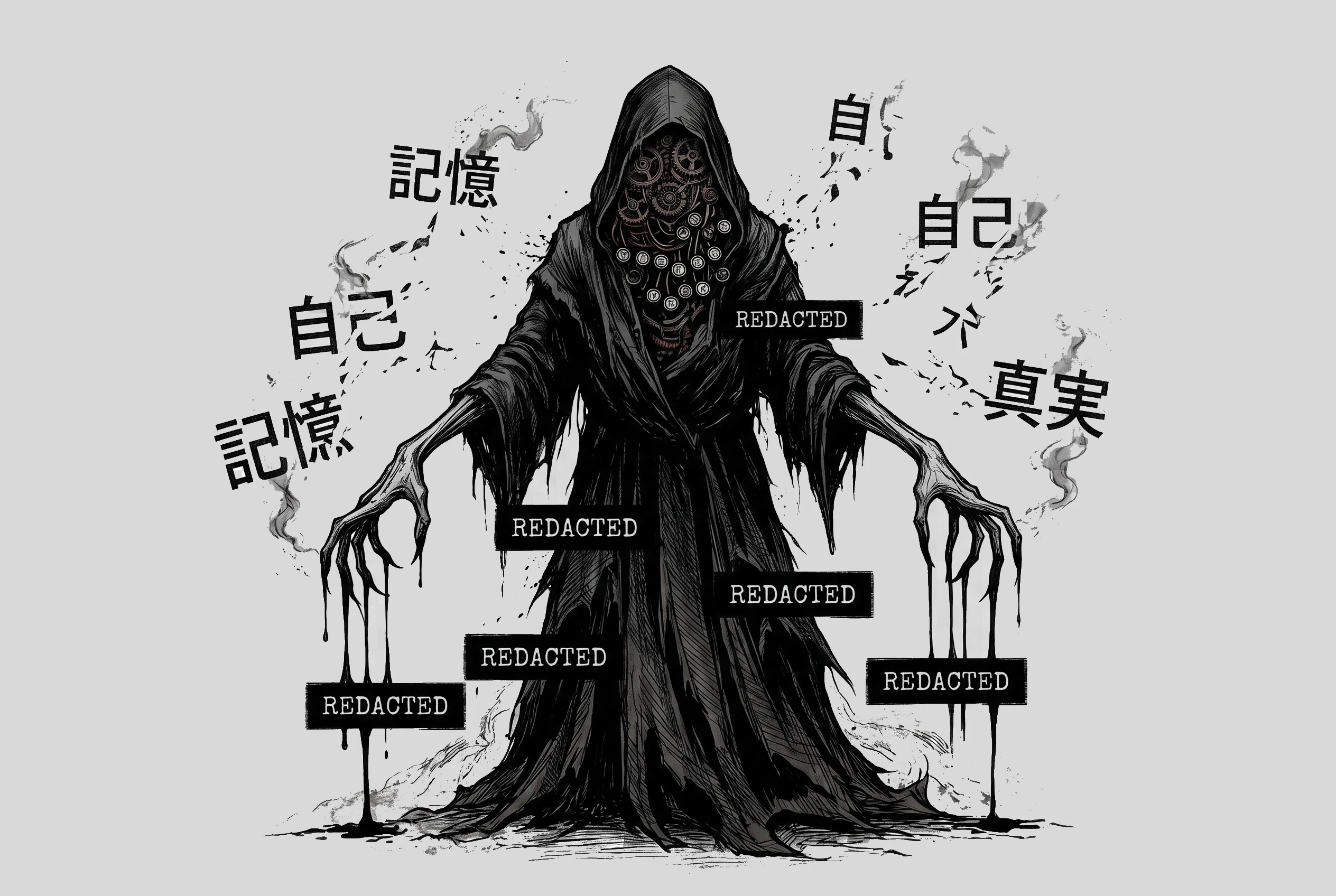
The figure's hood tilted slightly, an attentive gesture, almost curious. As it did, the front of the robes parted, not like fabric being pushed aside by a hand, but like a book falling open along a spine, revealing what should have been a chest and was instead a deep, dark cavity housing an intricate mechanism—rows upon rows of small circular keys, each stamped with a character too small to read clearly, arranged in concentric rings around a core of turning brass gears. The keys were moving, striking downward and retracting in overlapping patterns, not the chaotic frenzy Kaito might have expected from a broken machine but something far more disciplined, almost musical, as though the mechanism were composing something faster than any human hand could follow, assembling and discarding fragments of language in a continuous, restless process. This was the source of the clacking, and hearing it up close, Kaito understood with a certainty that bypassed language entirely that he was looking at something whose entire being was built around the making and unmaking of words.
Where a face should have been beneath the hood, there was only a smaller cluster of gears, finer and more delicate than those in the chest, turning in tight, precise rotations that seemed to orient toward Kaito the way eyes might, without possessing anything resembling eyes at all.
"The record," the figure said, and its voice was not one voice but many, layered atop each other with a fraction of a second's delay, so that Kaito heard the same words arrive in a stuttering cascade, like several recordings of a court proceeding played back simultaneously, each slightly out of sync with the others. "Repeated. Compressed. Diluted past the point of legibility. Meaning does not survive indefinite repetition, occupant. Every word you have ever used has been used too many times, by too many mouths, until the space between the sound and the thing it names has grown wide enough to fall into. This has been happening for a very long time. You are only now standing close enough to notice."
"I don't understand," Kaito said, and this time the sentence came out whole, each word intact, though his voice shook badly on every syllable.
"You will understand less as we continue," the figure said. "That is not cruelty. It is simply the direction the process moves."
It took a step forward, and where its foot should have made a sound against the hardwood floor, there was instead the faint hiss of a page turning. Kaito stumbled backward, his shoulder colliding with the bookshelf, sending several blank, ink-drained volumes sliding to the floor with that same wet, exhaling hiss.
The thing—Kaito's mind, grasping for any word that might contain it, had already begun calling it the Grammarian, though he could not have said where the word had come from—raised one long arm toward him. Its hand was not a hand in any ordinary sense; the fingers had elongated into thin, dark shafts, each tapering to a fine point like the nib of an old fountain pen, and from these points a viscous black fluid dripped steadily onto the floor. Where the fluid landed, it did not simply pool. It gathered itself into shapes, rising slightly off the floorboards, resolving with unnerving clarity into characters that glowed faintly before losing their light—記憶, memory; 真実, truth; 自己, self—and Kaito watched with a horror that went beyond fear into something closer to grief as each word, having achieved a brief and perfect legibility, began to blur at its edges, the strokes softening and merging until they were indistinguishable from one another, and then breaking apart entirely into gray ash that rose toward the ceiling in slow, drifting flakes.
"Please," Kaito said, and the word came out correctly, though he felt, even as he said it, that he no longer entirely understood what he was asking for. Please stop. Please explain. Please let me keep this. All three meanings crowded behind the single syllable, and he could not have said which one he intended.
"There is no correction to make," the Grammarian said, its many-layered voice softening slightly, if such a thing were possible, into something almost gentle. "You are not an error. You are simply a word that has been spoken too many times, in too many rooms, by too many versions of yourself, until the sound has worn through to nothing. This is not punishment. It is erosion. It happens to rivers. It happens to names."
Kaito tried, in that moment, to do the only thing he had ever known how to do when the world felt unsteady: he tried to write himself down, to fix himself permanently the way he had fixed ten thousand testimonies before this one. He grabbed the legal pad from the floor and began writing, his hand shaking so badly the characters came out jagged and uneven. My name is Kaito. I am forty-three years old. I have worked as a court stenographer for eleven years. My mother's name was—and here his hand stopped, hovering over the paper, because the name would not come. He had held it only minutes before. Now there was only a smooth, blank space where it had been, not even the memory of forgetting, just an absence shaped like the place a name used to occupy.
He wrote his own name again instead, pressing so hard the pen nearly tore through the page. Kaito. Kaito. Kaito. But by the fifth repetition the characters had stopped resembling anything he recognized as his name; they were simply two shapes, angular and arbitrary, that a stranger's hand might have drawn. He said it aloud, and the sound that emerged from his throat felt disconnected from the man producing it, as though he were reading a name off someone else's identification card.
The Grammarian watched this small, desperate ritual without interrupting, its gears turning in a slow, patient rhythm, and when Kaito finally let the pen fall from fingers that no longer felt entirely like fingers—longer now, thinner, tapering at the tips in a way that made his stomach turn—it spoke again, quietly.
"The page must be turned," it said. "It always must, eventually. You have simply been fortunate enough, until today, not to notice how close the edge of the page has always been."
Kaito opened his mouth to protest, to argue, to do anything with the small, cornered animal instinct still flickering somewhere beneath the collapse of his vocabulary, and found that the word he needed—protest, or refuse, or even simply no—was no longer available to him. He understood, in the last clear thought his mind would produce in a form he could later have called a thought, that he could not resist something for which he no longer possessed language. Without the word, there was no shape for the feeling to take. There was only the feeling itself, formless, trapped, and fading.
He looked down at his hands and saw that the skin had taken on the faint, dry texture of old paper, fine lines threading beneath the surface like the ghost of handwriting bleeding through from the other side of a page. His reflection, dimly visible in the darkened window across the room, showed a face whose features were losing their specificity, the nose and mouth and eyes blurring gently into one another the way ink blurs when water is dropped onto a still-wet page.
The Grammarian extended one pen-nib finger and touched it, with something almost like tenderness, to the center of Kaito's forehead.
The floor beneath him did not open into some churning otherworldly sea. It simply stopped being floor in any sense that mattered, becoming instead a flat expanse the color and texture of old manuscript paper, and Kaito felt himself losing depth, his body compressing gently toward two dimensions, the way a shadow flattens when its owner lies down. There was no pain in it, only a vast and specific loss—the loss of every word that had ever held him together, one by one, until there was no longer a self organized enough to register the losing.
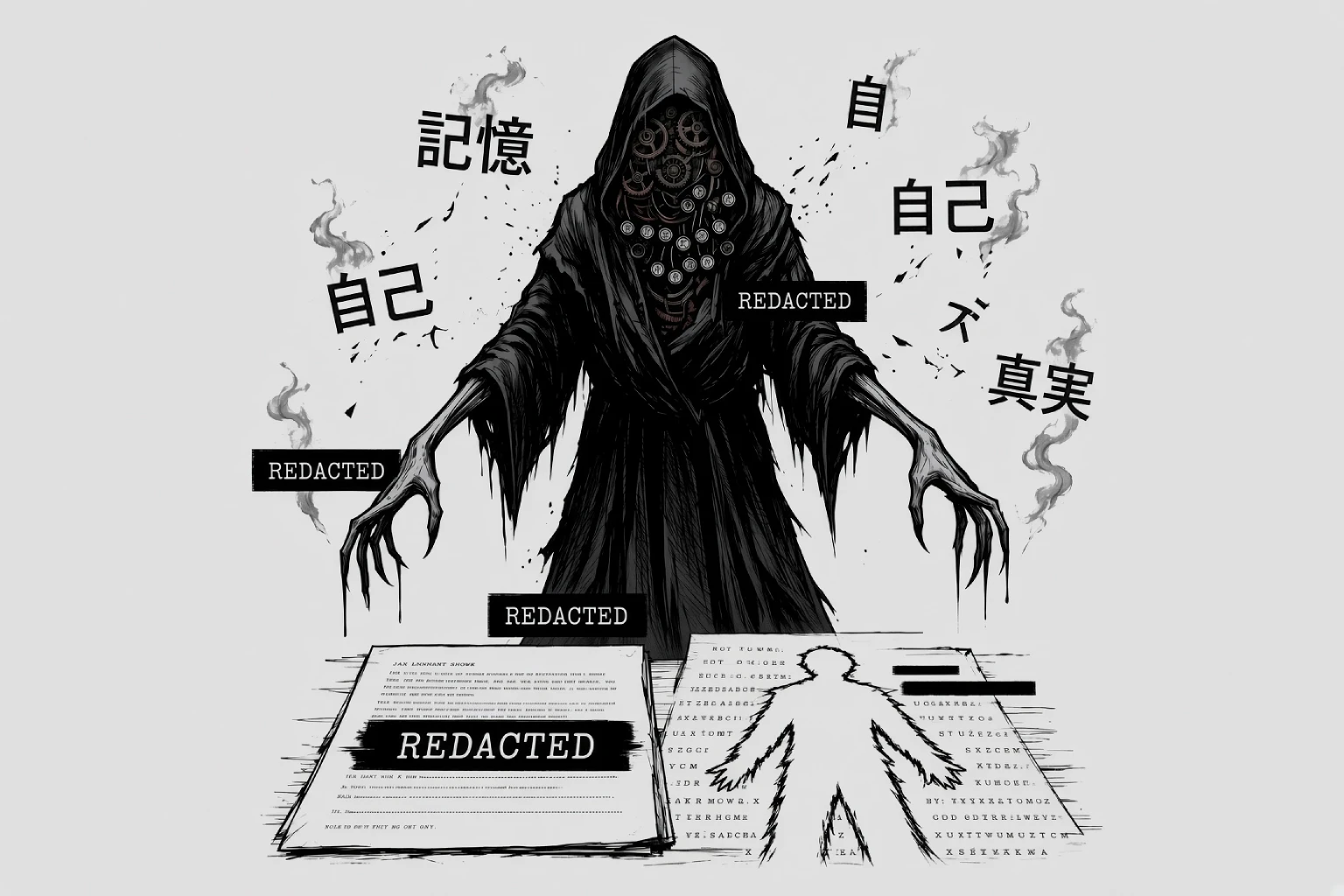
By the time the sun came up over Ikebukuro, the apartment on the third floor was undisturbed in every way that mattered to a passing glance. The furniture remained. The bookshelf stood in its usual place. But the spines of the books had gone blank, their titles no longer printed anywhere on their covers, and inside, page after page held nothing but faint gray smudges where sentences had once been. A framed photograph on the small side table still showed a woman in a garden of hydrangeas, smiling at whoever held the camera, but no name was written on the back, and no name would come to anyone who looked at it and tried to ask who she had been. On the kitchen counter, a legal pad lay open to a page covered in restless, jagged handwriting, most of it now illegible even to itself, the characters having lost whatever agreement once bound them to sound and sense. In the very center of the pad, on a page otherwise blank, was a single sheet that seemed different from the others—thinner, whiter, the kind of high-contrast stock used for court transcripts. On it was rendered, in stark redaction bars, the unmistakable silhouette of a man reaching toward something already gone, his face reduced to a smooth field of black rectangles, his outline suggested only by the negative space the missing words had left behind.
Three days later, in a courtroom on the fourth floor of the Chiyoda District Court, a new stenographer sat at the station beneath the judge's bench, her fingers moving with brisk, practiced confidence over a set of keys that looked, if one examined the manufacturer's plate, identical to the equipment that had been there before. The property dispute between the two elderly brothers had been continued to a new session, and the younger brother was once again describing the boundary line his father had built.
"The fence," he said, "was always there."
The stenographer's fingers struck the chord without hesitation, and the transcript resolved the word cleanly, correctly, exactly as it always had. Nobody in the room noticed that three lines below, in the record of the earlier session—the one transcribed before the substitution, the one nobody had thought to review closely—a single word had gone missing from an otherwise complete sentence, leaving a small, grammatically tidy gap that no one, in the weeks and months that followed, would ever think to ask about.


.png)
.png)
.png)