%20(1).png)

At 3:03 in the morning, the only light in Hina's apartment came from two monitors and the small blue rectangle of her phone, face-down but glowing faintly at the edges like something trying to breathe. She had been retouching the same photograph for forty minutes, a bridal portrait where the client wanted her arms slimmer and her jawline sharper, and Hina's stylus moved across the tablet with the tired precision of someone who no longer had to think about the motion. Her eyes ached. She had stopped noticing the ache hours ago, the way you stop noticing a hum until it cuts out.
The apartment was small even by Shinjuku standards, a single room stacked floor to ceiling with the evidence of a life lived mostly indoors. Manga she'd read once sat in leaning towers along the far wall, their spines bleached pale by monitor glow. Cables ran across the floor in black tangles, hidden under convenience store bags she kept meaning to throw out. The curtains had been closed for four days. She liked it that way. The dark made the screens brighter, made the colors truer, and truth was the one thing her job demanded of her, even when the truth was something she'd invented herself with a clone stamp and a feathered brush.
She was good at her work, better than good. She could find a mismatched shadow in a stock photo before her eyes had even finished scanning the frame. She could spot the telltale smear of a badly cloned background, the way skin sometimes looked too smooth in one patch and too textured in another, the subtle wrongness of a reflection that didn't match the angle of the light. Clients paid her because she saw what other people missed. She had spent a decade training her eyes to distrust the image in front of her, to hunt for the seam where the fake met the real.
It was this same eye, honed by ten years of pixel-picking, that first caught the wrongness in the dark screen beside her main monitor.
She had turned her secondary display off an hour earlier, tired of the extra light, and its black surface now worked as a kind of dim mirror, the way unlit screens always did. She caught her own reflection there sometimes without meaning to, a pale smear of a face floating in the glass. She reached for her cup of noodles, the motion so automatic she barely registered it, and it was only because her hand crossed in front of that dark screen that she noticed her reflection hadn't moved with her.
Her actual hand had already closed around the Styrofoam cup. In the black glass, her reflected hand still rested on the desk.
Hina went still, cup in hand, eyes locked on the screen. For a moment she assumed it was simple lag in her perception, the kind of glitch tired eyes produce at the end of a long shift. She'd seen enough compression artifacts to know that a brain running on caffeine and no sleep could invent all sorts of things. She set the cup down, slowly, and watched.
The reflection caught up half a second late, her hand sliding across the dark glass in a motion that didn't quite match the one she remembered making. It was subtle. It was the kind of discrepancy she would have flagged in someone else's photograph without a second thought — a frame dropped, an interpolation error, the visual equivalent of a stutter.
She raised her right hand slowly, testing.
The reflection lifted its hand too, but a beat behind, as though the image had to think about it first.
She turned the secondary monitor on and off. Nothing changed. She wiped her eyes, blinked hard several times, and tried again, waving her hand in a slow arc in front of the dark glass. The motion in the reflection was correct in its general shape but wrong in its timing, like watching a video with a slight desync between picture and sound. She had spent enough nights removing exactly that kind of desync from other people's home videos to know what she was looking at, except there was no video here. There was only her hand, and the glass, and the strange half-second gap between them.
"Okay," she said aloud, to no one, because the sound of her own voice felt like something solid to hold onto. "Okay. Eyes are just tired."
She stood up from her chair, joints stiff from sitting too long, and crossed the room to the dresser mirror she kept near the closet, a tall rectangle of glass in a cheap wooden frame she'd bought secondhand years ago and never bothered to replace. It was the only mirror in the apartment large enough to see herself in fully, and some old instinct told her that a real mirror, an ordinary one, would settle the matter. Screens could glitch. Glass didn't.
She stood in front of it and looked.
The mirror showed her the room precisely as it was — the tangle of cables on the floor, the stacked manga leaning against the wall, the twin glow of her monitors throwing pale light across the ceiling, even the crumpled delivery bag she'd forgotten to throw out that morning. Every detail of her apartment was rendered back to her in perfect, ordinary fidelity.
She was not in it.
Hina blinked, the way you blink when a word on a page suddenly stops making sense, when a shape refuses to resolve into anything familiar. She looked at the space where she was standing, then back at the mirror, then down at her own body, solid and present and undeniably hers. She raised a hand in front of her face. In the mirror, nothing moved, because there was nothing there to move. The room simply continued behind the empty space where she stood, undisturbed, as though she'd been carefully painted out of the reflection by someone with more patience than she had ever given her own retouching work.
She stepped closer, until her knees nearly touched the glass, until she could see the individual grain of the wood in the desk behind her reflected position. She waved both arms. She turned sideways. She crouched down and stood back up. The mirror recorded every change in the room around the space that should have contained her, adjusting shadows and light exactly as it would if a person were standing there, except no person appeared. She pressed her palm flat against the cold surface of the glass, and no fingerprint bloomed against the mirror's surface, no smudge of oil and warmth marking the place where flesh had touched it.
"That's not possible," she said, and her voice came out smaller than she meant it to.
She left the mirror and grabbed her phone from the desk, thumb swiping the camera open with the practiced speed of someone who used it constantly for reference shots and detail comparisons. She turned the front-facing lens toward herself and looked at the screen.
The little rectangle showed her apartment in cool digital color, the desk lamp slightly overexposed the way phone cameras always rendered warm light, the shelf of manga slightly soft at the edges from the lens's aggressive noise reduction. Her face should have filled the center of the frame. Instead there was only a faint discoloration where her outline should be, a kind of blur, as if someone had taken an eraser to a section of the image and smudged rather than removed it cleanly.
She tapped the shutter anyway, some part of her brain still operating on the assumption that a still photograph would resolve what the live preview couldn't. The photo saved to her camera roll a second later. She opened it with fingers that had started, very faintly, to shake.
The picture showed her desk chair, empty. It showed the edge of her sleeve, a sliver of gray fabric floating at the frame's edge with nothing attached to it. Her shadow was there, thrown long and correct across the floor by the desk lamp, but the shape that should have cast that shadow was missing entirely, as though the light had learned to bend around an absence.
Hina lowered the phone slowly. Her hands felt distant from her, the way a limb feels after you've slept on it wrong, present but unfamiliar. She looked around the room, at the very real clutter of her very real life, the ramen cups and the tangled cords and the dim blue wash of the monitors, and she felt, for the first time in longer than she could remember, that the room did not entirely believe she was in it.
She thought about calling someone. She scrolled through her contacts with the phone held too tightly, thumb hovering over a name she hadn't spoken to in months, a former coworker from her agency days who might still pick up at four in the morning if she made it sound urgent enough. But what would she say? That the mirrors had stopped agreeing with her? That her reflection was a half-second behind her own hand? She could already hear how it would sound out loud, and she put the phone back down without dialing.
Instead she turned to her laptop, opened the webcam software she sometimes used for video calls with clients, and set it to live preview. The little window populated with the familiar sight of her own face, tired and pale, lit from below by monitor glow. For a moment relief loosened something tight in her chest. There she was. Ordinary. Real.
Then she noticed the eyes.
They were looking slightly to the left of where she was actually looking, a small but definite few degrees of divergence, like a portrait painted by someone working from a photograph taken a moment before the subject had turned her head. She moved her gaze deliberately to the corner of her screen. In the webcam window, her reflected eyes drifted to follow, but slowly, arriving at the correct position a full second after she had already moved on, so that for most of any given moment, the eyes on her screen were looking somewhere she was not.
She smiled at herself, an experiment, baring her teeth in something that wasn't really a smile at all. On the screen, the mouth of her reflection curved upward too, but late, and held the expression a beat longer than she did, so that when her real face had already gone slack with unease, the webcam Hina was still smiling at her, patient and wrong.
She closed the laptop.
The apartment had gone very quiet. She realized she could hear the individual whir of each cooling fan in her two desktop towers, could hear the faint electrical hum behind the walls that she'd tuned out years ago, could hear her own pulse ticking somewhere behind her ears. She sat very still in her chair and told herself, in the calm and reasonable voice she used when clients sent unreasonable revision requests, that there was an explanation for all of this. There always was. She had spent her career finding explanations for the uncanny; a badly aligned reflection, a compression ghost, a trick of low light and exhausted eyes.
But the dresser mirror had shown an empty room with real fidelity, no glitching, no artifacts, no signs of malfunction at all. It had simply and calmly left her out.
She stood again, unsteady now, and moved toward the window, thinking that if all the screens and glass in the apartment had turned against her, ordinary daylight — or what passed for it in the depth of night, the orange smear of Shinjuku's light pollution — might offer something more trustworthy. She pulled the curtain aside an inch.
The window glass reflected the room behind her in a dark, warped ghost image, the way night windows always did, superimposing the interior over the exterior view. In that reflection, she caught the shape of her own shoulder, present this time, faint but there, a small mercy. She exhaled. Then she noticed that behind her own transparent shoulder, in the reflected version of her cluttered apartment, the bookshelf was in the wrong place.
It was a small thing. In the room behind her, the manga shelf stood against the east wall, beside the closet. In the window's reflection, it stood against the wall opposite, where her desk should have been, and her desk in the reflection had migrated to where the shelf belonged. She turned around fast to check the real room. Everything was where it had always been. She turned back to the window. The reflection held its wrong geometry, patient, unbothered by her confusion, as if it were reflecting some other, slightly different version of the same apartment that existed just behind the glass.
She let the curtain fall closed and stepped back into the center of the room, her arms wrapped around herself though the apartment wasn't cold. It occurred to her, distantly, that she had spent ten years teaching herself never to trust an image completely, and now the images had learned the same lesson about her.
The overhead light, an old fluorescent tube she rarely used because the monitors gave enough glow to work by, buzzed once and flickered, and in that half second of flicker, Hina thought she saw, reflected in the black surface of her turned-off television in the corner, a shape standing behind her that was not her own.
She spun around. The room was empty except for herself. She looked back at the television. It reflected only the room, dim and undisturbed.
She told herself it had been a shadow, a trick of the flickering tube, and she almost believed it long enough to sit back down at her desk. Her editing software was still open, the bridal portrait still waiting for its jawline, a small red dot pulsing on the layers panel where she'd left an adjustment unsaved. She reached for her stylus out of pure muscle memory, some animal instinct toward normalcy, toward the one task she knew how to do with total confidence.
Her hand ached as she picked up the pen. Not a deep ache, more like the dull tightness of a bruise she couldn't remember getting. She turned her hand over to check her knuckles under the desk lamp and saw, just beneath the first joint of her index finger, the faintest thread of a line, pale and fine as a hair, running beneath the surface of her skin. It caught the light strangely when she tilted her hand, a small glint where no glint should exist in ordinary skin.
She brought her hand closer to the lamp. The thread beneath her skin held a faint, glassy sheen, like a hairline crack seen through frosted material. She pressed her thumb against it. It didn't hurt, exactly. It felt cold in a way flesh had no business feeling, a coldness that seemed to originate from inside rather than from the air around her.
Hina set the stylus down very carefully, as though sudden movement might make the thing beneath her skin worse.
She stood again — she couldn't seem to stay in one place for long now — and caught her reflection once more in the dark secondary monitor. This time the delay was worse. She lifted her hand and the reflected hand did not merely lag; it hung suspended in the position from a full three seconds earlier, then jerked forward all at once to catch up, the motion broken into two distinct, jagged pieces rather than one continuous arc. It reminded her, sickeningly, of a video file with too few keyframes, the kind of choppy playback she used to fix for clients whose footage had been compressed too many times. Except she had never seen it happen to a live reflection. She had never seen it happen to herself.
The apartment's angles felt subtly off now too, though she couldn't immediately say why. She looked at the corner where two walls met above her bookshelf and had the unsettling sense that the angle was very slightly wrong, more acute than ninety degrees, as though the room had been redrawn by someone working from a photograph taken at a bad angle and not bothering to correct the perspective. She walked toward the corner to check it directly, and up close it looked ordinary again, walls meeting exactly where walls should meet. But when she stepped back to her desk and looked at it from a distance, the wrongness returned, subtle but present, a corner that didn't quite agree with itself depending on where she stood to view it.
She began to notice the same thing throughout the room. The reflection in her monitor glass showed the bookshelf slightly closer to the door than it actually stood. The window's dark reflection placed her desk lamp on the wrong side of the desk. Every reflective surface in the apartment seemed to be quietly disagreeing with the others about the shape of the room she was standing in, each one insisting on its own version of the space, and none of them quite matching the version she could touch with her own hands.
She thought, absurdly, of her own retouching work, of the countless times she had taken a photograph and shifted an object a few pixels to the left to improve a composition, adjusted a shadow to fall more convincingly, cloned out a stray cable or an unwanted reflection in a window. She had spent a decade deciding how reality ought to look in other people's pictures. It had never occurred to her that reality might someday decide to return the favor.
The cracking sound, when it came, was small and precise, like a knuckle popping, except it came from somewhere in the wall behind the bookshelf rather than from her own body. She turned toward it in time to see a thin fracture line spreading across the surface of a framed print she'd hung there years ago and mostly stopped noticing, a cheap poster of a Tokyo skyline behind glass. The crack ran diagonally across the print's protective sheet, and through it, for just a moment, Hina thought she saw not the skyline printed beneath the glass but a fragment of her own kitchen, rain streaking a window that did not exist anywhere in her apartment.
She crossed the room and touched the crack with one finger, and the moment her skin made contact, the fragment beyond it resolved further, showing not rain and a window but a face — her grandmother's face, unmistakably, wrinkled and soft and gone eleven years now, turned toward something outside the frame and smiling faintly at whatever she saw there. The image held for a second and a half before the crack in the glass simply reflected the room again, ordinary and cold.
Hina stepped back from the print, breath uneven, heart working hard enough that she could feel it in her throat. She had not thought about her grandmother in months. She had certainly never associated her with rain on a window. And yet the image had felt correct in some way she couldn't articulate, correct the way a half-remembered dream feels correct even as it dissolves.
More cracks were spreading now, not just in the poster's glass but in the black television screen, in the dark secondary monitor, in the window behind the curtain. Each one moved slowly, deliberately, the way a windshield cracks under sustained pressure rather than a single blow. And in each fracture, for a heartbeat at a time, something flickered through — the smell of hot asphalt after summer rain that she couldn't smell but somehow remembered smelling; a gray cat, her first, dead now for over a decade, stretching in a patch of sunlight on a windowsill she no longer owned; the sound of a voice she recognized as an old boyfriend's, saying her name in a tone she hadn't heard directed at her in years.
None of the memories stayed in the glass. Each one surfaced and then let go, dissolving back into ordinary reflected room, as if the glass itself were sampling her, tasting fragments of a life and setting them back down when it was finished.
Hina backed toward the center of the room, turning in a slow circle, trying to keep all the cracked surfaces in view at once, an impossible task in a room this small and this full. The air had taken on a strange density, thick in a way that made each breath feel deliberate, and beneath the ordinary smell of cold ramen and dust, she caught something sharper, a scent like a hot circuit board, like ozone after a lightning strike too close to home.
Her hands had begun to hurt in earnest now. She looked down and saw the pale threads beneath her skin had multiplied, running from her knuckles up toward her wrists in a fine network, faintly luminous in the dim light, catching stray gleams from the monitors the way a spiderweb catches morning light. Her fingertips, when she flexed them, had taken on a faint translucence, not transparent exactly but thinned, as though the top layers of her skin had become something closer to frosted glass than flesh. She could see, very faintly, the shape of her own bones inside her fingers, not as an anatomical illustration but as something more abstract, planes and facets rather than smooth curves.
She made a small sound, not quite a sob, and closed her hands into fists, as if hiding them from her own sight would undo what she'd seen. When she opened them again a moment later, a thin crack had appeared across the back of her right hand, hairline-fine, catching the light exactly as the cracks in the poster glass had.
It didn't bleed. There was no blood in it at all, only that same cold glassy gleam, and somewhere deep beneath the crack, for just an instant, she saw a tiny looping image of her own hand reaching for a cup of noodles, over and over, the memory of an hour ago trapped and repeating in the fracture like a stuck reflection.
She was still staring at her hand when she felt, more than saw, that she was no longer alone.
It wasn't a sound that alerted her, not footsteps or breathing or any of the ordinary signals a person's body gave off when it entered a room. It was a change in the light. The dim glow from her monitors seemed to bend somehow, curving away from a point near the far wall as though something there refused to be illuminated in any ordinary way. Hina turned toward it slowly, her cracked hand still raised in front of her, and saw the shape.
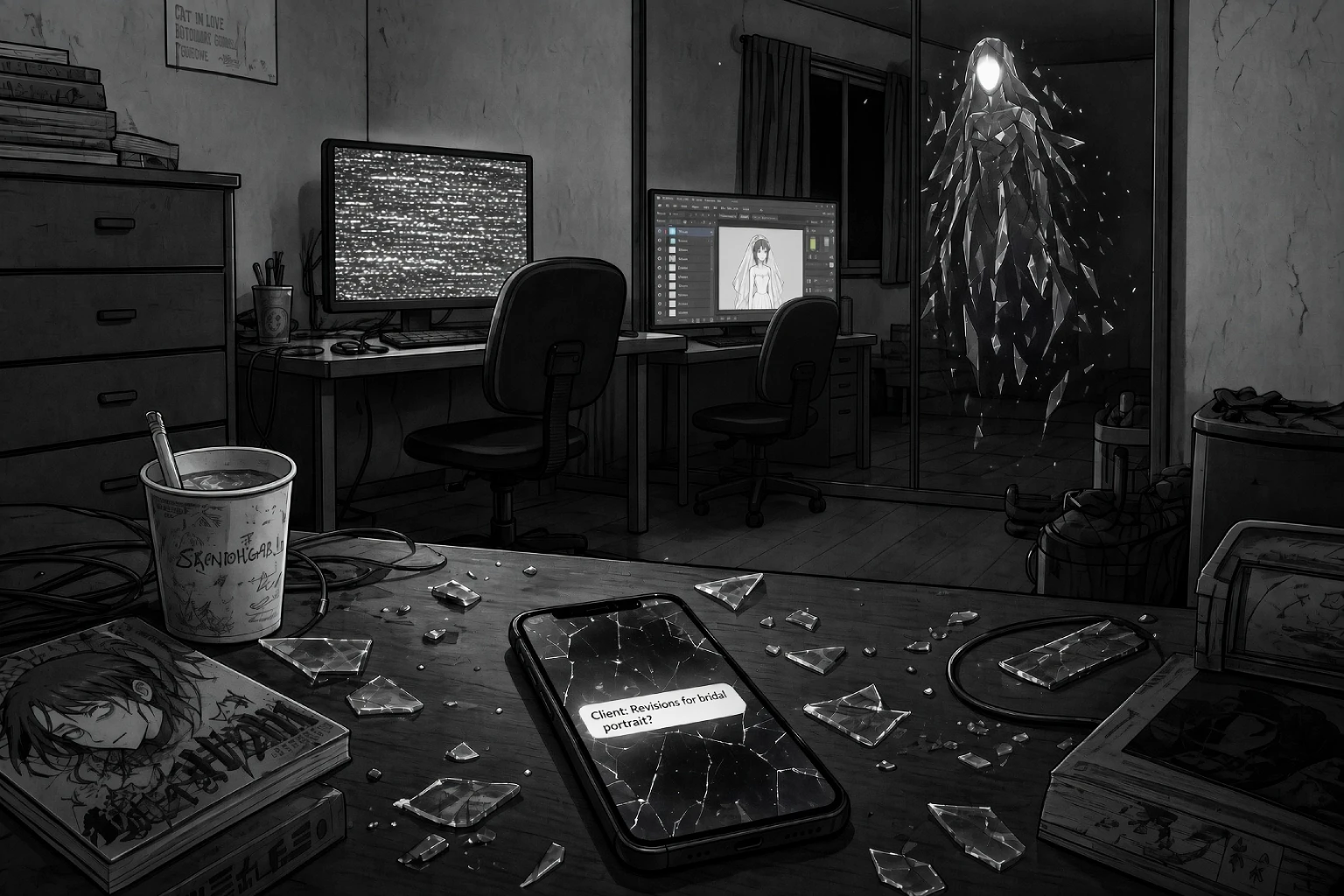
It stood nearly to the ceiling, though the ceiling was low enough that she couldn't understand how it fit, as if the room had quietly agreed to make space for it. Its body had the look of smoked glass, dark and faintly layered, catching light in shifting planes the way a chandelier catches candlelight, each surface slightly different in tone from the one beside it. It wore something like a gown, though gown was too soft a word for the countless translucent shards that hung and shifted around its form, each one chiming very faintly against the others as it moved, a sound like wind through a shop full of hanging glass ornaments. Some of those shards, Hina realized with a fresh wave of vertigo, held tiny moving images inside them, fragments of scenes she didn't recognize, other rooms, other faces, other hands reaching for other cups.
Where a head should have been, there was only light. Not a face, not features of any kind, just a smooth blank oval of white so bright it seemed to erase the air immediately around it, the way an overexposed photograph erases the details of whatever stood in the brightest part of the frame. Looking at it made Hina's eyes water, not from brilliance exactly but from the specific wrongness of trying to look at something that visual logic said should have depth and didn't.
The figure did not walk toward her so much as it arrived, closer with each blink than it had been before her eyes closed, though she never caught it in the act of moving. Its hands, when she made herself look at them, ended not in fingers but in long, needle-thin points of glass, delicate as the tools she used for detail work on her tablet, and just as precise.
She wanted to run. Her legs, cracked now at both knees with the same fine white lines that had spread across her hands, would not entirely obey her, each attempted step accompanied by a small grinding sound like a foot coming down on broken safety glass. She managed to stumble back until her spine met the wall beside her bookshelf, manga tumbling from their precarious tower to the floor around her feet.
The figure did not hurry. It never needed to. Every mirror in the room had turned to face it, she realized, the dresser mirror, the black television, the cracked poster glass, all of them angled by some logic she couldn't perceive toward this one point in space, all of them holding still images of the same faceless shape from different perspectives at once, so that Hina found herself looking at the thing from the front and, in the mirror to her left, from behind, and in the television's reflection, from an angle no living eye in the room could have actually achieved.
She was seeing herself the same way now. In the dresser mirror, she saw her own back, small and cracked and trembling against the wall. In the black glass of her monitor, she saw her own face from the front, eyes too wide, mouth slightly open. In the fractured poster glass, she saw herself from above, as if a camera floated near the ceiling, watching her from an angle her body had never occupied. Three versions of Hina existed in the room now, and she could no longer say with any confidence which one was the true position of her body and which were simply where the room had decided to place her image.
The figure raised one of its needle-fingers, slow and deliberate, more like a conductor lifting a baton than a predator reaching for prey.
"The picture stays," it said, and the voice did not come from any single direction, but from the glass itself, from every reflective surface at once, a chorus with no true source. "You were only ever the moment it was taken from."
Hina tried to answer and found that her voice, when it came out, sounded strange to her, layered somehow, as though she heard herself speaking from three positions in the room simultaneously rather than from her own throat alone. She pressed her cracked hand flat against her chest, feeling for the reassurance of her own heartbeat, and found instead a faint, high hum, like a wine glass rung by a fingertip.
The figure's stylus-hand came to rest, very lightly, against her sternum.
She felt herself begin to separate.
It did not hurt in the way she expected pain to feel. It was more like watching herself from too many places at once, the sensation growing so overwhelming that she couldn't hold onto the thread of which perspective belonged to her original body. She saw her own face reflected impossibly close, as if from inside a shard held an inch from her own eyes. She saw the back of her head from across the room. She saw her hand, and inside the crack in that hand, the moving image of a cup of ramen being lifted, the same lost fragment of memory looping over and over in miniature, no longer connected to any single point in time.
Her grandmother's face flickered again, this time not inside the print's cracked glass but somewhere inside her own translucent wrist, smiling faintly at something beyond the frame of Hina's understanding. The smell of rain on hot asphalt rose up around her, disconnected now from any specific memory, simply present in the air like perfume from a room she'd never actually stood in. Somewhere in the multiplying reflections, a gray cat stretched in remembered sunlight, and Hina realized, with the calm horror of someone watching their own hand catch fire from a safe distance, that these images no longer felt like they belonged to her. They had become things the room contained rather than things she remembered.
The cracks that had spread across her hands and legs began to widen, not violently, but with the unhurried certainty of ice giving way on a lake. Where each crack opened, she caught a glimpse of another moment of her life, sealed inside like an insect in amber: her hand on a childhood doorknob, sunlight through a bus window, the particular blue of an old monitor glow reflected in a much younger version of her own eyes. Each fragment held itself apart from the others, distinct and complete, no longer arranged into the single continuous story she had once called her life.
She understood, in the last clear moment she would ever recognize as fully her own, that she was no longer one person looking out through one pair of eyes. She was becoming many small, precise angles of herself, each one true, none of them whole.
The final crack ran the length of her body all at once, silent, almost gentle, and the glass that had been Hina came apart the way a windshield does under the right kind of pressure — not into violence, but into a soft, glittering collapse, thousands of small clear fragments falling and catching the light in a hundred colors that shouldn't have existed in a room lit only by monitor glow. Each fragment, as it settled onto the floor among the fallen manga, held some small captured piece of her: a blink, a smile, a hand reaching for a cup that would never be finished. The chiming sound of settling glass filled the room and then, slowly, faded into silence.
The figure was gone by the time the last shard came to rest. It had never seemed to need a door.
The apartment did not change. The monitors continued to glow, one of them still displaying the half-finished bridal portrait, the jawline still waiting for its final adjustment. The desk chair sat empty, angled slightly as though someone had just stood from it. The ramen cup remained where it had been left, cold and untouched. On the floor, scattered among fallen manga volumes, small clear fragments caught the light and held it, patient, silent, arranged in no pattern that meant anything to whoever might eventually find them.
Some hours later, gray light began to seep faintly around the edges of the closed curtains, the ordinary approach of an ordinary morning. Hina's phone lit up on the desk with a notification, the screen's spiderweb crack — there from a drop weeks earlier, never quite bad enough to warrant fixing — catching the new light at an angle that made it look, for just a moment, deeper than it should have been. A client had sent a message asking about revisions to the bridal portrait, wondering, politely, whether the file might be ready by morning.
The phone's screen dimmed again after a few seconds of inactivity, and in its dark, cracked surface, the room reflected back with reasonable fidelity — the shelf of manga, thinner now by one fallen stack, the twin monitors casting their familiar blue light, the empty chair pushed slightly away from the desk.
The mirror across the room showed the same scene from its own angle, exact in every detail down to the crumpled delivery bag near the door. It held that image steadily, without disturbance, the way it always had.
Nothing in the reflection moved. No shape stood in front of the chair, no hand reached for a cold cup of noodles, no face turned toward the glass to check its own uncertain edges. The room reflected itself perfectly, complete and undisturbed, exactly as it would have looked if no one had ever lived there at all.


.png)
.png)
.png)