%20(1).png)
The bar on Concourse Seven called itself the Regulars Section, though nobody Jovia had ever met there actually was one. It sat wedged between a noodle stall and a pawn shop that traded almost exclusively in salvage parts. Its neon signage buzzed with the specific tired flicker of a light repaired too many times by people who didn't really know how.
Jovia liked it anyway. The old chrome-faced bartender never asked questions about her eyes, which was more than she could say for most of the station. She sat at the end of the bar with a drink she hadn't touched in ten minutes, watching the crowd the way she watched everything, in layers most people never noticed.
Heat signatures moved through the dim room like slow orange weather. A service drone near the door ran hot along one damaged strut, a fault nobody had reported yet. Somewhere under the floor, a power conduit pulsed with the faint, steady rhythm of a station doing exactly what it was built to do.
"You're Jovia," said the woman who sat down two stools away, close enough to talk, careful not to crowd her. "Lucent Order. Independent contractor. I was told you take sensory work."
"Depends on the work." Jovia turned enough to look at her properly. Mid-forties, expensive coat, the kind of posture that came from a career spent convincing people of things.
Heat bloomed faintly along the woman's jaw, the ordinary kind, nothing to flag. Just someone a little warm in a room that ran cold. "Depends more on who's asking."
"Varda Kessing. I broker specialist contracts for private clients." Varda set a slim data chip on the bar between them, the universal gesture of someone who wanted to be taken seriously without saying too much out loud. "A client of mine has recovered something they don't fully understand. Standard sensors can't make sense of it. They want someone who can."
"That's a big category of things."
"It's an artifact. Possibly military, possibly older. Found in a derelict about six hours out, in a debris field nobody's supposed to be salvaging but everybody does anyway." Varda offered a thin, professional smile. "They need an assessment. Is it safe to move. Is it worth what they think it's worth. What it actually does, if anything."
Jovia studied her for a long moment, letting her expanded vision drift across the woman's face out of habit more than suspicion. Varda's pulse sat a little high. Not panicked. Careful.
"That's an inspection job," Jovia said. "I charge for those by the hour, not the mystery."
"The hours would be generous."
"How generous?"
Varda told her a number. It was generous enough that Jovia set her drink down entirely.
"You could hire three conventional techs for that," Jovia said. "Better sensors, cheaper rates, no religious dress code to work around."
"My client tried conventional techs," Varda said. "Twice. Both times the equipment returned readings that didn't hold up on a second pass. Contradictory numbers. Noise where there shouldn't be any." She turned her glass a quarter turn on the bar, an old habit dressed up as patience. "That's usually the point someone remembers the Order exists."
"Usually the point someone gets desperate," Jovia said.
"I didn't say it wasn't both."
"That's not inspection money," Jovia said. "That's keep-quiet money."
"It's remote-site money," Varda said, without missing a beat. "You'd be six hours out, in a debris field with no station services and uncertain salvage rights. My client pays for inconvenience as much as expertise."
It was a reasonable answer. It was also, Jovia noted, not actually a denial.
"I'll want a full manifest before I board anything," she said. "What the site is, who's running it, what equipment's already been attempted on the object, and what happens to me legally if your client's salvage rights turn out to be fiction."
"All reasonable," Varda said, and meant it, or seemed to. "I can have that to you within the hour."
"Then send it," Jovia said. "I haven't said yes yet."
The manifest, when it came, was thin in the specific way documents were thin when someone had spent real effort making them look complete. A registered salvage permit, technically valid. A site designation in the debris field, technically real. No mention of what kind of derelict the object had come from, no imaging of the artifact itself, and a security detail listed as four personnel for what was supposedly a routine cargo recovery.
Jovia read it twice, then said yes anyway. The pay was good, and she had learned, across eleven years in the Order, that the surest way to find out what people were hiding was to let them show you in person.
The transport was a boxy little hauler with a name stenciled over the airlock that had clearly been painted over at least twice. Dace Holloway met her at the ramp, a broad, sun-weathered man with the easy, unbothered manner of someone used to running sites where questions weren't encouraged.
"You're smaller than I pictured," he said, which Jovia had heard often enough not to bother responding to.
"You're less armed than I expected for a cargo job," she said instead, nodding at the woman standing a few paces behind him, sidearm holstered but visible, posture entirely professional.
"Debris field's rough," Dace said. "Mireille's precaution, not policy."
Mireille Sato didn't offer her name herself. She studied Jovia the way security people studied everything, cataloguing rather than greeting, and said nothing at all.
The six hours out gave Jovia plenty of time to watch both of them without seeming to. Dace talked too much for a man running routine cargo, filling silences with weather reports on a debris field that didn't have weather, stories about salvage runs that never quite finished the way he set them up to. Mireille talked almost never, and when she did, it was short, precise, entirely functional, the speech pattern of someone who'd been trained to treat words as ammunition rather than company.
"You always this quiet on a job?" Jovia asked her, somewhere around hour four, mostly to see what would happen.
"You always this nosy on a job?" Mireille said, without looking up from the tablet in her lap.
"Occupational habit," Jovia said. "I notice things. It's most of what I'm for."
"Then notice something useful," Mireille said, "and keep it to yourself until somebody asks."
Jovia took the hint, and spent the rest of the trip watching instead of talking, which suited her better anyway.
The site, once they reached it six hours later, was not what Jovia had expected from a salvage manifest. It wasn't a derelict hauled into a cargo bay for inspection. It was a research module, intact, docked to a private rig floating in the debris field like something that had been waiting there a long time.
"This isn't what was recovered," Jovia said, as they moved through the airlock. "This is where it's being kept."
"The derelict's structurally compromised," Dace said. "We moved the object here for a stable environment. Same thing, different room."
"It's not the same thing," Jovia said, "but go on."
The object sat in the module's central chamber under a containment frame that looked, to her expanded vision, considerably more sophisticated than anything a routine salvage crew would bother installing for an unknown artifact. It was roughly the size of a seated person, matte black, its surface etched with a lattice of fine channels that pulsed, faintly, in wavelengths no unmodified human eye would have caught at all.
"There," Dace said. "The Halyard. That's what the client calls it. Tell us what we're looking at."
Jovia stepped closer, letting her vision widen the way it did when she stopped filtering for convenience and let the full spectrum in. The lattice wasn't decorative. It was active circuitry, structured in a pattern she recognized in its shape if not its origin, a design built to carry information rather than power.
"It's an interface," she said slowly. "Not a weapon housing. Not a core. This is a lock, meant to talk to something else."
"Talk how?"
"Optically. Some of it, anyway." She crouched, careful not to touch the containment frame yet. "There's a verification layer running across most of the ultraviolet band, and beneath that something in a range I don't have a clean name for. It's reading for a response. It wants to be answered, not just looked at."
"Can you answer it?"
Jovia looked up. The question had come too fast, too eager, from a man who two minutes earlier had been playing at bored professionalism.
"That depends what you think I am," she said. "I can read wavelengths most sensors miss. I can't necessarily speak a dead system's private handshake because I happen to have pretty eyes."
"But you could try," Dace said.
"I could look longer. That's different from trying to open it." She straightened, studying his face instead of the object now. "You didn't hire me to assess this. You hired me because you think I can unlock it."
"You keep saying *we need*," Jovia said, before he could answer. "Your manifest listed one client. A private buyer. Not a crew with opinions of its own."
"Figure of speech," Dace said, a beat too quickly.
"It's a very specific figure of speech for a man supposedly just running cargo." She let the silence sit a moment. "How many people actually know you brought me out here?"
Nobody answered immediately, which was, in its own way, an answer.
"The manifest said inspection," Jovia said, keeping her voice level. "It didn't say interface."
"Does it matter which word we used?" Dace asked. "You're here. You can see things nobody else on this rig can see. That's exactly what we need."
"It matters because I agreed to look, not to be part of the machine." Jovia stepped back from the containment frame, deliberately, putting distance between herself and the lattice's faint pulse. "What does this actually control?"
Varda, who had been quiet since they'd boarded, finally spoke. "A ship. A decommissioned military platform, still holding position about forty kilometers from here. It's been dark for a long time. Nobody's been able to access its systems, because the access key was built the way that object is built, designed so nothing conventional could forge its way in."
"What kind of platform?"
"Orbital bombardment class," Varda said, quieter now. "Kinetic strike capability. Whoever controls it controls a weapon nobody's supposed to still have access to."
Jovia felt something cold settle under her ribs, steady and clear, the same feeling she got when a reading came back wrong in a way that mattered.
"You want to sell access to a bombardment platform," she said.
"We want to confirm it's still functional," Dace said. "What happens after that isn't your concern."
"It is now," Jovia said. "I'm not doing this."
"You already looked at it," Dace said. "You already told us what layer it's reading on. That's most of the work."
"Looking isn't unlocking." She kept her voice level, though something cold was settling steadily under it now. "There's a difference between reading a system and feeding it what it's asking for. I don't know what's on the other side of that handshake, and neither do you, and that's exactly the kind of job I don't take."
"We're not asking you to take a risk for free," Varda said, stepping in, her voice softer than Dace's, more careful. "The payment structure can change. Substantially."
"This isn't a negotiation about price," Jovia said. "It's a decision about whether I let something I can't identify read my nervous system to unlock a weapon I've now been told exists. Money doesn't move that number."
"Everyone has a number," Dace said.
"Not this one." She looked between them, steady, done. "I'm leaving."
She turned toward the module's exit, already calculating the walk back to the hauler, the time it would take, whether the pilot would actually let her board without Dace's say-so.
Mireille moved before she reached the hatch, unhurried, deliberate, planting herself squarely in the doorway with the flat, unbothered patience of someone who had done this before.
"I don't think that's happening," Mireille said.
"I'm a contractor, not cargo," Jovia said. "You don't get to keep me here."
Mireille didn't raise her voice, and didn't reach for the sidearm at her hip, which somehow made the moment feel more dangerous rather than less. "I've walked people out of rooms they didn't want to leave before. Some of them fought me. All of them still left."
"I'm not interested in finding out which category I'd fall into," Jovia said.
"Then don't make me sort you," Mireille said.
Jovia let her vision widen for half a second, just enough to read the woman properly. Steady pulse. No elevated heat anywhere that suggested bluff. Mireille meant every word of it, plainly, the way some people only ever spoke.
"We paid you," Dace said, stepping closer, his earlier easy manner gone entirely now. "We can pay you more. Or we can stop asking."
"You don't understand what you hired," Jovia said, and meant it as a warning more than a threat, though she watched neither of them take it that way.
"We hired someone with the right eyes," Dace said. "We understand that part fine."
"You understand the part that's public," Jovia said. "That's not the same thing."
Dace's jaw tightened, and whatever patience he'd been holding onto for Varda's benefit finally ran out. "We don't have time to keep being patient about this." He looked past Jovia, to Mireille. "Bring her back to the frame."
"Don't," Jovia said, already backing a step, the calm in her voice costing her more than it showed. "You don't understand what you're asking that thing to do to me."
"Then explain it fast," Dace said, "because we're doing this either way."
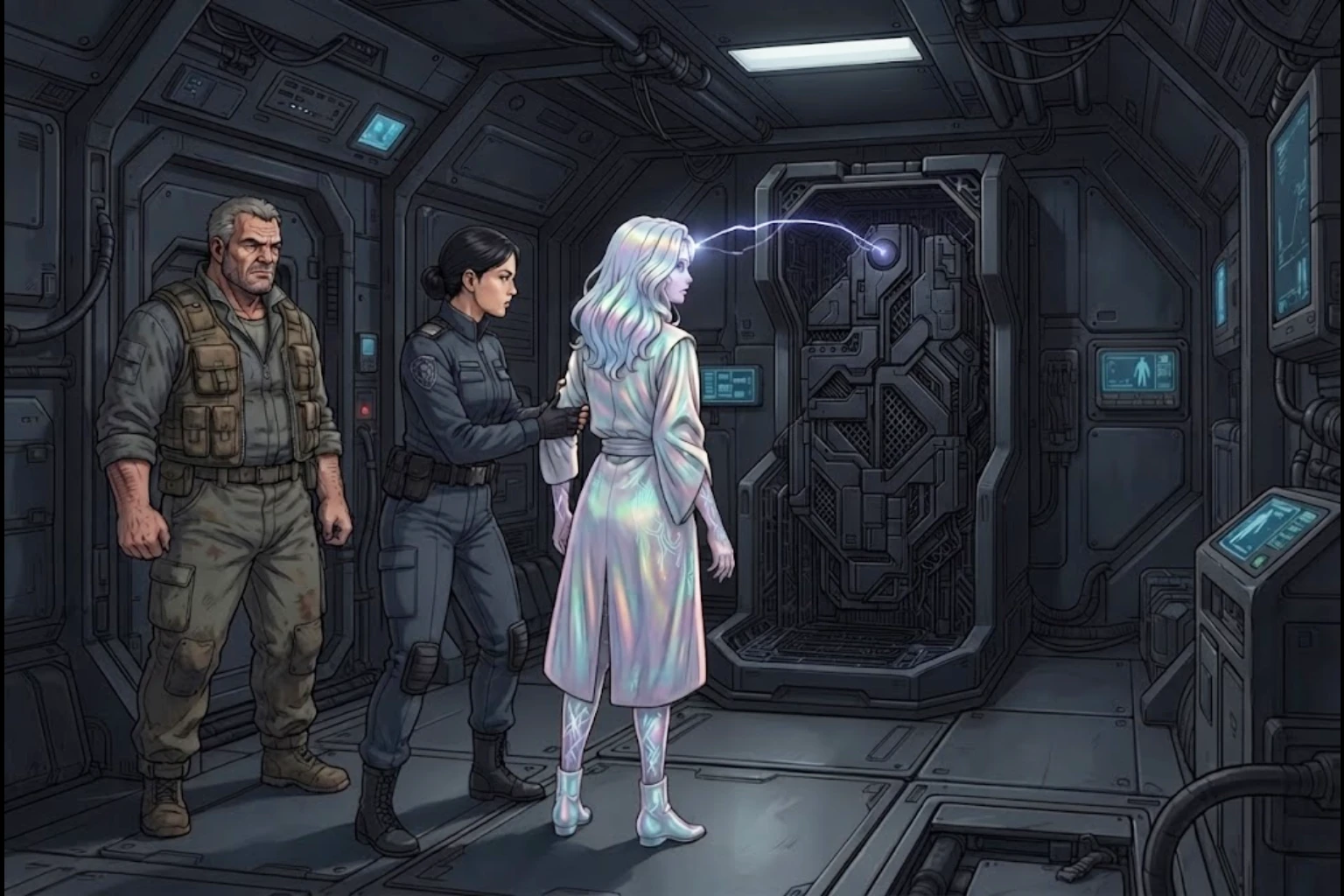
Mireille's hand closed around her upper arm before she'd finished the sentence, firm and controlled, the grip of someone trained to move a person without injuring them, which somehow made it worse rather than better. Jovia twisted, found no give in it at all, and let herself be walked the last few steps toward the containment frame rather than waste strength fighting a hold that wasn't going to break.
"You don't need all of me," she said, fast now, watching the lattice's pulse brighten as she neared it. "Nobody built a lock that opens itself on a partial answer. If this goes wrong, it doesn't just fail quietly—"
"Five seconds," Dace said. "That's all we're asking."
Mireille brought her forward the last half meter, one hand still locked on her arm, the other coming up to steady the back of Jovia's skull, tilting her face toward the frame until the crystalline implant at her forehead hovered a hand's width from the lattice's surface.
The light found her before contact did.
It came in through the implant the way a held breath comes in through a suddenly opened door, not painful at first, just enormous, two separate rhythms overlapping in the same channel, each one demanding to be answered in a shape the other one refused to make. Her own neural filters, built for exactly this kind of flood, strained to sort it and couldn't, because there was nothing coherent underneath it to sort toward. It wasn't one voice. It was two voices, out of time with each other, each one certain it was the only one speaking.
She heard herself make a sound she didn't choose, somewhere between a gasp and a cry, and felt her knees buckle against Mireille's grip.
"Pull her back," Mireille said, sharp, no longer to Dace but to herself, already doing it. "She's not answering it, she's seizing."
The implant's light cut off the instant the distance opened, and Jovia folded forward, caught by Mireille's arm rather than the floor, breath coming in ragged pulls, the subdermal lines along her arms flaring bright and uneven before she managed to bring them back under control.
"What did you get," Dace said, crouching in front of her, impatient even now. "Does it work? Can you open it?"
"It's not one lock," Jovia said, when she trusted her voice again, low and rough. "It's a pair. Two matched signatures, in rhythm with each other, not one. That's why your first two techs came back with numbers that contradicted themselves — they were each only carrying half a conversation. Alone, it doesn't just refuse. It's built with a fail-safe for exactly that. An unmatched attempt reads as tampering, and tampering gets purged, not politely." She looked up at him, steadier now than she had any right to feel. "That chamber has a vent cycle built into its containment. I don't know how fast, and I don't particularly want to find out standing this close to it."
"How do we know that's true," Mireille said, quiet, still crouched beside her, "and not just something that gets you out of doing this again."
"You don't," Jovia said. "That's rather the problem with needing someone like me for something you don't understand yourselves."
Dace stood, paced the length of the containment frame once, and came back with the particular flat expression of a man recalculating a plan he'd been too committed to for too long. "You said a pair. Bring us a second one of your Order. We pay you both. Triple, split however you like."
"No," Jovia said, immediately, no hesitation in it at all.
"That's a very fast no for someone who just said money doesn't move her."
"It doesn't move me on this job," Jovia said. "It moves me even less when the job is handing another person into the same chair I'm sitting in right now. I'm not delivering one of my own into this."
"Then we've got a problem," Dace said.
"You had a problem before you ever found me," Jovia said. "I'm just the one who finally told you the shape of it."
He didn't have an answer for that, and after a long moment he gestured to Mireille, tight and irritated. "Put her somewhere she can think about it."
They walked her to a small crew berth off the module's main corridor, Mireille's grip gentler now than it had been at the frame, though no less certain. The door locked from the outside, and Mireille posted herself close by this time, near enough that Jovia could hear her settle into a chair just past the threshold, patient in the specific way of someone who had decided the asset in this room was now both more valuable and more dangerous than she'd been that morning.
The room held a bunk, a narrow washbasin, and a single reinforced window looking out on the slow, silent drift of the debris field.
Jovia sat on the edge of the bunk and made herself breathe slowly, the way the Order taught in the first year, before any of the modifications, back when the only discipline she had was the discipline of her own mind. Her skull still ached behind the implant, a low, grinding pressure that hadn't finished settling, and she let herself sit with it a moment before asking anything more of the systems underneath it.
The subdermal lines along her arms ran brighter when her pulse climbed, a visible tell she'd never had much reason to hide from anyone before tonight. She let herself quiet them now, deliberately, damping the glow to something flatter and calmer than what was actually happening underneath it. If Mireille checked on her through the door's narrow viewport, she would see someone resigned. Not someone working.
Panic narrowed vision. She needed hers wide.
She let it widen now, deliberately, filtering out the parts that didn't matter. The wall beside the bunk carried a faint electrical hum, a power conduit running behind the plating toward the module's main systems. She traced it with her eyes the way another person might trace a map. She noted where it thickened, where it thinned, where it likely fed a junction she couldn't see but could infer from the heat bleeding through the wall.
Her crystalline devices, three of them, hung quiet at her collar and wrists, the ones people assumed were purely decorative, sect markers rather than tools. Dace hadn't confiscated them. Nobody ever did. That was, she'd found over the years, the single most reliable thing about people who thought they understood her kind.
The devices weren't decorative. They were passive receivers, tuned to the same expanded bands her eyes read, built to extend her perception past the limits of her own skull. What most people didn't know, because the Order had never seen a reason to advertise it, was that they could also transmit.
She keyed the collar device first, low priority, low power. It sent a slow pulsed sequence in a band the Order used for exactly this, a general distress marker meant for any Lucent receiver within range, or for the handful of station traffic systems quietly configured to notice it. She had no way of knowing if anything was close enough to hear it. She sent it anyway, because a signal nobody caught cost her nothing, and a signal somebody did catch might matter later, long after she was gone from this rig one way or another.
Then she went back to the wall, and the conduit, and the slow, patient work of finding a way out that didn't depend on anyone hearing her at all.
Dace knocked twice on the door an hour later, more courtesy than the situation warranted, and let himself in without waiting for an answer.
"I want to be reasonable about this," he said, pulling the room's single chair around to face her. "You reach out to someone in your Order. Somebody you trust to handle themselves. We pay you both, triple, and you both walk when it's confirmed working."
"I already gave you an answer on that," Jovia said. "It hasn't changed in the last hour."
"An hour's a long time to sit somewhere reconsidering."
"I spent the hour with a headache, not a change of heart." She met his eyes. "You felt what came through that implant secondhand, from across the room. I felt it directly. I'm not inviting anyone else into that chair, not for triple, not for any number you're capable of offering."
Something in his face shifted, small and quick, gone before she could name it. "The fail-safe. The vent. Is that real, or is that something you built on the spot because you're good at reading a room."
"You'll find out which if you try forcing it again without a second signature," Jovia said. "I'd rather you didn't find out with me still standing next to it."
He didn't answer that, which told her more than an answer would have.
"What happens if I keep refusing," she said.
"Then we sit here until the client decides what that's worth," Dace said, flat now, all pretense gone. "Mireille's not going anywhere. Neither is the door."
"That's assuming I intend to wait for the client to decide anything," Jovia said, mild, watching him carefully. "You'd be surprised how patient I can be with a problem once I've had a good look at it."
It wasn't entirely a bluff. It wasn't entirely honest either, and she let the ambiguity sit there, doing its work.
Dace studied her for a long moment, then stood, chair scraping against the deck plating. "Get comfortable," he said, and left without locking eyes with her again, which told her, more than anything he'd said, that some part of the threat had landed exactly the way she needed it to.
Varda came by an hour after that, alone, without Dace, and stood near the door rather than sitting, as though she hadn't quite decided whether she was staying.
"This wasn't supposed to go this way," Varda said.
"Which part," Jovia said. "The lying about the job, the part where they dragged me to that frame, or the part where I'm locked in a crew berth now."
"All of it, honestly." Varda rubbed at her jaw, the same warm patch of skin Jovia had noticed back on Concourse Seven. "I broker contracts. I don't run security details, and I didn't know Dace would put his hands on you the second you said no. I should have. I didn't want to know it."
"But you knew what the object could do," Jovia said. "You told me about the bombardment platform yourself. You didn't learn that detail in the last three hours, and you didn't warn me it might come to this either."
Varda didn't answer that directly. "I can talk to Dace. Try to get you a better arrangement."
"You can open the door," Jovia said. "That's the only arrangement I'm interested in."
"I can't do that."
"Then we don't have much left to talk about," Jovia said, and after a moment, Varda left too, taking whatever guilt she'd brought in with her back out the same way.
Alone again, Jovia let herself sit with the shape of what she actually had. No weapon. No way past Mireille by force. Only the room, the wall, and whatever the wall was willing to tell her.
She spent the next several hours doing the only thing that mattered, mapping the module the way her training had built her to map anything: not with her hands, but with everything else.
The corridor outside her door carried two distinct heat signatures most of the time, Mireille stationed near the junction, a second guard rotating past at intervals she timed against her own pulse until the pattern held steady. The power conduit behind her wall thickened toward a junction box roughly four meters down the corridor, close to where the containment chamber's systems drew their feed.
The junction box, when she studied its emission pattern closely enough, ran hot in a way that suggested aging insulation. Nobody had scheduled maintenance for the fault, because nobody on this rig was thinking about anything except the object in the next room.
It wasn't a weapon. It was a weak point, and weak points were the only kind of leverage she actually had.
She waited until the corridor's rotation brought the second guard past her door, timed against the small, private rhythm she'd built from hours of patient listening. Then she pressed her palm flat against the wall beside the bunk, letting her crystalline devices key to the conduit's frequency the way they were built to key to anything transmitting in range.
She couldn't cut the power. She didn't have the tools, and doing it clumsily would only tell them exactly what she was doing before she'd finished doing it. But she could feed the junction's own aging sensor array a signal it was primed to misread, a small, targeted pulse mimicking the exact thermal spike its overdue maintenance log was already flagged to expect.
The corridor lights flickered once, then dimmed. Thirty seconds later the junction box tripped its own local breaker exactly the way a genuinely failing system would have, plunging her section of the module into the low amber glow of emergency lighting, the residual charge still bleeding off the chamber's containment adding a faint, unsteady flutter to the failure that made it read even more convincingly like something coming apart on its own.
She heard the second guard's footsteps hurry toward the junction, but Mireille's didn't follow them. They came toward the door instead, unhurried, exactly the pace of someone who had decided a coincidence this timed wasn't worth trusting.
Jovia was already moving before the footsteps reached her.
The lock on her door was electronic, tied to the same local grid the junction had just interrupted, and it released with a soft, unglamorous click the moment the breaker failed. She was through the loosened wall panel behind the bunk and into the crawlspace with seconds to spare, easing the panel shut behind her just as she heard the outer door open and Mireille's voice, flat and immediate, say her name to an empty room.
"She's out." Mireille's voice again, further off now, pitched for a comm rather than the room. "Seal the collar. I want eyes on every hatch between here and the hauler."
Jovia moved fast through the passage after that, heat and current her only map, the conduit's path already memorized from the hour she'd spent tracing it in her mind. The crawlspace ran tight and dark, barely wide enough for her shoulders, and she kept her own signature as flat as she could manage, breath shallow, pulse willed down toward something that wouldn't bloom bright against the wall.
Halfway along, the passage narrowed further, forcing her sideways past a cluster of relay housings that ran warmer than anything around them. A grate ahead of her, one she hadn't accounted for in her earlier mapping, showed the unmistakable orange shape of a body crouched on the other side of it, close enough that she could hear the small, controlled sound of a weapon being unholstered rather than fired.
Mireille had found the crawlspace before Jovia had finished crossing it.
"I know you can hear me," Mireille said, quiet, almost conversational, on the other side of the grate. "You're good. You're not getting past me in a space this tight without me knowing exactly where you are."
Jovia didn't answer. She reached instead for the device at her wrist, thumbing it live, angling it toward the grate rather than toward Mireille directly. It wasn't built as a weapon. It was built to extend her own vision into bands a human eye couldn't safely process, and at close range it could discharge a broad-spectrum calibration pulse. Most of the energy sat outside ordinary vision, but enough spilled into visible light to overwhelm an unfiltered eye.
Mireille's sharp, involuntary gasp told her it had worked before the sound of a boot scraping backward confirmed it.
Jovia was past the grate and moving again before Mireille finished blinking the afterimage clear, the passage opening, at last, into the module's aft section, close enough to the docking collar that she could hear the hauler's idle engine through the hull. The low, steady vibration felt, after the passage's crushing silence, almost like a voice telling her she was close.
Dace was already there.
He stood near the collar's manual release, one hand on the housing, clearly midway through trying to override it from this side after whatever remote lockdown Mireille had called for had failed to engage in time. He turned at the sound of her arrival, and for a moment neither of them moved.
"You're not getting on that ship," he said.
"You're not stopping me by standing in front of a door you don't actually control," Jovia said, watching the housing under his hand rather than his face. "That release cycles from the pilot's side too. You know that."
"Mireille's two minutes behind you."
"Mireille's currently seeing spots," Jovia said. "And that chamber back there is still bleeding charge from what you put me through an hour ago. I don't know exactly how long a vent cycle takes to wind down on its own once it's been triggered that close to threshold. Neither do you. You really want to be the one standing this far from an exit when it finishes deciding?"
It wasn't entirely true. It wasn't entirely false either, and for the second time that day she let the uncertainty do the work honesty couldn't.
Dace's hand didn't leave the housing, but it didn't move either, and in the half second his composure cracked, Jovia was past him and through the hatch.
The pilot, a wiry man who'd said maybe ten words to her on the trip out, looked up from his seat with open alarm when she came through, breathless, hair damp with the passage's recycled heat.
"You're supposed to be—"
"Change of plans," Jovia said. "We're leaving. Now."
"Dace is right outside that hatch—"
"Dace is deciding whether he believes me about something dangerous," she said, already moving past him toward the controls. "You can fly us out while he's still deciding, or you can wait and find out which way he lands."
The pilot looked at her for one more second, weighing something she couldn't quite read, then reached for the release controls instead of the comm.
"You're one of the glass-eyes," he said, half question, half something closer to apology, as the docking clamps released and the module began to fall away behind them.
"I'm a Lucent," Jovia said. "And I'd like you to fly faster, if it's all the same to you."
Behind them, through the narrow viewport, she caught one last look at the collar housing, Dace still standing beside it, not reaching for a weapon, not calling anything further over the comm, just watching the hauler go the way a man watches something he's already decided isn't worth the risk of chasing. She let out a breath she hadn't noticed holding, and watched the rig shrink behind them. The module's lights stuttered back on one section at a time as whatever backup systems they had finally caught up to the fault she'd handed them. The cold, clear feeling settled over her again, the one that told her a reading had finally come back right.
She didn't know, yet, what would happen to the platform drifting forty kilometers from that rig. She didn't know whether someone else would eventually find a way to answer its lattice, or whether Dace and Varda and whoever they worked for would simply try this again with someone less careful than she'd been. That wasn't hers to solve from the cockpit of a stolen hauler, six hours from the nearest station, with a pilot who clearly wished he'd asked more questions before taking this job.
It was hers to report, though, once they docked. The Order kept its own records of things like this, quiet and thorough, the kind of records that moved slowly through channels most people never saw and eventually arrived somewhere that mattered. Somewhere, she hoped, that still had the reach to do something about a decommissioned bombardment platform waiting patiently for someone else to answer its lock.
She thought, too, about the pulse she'd sent from the crew berth, the small, low signal cast out into a debris field with no guarantee anything had been listening. Maybe it had reached another Lucent somewhere along a trade route, logged and filed and eventually acted on. Maybe it had reached nothing at all, and the only thing that had actually gotten her out of that room was a failing junction box and a great deal of patience. She found she didn't mind not knowing which. Both were true enough to be worth having tried.
For now, she let herself lean back in the narrow passenger seat and close her eyes. She dialed her vision down at last to something closer to ordinary, the debris field sliding past outside reduced to plain, unremarkable starlight, exactly the way it was supposed to look to everyone who wasn't her.


.png)
.png)
.png)