%20(1).png)
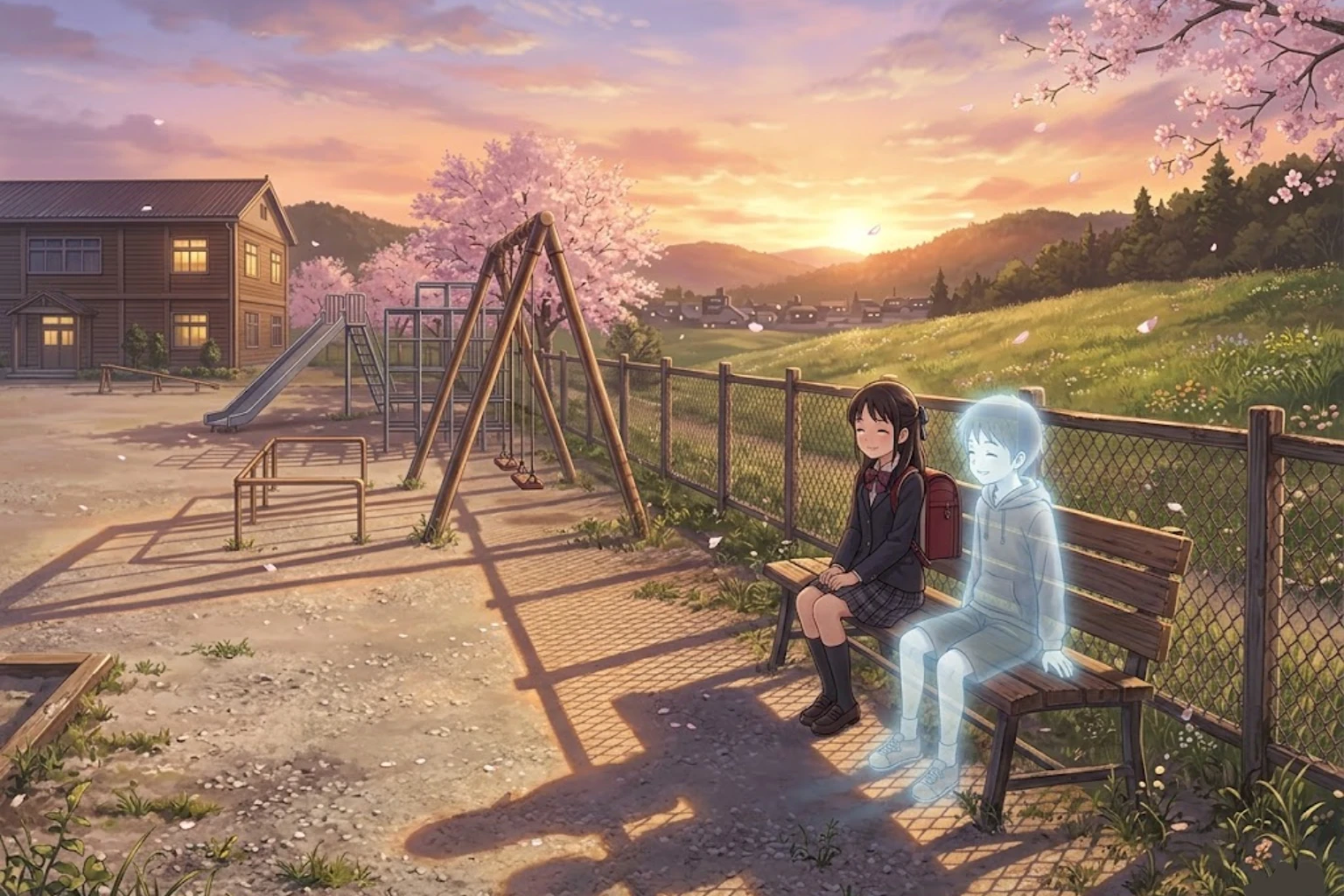
Hana was seven when she met him.
She was sitting at the far end of the school playground, which was where she usually sat — not from sadness, particularly, though sadness was present, but from the practical reality that the middle of the playground was occupied by games she hadn't been invited into and the far end had a good view of the hill beyond the school fence and the hill was interesting in ways the games were not.
He was just there, suddenly, sitting beside her on the bench.
Not arriving — not walking up, not appearing in any dramatic way. Just present, the way certain things were present when you looked at them after not looking at them, like a cloud that had been in the sky all along.
He was a boy. Or the shape of a boy — she couldn't see him the way she saw other things, not with the same quality of light and shadow. He was slightly translucent at the edges, slightly uncertain, like a photograph taken while the subject was moving. He looked about her age, maybe a little older.
He was looking at the hill.
"I like that hill too," he said.
She looked at him.
"Can you see me?" he said.
"Yes," she said.
He looked at her with an expression that was difficult to describe — relief and surprise together, mixed with something older than both.
"Most people can't," he said.
"I know," she said. Because somehow she did know, the way she knew certain things without being told them. "What's your name?"
He thought about it for a moment.
"I don't remember," he said. "I had one. I just can't find it anymore."
"I'll call you Shiro," she said. Because he was pale and slightly luminous and it seemed right.
He considered this.
"Okay," he said.
He was with her most of the time after that.
Not always visible — sometimes she could only feel him, a presence at the edge of her awareness, the way you felt a room was occupied before you saw anyone in it. But he was there, and she was not alone, and the specific loneliness of the far end of the playground became something else entirely when there was someone to share the view of the hill with.
He didn't know much about himself. He knew he had been a child, that he had lived somewhere near here, that something had happened and then there had been a long time of nothing and then there had been Hana, sitting on the bench, looking at the hill. He didn't know how long the nothing had lasted. He didn't know what year he had been a child in. He didn't know what the something was that had happened, and after Hana asked once and watched his expression go somewhere difficult, she stopped asking.
What he did know: how to play cards, which she taught him and which he was immediately better at than her. How rain felt, which he remembered but couldn't feel anymore and sometimes asked her to describe. The names of the mountains visible from the hill, which he had known as a child and still retained. How to be quiet in the way that was comfortable rather than empty.
And: things.
He knew things sometimes.
Not always. Not reliably. But occasionally, with no explanation he could offer, he simply knew something — about what was going to happen, about what had happened, about the hidden connections between events that most people couldn't see. He described it as knowing the way you knew a word you hadn't thought of in years: suddenly, completely, without being able to explain how you had retrieved it.
"Your teacher is going to be sad tomorrow," he told her one evening in October. "Something at her house."
Her teacher was sad the next day — came in with red eyes and left early. Hana brought her a drawing she had made and the teacher held it for a long time and said thank you in the voice of someone who needed to hear exactly that.
"Your mother is thinking about changing jobs," he said in November. "She hasn't told anyone yet."
Her mother changed jobs in January.
"Don't take the shortcut past the Yamada house on Thursday," he said one Wednesday in spring. "Something is loose."
She took the long way. On Friday she heard that the old wall beside the Yamada house had partially collapsed on Thursday afternoon, and two children had been nearby and jumped back in time, and nobody had been hurt.
She looked at Shiro when she heard this.
He was looking at his hands.
"Does it always work like that?" she said. "Like — does knowing it stop it?"
"I don't know," he said. "I knew the wall would fall. I didn't know if I could change it by telling you." He paused. "I think sometimes I can. I think sometimes it doesn't matter what I say."
"But this time it worked."
"This time," he said.
The first unintended thing happened when she was nine.
She had told her mother — carefully, the way she had learned to be careful — that their neighbor Ogawa-san was going to fall. She had said it as a general warning, a suggestion that someone check on him, without explaining how she knew.
Her mother had taken it seriously enough to go next door that afternoon.
Ogawa-san had been fine. Surprised by the visit, then touched by it, then — because he was a man who responded to kindness by talking — he had talked for two hours, and in that time he had mentioned to her mother that he had been feeling dizzy in the mornings, and her mother had mentioned it to his daughter, and his daughter had taken him to the doctor.
The doctor found something. Something that was better found early than late.
This was good. Unambiguously good.
But Ogawa-san's daughter, coming out of the hospital with her father after the first appointment, had been struck by the specific quality of her own relief and had called her estranged brother, whom she had not spoken to in six years, and they had argued, and the argument had covered old ground and broken something that had been in the process of slowly healing.
Hana didn't know about the argument until much later.
Shiro didn't know about it at all.
"How do you know what to say?" she asked him, after she heard about the brother. "How do you know when to tell me something?"
"I tell you when it seems important," he said.
"But important to who?"
He was quiet for a while.
"I don't know," he said. "I can see the thing that's going to happen. I can't always see what happens after."
The adults began to notice when she was ten.
Not about Shiro — nobody except Hana could see Shiro, and she had understood very early that mentioning him by name produced the kind of concerned adult response that led to doctor visits and careful conversations. But the predictions were harder to hide, and she had been careless in the comfort of two years of mostly positive outcomes.
Her aunt's car. She had said something about her aunt's car, the specific left front tire, and her aunt had taken it to the mechanic who had found the problem and fixed it and told the story at a family dinner as an amusing coincidence, and the table had gone slightly quiet in the way of people sitting next to an explanation they didn't like.
Her teacher, the following week, had asked her gently and directly how she had known about the tire.
She said she didn't know.
This was true.
The conversations started being had around her rather than to her — the quiet adult conversations in other rooms, the kind that stopped when she entered. She heard fragments. Coincidence. And: It's not normal. And once, from someone whose voice she didn't recognize: It's not healthy.
"They're scared of me," she told Shiro.
"They're scared of what they don't understand," he said. "That's different."
"Is it?"
He considered this honestly. "A little," he said.
She was eleven when the irreversible thing happened.
It was small. That was the thing about it that she would carry the longest — how small the initial thing was, how ordinary, how completely unrelated to tragedy on its face.
She had been in the kitchen when Shiro had said, quietly and with the particular quality of his certain-knowing: Kenji's father is going to lose his job next week.
Kenji was in her class. She liked him — he was funny and kind and had once defended her from a group of boys who had been saying things about her being strange, which she had never forgotten.
She had not passed the warning on. There was nothing useful to pass on. Your father is going to lose his job was not actionable information. She filed it and let it go.
What she hadn't known: that the same week, Kenji's father had been planning to buy a car. A specific car, for a specific reason — his elderly mother lived far away and the bus routes had changed and he had been saving for two years.
He bought the car the week before he lost his job, because he didn't know he was going to lose it, and the timing meant that the savings he would have needed for the coming months were gone.
She also hadn't known: that Shiro, who sometimes felt what was happening to people nearby without her asking, had been quiet for three days before telling her about the job. Quiet in the way he got when something was complicated. She had thought he was simply in one of his distant moods, which happened sometimes, and she had not asked.
Later she understood that he had been trying to figure out how to tell her something that might help without triggering something it shouldn't.
He hadn't found the answer in time.
Kenji's family moved at the end of the school year. Not far — to his grandmother's house, which solved the distance problem in a different way than the car would have but solved it. Kenji was okay. His family was okay.
But she sat with what she knew and what she hadn't said and the specific weight of the car bought the week before, and she thought about the brother who hadn't spoken to his sister in six years and the wall that fell anyway for two children who jumped back in time and the accumulation of everything she had passed on and everything she hadn't and the things that had helped and the things that had changed other things that had changed other things and she thought:
We don't know what we're doing.
She looked at Shiro.
He was looking at his hands again.
"You knew about the car," she said.
"Not specifically," he said. "I knew the timing was wrong. I didn't know what the timing was for."
"You should have told me."
"I know," he said. "I was trying to figure out how."
She looked at him for a long time. At the translucent edges of him, the slight luminosity, the face that had been her closest companion for four years.
"Do you think," she said slowly, "that people would be better off if we stopped?"
He was very still.
"Stopped telling them things," she said. "Stopped — trying to help."
"I don't know," he said.
"I think maybe," she said, "every time you know something and we do something about it, we change what happens. And we can't see far enough to know if what we change is better or worse."
"Sometimes it's better," he said.
"Yes," she said. "Sometimes."
The silence between them had a different quality than usual.
"Hana," he said.
"I'm not saying it yet," she said. "I'm just — thinking about it."
He nodded.
They sat together on the bench at the far end of the playground — the same bench, four years later, the same hill beyond the fence — and didn't say anything for a long time.
She said it three weeks later.
Not impulsively. She had thought about it every day in the interim, turned it over and examined it, looked for the argument against it that would be strong enough. She had watched Shiro become quieter and more careful, watched him hesitate before telling her things he would previously have said without pause, watched him carry the weight of knowing in a way that was visibly different from before.
He was hurting himself to protect other people.
She was hurting other people by trying to protect them.
She had tried to find a middle way and couldn't. The problem wasn't the specific warnings. It was the fundamental architecture of it — a knowing that couldn't see its own consequences, applied to a world made entirely of consequences.
She was eleven years old and she understood this with the specific clarity of a child who has had to think about something adult-sized for a very long time.
She found him in the evening, in the corner of her room where he usually sat when she was doing homework.
"Shiro," she said.
He looked up.
She could see from his expression that he knew what was coming. Of course he did.
"I need you to go away," she said.
The room was very quiet.
"I know," he said.
"I don't want to," she said. "I want you to know that. I don't want to."
"I know that too," he said.
"But people keep getting hurt," she said. "Not because you're bad. Not because you want to hurt anyone. Just because—" She stopped. "Because we can't see far enough. And every time we try to help it changes things and the things it changes change other things and we can't follow it all the way out."
He was looking at her with the expression she would spend the rest of her life trying to find the word for and never quite managing. Not sad exactly. Something more complete than sad.
"If I go," he said, "I won't come back."
"I know."
"And you won't—" He stopped.
"I know," she said.
She was crying, which she had expected. He couldn't cry, which she had also known and which was somehow the worst part — the way he sat with everything she was feeling and had no equivalent outlet for whatever he was feeling, only stillness and those eyes that had been her closest companion for four years.
"Okay," he said.
"Okay?" she said.
"You asked me to go," he said simply. "So I'll go."
"Just like that?"
"You asked me," he said. "You're the only person who has ever been able to see me. The only person who ever—" He paused. "If you ask me to go, I go. That's what it means to care about someone. You don't stay when they ask you to leave."
She couldn't say anything.
"Hana," he said.
"Yes."
"It was good," he said. "Four years of it. It was really good."
She nodded.
He was gone.
Not dramatically — not a light, not a sound, not a final image. He was there and then the room was simply a room, with her in it, and the corner where he usually sat was just a corner, and the quality of the silence was entirely different from what it had been four seconds before.
She sat on her bed for a long time.
Then she got up and did her homework.
Twenty-two years later.
Hana was thirty-three.
She had a life — a real one, accumulated through the ordinary mechanisms of time and choice and the gradual construction of something that felt, most days, like hers. Work she found meaningful. A small apartment with a window that faced a hill, which she had not chosen consciously and noticed only when it was already done. Friends who knew her as a person who was sometimes quieter than seemed warranted, who occasionally looked at nothing with an expression they couldn't name.
She had never told anyone about Shiro.
This was not a decision she had made so much as a silence that had established itself — first from necessity, then from the understanding that the shape of the explanation would require more than she had ever found herself able to give.
She thought about him sometimes. Not always — she had a life, and lives required presence, and she had learned to be present in hers. But sometimes.
She was reading the news on a Wednesday morning when she saw it — a small item, local, the kind that appeared and disappeared without much comment. A family in a town two hours north. A car, a bridge, ice on the road. Everyone was fine. It had been very close.
She read it twice.
She thought about the ice and the bridge and how close it had been and how easily it could have been different.
She set her phone down.
She looked at the corner of the room — not her childhood room, a different room, twenty-two years later — and the corner was a corner.
You would have warned me, she thought. About the ice. About the bridge. You would have told me something and I would have known to tell someone and maybe it wouldn't have been as close.
She sat with this for a while.
Or maybe I would have told someone and they would have taken a different route and something else would have happened. Something I couldn't see. Something you couldn't see either.
She picked up her phone again.
The item was still there. The family was fine. The bridge was fine. The ice had melted by afternoon.
She thought: I don't know if asking you to leave was right.
She thought: I don't know if it was wrong.
She thought: I think I'll never know. And I think that might be the truest thing about it.
Outside, the hill was doing what hills did in early spring — the brown of it giving way gradually at the edges to green, the change so slow it was invisible day to day and undeniable across weeks. She watched it for a while.
The world was quieter without him.
That was simply true, and she had learned to live inside it, and most days it was fine, and some days it was the specific kind of not-fine that had no name and required no fixing, just sitting with.
She got up. Made tea. Went about her Wednesday.
Somewhere, she thought — not in a sentimental way, just in the way of things that were simply true — somewhere the hill beyond her childhood school was still there. The bench at the far end of the playground. The view.
She hoped, wherever he was, there was something worth looking at.


.png)
.png)
.png)