%20(1).png)
The first time Michiko saw him, she thought he was a student who had missed his train.
This was a reasonable assumption. She worked the late window at Nishi-Oka station — ticket corrections, lost property, the occasional confused traveler — and missed-train students were a demographic she knew well. They had a specific quality: the slumped resignation of someone recalculating their evening, phone already out, message to someone already being composed.
He didn't have that quality.
He was standing at the far end of the platform, near the emergency phone nobody ever used, looking at the departures board with an expression she couldn't immediately categorize. Not reading it, exactly. More like — absorbing it. The way someone looked at a painting rather than a sign.
The last train came and went. The platform cleared. He stayed.
She watched him through the window for a while. He didn't move. Didn't check his phone — no phone, she realized. Didn't sit on the bench. Just stood there looking at the board, and then at the empty tracks, and then at the ceiling of the platform where the fluorescent lights hummed in their long rows.
She went out to ask if he needed help.
By the time she reached the end of the platform he was gone.
She checked the exits. Both unmanned, both logged — nobody had passed through. She walked the length of the platform twice and found nothing, which left the logical explanation that he had simply left while her attention was elsewhere, which she accepted because it was the only available explanation and went back to her window.
She thought about his expression for the rest of her shift.
Not lost. Not waiting. Something she didn't have a word for yet.
The second time was eight months later.
She had gone to the Midori carnival on her day off — alone, which she had stopped feeling self-conscious about somewhere in her mid-thirties, the way you stopped feeling self-conscious about a lot of things. It was a warm October evening, the kind that felt like summer's last argument, and the carnival had the quality it always had in that light — slightly unreal, the colored lights too bright against the dusk, the sounds too layered, the whole thing existing in a register slightly above ordinary life.
She was eating taiyaki near the ring toss stall when she saw him.
He was standing at the edge of the crowd, watching the ferris wheel with the same expression she had been trying to name for eight months. She had it now, or closer to it — the expression of someone seeing something for the first time that everyone else had stopped seeing years ago. Not wonder exactly, though wonder was part of it. More like — attention. Complete, undiminished, given freely to the ferris wheel as if the ferris wheel deserved it, as if the ferris wheel were in fact extraordinary rather than ordinary, which it was, she thought, if you were seeing it correctly.
She looked at him for a long moment.
The same person. She was certain of it, though she would have struggled to explain why, because something about his face was difficult to fix — the age of it, specifically, kept shifting depending on the light or the angle. In the carnival lights he looked young. When she blinked he looked older. When she looked directly he was somewhere in between.
She started toward him.
He turned and walked into the crowd and she lost him in thirty seconds, which should not have been possible in a carnival crowd but was.
She stood where he had been standing and looked at the ferris wheel.
She tried to see it the way he had been seeing it.
It was, she thought, actually quite extraordinary. The way the gondolas moved against the darkening sky. The lights. The slow, patient revolution of it.
She finished her taiyaki.
Went home.
Thought about him for several days in the unfocused, peripheral way you thought about something that didn't have a category yet.
The third time, she was ready.
Or as ready as a person could be for something they couldn't fully explain. She had decided, in the interval, that there was a person — a real, living, unusual person — who for some reason was present in her vicinity with a frequency that exceeded coincidence and who had a way of leaving before being spoken to that was either very practiced or very strange.
She was at the public library on a Wednesday afternoon, in the reading room, when she looked up from her book and he was at the periodicals shelf six feet away.
He was reading — no, not reading, holding a newspaper open and looking at the photographs in it. Not the headlines. The photographs. He went through the pages slowly, the way someone went through a picture book, spending time on each image.
She closed her book and said, clearly but not loudly: "Excuse me."
He looked up.
Up close, the age problem was worse. His face was — she couldn't say. Not young, not old. The word that came to her was unweathered, which wasn't quite right either but was closer than anything else she had.
His eyes were calm. Not the calm of someone suppressing something, but the other kind — the calm of someone who genuinely was.
"You were at Nishi-Oka station," she said. "Last year. And the Midori carnival in October."
He looked at her without alarm.
"Yes," he said.
One word, offered simply, with the quality of someone who answered questions honestly because the alternative hadn't occurred to them.
"Do you remember me?" she said.
He considered this.
"Yes," he said.
She waited for more. More did not come.
"Are you—" she started, and stopped, because the question she was about to ask was are you alright and something about him made the question feel sideways, not wrong exactly but aimed at the wrong target.
"I'm Michiko," she said instead.
He looked at her name the way he had looked at the photographs. Taking it in. Giving it attention.
"I don't have one," he said.
"A name?"
"I don't think so." He looked at the newspaper in his hands. "People have given me different ones. None of them felt like mine."
She sat down at the nearest table.
He remained standing, but he didn't leave, which she took as permission to continue.
"Are you waiting for someone?" she said.
"No."
"Are you looking for something?"
He thought about it. "No," he said. "I don't think so."
"Then what are you doing?"
He looked at the reading room — at the shelves and the light through the high windows and the other patrons bent over their books, and the particular quality of a library in the afternoon, the specific hush of it.
"I'm here," he said. "For now."
He put the newspaper back on the shelf, precisely where he had found it.
And left before she thought to ask anything else.
She began keeping a notebook.
Not obsessively. She was a practical woman — she had been a night-shift station worker for eleven years, she had filled out more incident reports than she could count, she understood the value of documentation. She wrote down the dates and locations and what he had said, which was not much, and what he had been doing, which was always some variation of the same thing: observing. Attending. Being somewhere and giving that somewhere his complete and unhurried attention.
Train station — departures board — late night.
Carnival — ferris wheel — dusk.
Library — periodicals — Wednesday afternoon.
Park — children flying kites — she had seen him at the edge of the park near her apartment, just once, standing at the fence watching a group of children run with kites in the autumn wind, his face doing the thing it always did, giving the kites everything.
She had not approached him that time. She had watched him watching the kites and felt something she couldn't name and gone home.
She added: Park — kites — he stayed for a long time after the children left.
She looked at the notebook.
Four entries. Spread across two years. Always in public places. Always alone. Always watching something ordinary with the attention most people reserved for the extraordinary.
She thought about what she knew and what she didn't know and what she suspected, and the thing she suspected sat at the edge of her thinking like something she kept approaching and then stepping back from because it changed the shape of everything else.
She saw him at the museum in spring.
The natural history museum, a Tuesday, her day off. She had been going to look at the new fossil exhibit and had found him instead, in the hall of the ocean, standing in front of the blue whale skeleton suspended from the ceiling.
He had been there for a while, by the look of it.
She stood beside him and looked up at the whale.
"It's bigger than I expected," she said.
"Everything is," he said.
She looked at him.
"Everything?" she said.
"Everything I see," he said. "I didn't know what to expect of anything. So everything is bigger or smaller or different than — than whatever the expectation was." He looked up at the whale. "I don't know where the expectations come from. But they're always wrong."
She was quiet for a moment.
"What did you expect the whale to be?" she said.
He thought about it with the seriousness he gave to all her questions, which she had come to understand was not deliberateness but simply how he was — each thing considered fully, because why wouldn't you consider a thing fully.
"Smaller," he said. "I think I expected it to be smaller."
She looked up at the whale. Fifty feet long, suspended in the blue light of the hall, enormous and patient.
"Do you remember your family?" she said.
"No."
"Do you remember anything? Before — before now?"
"No," he said. Again simply. Without distress.
"Doesn't that bother you?"
He considered this for longer than the others.
"I don't know what it would feel like if it didn't bother me," he said. "So I don't know if it does."
She looked at her hands.
"I brought you something," she said. She reached into her bag and produced a paper cup of coffee from the museum café, which she had bought on impulse without fully deciding why. "I don't know if you—"
"Thank you," he said.
He took the cup. Held it in both hands. Looked at it.
"It's warm," he said.
"Yes," she said.
He held it for a while without drinking. She didn't push. They stood together under the whale in the blue light and she drank her own coffee and he held his and neither of them spoke for a long time, which was the most comfortable silence she had shared with anyone in longer than she wanted to calculate.
She tried, over the following months, to solve him.
Not aggressively. She was not that kind of person. But she had grown up believing that things had reasons — that effects had causes, that conditions had solutions, that a problem properly understood was a problem half-resolved. She had lived her life on that basis and it had served her reasonably well and she applied it now.
She read about ghosts. Not the dramatic kind — she had no patience for dramatic things — but the folklore, the old records, the documented accounts, the serious ethnographic work done by serious people who had approached the subject without embarrassment. She read about unfinished business and traumatic impressions and residual hauntings and place memory and the various theories about why certain presences persisted.
None of it fit.
He wasn't attached to a place — she had seen him in six different locations across the city. He wasn't replaying an event — he was fully present, responding, curious. He wasn't protecting something or pursuing something or trying to communicate something. He wasn't angry or sad or afraid.
He was just — there.
Interested.
She closed the last book and sat in her apartment at midnight and looked at her notebook and understood, with the particular discomfort of a practical woman encountering the edge of practicality, that she was trying to solve a problem he didn't know he had.
She saw him on a bridge in early summer.
Standing at the railing looking at the river below — not the desperate looking-at-river that she had learned, in her years working nights, to recognize and respond to. The other kind. The same way he looked at everything.
She stood beside him.
"There has to be something you're looking for," she said.
He looked at the river.
"Everyone says that," he said.
"Because it's usually true."
"Maybe," he said. "For people who have been somewhere before. Who had things and lost them." He watched the water move. "I haven't lost anything. I don't have things to go back to. I don't have — a before." He paused. "There's just this."
"This," she said.
"The river," he said. "Right now. The way the light is on it." He looked up. "The bridge. You. The sound that the water makes when it goes around that rock down there — do you hear it? The lower sound. Under the main sound."
She listened.
She heard it.
"Yes," she said.
"I didn't know rivers had more than one sound," he said. "Until I stood on this bridge."
She looked at the river.
"Are you happy?" she said. It came out more directly than she intended, the way things did when she had been building to them for a long time.
He was quiet for a long time.
"I don't know what that means," he said. "Exactly. I think I'd need to have been unhappy first, to know the difference." He looked at the water. "But I like the river. I liked the whale. I liked the carnival lights and the kites and the way the departures board changes all at once and then is still." He paused. "I think that might be something like it."
She looked at him.
The light on the river was the particular gold of early summer evening, the kind that made ordinary things look the way they felt when you remembered them later. He was looking at it with his full attention, giving it everything, the same way he had given everything to the ferris wheel and the kites and the whale and the newspaper photographs and the coffee cup warming his hands.
She had spent two years trying to find what was wrong with him.
There was nothing wrong with him.
That was the most unsettling thing she had ever understood.
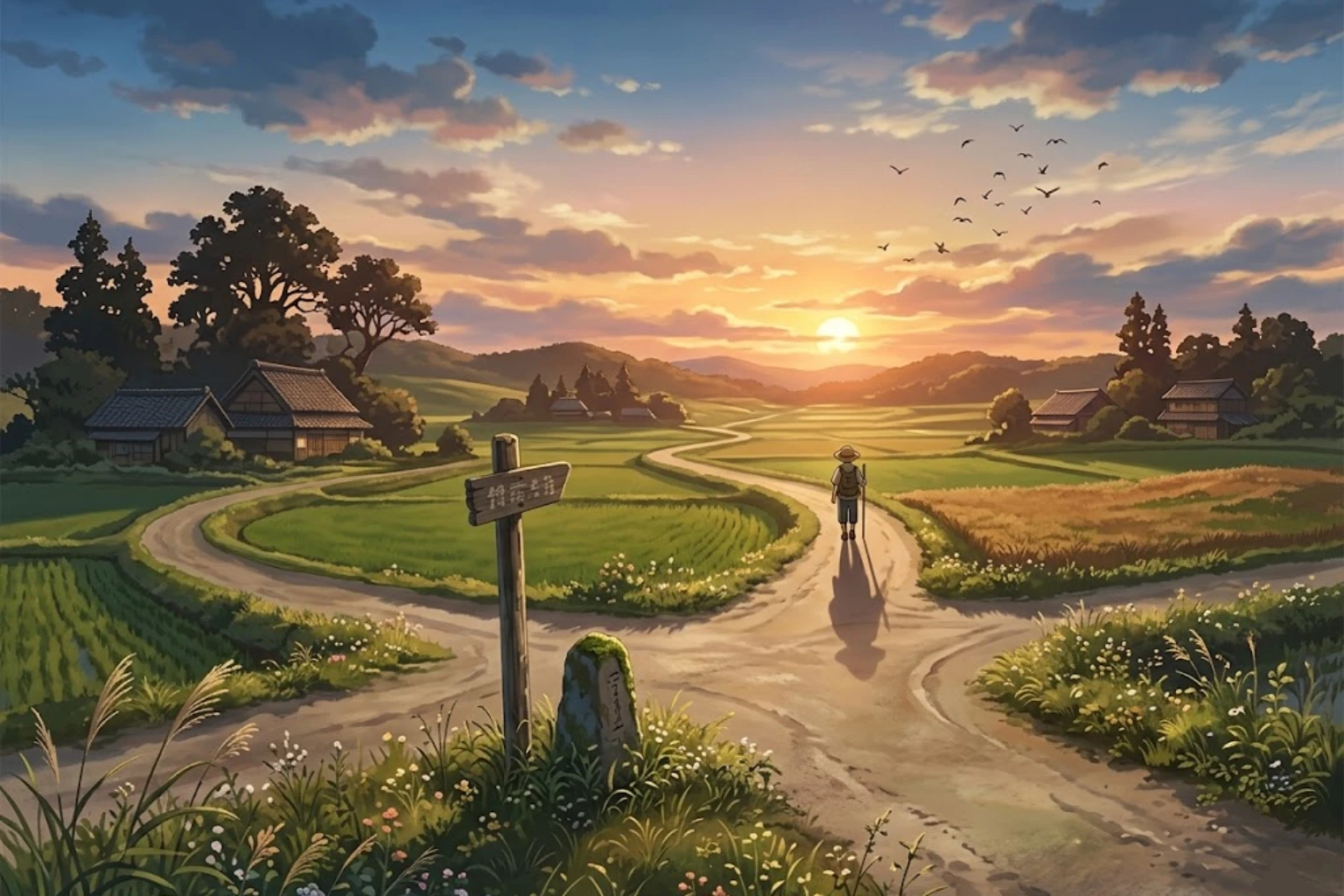
She saw him one last time at a crossroads outside the city, which she had driven past on the way back from visiting her sister and had pulled over for without fully deciding to.
He was standing where the two roads met, looking west, where the sun was going down in layers of orange and deep red, the sky doing what it did at the end of good days.
She got out of the car.
"Which way are you going?" she said.
He looked at both roads. Considered them with the same full attention he gave to everything.
"I think I'll take the right," he said.
"Why?"
He almost smiled. It was the closest thing to a smile she had seen on him — not quite there, not quite not.
"Because I've never been down that one before," he said.
She looked at the right road. It went east, into the early dark, through flat land and scattered lights, unremarkable and long.
"Will I see you again?" she said.
He thought about it honestly.
"I don't know," he said. "I don't plan very far." He looked at the road. "Do you want to?"
She thought about the notebook. The coffee cup. The whale. The river with its two sounds.
"Yes," she said.
He looked at her with his indeterminate face in the last of the sunset light.
"Then maybe," he said.
He turned and walked east down the road he had never been down before, unhurried, his attention already moving forward to whatever was next, and the light went with him slowly the way light did at that hour, and she stood at the crossroads and watched until he was gone and the sky had finished what it was doing and the stars began their own patient attendance on the dark.
She got back in her car.
Drove home.
Opened her notebook to a new page.
Wrote nothing for a long time.
Then wrote: He's not lost. He's not looking for anything. He's just here, the same way the river is here, the same way the whale is here. The same way everything is here that was never somewhere else first.
She closed the notebook.
Outside, the city went on doing what cities did at night — lights and movement and the accumulated ordinary life of several hundred thousand people, each of them here, each of them somewhere for the first time or the last time or the thousandth time, each of them giving the world whatever attention they had left at the end of a long day.
Somewhere in it, she thought, he was walking a road he had never seen before.
Looking at everything.


.png)
.png)
.png)