%20(1).png)
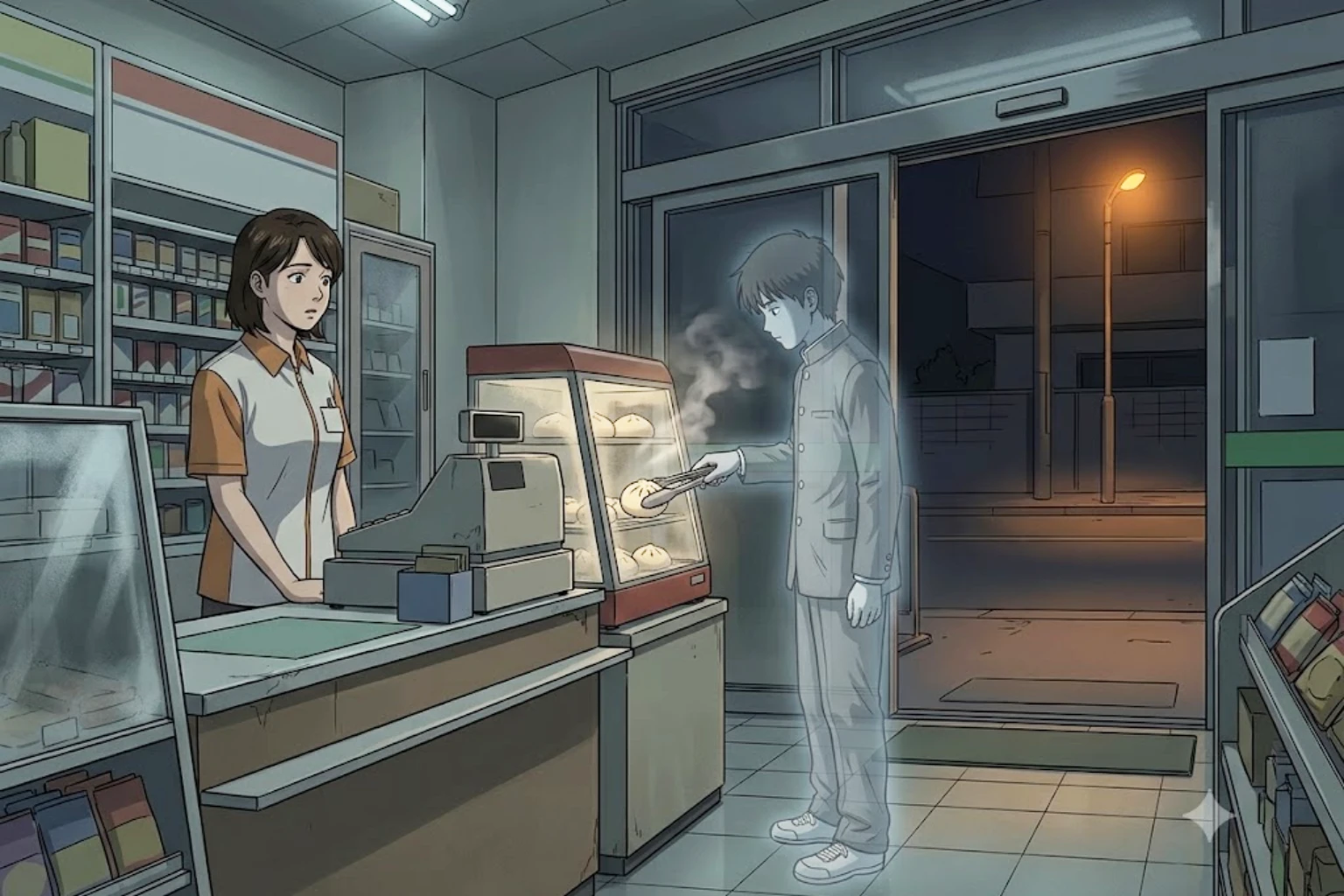
Sana had worked the night shift at Tsukikage Mart for two years, which was one year and ten months longer than she had ever meant to.
It was supposed to be temporary. That was the whole point of a night shift at a convenience store three blocks from the apartment she still shared with two roommates she barely saw — something to hold the space open while she figured out the actual shape of her life, the one she'd sketched out so confidently in her last year of design school, freelance illustration work, maybe a proper studio job eventually, something that used the hands she'd spent four years training. The temporary thing had simply never ended. It had just quietly become the permanent thing instead, the way water finds the lowest point in a room and settles there without ever deciding to.
The store itself had settled into its own kind of stillness a long time before Sana ever started working there — a narrow aisle store on a street of shuttered shops and one all-night laundromat, its fluorescent lights humming just slightly out of tune, its automatic doors chiming with a soft two-note melody every time someone came or went. Most nights, past eleven, nobody came or went at all. Sana restocked what needed restocking, wiped down counters that were already clean, and let the hours pass the way she let most things pass now, without much resistance.
She noticed the doors first, before she noticed anything else.
Every night, at exactly 11:47, they opened.
No one was ever standing outside them when it happened. She checked, the first several times, certain a customer had simply stepped just out of frame, and each time found the sidewalk beyond the doors entirely empty, lit only by the streetlamp's flat orange glow. The doors would hold themselves open for exactly as long as they always did for an actual customer — four seconds, five — and then slide shut again, and Sana would stand behind the register feeling the small hairs on her arms rise, telling herself it was a sensor malfunction, a stray cat, a trick of the wind.
Then she would notice, some minutes later, that the steamer case by the register was missing one nikuman.
She counted them carefully after that first night, unnerved enough to actually pay attention — six buns in the case at closing prep, five once the store had gone quiet again, though she never once saw a hand reach for it, never heard the tongs, never rang up a sale that would explain the missing bun on the register's nightly total. She mentioned it to her manager, tentatively, expecting to be told about a hole in the till or a miscount somewhere. He shrugged, said the case probably ran warm and dried one out sometimes, and told her to just log the loss and move on.
She logged the loss. She did not stop noticing.
---
It took nine nights before she finally saw him.
She'd started positioning herself differently by then, without fully admitting to herself why — angling near the front windows around 11:40, pretending to restock a display that didn't need restocking, watching the sidewalk with the kind of attention she usually reserved for nothing in her life at all.
At 11:47, the doors opened, and a boy walked through them.
He looked sixteen, maybe seventeen, dressed in a school uniform Sana didn't recognize from any of the schools currently zoned for this neighborhood — a dark jacket with a stiff collar, a style that belonged to some decade before her own, worn the way boys that age always wore uniforms, slightly rumpled, top button undone, a bag slung over one shoulder with the particular exhausted slouch of someone walking home after a long day.
He didn't look at her. He walked straight to the steamer case, lifted the door, and used the tongs — she watched them move, watched a bun actually lift free of its slot — and set it on a small paper tray with the ease of a routine performed hundreds of times before.
"That'll be—" she started, out of pure reflex, register instinct kicking in before her brain had caught up to anything else.
He didn't answer. He didn't even glance toward her. He unwrapped the bun standing right there at the counter, took a bite, chewing with the unhurried satisfaction of someone who'd been looking forward to exactly this all day, and turned back toward the door.
"Hey," Sana said, louder this time, stepping around the counter. "You didn't pay for that."
The doors opened for him again, the same soft two-note chime, and he stepped through them onto the empty sidewalk, and by the time Sana reached the window herself, breathless, heart hammering in a way that had nothing to do with the short distance she'd crossed, the street outside held nothing at all. No boy. No retreating footsteps. Just the orange streetlamp and the closed laundromat across the road and the ordinary, empty quiet of a street at midnight.
She checked the steamer case. Five buns remained where six had sat only a minute before.
---
She didn't tell anyone. She wasn't entirely sure, in the days that followed, that she believed it herself — until the same thing happened the next night, and the next, and the next, always at 11:47, always the same boy, always the same bun, always the same door closing on an empty street the instant she tried to follow.
By the second week, fear had quietly given way to something else. She started arriving early to her usual angle by the window, not out of dread now but out of something closer to anticipation, the specific, guilty thrill of having a secret nobody else in her life shared.
She began setting a bun aside for him before he arrived, wrapped and warm, placed at the edge of the counter rather than left for him to retrieve himself. The first night she did it, he paused at the steamer case, glanced toward the counter, saw the paper tray waiting there, and looked up — properly up, meeting her eyes for the first time since she'd started watching him — with an expression of open, unguarded surprise.
"You saw me," he said. His voice sounded almost more surprised by that fact than by the bun itself.
"I've been seeing you for two weeks."
"Nobody's ever—" He stopped, frowning slightly, as though reaching for a thought that kept sliding out of his grip before he could finish it. "I don't think anyone's ever talked to me here before."
"I don't think you're actually walking in from outside," Sana said, gently, watching his face for whatever reaction might come. "I don't think you've been outside in a long time."
He considered that for a moment, unbothered in a way she hadn't expected, and took a bite of the bun instead of answering directly. "I walk this way every night," he said, finally. "After cram school. It's the last stop before I get home. I like the way the case fogs up on cold nights, right before you open it."
"What's your name?"
He opened his mouth, and stopped, and something crossed his face that Sana would come to recognize, over the following weeks, as the particular helplessness of reaching for something that simply wasn't there anymore. "I don't," he said slowly, "actually know."
"Where do you live?"
"Down the street. Past the shrine. There's a—" He frowned harder. "There's a light. I know there's a light. I can't remember the rest of it."
He finished the bun in silence after that, and left at his usual pace, through doors that opened for him and no one else, and Sana stood behind the counter for a long time afterward, understanding, with a strange, settling calm rather than the fear she might once have expected of herself, that she had just spoken to a ghost, and that some part of her had already decided this didn't frighten her nearly as much as it probably should.
---
The next night, neither of them mentioned any of it.
He arrived at 11:47 the way he always did, and this time, instead of eating standing at the counter and leaving right away, he lingered, leaning against the far end near the magazine rack while he unwrapped the bun, glancing around the store with the mild, unhurried curiosity of someone finally allowed to actually look at a place he'd only ever passed through before.
"You changed the register," he said. "It used to be over there. By the window."
"It's been in this spot since before I started working here."
"Huh." He considered that, chewing thoughtfully. "Things keep moving on me a little at a time. I don't always notice until I say something out loud and you look at me like I've said something strange."
"You do say a lot of strange things."
"I have limited material to work with." He said it dryly enough that it took Sana a second to realize he'd made an actual joke, and when she laughed, surprised, something in his own face brightened at having landed it.
They talked that night about nothing in particular, the way people do once the strangeness of a situation has worn down enough to leave room for ordinary conversation underneath it — what her job actually involved on a slow night, whether the vending machine outside ever worked properly, whether he'd always liked nikuman or just gotten used to it through repetition until liking it stopped being a question that made sense to ask.
"I think I liked it first," he said. "Before it was just what I did every night. I remember liking the smell of the steam when you crack the case open. I don't know if that's a real memory or just something that's become true from doing it so many times."
"Does it matter which?"
"Maybe not." He smiled, small and easy, entirely unguarded. "You're not scared of me anymore."
"I don't think I really ever was, past the first night. I was more scared of what it meant that I could see you at all."
"What does it mean?"
"I don't know yet," Sana admitted. "But I like this part. Whatever it turns out to mean."
He left a little before midnight, the way he always did, and the store felt, once the door had chimed shut behind him, less lonely than it had in longer than Sana could remember, rather than more.
---
Their conversations became a fixture of her nights after that, the same way the bun did, the same way the 11:47 chime did.
He didn't remember much beyond the fragments he'd offered that first proper conversation — cram school, the walk home, the fogged glass of the steamer case, a porch light he couldn't place beyond knowing, with total certainty, that it mattered. He didn't seem distressed by the gaps, exactly, the way Sana might have expected a person confronting the shape of their own death to be. He simply existed inside the routine he had, night after night, the way a song loops back to its first note without remembering it's already been played.
She started talking to him about herself, somewhere in the third week, mostly because the silence between his short visits had started to feel too large to leave entirely empty.
"I went to school for illustration," she told him one night, leaning against the counter while he ate. "I used to think I'd be doing something with my hands by now. Actual work. Instead I count nikuman and restock energy drinks and tell myself it's temporary, and it's been temporary for almost two years."
"Why don't you do the other thing instead?"
"It's not that simple."
"Isn't it?" He said it without judgment, just genuine curiosity, the plain, unfiltered directness of someone young enough not to have learned yet how complicated adults liked to pretend simple things were. "You just decide, and then you do it."
"You make it sound easy."
"I don't actually know if it's easy," he admitted. "I don't remember enough about my own life to know if I ever decided anything difficult. I just know that saying it out loud — *it's not that simple* — sounds like something you tell yourself so you don't have to actually try the simple version."
She didn't have a ready answer for that, and something about the accusation, gentle as it was, lodged itself somewhere she couldn't easily dislodge it.
---
He pressed harder a few nights later, in a way that surprised her.
"You said that same thing again tonight," he said, watching her carefully over the edge of his half-eaten bun. "About it not being that simple. You've said it three times now, about three different things. The portfolio. Calling the studio. Even just deciding what to have for your own dinner instead of eating whatever's easiest off the shelf here."
"That's not the same kind of thing."
"Isn't it? It sounds like the same shape to me. Small thing, big thing, doesn't matter — you find the same door and you don't walk through it." He wasn't unkind about it, just plain, the way he seemed to be plain about everything, unburdened by whatever social instinct usually taught people to soften an observation like that. "I don't have a life to compare it to anymore. I only have this. The store, the walk, you. So maybe I notice patterns more than someone who has other things distracting them from noticing."
"That's a little frightening, actually. Being studied that closely."
"I'm not studying you. I just listen, because it's mostly all I can do most nights, and after a while listening starts to look a lot like understanding whether you meant to or not." He set the bun down, wrapper still half on, and looked at her with something unexpectedly serious for a boy who spent most of his visits making small jokes about vending machines. "I think I was afraid of something too. Before. I don't remember what, exactly, but I remember the feeling of it — some test, maybe, or a conversation I kept putting off having with someone. I remember telling myself I had time. I clearly didn't have as much of it as I thought."
Something in his voice, quiet and without any self-pity in it at all, landed harder in Sana's chest than anything he'd said so far.
"I don't want to end up like that," she said, finally. "Out of time and never having tried the thing."
"Then don't," he said, simply. "You still get to choose. That's the part I'd give almost anything to have back, if I could. You're just choosing not to use it."
She didn't answer that one either, not right away, but she noticed, closing the register that night, that her hands had stopped quite so easily reaching for excuses the next time the thought of the portfolio surfaced in her head.
It was a few nights later, telling him about a specific fear — the fear of showing her portfolio to anyone who might actually judge it seriously, the fear that two years of not trying had already answered the question of whether she was good enough — that his face changed, mid-listen, in a way she hadn't seen before.
"There's a corner," he said, slowly, interrupting her without seeming to notice he'd done it. "Past the shrine. Where the street bends. There's a house with a gate that sticks, you have to lift it a little to get it open." He blinked, startled by his own words. "I don't know why I just remembered that."
"Do you remember more?"
"A little more each time you talk," he said, wondering. "I don't understand why."
---
It became a pattern, over the following two weeks — Sana talking about her own stuck, hesitant life, and fragments of his returning in pieces that seemed to arrive alongside her honesty rather than his own effort, as though the simple act of someone speaking plainly about fear had loosened something in him that had otherwise stayed sealed for however many years he'd been walking through these same doors alone.
A street lined with old plum trees. A grandmother two doors down who used to yell at him for cutting through her garden. The specific creak of a particular stair. A porch light, always, returning again and again, more solid each time, until he could describe its exact warm yellow color, the paper shade someone had once patched with tape after a storm cracked it.
"Someone left that light on for me," he said, one night, quiet with the weight of finally understanding something. "I think someone's been waiting."
"Do you want to find the house?"
He looked at her, something hopeful and afraid moving across his face in equal measure. "I don't know if I can walk that far. I've never made it past this store. Not once, that I can remember."
"Then I'll walk with you."
---
She told her manager she needed the following night off, an unheard-of request from someone who'd never once called in across two full years, and he was surprised enough by it that he didn't ask any real questions.
She met the boy — she still didn't have a name for him, and had grown accustomed to the strange intimacy of speaking to someone she had no way to address — outside the store at 11:47, and for the first time, he crossed the threshold and kept walking, past the point where he'd always turned back before, his steps slow and uncertain, testing ground he apparently hadn't trusted himself to cross in longer than either of them could measure.
They walked together down streets gone quiet with the deep, particular stillness of very late night, past shuttered shops and a closed shrine gate, past a corner where a stand of old plum trees, bare in this season, arched over a narrow lane he recognized instantly, his pace quickening despite himself.
"This way," he said, no longer guessing, walking now with the easy certainty of muscle memory finally waking all the way up. "It's this way."
They passed a vending machine at the mouth of the lane, and he stopped in front of it, frowning at his own reaction to something so ordinary. "I used to buy a canned coffee here sometimes, when I had extra change. The cold kind, not the hot kind, even in winter. I don't know why that one detail is so clear when so much else isn't."
"Maybe it doesn't have to make sense. Maybe it just gets to be true."
He nodded slowly, and they walked on, past a small shuttered barbershop with a striped pole gone dull with age, and he touched the glass of its window lightly in passing. "I got my hair cut here. Badly, once, right before some school photo. I remember being furious about it for exactly one day and then forgetting it mattered at all."
They crossed a narrow footbridge over a drainage canal, water moving black and quiet below them, and halfway across he stopped again, gripping the rail.
"I used to lean over this exact spot and spit into the water," he admitted, half-laughing at himself. "Just to watch the ripples. I don't know why that's the memory that's surfacing right now, of all the ones that could."
"It's not always the important ones that come back first. Sometimes it's just whatever's closest to the surface."
"Maybe the important ones are harder to look at directly. Maybe they need the small ones to clear a path first." He said it almost to himself, testing the thought as it arrived, and kept walking.
A grandmother's house came next, a narrow garden overgrown now behind a low wall he remembered as freshly painted. "She used to yell at me for cutting through here on the way home. Every single time, like it hadn't happened the day before too. I think I secretly liked being yelled at. It meant someone besides my mother noticed whether I existed that day."
The stairs of a shrine, worn smooth in the middle from decades of footsteps, produced nothing at all when he paused at their base, though he stood there a long moment anyway, waiting, before shaking his head and moving on, unbothered by the gap, trusting by now that not every stone along this path was going to give something back.
It was past the shrine, at the bend where the plum trees gave way to a quieter residential lane, that the memories began arriving faster than either of them could fully absorb — a specific dog that used to bark at him from behind a fence two houses down, the particular smell of someone's dinner cooking that he'd apparently timed his walk around for years without noticing he was doing it, the sound of his own footsteps changing rhythm on a stretch of cracked pavement he'd learned to step around instinctively as a child and apparently never stopped stepping around, even now.
At the end of the lane, he slowed. His attention fixed on something beyond the final row of houses, and the uncertainty left his expression all at once.
“It’s close,” he said. “I remember this part.”
They found the house at the bend in the street exactly where his fragments had promised it would be — a small, aging house with a gate that stuck, requiring Sana to lift it slightly the way he'd once described, and beyond it, glowing warm and yellow in the dark, a porch light burning steadily above a door that had clearly been repainted more than once over the years but never once let its light go dark.
He stood very still at the gate, staring at that light, and something in his face began, slowly, to remember everything at once.
"I was late," he said, voice thin. "I stayed too long at cram school, and I stopped here, the way I always did, and I was going to be quick about it, I told myself I'd be quick, because she doesn't like waiting up too long—"
He stopped. His hand had come up, without seeming to notice, pressed flat against his own chest.
"There was a car," he said, very quietly. "At the crossing, just past the store. I didn't see it in time. I don't remember much after that. I don't think I ever actually got here. I think I've just been walking the same distance, over and over, and never quite reaching the end of it."
Sana didn't say anything. There wasn't anything to say that would have made the shape of that smaller.
The front door opened before either of them moved toward it, and an elderly woman stepped out onto the porch in a thin robe, the way people do when some old habit wakes them at an hour they can't fully explain, drawn by nothing they could name. She looked out at the dark street, at the gate, at the two figures standing just beyond her small garden, and for a long moment said nothing at all, simply looking, the particular unfocused, searching look of someone straining to see something just past the edge of what her eyes could actually confirm.
"Haru?" she said, finally, so quietly it barely carried, a question she didn't seem to fully believe she was allowed to ask out loud. "Is that you?"
He made a small sound, something between a laugh and something closer to grief, hearing his own name spoken back to him for the first time since he'd lost track of it entirely.
"I'm sorry I'm late," he said, though Sana doubted the woman on the porch could hear the words themselves so much as feel the shape of them arrive.
He crossed the small garden alone, Sana staying back at the gate, watching him climb the two front steps he'd apparently never once managed to climb in all the years since, and stand, finally, directly beneath the porch light that had burned every single night, without fail, for however long his mother had refused to stop believing he might still come home to it.
He turned back once, at the top step, and gave Sana a small, grateful smile.
"Thank you," he said. "For seeing me. For walking with me. I don't think I could have made it the rest of the way alone."
"You did the walking," she said. "I just kept you company."
"That's not nothing."
He turned back toward the light, and toward the woman standing beneath it, her hand pressed against her mouth now, tears silently tracking down a face that had aged decades waiting for a boy who would never grow any older than the night he'd last stood on this exact step. Sana watched him grow fainter with each passing second, not vanishing all at once but softening, gently, at the edges, the way morning light softens the hardest shadows of the night before it, until there was nothing left standing on the porch at all except an old woman alone in the dark, her porch light still burning above her, though something in her posture had eased, finally, as though whatever she'd been holding onto all these years had, at last, been allowed to set itself down.
Sana didn't approach her. Some things belonged only to the person who'd waited for them. She turned and walked back the way she'd come, alone now, through streets gone entirely quiet, and didn't look back until she'd nearly reached the store again, its lights still burning, its doors, when the clock finally ticked past midnight, opening for no one at all.
---
The next night, at 11:47, the doors stayed closed.
Sana stood at her usual angle by the window, watching the empty sidewalk, feeling the absence the way you feel a missing tooth — a smaller shape in the world where a larger one used to sit, tender in a way that surprised her with how much it actually hurt. She counted the buns in the steamer case out of pure habit. Six remained at closing, and six remained an hour later, and she understood, standing there, that the count would stay honest every night from now on.
She didn't cry, not exactly, though something close to it sat behind her eyes for the rest of her shift.
The nights that followed carried their own quiet weight. She still angled herself toward the window out of habit, some part of her not yet convinced the doors wouldn't simply open again the way they always had, and each night the sidewalk stayed exactly as empty as the last, and each night the small, foolish hope she hadn't quite let go of had to be set down again a little further. She caught herself, more than once, wrapping a bun and setting it at the edge of the counter before remembering there was no one left to leave it for, and eating it herself instead, standing at the same spot he used to stand, chewing slowly, missing a boy she'd known for barely two months more than she'd expected to miss anyone.
She thought, during those quieter nights, about the small, plain accusation he'd offered her weeks earlier, about deciding and then doing, and about the harder conversation that had followed it — the one where he'd told her, plainly, that she kept finding the same door and not walking through it. She turned both conversations over more than once, some nights defensive on her own behalf, telling herself he hadn't understood how complicated real decisions actually were, other nights uncomfortably certain that he'd understood exactly enough, precisely because he no longer had the luxury of pretending otherwise.
She didn't open the portfolio folder the first night. She told herself she was tired, which was true, and let it sit.
She didn't open it the second night either, and recognized, doing the dishes the next morning, the exact shape of the excuse she was making, the same shape he'd named for her three separate times before she'd even noticed she kept making it.
It was on the fourth night since the doors had stopped opening, sitting alone in her apartment with her roommates already asleep, that she finally let herself sit with the plainest version of the fear instead of dressing it up as exhaustion or bad timing. She was afraid the work wasn't good enough. She was afraid it never would be. She was afraid that trying and failing would cost her the last comfortable excuse she had left — that she simply hadn't tried yet — and that once that excuse was gone, she'd have nothing left to hide the actual answer behind.
She sat with that fear for a long time, longer than she expected to need, and found, eventually, that naming it plainly had taken some of its size away, the way a shadow shrinks once you finally turn on the light instead of guessing at its shape in the dark.
She opened her laptop, then, and found the folder, and looked, for the first time in a very long while, at the work she'd once been proud enough to imagine building an entire life around.
It wasn't good enough yet, some of it. She could see that clearly, without flinching from it the way she once might have. But some of it was better than she'd let herself remember, and none of it was going to get any better sitting untouched in a folder she was too afraid to open.
She found a small local design studio's open call for portfolio submissions, one she'd bookmarked over a year ago and never once acted on, and before she could talk herself into waiting one more day, she attached three pieces she still believed in and sent it.
It wasn't the whole shape of the life she'd once sketched out so confidently in her last year of school. It was one small step of it, taken finally instead of postponed again, and for the first time in longer than she could remember, that felt like enough to actually count as something.
She kept going back to work every night after that, and the doors stayed closed at 11:47, and every night after that too, and though she missed him more than she expected to for longer than she expected to, she found she didn't mind the quiet nearly as much anymore. It no longer felt like a room she was stuck waiting in. It felt, instead, like a room she had finally, deliberately, chosen to walk through on her own two feet, toward whatever light was waiting for her at the other end of it.


.png)
.png)
.png)