%20(1).png)
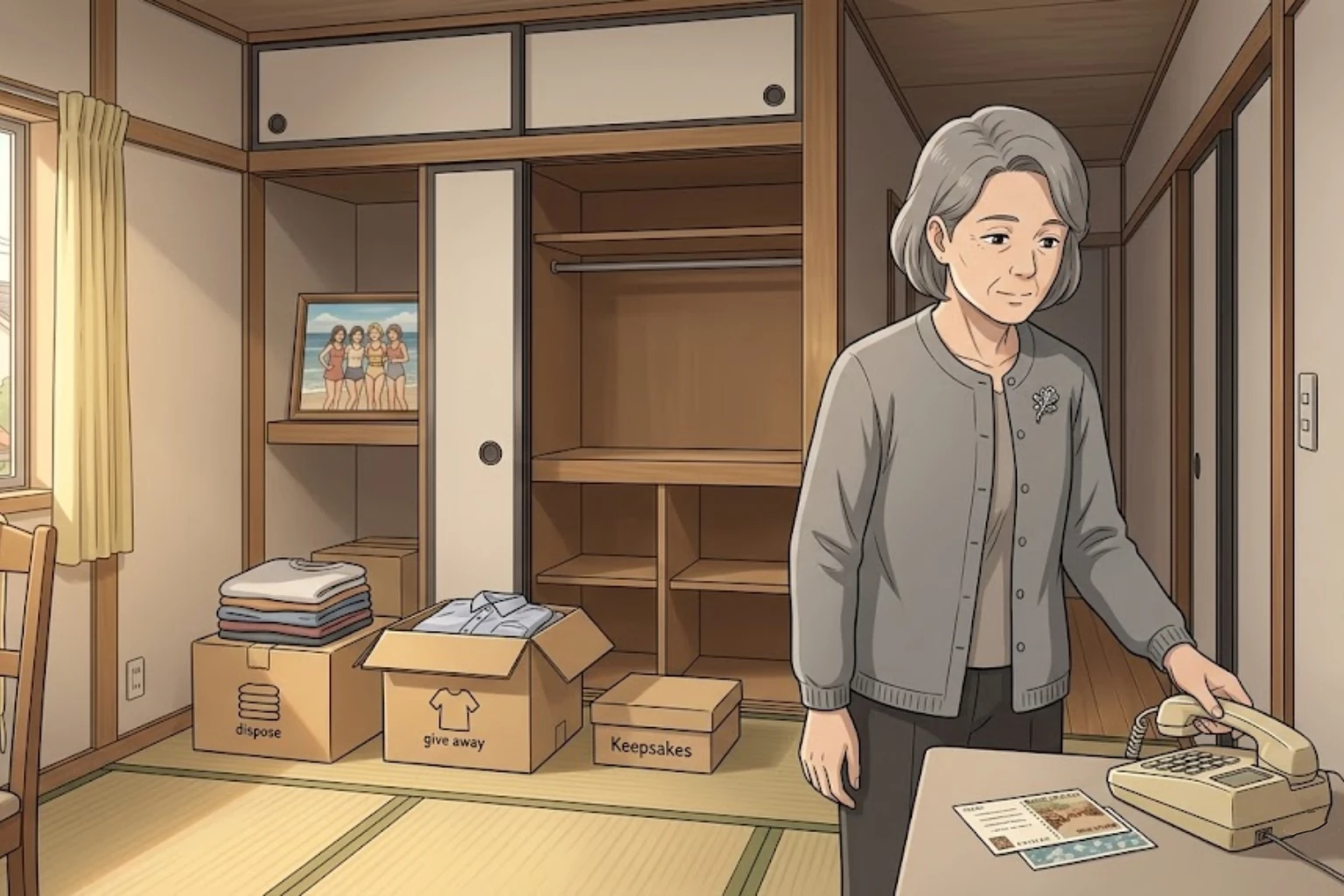
The closet had been closed for longer than it should have been, which was, Michiko supposed, the entire problem with closets. You shut a door on a Tuesday with every intention of dealing with it next weekend, and then several Tuesdays accumulated on top of each other without permission. One day you opened it again and were confronted with several years of your own avoidance, neatly stacked.
She had set aside the whole afternoon for it. That felt like the responsible way to approach it — declare a block of time, bring it under control, be done. She had even prepared the system in advance: three cardboard boxes on the floor of the bedroom, labeled in her own neat handwriting. Discard. Donate. Keep.
It was a good system. It lasted approximately forty minutes.
The first hour was exactly as ordinary as she had hoped it would be. She worked from the top shelf down, the way her mother had taught her decades ago, though she couldn't remember now whether that was good advice or simply the order her mother had preferred.
Old sweaters that had gone out of shape went into the discard box without ceremony. A wool one had a moth hole at the elbow she hadn't noticed in years of not wearing it. Another had simply lost whatever it was that made a sweater worth keeping, the shape gone soft and shapeless in a way that couldn't be blocked back into service.
A coat came next — good wool, a color she had once liked, still perfectly wearable. She hadn't put it on in three winters. She held it up to the light from the window, turned it over once, and decided that someone else's closet deserved it more than hers did. Donate.
Then came the papers. Boxes of them, stacked at the back of the shelf like they'd been waiting for a reckoning. Most of it turned out to be receipts for things she no longer owned, and instruction manuals for appliances that had been replaced, or had simply stopped working and been thrown away without her ever missing the manual that went with them. A toaster oven from a decade ago. A rice cooker with a warranty long since expired. She discarded these without much thought, the way you discard things that never really asked to be kept in the first place.
By the time she reached the back corner of the closet floor, the discard pile had grown satisfyingly large, and the donate pile had a respectable coat and two pairs of shoes she'd forgotten she owned. The keep pile was small, which felt right. It suggested she had been sensible about what mattered.
She worked through it with the particular satisfaction of someone making real progress. The closet floor, when it became visible again, looked encouragingly empty. She could see the pattern of the wood underneath, dust outlined in rectangles where boxes had sat undisturbed for years.
Then she found the shoebox at the back, behind where the winter futons had been stored, and the afternoon changed shape.
It wasn't a box she remembered putting there, exactly, though she must have, at some point, with the specific kind of decision that involved not looking too closely at what she was deciding. The cardboard had softened slightly with age, the corners gone round instead of sharp. There was no label on it, which was unlike her. Everything else in the closet had been labeled, dated, accounted for. This one box had simply been hidden behind the futons, as though she had wanted it kept but not found.
She sat down on the edge of the bed with it in her lap and lifted the lid.
The photograph was on top.
She was eighteen in it, sitting in damp sand with her knees pulled up, squinting against a sun that had clearly been doing real damage to all four of them. Rei was beside her with one shoe in her hand and the other nowhere visible in the frame, mid-laugh at something that had happened a half-second before the shutter clicked. Yui was holding half a watermelon that had split unevenly when they'd cracked it open on a rock, looking genuinely betrayed by the fruit. Keiko stood slightly apart from the rest of them, facing the water instead of the camera, because she had been insisting all afternoon that the sea looked better right before sunset and had wanted to prove it.
Michiko looked at the photograph for a long moment.
That was the summer she was eighteen, the summer before things began quietly rearranging themselves the way they do at that age, without asking permission. She remembered the heat of that particular day more than any single conversation — the sand too hot to sit on directly, the four of them spreading out towels that did almost nothing to help.
Rei had lost her sandals somewhere in the dunes and never found them again. She'd walked the whole way back to the train station barefoot, complaining loudly the entire time in a tone that made it obvious she was enjoying the complaining more than she minded the gravel. "This is exactly the kind of thing that happens to me," she'd announced, to no one in particular, several times. "Exactly this kind of thing."
Yui had cried over the watermelon. Not because the watermelon mattered — it was just fruit, and there had been another one in the cooler — but because it was hot, and she was tired, and the watermelon had simply been the thing that broke first. Michiko remembered patting her shoulder rather uselessly while Rei tried to make her laugh by holding the ruined half up like a trophy, declaring it the ugliest watermelon in the history of watermelons, until Yui had laughed despite herself, wet-faced, calling Rei an idiot with real affection in her voice.
Keiko had insisted, the entire afternoon, that they needed to stay until sunset. "You'll regret it if you don't," she kept saying, with the flat certainty she brought to almost everything, useful and trivial alike. None of them had argued very hard. They rarely did, with Keiko. She had a way of being right that made objecting feel like a waste of energy better spent elsewhere.
And she had been right, in the end. They'd stayed the extra hour, sat on towels gone gritty with sand, and watched the light go orange and then pink and then a deep unlikely red over the water. None of them admitted at the time that it had been worth it. They admitted it later, on the train home, in the specific quiet that comes after four teenagers have run out of things to say to each other for one day.
They had been so loud that day, Michiko thought. Not any one thing they'd said — she couldn't reconstruct half the actual conversation now, forty years on — but the volume of it, the sheer unapologetic noise of four girls who had not yet learned to make themselves smaller for anyone. Rei's complaints, Yui's laugh, Keiko's flat pronouncements delivered like weather reports, and her own voice somewhere underneath all of it, worrying about the tide, or the time, or whether they'd packed enough water.
She set the photograph aside, not in any of the three boxes, and kept looking.
Beneath it was a small box, the cardboard gone soft at the corners, and inside it a brooch — simple, silver, shaped like a folded fan. The kind of thing that had probably not been expensive even when it was new, the plating starting to wear thin at the edges where it had been handled. She held it in her palm and felt the specific weight of an object that had outlasted the occasion it was bought for.
A boy had given it to her before a festival, when she was seventeen. She could see the moment more clearly than she expected to — him standing too straight, the small box held out at an angle that suggested he hadn't decided how casual to be about the gesture, his ears slightly pink even before he'd said anything at all.
"It looks like something you'd wear when you're older," he'd told her, with the particular confidence of someone who genuinely believed this was a compliment.
She had told him, flatly, that this was a terrible thing to say to a seventeen-year-old. He'd gone red at that — properly red, not just his ears now but his whole face — and stayed that way for most of the evening, avoiding her eyes at the festival for the next hour out of something that wasn't quite shame and wasn't quite pride either. She remembered him buying her a grilled squid skewer as a kind of silent apology, and eating it beside him without either of them mentioning the brooch again that night.
She could no longer remember his face with any real precision. If she tried, she got only a general impression — dark hair, a school uniform jacket a size too large for him, the specific awkwardness of someone still growing into his own limbs. But she remembered the moment itself exactly: the heat coming up his neck, the box held at that uncertain angle, the squid skewer offered up like a peace treaty.
She turned the brooch over once in her fingers, feeling the small clasp on the back, still functional after all this time. Then she pinned it to the cardigan she was wearing, without entirely deciding to. It sat oddly bright against the gray wool, catching the afternoon light in a way the cardigan alone never had.
There was a ticket stub further down in the box, soft and creased from being folded the same way for years, the fold lines gone almost white. A concert, the ink mostly faded now, the venue name barely legible. She didn't need the ink to remember it, though. She could still hear it, in a way — not the music itself, which had blurred into general impression the way old songs do, but the specific chaos of the evening around it.
They had stayed for the encore against everyone's better judgment, or at least against Michiko's better judgment, which had been raising quiet objections since roughly the third song. The last train had a schedule that did not care about encores, and Michiko had known this, and said so, twice, to general disinterest.
They'd missed it. Of course they had.
Rei had declared, with enormous drama, that sleeping at the station would be a perfectly acceptable outcome, and possibly even an improvement on the evening. "Think of the story," she'd said, spreading her arms as if presenting the station concourse as a grand adventure. "Nobody remembers the nights that went according to plan."
Michiko had not found this comforting. She remembered checking the schedule board obsessively, walking back and forth in front of it as though staring hard enough might rearrange the departure times, while the others sat on a bench nearby eating convenience store snacks like the entire situation was a minor adventure rather than a genuine problem requiring a solution. Yui had offered her a rice cracker at one point, which Michiko had refused, too anxious to eat, which in retrospect struck her as faintly ridiculous. They'd found a later train eventually. Everything had been fine. It always had been fine, in the end, on those nights.
She had always been the worried one. It occurred to her, sitting on the edge of her bed forty years later with a faded ticket in her hand, that she still was, a little, and that this had perhaps never been a flaw so much as a fact about her, like the color of her eyes. Someone had to check the schedule board. It just usually turned out to be her.
The scarf was wrapped around something else further down in the box — pale yellow, light enough to have been meant for spring, and when she lifted it out the fabric still held its shape in a way that surprised her, as though it had simply been waiting all this time for someone to need it again.
Yui had given it to her, insisting at the time that yellow made her look brave.
Michiko remembered laughing at that, actually laughing, and telling Yui that scarves did not have opinions about anything, least of all courage. It was a piece of fabric. It had no view on the matter.
Yui had looked at her then with the patient certainty she'd always had about things that didn't matter much and several things that did. "Mine does," she'd said, and that had been the end of the argument, because there was no good way to argue with that particular tone of Yui's, the one that suggested the conversation was already finished whether or not you agreed with the conclusion.
Michiko had worn the scarf exactly twice, she thought, both times to occasions she could no longer specifically place. It had spent most of its life in boxes since then, folded and put away, waiting for an excuse it never quite received.
She did not fold it back into the shoebox now. She draped it instead over the back of the chair by the window, where the afternoon light caught it, pale and soft against the dark wood, and looked at it there for a moment before continuing.
The postcard was at the very bottom of the box.
The handwriting was unmistakable before she even turned it fully over — small and slanted and rushed, the letters leaning into each other like they were in a hurry to get somewhere else. Three lines. Almost no punctuation to speak of. Keiko had always written like she was already halfway out the door, as though finishing a sentence properly was a concession she was making reluctantly and only under protest.
The postcard mentioned a market, and a cat that had apparently followed Keiko for two full blocks before losing interest, and a man who had tried, with great confidence, to sell her counterfeit tea. Nothing more substantial than that. No news, no updates on a life, just three rushed lines about a single afternoon somewhere far from here. And yet Michiko could hear her exactly, could hear the specific rhythm of Keiko's voice underneath the words, the dry amusement she brought to almost everything, the same flat certainty she'd once used to insist a sunset was worth waiting for.
There was a return address in the corner, faded but still legible, the ink held up better there than in the message itself, as though the postal service had insisted on more permanence than Keiko herself had intended.
Michiko sat holding the postcard for a long time after she'd read it. Long enough that the light through the window moved a little, the scarf on the chair catching it at a slightly different angle than before. Long enough that her legs began to ache faintly from sitting in one position, a small reminder that forty years had, in fact, passed, whatever the shoebox seemed to suggest otherwise.
She thought about the years between then and now, though not in any organized way — more a general sense of time passing, of the four of them scattering the way people do, not through any single decision but through a thousand small ones, each reasonable on its own. A move. A new job. A wedding that overlapped badly with someone else's schedule. Nothing dramatic. Just the ordinary erosion of distance and time that happens to almost everyone, whether or not anyone intends it.
She hadn't decided to lose touch with Keiko. She was fairly certain no one ever decided that, exactly. It simply happened, the way sand moves — slowly, and then, if you looked back after enough years, completely.
The closet, when she finally looked back at it, was nearly empty. The three boxes on the floor were full — genuinely full, real progress, exactly the kind of afternoon she had set out to have. The discard pile was heavy with things that had needed to go for years, the moth-eaten sweater on top like a small flag of accomplishment. The donate pile would make someone else's winter warmer, or at least someone else's closet more useful than hers had been. The keep pile was practical and small and entirely reasonable — a few things worth the shelf space, nothing more.
But there was a fourth pile, and it wasn't in a box at all.
It was the photograph, which she had moved to the shelf above her dresser, angled so she could see it from the bed. It was the brooch, pinned now to her cardigan, catching the light whenever she shifted position. It was the scarf, draped over the back of the chair, pale yellow against dark wood, waiting for an excuse to be worn again. And it was the postcard, which she had not put back into the shoebox with the rest, but had carried out of the bedroom entirely.
She hadn't decided to do any of this, not in the way she'd decided, this morning, to sort the closet into three tidy categories. It had happened more the way sand moves, she thought — slowly, without a clear point where the decision could be located, until she looked up and found that four objects had simply relocated themselves into her present life, without asking her permission first.
She carried the postcard down the hallway and set it on the small table by the telephone, propped against the base of the lamp so the return address faced outward, legible in the afternoon light.
The house was quiet in the particular way it was quiet most afternoons — not empty exactly, just settled, the kind of quiet she had stopped noticing most days because it had become the ordinary sound of her own life. A clock somewhere in the kitchen. The occasional creak of the house settling into the warmth of the day. Nothing more than that.
She stood in the hallway for a moment, looking at the postcard against the dark wood of the table, the faded ink, the return address still legible after all this time, thirty years or more since it had been written, and she found herself wondering, in no particular order, whether the street still existed, whether the market did, whether Keiko's handwriting had changed at all, or whether it still leaned into itself the same impatient way, still sounded like someone halfway out the door even on paper.
She thought about Rei's bare feet on the gravel path back to the station, and Yui's wet-faced laugh over the ruined watermelon, and the particular red that had come up the boy's neck at the festival, and the sunset Keiko had promised would be worth the wait.
She thought about how loud they had all been that summer, and how she had never quite managed to make herself as small as she sometimes suspected she was supposed to.
Then she picked up the phone.


.png)
.png)
.png)