%20(1).png)
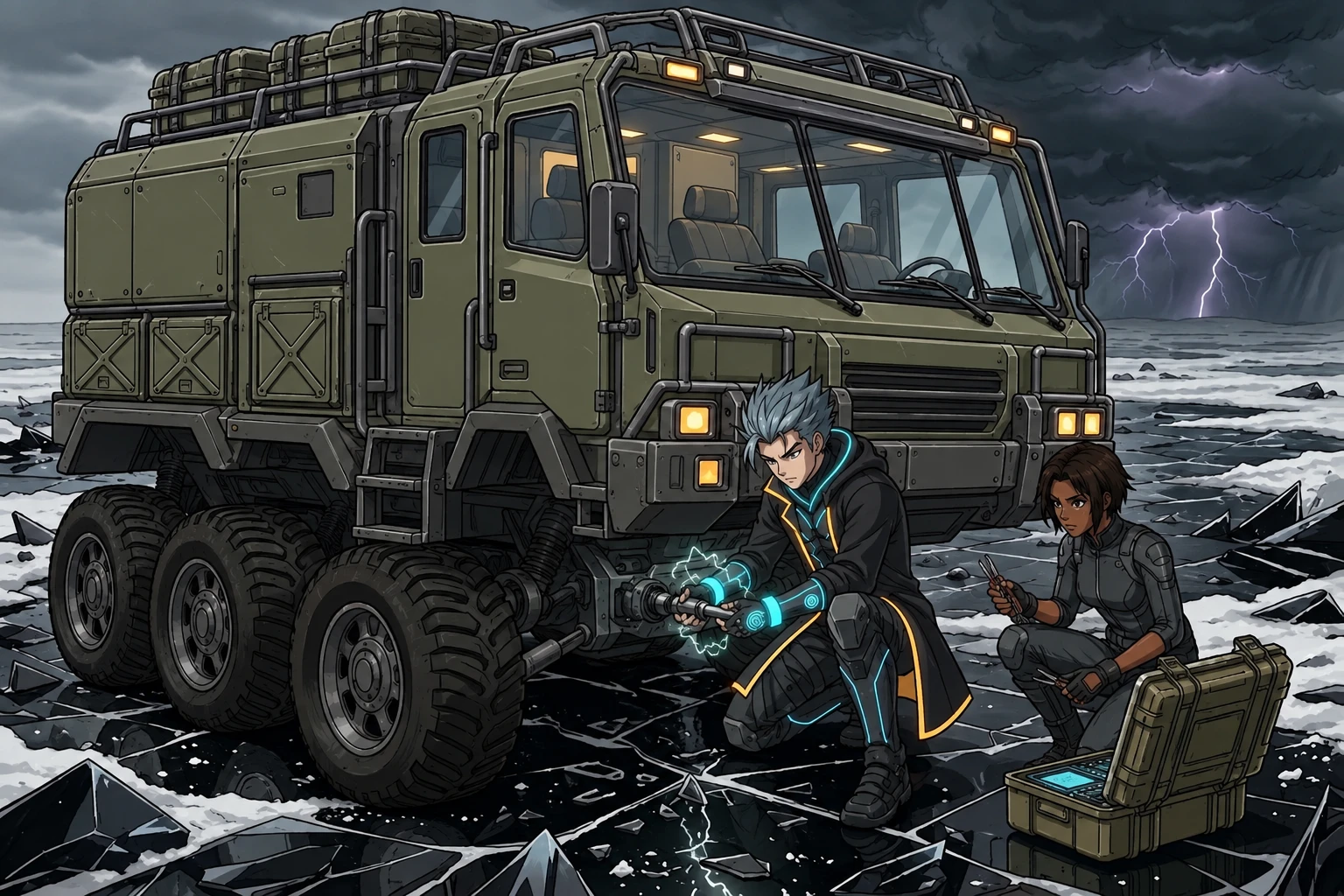
Tamsin Adeyemi carried the case across the depot floor in both arms, because the strap was rated for eleven kilos and the case weighed fourteen, and because she did not trust anything but her own body to be gentle with it.
Coldwater Depot was a long tin hangar on the edge of the Bitter Reach, full of salt-scarred crawlers and the smell of hot coolant. A wall map covered one end, pinned with colored tags, and a bank of storm monitors flickered above the dispatch counter.
A big man in a fleece cap stood behind the counter with a clipboard. At the far end of it, a younger man sat with a paper cup of tea and a rice ball, watching the monitors as if they were mildly disappointing television.
"Dr. Adeyemi," said the man with the clipboard. "Bram Hollis, we spoke on the line. You can put that down, you know. It's a table. It's a very good table."
"Tables vibrate."
"Only when people lean on them."
"I would rather not find out." She shifted the case higher against her chest. "I'm sorry. I'm sure it's a lovely table."
Bram looked at the case, then at her, and gave up with the grace of a man who had argued with clients before. "Fair enough. This is your driver. Rion, this is the client representative."
The younger man turned on his stool. He was gray-haired in a way that didn't match his face, with a dark hooded jacket and thin gloves that he did not take off. His eyes went to the case first, then to her, and stayed on her for a moment longer than was comfortable.
"Ms. Adeyemi," he said.
"Doctor."
"Dr. Adeyemi." He said it without any fuss, and turned back to his rice ball.
Tamsin waited to see whether there would be more. There was not. She had prepared an opening sentence on the tram, and she noticed with dismay that it had slipped entirely out of her head.
"I've read the route brief," she said. "All forty pages. I have concerns."
"Everyone has concerns," Bram said cheerfully, and pulled a laminated map from beneath the counter. "Let's go through them."
There were three routes, drawn in three colors. The northern road was a thin blue line that curled around the whole storm belt, paved and safe and eleven hours long. The direct route was red and ran straight across the middle of the map, through a wide gray stain marked GLASS FIELDS. The third, in green, dropped into a squiggle labeled THE SUMP and followed it west before climbing out to meet the red line at a narrow crossing called the Causeway.
"The northern road is out," Tamsin said at once. "The tissue is viable for eight hours from sealing. I sealed the case sixty minutes ago. Eleven hours doesn't work."
"No," said Bram. "It doesn't."
"So we take the direct route."
"Nobody takes the direct route," said the man with the rice ball.
"Why not?"
"The Glass Fields," he said. "Crawlers can't cross them. The lightning has fused the sand into glass, and the glass cuts tracks. There's one hardpan strip through the middle, the Causeway. To reach it you go through the Sump."
"That's a dry riverbed."
"Yes."
"Which floods."
"Not today."
"How do you know it won't flood today?"
He glanced at the monitors. "The sky."
"That is not a data source."
"It's the best one we've got," said Bram, and Tamsin felt a little of her confidence drain out of her.
She set the case down at last, not on the table but on a padded bench Bram slid over, and opened a tablet with hands that were not quite steady. "All right. Here's what you need to understand about what's in there. Those are three cardiac patches, cultured from donor cells.
They're about the size of a coaster, and they beat. They've been beating for eleven weeks. When they're healthy, they beat in synchrony. When they lose synchrony, they're just tissue, and then they're not anything."
"What breaks the synchrony?" the man asked.
"Electrical fields. The case shields them, and there's a bias circuit that holds them steady, but the shielding has limits. Sustained ambient field above forty volts per meter, and I start losing cells. Above a hundred, the shielding fails." She swallowed. "A direct strike within a couple of hundred meters can push the field past that without warning. And you're going across a lightning field."
"I'm going across a lightning field," he agreed.
"And you are on the list of hazards."
"I'm what?"
"There's an appendix to the safety brief." She pulled it up on the tablet and turned the screen toward him. "Personnel field classification. It says courier R. Tempest, ambient class four."
He read it with an expression she couldn't quite interpret. "I'm in a lot of appendices."
"Class four is bad."
"Class four is manageable." He set down the cup. "How close is too close?"
"To the case? Within a meter, at your usual output, you'd exceed forty."
"At my usual output."
"I don't know what your output is when you're being careful."
"Neither do I." He said it plainly, and she found she had no reply. "I'll keep it under forty around the case. You'll tell me when I don't."
"I'll have to be able to see the monitor. Every minute. At all times."
"Fine."
"And I ought to warn you that I talk when I'm nervous."
"I'd noticed."
"That was before I started."
For the first time, something moved at the corner of his mouth. It was gone before she could be sure of it.
"We leave in ten minutes," he said. "Eat something."
"I'm not hungry."
"You will be at hour four, and we won't be stopping at hour four." He nudged a paper bag along the counter toward her. It held three more rice balls. "Salted plum. Nobody likes the plum. That's why there are three."
The crawler was a six-wheeled salt-runner with a cab that smelled of hot plastic and old tea. Bram's crew had bolted a padded cradle behind the passenger seat and run a power cable to the vehicle's bus.
Tamsin tucked the case into the cradle, checked the seals twice, and clipped the monitor to a bracket on the dash where she could read it. Three thin traces rolled across the screen, small and steady, three little hills that rose and fell at the same instant.
"Those are them?" Rion asked, glancing over.
"Those are them. That's Biscuit on top, Toast in the middle, and Doreen at the bottom." She felt her face heat up. "That's not official. The designations are alphanumeric. I name them privately."
"Doreen."
"She's the strongest. She was the first to synchronize, and she's never missed a beat. I don't know why she's Doreen. She just is."
"That's fair," he said, and put the crawler in gear.
The depot dropped behind them, and the Reach opened out ahead, white salt flats running to the horizon under a hard, bright sky. The crawler drummed across them at a steady pace. Far to the west, a wall of dark cloud stood on the horizon like a piece of the night that hadn't been put away.
For a while neither of them spoke, and Tamsin used the silence to check the monitor three times in the space of a minute, until she caught herself doing it and made herself stop.
"You keep looking at it like it's going to change its mind," Rion said.
"It might."
"It's cardiac tissue. It doesn't have opinions."
"Everything has opinions if you stare at it long enough." She glanced sideways at him. "How long have you been driving out here?"
"Six years."
"And before that?"
"Somewhere else."
"That's not an answer."
"It's the answer I'm giving." He said it without heat, and she decided, for the moment, to let it sit.
"Can I ask you something else, then? Something with an actual answer?"
"You can ask."
"Do you like the job?"
He considered this longer than the question seemed to warrant. "I like the driving part."
"Not the cargo?"
"The cargo's usually crates. Machine parts. Bram gives me the interesting ones." He nodded at the case without taking his eyes off the flats. "That's the first one that beats."
"They're not going to keep beating if we don't get there," she said, and heard the edge come into her own voice, and tried to smooth it back down. "Sorry. I don't mean to be grim."
"You're not being grim. You're being accurate."
"I've been told those look the same on me."
That earned her the ghost of something again, not quite a smile, gone as soon as it came.
She found, over the next hour, that if she gave him something small he would sometimes give a little back, and that the exchange rate was not entirely predictable. She told him about the culture room, the shelves of incubators humming at exactly thirty-seven degrees, the way the whole building smelled faintly of warm plastic and iron.
"Iron?" he said.
"Blood serum. It's in the growth medium. You stop noticing after the first month, and then you go home and notice that home smells wrong."
"Wrong how?"
"Like nothing. Like a place nothing's growing in." She turned the tablet over in her hands. "That sounds worse than I mean it."
"No. I think I know what you mean."
"Do you?"
"I live above the depot," he said. "It smells like coolant. I stopped noticing that a long time ago too."
"Is that where you sleep?"
"It's where I keep things."
"That's not the same as where you sleep."
"No," he agreed, and did not elaborate, and she let that one go as well.
She told him, in pieces, about the woman who had asked whether the patches had a favorite song, and how she'd promised to ask them, and how she still hadn't decided what she'd say if the woman asked again.
"What would you say?" Rion asked.
"I don't know. Something true. I could tell her they like a low, steady rhythm, because that's what keeps them in phase in the incubator. I run a metronome track sometimes, very quiet, just to see if it does anything."
"Does it?"
"Doreen speeds up half a beat per minute when I play it. The other two don't care." She smiled despite herself. "I told my supervisor that and he said I'd been in the lab too long."
"Had you?"
"Almost certainly."
"How much of that talking was to keep from thinking about the storm?" Rion asked, after one of these silences.
"Most of it."
"It's working."
"It's not, actually. I can see it out the window."
"Then talk about something else."
"Like what?"
"Doreen," he said. "Tell me about Doreen."
"You already know about Doreen."
"Tell me again."
So she did, and somewhere in the middle of the second telling, she realized her hands had stopped shaking, and understood that this had probably been the point.
Later, a far-off flash lit the base of the cloud, white and silent, and Rion began counting under his breath. She listened without meaning to. At eleven the thunder arrived, a low rolling sound like furniture being moved in another house.
"Four kilometers," he said.
"You can do that by counting?"
"Sound travels about three hundred meters a second."
"I know that. I just didn't think you'd do arithmetic."
"I do arithmetic constantly. You'd be surprised how much of my job is arithmetic." He glanced at the monitor. "How are they?"
"Beating." She let out a slow breath. "Still beating. Do you want a candy?"
"No."
"They're sour. They're the only thing that keeps me from talking."
"Then keep them."
"They don't work," she admitted. "I've been eating them for an hour."
Pilot Rock Station stood at the edge of the flats, a long low building painted with orange stripes and a barrier that swung on a counterweight. A warden in a reflective jacket strolled out to meet them holding a handheld meter, and Tamsin saw the display flicker as he approached the cab. He glanced at the meter and stopped walking.
"Morning," he said, and his voice held a note of forced neutrality. "Warden Oduya. Field survey on all vehicles entering the Reach interior. Would you shut down the engine, please?"
Rion killed the engine. The warden stepped closer, and the meter chirped once, then again, then began to run through numbers faster than she could read.
"That's higher than it should be," Oduya said.
"It's the driver," said Tamsin. "He's class four. It's in the paperwork."
"I see that. I'd also like to look at the cargo."
"I'm afraid you can't."
"I'm sorry?"
"It's a sealed medical shipment, and the seal cannot be broken until it reaches the clinic. If it is, the contents are compromised." She had already pulled out the folder and was turning to the right tab. "Under Reach Authority Regulation 14, subsection C, medical priority cargo with an intact seal is exempt from physical inspection. You may perform a non-contact survey. You may not open the case."
Oduya blinked. "You know the regulation."
"I've had to know it. I've shipped these before."
"All right." He rubbed the back of his neck and lifted the meter toward the cradle behind her seat. The numbers climbed at once. "I'm reading a lot of field here."
"That's the driver."
"It's also the case. Or it's my meter. I can't tell." He frowned at the display. "This thing throws errors around anything above class three. I'm going to need to run a full survey, and that's going to take a while."
"How long?"
"Thirty-five, maybe forty minutes."
Tamsin felt her stomach tighten. She had no idea how much slack they had, but she knew it wasn't forty minutes. "May I see the meter?"
"It's a regulation instrument."
"I'm not going to break it. I want to try something." She held out her hand, and after a moment, he gave it to her. She turned it over, found the reference port on the side, and held it against the case's reference cell, a small silver disc set into the corner of the shell. "You can zero it against a known-shielded source. It fixes the drift from ambient fields. We do it with the incubators all the time."
She pressed the button. The numbers dropped, blinked, and settled into a steady, sensible reading.
"There," she said. "Now scan the driver."
The warden scanned him. The meter read high but stable, and Oduya let out a quiet, surprised breath. "That's a real number," he said. "That's a class four."
"I told you."
"You did." He looked down at the paperwork with the expression of a man trying to remember how his day had gone off script. "Name for the log?"
"Rion Tempest."
Oduya's pen stopped. He looked up at the driver, slowly, and his face changed. "Tempest," he said. "Hollin Bridge?"
Rion said nothing. Tamsin did not know what Hollin Bridge was, but she knew what it felt like when someone was about to make a scene.
"He's the driver," she said.
"The driver."
"Just the driver. It's a driving job."
Oduya looked between them for a long moment. Then he wrote something on the log, and stamped it, and stepped back.
"Field class four, driver," he said. "Safe travels, Doctor."
The barrier swung up. Rion started the engine, and neither of them spoke until the station had shrunk to a striped line behind them.
"That was quick," he said at last.
"It's the same trick we use on the incubators."
"Thank you."
"I'm the one who should be thanking you. It's your paperwork that says you're a hazard." She kept her eyes on the monitor. "You didn't want it said."
"No."
"I don't know what Hollin Bridge is."
"Good," said Rion.
"Is it—"
"It's a bridge."
She let it go. The flats slid past, and the horizon ahead of them slowly began to change from white to gray.
The Sump began as a shallow dip in the salt and deepened until the crawler was running along the bottom of a wide cracked channel, with banks of dried mud on either side and a floor strewn with fragments of black glass. The storm had built into a wall in the west, and thunder came with less delay now, and the light had taken on a bruised yellow tinge.
"Twelve seconds," Rion said, after a flash. "Four kilometers."
"It's closer."
"It's moving."
"Does it usually move?"
"It's a storm. It moves."
They were rounding a bend in the channel when the crawler struck a shard of glass the size of a dinner plate. There was a crack like a rifle shot, and then a grinding shudder, and the whole vehicle lurched sideways and slewed to a halt. The engine kept running for a moment. The wheels did not turn.
"That was not good," said Tamsin.
"No."
Rion was out of the cab before she could ask what he was doing. She saw him drop flat and slide under the vehicle, and there was a great deal of clanking and a couple of quiet words she didn't catch. After a minute he pulled himself out again and knelt beside the door, wiping his hands on his trousers.
"Coupling pin," he said. "It sheared."
"Can it be fixed?"
"With a pin."
"Do we have a pin?"
"No."
She looked at the monitor. Three little traces rolled on, steady as ever. Then she looked at the clock, and did a sum she would rather not have done. "We've got about three hours and twenty minutes before the tissue drops out of the viable window. The case has a reserve battery, but it only holds forty minutes off the vehicle's power. Can we call Bram?"
"No signal in the Sump."
"Can we walk?"
"To the coast road? Six hours, at least."
"That doesn't work."
"No."
They stood for a moment in the yellow light, and the thunder rolled again, closer.
"Show me," Tamsin said.
"Show you what?"
"The pin. The coupling. I want to see it before we decide there's nothing to be done."
Rion looked at her for a moment, as if weighing whether this was a reasonable use of the time they didn't have, and then dropped back down and slid under the vehicle again. She got down on her knees in the dried mud, ruining a pair of trousers she'd bought for exactly this trip, and looked under the chassis.
"There," he said, pointing with a small flashlight. The coupling was a heavy steel yoke where the drive shaft met the axle housing, and where a pin should have run through it there was only a ragged stub and a scatter of bright fragments in the dust.
"That's a clean shear," she said. "Not a bend."
"Does that matter?"
"It matters if the metal was fatigued or if it just hit something harder than it was rated for. If it was fatigued, a replacement pin might go the same way. If it just hit something harder, a stronger pin fixes it outright."
"It hit glass at speed. I'd guess the second one."
"I'd agree, but I don't have anything steel eight millimeters across regardless of which one it is."
"No," he said. "Neither do I."
"What kind of pin is it?" Tamsin asked, though she had more or less seen it now. "Steel, this long?" She held her thumb and finger apart to match the stub.
"About that. Eight millimeters across."
"Would titanium work?"
"It'd work. It's stronger, and it's lighter. Why?"
"Because I've got some." She was already climbing into the back, unzipping the small hard kit she kept beside the cradle. "The racks that hold the patches in culture are mounted on titanium spindles. I carry spares in case one bends. They're eight millimeters."
Rion looked at her for a long, unguarded moment. "You brought spare spindles."
"I bring spares of everything. It's a professional weakness."
She found three of them wrapped in a strip of foam, each one slightly longer than the sheared pin and a shade too smooth to seat properly on the first try. They lay back down together in the mud, shoulder to shoulder under the chassis, and Rion held the coupling steady with both hands while she guided the spindle in.
"It's too long," she said, after the third attempt.
"By how much?"
"A centimeter, maybe less."
"Can you cut it?"
"Not without ruining the temper. You'd want a file, and even then, you'd have to go slowly or it'll heat up and warp."
"I have a file."
"Of course you do."
"I carry spares too," he said, and there was something almost like amusement in it. He reached into a canvas roll she hadn't noticed clipped under the seat and came out with a battered flat file and a screwdriver with a chewed handle.
"You hold it," she said. "I'll file. My hands are steadier for fine work, yours are steadier for holding four kilos of steel in place."
"That's a fair division."
"I have a lot of fair divisions. I run a lab. Half my job is deciding who holds what."
She filed in short, careful strokes, checking the fit against the coupling every few passes, aware the whole time of the thunder growing louder above them and of his hands, utterly still, bearing the weight of the yoke without complaint.
"You don't shake," she said, at one point, not looking up.
"Not for this."
"For what, then?"
"Ask me again after the crossing."
That stopped her filing for a second. Then she went back to it, because there was nothing to say to that yet, and the pin needed another two passes before it would seat.
"Try it now," she said, and he slid the spindle home. It went half a centimeter and stuck.
"Close," he said.
"Give it here again."
They repeated it twice more, a rhythm settling between them, file and check, file and check, until the spindle slid through the yoke and out the other side with a small, satisfying click, seating flush against the housing.
"Tap it," she said. "Gently. If you drive it in hard you'll deform the head and it won't hold."
He tapped it with the butt of the screwdriver, three light strokes, and the pin bedded down and stayed.
"Try it," he said, sliding out from under the crawler and offering her a hand she didn't really need but took anyway.
She climbed into the cab and pressed the starter. The engine caught, the wheels bit, and the crawler rolled forward a few meters before Rion signaled her to stop.
"It'll hold," he said. "Not fast."
"How slow?"
"Eight kilometers an hour. Any faster and the pin will shear again."
"That's a walking pace."
"It's a bit better than a walking pace."
"It's not enough."
"No," he said. "But it gets us out of the Sump."
They crept out of the riverbed at the speed of a cyclist, and it took nearly an hour. The storm had swallowed half the sky by the time they reached the far bank, and the light had gone from yellow to a dark, coppery green. Ahead of them lay the Glass Fields, a wide plain of fused black sand that gleamed like wet slate under the cloud. In the middle of it ran a thin gray strip, the Causeway, and directly above it, low and roiling, sat the heart of the storm.
Lightning struck the plain twice while they watched, two clean white lines with a shudder of sound behind them.
"The storm's sitting on the crossing," Rion said.
"Can we wait for it to pass?"
"We have a forty-minute battery, and the vehicle's power only lasts as long as the vehicle does. If we sit here, the battery drains, and if we go across at eight kilometers an hour we're under that cell for three hours. The crawler's got a mast." He nodded up at the antenna rising from the roof. "It would draw strikes the whole way."
"So we abandon it."
"We leave it here."
"And go where?"
"Across."
She stared at him. "On foot, it's six hours. The case has forty minutes."
"I know."
"Then what are you—"
"I can cross it in less than forty minutes."
The words hung in the air. She looked at him, and then at the plain, and then at the wall of storm above it, and understood what he was telling her before she wanted to.
"You want to carry me," she said. "And the case."
"I want to carry the case. You're what happens if the case can't go without you."
"Because I'm the only one who can read it."
"Yes."
"You said you don't cross that kind of distance with people."
"I said no such thing."
"You said it with your face. Your face said it quite clearly." She wrapped her arms around herself. "What happens when you go that fast?"
Rion did not answer for a moment. He looked at the storm, and his jaw tightened, and she saw the muscles of his forearm move under the sleeve.
"People break," he said.
"Break how?"
"Ribs. Necks, if I'm careless. The acceleration alone would—" He stopped. "I've done it once."
"And?"
"He was fine."
"But?"
"He never spoke to me again." His voice was flat. "I don't like carrying people, Dr. Adeyemi. That's the only reason I'm hesitating. It isn't ego."
She understood then that it was the longest speech she had heard him make, and that he had said it as though it cost him something. She was quiet for a moment.
"All right," she said. "Then here is what I have to offer. You can go faster alone, but you can't do this alone. You can feel your own field, but you can't feel what it's doing to the case. I can. I'll be reading it the whole way, and I can tell you the second you cross forty." She took a breath. "You don't have to like it. But you're the fastest thing out here, and I'm the only one who can tell you whether it's working."
He was silent for a long time. Thunder rolled, close and heavy, and a few big drops of rain hit the salt and vanished.
"If I say hold on—"
"I hold on."
"That's not the same as stopping."
"I know."
"It's the only kind of stopping there is."
"Then that's what I'll do."
He let out a slow breath and nodded once.
They rigged the harness out of cargo straps and the rubber mat from the crawler's floor. Rion cut the mat into a pad the width of his back and buckled it beneath the straps.
Tamsin held the case against her chest while he cinched her in behind him. The padding kept a thick layer of insulation between them.The monitor went on her lap, clipped to the case. She checked the seals for the fourth time. Three small traces rolled across the screen, steady and stubborn.
"Don't lean forward," Rion said.
"Understood."
"Don't touch my neck."
"Where do I put my hands?"
"On the case."
"Not on you?"
"On the case," he said again. "And it'll be loud."
"I'm fine with loud."
"It won't be loud. It'll be fast."
She had time to wonder what he meant, and then the world came apart.
The first thing she noticed was that there was no jolt. She had braced for the rough, lurching gait of someone running with a heavy load.
Instead there was only an enormous, silent pull, as though the ground had been cut out from under them and everything else was being drawn rapidly past. The salt became a smear. Glass flickered beneath his feet in streaks of black and silver.
The wind hit her face like a slap. She shut her mouth on a shriek and kept the case clamped to her chest.
"Forty-one," she shouted. "You're at forty-one! Bring it down!"
"Venting."
"Where?"
"Right arm."
"Vent left, left, you're pushing it toward the case—"
"Left."
The numbers dropped to thirty-six and held. She let herself breathe for exactly one second before she went back to watching the screen.
"Thirty-six. Good. Stay there."
"Talking helps," he said, over the wind. "Keep going."
"Keep going with what?"
"Anything."
"Thirty-six. Still thirty-six." She swallowed against the rush of air. "Doreen. I was telling you about Doreen."
"Tell me the rest."
"At eight weeks she held a beat when I raised the incubator two degrees. I ran the test three times because I didn't believe it the first time, and then a second time because I didn't believe it the second time either."
"Numbers."
"Thirty-seven. Climbing. Thirty-eight—"
"Venting left."
"It's not dropping fast enough, thirty-nine, there—thirty-five. Good. That's good."
"What happened the third time?"
"What?"
"The third test. You said you ran it three times."
"Oh—the third time I believed it, and I still didn't believe it. Doreen didn't miss a beat, Biscuit missed one, Toast missed two." She was shouting to be heard, and somewhere in the shouting she'd stopped noticing how frightened she was. "I thought, she's doing it on purpose, which is absurd, they're cells, they don't do anything on purpose—"
"Left. Field's climbing again."
"Thirty-seven — thirty-eight, vent it—"
"Venting."
"Better. Thirty-six." She pressed her palm flat against the case, feeling the faint hum of the bias circuit through the shell. "You're doing this on purpose too, aren't you. Keeping me talking."
"Is it working?"
"I haven't screamed in almost a minute."
"Then it's working."
They ran on. The storm boomed and cracked around them, and she found that the numbers came easier when she was talking, and that the talking came easier when she stopped thinking about where she was.
"Tell me something about you," she said. "Since you've got me talking about incubators like you actually care."
"I do actually care."
"You don't have to be polite. I know it's a lot of incubators."
"I like the incubators," he said. "Numbers."
"Thirty-eight. Fine, then tell me something. Anything. A rule. You said don't touch your neck. What else is a rule?"
"Don't grab my arms if I stumble."
"Why?"
"Because you'd get more field, not less. Hold the case. Let me fall if I fall."
"That's a terrible rule."
"It's the rule."
"Thirty-nine. It's creeping. Where are you venting?"
"Both arms. It's not enough."
"Why not?"
"Because I'm running, and running takes more."
"Then run less."
"Numbers say I can't."
She checked the clock stitched into the corner of the monitor without meaning to, and did the arithmetic despite herself. "We're eleven minutes in. Battery says twenty-nine left."
"That's on pace."
"Don't tell me things are on pace, tell me things are fine."
"They're on pace, which is the version of fine you're getting."
She almost laughed, and the wind took it out of her mouth before it could become a real sound. "Forty. You're at forty."
"I know."
"Forty-one."
"Venting both arms."
"It's not moving. Forty-two—"
"I hear you."
"Rion—"
"I said I hear you." His voice had gone tight, the first real strain she'd heard in it. "Give me three seconds."
She counted them in her head instead of aloud, because she didn't trust her voice not to shake, and on the third second the number folded back down to thirty-four and stayed there.
"Thirty-four," she said, and heard how much relief was in it. "Thank you."
"Don't thank me yet."
"I'll thank you when I want to."
"Fair," he said, and for a moment, even at that speed, she thought she heard something like a laugh underneath the word.
The second strike came without warning. There was no flicker, no countdown, only a white blaze that swallowed the world and a crack that seemed to split the sky. She felt his whole body jolt beneath her. The straps went rigid, and a shock of raw current ran through the pad and her spine and out through the soles of her feet, and the monitor screen flared white.
"Fifty," she screamed. "Fifty-two, fifty-eight, Rion, sixty—"
"I know."
"Sixty-one, drop it, drop it now—"
"Dropping."
She felt the field fall away from him like a held breath let go. His stride broke. For one horrible second he stumbled, and the ground tilted, and she clung to the case with both arms and shut her eyes. Then he caught himself, and the wind and speed settled, and she opened her eyes to find the monitor scrolling normally again.
"Are they—" she said. "Are they still—"
Three traces rolled across the screen. She stared at them. Then she leaned close, her breath fogging the glass, and watched all three of them rise and fall at the same instant.
"They're in sync," she said. "They're still in sync."
"Good."
"Doreen didn't miss a beat."
"I'd assumed not," Rion said, and there was something in his voice that might have been laughter, if he'd had any breath to spare.
The glass gave way to hardpan, and the hardpan to a strip of cracked road. Lightning lit the horizon behind them, but the storm was thinning, the thunder falling farther and farther behind. Ahead, a cluster of low white buildings rose from the coastal plain, and a set of floodlights was already turning toward them across the road. Rion slowed, and slowed again, and finally came to a stop in the middle of the road with his chest heaving. It took Tamsin a moment to remember how to unbuckle.
Two clinic staff were running toward them with a cart. A tall woman in scrubs reached them first and took the case from Tamsin's arms with a smooth, practiced motion. She glanced at the monitor, and her face went very still.
"Three traces," she said. "All in sync."
"They've been in sync for eleven weeks," said Tamsin. She had meant to sound composed. Her voice came out as a croak. "The case has about four minutes of battery left. The seals are intact. There was a strike, a big one, about ten minutes back, so you should log a field excursion. It peaked at sixty-one volts per meter for about a second."
"For a second?" The woman looked up. "And they held?"
"They held."
"That's extraordinary." She was already wheeling the cart toward the doors. "I'll need a full handoff in ten minutes, but sit down, Doctor, you look like you're going to fall over."
The doors closed behind her. The road was very quiet.
Tamsin sat on the edge of the loading dock because her legs had stopped working. After a moment, Rion sat beside her, and neither of them said anything for a while. His jacket was scorched along both sleeves, and the gloves had burned through at the fingertips. When he set his hands on his knees, she saw that the skin beneath was red and blistered.
"Oh," she said. "Let me see those."
"They're fine."
"They are absolutely not fine."
"They'll heal."
"I have burn gel in my kit. It's for the incubators, it's very good, and I'm going to put it on your hands, and you're going to let me." She was already digging in the kit, and when she looked up, he was holding his hands out with the wary expression of a man being handed a small animal. She worked in silence for a while, smoothing the gel over his knuckles and wrapping each hand in a sterile strip. His palms were rough as leather, and he sat very still.
"You're good at this," he said.
"I'm a biologist. It's mostly holding still and being gentle."
"That's true of my job too."
"I've noticed."
She finished the second hand and sat back. The night air was cool. Behind the buildings, the storm muttered to itself over the flats like an old man arguing with no one.
"You've been quiet," Rion said.
"I've been thinking."
"About what?"
"About how I've never been outside the city before this." She wrapped her arms around her knees. "I've lived in one place for twenty-nine years. I've worked in one lab for six. I thought this was going to be a long drive."
"It was a long drive."
"It was a long drive that turned into something else." She laughed unsteadily. "I screamed at you."
"You did."
"I'm sorry."
"You gave me numbers the whole time," he said. "It's the best I've done in years."
She looked at him, and he was watching the storm, and she could not tell whether he was joking. "How many people have you carried like that?"
"You're the second."
"Was the first one all right?"
"He was fine. He never spoke to me again."
"That seems unfair."
"It was fair," said Rion.
She thought about that for a while. The clinic's doors were still closed, and somewhere inside them, three small pieces of muscle were beating in perfect unison on a monitor she couldn't see.
"I'll talk to you," she said. "If you want."
"You'd talk to me anyway."
"That's true."
"That's not a complaint."
She reached into her jacket pocket and came out with the small tin of sour candies. She held it toward him without a word. He looked at it for a long moment, then took one and put it in his mouth.
His whole face folded. It was the most expressive she had ever seen him.
"That's terrible," he said.
"I know."
He took a second one anyway.


.png)
.png)
.png)