%20(1).png)
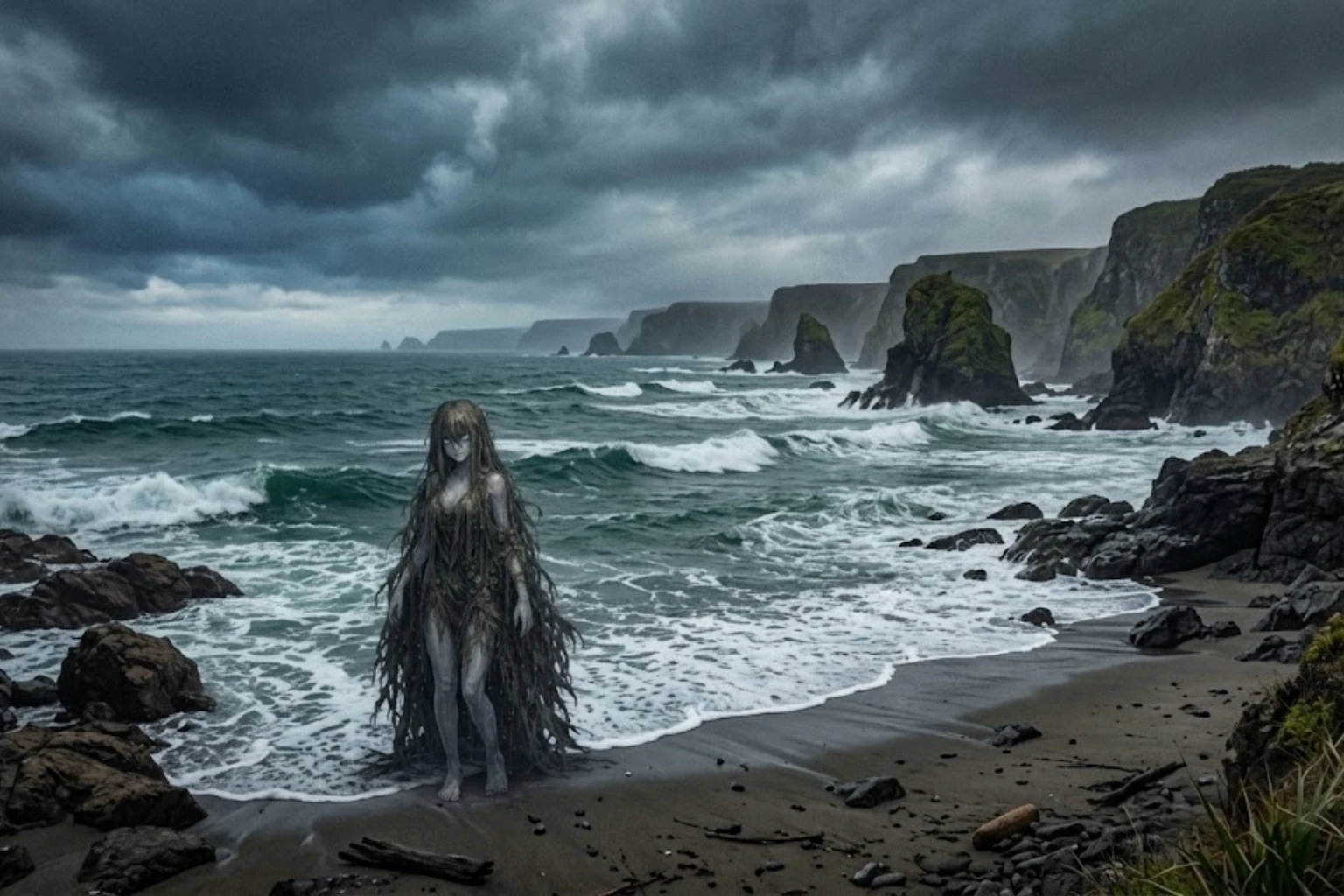
The log said 0300 — visibility poor, seas running 12-14ft, no vessel traffic, and Edvard Moss set the pen down and looked at what he had written and thought that it described his life as accurately as it described the weather.
He had been keeper of Carrow Point light for eleven years. Before that, six years at Dunskey, which was if anything more isolated, a finger of rock pointing into the North Channel with the nearest town forty minutes by road and the road itself frequently impassable between November and March. He had gone to Dunskey at thirty-two, a year after his divorce, and stayed because the work suited something in him he'd stopped trying to name.
It hadn't been a bad marriage. That was the thing people never quite believed when he told them, on the rare occasions he told anyone anything. Marion hadn't left because he'd done something unforgivable. She'd left because she'd finally said, one evening over dishes neither of them was really washing, "You disappear into the quiet like it's a room only you can enter, Ed, and I don't think you even notice you're doing it." He had not been able to argue with that. He'd thought about it for years afterward, usually at three in the morning, usually with the beam turning overhead, and he had never entirely decided whether it was a diagnosis or simply a fact about him, neutral as a barometer reading.
Carrow Point had automated systems now that Dunskey never had — a satellite uplink, a backup generator that started itself, sensors that reported wave height and wind speed to a monitoring station in Aberdeen without him lifting a finger. The job existed less than it used to. He knew that. The Northern Lighthouse Board kept a keeper at Carrow Point partly out of institutional habit and partly, he suspected, because someone in an office somewhere understood that machines failed in exactly the way that mattered least conveniently, at three in the morning in a nor'easter, and that it was worth paying one competent man to be there when they did.
Edvard was competent. He took a plain, unglamorous pride in it. He knew the lamp mechanism the way another man might know an engine he'd rebuilt himself — the particular grinding sound the rotation gearing made in December when the cold thickened the lubricant, the way the lens needed cleaning twice as often in a spring following a mild winter because the salt built up differently. He kept the log in handwriting that hadn't changed in a decade, not because nothing happened but because he had trained himself to write clearly no matter what was happening, since a keeper's log was only useful if the next man could read it in a hurry.
The storm had been building since midday. He'd tracked the barometer's fall the way other men followed sports scores, in steady increments, and by four in the afternoon he'd gone out in a gap between squalls to check the guy-wires on the fog signal mast, tightening one that had worked itself half a turn loose. By six he'd radioed it in.
"Carrow Point to Stranraer Coastguard, radio check, over."
"Stranraer, go ahead, Ed." Fiona Blair had the overnight desk most Tuesdays, and she and Edvard had developed, over three years, the kind of relationship that existed almost entirely over VHF and yet had its own real warmth to it. "You sound cheerful for a man about to get thumped."
"Barometer's down to 986 and falling. Seas building out past the point, I'd guess twelve foot and climbing. Signal's operational, lamp's operational, I've had a look at the mast guy-wires and they'll hold."
"Copy that. We've got nothing moving tonight, everyone with sense is in harbour already. You need anything before the weather really sets in?"
"I'm well stocked, Fiona. Tell your husband I still owe him for that whisky."
"I'll tell him you said that instead of paying him." A pause, a small laugh crackling through the static. "Stay dry, Ed. Call if the tower starts singing to you."
"Always does in a blow. Out."
He'd smiled, setting the handset down. It was a small thing, four minutes of ordinary human contact, and it would be the last conversation he'd have with anyone before the night narrowed down to just himself and the storm, which was the shape most of his nights took and which he had, for a very long time, found restful rather than difficult.
By eight the windows were sheeted with horizontal rain and the beam above him was cutting through visibility reduced to a quarter mile at best. He ran the fog signal at the scheduled intervals, checked the rotation speed against his watch out of an old habit that predated the automated timer by a decade, ate crackers and tinned sardines standing at the counter because sitting down to a proper meal alone in weather like this had always felt faintly absurd to him, like setting a table for one in an empty banquet hall.
At half past ten he read forty pages of a novel he'd been working through for three weeks without particular urgency, a slow interior book about a family in Norway that he liked precisely because nothing in it was required to happen quickly. At three he wrote the log entry. At three fifteen, for reasons he didn't examine too closely, he pulled on his oilskin and went outside.
The wind hit him like a decision. Cold, salt-heavy, the kind of force that made thought difficult and the body purely physical, which was sometimes exactly what he wanted from it. He leaned into it and made his way down the stone path toward the shore, the beam sweeping overhead in its slow rotation, throwing his shadow long and brief and long again across the wet rock.
This was a ritual, if it could be called that. Most nights when sleep didn't come easily he walked the shingle below the lighthouse and counted the waves, not for any purpose but because counting gave his mind somewhere to sit that wasn't the empty rooms of the keeper's house or the particular quality of silence that came after midnight when even the radio traffic thinned to nothing. He had never told anyone he did this. There had been no one, for a long time, to tell.
He came around the last rock formation and stopped.
She was standing at the water's edge.
His first thought, arriving with the automatic urgency of someone responsible for this stretch of coast, was that she'd come off a vessel. That she was a survivor of something. She stood in the foam where the waves came in, barefoot on the shingle, the water running over her feet, and she wasn't moving, and the cold alone should have — his mind was already running the protocol, blankets, the radio call, the nearest station —
Then the beam swept overhead and he saw her properly.
Her skin was not pale the way cold made people pale. It was grey in the way stone was grey, in the way the underside of a wave went grey before it broke. Waterlogged, but not swollen, not wrong in the way a drowned body was wrong — more as though she had simply reached an accommodation with the sea over a very long time, the way rock reached an accommodation with tide. Her hair hung in heavy matted lengths that moved with the water rather than the wind, dark and dense, threaded through with kelp in a way that suggested it hadn't tangled there so much as grown that way. The seaweed draped down from her shoulders in a continuous sodden mass, indistinguishable at the edges from her hair, from the water behind her.
Her eyes were open. Pale, wide, unblinking against the rain.
She was looking at him with the patient, total attention of something that had been standing there a long time and had simply been waiting for him to arrive.
Edvard stood very still.
The logical part of his mind produced a list of explanations and discarded them as fast as it produced them. The other part — older than logic, sharpened by eleven years of listening to what the ocean did at three in the morning with no one to share it — recognized what he was looking at the way you recognized a smell from childhood, before you had language for it.
She took one step toward him.
The shingle didn't shift under her feet. He heard nothing. The wave that came in at that moment moved through her ankles and around them and receded, as though it knew better than to disturb her passage.
"You come here every night," she said.
Her voice was not what he expected. It was low, and it carried easily over the wind without being raised, and it had a resonance beneath it like sound heard through water — the way whalesong traveled impossible distances through the cold deep. It was not unpleasant. That was somehow the most unsettling thing about it.
"Most nights," he said. His own voice came out steadier than he felt.
"You count the waves. When you can't sleep."
He did. He had told no one that. "Yes."
She took another step, close enough now that the beam's sweep lit her fully every time it passed, and in that light the water ran constantly from her hair and shoulders and hands, a slow continuous draining that the rain kept replenishing, so that she was always pouring herself out and always full.
"You are very tired," she said.
It wasn't a question, and it wasn't sympathy. It had the flat observational quality of a depth sounding — a fact noted and reported back.
"Tired of what?" Edvard asked, and heard something in his own voice he hadn't meant to put there.
She considered him. It was the consideration of something very old looking at something temporary, without cruelty and without kindness, only accuracy. "Of burning," she said. "The light burns every night. You feed it. You tend it. You send it out over the water." She tilted her head, the motion fluid and wrong in a way he felt before he could name it. "Nothing ever burns in the deep."
"What are you," Edvard said.
"I don't know the word you would use for it." She said this simply, without evasion, as though it were an ordinary gap in translation rather than a secret withheld. "I have been in this water longer than your lighthouse has stood on that rock. Longer than the rock, perhaps. I don't count time the way you do."
"Have you watched me before tonight?"
"Yes." Again, no hesitation. "You are not the first keeper of this light I have watched. You are the first in a long while who walks down here in weather like this instead of only in fair nights. The others came to the beach for pleasure. You come for something else."
"For quiet," Edvard said.
"For relief from counting," she said. "You count all night, in that tower. The rotations. The wave intervals. The hours until the next entry in your book. Down here you count only waves, which asks less of you." She paused. "I have watched you find that a comfort. I have also watched it stop being enough."
Edvard didn't answer that immediately. The wind pushed against his back and the rain ran cold down his collar and he thought, with a kind of distant surprise, that she wasn't wrong, and that he hadn't known that until she'd said it.
"What's in the deep," he asked instead.
"Cold," she said. "Still. The pressure is very even. Nothing is required of you there." A pause, the water running from her steadily. "You would not be lonely."
"I'm not lonely," Edvard said.
"I did not say you were."
He looked at her. The wind seemed to drop, or he simply stopped noticing it.
"I know the difference," she went on, "between a man who is alone and unhappy about it, and a man who chose to be alone and has been carrying it a long time. You are the second kind. I am not offering you company. I know you would not want it."
"Then what are you offering."
"An end to tending." She said it as plainly as she'd said everything else. "You have fed something every day for seventeen years. The lamp. The log. The radio. Your own body, which must eat and sleep and rise again regardless of whether you wish it to. I am telling you there is a place where none of that is asked of you. I am not telling you it is better. I am telling you it exists, and that you may go there, if you choose."
Edvard found, to his own mild surprise, that he wanted to defend himself — not to her exactly, but to something.
"The light matters," he said. "Ships never know my name. Nobody on those decks ever thinks about the man in the tower. But the light's there because I tend it, and if I didn't, some night, some vessel finds these rocks instead of finding the channel. That's not nothing. That's not a burden I resent."
"I did not say you resented it."
"Then what did you say."
"That it is heavy. A thing can be worth carrying and still be heavy. You have never let yourself measure the weight, because you were taught, somewhere, that measuring it was the same as complaining about it." She tilted her head again. "I do not think those are the same thing."
He had no answer for that either. The beam swept overhead, indifferent, reliable, turning because he turned it, because he fed the machine that turned it, because someone always had to.
"Do you understand duty," he asked her, "or is that a human word too."
"I understand tides," she said. "The tide is not required to come in. It comes in because it is the nature of water under the moon's pull to do so. Perhaps that is close to what you mean. I do not think the sea considers it a duty. I think it simply does not know how to be anything else." She looked at him. "You have made yourself into something that does not know how to be anything else either. That is not an insult. It is only what I see."
Edvard was quiet for a while. The rain had eased slightly, or he had simply stopped feeling it.
"Would I still be myself," he asked. "In the deep."
"I don't know how to answer that in a way your language would hold onto," she said. "You would not be cold, the way you understand cold. You would not count the way you count now. Whether that is still you, I cannot say. I have never been what you are, so I do not know what of it you would lose."
"That's not an answer."
"No," she agreed. "It isn't."
She extended one hand toward him then, palm up, the way you offered a hand to something you wanted to come to you of its own will. The water ran off her fingers in thin continuous streams, and the beam swept overhead, and for one full rotation of the light Edvard Moss looked at her hand and felt eleven years of three-in-the-morning log entries and crackers and counted waves settle into their actual weight, which was considerable.
He took one step forward.
The shingle moved under his boot.
The sound of it — ordinary, physical, the crunch of wet stone under his weight — arrived in his ears and he stopped.
He stood with one foot forward and one back, the wind pressing at him from the sea side, and he looked at her hand and then at her face, and he thought of the light turning above him, and how someone had to feed it, tonight at least, because he had told no relief keeper to expect otherwise and the automated backup was not to be trusted past a certain wind speed and there was, in the end, no one else.
"Not tonight," he said.
She lowered her hand. Her expression, if it had ever fully been an expression, didn't change. She looked at him a long moment with those pale unblinking eyes, water running from her continuously, the sea rising and breaking and rising again behind her.
"I will be here," she said.
Not I'll come back. Not another time. Just the plain, patient, geological fact of her continued presence on this shore, the way the tide would be there, the way the cold would be there.
She turned and walked back toward the water, and the sea received her without ceremony, closing around her in increments until there was nothing left to see but waves and rain and pale foam climbing the shingle and retreating.
Edvard stood on the beach a long time afterward, long enough that his hands had gone properly numb inside his gloves, and then he went back inside.
The log was still open on the table. He looked at the last entry — 0300 — visibility poor, seas running 12-14ft, no vessel traffic — for a while, then wrote the time beneath it and stopped, pen resting, and did not write anything else. Eventually he closed the book without finishing the line.
He went to bed as the storm began its slow withdrawal, listening to the beam turn overhead, counting waves the way he always did, until something like sleep arrived.
In the morning the shingle held the usual evidence of a storm tide — kelp, driftwood, the plastic the ocean collected from wherever plastic went. The coastguard helicopter did its routine pass at nine, and Edvard watched it from the lantern room and raised a hand, and the pilot banked slightly in acknowledgment. He wrote the morning entry — weather clearing, wind dropping from the northeast, seas moderating — in his usual clear hand, and it looked, on the page, like every other morning entry he had written in eleven years.
He ate breakfast standing at the counter. He did not go down to the beach that evening, which was the first evening in longer than he could easily remember that he hadn't, and he told himself it was because the shingle would still be unstable from the surge.
He didn't go the evening after that either.
He did his work. That was the thing he noticed most, in the days that followed — how completely the work continued, unbothered by whatever had happened on the beach. The lamp needed its lens cleaned on schedule, and he cleaned it, working the chamois cloth in the slow circular motion he'd used for eleven years, and the salt came away the way it always did. The generator needed its fuel checked, and he checked it. The log needed its entry twice a day, and he wrote it in the same hand.
But he began to notice these things in a way he hadn't before. Not that they were unbearable — nothing about them had changed — only that he was aware of them now as things that required him, the way you become aware of a low hum in a room only after someone points it out, and can never afterward fully stop hearing it. The lamp required tending.
The log required an entry. The radio required an answer when Fiona's voice came through at the scheduled check-in. Food required preparing. Sleep required that he stop thinking, which some nights was easier than others. Morning required, simply, that he get up, and lately that had started to feel less automatic than it used to.
None of it became unbearable. That was important, and he held onto it deliberately, the way he held onto a compass bearing in poor visibility. He still took the same plain pride in the work. He still liked, most days, the particular texture of solitude at Carrow Point — the way it had a density to it, on bad nights something close to being buried, on better nights something closer to being preserved.
What had changed was smaller and stranger than misery. He had learned that somewhere, not very far from where he stood every day, there was a place where none of it was asked of anyone. And once you knew a place like that existed, the weight of what was asked of you here became impossible to entirely unknow.
Ten days after the storm, the supply boat came in on its fortnight run, and Cammy Reeve, who'd been ferrying stores out to Carrow Point for six years and had opinions about most things, hauled two crates of tinned goods and a replacement fan belt for the generator up the landing steps and stood a while catching his breath.
"You're quiet today, Ed."
"I'm quiet most days, Cammy."
"Aye, but there's quiet and there's quiet." Cammy squinted at him, the frank, unbothered squint of a man who had known Edvard a long time without ever pretending to understand him fully. "You sleeping alright out here?"
"Well enough."
"You'll come to my sister's wedding in September, aye? I told her you'd said you would."
"I said I'd try."
"You always say you'll try. One of these years you should just come." Cammy grinned, hefted the empty crate back toward the boat. "Radio's playing up on channel eight, by the way, if Stranraer sound like they're underwater when you call them. Should sort itself by Thursday."
"I'll listen for it."
"See you in a fortnight, keeper."
"See you, Cammy."
It was an ordinary five minutes, and Edvard found himself thinking about it for the rest of the afternoon in a way he wouldn't have before the storm — turning it over, the wedding invitation he probably wouldn't take up, the easy familiarity of a man who expected to see him again in a fortnight and had no reason to think otherwise. It anchored something in him. He was glad of it, and also, in a way he didn't examine too closely, faintly troubled that he'd needed the anchoring.
He went down to the beach again eleven days after the storm, telling himself he wanted to check the rock formations for damage the surge might have caused, a plausible enough errand that he almost believed it himself. The shingle was empty. He stood at the water's edge a long time, long enough for the cold to work through his oilskin, and felt something he identified, with some reluctance, as relief.
He went again nineteen days after the storm, on a calm clear night with no plausible errand at all, and told himself nothing. The shingle was empty again. This time what he felt, standing there with the stars out and the sea moving in its ordinary undramatic way, was not relief.
It was closer to disappointment, and recognizing it as such frightened him more than anything he'd felt on the night he'd actually seen her.
He did not go back a third time in those weeks. He was disciplined, and he understood, in the plain unsentimental way he understood weather patterns, what he was doing when he stayed inside instead — that he was keeping himself from a door he had already found himself standing in front of once. He wrote his log entries. He answered Fiona's Tuesday check-ins with the same dry humor he always had. He finished the slow Norwegian novel and started another, about a man crossing a country on foot for reasons the book was in no hurry to explain, and found he liked it for the same reason.
Three weeks after the storm, the weather turned again.
The barometer began its familiar fall in the early afternoon, and by evening the wind had backed round to the northeast and started building in the way that meant the night would be a long one. Edvard ran through his checks with the same unhurried competence he always brought to it — the mast, the fog signal, the fuel levels — and radioed Stranraer at six.
"Carrow Point to Stranraer, radio check, over."
"Go ahead, Ed." Not Fiona's voice tonight — a younger man's, one of the newer operators Edvard didn't know as well yet.
"Barometer's dropping fast, we're in for a rough one. Everything here's operational."
"Copy that, Carrow Point. Forecast has this easing off by dawn. Stay safe out there."
"Always do."
By half past ten the rain had set in properly, and by three the beam was cutting through visibility reduced again to a quarter mile, and Edvard wrote the log entry — 0300 — visibility poor, seas running 15ft, no vessel traffic — and sat looking at it for a while before he put on his oilskin and went outside.
The wind hit him the same as it always did, and he leaned into it and walked the path down to the shore with the beam sweeping overhead, and he told himself nothing about why he was doing it, because by now there wasn't much point pretending he didn't know.
She was there.
The beam swept over her and lit the grey of her skin, the kelp threaded dark through her hair, the water running from her in its slow continuous draining, and her pale eyes found him the moment he came around the rock formation, as though she had known exactly when he would arrive.
"You said you'd be here," Edvard said.
"I am."
He came a little closer, close enough that he didn't need to raise his voice over the wind, close enough that the water at the edge of the waves ran cold around his boots and didn't seem to touch hers at all.
"Do you know why I went inside, that night," he said.
"You have a light to tend. I understood that then."
"I still have it."
"I know." She said this without any weight of expectation in it, and that, more than anything else she'd said to him, was what made him trust her, in whatever strange way you could trust something that was not a person and did not pretend to be one.
"Tell me about the deep again," he said. "Properly this time. Not the short version."
She considered that, the way she seemed to consider everything, as though his questions arrived to her slowly, through water, and required time to resolve into shapes she could answer.
"There is a place beneath the currents where the water does not move the way it moves near the surface," she said. "It is old there. Old in the way stone is old, not in the way a person becomes old. The pressure holds everything very evenly, the way your hand is held evenly by air, without you feeling the weight of it. Nothing is asked of what is there. It does not need to eat. It does not need to sleep in order to stop thinking. It does not need to tend anything, because nothing there is burning that requires tending." She paused. "That is the truest way I can say it."
"Would I remember Carrow Point?"
"I don't know," she said again, and this time it did not feel like an evasion, only an honest limit. "I have never carried a memory of a lighthouse into the deep before. I don't know what becomes of the memory, whether it stays whole or unravels the way rope unravels in current, slowly, until you can no longer say what shape it once held."
"That frightens me more than anything else you've told me."
"I know," she said. "I would not lie to you and tell you it shouldn't."
He was quiet for a while, the wind moving around them, the beam turning overhead in its patient rotation.
"If I choose this," he said, "does that mean I failed at the life I chose. Seventeen years of it. Does wanting relief mean none of it was worth what I gave it."
"No," she said, and there was something in the flatness of her voice that felt, for the first time, almost gentle. "The tide does not fail by going out. It has come in a great many times before that. Going out does not undo the coming in."
"What happens to the light. If I go."
"Another will come," she said. "That has always been true, hasn't it. Long before I first watched this rock, and long after."
Edvard looked past her, out at the black water where the waves rose and broke and rose again, indifferent, enormous, exactly as old as she was.
"I'm not choosing this because I hate the life," he said, half to her and half to himself. "I want you to understand that. I liked most of it. I chose the quiet because it suited me, same as I chose it at Dunskey, and there were years and years where it never once felt heavy."
"I understand that," she said. "I have never believed otherwise."
"Then why does it feel like this now."
"Because you have carried it a very long time," she said, "and because you now know there is a place where you would not have to carry it any longer. That knowledge does not make what you carried any less worth carrying. It only makes it harder to keep carrying, once you know you could set it down."
He stood there a long time with the rain running down his collar and the beam sweeping past at its steady interval, counting the rotations without meaning to, the way he always counted things, and he understood, with a calm that surprised him more than any fear could have, that he had already made the choice somewhere in the three weeks between the beach and this beach, in the disappointment he'd felt finding the shingle empty, in the weight the log entries had taken on, in the small grief of imagining Cammy's boat coming in a fortnight from now to find the light on automatic and no one on the landing steps to take the crates.
She extended her hand again.
This time the shingle did not stop him.
He walked forward and the water came up cold and then colder around his boots and then his knees, and he did not look back at the tower, though the beam kept turning behind him, patient, indifferent, already becoming someone else's to tend.
The log entry from that night was the last one he wrote. 0300 — visibility poor, seas running 15ft, no vessel traffic, in the same clear hand he had used for eleven years.
The coastguard conducted a welfare check four days later, when the light failed to answer its scheduled radio check twice running and the lamp switched itself over to automatic backup. They found the lighthouse in good order. The generator was fueled. The lens was clean. The log was closed on the table, its final entry unremarkable, no note beneath it, no explanation. The Norwegian novel sat finished on the shelf and the second book, the one about the man walking across a country, lay open and face-down on the arm of the chair, bookmarked at page two hundred and twelve.
There was no sign of disturbance. No sign of Edvard Moss. No indication of where he had gone, or whether he had gone willingly, or whether willingly was even a word that applied to what had happened to him.
Fiona Blair, when they asked her, said only that he'd sounded the same as he always did, the last time she'd spoken with him. Dry. Steady. A man doing his job the way he'd done it for seventeen years.
The sea, when they asked it, said nothing.
It never did.


.png)
.png)
.png)