%20(1).png)
The coordinates had come from a dead man's field notes.
Not literally dead — Professor Aldric Sunn was very much alive and currently somewhere in Edinburgh enjoying a comfortable retirement — but his fieldwork was dead, buried in a university archive for thirty years under the classification of inconclusive data, which in Marcus's experience was academic language for we didn't understand what we found and didn't want to admit it.
He had spent two evenings in the reading room going through the original survey files, photographing pages with his phone because the archivist wouldn't allow removal, and another three days at his own desk cross-referencing Sunn's GPS approximations against current satellite imagery. The ravine was real. It was accessible, in the loosest technical sense of the word, through terrain that the mapping software described as dense secondary growth, which turned out to mean something considerably more hostile than the phrase suggested.
He'd left the vehicle at first light with sixty pounds of gear on his back, three separate devices carrying copies of Sunn's notes in case any one of them failed, and the specific calm that came before a long day of difficult, familiar work. The notes themselves were frustratingly thin. Sunn had been meticulous about coordinates and useless about description, as though something in him had resisted committing detail to paper. Reached the described feature, one entry read. Team unanimous on withdrawal. No further survey attempted. Marcus had read that line perhaps twenty times over three days and each time it told him less than the time before.
The first two hours were unremarkable fieldwork, the kind he'd done in a dozen countries. He hacked through undergrowth thick enough to swallow a machete stroke, checked his compass against the GPS unit every twenty minutes because the canopy was too dense for reliable satellite lock, and stopped twice to bag leaf samples from a fig species he couldn't immediately place.
He logged both finds with coordinates and canopy height estimates, the habitual precision of a man who had learned early that fieldwork without documentation was just an expensive walk. He compared his position against Sunn's coordinates at each stop, watching the gap close with a satisfaction that had nothing to do with the destination and everything to do with the accuracy of thirty-year-old fieldcraft.
By the third hour the terrain began doing something Sunn's notes hadn't prepared him for. The secondary growth thinned in a way that didn't match any successional pattern he knew. Instead of grading gradually into older forest, it simply stopped, replaced by trees whose girth suggested centuries rather than decades, their bark crusted with epiphyte communities so dense he could have spent a week cataloguing a single trunk. He crouched at the base of one and ran a hand over a cluster of moss that had produced spore structures unlike anything in his regional flora guides.
"That's not right," he said aloud, to no one, a habit he'd never quite broken in the field.
He photographed it anyway and logged the coordinates, because the professional part of his brain had already started composing the paper this discrepancy might justify, and the professional part of his brain generally won these arguments.
He found two more anomalies over the next hour — a fern with a frond arrangement he could not reconcile with any known genus, and a stand of palms whose fruiting bodies looked wrong in a way he couldn't yet name, though it nagged at him the entire time he was bagging a sample. He noted, almost as an aside in his notebook, that the air had begun carrying a persistent sweetness that didn't correspond to any single bloom he could identify.
The air changed further before anything visible did. Thickness replaced by something cooler and more layered — wet moss, sweet bromeliad, and underneath both something older and richer, the biological equivalent of a room sealed for a very long time. The canopy thickened into genuine old growth, the light filtering down in long green columns that turned the undergrowth cathedral-dim.
His pace slowed the way it always did when an environment shifted into something worth paying attention to, and he checked his instruments out of habit. The humidity gauge read higher than the ambient conditions should have supported at this elevation. He wrote it down and underlined it, uncertain what the underline was for, only that some part of him wanted the number marked.
Then the ravine opened up ahead and Marcus stopped walking entirely.
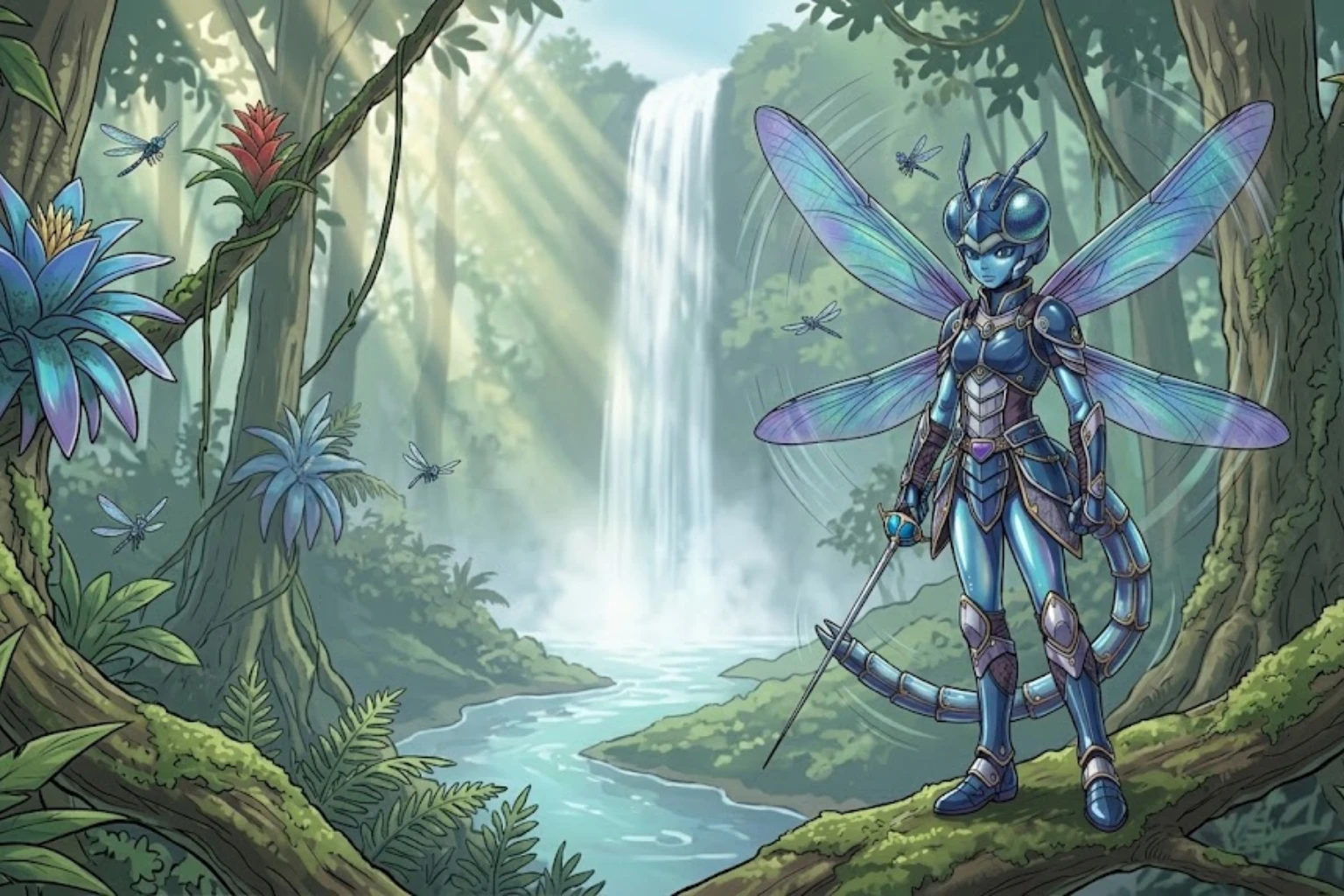
The waterfall came first — massive, roaring, dropping sixty feet down a jagged cliff face dark with moisture and crusted with growth he could identify by genus from fifty feet away and desperately wanted closer. The water hit the basin below with a force that sent permanent mist drifting across the valley floor, catching the afternoon light that poured through a split in the canopy in a single brilliant column. The river running from the basin through the valley floor was the particular clear that only existed in water untouched by human infrastructure.
And the dragonflies.
Hundreds of them, large enough that his brain initially refused to correctly categorize their size, wings catching the light in overlapping flashes of blue and silver and teal that turned the air above the water into something between natural phenomenon and hallucination. Marcus had documented Pseudolestes mirabilis in the Philippines, had spent a week in Borneo tracking Heliocharis through secondary swamp forest, and nothing in that experience had prepared him for the scale and density of what hovered in front of him now.
He had his camera off his hip and his eye to the viewfinder before he'd consciously decided to move.
He worked the scene methodically, the way he'd trained himself to work any exceptional find. Wide shots first, to establish scale and context. Then progressively tighter frames, cataloguing wing venation on the largest dragonflies, noting a thorax coloration that shifted between blue and near-violet depending on the angle of the light.
He crouched at the water's edge and got three good frames of a specimen resting on a reed, its abdomen segmented in a pattern he was fairly sure corresponded to no described genus in the region. His hands were steady. His mind was already drafting field notes, already imagining the specimen collection request he'd need to file, already composing the opening paragraph of a paper that would make three careers, his own included.
He moved along the bank studying the plant communities, and found a symbiotic relationship between a bromeliad and a species of frog he couldn't place, the frog's coloration matching the bloom so precisely he nearly missed it twice before the third glance caught the shape. He spent almost ten minutes on that alone, sketching the relationship in his notebook, thinking about the paper's second section, thinking, absurdly and pleasurably, about what he might name the frog if it turned out to be new.
The blue orchids growing along the near bank stopped him completely. They clustered across a moss-covered trunk fallen into the shallows, blooms larger than any Vanda he'd documented, the coloration a blue so saturated it looked artificial, closer to dye than pigment. He moved toward them with the focused tunnel vision fieldwork produced in him, the rest of the world receding to background noise while the viewfinder filled with the kind of image that ended careers of fieldwork on a high note.
He knelt at the trunk and studied the nearest bloom without touching it, noting the labellum structure, the unusual reflexed petals, the faint sweetness in the air around it that seemed too concentrated for a cluster of flowers this size. He reached for his notebook to sketch the column structure, already imagining the type specimen designation, already imagining the letter he'd write to the herbarium in Kew describing a genus that might not exist in any collection on earth.
That was when he noticed the birds had stopped.
It arrived in his awareness a half-second before he consciously registered it, the way important things sometimes did. The frogs had gone quiet too, though he realized, thinking back on it later, that this hadn't happened all at once. The frogs first, then a gap of some seconds, then the insects, then finally the birds, as though something had swept through the valley in stages rather than as a single event. The constant ambient chirp and buzz and rustle of old-growth jungle had ceased entirely, and the silence that replaced it had a texture to it, a pressure, the kind of quiet that felt less like absence and more like something listening.
He straightened slowly, notebook still open in his hand, and looked up at the dragonflies.
They were still moving, still turning above the water in their loose extraordinary formations, but he noticed now — really noticed, the way he should have noticed minutes earlier if the orchids hadn't monopolized his attention — that none of them crossed an invisible point roughly two-thirds of the way down the valley. They approached it, turned, and came back, every single one, as though the air itself resisted them past that line. He watched three full cycles of it, timing them without meaning to, and each time the turn happened at what looked like the exact same coordinate in space.
He looked at the point where they turned. The light beyond it was subtly wrong — not darker, but thicker, the way air thickened at the edge of a heat shimmer, except this didn't waver with temperature. He checked his handheld gauge and found the humidity reading climbing, slowly, in a way that didn't correspond to any weather pattern he could account for given the clear sky overhead. The orchids on the far side of that line, visible in patches through the mist, were the same species but larger, their blooms open at angles that didn't track with any consistent light source.
"That's not right," he said again, quieter this time, and this time he believed it.
He was still turning the observation over — dragonflies avoiding a fixed line, humidity climbing without cause, animal calls vanishing in sequence rather than at once — when the mechanical drone started. It built for half a second, a frequency so far outside the range of anything he'd encountered in seventeen years of fieldwork that his body reacted before his mind did. Shoulders drawing up. Breath stopping. Every instinct recalibrating toward the specific quality of wrongness the sound carried in his chest rather than his ears.
The air in front of him fractured.
That was the only word Marcus had for it afterward, going over it again and again on the long hike back. Not split, not opened — fractured, the way a windshield went when something struck it at speed, reality developing a sudden network of lines before resolving back into itself. In the space between the fracture and the resolution, something came through and landed on the mossy branch ten feet from him with zero sound and zero impact, as though weight and momentum were negotiable terms rather than physical law.
Marcus stumbled backward and hit a fern wall and stopped.
The thing on the branch was looking at him.
Knight was the word his brain reached for, and it was both accurate and completely insufficient. The armor was real — fitted, articulated, covering torso and shoulders and arms in plates with the blue-black sheen of a beetle's carapace, trimmed at the edges in gold so sharp it looked functional rather than decorative. The helmet was enclosed, featureless except for the compound eyes, which were the part his brain kept snagging on and failing to process correctly. Massive, multi-faceted, teal shifting to cold blue at the edges, moving not the way camera lenses moved but with the continuous micro-adjustment of real eyes tracking a subject with absolute precision. Above the helmet, four wings blurred at a frequency that put the drone in his chest rather than his ears. A segmented tail curved behind the figure and twitched once, slowly, with the patient economy of something entirely unconcerned about the outcome of this situation.
The rapier appeared in the same instant the figure crossed the ten feet between them, which took no time Marcus could measure. One moment there was distance. Then there wasn't, and the blade was at his throat with a steadiness that suggested the arm holding it could maintain the position indefinitely without strain.
Marcus did not move. He did not reach for the camera still hanging from his hand. He could see his own face reflected in the compound eyes — white, wide-eyed, reduced to a curved image in each facet, multiplied across the surface into a hundred small versions of his own fear. He breathed carefully through his nose and thought, with the specific clarity that genuine mortal threat sometimes produced, that he was either about to die in an unmapped ravine over orchid photographs, or something else entirely was happening.
The sound came from the helmet directly into his skull, bypassing his ears. Clicks and sharp rhythmic patterns his auditory cortex tried to process as language and, after a lag of roughly a second, somehow succeeded.
You have breached the Threshold, human.
"I was taking photographs." His voice came out steadier than he had any right to expect. "I'm a field botanist. Dr. Marcus Vance, University of Edinburgh. I followed survey coordinates from a 1987 research file. I had no idea this valley was —" He stopped. Occupied was the wrong word. Protected didn't quite cover it either. "I didn't know," he finished.
The compound eyes regarded him. The wings maintained their frequency. The blade did not move.
The Veil is closed. Your coordinates led you to a boundary marker, not an invitation. The survey team that placed them was warned and complied. A pause, during which the tail twitched again. You were less easy to discourage.
That stopped him more than the blade had. "Sunn's notes didn't mention a warning."
The warning was not written in a form your colleague chose to record.
"What form was it, then?"
The blade did not waver, but something in the angle of the helmet shifted, a fraction of a degree, that read to Marcus as consideration. Sound. Sensation. The kind of communication that does not survive translation into your alphabet. Your colleague understood it well enough to leave and well enough never to return. That is more than most manage.
Marcus filed that away for later, assuming later existed for him. "I'll leave," he said. "I'll delete the photographs. I'll —"
You will do both of those things. The blade dropped a precise half-inch, which was not the same as being lowered. The question currently under consideration is whether you leave before the deep mire registers your presence, or after.
Marcus became aware, in the way you noticed something that had been true for a while before it reached you, that the air at the far end of the valley had changed quality. The mist from the waterfall extended perhaps two-thirds of the way down the valley floor before the light thickened, the atmospheric shift visible without being definable, the way the edge of a weather front was visible from a distance. Beyond it the valley continued but the details were wrong — the orchids larger, the blooms angled toward a light source that didn't correspond to anything overhead.
"What is beyond that line?" Marcus asked, and heard the specific stupidity of the question even as it left him — a man with a blade at his throat asking for field data.
Nothing that concerns you. The blade came back up. Because you will be leaving.
"Does it belong to you? The ravine, I mean. Is this your territory, or are you protecting something that belongs to someone else?"
The compound eyes held on him a moment longer than the previous questions had earned. I am not the owner of this place. I am its Warden. The distinction matters more than you would think, human, though I doubt you'll live long enough as a species to appreciate why.
"But you patrol it. You respond when the boundary is crossed."
I respond, the Warden said, when the boundary is crossed by something capable of causing harm to itself or to what lies beyond it. Most things that cross do neither. You are, at present, an open question on both counts.
"I'm not trying to provoke you," Marcus said. "I'm trying to understand the situation I'm in. That seems relevant to surviving it."
A pause, longer this time. The wings held their frequency but something in the tail's stillness suggested consideration rather than mere threat display.
You are a human standing inside a protected boundary with an unsheathed blade at your throat, asking a Warden of the Threshold to brief him on classified terrain. The chittering carried, in a way that in a human voice would have been exhausted patience, the specific weariness of someone who had had this exact conversation before, with someone else, thirty years ago. The intersection of those facts should be producing a different conversation than the one you are currently attempting.
"You could have killed me when you landed," Marcus said. "You didn't."
The compound eyes held on him.
"That means something," he continued, on the theory that having started he might as well finish. "You're a border guard. You enforce a boundary, and killing me here is presumably more complicated, procedurally, than sending me back. Which means you'd rather I left alive than died on your patch.
Which means, right now, we actually want the same outcome." He paused, aware of how the words sounded and unable to find better ones. "I'd like to propose you let me walk back to the fern line. I'll delete every photograph I've taken since the canopy changed. I'll file Sunn's coordinates as a dead end. Whatever's beyond that boundary never has to know I was here."
The valley was very quiet except for the waterfall.
Marcus is my name for this individual, the Warden said, and if he'd not been listening for it he'd have missed the dryness threaded through the clicks. You reason well for someone who nearly died photographing flowers.
"I'm told it's a professional flaw."
It is a survivable one today. That does not make it a virtue.
"Do you remember Sunn's team? Specifically."
I remember every crossing this valley has produced in the time I have held this post, which is longer than your species has kept written records. Your colleague's team numbered four. One of them touched the water of the basin before I arrived. That is why the warning they received was more severe than the one you are currently receiving. You have been, so far, comparatively well behaved.
"He never wrote that down. The report says the team withdrew voluntarily."
Withdrawal is an accurate description of what followed the warning. Voluntary is a word your colleague chose for reasons that were his own. The Warden's tail shifted, a slow controlled arc. I would not assume incompetence explains what your archive calls inconclusive. Some silences are chosen.
Marcus said nothing to that immediately. Something in it settled into place beside the thought he'd already been circling since the third hour of his hike, the thought about Sunn's notes being thin by design rather than by failure. He filed it, the way he'd filed everything else today, for later consideration, and returned to the more immediate matter.
"The dragonflies won't cross that line," he said, nodding very slightly toward the boundary without turning his head. "I watched them turn back three times before you arrived. Is that the same boundary you're describing?"
It is. They possess an instinct for it that most things do not. It has kept a great many of them alive over a great many years. You would do well to develop the same instinct on considerably shorter notice.
"Has it already noticed me? Whatever's beyond the line."
The Warden did not answer immediately, and the delay told Marcus more than the eventual response did.
It is aware that its water was disturbed. It has not yet decided whether the disturbance warrants its attention. That decision does not proceed on a timescale you would find reassuring, and it does not proceed faster because you are curious about the answer.
Something moved in the mist beyond the boundary. Large. Slow. The kind of movement that registered as wrongness before it resolved into shape, the visual equivalent of the drone that had preceded the Warden's arrival — his body knowing before his mind caught up that the scale was wrong, that the geometry didn't sit correctly against the mist behind it.
"What is that," Marcus said. Not really a question. His eyes had already started drifting toward the boundary and he dragged them back with an effort that surprised him.
Nothing you will describe to your university. The Warden's attention seemed split now, some fraction of it turned toward the mist even as the compound eyes stayed fixed on Marcus. It has a long attention span and a longer memory than either of us. It is aware, at present, that something has disturbed the water. It has not yet decided that the disturbance is worth the effort of investigation. That calculation changes the longer you remain.
The Warden's wings shifted frequency as it spoke — a small drop, barely perceptible, the drone falling half a tone. The tail went still in a way the constant slow twitching had made significant by contrast, and for the first time since it had landed, the Warden looked, for a fraction of a second, less like a threat and more like something bracing.
"Then we should move quickly," Marcus said.
We should. The blade lowered fully this time, a clean deliberate motion, the rapier returning to the figure's side. Walk. Do not run. Running produces responses in this valley that walking does not, in you and in what watches you leave.
"I understand."
Keep your eyes on the fern line. Do not look toward the boundary again, regardless of what you hear, or what the dragonflies do, or what you believe you glimpse at the edge of your vision. Whatever it is will not be worth what it costs you.
Marcus nodded. He turned toward the fern wall he'd come through, and became aware, in the middle of turning, of how badly he wanted to look back at the orchids one more time — not out of fear, not to check on the Warden, but because some part of him that had spent seventeen years going toward things other people avoided had already started grieving the photographs he was about to lose.
"For what it's worth," he said, without turning around, "those orchids may be the single most extraordinary thing I've seen in my career."
They are older than your career. Older than your discipline. The Warden's voice carried something that might, in a human throat, have been the ghost of amusement. They will remain extraordinary whether or not you photograph them again. This is generally true of things worth seeing.
Marcus walked.
He kept his eyes on the fern wall ahead of him and the ordinary jungle light beyond it, and he held his pace at the steady, even rhythm of a man crossing a wet campus quad, nothing more urgent than that, nothing that would read as flight to whatever watched him go. The camera still hung from his hand. He didn't dare stop to put it away. Any change of motion felt, in that moment, like it might mean something to something that was paying very close attention to meaning.
The pull to look back was almost physical. It sat behind his sternum like a hook, dragging with every step, fed by the same part of him that had knelt at the orchid trunk an hour before with his eye pressed to the viewfinder, unwilling to miss a single frame of something no one else had ever documented. He thought about the frog matched perfectly to its bloom, the dragonfly abdomen segmented in a pattern no key would name, the sketch half-finished in his notebook of a column structure that might have justified an entirely new genus. All of it sat behind him now, ten steps and then twenty and then thirty, receding with every stride he refused to slow.
His neck ached with the effort of holding still. Somewhere behind him the drone shifted again, sharper now, a quality of alert attention that reached him like a hand on the back of his neck. He didn't turn to find out what it meant. He counted his footsteps instead, because counting gave the walking a shape that pure endurance didn't. Twenty. Thirty. The fern wall seemed, absurdly, no closer than it had a minute before, as though the valley had stretched itself to make the walk cost more than it should.
At forty steps something moved at the very edge of his vision, low and pale against the green, and every instinct he owned screamed at him to confirm what it was. He kept his eyes forward. It was, he told himself, almost certainly nothing — a trick of the mist, a bird returning early, his own peripheral vision manufacturing shapes out of stress the way it always did after an adrenaline spike. He would never actually know, and understood, walking, that this not knowing was the price the Warden had named and he had agreed to pay.
The drone behind him climbed and held and then, abruptly, cut off entirely, the silence that followed somehow louder than the sound had been. He didn't turn to find out what that silence meant either.
The waterfall's roar thinned as the fern wall grew closer, the mist-heavy air giving way by degrees to something drier and more familiar. A bird called, tentative, somewhere off to his left, the first sound in what felt like an hour though it had likely been minutes. Another answered it. He reached the fern wall and pushed through it, and the ordinary jungle closed around him, and the roar of the waterfall receded entirely behind the vegetation, and the birds kept coming now, bolder every second, the way a held breath released all at once rather than gradually.
Marcus walked ninety more seconds before stopping with both hands on his knees, breathing the specific ragged way people breathed when the immediate emergency was over and the larger fact of having survived it was still arriving. He straightened up eventually. The heat found him again, ordinary tropical heat, mosquitoes rediscovering his ankles, mud sucking at his boots the way mud was supposed to. It felt, for a moment, almost like an insult — the world resuming its unremarkable business as though nothing behind him had happened at all.
He took the camera off his hip.
He scrolled back through the images slowly, the wide establishing shots of the waterfall first, then the dragonflies, wings frozen mid-flash in a dozen impossible colors, then the frog nested against its matching bloom, then the orchids — six frames, each one better composed than the last, the final shot a close study of the labellum that had taken him nearly two full minutes to frame correctly. He sat with his thumb over the delete function for longer than the task strictly required.
These were, without exaggeration, the best photographs of his career. He understood, looking at them, exactly what they would mean if he brought them home — the papers, the funding, the reputation that followed a genuinely new discovery through an entire discipline for a working lifetime. He understood, with equal clarity, what would happen to the valley the day those images left his camera and entered any archive, any journal, any conversation with a colleague who asked one too many follow-up questions. Someone would go looking. Someone always went looking.
He deleted them one at a time, watching each frame disappear before moving to the next, the frog image, the dragonfly close-ups, the six shots of the orchid in sequence, until the card showed only the morning's ordinary collection — the fig species, the unusual moss, nothing that would raise questions — and nothing after.
He opened his field notebook.
He sat for a while with the pen not quite touching the page, and thought about Sunn, thirty years younger than he was now, standing somewhere near this same fern line with his own team and his own instinct to record everything, and choosing, in the end, to write something considerably less than the truth. Marcus understood the choice now in a way the archive files had never let him understand it. It hadn't been incompetence. It had been protection, dressed up as an inconclusive result so that no one who came after would have reason to try harder than Sunn had tried.
He wrote: Sunn coordinates — negative result. Secondary growth only. Recommend removing from active survey list.
He looked at the sentence for a long moment, aware of exactly what he was doing and exactly whose footsteps it followed. Then he closed the notebook, repositioned the camera bag on his aching shoulder, and started the four-hour walk back to the road.
He moved at a steady pace and didn't stop, working through what he would say if anyone at the research station asked how the day had gone, settling eventually on tired and unproductive, which had the advantage of being mostly true. He thought, more than once during the walk, about whether he should write to Sunn at all, turning the decision over the way he'd turned over every observation that day, weighing what it would mean to reach out against what it would mean to simply carry the knowledge alone the way Sunn apparently had for three decades.
He decided, somewhere in the third hour, that Sunn deserved to know someone else finally understood.
He wrote to him weeks later, once the exhaustion had worn off and the ordinary business of the research station had resumed around him — a short note about an unrelated orchid genus, professional and unremarkable, ending with a single line that had nothing to do with the rest of the message. I found the ravine. I understand now.
Sunn's reply came after several days, brief enough that Marcus read it twice before he was sure he hadn't missed anything. Good. Leave it as you found it. Neither man mentioned it again, in that correspondence or any that followed, and Marcus understood that this was itself an answer, the kind Sunn had apparently decided, three decades earlier, was the only kind worth giving.
By the time Marcus reached the vehicle the light was failing and his legs had gone past aching into the particular numbness that came near the end of a very long day. He sat in the driver's seat without starting the engine for several minutes, looking at nothing through the windshield, letting his hands stop shaking before he trusted them on the wheel.
On the drive back his mind kept returning not to the Warden, or the rapier, or the shape that had moved in the mist, but to the orchids on the bank — the coloration no pigment pathway he knew could explain, the bloom structure he'd had, for perhaps thirty seconds, entirely to himself before the birds went quiet. He thought about them for a very long time, replaying the labellum shot from memory since the file no longer existed to replay.
He didn't go back.
But it took him considerably longer than he expected to stop wanting to, and he came to understand, somewhere in the months that followed, that this was its own kind of warning — one that hadn't arrived by way of a blade, and wouldn't be so easily obeyed, and that he would likely go on carrying it, quietly, for the rest of a career built on exactly the instinct the Warden had warned him about and exactly the instinct he had no intention of ever fully setting down.


.png)
.png)
.png)