%20(1).png)
The Inn-Dweller
Her grandmother had lived in the house for fifty-three years.
Natsuki had known this number her whole life the way she knew other fixed facts — her own birthday, the distance from Tokyo to Osaka, the year the war ended. Fifty-three years.
Her grandmother had moved in at thirty-one with a husband and two small children and had stayed after the husband died and the children grew and left and the neighborhood changed around her, had stayed through renovations she hadn't requested and construction noise she had endured and the slow conversion of the surrounding streets from residential to something more complicated, had stayed until she had not stayed anymore, which had happened in February, quietly, in her sleep, at eighty-four.
Natsuki had inherited the house.
Not because she was the closest — her mother was closer, geographically and genealogically — but because her grandmother had specified it, in the will, with the particular specificity of someone who had thought carefully about who should have something. To my granddaughter Natsuki, the house on Minami Street, with the request that she take her time with it.
Take your time with it.
She had been trying to understand what that meant for three months.
She moved in on a Saturday in May, with two suitcases and a box of books and the particular unsteadiness of someone doing something that felt larger than its practical dimensions.
Not permanently — she told herself not permanently, told her friends not permanently, told her mother, who had complicated feelings about the inheritance, that she was simply going to spend the summer sorting through things, deciding what to keep, determining what the house needed before any decision about selling was made. This was practical. This was responsible. This was what you did with a house you had inherited.
She had also, and she did not say this to anyone, wanted to be inside it. To live inside it for a while. To understand what fifty-three years of a person felt like from the inside of the space they had inhabited.
The house was full of things.
This was expected — her grandmother had been a keeper, not a hoarder, the distinction being that everything in the house had a place and a reason even when the reason was invisible to anyone but its keeper. It took Natsuki most of the first week simply to walk through the rooms without touching anything, to let her eyes adjust to the density of it, the way a diver had to let their eyes adjust to depth.
The books were the first thing she tried to understand.
They were arranged by a system she could not immediately identify, and for several days she assumed there was no system at all — just the accretion of decades, books added wherever there was room. But on the fourth day, reshelving a cookbook that had fallen, she noticed that the books at eye height were not the newest or the most valuable.
They were, when she checked the flyleaves, gifts. Inscribed. To Fumiko, on her fortieth birthday, from your loving son. For Grandmother — you always said you liked mysteries, so here is a mystery. Love, Natsuki. She had forgotten giving that one. She had been eleven.
The books at eye height were the books that had been given to her by people who loved her. The books above and below — bought for herself, borrowed and never returned, acquired for reasons that had nothing to do with sentiment — were shelved by subject, alphabetically, the ordinary way.
Natsuki stood in front of the bookcase for a long time with the fallen cookbook in her hands.
She thought: she kept the loved things closest, without needing to say why, without needing anyone to notice.
She put the cookbook back where it had fallen from, at eye height, though it had no business being there by subject or by alphabet.
The kitchen took longer. Her grandmother had cooked seriously for decades, and the drawers reflected an expertise Natsuki did not have — implements for tasks she could not name, a specific knife for what she eventually determined was deboning small fish, a mortar with a residue of something ground so many times the stone had taken on a faint permanent color.
She began, cautiously, to cook her own meals using her grandmother's pans, and found that the pans had opinions. The smallest one scorched rice unless the heat was kept low. The largest one, when she used it for vegetables, produced a result that tasted faintly, inexplicably, of something her grandmother used to make — she could not place the dish, only the ghost of its flavor, present in a pan that had clearly held it ten thousand times.
She learned the house by using it. That was the only way it seemed willing to be learned.
She had also, that first week, met the accumulated furniture — the dining table with its particular smoothness, the kitchen chairs with their worn patches, the bookcase's faint lean — and the armchair.
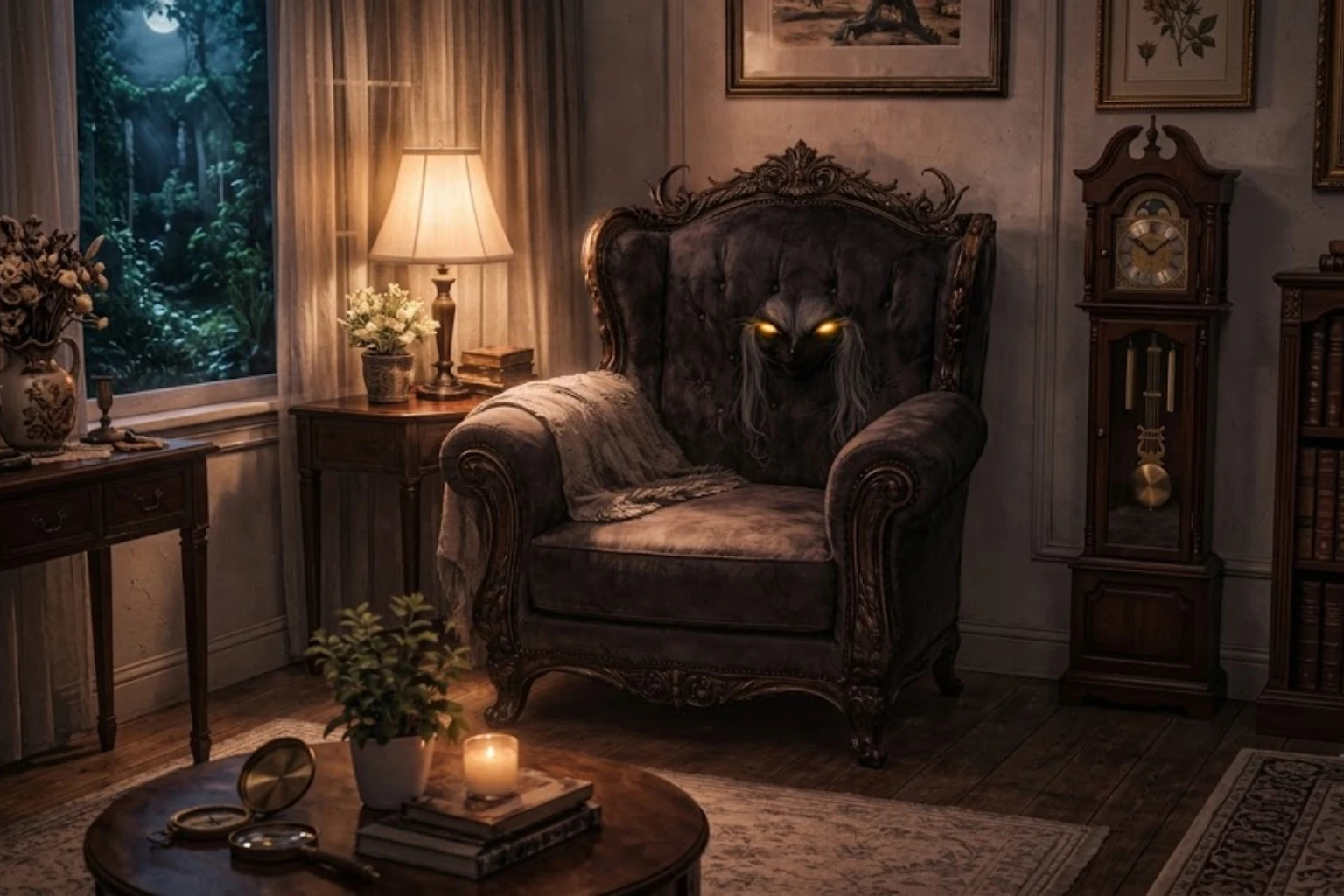
The armchair was in the corner of the sitting room, angled toward both the window and the small television her grandmother had watched in the evenings. Large, dark, upholstered in a fabric that had once been a color Natsuki couldn't quite determine — not quite purple, not quite grey, something between that had faded further toward between over decades of use. The carved wooden frame had the flourishes of furniture made in an era that believed in flourishes, and the cushions had the depression of a specific person's specific weight, decades of evenings pressed into the foam.
It had been her grandmother's chair.
Natsuki did not sit in it.
Not at first. Not for the first two weeks. She sat on the sofa across from it, eating the meals she made in the kitchen she was slowly learning, watching the television her grandmother had watched, and the chair was simply there — present, occupied in the way that furniture was occupied, full of the history of its use.
She told herself this was why she didn't sit in it.
The first thing she noticed was the weight.
Not of the chair — she hadn't touched it yet. The weight of the room when she was in it. A quality of the air that was different from the other rooms, not heavier exactly but more present, as if the sitting room contained slightly more of something than rooms usually contained.
She noticed it at the end of the second week, sitting on the sofa with a book at eleven in the evening, the lamp on, the window showing the dark garden beyond the glass. She looked up from the page for no reason — the kind of looking up that happened when something at the edge of perception shifted, when the background changed in a way the foreground hadn't registered yet.
The room was the same.
The chair was the same.
She looked at it for a moment — at the carved frame, the faded upholstery, the depression in the cushion — and then looked back at her book.
She did not think about it again until the following night, when she looked up again, from the same sofa, at the same hour, and had the same sense of the room being more present than rooms usually were, and this time she held the feeling longer before dismissing it.
The chair, in the lamplight, had a quality she couldn't name.
Not threatening. Not wrong. Just — attended to. The quality of something that was being looked at from the inside.
She went to bed.
She did not think about this in the morning.
By the third week she had settled into a rhythm — mornings for sorting, afternoons for errands and the practical business of a house that needed things a house needed, evenings for the sitting room, the sofa, the television her grandmother had watched, and later, always later than she meant to stay up, a book by lamplight.
The sorting was slow because she kept stopping to hold things.
She had labeled two boxes on the kitchen counter, in marker, in her own decisive handwriting: KEEP and DONATE OR DISCARD. The DONATE OR DISCARD box filled slower than she expected. She would pick something up — a wooden spoon worn thin on one side, a chipped saucer, a folded tablecloth yellowed at its creases — turn it over, and find that she could not locate a reason to put it in the box that felt stronger than the reason not to.
She called her mother in the second week to ask about a set of lacquered trays she didn't recognize.
"Trays," her mother repeated, on the phone, with the particular flatness of someone summoning a memory she hadn't expected to need. "Red ones? With the gold edge?"
"Yes."
"Those were for New Year's. She only used them once a year." A pause. "You can get rid of those. Nobody's used them since I was a child."
"They're beautiful, though."
"They're a lot of work to keep beautiful," her mother said. "That was the whole problem with your grandmother's house, if you want my opinion. Too many things that were beautiful and required upkeep nobody asked for."
Natsuki turned one of the trays over in her hand. The lacquer had a depth to it, layers built up over years, the kind of finish that could not be achieved quickly.
"I'll keep them," she said.
Her mother made a small sound that was not quite disagreement.
"You sound like her," she said. "That's all."
Natsuki didn't ask what she meant. She put the trays in the KEEP box, wrapped in the yellowed tablecloth, and went back to sorting.
The teacup was in the third week.
She had been clearing the kitchen — not aggressively, not with the energy of someone dismantling, but the slow, careful sorting of someone learning what was worth keeping. Most things were worth keeping. Some things were not. The distinction required handling each object, which she had come to understand was the point of her grandmother's instruction: take your time.
The teacup was at the back of the cabinet. Small, pale blue, cracked along the side in a line that ran from the rim nearly to the base — not a clean break, not two pieces, but a crack that had been there long enough that the edges had smoothed and the crack itself had become part of the cup's character. It held nothing. It could hold nothing — anything poured into it would find the crack immediately.
She turned it over in her hands.
No maker's mark she recognized. Old. The blue of it was the specific faded blue of things that had been washed many times in water that was slightly too hot.
She thought, briefly, of asking her mother about it, and then didn't, because she suspected the answer would be get rid of it, it's cracked, it's useless and she did not want to hear that yet.
She put it in the box she had labeled donate or discard.
She finished sorting the cabinet — a set of mismatched chopsticks she kept, a stack of paper napkins gone brittle with age she didn't, three teapots when one would do, of which she kept two because she could not decide between them. She made dinner. She watched television from the sofa with the sitting room's particular weight around her, and at some point in the evening, without deciding to, she found herself looking at the chair instead of the screen. She watched it the way you watched something you expected to move.
It did not move.
She went to bed.
In the morning the teacup was on the kitchen windowsill.
She stood in the kitchen doorway and looked at it.
She was certain — she held the certainty carefully, examined it, looked for the gap in it — that she had put it in the box. She had held it and decided and placed it in the box and continued sorting. She was certain of this.
The box was on the counter where she had left it. She looked inside it. The teacup was not there. She checked the other items in the box, lifting the napkins, feeling along the bottom, as though the cup might have shifted itself downward through some ordinary mechanical process. It had not. It was not there.
It was on the windowsill, in the morning light, the crack visible along its side, the faded blue catching the sun, positioned — she noticed this only after several seconds — exactly where the light would fall on it first, at that hour, from that angle.
She picked it up.
She turned it over again in her hands.
She thought about what her grandmother had kept and why, about the difference between broken and finished, about objects that had been touched by the same hands every morning for decades until the morning they hadn't been.
She thought, too, of something her grandmother had said once, years ago, that she had not thought of in a long time and that surfaced now with the particular clarity of a memory returning intact.
Natsuki had been perhaps nine, staying over during a school holiday, and had asked — the way children asked things, without tact, pointing at a chipped bowl her grandmother nonetheless used every day — why she didn't just buy a new one.
Her grandmother had been at the stove. She hadn't turned around.
"A new bowl doesn't know anything yet," she'd said. "This one knows how I like my rice. Give it forty years and your bowls will know things too. That's not a reason to throw them away. That's the whole reason to keep them."
Natsuki, at nine, had accepted this the way children accepted most adult logic — as slightly strange but not worth arguing with. She had not thought of it again until this moment, standing in the kitchen doorway at thirty-two, holding a cracked cup that had moved itself in the night.
She opened the cabinet and put the teacup back where she had found it.
She did not put it in the box again.
She called her mother that afternoon.
Not about the teacup — she wasn't ready to describe the teacup to anyone, wasn't sure yet what words she would use — but about the house in general, the practical questions of what to do with fifty-three years of accumulated living, the decisions that needed to be made. Her mother had opinions about most things and offered them freely, which was normally something Natsuki found exhausting and which she found, in this context, grounding.
"The furniture," her mother said. "Most of it can go. The table is nice — keep the table, it's good wood, they don't make tables like that anymore. The bookcase, keep, obviously. But the rest — there are services that come and take everything, very efficient, you don't have to deal with it piece by piece."
"What about the armchair?" Natsuki said.
A pause.
"Which armchair?"
"The one in the sitting room. The big dark one, by the window."
Another pause, shorter, but Natsuki heard something shift in it.
"Get rid of it," her mother said. "It's old. It's worn. There's no reason to keep it."
"It was her chair," Natsuki said.
"It was a chair she sat in," her mother said. "That's not the same as a reason to keep it."
Her voice had a flatness Natsuki recognized — the specific flatness her mother used when discussing her own mother's house, a flatness that suggested history rather than indifference.
"You don't like that chair," Natsuki said. Not a question.
There was a longer silence this time, long enough that Natsuki checked whether the call had dropped.
"I sat in that chair exactly once," her mother said finally, "when I was seventeen, and your grandmother came into the room and told me, very calmly, to get up. Not angrily. Just — get up. Like I'd sat somewhere I had no business sitting. I never sat in it again. I don't think anyone did, except her." A breath. "It's a chair, Natsuki. It's an old, worn chair that took up a corner of that room for longer than you've been alive. Get rid of it."
"I don't think I'm going to," Natsuki said.
"Of course you're not," her mother said, and there was something in it that was almost, but not quite, amusement.
They talked a little longer about the trays, about a leak in the bathroom ceiling that needed a plumber, about whether Natsuki was eating properly, and then the call ended the way their calls usually ended, with her mother saying she had to go, and Natsuki saying she'd call again soon.
After the call Natsuki sat on the sofa and looked at the chair for a long time.
I sat in that chair exactly once.
She wondered, not for the first time, what her grandmother had been like at the age her mother had been seventeen — thirty-eight, maybe, the children not yet grown, the house not yet fully hers in whatever sense a house became fully someone's. She wondered whether the chair had already been the chair by then, already occupied by whatever it was occupied by, or whether that had come later, accumulated the way the smoothness of the dining table had accumulated, degree by degree, evening by evening.
She had no intention of getting rid of it.
She wasn't sure when she had decided this. She thought about it and could not locate the decision — could not find the moment where she had gone from I should sort through everything to the chair stays. It had simply become true at some point, the way certain things became true without announcement.
The room was very quiet.
She looked at the chair.
The chair was just a chair.
She went to make tea.
June moved slowly and then, the way months did, all at once. She finished the kitchen. She finished the linen closet, which held nothing more remarkable than linens, though she kept all of them anyway, unable to locate an argument for discarding cloth her grandmother had folded so precisely. She started on the second bedroom, which had been her mother's as a child and then, later, a room for guests who rarely came, and which held boxes she had not yet opened.
She found, in one of those boxes, a stack of letters tied with string — not romantic, as far as she could tell from the ones she allowed herself to read, but ordinary correspondence between her grandmother and a sister who had moved to Hokkaido decades ago and whom Natsuki had met perhaps three times in her life.
The letters were mundane in the way real letters were mundane — weather, health, complaints about neighbors, a running disagreement about a recipe for pickled plums that spanned at least four letters and was never resolved to either woman's satisfaction.
Natsuki read twelve of them in one sitting, on the floor of the guest room, and felt something in her chest that she recognized, after a while, as a specific kind of grief — not the grief of the funeral, which had been sharp and finished its business quickly, but a slower grief, the grief of getting to know someone in more detail after they were no longer available to ask follow-up questions.
She kept the letters. She didn't need to deliberate.
It was around this time — she could not afterward locate the precise date, only the general period, the turning of June toward July — that the small things began.
A book she had left on the coffee table, its place marked with a receipt, found the following evening moved to the side table by the lamp, the receipt still in place, the book's position more sensible than where she'd left it, closer to the light.
The candle on the coffee table — a plain white candle in a plain dish, unlit since she'd moved in, decorative more than functional — with a soft collar of dripped wax at its base one morning, as though it had burned partway down and been allowed to go out on its own.
The curtains in the sitting room, left open before bed on a night she specifically remembered leaving them open because she'd wanted to see the moon, found closed in the morning, drawn with a neatness she associated with intention rather than accident.
None of it alarmed her. She noted these things the way she'd note a draft, or a floorboard that creaked in a particular spot — details of a house, filed for later consideration, not urgent enough to interrupt whatever she was doing.
She did not say the word for what she was thinking, mostly because she did not yet have the word.
She had grown up with her grandmother's stories — the quiet ones, told in this very sitting room in the evenings when Natsuki was young enough to be sent to bed afterward and old enough to remember them clearly. Stories about houses and what lived in them. About objects and what they kept. About the difference between a house that was empty and a house that was simply quiet.
She remembered one in particular, more clearly than the others, because her grandmother had told it while sitting in that same chair, Natsuki cross-legged on the floor in front of her, perhaps ten years old, the television off, only the lamp on.
"There was a woman," her grandmother had said, "who lived alone in a very old house, much older than this one, and she used the same kettle every single day for forty years. And when she died, her daughter wanted to throw the kettle away, because it was dented and the handle was loose, and there were newer kettles, better kettles. But the neighbor — an old woman who had lived next door the whole time — told her, don't throw that away. That kettle isn't just a kettle anymore.
It's been filled with the same hands so many times that something has moved in. Something has made a home in it. If you throw it away, you're not just losing a kettle. You're putting something out of its house."
Ten-year-old Natsuki had asked, "What happens if you throw it away anyway?"
Her grandmother had smiled — Natsuki remembered the smile specifically, small and a little private. "Nothing happens to you," she'd said. "But something happens to it. It has to go somewhere, and it doesn't get to choose where, not anymore, because you took its choosing away." She'd reached over and touched the arm of the very chair she was sitting in, an absent gesture, the kind you made toward something you'd stopped noticing you were touching. "Better to just let old things stay old, when they've been good to you. That's all the story means. Now go to bed."
Natsuki had filed this, at ten, in the category of things that were beautiful without being literal — true in the way of all good stories, without being true in the way of facts.
She was thirty-two now, sitting on the same sofa in the same room, and she was filing different things in different categories.
She looked up the term in late June, on a night when the curtain thing had happened for the third time and she had run out of ordinary explanations that satisfied her.
Not ghost — that wasn't the right category, and she had known it wasn't the right category since the second week, since before she'd have admitted to having a category at all. Ghosts, as she understood the idea, were about people, about unfinished business, about a specific human consciousness lingering past its welcome.
This didn't feel like that. It didn't feel like anyone at all, exactly. It felt like something that had always been slightly separate from any single person who lived here, something that had simply been present in the house the way damp was present in a house near a river, something that attached itself to certain objects the way moss attached itself to certain stones and not others.
Domestic spirit brought her to folklore databases and ethnographic records, academic papers with titles too dry for what she was actually feeling, until she found, in one paper, footnoted almost as an aside, a specific term that she read three times before closing the laptop.
In-Dweller.
She opened the laptop again the next night and read further, more carefully this time, with the part of her mind that assessed information for credibility before accepting it — the same part of her that had gotten her through university, that she trusted more than the part of her that was, if she was honest, a little frightened.
The folklore was old. Multiple sources, different regions, a consistent core beneath the regional variation: an entity that inhabited objects, specifically objects of long domestic use — chairs, kettles, cups, the worn places in a house where the same hands returned again and again over years.
An entity that was possessive of its chosen form, though possessive in these accounts did not mean hostile — more territorial in the way an animal was territorial of a den, invested rather than aggressive. An entity that observed, that arranged, that occasionally moved small things as if tidying, or as if simply asserting a continued presence in a space it considered its own. An entity that, during certain seasons — the long light of summer, the accumulated heat of the year — became more active. More felt.
Nothing in any of the accounts described danger. Nothing described malice. The closest anything came to a warning was a repeated, almost formulaic caution: do not discard what it has chosen. Not because harm would come to the person who discarded it — the sources were vague and inconsistent on what, if anything, happened to a person who did — but because something would be lost that could not, by its nature, be replaced. A continuity broken. A home undone from the inside without the house itself ever knowing it had happened.
She closed the laptop.
She sat in the sitting room, in the lamplight, with the chair across from her, and let the information settle the way food settled after a large meal — slowly, with a faint discomfort that wasn't quite pain.
She did not feel afraid, exactly. She felt observed in a new way — not more observed than she had felt for weeks already, but observed with the knowledge, now, that she was being observed, which was a different thing entirely. It was the difference between suspecting someone was in the room with your eyes closed and opening them to confirm it.
She thought about the teacup on the windowsill.
She thought about her mother, seventeen, being told to get up from a chair, calmly, without explanation.
She thought: she knew. My grandmother knew, the whole time, and she never told anyone directly. She only ever told it as a story, and let people decide for themselves whether it was a story.
She did not sleep well that night, not from fear but from the particular restlessness of a mind that had been given new information and had not yet finished rearranging itself around it.
The knowledge did not resolve anything. She had expected, in some unexamined way, that finding the term would settle the matter — that a name would function like a diagnosis, converting an unsettled feeling into a manageable fact. It did the opposite. Once she had the word, she began noticing evidence for it everywhere, the way a new vocabulary word appeared suddenly in every book you picked up afterward.
She started testing, cautiously, the way a scientist tested a hypothesis she was reluctant to confirm.
She left a spoon in a deliberately wrong place in the kitchen drawer — not where it belonged by her grandmother's system, which she had mostly reconstructed by now, but in the gap reserved for something else entirely. She found it returned to its correct place two mornings later, not immediately, as if whatever had done it had noticed the error but had not been in a hurry to correct her.
She left the curtains open on three consecutive nights, specifically to see whether the closing was reliable or coincidental. They were closed on two of the three mornings. On the third, they remained open — and it was only later, reviewing the week in her mind, that she realized that had been the one night she'd forgotten to turn off the lamp before bed, so perhaps the room had simply not needed the same attention.
She did not test the chair. She understood, without deciding to understand it, that the chair was different in kind from the spoon and the curtains — that those were the edges of the presence, the places it touched incidentally, and the chair was its center, and testing the center felt like a different order of transgression than testing the edges.
She called her mother again in the first week of July, not with any plan to discuss the In-Dweller specifically — she still did not have language for that conversation, and suspected she might never have it, not with her mother — but the conversation moved there anyway, sideways, the way conversations about a shared house tended to.
"I found the letters," Natsuki said. "The ones from Great-Aunt Michiko. In the guest room."
"Oh," her mother said, and there was a warmth in the single syllable that surprised Natsuki. "She kept those? I didn't know she kept those."
"Twenty years of them, at least. Maybe more. Arguing about pickled plums."
Her mother laughed — a real laugh, short and unguarded, the kind Natsuki didn't hear from her often. "God, that argument. I remember that argument going on my entire childhood. Neither of them would ever admit the other one's recipe was better." A pause. "She kept everything, your grandmother. I used to find that maddening. I thought it meant she couldn't let go of anything. I'm starting to think it meant something else."
"What do you think it meant?"
Her mother was quiet for a moment.
"I think it meant she paid attention," she said finally. "To what mattered and what didn't. She wasn't sentimental about everything — God, no, she threw out plenty. But what she kept, she kept on purpose. I didn't always understand the purpose. I'm not sure I understand it now. But I don't think it was carelessness, if that's what you were asking."
"I wasn't sure what I was asking," Natsuki admitted.
"No," her mother said. "I don't suppose you were."
There was a silence that was, for once, comfortable rather than strained.
"How's the chair?" her mother asked, and there was something careful in the question, something that told Natsuki her mother had been thinking about the earlier conversation as much as she had.
"Still there," Natsuki said. "I haven't sat in it."
"But you're going to."
It wasn't a question, and Natsuki didn't treat it as one.
"I think so," she said. "Eventually."
"Take your time with it," her mother said, and Natsuki went very still, because those were the words from the will, the exact words, and she did not think her mother had used them accidentally.
"That's what she wrote," Natsuki said. "In the will."
"I know," her mother said. "I was there when the lawyer read it. I've had those words in my head for three months too, Natsuki. I just haven't known what to do with them any better than you have."
They talked a little longer, about ordinary things, and when the call ended Natsuki sat in the kitchen with her phone in her hand for a long time before she went back to the sitting room.
The summer went on. She finished sorting the guest room. She started, tentatively, on her grandmother's own bedroom, which she had been avoiding since May, and found it, when she finally opened herself to it, less difficult than she'd feared — full of the ordinary effects of an ordinary life, clothes she folded and set aside for donation without much internal argument, a jewelry box whose contents she catalogued carefully and kept entirely, a nightstand drawer with reading glasses and a rosary and a folded photograph of a man Natsuki recognized, after a moment, as her grandfather, young, smiling at whoever was holding the camera.
The garden, too, asked for attention, and she gave it what she could — weeding, mostly, and the rescue of a few plants that had gone leggy with neglect, and the discovery, halfway through July, of a small stone marker near the back fence that she initially mistook for decorative and then realized, examining it, was a grave — a cat's grave, the name worn nearly illegible, a date that put it decades in the past.
She left flowers there without entirely knowing why, and felt, doing it, the same quality of attention she'd noticed in the sitting room — not directed at her, exactly, but present, as if the gesture had been witnessed and approved of.
The incidents in the house continued, spaced now closely enough that she stopped being surprised by them and started, instead, to feel something closer to familiarity. A drawer that stuck, unstuck. A window that had been painted shut in one of the upstairs rooms, found cracked open on a hot night when she hadn't touched it. The teacup, twice more, moved from the cabinet to the windowsill and back to the cabinet by the time she next opened it, as though it took its walks and returned home on its own schedule.
She began to think of the house less as a space she was clearing and more as a space she was being introduced to — carefully, at a pace not entirely her own.
She did not go into the sitting room every night with the intention of looking at the chair, but she often ended up looking at it anyway, the way your eyes returned, without instruction, to a person across a room you were trying not to stare at.
She sat in it for the first time on a Thursday evening in July.
Not impulsively — she had been moving toward it for weeks, had been aware of the moving toward it without acknowledging it, had been circling the decision the way you circled something you weren't ready for but knew you were going to do eventually. She had made tea. She had turned on the lamp. She had, for reasons she didn't examine too closely, put on the cardigan she usually wore only when it was cold, though the evening was warm — a kind of readiness that had nothing to do with temperature.
She stood in front of the chair for a moment.
Then she sat down.
The chair received her the way old chairs received people — with the accumulated memory of every person who had sat in it before, the cushion shaped by decades of a specific weight that was not her weight, the armrests worn at the exact height of her grandmother's arms, which were shorter than Natsuki's. She fit into it imperfectly, the shape of it tuned to someone else, and this imperfection was specific and informative, and she sat with it rather than adjusting against it.
The room looked different from this angle.
She had known it would. She had been looking at this chair from the sofa for two months, and now she was inside it looking back at the sofa, and the room had rearranged itself around the new perspective — the window was to her left now, the television slightly to her right, the bookcase straight ahead, the coffee table closer than she'd expected, close enough to reach without leaning.
The lamp was at her right shoulder.
The warmth of it was on the right side of her face, and she understood, sitting here, exactly why the lamp had always been positioned where it was — not centrally, not for even light across the room, but specifically for this chair, for this angle, for someone reading or watching television from exactly this position for exactly this many years.
She understood, sitting in this chair in this light, how her grandmother had spent her evenings. The specific quality of the view. The warmth. The window with the garden beyond it, dark now, the outline of the fence just visible, the place where the cat was buried somewhere out past what she could see.
She put her hands on the armrests.
The wood beneath her fingers was smooth in a way that had nothing to do with polish and everything to do with contact — decades of hands resting exactly here, in exactly this place, wearing the grain down to a softness no varnish could replicate.
The room was very quiet.
And then — not dramatically, not as a sound or a movement or anything she could have described afterward to anyone who asked — she understood that she was not alone in the chair.
Not that something was sitting with her, crowding her, sharing the physical space in any way she could have pointed to. Not that she was being held or touched or affected in any way she could name. Simply that the chair was occupied in a way that extended beyond her own occupation of it. That the warmth she felt was not only the lamp.
That the presence she had been feeling since the second week, the weight in the room, the attention, was not ambient and general but specific and close, gathered here, in this chair, around her, the way water gathered in the lowest part of a room during a flood — not arriving, exactly, because it had already been here. Simply becoming apparent, now that she was sitting where it lived.
She sat very still.
She did not know how she communicated that she was not going to be a problem — there were no words for it, and she suspected words would have been the wrong tool even if she'd had them. She simply sat in the chair and did not move and did not reach for the lamp or the television or her tea, and let whatever assessment was happening happen, the way you let a strange animal approach you by staying still and looking somewhere other than directly at it.
She thought, without deciding to think it: I'm not here to take anything from you. I'm here because she wanted me to be here, and I think you know that, and I think you've known it since May.
She did not say this aloud. She was not sure it needed saying.
Eventually — she could not have said how long, only that the tea beside her had gone from steaming to merely warm — the quality of the room shifted slightly, the way a room shifted when something in it relaxed. The weight did not leave. It simply changed in character, the way a hand on your shoulder changed in character between a hand that was restraining you and a hand that was simply resting there.
She exhaled, and realized only in the exhaling that she had been holding her breath for some time without noticing.
She sat in her grandmother's chair, in her grandmother's house, for a long time after that — long enough that the tea went fully cold, long enough that the garden outside the window disappeared entirely into full dark, long enough that her own thoughts slowed and quieted in a way they had not quieted in the three months since the funeral.
She thought about her grandmother at thirty-one, moving in with two small children and a husband who would not, in the end, stay as long as the house did. She thought about her at fifty, at seventy, at eighty-four, in this same chair, in this same light, watching this same garden go dark night after night for fifty-three years. She thought about what it meant to be witnessed like that, consistently, by something that never needed to be told what you liked, something that simply learned it, the way water learned the shape of a container by filling it.
She thought: take your time with it.
She thought she finally understood what that meant, and the understanding did not arrive as a sentence she could have written down. It arrived the way the warmth of the lamp had arrived, as something felt on one side of her face, undeniable and wordless.
She called her mother the following afternoon, sitting at the kitchen table rather than the sofa, the phone warm against her ear in the July heat.
"I'm keeping the chair," she said.
A pause, shorter than she expected.
"Natsuki—"
"I'm keeping it," she said. "And I'm keeping the house. I'm not selling."
Her mother was quiet for a moment — not the flat quiet of disapproval, Natsuki realized, but a different kind, one she didn't have a name for yet.
"It's an old house," her mother said finally. "It needs work. The roof, for one thing, and that leak in the bathroom isn't going to fix itself. It's going to cost you—"
"I know."
"And you'd have to give up your apartment. Your job's an hour from here, at least, maybe more with the way traffic's gotten—"
"I know," Natsuki said again, and let the silence after it do the rest of the arguing for her.
Her mother was quiet for longer this time.
"Your grandmother wanted you to have it," she said at last. Not conceding — acknowledging, the way you acknowledged weather, or a fact too large to argue with. "She said to take your time."
"I think," Natsuki said, looking through the kitchen doorway toward the sitting room, where the chair sat in its corner, waiting for evening the way it had waited for fifty-three years of evenings, "I think I understand what she meant now."
Her mother said nothing for a moment.
"You sat in it," she said. Not a question.
"Yes."
"And?"
Natsuki thought about how to answer this — about the presence, the weight, the sense of a hand resting rather than restraining, the years of evenings folded into a single chair like light folded into a single lens.
"And I understand why she didn't want you sitting in it at seventeen," she said finally. "It wasn't about you. I don't think it was ever about you."
Her mother exhaled — not quite a laugh, not quite a sigh, something between, the sound of a much older question finally being set down.
"Alright," she said.
Natsuki made tea that evening — properly, the way she had learned that summer, the small pan for rice, the large one that remembered vegetables it had cooked a thousand times before she ever touched it. She brought her tea to the sitting room and sat, without hesitation this time, in the chair.
The house settled around her — the creak of old wood, the particular sound of a structure that had been inhabited for fifty-three years and knew how to be inhabited, the quality of a space that was not empty and had not been empty and was not going to be empty, whatever she eventually decided to do with the rest of her life.
She drank her tea.
The lamp was warm on the right side of her face.
Outside the window the garden was dark and still, and the summer night was long, and the house held everything it had always held, quietly, the way houses did when something in them had decided that what was here was worth keeping.
She finished her tea.
She stayed in the chair until the candle on the coffee table burned low, the wax gathering at its base in a soft collar, the flame guttering gently in air that hadn't moved.
She did not light it herself.


.png)
.png)
.png)