%20(1).png)
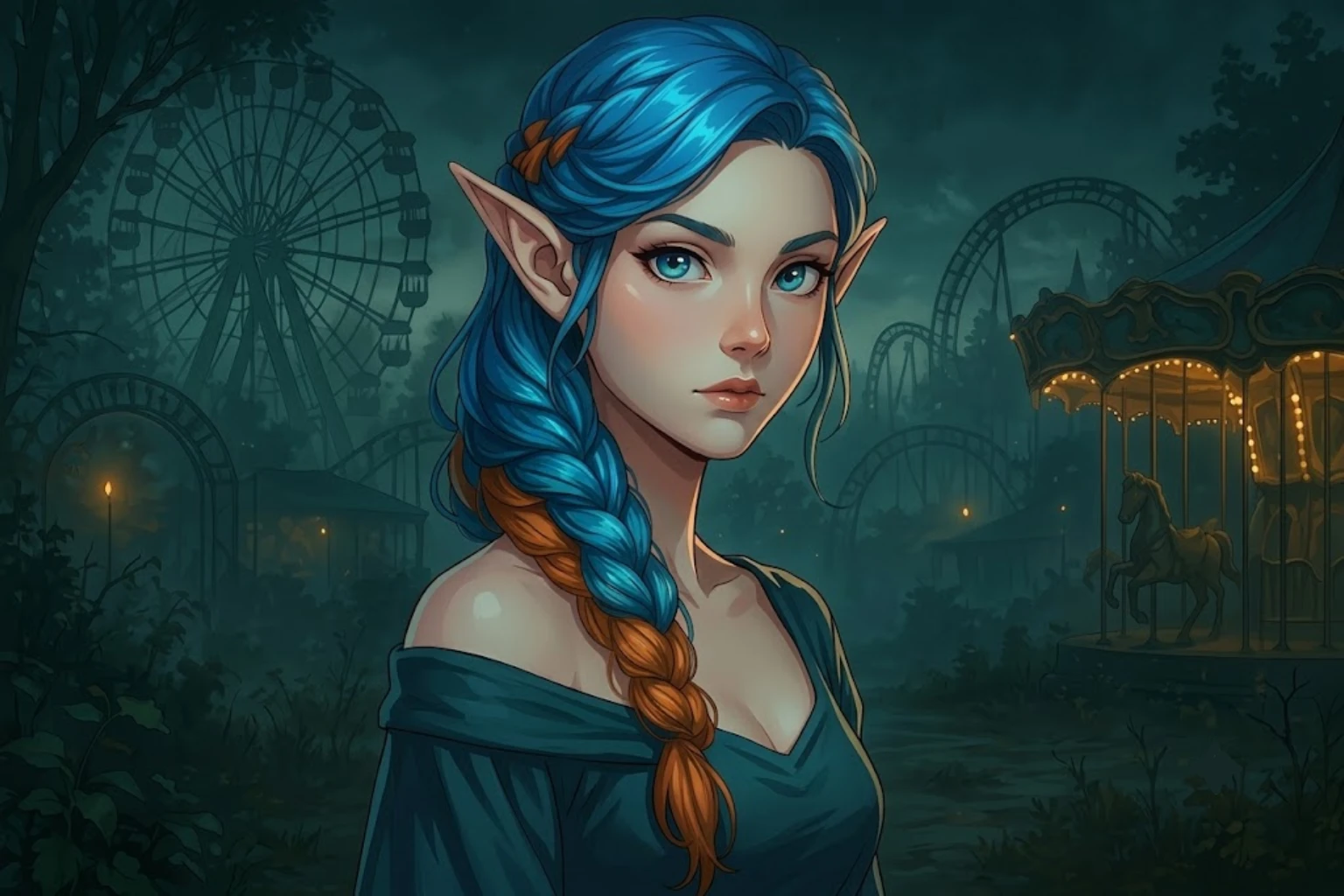
The road had not been on his original route. That was the first truth. The second was that he had not been paying enough attention to know exactly when he had left it.
By the time he noticed, the main highway had already narrowed into a quieter two-lane stretch bordered by scrub, low fencing, and the occasional dead sign half-swallowed by weeds. The last cluster of lights he remembered passing lay somewhere behind him now, miles back at least, and the dark ahead had settled into that strange kind of open-country night where distance stopped behaving normally. Objects appeared farther away than they were, then, without warning, suddenly close enough to touch.
He should have turned around sooner. He knew that. But there had been something numb and mechanical in the way he kept driving, hands loose on the wheel, thoughts moving in circles too familiar to deserve another lap around his mind. The radio had lost its station twenty minutes earlier. He had shut it off instead of trying to find another. Since then, the sound in the car had been limited to engine hum, occasional gravel spit beneath the tires, and the soft rattle of something in the passenger-side door he kept meaning to fix.
He drove because driving was movement, and movement felt better than sitting still with the things he was trying not to think about. Only later would he realize that was probably why he missed the turn.
The pavement thinned until it no longer felt like a maintained road so much as an agreement between tire tracks. Then it gave way to gravel without warning. His headlights washed over pale stone, dust, and a crooked post with no sign attached to it. He slowed automatically, leaning forward slightly, as if a better posture would make the road make more sense. It did not. He should have stopped there. Instead, he rolled on.
The gravel lane bent left around a line of neglected trees, then straightened. Something massive emerged in the distance—not all at once, but piece by piece, as the headlights found it. First thin bars of metal. Then a curve. Then a full ring against the dark.
A Ferris wheel.
He took his foot off the gas. The car crawled forward another twenty feet before he finally braked and brought it to a stop. The engine idled, headlights holding steady on the open stretch ahead, where the Ferris wheel stood motionless beyond a scatter of lower shapes he could not yet make out clearly. He stayed in the driver's seat with both hands on the wheel, doing nothing at all for a few seconds. Then he looked at the dashboard clock, as if the time would explain why there was an abandoned carnival sitting off a road he had never meant to take.
11:42. That told him nothing.
He shut off the engine. The sudden quiet pressed in so quickly it felt physical—not complete silence, there was a thread of wind somewhere, maybe moving through wire or dry leaves, but close enough that his own breathing seemed louder than it should have. He took the keys from the ignition. The metal clicked faintly in his hand. Still he did not move.
The Ferris wheel waited outside his windshield, huge and still, dark against the darker sky. Around it, more shapes began to separate from the night as his eyes adjusted: a ticket booth, strung poles, low awnings sagging over nothing, a game stall with its painted face mostly gone, the ghost-outline of a carousel roof farther in.
He had seen abandoned places before—empty gas stations, derelict farmhouses, strip malls with their signs removed and their windows papered over from the inside. They all carried the same feeling: absence, human use torn out of them so completely that all that remained was function without purpose. This place didn't feel absent. It felt paused. That was different.
He exhaled slowly, opened the door, and stepped out. The night air met him with a chill too soft to call cold. Gravel shifted beneath his shoes. Behind him, the cooling engine ticked once, then again. He closed the door without slamming it.
The carnival sat just beyond the reach of the headlights, close enough now to be unmistakable. The Ferris wheel rose above everything else, its frame streaked with rust but structurally whole—no missing cars, no bent supports, no evidence of collapse. Below it, the smaller rides and stalls stood in place with an almost stubborn intactness, as if deterioration had started everywhere at once and then grown bored before it could finish.
He took a few steps forward. The entrance was marked by two leaning posts and a sagging crossbeam with half its lettering peeled away; he could make out only the last few painted characters, nothing useful. The boards underfoot were warped and pale with age, grass pushing through the cracks near the edges. To his left stood an old ticket booth with clouded windows and a brass rail turned green at the joints. No lock. No chain. No warning signs.
He told himself he was just looking, that he would walk to the entrance, confirm that it was exactly what it appeared to be, then get back in the car and leave before he drifted any farther from roads that belonged on maps. He believed that right up until he saw her.
She stood beside the ticket booth with one hand resting lightly on the counter edge, as if she had been there long enough for stillness to become comfortable. He had no idea how he had missed her before. She was not hidden, not dressed to blend into the dark. She was simply present in a way that seemed to settle the space around her instead of drawing attention to itself.
He stopped. For a moment his brain did what brains do when reality presents an inconvenient addition: it looked for a normal explanation. Maybe she had pulled up while he sat in the car. Maybe there was another road in. Maybe this place was not abandoned after all, just maintained badly and operating under some niche, midnight-only logic he was too tired to understand. But none of those explanations held—not because they were impossible, but because they felt unnecessary.
She looked at him without surprise, and without suspicion either. If anything, her expression suggested mild recognition—not recognition of him specifically, but of the type of person who arrived here by accident and needed a second to decide whether accident was the right word.
"Didn't expect anyone out here," he said. His own voice sounded flat in the open air.
She tilted her head a fraction, considering him. "Most people don't."
It was the kind of reply that should have registered as strange. Instead it slid into the night as naturally as the wind.
He glanced past her into the carnival grounds. Nothing moved. No lights. No music. The same still, dim quiet he had seen from the car.
"Is this place even open?" he asked, half-aware of how stupid the question sounded the moment it left his mouth.
She followed his glance, then looked back at him. "Do you want it to be?"
He almost laughed, but something in her tone stopped him. Not seriousness, not threat—just a complete lack of performance. She was not teasing him. She had asked the question as if the answer mattered structurally, not socially.
He shifted his weight. "I don't know what this place is."
"That isn't necessary."
The answer landed more softly than it should have. There was a pause, not uncomfortable, just suspended. Then she lifted one hand and gestured inward, past the ticket booth and into the dark.
"Want to take a ride?"
No smile. No pitch. No insistence. Just an offer so cleanly given that refusing it would have felt more deliberate than accepting it.
He looked past her again. The Ferris wheel stood dark in the distance. The carousel roof sat still beneath its canopy. The midway stretched into shadow between rows of silent booths and shuttered stalls. Nothing about the place suggested motion, power, or life. Everything about it suggested he should leave.
Instead he took one step forward. The boards creaked beneath his shoe. He took another. And somewhere between that step and the next, the world slipped.
He would later try to describe it in several ways and fail each time—a pressure behind the eyes, a brief imbalance in the ears, the sensation of opening your eyes underwater for half a second and finding that the world had thickness now. None of it was exact. All of it was close.
He blinked. The air had changed. Not temperature—something subtler. The outside air had carried emptiness in it, wide open and dry. This air felt shaped, held, like it belonged to walls he could not see.
He turned his head. The boards beneath his feet no longer looked warped; the cracks between them were narrower now, cleaner. The paint on the old posts beside him had not returned fully, but it was brighter, less flayed by time. The brass rail on the ticket booth caught a warm point of light.
He frowned and looked up. Lanterns—not electric bulbs sputtering on half-power, but lanterns, glass-shielded and softly golden, hung overhead along strings and poles that, moments before, he would have sworn were bare. Their light spread across the midway in overlapping pools that made every surface ahead feel warmer, nearer, more complete.
Somewhere deeper in the grounds, music drifted into the air. Not loud enough to identify—organ tones, maybe, something old-fashioned, slowed by distance and softened by movement.
He turned toward the Ferris wheel. It was moving. Slowly. Smoothly. No groan of rusted gears, no stutter—each gondola rose and descended with impossible steadiness, the rim lit by small bulbs that traced the circle in patient, honey-colored light.
His mouth parted slightly before he could stop it. "What—"
He looked back toward the entrance. And that was his first mistake, because the entrance was still there. He could see the place he had stepped through, at least he thought he could—the angle of the path, the posts, the suggestion of dark beyond it. But something about the distance felt wrong. Not farther. Not nearer. Just not behaving.
Before he could examine that feeling, she moved. Again, he had not seen her begin; she was simply several steps ahead now, on the midway proper, one hand trailing lightly along the rail of a game stall as if reacquainting herself with something familiar.
He stared after her. The carnival extended beyond her in impossible completeness. Painted signs hung whole above booths that had been rotted moments earlier. Plush prizes sat untouched on shelves. Glass bottles gleamed in neat pyramids beneath rings waiting to be thrown. A carousel turned in the distance with its mirrors uncracked and its horses lifting and falling in elegant silence.
Nothing felt newly restored. That was the unsettling part. It did not feel repaired. It felt as if the ruin he had first seen was the temporary condition, and this was the truer form beneath it.
She glanced back over her shoulder—not to make sure he was impressed, not to see if he was frightened, just to check whether he was still following.
"See?" she said.
It was not triumph. It was not mystery. It was the tone you used when showing someone something simple they would have understood earlier if they had only looked properly.
He took another step, and another. The lights warmed his face. The music threaded more clearly through the air. Somewhere ahead, something creaked in a steady, rhythmic way that did not suggest disrepair, only age.
He should have turned around then, should have gone back through the entrance, however it worked, while the road, the car, and the shape of ordinary night still belonged to him in a way he could trust. Instead he kept walking. Because nothing inside him was afraid yet. Because the place did not feel hostile. Because a part of him, deeper than caution and quieter than reason, had already begun to understand what made the carnival dangerous.
It was not that it wanted him. It was that it fit around whatever in him had grown tired of leaving things behind. And for the first time in longer than he cared to measure, something in the world felt not merely interesting, but exact.
He let his hand brush the edge of a booth as he passed. The painted wood was smooth beneath his fingers, warm from the lantern light. A row of hanging paper stars turned slowly overhead, their shadows crossing one another on the ground. To his right, a row of empty benches curved around a fountain where dark water reflected points of gold. Beyond that, the Ferris wheel turned patiently against a sky that no longer seemed entirely connected to the one above the road.
He looked back one more time. The entrance remained where it had been, small and still, reachable. He told himself that noticing it mattered, that he could leave whenever he wanted. Then he faced forward again, and followed her deeper into the lights.
The deeper he went, the less the entrance felt like something behind him and more like something that had belonged to a different version of the night.
The midway stretched ahead in long, gently curving lines, as if the place had been designed not for efficiency, but for wandering. No straight paths. No direct routes. Everything invited drifting. She walked ahead without urgency, her pace unhurried in a way that suggested she had nowhere else to be, and no need to arrive anywhere at all. He followed—not because he had decided to, but because stopping would have required a decision.
A booth to his left caught his attention. Glass bottles stacked in perfect pyramids, their surfaces catching the lantern light and bending it into soft distortions. Rings lay scattered across the counter, their edges worn smooth from use that had clearly not happened in years, and yet they did not look unused. He slowed, reaching out without thinking, lifting one of the rings. It had weight to it. Real weight. He turned it in his fingers, then glanced toward the bottles again. The arrangement was flawless, not the kind of flawed perfection you saw in modern displays trying to imitate nostalgia. This felt like it had always been exactly this way.
"Go ahead," she said, without turning. "You can try."
"I don't have anything to trade," he replied.
"You already did."
That made him pause. He frowned slightly. "I didn't—"
But she had already moved on, her attention drifting toward the next stretch of the midway.
He stood there for a second longer, the ring still in his hand. Then, almost absently, he tossed it. The ring spun once, twice—and landed cleanly over the neck of a bottle. No wobble. No near miss. Perfect. There was no small victory in it, no satisfaction, just a quiet certainty that it had always been going to land that way.
He set the remaining rings down. "Lucky," he muttered. But the word didn't hold. Nothing here felt like luck.
He moved on. The sounds of the carnival began to separate as he walked. What had first been a single wash of distant music resolved into layers: a calliope somewhere near the carousel, a low mechanical rhythm beneath the Ferris wheel, the soft creak of moving parts that were not struggling, not failing, just existing in motion.
People should have been here. That was the thought that finally surfaced clearly. A place like this, lit, alive, running, should have been full of voices, movement, laughter, noise layered on noise until it became a kind of living thing. Instead there was only him. And her.
He glanced toward her again. She had stopped beside a different stall now, one lined with small prizes—wooden animals, painted figures, delicate things that looked handmade in a way that resisted being called craft. She picked one up, turned it slightly, then set it back exactly where it had been.
"Where is everyone?" he asked.
She considered that for a moment, as if deciding how much of the question deserved an answer. "They're where they chose to be."
"That's not really an answer."
"It's the only one that matters."
He exhaled through his nose, half amused, half frustrated. "You talk like this place makes sense."
"It does." She looked at him then, not challenging, not defensive, just certain. "You're the one trying to make it something else."
That landed more directly than anything she had said so far. He didn't respond. Instead, he kept walking.
The carousel drew his attention next. It turned slowly, its platform rising and falling in gentle rhythm. The horses were carved in exaggerated motion, rearing, leaping, frozen mid-flight, but there was nothing exaggerated about the craftsmanship. Every detail felt intentional. Every line clean. Mirrors lined the inner ring, catching the lantern light and reflecting it back in softened fragments.
He stepped closer. The music here was clearer, not loud, just close enough to feel present.
"You can ride it," she said.
He shook his head slightly. "I'm not really in the mood for that."
"You don't have to be."
That answer again—not persuasion, not encouragement, just removal of the idea that his mood had anything to do with it.
He placed a hand on one of the poles as a horse passed by. The metal was warm. That was wrong. Everything about that should have been cold. He watched the horse complete its slow circle, then another. Time felt different here—not faster, not slower, just less important.
"How long has this place been here?" he asked.
She didn't answer immediately. Instead, she stepped up onto the carousel platform with an ease that suggested she had done it countless times before, moving between the poles without looking, resting one hand lightly against the back of a passing horse.
"Long enough," she said.
"That doesn't help."
"It's not supposed to."
He frowned. "That's a strange way to explain anything."
"It's not an explanation." She looked at him again. "It's an answer."
There it was again, that subtle difference that kept slipping past him until it was already behind him. He let it go. There was no point trying to pin this place down with logic that didn't seem to apply. Instead, he stepped back from the carousel and continued along the path.
The midway opened slightly ahead, widening into a central area where several paths intersected. At its center stood a tall structure, something between a clock tower and a ride mechanism, its face circular but not marked with numbers. The hands, if they were hands, moved slowly, but not in a way that tracked time he recognized.
He stopped. Something about it pulled at his attention in a way the other attractions hadn't. "What is that?" he asked.
She followed his gaze. "That?" A pause. "That's how you keep track."
"Of what?"
She looked back at him. "Of how long you have left to decide."
The words settled quietly between them. Not dramatic. Not ominous. Just stated.
He looked back at the tower. The hands moved again, slightly, almost imperceptibly. A flicker of something, unease maybe, touched the edge of his thoughts. Then it passed.
"That doesn't mean anything," he said.
"It will." She stepped down from the carousel. "You'll understand it later."
He nodded once, dismissing it more out of habit than conviction. "Sure."
They moved on. The Ferris wheel loomed closer now, its slow rotation steady and hypnotic. The lights tracing its rim gave it a sense of scale that felt larger than it should have been, as if it extended farther upward than the structure alone accounted for.
"Is that where we're going?" he asked.
"If you want to see everything."
"And if I don't?"
She stopped walking, turned, looked at him fully this time. "Then you can leave." Simple. Clean. No resistance.
He glanced back again, instinctively. The entrance was still there. But closer. He narrowed his eyes slightly. That wasn't possible. He hadn't walked that far.
He turned back to her. "You said I could leave whenever I wanted."
"I did."
"But that—" He gestured behind him. "It looks closer."
"It is."
"That doesn't make any sense."
"It doesn't have to." She stepped toward him slightly, closing a small portion of the distance between them. "It's just how it works."
A faint tension settled in his chest. Not fear, not yet, just awareness.
"So what happens if it reaches me?" he asked.
She held his gaze. "Then you've made your choice."
"I haven't chosen anything."
"You stepped in."
"That's not the same thing."
Her expression didn't change. "It is here."
The words hung there, steady and unyielding. He looked past her again toward the Ferris wheel. It turned, unbothered, unchanging. He looked back once more toward the entrance. Closer still. Not rushing, not collapsing inward in some violent way, just approaching, like the boundary between two places that had decided to meet in the middle.
He exhaled slowly. "Okay," he said, more to himself than to her. "Okay." Then he started walking again, toward the Ferris wheel. Because whatever this place was, it wasn't pushing him out. It was letting him decide. And that, more than anything else, was what made it dangerous.
The Ferris wheel was larger up close. Not just in scale, though it towered above him now in a way that made the rest of the carnival feel like something arranged around it, but in presence. The slow turning of it carried a weight that didn't belong to metal or machinery. Each gondola rose and fell with a kind of quiet inevitability, as if the motion had never started and would never stop.
He stood at its base, looking up. The lights traced the rim in a steady glow. No flicker. No failure. Each bulb burned with the same soft intensity as the lanterns along the midway, but here, arranged in a perfect circle, they gave the wheel something else—finality.
"You'll see everything from up there," she said. Her voice was close now, though he hadn't heard her approach.
He didn't turn. "What does that mean?"
"It means you won't have to guess anymore."
He let out a small breath. "I'm not guessing now."
"You are."
He glanced toward her, then back up at the wheel. The nearest gondola descended toward them, empty, its door swinging slightly as it reached the loading point. It slowed, not with a mechanical jerk, not with the resistance of brakes, but with intention, like it understood that this was where it was meant to stop. It came to rest in front of him, waiting.
He hesitated. Not because he didn't understand what this was. Because he did. Too clearly.
"If I get on," he said slowly, "that's it, isn't it?"
She didn't answer immediately. For the first time since he had seen her, there was something like care in the pause—not concern, not warning, just an awareness that the moment mattered.
"Yes." Simple. No disguise. No softening.
He nodded once. "Thought so." He looked back over his shoulder. The entrance was closer again, close enough now that he could make out details he hadn't noticed before: the exact angle of the leaning posts, the worn edge of the boards where the gravel met the threshold, even the shape of the darkness beyond it, like a doorway that was no longer distant, but approaching.
He turned forward again. The gondola waited. The wheel turned. The music continued somewhere behind him, unchanged.
"How long?" he asked.
She followed his gaze to the tower at the center of the midway. The hands had moved—not much, but enough.
"It doesn't measure time the way you think," she said.
"That's not what I asked."
"I know." A pause. "Long enough to choose."
He gave a quiet, humorless breath. "That's not helpful."
"It's not supposed to be."
There it was again. No comfort. No guidance. Just truth, offered without weight.
He looked down at the step of the gondola. One motion, that's all it would take. He could step in, sit down, let the wheel carry him upward, and whatever happened after that would no longer be a question. It would be an answer.
He glanced back again. The entrance was closer, not rushing, not threatening, just arriving. And with it came something he hadn't felt since stepping inside: memory. Not forced, not sudden, just present.
The road. The car. The reason he hadn't turned around. It all came back without resistance. He saw himself behind the wheel, driving without direction, the quiet in the car, the weight he had been carrying without naming it, the things waiting for him back on that road—not danger, not disaster, just life. Unfinished. Complicated. Heavy in ways that didn't resolve cleanly.
He looked at the Ferris wheel again, at the steady rise and fall of it, at the perfect, unbroken motion. No uncertainty. No loose ends. No need to go back and deal with anything that hadn't worked out the way it should have.
"You don't have to leave," she said.
He looked at her. There was no manipulation in it, no attempt to pull him toward the ride, just a statement of fact.
"I know."
He turned back toward the entrance. Closer. Always closer.
"And if I stay?"
She held his gaze. "Then you stay."
"That's it?"
"That's it."
No hidden cost. No warning. No dramatic consequence. Just a line drawn so cleanly it almost didn't feel real.
He laughed once, quietly. "That's... simple."
"Yes."
"That's the problem."
She didn't argue, didn't respond, because there was nothing to argue. He looked between the two again, the gondola, the entrance, forward, back. Except it didn't feel like forward and back. It felt like one place that asked nothing of him, and another that asked everything.
The wheel creaked softly as it began to move again, the gondola shifting just slightly as it prepared to rise. He stepped forward. For a moment, it looked like he was going to get on. Even she watched him then, not expecting, just witnessing.
He reached out. His hand brushed the edge of the door. Warm. Solid. Real. He held it there, just for a second. Then he let go, and stepped back.
The gondola lifted, slowly, empty. It rose past him without pause, joining the steady rhythm of the wheel. He exhaled. Not relief, not regret. Just release.
Behind him, the entrance was close now, very close. He could see the gravel beyond it clearly, the faint outline of his car where the headlights still cut into the night, the shape of the world he had come from, waiting exactly where he had left it.
He turned toward it.
"You're sure?" she asked.
He glanced back at her. For the first time, there was something different in her expression—not disappointment, not approval, just acknowledgment.
"Yeah," he said, a small nod. "I think I am."
She studied him for a moment longer, then gave the slightest incline of her head. "As you wish." No farewell, no warning, no attempt to stop him. Because that wasn't how this place worked.
He turned fully and walked toward the entrance. Each step felt heavier than the last, not because something was pulling him back, but because something wasn't.
The ease of the carnival fell away gradually as he moved. The lantern light dimmed behind him. The music softened. The warmth in the air thinned into the quiet openness he remembered from before.
At the threshold, he paused. Not because he needed to reconsider. Because he understood.
He looked back one last time. The carnival still stood there, lights on, wheel turning, unchanged, as if it would continue exactly like this whether he stayed or left, as if his decision had mattered only to him.
He nodded once, then stepped through.
The shift hit him again, that brief, disorienting pressure, like crossing through something that didn't want to be noticed. He blinked. The lights were gone. The Ferris wheel stood still again, dark, rust-lined, silent. The music was gone. The air was empty. The carnival had returned to what he had first seen. Or maybe this was what it had always been. He didn't try to decide which.
He walked back to the car. The gravel crunched beneath his feet, louder now, harsher. The engine clicked as it cooled, exactly as it should have. The headlights still cut forward into the night, unchanged, as if no time had passed at all.
He opened the door, paused, and looked back one last time. Nothing moved. Nothing called him. Nothing tried to convince him he had made the wrong choice.
He got in, started the engine. The radio crackled briefly, then found a station on its own, something low and distant, easy to ignore. He put the car in gear and pulled forward, the gravel shifting beneath the tires as he turned the car around, aligning it back toward the road he had never meant to leave.
As he drove away, the carnival disappeared from view faster than it should have. One bend, then another, and it was gone. Not hidden, not obscured. Just not there anymore.
He didn't stop to look for it. Didn't turn around again. Because he understood something now that hadn't been clear before. The place hadn't been waiting for him. It hadn't been trying to take him. It had simply been there, offering him something clean, complete, and final. And he had chosen something else. Not better. Not worse. Just unfinished.
The road stretched ahead, dark, uneven, real. He adjusted his grip on the wheel slightly and kept driving. And somewhere behind him, or maybe somewhere else entirely, the Ferris wheel continued to turn, waiting for the next person who needed to decide.

The deeper he went, the less the entrance felt like something behind him and more like something that had belonged to a different version of the night.
The midway stretched ahead in long, gently curving lines, as if the place had been designed not for efficiency, but for wandering. No straight paths. No direct routes. Everything invited drifting.
She walked ahead without urgency, her pace unhurried in a way that suggested she had nowhere else to be—and no need to arrive anywhere at all.
He followed.
Not because he had decided to.
Because stopping would have required a decision.
A booth to his left caught his attention. Glass bottles stacked in perfect pyramids, their surfaces catching the lantern light and bending it into soft distortions. Rings lay scattered across the counter, their edges worn smooth from use that had clearly not happened in years—and yet they did not look unused.
He slowed, reaching out without thinking, lifting one of the rings.
It had weight to it.
Real weight.
He turned it in his fingers, then glanced toward the bottles again. The arrangement was flawless. Not the kind of flawed perfection you saw in modern displays trying to imitate nostalgia. This felt like it had always been exactly this way.
“Go ahead,” she said, without turning.
He looked up.
“You can try.”
“I don’t have anything to trade,” he replied.
“You already did.”
That made him pause.
He frowned slightly. “I didn’t—”
But she had already moved on, her attention drifting toward the next stretch of the midway.
He stood there for a second longer, the ring still in his hand.
Then, almost absently, he tossed it.
The ring spun once, twice—
and landed cleanly over the neck of a bottle.
No wobble.
No near miss.
Perfect.
He blinked.
There was no small victory in it. No satisfaction. Just a quiet certainty that it had always been going to land that way.
He set the remaining rings down.
“Lucky,” he muttered.
But the word didn’t hold.
Nothing here felt like luck.
He moved on.
The sounds of the carnival began to separate as he walked. What had first been a single wash of distant music resolved into layers. A calliope somewhere near the carousel. A low mechanical rhythm beneath the Ferris wheel. The soft creak of moving parts that were not struggling, not failing—just existing in motion.
People should have been here.
That was the thought that finally surfaced clearly.
A place like this—lit, alive, running—should have been full of voices. Movement. Laughter. Noise layered on noise until it became a kind of living thing.
Instead—
there was only him.
And her.
He glanced toward her again.
She had stopped beside a different stall now, one lined with small prizes—wooden animals, painted figures, delicate things that looked handmade in a way that resisted being called craft.
She picked one up, turned it slightly, then set it back exactly where it had been.
“Where is everyone?” he asked.
She considered that for a moment, as if deciding how much of the question deserved an answer.
“They’re where they chose to be.”
“That’s not really an answer.”
“It’s the only one that matters.”
He exhaled through his nose, half amused, half frustrated.
“You talk like this place makes sense.”
“It does.”
She looked at him then—not challenging, not defensive. Just certain.
“You’re the one trying to make it something else.”
That landed more directly than anything she had said so far.
He didn’t respond.
Instead, he kept walking.
The carousel drew his attention next.
It turned slowly, its platform rising and falling in gentle rhythm. The horses were carved in exaggerated motion—rearing, leaping, frozen mid-flight—but there was nothing exaggerated about the craftsmanship. Every detail felt intentional. Every line clean. Mirrors lined the inner ring, catching the lantern light and reflecting it back in softened fragments.
He stepped closer.
The music here was clearer. Not loud. Just close enough to feel present.
“You can ride it,” she said.
He shook his head slightly. “I’m not really in the mood for that.”
“You don’t have to be.”
That answer again.
Not persuasion.
Not encouragement.
Just removal of the idea that his mood had anything to do with it.
He placed a hand on one of the poles as a horse passed by.
The metal was warm.
That was wrong.
Everything about that should have been cold.
He watched the horse complete its slow circle, then another.
Time felt… different here.
Not faster.
Not slower.
Just… less important.
“How long has this place been here?” he asked.
She didn’t answer immediately.
Instead, she stepped up onto the carousel platform with an ease that suggested she had done it countless times before. She moved between the poles without looking, resting one hand lightly against the back of a passing horse.
“Long enough,” she said.
“That doesn’t help.”
“It’s not supposed to.”
He frowned.
“That’s a strange way to explain anything.”
“It’s not an explanation.”
She looked at him again.
“It’s an answer.”
There it was again—that subtle difference that kept slipping past him until it was already behind him.
He let it go.
There was no point trying to pin this place down with logic that didn’t seem to apply.
Instead, he stepped back from the carousel and continued along the path.
The midway opened slightly ahead, widening into a central area where several paths intersected. At its center stood a tall structure—something between a clock tower and a ride mechanism, its face circular but not marked with numbers. The hands—if they were hands—moved slowly, but not in a way that tracked time he recognized.
He stopped.
Something about it pulled at his attention in a way the other attractions hadn’t.
“What is that?” he asked.
She followed his gaze.
“That?”
A pause.
“That’s how you keep track.”
“Of what?”
She looked back at him.
“Of how long you have left to decide.”
The words settled quietly between them.
Not dramatic.
Not ominous.
Just… stated.
He looked back at the tower.
The hands moved again—slightly, almost imperceptibly.
A flicker of something—unease, maybe—touched the edge of his thoughts.
Then it passed.
“That doesn’t mean anything,” he said.
“It will.”
She stepped down from the carousel.
“You’ll understand it later.”
He nodded once, dismissing it more out of habit than conviction.
“Sure.”
They moved on.
The Ferris wheel loomed closer now, its slow rotation steady and hypnotic. The lights tracing its rim gave it a sense of scale that felt larger than it should have been—as if it extended farther upward than the structure alone accounted for.
“Is that where we’re going?” he asked.
“If you want to see everything.”
“And if I don’t?”
She stopped walking.
Turned.
Looked at him fully this time.
“Then you can leave.”
Simple.
Clean.
No resistance.
He glanced back again, instinctively.
The entrance was still there.
But—
closer.
He narrowed his eyes slightly.
That wasn’t possible.
He hadn’t walked that far.
He turned back to her.
“You said I could leave whenever I wanted.”
“I did.”
“But that—”
He gestured behind him.
“It looks closer.”
“It is.”
“That doesn’t make any sense.”
“It doesn’t have to.”
She stepped toward him slightly, closing a small portion of the distance between them.
“It’s just how it works.”
A faint tension settled in his chest.
Not fear.
Not yet.
Just awareness.
“So what happens if it reaches me?” he asked.
She held his gaze.
“Then you’ve made your choice.”
“I haven’t chosen anything.”
“You stepped in.”
“That’s not the same thing.”
Her expression didn’t change.
“It is here.”
The words hung there, steady and unyielding.
He looked past her again toward the Ferris wheel.
It turned.
Unbothered.
Unchanging.
He looked back once more toward the entrance.
Closer still.
Not rushing.
Not collapsing inward in some violent way.
Just… approaching.
Like the boundary between two places that had decided to meet in the middle.
He exhaled slowly.
“Okay,” he said, more to himself than to her.
“Okay.”
Then he started walking again.
Toward the Ferris wheel.
Because whatever this place was—
it wasn’t pushing him out.
It was letting him decide.
And that, more than anything else, was what made it dangerous.

The Ferris wheel was larger up close.
Not just in scale—though it towered above him now in a way that made the rest of the carnival feel like something arranged around it—but in presence. The slow turning of it carried a weight that didn’t belong to metal or machinery. Each gondola rose and fell with a kind of quiet inevitability, as if the motion had never started and would never stop.
He stood at its base, looking up. The lights traced the rim in a steady glow. No flicker. No failure. Each bulb burned with the same soft intensity as the lanterns along the midway, but here, arranged in a perfect circle, they gave the wheel something else—finality.
“You’ll see everything from up there,” she said.
Her voice was close now, though he hadn’t heard her approach.
He didn’t turn. “What does that mean?”
“It means you won’t have to guess anymore.”
He let out a small breath. “I’m not guessing now.”
“You are.”
He glanced toward her, then back up at the wheel. The nearest gondola descended toward them, empty, its door swinging slightly as it reached the loading point. It slowed—not with a mechanical jerk, not with the resistance of brakes—but with intention. Like it understood that this was where it was meant to stop.
It came to rest in front of him, waiting.
He hesitated. Not because he didn’t understand what this was. Because he did. Too clearly.
“If I get on,” he said slowly, “that’s it, isn’t it?”
She didn’t answer immediately.
For the first time since he had seen her, there was something like… care in the pause. Not concern. Not warning. Just an awareness that the moment mattered.
“Yes.”
Simple. No disguise. No softening.
He nodded once. “Thought so.”
He looked back over his shoulder.
The entrance—was closer again.
Close enough now that he could make out details he hadn’t noticed before. The exact angle of the leaning posts. The worn edge of the boards where the gravel met the threshold. Even the shape of the darkness beyond it had definition now, like a doorway that was no longer distant, but approaching.
He turned forward again.
The gondola waited. The wheel turned. The music continued somewhere behind him, unchanged.
“How long?” he asked.
She followed his gaze to the tower at the center of the midway. The hands had moved. Not much. But enough.
“It doesn’t measure time the way you think,” she said.
“That’s not what I asked.”
“I know.”
A pause.
Then—“Long enough to choose.”
He gave a quiet, humorless breath. “That’s not helpful.”
“It’s not supposed to be.”
There it was again. No comfort. No guidance. Just truth, offered without weight.
He looked down at the step of the gondola.
One motion. That’s all it would take.
He could step in, sit down, let the wheel carry him upward—and whatever happened after that would no longer be a question. It would be an answer.
He glanced back again.
The entrance was closer. Not rushing. Not threatening. Just arriving.
And with it came something he hadn’t felt since stepping inside—memory.
Not forced. Not sudden. Just… present.
The road. The car. The reason he hadn’t turned around.
It all came back without resistance.
He saw himself behind the wheel, driving without direction. The quiet in the car. The weight he had been carrying without naming it. The things waiting for him back on that road—not danger, not disaster—just life.
Unfinished. Complicated. Heavy in ways that didn’t resolve cleanly.
He looked at the Ferris wheel again. At the steady rise and fall of it. At the perfect, unbroken motion.
No uncertainty. No loose ends. No need to go back and deal with anything that hadn’t worked out the way it should have.
“You don’t have to leave,” she said.
He looked at her. There was no manipulation in it. No attempt to pull him toward the ride. Just a statement of fact.
“I know.”
He turned back toward the entrance.
Closer. Always closer.
“And if I stay?”
She held his gaze. “Then you stay.”
“That’s it?”
“That’s it.”
No hidden cost. No warning. No dramatic consequence. Just a line drawn so cleanly it almost didn’t feel real.
He laughed once, quietly. “That’s… simple.”
“Yes.”
“That’s the problem.”
She didn’t argue. Didn’t respond. Because there was nothing to argue.
He looked between the two again.
The gondola. The entrance.
Forward. Back.
Except it didn’t feel like forward and back.
It felt like—one place that asked nothing of him… and another that asked everything.
The wheel creaked softly as it began to move again, the gondola shifting just slightly as it prepared to rise.
He stepped forward.
For a moment—it looked like he was going to get on.
Even she watched him then. Not expecting. Just witnessing.
He reached out.
His hand brushed the edge of the door.
Warm. Solid. Real.
He held it there. Just for a second.
Then—he let go.
And stepped back.
The gondola lifted. Slowly. Empty. It rose past him without pause, joining the steady rhythm of the wheel.
He exhaled.
Not relief. Not regret.
Just… release.
Behind him, the entrance was close now. Very close. He could see the gravel beyond it clearly. The faint outline of his car where the headlights still cut into the night. The shape of the world he had come from, waiting exactly where he had left it.
He turned toward it.
“You’re sure?” she asked.
He glanced back at her.
For the first time, there was something different in her expression. Not disappointment. Not approval. Just—acknowledgment.
“Yeah,” he said. A small nod. “I think I am.”
She studied him for a moment longer.
Then gave the slightest incline of her head. “As you wish.”
No farewell. No warning. No attempt to stop him.
Because that wasn’t how this place worked.
He turned fully and walked toward the entrance.
Each step felt heavier than the last—not because something was pulling him back, but because something wasn’t.
The ease of the carnival fell away gradually as he moved. The lantern light dimmed behind him. The music softened. The warmth in the air thinned into the quiet openness he remembered from before.
At the threshold—he paused.
Not because he needed to reconsider.
Because he understood.
He looked back one last time.
The carnival still stood there. Lights on. Wheel turning. Unchanged. As if it would continue exactly like this whether he stayed or left. As if his decision had mattered only to him.
He nodded once.
Then stepped through.
The shift hit him again—that brief, disorienting pressure, like crossing through something that didn’t want to be noticed.
He blinked.
The lights were gone.
The Ferris wheel stood still again. Dark. Rust-lined. Silent.
The music—gone.
The air—empty.
The carnival had returned to what he had first seen.
Or maybe this was what it had always been.
He didn’t try to decide which.
He walked back to the car.
The gravel crunched beneath his feet, louder now, harsher. The engine clicked as it cooled, exactly as it should have. The headlights still cut forward into the night, unchanged, as if no time had passed at all.
He opened the door.
Paused.
Looked back one last time.
Nothing moved. Nothing called him. Nothing tried to convince him he had made the wrong choice.
He got in.
Started the engine.
The radio crackled briefly, then found a station on its own—something low and distant, easy to ignore.
He put the car in gear.
Pulled forward.
The gravel shifted beneath the tires as he turned the car around, aligning it back toward the road he had never meant to leave.
As he drove away, the carnival disappeared from view faster than it should have.
One bend.
Then another.
And it was gone.
Not hidden. Not obscured.
Just—not there anymore.
He didn’t stop to look for it. Didn’t turn around again.
Because he understood something now that hadn’t been clear before.
The place hadn’t been waiting for him. It hadn’t been trying to take him.
It had simply been there—offering him something clean, complete, and final.
And he had chosen something else.
Not better. Not worse.
Just—unfinished.
The road stretched ahead. Dark. Uneven. Real.
He adjusted his grip on the wheel slightly and kept driving.
And somewhere behind him—or maybe somewhere else entirely—the Ferris wheel continued to turn.
Waiting for the next person who needed to decide.


.png)
.png)
.png)