%20(1).png)
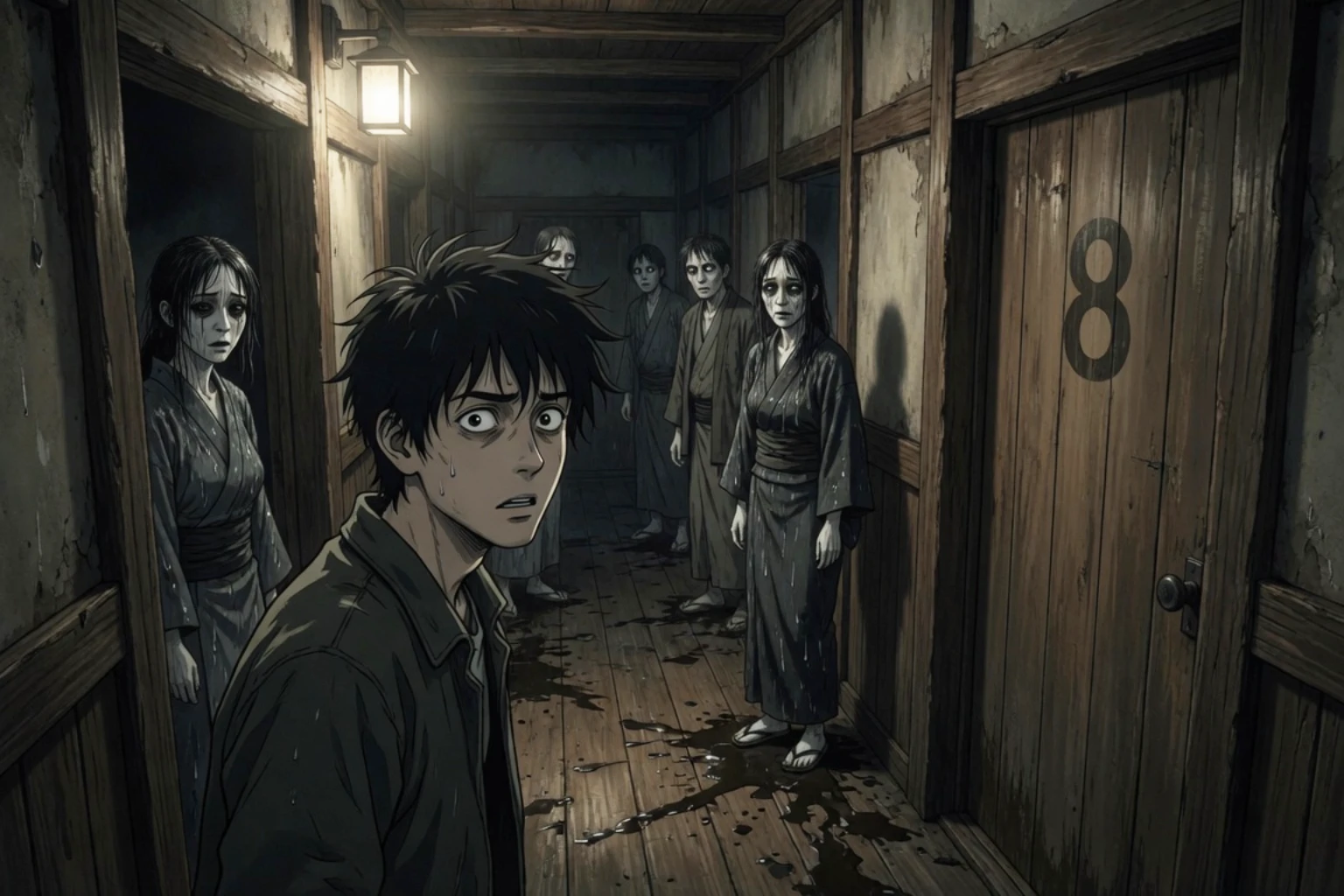
The rain had taken the mountain road an hour before Sota did.
It wasn't a dramatic rain. It was the kind of steady, cold, vertical rain that erases a mountain in layers. First the peaks go, then the cedars halfway up, then the road markers, then the white line in front of your tires. The last bus from Hirayu had been twenty minutes late to the stop at the trailhead, its wipers slapping frantically. The driver had taken one look at Sota with his wet backpack and his cheap hiking shoes and said, "No through buses after this. Landslide check on Route 158. You sure?"
Sota had nodded. He was twenty-nine and had spent the last three years at a desk in Nagoya drawing convenience store layouts. He had wanted to see the old Nakasendo stones, the kind of place that didn't have vending machines.
Halfway up the pass, the bus stopped. Not at a stop. Just in the road, where a thin skin of mud and broken branches had slid down the slope and covered half the asphalt. The driver got out with a flashlight, looked at it, got back in, and said, "We turn back. Sorry."
"I have a reservation," said an old man in the back, but the driver shook his head.
Sota got off at the narrow shoulder with two other people who quickly disappeared under umbrellas toward a lower hamlet. The bus turned, its red taillights smearing in the rain, and then it was gone. The mountain was suddenly very loud. Rain on leaves, rain on his hood, water running in the ditches.
He checked his phone. No signal. The paper map he had was already bleeding ink. He had passed a wooden sign about two hundred meters back - YAMABIKO INN 0.8KM, with a faded painted sparrow. He remembered it because he thought it was strange to advertise an inn on a hiking trail that barely counted as a road.
He walked.
The inn found him more than he found it. The cedars broke and there was a flat cut in the hillside, and the building was there, low and long and dark, as if it had grown out of the rock. It was an old ryokan, not the renovated kind for tourists. Black tiles, wooden walls gone silver with age, a noren curtain over the entrance so heavy with rain it barely moved. A single amber light burned over the door, haloed in mist. The windows glowed warm. From the eaves, water fell in a solid sheet.
He pushed the noren aside and stepped onto the concrete genkan, breathing hard.
"Sumimasen!" he called.
For a long moment there was only the rain and the ticking of an old clock somewhere inside. Then a sliding door opened at the back of the entrance hall.
The innkeeper was a woman in her late seventies, small, straight-backed, wearing a dark cardigan over a plain kimono. Her hair was pulled back neatly. Her face was handsome and unsmiling.
“We are closed for the night,” she said.
"I was on the bus. The road is closed ahead. Is there—" He gestured helplessly at the rain behind him. "Even a floor. Anywhere."
She looked at him, at the water pooling around his shoes, and her expression didn't change, but she slid the door a little wider.
"How many nights?"
"One. Just tonight. I'll leave first thing."
She took a ledger from a low desk. The wood of the desk was worn to a shine where hands had rested for decades.
"Name?"
"Mizuno Sota."
She wrote it down. “We have seven guest rooms. Two are occupied. You will be in number three. Bath is at the end, on the left. Dinner is already finished, but I can bring tea and rice. Boots there. Shoes off.”
The genkan smelled of cedar and old smoke and faint mildew, the honest smell of a building that has been closed up against mountain winters for fifty years. She gave him a faded green yukata and led him inside in socks that made no sound on the polished wood.
The ryokan was built like a U around a small inner garden that was now a square of black mud and moss being hammered by rain. The upstairs corridor ran the length of the second floor, with rooms on one side and paper screens on the other looking down into the garden. Each sliding door had a small wooden number plate burned into it. 1, 2, 3, 4, 5, 6, 7. Seven rooms. The hallway was too long for seven rooms; there was a stretch of blank wall at the far end past room seven where the roofline continued, but Sota thought that was just storage or the owner's quarters.
The lights in the corridor were low-watt bulbs in paper shades. They hummed faintly.
"This is it," the innkeeper said at the third door. "Futon is in the closet. Do not use the heater too high. The mountain is cold at night but the wiring is old. Bath is hot until nine. Please be quiet. Other guests are resting."
She slid the door open. Room three was six tatami, clean, bare except for a low table and a dented thermos. The shoji screen looked out onto the garden and the rain. It was, despite everything, profoundly welcome.
Sota thanked her. She gave a short nod and left, her socks whispering.
He changed, sitting on the tatami and listening to the rain become louder now that he was still. From somewhere down the corridor came a cough, a man's cough. From the room next to him, room two, he heard the soft murmur of a television, barely audible, playing an old drama.
He went to the bath.
The bath was small, three steps down into a tiled room with a deep wooden tub that smelled of hinoki. The water was almost scaldingly hot, and he got in until his skin turned red and the chill finally left his bones. The small high window showed nothing but black and water streaks. While he soaked, the building creaked around him. Old buildings settle in the rain. He told himself that.
When he came back upstairs in his yukata, a tray had been left outside room three - rice, pickles, miso soup gone lukewarm, tea. He ate kneeling at the low table, listening to the storm pick up. The wind had risen. It came down the pass now, throwing the rain sideways against the shoji, making the paper rattle in its frame. The light bulb swayed a fraction.
At eight-thirty, he turned off his light and lay on the futon and tried to sleep.
He woke to a sound he could not place.
It was after midnight. The rain was a roar now. The wind whistled under the eaves. The power must have flickered at some point, because his phone, which he had plugged into the single outlet, showed 1:47 with no charge.
The sound that had woken him was in the corridor. A soft, dragging step. Not the brisk walk of the innkeeper. This was slow. A foot, then a pause, then another foot being pulled forward. Like someone walking with an injury, or someone who had forgotten how to walk.
Sota lay in the dark and listened. The building was otherwise silent. No television now.
The dragging came closer. Past his door. Past room four. Past room five. All the way to the far end. Then it stopped.
He told himself it was the old man he had heard coughing. Maybe going to the toilet. But the toilets were on the first floor.
He sat up. His mouth was dry. The room was cold. The heater he had left on low was off. The bulb in the paper shade above was dead.
Light came from the corridor, thin and orange, slipping under his door.
He slid the door open an inch.
The corridor was dark except for the far end, where one of the paper-shaded bulbs was still on, swaying in a draft that shouldn't exist in a closed hallway. In that swaying light, the hallway was longer than it had been in the afternoon.
At the very end, past the blank wall beyond room seven, there was a door.
Sota stared.
It was a guest room door, identical to the others. Same wood frame, same shoji paper, same small burned number plate. The number was 8.
It had not been there before. He was certain. He had counted the doors that afternoon. Seven. The wall beyond seven had been blank, with a faded calendar tacked to it.
Now there were eight.
The dragging sound had stopped in front of that door. There was no one there now. But the door to room eight was open a crack, maybe two inches. A thin line of darker dark inside.
From inside that crack, cold air was pouring out. He could see the dust motes in the hallway disturbed by it, moving against the draft that should have gone the other way.
His first, stupid thought was that the innkeeper had made a mistake. She said seven rooms but there were eight. He should tell her.
He closed his own door and slid his feet into the slippers and stepped into the corridor.
The tatami runner was cold through his socks. The rain hammered the roof directly above him now. As he walked past room four, room five, room six, room seven, he felt the building get older. The wood darker, the smell stronger - not cedar anymore but wet earth, like the underside of a rock.
Room eight's door was old. The shoji paper was yellowed and in places torn and re-patched with different paper. The number plate was not burned but scratched in with something sharp: 8, the lines deep and uneven.
The cold coming from inside made his ankles ache.
He raised his hand to knock, then stopped. From inside, there was no sound. No rain. That was wrong. He could hear the rain everywhere else, on every tile, but from that two-inch crack came absolute silence, as if the room swallowed sound.
He should go back. Every instinct he had said go back, slide his own door shut, put the table against it, and wait for morning.
He reached out and pushed the door.
It didn't slide. It swung inward on hinges, heavy. The inside was dark.
It was not a guest room. Or rather, it was, but wrong.
The layout was a perfect copy of his own room - six tatami, a low table, a tokonoma alcove - but everything in it was decayed. The tatami were black with rot and sunk in the middle, as if something heavy had lain there for years. The table was overturned. The tokonoma held not a scroll but a dark stain that ran up the wall in the shape of a standing person, arms at its sides, head slightly bowed. The shoji was closed but the paper was black with mold and the rain made no sound on it at all.
And the room smelled like a riverbed in winter.
In the center of the sunken tatami, there was an impression, body-shaped, still faintly warm-looking, as if someone had just stood up from lying there for a very long time.
Behind him, in the real hallway, one of the bulbs popped loudly and went out.
Sota jerked back, slammed the door - or tried to. The door wouldn't close. It stayed open that two inches, exactly as before, as if held by a finger on the other side.
He ran back to room three, slid inside, and locked it with the thin brass hook. His heart was hammering so loud he could hear it over the rain, which had returned all at once in a crash against the roof.
He sat on his futon in the dark, in his yukata, soaking wet with cold sweat, and stared at the line of light under his door until it flickered and steadied.
Someone walked past his door. Slow. Dragging. He did not look.
In the morning, the rain had lessened to a drizzle, and the garden was a swamp.
Sota went downstairs. He had not slept. The eighth door was still burned into his vision.
The innkeeper was in the small kitchen, washing rice. She looked up when he entered.
"The road?" he asked.
"Still closed. Men will come at noon to clear it. You can leave after lunch."
He swallowed. "There is a room upstairs. At the end. Number eight. The door was open. Is someone staying there?"
Her hands stopped moving in the water. She looked at him for a long time. Her face, which had been merely unsmiling before, was now completely empty.
"There are seven guest rooms," she said. "This inn has had seven guest rooms for forty years."
"I saw it. Past room seven. Number eight."
"There is no room eight. You were tired. The wind plays tricks."
She said it flatly, like a line rehearsed.
"There was a mark on the wall inside, like—"
"There is no room eight," she said again, louder. The water kept running. "Please do not disturb the other guests with stories."
From the entrance, a cough. The old man from room five came down, wearing his own yukata, his face gray. He glanced at Sota and then quickly away.
At the low dining table, breakfast was pickles and fish and rice. The other guest was already there - a woman in her early twenties, hair still damp, wearing a bright yellow raincoat over her yukata like she didn't intend to stay inside. She introduced herself as Mika, a university student who had been hiking the old post road.
"You heard it too, didn't you?" she said quietly when the innkeeper went back to the kitchen.
Sota looked up.
"The dragging," she said. "At 1:47. I looked at my watch. And then the light in the hall. I saw a door at the end that wasn't there yesterday."
The old man made a small noise and stood up, taking his tray with him.
"Don't," he said to them, without looking. "Don't talk about it. And don't open it."
He left.
Mika leaned forward. "My friend and I stayed in a temple lodge last year in Nagano. The monks told us about places where a death is... unfinished. Where someone dies and keeps the shape of the building wrong. This inn is on the old map as Yamabiko Inn but the new maps don't list it."
Sota wanted to tell her she was being superstitious. But his hands were shaking.
"Have you been here before?" he asked.
"No. But the man in room five has. I talked to him last night. He came here three years ago with his wife. She opened a door that shouldn't be there. She went inside."
Sota felt cold again despite the hot tea.
"He said she came back three days later. In the rain. She didn't speak. She just stood outside his room. Outside his door. All night. Staring at the wood. When he opened the door in the morning, she was gone. But the next guest who stayed in room two saw her standing outside his door. And then he disappeared. And now he's the one who stands."
Mika's eyes were wide and bright and scared. She was trying to make it sound like a ghost story, something you tell at a lodge to scare each other. But her voice cracked.
"The innkeeper told him not to open it either," she whispered. "She says there is no eighth room because if you admit there is, you have to admit what it does."
The old man did not come back downstairs.
The morning dragged. Sota tried to charge his phone in the kitchen outlet. Mika tried to hike out despite the mud. The innkeeper watched them both from the doorway, her hands folded in her sleeves.
At noon, the rain started again, harder.
"No men today," the innkeeper said, looking out at the white sky. "Tomorrow."
Sota went back to room three and tried to barricade his door with the low table. It was stupid; the doors slid. He sat with his back against the far wall and watched the light change.
At dusk, the power went out completely.
The innkeeper came upstairs with candles in glass holders, her face lit from below. She set one outside each occupied room without a word. The hallway was full of moving shadows. The rain was a hammer.
"The generator is broken," she said. "Stay in your rooms."
"What about the eighth—" Mika started, holding her candle.
"There are seven guest rooms!" the innkeeper snapped, and for the first time her composure broke. Her eyes were wet and furious. "Seven! Do you understand? If you count seven, it cannot hurt you! If you count seven, it stays at the end! Do not count it! Do not see it!"
She turned and went downstairs, taking her light with her.
The three candles in the hall burned, their flames perfectly still despite the draft that should have been there. Sota counted. Three flames. Three occupied rooms. 2, 3, 5. That was what was left.
The candle outside room seven flickered, though there was no wind.
Sota went into his room and closed the door. He could still see the line of candlelight underneath.
At 1:13 a.m., the dragging started again.
Louder this time. Not trying to be quiet. A wet, heavy drag, like a body being pulled by its own arms. It started at the far end of the corridor, where the eighth door would be, and it moved slowly past room seven, six, five—
It stopped outside room five.
Sota held his breath.
He heard the old man whimper through the thin wall.
Then a soft, terrible sound - bare feet shifting on wood, stopping. Standing. Perfectly still. Right outside a door.
Not Sota's. The old man's.
A minute passed. Then another. Then the old man screamed, a short, choked scream that was cut off.
Sota's candle went out.
He scrambled for his phone, his lighter, anything. The darkness in the room was absolute, a black that had weight. The rain was deafening again, but underneath it he could hear something else now, inside his room. A faint creak, as if someone had stepped onto the tatami even though his door was still closed.
The smell of riverbed, of cold mud and stagnant water, filled his nostrils.
He turned around.
In the corner of room three, where the closet was, there was now a second door. It was not there in daylight. It was the same patched shoji, the same scratched number 8. It was standing open two inches. Cold poured from it.
And from the crack, in the dark, something looked back at him. Not with eyes. The darkness itself was looking.
Behind him, out in the hall, the old man was begging. "No, no, please, not again, you already took her—"
Then the sound of a sliding door opening.
Sota did not open his eyes. He pressed his hands over his ears and screamed silently and waited for the dragging to come for him.
It did not. After a long, long time, the begging stopped. There was a soft thump, as if something had fallen gently against wood. Then the dragging resumed, moving away now, past his door, toward room two.
He heard Mika's door rattle.
"Sota? Sota! Something is outside my room!"
He couldn't move. He couldn't open his mouth.
Mika's voice rose to a shriek. "There is someone standing there! There is someone standing outside my door and it's not moving!"
Sota forced himself to slide his own door open a crack.
The hallway was lit only by two candles now - the one outside his room and the one outside room two. The candle outside room five was gone, tipped over, wax spilled.
Outside room two stood the old man.
He was in his wet yukata, barefoot, his feet black with mud. His head was bowed so far his chin touched his chest. His hair dripped. He was standing perfectly still, inches from Mika's door, facing it. Not moving. Not breathing that Sota could see. Just standing, as if he had been told to wait there and would wait forever.
And behind him, at the far end of the hall, the door to room eight was wide open.
Inside, it was not a room anymore. It was the hallway, extended, impossibly long, with many more doors, dozens of them, each with a number scratched out and rewritten, and in front of each door stood a figure, head bowed, dripping, absolutely still.
In the closest doorway of that impossible hall stood a woman in a white kimono that had turned gray with water. Her hair covered her face. Her neck was too long. She was turned directly toward Sota. She was smiling with a mouth full of mud.
The cold hit him like a wall and his door was yanked from his hands and slammed shut by a force that was not wind. The candle outside his room went out.
Mika screamed once, very loudly, and then stopped.
Silence, except for the rain.
Sota lay on his futon and shook and did not sleep.
At dawn, the rain stopped.
The sky was a clean, washed blue, too bright to be real. Birds called. The garden steamed.
Sota opened his door. The corridor was normal. Seven doors. The wall beyond room seven was blank, with the faded calendar. The tatami runner was dry. The candles were gone.
Rooms two and five were empty. Their futons were neatly folded. Their bags were gone. But their slippers were left outside the doors, neatly paired, soaking wet and filled with black mud.
The innkeeper was downstairs sweeping, as if nothing had happened.
"Bus will come at ten," she said without looking up. "Road is open."
"Where are they? The other guests?"
"What other guests? There were seven rooms. Only you stayed last night. The storm kept others away."
Her hands were steady. Her face was empty again. She had been doing this for a very long time.
Sota did not argue. He put on his still-damp hiking shoes and ran out of the inn and down the mountain road without looking back, half expecting the road to disappear. It didn't. At the bottom, by the bus stop, a small prefectural truck was pulling away, and a bus was coming up the hill, real and noisy and full of people.
He got on. He did not sit. He stood by the door and watched the inn vanish around a bend in the cedars, that single amber light still burning faintly even in daylight.
He made it back to Nagoya. He showered for an hour. He threw away his yukata and his shoes. He told no one where he had been.
For three nights he slept fine.
On the fourth night, at 1:47 a.m., he woke up to the sound of dragging in his apartment hallway.
His apartment was on the third floor, and the hallway outside was concrete. He had never heard anyone dragging anything through it.
He lay frozen and listened to it come closer, past his neighbor's doors, past his bathroom wall, and stop outside his front door.
He did not look through the peephole. He knew what he would see. An old man, head bowed, dripping, standing silently, waiting.
The dragging started again the next night, and the next. Each night closer. Each night longer.
On the seventh night, Sota woke at 1:47 to the click of his front lock. His steel door swung inward before he could reach it.
The hallway outside was no longer the concrete corridor of his apartment building. The upper floor of the Yamabiko Inn stretched beyond the threshold, dimly illuminated by swaying paper lamps. Seven numbered rooms lined one wall. At the far end, the eighth door stood open.
The old man from room five waited in the corridor with his head bowed. Water dripped from his yukata, collecting around his bare, mud-blackened feet. Behind him stood Mika and the other silent figures Sota had seen within the impossible hallway. The woman in the gray kimono watched from the open doorway, smiling through a mouth filled with wet earth.
Sota seized his apartment door and tried to force it shut. The old man raised his head, and Sota saw that his clouded eyes were fixed directly on him.
“You opened it,” the old man said.
Black water crossed the threshold and spread across Sota’s apartment floor. Pale hands reached through the widening doorway, caught his wrists, and pulled him into the corridor. His apartment door closed behind him, leaving the room silent and empty.
A week later, another storm stranded a traveler on the mountain road above Hirayu. The innkeeper gave him room three and warned him to remain inside after midnight.
At 1:47 in the morning, the traveler woke to the sound of someone dragging one foot along the corridor. He opened his door a crack and saw a young man standing directly outside, perfectly still, with rain dripping from his hair and black mud covering his bare feet.
At the end of the hallway, an eighth door waited in the wall.
Sota slowly raised his head and smiled.


.png)
.png)
.png)