%20(1).png)

The rain had been falling for three days, and I was sick of it.
That's the honest reason. Not fate, not destiny, not some invisible thread pulling me toward the thing that would nearly kill me. I was just tired of walking the long way around Mount Kurogane's shoulder with wet socks, and the cedar forest cut a full twenty minutes off the trip between the Sakuragaoka bus stop and my apartment in Nishimachi. Everyone at Tōno Municipal University knew about the shortcut. Nobody used it, because the path was old and the ground was root-knotted and the cedars grew so thick that even at noon it felt like six in the evening. But everyone knew.
My name is Aoi Yamashiro. I was twenty-one, a third-year sociology student, and I had spent most of my adolescence deciding that nothing was real except the things that could be measured. My mother had spent four years and two million yen on faith healers and spirit consultants and a temple in Nagano that promised to "realign her karmic burden," and she had died anyway, of an ordinary cancer, in an ordinary hospital bed. So I had opinions about the invisible world. My opinion was that it was a marketplace and everybody in it was selling.
I went into the trees at 4:40 in the afternoon on the ninth of November with my hood up and my earbuds in and my hands in my pockets, and the rain stopped mattering almost immediately. That's the thing about a cedar forest that old — the canopy is so dense it becomes its own weather. Water gathered on the needles high above and released in slow fat drops that struck my shoulders like tapped fingers. The ground was a dark red-brown carpet of dead needles and moss. The trunks went up straight and enormous, some of them wide enough that two people couldn't have joined hands around them. The air smelled of wet bark and something sweetish underneath, like fruit going over.
Sound behaved strangely in there. My own footsteps came back to me a half-beat late.
I took my earbuds out. I told myself it was so I could hear if a car came along the forestry road, but there was no forestry road for two kilometers, and I knew it.
About fifteen minutes in, the path forked. The left branch was the one people used — it ran downhill toward the drainage channel and eventually the back of the Nishimachi housing block. The right branch went up, narrower, half-swallowed by fern. I'd never taken it. I took it that day because I could hear water on the left and I didn't want to wade.
The right path climbed maybe eighty meters and then flattened into a small clearing, if you could call it that. It was more like a place where the cedars had agreed to stand a little farther apart. The light there was green-grey and thick. There was a rope strung between two trees at the clearing's edge — a shimenawa, though I only knew the word later. Rice-straw, braided, gone black with rot, sagging in the middle so low it nearly touched the moss. The paper streamers that should have hung from it were mostly gone. Two remained, and they were not white. They were the color of old teeth.
I ducked under it without thinking. Later, the priest would tell me that ducking under it was the second mistake, and that the first was going up the right-hand path at all, and that the third was the one that mattered.
In the middle of the clearing there was a stone. Knee-high, roughly cubic, so furred with moss and lichen that it looked more grown than carved. Another shimenawa was wrapped around it, this one thinner, wound three times, and I could see the wood beneath — no, not wood. The rope was tied around a stack. The knee-high thing wasn't one stone. It was four flat stones set on top of each other like a stubby little pagoda, with the rope binding them, and on the topmost one, under all that moss, I could see the ghost of characters cut into the surface.
There was no offering box. No torii. No path to it but the one I'd come up. Just this small ugly thing in a hole in the forest, tied shut.
I want to be clear that I felt nothing. No dread, no warning chill. That's what people expect you to say — I knew right away that something was wrong. I didn't. I looked at it the way you look at a broken vending machine. Some village had put it there a hundred years ago for reasons that made sense to them and made no sense now, and the village was gone, and the reasons were gone, and the stone was just weather.
I got out my phone to take a picture, because Kanae in my seminar group collected photos of abandoned things and I thought she'd like it.
The phone was dead. It had been at sixty-two percent on the bus.
I said something impolite and put it away, and as I turned, my heel came down on the wet moss and slid, and my other foot came out to catch me, and it caught the stack of stones instead.
I felt it go. The whole thing had been balanced, not mortared — the rot-black rope was the only thing holding it, and the rope was a hundred years past its work. The top stone went off into the ferns. The second and third came apart and rolled. I went down on my backside with a jolt that snapped my teeth together, and when I opened my eyes I was sitting in the wet with the bottom stone tipped on its side in front of me and a hole in the ground where it had been.
Not a hole exactly. A hollow. A shallow depression maybe thirty centimeters across, lined with smaller stones set edge to edge, and in the middle of it, half-buried, something pale.
I reached in and pulled it out. It was a piece of wood, flat, about as long as my forearm and as wide as three fingers, shaped like a little tombstone at the top. Rotted at one end, but the surface had been lacquered once and the lacquer had kept it. There was writing on it in ink, in a hand that was fast and heavy and not at all decorative. I could read maybe a third of the characters. One of them was 封 — seal. One of them, near the bottom, was 名 — name.
The clearing had gone completely silent. Not quiet. Silent. The dripping had stopped. My ears did the thing they do in a pressure change, that thick swallow-and-pop, except it didn't pop.
I said, out loud, "Okay," and put the wood back in the hollow, and stood the bottom stone upright over it, and then, feeling absurd, I found the second stone and put it on top. The third had rolled somewhere I couldn't see. The rotten rope had broken in four places and there was nothing to do with it. I laid it over the stones like a scarf.
"Sorry," I said to the clearing, in the tone you use to a neighbor whose bicycle you've knocked over. "It was an accident."
Something in the forest, off to my right, took a step.
It was one sound. A single compression of dead needles, exactly the weight of a person. I looked. There were four hundred cedars and nothing else.
I walked out of there. I did not run, because I was twenty-one and cynical and running would have meant admitting something. But my walk had a length to it that wasn't natural, and when I came out onto the wet asphalt of the Nishimachi approach road twenty-five minutes later, the streetlights were on and my shirt was soaked through under my coat with sweat and not rain.
My phone turned on the moment I stepped onto the road. Sixty-one percent.
---
I lived on the third floor of the Corpo Nishimachi, a four-story concrete box from the eighties with an exterior walkway on each level and a stairwell open to the air at the north end. My apartment was 305, second from the far end. It had one main room with tatami, a small kitchen, a unit bath, and a window over the walkway railing that looked out on the parking lot and, beyond it, the black bulk of the mountain.
That night I ate convenience-store curry and watched two episodes of something and did not think about the clearing, in the specific effortful way that means you're thinking about nothing else.
At 2:14 in the morning I woke up.
I know it was 2:14 because I looked at my phone immediately, which is what I always do, and because the number is one of the few clean facts I have from all of this.
The sound was coming from outside and below. Clack. A pause of about a second and a half. Clack. Wood on concrete. That specific hard hollow report of geta — the raised wooden sandals, the two teeth striking one after another, though in this case it was one clack per step, heavy, like whoever wore them was setting the whole foot down at once.
Clack. Clack.
Down in the parking lot, moving from the far end toward the stairwell. Unhurried. Metronomic.
My first thought was Kobayashi from 201, who was seventy-eight and sometimes wandered. My second thought was that Kobayashi wore slippers.
I got up. The floor was cold. I went to the window and put two fingers on the curtain, and then I did not open it.
That's the part I still don't understand about myself. I'd have said I was the kind of person who opens the curtain. Instead I stood there with my fingers on the fabric and my heart going and I listened to the clacking cross the lot, and stop.
Silence for maybe forty seconds.
Then it started again, and this time the sound had changed. It was on the stairs. Clack — clack — clack, and with each one a faint metallic resonance from the steel staircase, and it was coming up.
It reached the second floor landing and stopped, and there was a pause so long I began to believe it was over, and then the sound simply ended. Not receded. Ended, mid-building, as if someone had switched it off.
I did not sleep again. In the morning I went down and looked at the second-floor landing and the concrete steps and the parking lot and found exactly nothing, because concrete doesn't take footprints, and I told myself a very long story about acoustics and drainpipes and old men in hard-soled shoes, and I believed about sixty percent of it, which was enough.
---
It came back the next night at 2:14. It came the night after that. On the fourth night it made the third floor and walked the length of the exterior corridor, past 301, 302, 303, 304, and stopped, and I lay in the dark on my futon with my hands flat on the tatami and counted the seconds until it would resume and it never did.
On the fifth day I saw it.
I was on the campus quad at four in the afternoon, sitting on the low wall by the bicycle racks with a can of coffee, having a conversation with Kanae about her thesis that I was not participating in. The light was that flat November gold. Students crossed in front of the library. And past them, at the edge of the quad where the ginkgo trees stood in a line, there was a shape between two trunks.
It was tall. That was the first wrong thing. Not tall like a tall person — tall like something built to a different scale, easily two and a half meters, and thin in a way that made the height worse. It wore something dark and long, and there was pale at the top where a face should be, and the face —
I only looked for a second and a half. What I retained was that the features were in the right places but the proportions were wrong, stretched and pulled downward as though the whole face were slipping off the skull, the mouth much too long and running at a diagonal, and that it was pale not like skin but like a lantern seen through paper. And I retained the eyes, which were not looking around, or scanning, or searching. They were already on me. They had been on me before I looked.
"—Aoi. Aoi?"
I turned to Kanae. Turned back. Two ginkgo trees, a bicycle rack, a first-year girl on her phone.
"You've gone grey," Kanae said.
"I didn't sleep."
"You said that yesterday."
"It's cumulative."
She looked at me for a while. Kanae was the only person at that school who I would have called a friend, mostly because she never pushed, and she didn't push then. She just said, "My grandmother used to say if you dream about a road, don't take the road."
"That's not a real saying."
"No," she agreed. "She made up a lot of things."
That night it was on my floor again, and it walked to 305, and it stopped outside my door.
I could hear it breathe. That's not a metaphor. Through the aluminum door, through the thin gap at the bottom where the November cold came in, I could hear a long slow intake, and a long slow release, and it was not the sound of lungs. It was the sound of wind in a pipe.
I sat with my back against the wall beside the door, in the dark, with a kitchen knife in my hand that I had picked up without deciding to, and I did not move for one hour and twenty minutes. At some point during that time the breathing stopped and I hadn't noticed when.
In the morning there was a smell in the corridor outside my door, faint but distinct: wet bark, and underneath it that sweetish rot, like fruit going over.
I called in sick. Then I went to find a priest.
---
Tōno has two shrines. Hachiman-gū on the east side is large and prosperous and has a parking lot with lines painted on it. I went there first. The young priest who spoke to me was polite and clean and about my age, and he listened to a heavily edited version of my story with an expression of enormous professional sympathy, and then he sold me an amulet for eight hundred yen and suggested I speak with a doctor about my sleep. He was, I think, entirely sincere. I put the amulet in my pocket and thought about my mother.
The second shrine was Ryūjin-sha, up a side street behind the old shopping arcade, and it had been closed to the public for six years. The gate was chained. The grounds behind the chain were a mess of weeds and cracked flagstones and one enormous camphor tree. I only knew about it because I'd walked past it a thousand times without seeing it.
I went to the arcade and asked at a tobacconist, because in a town like Tōno the tobacconist knows.
"Ryūjin-sha," the old woman said. "Ah." A world of judgment in one syllable. "Sonoda-san still lives in the back. Nobody's thrown him out. Somebody should."
"Why?"
She looked at me over her glasses. "You want to know, ask him. He's usually at the drinking place with the blue curtain after five. He'll be the one who smells like a fire."
---
His name was Sonoda Ichirō and he was fifty-six and he was at the drinking place with the blue curtain at five-fifteen, at the end of the counter, with a bottle of shōchū and a saucer of pickles he wasn't eating and a cigarette going in a foil ashtray with four dead ones in it.
He didn't look like a priest. He looked like a man who worked outdoors and had stopped. Broad-shouldered, gone soft around the middle, grey stubble, hands with knuckles like walnuts. He was wearing a fleece jacket over a work shirt. His hair was cut short and badly, as though he'd done it himself with kitchen scissors, which it later turned out he had.
I sat down two stools away, which was the wrong move, and ordered a beer I didn't want.
He lit a new cigarette off the old one. "You've been standing outside for six minutes," he said, without looking at me. "It's cold. Either sit next to me or go home."
I moved over.
"Sonoda-san?"
"Mm."
"I need help with something."
"No, you don't." He exhaled through his nose. "You need help with something and you've decided it's a joke, and you're going to tell it to me like a joke so that when I laugh you can laugh too and go home. Skip that part. I'm expensive by the hour and I only charge in shōchū."
That knocked the air out of my prepared speech. I sat there feeling about fourteen years old.
"Five nights ago," I said, "something started walking up to my apartment."
His cigarette stopped halfway to his mouth.
"Geta," I said. "The sound of geta. It's closer every night."
He put the cigarette down. He turned on his stool and looked at me for the first time, and his eyes were wet-rimmed and bloodshot and completely, alarmingly clear.
"Where did you go," he said, "and what did you break?"
---
The back room of Ryūjin-sha was one eight-mat space with a kerosene heater, a low table, a wall of cardboard boxes, and a shelf of books that had been arranged by someone who cared and then let go by someone who didn't. There was dust on everything except the table and the ashtray.
Sonoda spread a 1:25,000 topographic map over the table and weighted the corners with a lighter, a teacup, a stone, and his elbow.
"Show me."
I found the fork in the path, and the right-hand branch, and put my finger on the flat place where the clearing had been.
He looked at it for a long time. Then he got up, went to the boxes, and dug for four minutes, swearing under his breath, and came back with a folder of photocopies so old the toner had gone brown.
"This is a survey," he said. "1974. Prefectural cultural properties division. They walked every shrine and roadside stone in the district. Every one." He turned pages. "Kurogane's western slope. Here — Yamanokami stone, here — a Jizō, here, here, a pair of dōsojin. And here." He tapped. "Unnamed. 'Small stone assembly, four courses, shimenawa, no dedication, no honorary rites recorded. Local informant declined to comment.'"
"Declined."
"There's a note. The surveyor wrote: 'The informant, aged 81, stated that the stone is not a shrine and should not be listed as one. When pressed he stated that it is a lid.'" Sonoda looked up. "That's the whole entry."
The kerosene heater ticked.
"A lid," I said.
"Do you want me to make it comfortable for you," he said, "or do you want the truth?"
"I broke it."
"You broke it." He lit another cigarette. "Right. Let's have the rest, then. What was under it?"
I described the hollow and the flat wooden marker and the ink. He made me draw the characters I remembered. My hand was unsteady and my kanji was worse, but when I sketched the shape of the board itself — the little peaked top — he went very still.
"That's not a marker," he said. "That's a fuda. A big one. That's a name-board." He turned the paper around. "You said one character was 名. You're sure?"
"Near the bottom."
"Then it wasn't sealing a place. It was sealing a name." He rubbed his face with both hands, hard, the way you do when you're trying to wake up. "God damn it."
"Sonoda-san. What is it?"
"I don't know yet, and I'm not going to guess in front of you, because if I guess wrong you'll hold onto the wrong thing and it'll get you killed." He pushed the ashtray away. "But I'll tell you the shape of it. In this district — and it's not only this district — when a thing came out of a mountain and couldn't be driven off, sometimes it wasn't driven off. It was named. You give a thing a name and the name is a handle, and you write the handle on a board, and you put the board in the ground under a weight, and you tie the weight with rope, and you renew the rope every year at the same festival and you never, ever say the name out loud. And after four or five generations everybody's forgotten what the ceremony's for, and after seven or eight generations the village is empty because the young people went to Sendai, and the rope rots, and one day a boy in a raincoat slips on some moss."
"I'm twenty-one."
"You're a boy in a raincoat."
I looked at my hands. "Then I just put the board back and re-tie the rope."
Sonoda laughed. It was not a kind sound. "You put the stones back already. Did it stop?"
"No."
"No. Because the seal was broken at the moment the rope parted, and a broken seal doesn't rejoin because you tidy up. It has to be made again. Which means salt, which is easy. Ofuda from a shrine that still has standing to issue them, which is not easy for me, because I don't. A hamaya — a purifying arrow — properly blessed. Sakaki. Rice. Shōchū is fine; sake is better. A new shimenawa, hand-braided, and I'll do that part because you'd make a mess of it. And the name." He tapped the drawing. "The board is the seal. Whatever's left of it. Without the name written on it, everything else is furniture."
"So we go get the board."
"Yes."
"When?"
"Not tonight." He looked at the window. It was fully dark outside. "You don't go up that mountain in the dark while it's walking. Tomorrow, first light. Go home. Sleep if you can."
I stood up and then didn't leave. "Sonoda-san. Why is the shrine closed?"
He tipped ash. "Because six years ago I got drunk and told a family that their daughter's illness was a curse from their grandfather's second wife," he said, "and they believed me, and they stopped taking her to the hospital for eleven days."
I said nothing.
"She lived," he said. "She has a limp. The shrine association pulled my certification. I still do the work because the work still needs doing and nobody else in this town will do it, and because —" He stopped. "Go home."
---
That night the sound came at 2:14 and it did not stop at the door.
It stopped at the door, and then the door handle turned.
I was awake. I'd been awake since midnight, sitting on the futon with my back to the wall. I watched the handle rotate down as far as it would go, slowly, all the way, and stop, and hold. The lock — a cheap thumb-turn deadbolt — held it. The door flexed maybe two millimeters in its frame.
The handle stayed down for a count of thirty.
Then it came back up, and there was a sound at the bottom of the door, and something came under the gap. Not a hand. It looked at first like water spreading in — a thin dark tongue of shadow, sliding across the entryway tile toward the step up to the tatami. It came in about forty centimeters and then it hit the line of the raised floor and stopped, and quivered, and I could hear it: a papery scraping, like a moth against a lampshade, over and over, pressing.
I found I was making a small continuous sound in my throat.
The eight hundred yen amulet from Hachiman-gū was in my coat pocket by the door. I don't remember deciding. I got up and I grabbed the coat and I threw the whole thing at the shadow on the tile.
There was a crack like ice underfoot. The shadow went out — went out, like a shorted bulb — and out in the corridor the geta struck concrete once, hard, retreating, and then twice more, and then nothing.
In the morning the coat was fine. The amulet inside it had split in half down the middle and the paper within had gone brown and brittle, as though it had been in a fire.
---
We went up the mountain at 6:40 in a fog that made the cedars into suggestions.
Sonoda climbed badly. He stopped twice, wheezing, hands on his knees, and lit a cigarette both times, which I decided not to comment on. He carried a canvas satchel and a folded tarp and a coil of new rice-straw rope, and he'd made me carry a five-kilo bag of coarse salt.
"You feel it?" he said, at the fork.
"Feel what?"
"Exactly." He pointed up the right-hand path. "Listen."
I listened. There was nothing. No birds. No insects. No wind, though the fog was moving.
"A mountain that isn't making noise is a mountain that's paying attention," he said. "Walk behind me. If I stop, you stop. If I say get out, you go down the hill and you don't look at anything."
The clearing was as I'd left it: the bottom stone upright, the second on top, the black rope draped over them, ferns crushed where the third stone had rolled.
Sonoda set down his satchel and stood at the edge of the clearing for a full minute without entering. Then he took a handful of salt from the bag and threw it in a wide arc ahead of him, and stepped in.
"Where's the hollow?"
"Under the stones."
He lifted them off — grunting, one at a time — and set them aside and crouched, and I heard him make a small noise.
The hollow was empty. The lining stones were there, edge to edge. The wooden board was gone.
"I put it back," I said. "I put it back, I swear to God, I—"
"I believe you." He was very calm, and the calm was worse than shouting. He put his hand into the hollow and felt around the edges, and brought out something between two fingers: a splinter of lacquered wood the length of a fingernail. Then another. Then a small flat piece with two-thirds of one character on it.
He laid them on his palm.
"It's been taken apart," he said.
"By what? An animal—"
"An animal doesn't take apart a name." He tipped the fragments into a paper envelope. "It's not gone far. It can't leave the ground it was buried in — the earth here still remembers it even if the wood doesn't. It's been scattered. Like tearing up a letter." He straightened, knees popping. "So. We look."
We looked for five hours.
We built a grid with string and tent pegs and we went over that clearing on hands and knees, sifting needle litter through our fingers. It rained twice. My knees went numb and then stopped being numb in a much worse way. Sonoda worked without talking, methodically, and I began to understand that whatever else he was, he was not lazy. He had simply not had anything to be industrious about in six years.
We found eleven fragments. Eight of them had ink. Laid out on the tarp under the pale sky, they made a broken constellation of a word.
"Read it," I said.
He crouched over them a long time.
"There's a radical here — 山, mountain, or part of a compound. This one's clearly 口, mouth, but it's part of something bigger. This one—" He stopped. "I can read maybe half. Half's no good. A name with a hole in it is a door with a hole in it."
"So we find the rest."
"The rest isn't here." He gestured at the grid. "We've been over it twice. Whatever pulled the board apart carried the rest away, or put it somewhere we won't find by looking." He rocked back on his heels and lit a cigarette with hands that I noticed, for the first time, were shaking. "There's another way to get a name."
"What?"
"Records." He said it like a man reading out a diagnosis. "The kind of thing that gets written down once and then locked in a box. Village association minutes. Temple death registers. Somebody knew the name. Somebody wrote it in something." He exhaled. "Who owns this land?"
The forestry office in the municipal annex told us the western slope of Kurogane had been common land held by the former village of Ōgi-mura until the amalgamation of 1955, at which point the records went to Tōno City, at which point most of them went into a warehouse, at which point half the warehouse flooded in 1998.
The remaining half was in the basement of the old city hall, and the woman who ran it, Mrs. Tokunaga, was sixty and unimpressed by both of us.
"You're not researchers."
"No," said Sonoda.
"You're not press."
"No."
"You smell like an ashtray."
"That's fair."
She looked at me. I hadn't slept in six days by then and I know what I looked like. Something in her face changed.
"Ōgi-mura," she said. "Boxes forty-one through fifty-three. Gloves are on the table. You have until five."
We had until five, and then we had until five the next day, and the day after that, because Mrs. Tokunaga started leaving the light on for us.
Here's what we found, in pieces, over three days:
Ōgi-mura had been a charcoal-burning settlement of about ninety people. It emptied in 1961 when the last four households moved down to the plain. There was a shrine association with a ledger, and the ledger listed annual expenditures, and every year, without fail, from the earliest surviving page in 1888 through to 1960, there was a line item in the eleventh month for straw rope, paper, salt, and one shō of sake, marked with two characters that Sonoda stared at for a long time:
御縄. Honorable rope.
"Every year," he said. "Ninety people scraping charcoal out of a hillside and every single year they found the money for a new rope. Nobody spends money for seventy-three years on a superstition. They spend it because they saw something."
The name wasn't in the ledger. But in box forty-nine, in a bundle of correspondence tied with hemp string, there was a letter dated the fourth month of 1889, from the headman of Ōgi to a priest at a shrine in Hanamaki, and it was mostly a complaint about a boundary dispute, and at the bottom, in a cramped postscript, it said:
*Regarding the other matter, we have done as your predecessor instructed. It has been quiet since the winter. I do not write the name here for the reason you know. It is kept where you said, in the mouth of the mountain, and in the hand of the family that was made responsible.*
Sonoda put the letter down very gently.
"'In the hand of the family,'" he said. "There was a second copy. There's always a second copy — you don't trust a single board in the wet ground. One family held the name in writing and one family held the ceremony. They'd have been the same family or two that intermarried." He was already going back to the boxes. "Find me a name. Not the name — a surname. Somebody in that ledger signs off on the rope every year."
We found it in an hour. At the bottom of each annual entry, in seventy-three years of changing handwriting, there was the same surname with different given names after it.
Umezawa.
---
There were nine Umezawa households in the Tōno phone directory. Sonoda called them from the payphone in the arcade because his mobile was cut off. Seven were no relation. The eighth hung up on him.
The ninth was a woman named Umezawa Sachiko, aged eighty-four, in a care home in Kamiyama, two towns over.
We took the 7:20 bus.
She was in a wheelchair by a window that looked at a car park and a hedge. She was very small and her hands moved constantly in her lap, folding invisible cloth. The staff said she was clear about the distant past and confused about lunch.
Sonoda sat down in front of her, and I watched him become someone else — his shoulders came down, his voice dropped and slowed, the whole slouching wreck of him reorganized into something patient and steady. It was, I realized, the first time I'd seen him do his job.
"Umezawa-san. My name is Sonoda. I served at Ryūjin-sha in Tōno. Do you know it?"
"The one with the big camphor."
"That's right." He smiled. "I want to ask you about Ōgi."
Her hands stopped moving.
"I was born there," she said.
"You were. Do you remember the eleventh month? When they went up to the mountain?"
The old woman turned her head toward the window. She was quiet for so long that a nurse looked over.
"My grandfather went," she said. "And my father. Not the women. They went before dawn and came back after dark and my mother made them wash outside, even in the snow, before they came in. Even in the snow." Her hands started again. "They took the rope up in a bundle on a pole between them because you weren't to let it touch the ground on the way."
"Do you know what it was for?"
"It was for the lid."
"Did anyone tell you what was under the lid?"
"My grandfather said a hungry thing." Her mouth pulled. "He said in the old days there was a bad winter and people did a bad thing, and afterwards something came down the mountain wearing the shape of what they'd done. And a priest came from far off and couldn't send it away, so he tricked it into telling him what it was called, and he wrote that down and put it in the ground. He said: it can't come past a threshold unless it hears its own name spoken, or unless there's no name at all. That's what the rope's for. To keep the name in the dirt."
The room was very warm. I felt cold all through.
"Umezawa-san," said Sonoda, and his voice didn't change at all. "Your family kept a copy of the name. In the house. Do you know where it went?"
"In the butsudan," she said immediately. "Behind the back panel of the butsudan, with the ancestor tablets. My mother showed me when I was eleven and told me if I ever read it she would put me out on the mountain."
"Where is the butsudan now?"
She looked at him with sudden, terrible lucidity.
"Why?" she said.
Sonoda didn't lie to her. I would have. He said, "Because the rope broke."
Umezawa Sachiko closed her eyes. A tear went into the seam beside her nose and stopped there.
"My son sold the house in Heisei nine," she said. "He sold everything in it. He said the butsudan was too big for the flat."
"Sold to whom?"
"There's a shop." Her hands folded and folded. "Near the station in Tōno. He got forty thousand yen. He was very pleased." She opened her eyes. "Young man. The one it's following."
I hadn't spoken. I said, "Yes."
"Don't ever answer it," she said. "Whatever it says outside your door. My grandfather said the last thing before the end is that it calls your name in a voice you love."
---
The shop near the station was called Kotobuki Antiques and it had been closed for two years and the owner had retired to Chiba. Sonoda got the number from the neighboring shop, and the owner, an irritable man named Ide, told us over the phone that yes, he remembered the Umezawa butsudan, a big black-lacquer thing, water-damaged, and he'd broken it up for parts because nobody wanted the old huge ones any more, and he'd sold the doors and the fittings separately, and the back panel—
"The back panel I burned," he said. "It was rotten. Is that a problem?"
Sonoda hung up the phone with great care, and then put his forehead against the glass of the phone box and left it there.
It was the ninth day.
---
That night I stayed at Ryūjin-sha, because Sonoda said only an idiot sleeps behind a door that thing has already touched, and because I no longer had any resistance in me.
He gave me a futon that smelled of mildew and he sat up by the heater with the eleven fragments spread on a black cloth and a magnifying glass and a brush, and he worked.
I woke at 2:14 anyway. Everyone in that room woke at 2:14.
The clacking was in the shrine grounds. Coming up the flagstone path from the chained gate, past the camphor tree, toward the back building.
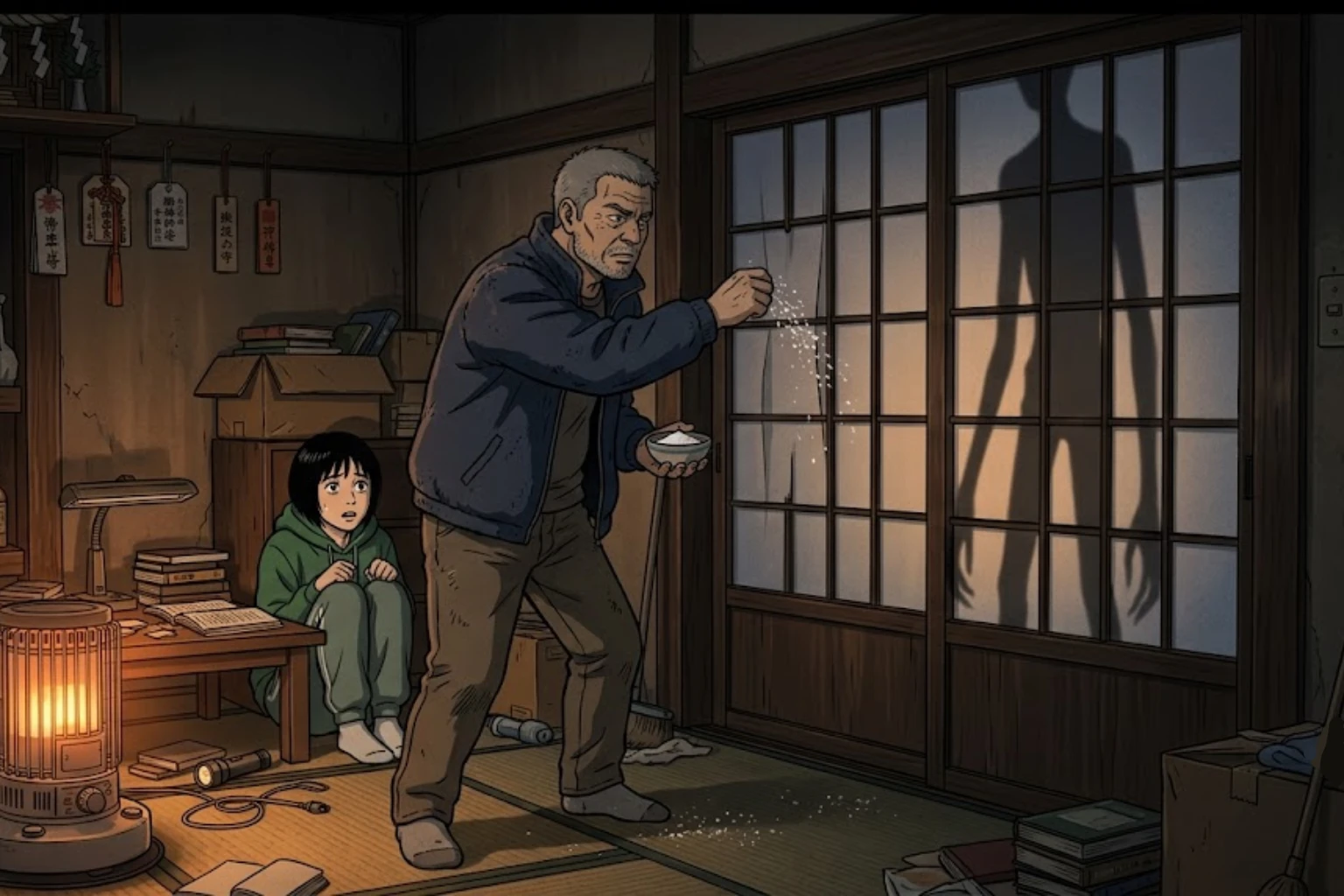
Sonoda was already standing. He had a bowl of salt in his left hand.
"Don't look at the window," he said. "Don't speak."
The sound came up to the wooden step outside and stopped. The building settled — one long creak, as though something enormous had leaned against it. The paper of the shōji glowed very faintly, and against that glow there was a shape.
It was too tall for the door. The head of it was somewhere above the lintel, out of view, and what we could see through the paper was the long dark trunk of it, and one arm, hanging, with fingers that went down past where a knee would be.
The wind-in-a-pipe breathing started.
Sonoda walked forward. He walked right up to the shōji, close enough to touch it, and he began to speak — not loudly, in a low even chant, the old words with the long vowels, *harae-tamae kiyome-tamae*, and he threw salt against the paper.
The paper hissed. Actually hissed, like water on a griddle. The shape recoiled — I saw it fold back away from the door — and Sonoda pressed forward, chanting, throwing salt, and for maybe six seconds I believed we were going to win.
Then the shape stopped recoiling. It leaned in. And the shōji, which is nothing, which is paper and lattice, bulged inward around the pressure of a face.
Every feature came through the paper in relief. The long slipped nose. The diagonal mouth, open, the size of a forearm. And the eyes, pressing, two blind bulges of straining paper, and they were pointed at me and not at Sonoda at all.
Sonoda shouted the last of the invocation and threw the entire bowl.
The paper tore. Salt went out into the dark. The pressure vanished. Something struck the flagstones once — clack — and was gone at the gate, and the camphor tree thrashed as though a truck had passed.
We stood in the wrecked doorway with cold air pouring in.
"It came to me," Sonoda said. He was breathing hard, hand on the frame. "It followed you here and it came at the priest first. It's not stupid."
"You hurt it."
"I inconvenienced it." He looked at the torn shōji. "That was the whole of what I have, Yamashiro. Everything I know how to do, right there, at full strength, and it backed up six feet and came again. Tomorrow night it doesn't back up."
"Then what do we do?"
He sat down heavily on the step. "You could run," he said. "People do. There's a man in Akita who ran to Okinawa in the sixties. It took eleven months."
"And then?"
"And then it caught up."
I sat down next to him. The fragments were still laid out behind us on the black cloth.
"How much of the name do you have?" I asked.
"Six characters of what I think is nine. Maybe eight. I can't guess the rest — if I write it wrong the board is a lie and a lie won't hold." He put a cigarette in his mouth and didn't light it. "I need the real thing. There's no version of this where I don't need the real thing."
I looked at the fragments.
"Sonoda-san," I said. "It took the board apart."
"Yes."
"Why?"
He turned his head.
"It's the one thing that can put it back in the ground," I said. "If it could destroy the board it would have burned it. It didn't. It broke it and it scattered the pieces and it left eleven of them in the hole for us to find." I was thinking out loud, and my voice sounded strange to me. "It doesn't want the name gone. It wants the name where it can watch. Because —" and this is the moment I felt it, the click, the cold — "because it can't cross a threshold unless it hears its own name spoken. It's been waiting for somebody to find the rest of it and say it out loud."
Sonoda took the cigarette out of his mouth.
"It's carrying them," I said. "It's carrying the missing pieces."
---
Here is the plan we made in the last two days, in daylight, with the kerosene heater running and Sonoda's hands steadying as the work gave him something to hold.
We could not get the name from the thing at a distance. We had to let it come close enough to be bound, and it would only come close for one reason: for me, through my door.
So we would let it come to the door.
Sonoda would not be at the door. He would be at the clearing, on the mountain, with the seal half-built and waiting, and he would need to speak the completed name at the moment the seal was set. Which meant I had to get the missing fragments off the thing and get them up the mountain to him, at night, on foot, with it behind me.
"This is insane," I said.
"Yes."
"There's no other way?"
"There's the way where you go to Okinawa for eleven months."
He spent that day braiding the rope. He'd bought fresh rice straw from a farmer he knew in Kamiyama, and he sat on the shrine steps with it across his knees, three strands, left-handed twist, working the whole length without stopping to eat. It took nine hours. I'd never watched anyone make anything before. His hands knew it completely; his face while he did it was the most peaceful I ever saw it.
"My father taught me this," he said, near the end, without looking up. "I was seven. He said the rope's the only part where you can't cheat. You can buy paper. You can buy salt. The rope's you."
The ofuda were the problem. Sonoda's certification was revoked and he could not issue them, and any he wrote himself would be, in his words, "a signature on a bounced cheque."
So he went to Hachiman-gū and he asked.
I went with him and I stood in the office doorway and watched a fifty-six-year-old man stand in front of a chief priest twelve years his junior and say: *I was wrong six years ago and I have been wrong most days since and I am asking you for six ofuda and a hamaya and I will sign whatever you want.*
The chief priest, whose name was Ōkubo, looked at him for a very long time.
"Sonoda-san," he said. "You were the best kannushi in this prefecture."
"I know."
"Do you have a shrine to make them for?"
"I have a hole on a mountain," said Sonoda, "and a boy who slipped in it."
Ōkubo gave him eight ofuda, a hamaya with the bell still on it, a bundle of sakaki cut that morning, and a wooden box of masu-measured rice. He also gave him a blank fuda board of unlacquered hinoki, twenty-eight centimeters, with the peaked top, and a stick of sumi ink, and said nothing about it at all.
At the gate Sonoda stopped and stood with his hand on the post and breathed a few times.
"Are you okay?"
"No," he said, and started walking.
---
On the twelfth night I went home.
I got to Corpo Nishimachi at eight and I climbed to the third floor and I went into 305 and I turned on every light.
At the entryway I laid down a line of coarse salt across the tile, a finger thick, from wall to wall. On the door, at head height inside, I pasted one ofuda. Two more went on the window frames. The remaining five were in the pocket of my coat, along with a paper envelope, a small ziplock, and a folded map with the fork of the path circled in red.
At the far end of the room, by the window, I laid out the last of the salt in a circle a meter and a half across, and I sat down in the middle of it with my knees up.
At eleven, Sonoda called from a payphone at the trailhead.
"I'm here," he said. "I've got the fire going. The stones are set. I've got everything but the name."
"Okay."
"Yamashiro." A crackle. "It has to speak. It has to open that mouth and I need you to see what's in it. And then you have to run four kilometers in the dark up a mountain."
"I know."
"Don't answer it. Whatever voice it uses."
"You said that."
"I'm saying it again."
He hung up. I put my back against the wall and I waited.
---
At 2:14 the clacking came into the parking lot.
I heard it cross to the stairwell. I heard it climb — no pauses this time, no measured stops, a steady deliberate ascent, and the steel of the staircase groaning under something that weighed far more than a man. Second floor. Third floor. And then along the corridor, past 301, 302, 303, 304, and the sound of it was different up close: not just the strike of wood but a wet creak underneath, like a rope under load.
It stopped at my door.
The lights went out. All of them, at once — the ceiling fluorescent, the kitchen strip, the little lamp — and the parking lot lamps outside went with them, and the whole building went silent as the refrigerator died.
In the dark I could hear it breathing.
The handle turned. Held. Released.
Then it knocked. Three times, politely, knuckle on aluminum.
And a voice said, "Aoi. It's cold out here."
It was my mother's voice.
I want to explain what that was like and I can't, entirely. It wasn't an impression. It was her — the specific slight rasp she had at the end of sentences, the way she leaned on the second syllable of my name, the particular tiredness of her last year. Four years of not hearing it and it came through that cheap door and went into me like a hand.
I put both fists against my mouth and made no sound at all.
"Aoi. Open the door, I'm so cold, I've been walking so long—"
Under the door, the shadow came in. It flowed over the tile and hit the line of salt and stopped, and the salt began to darken, wetting, greying, the way salt does in humid air but fast, and I watched a section of the line slump.
"Aoi." The voice changed, mid-word — dropped, thickened, opened out into something with too much room in it. "**Say it.**"
The door bulged.
The aluminum groaned outward in the middle, the frame screaming in its concrete, and the ofuda I'd pasted at head height went white-hot at its edges and blackened and curled and fell.
I got up. I put my hand in my coat pocket and closed it around the hamaya — the arrow, white-fletched, its little bell taped silent — and I walked toward the door with the salt circle behind me and no plan except the plan.
"Come in, then," I said.
The door tore off its top hinge.
It didn't open. It bent inward and came off in one motion, and the thing that had been standing behind it filled the doorway completely, folded down and forward to fit, and I looked at it fully for the first and only time.
Two and a half meters at least, hunched. Not clothed — what I'd taken for a robe was the surface of it, dark and fibrous and wound, and I understood with a lurch that it was rope. Old rope, black rope, hundreds of meters of rotted shimenawa wound around and around a shape, and where the winding was loose you could see there was nothing underneath, just a suggestion of depth. Its feet were wooden. Actually wooden, actually geta, but grown into it, splitting, the toe-thong sunk into the fiber.
And the face was a face of paper.
Layered, wet, sagging paper — old shide, hundreds of the streamers that hang from a sacred rope, pressed and molded into features by whatever pushed out from inside, so that everything drooped and slid. The mouth ran diagonally from under the left eye to the right side of the jaw, and it was open, and inside it there was no throat.
Inside it there were pieces of wood.
Four of them, lacquered, held in the wet paper like teeth in a gum, their inked faces turned outward as though it wanted me to see them. It had carried its own name in its mouth for twelve days, waiting for someone to read it aloud.
I threw the hamaya.
Not like an arrow — like a knife, underhand, from a meter away, straight into the open mouth.
The paper split. The whole face came apart the way a wasp's nest comes apart, in sheets and wet fragments, and the thing folded backward into the corridor with a sound I have never been able to describe to anyone, a long dragging shriek that was partly the noise of straw rope tearing under tension. The four pieces of wood went out of its mouth and scattered across the concrete walkway.
I went after them on my hands and knees.
It was thrashing above me. Coils of black rope whipped the railing and left it bent; something raked across my back and opened my jacket and the skin under it. I got one fragment, two, three — the fourth had gone under the railing and I caught it in the air over three stories of dark with two fingers and pulled it in and I ran.
Down the stairwell four steps at a time, out across the parking lot, and behind me the geta struck concrete once, and again, and settled into that terrible unhurried rhythm.
*Clack. Clack. Clack.*
It never ran. That was the worst thing. I ran the whole way — through the drainage underpass, along the black length of the Nishimachi approach road, past the shuttered farm-supply and the vending machine glowing like a lit aquarium — and it never once ran, and it never fell behind. Whenever I looked back it was the same distance. Sixty meters. Fifty. Forty-five. It walked, and its walk was the length of four of my strides, and the sound of it came clean and hard through the freezing air with no echo at all.
I hit the trailhead at 2:50 with my lungs full of blood-taste. The forest swallowed the last of the streetlight in thirty seconds and after that there was only my phone torch, jerking, showing me roots and mud and the trunks going past like pillars in a flooded hall.
The fork. The right-hand path. Uphill.
And on the uphill it began to gain.
Forty meters. Thirty. I could hear the wet creak of the winding now under each footfall. The cedars on either side of the path had begun to lean — I saw it in the swing of the torch beam, whole trees canted inward over the track, and the ground under my feet went soft and gave like something breathing, and the dead needles came up around my ankles in drifts that hadn't been there. It was making the mountain against me. Twice the path simply stopped and I had to break through fern that closed behind me like water.
Twenty meters.
Then, ahead and above, orange light.
Sonoda had built the fire at the clearing's edge and it was burning high and ragged, and by it I could see the shape of him standing in the middle of everything with the new rope over his shoulder like a stole.
I came under the shimenawa strung between the two trees — he'd rehung it, new and pale gold — and the salt line inside it, and I went down on the moss.
The clacking stopped at the edge of the clearing.
"Pieces," Sonoda said. He didn't shout. His voice was the low steady one, the one he'd used with the old woman.
I put them in his hand. He carried them to the flat stone he'd set beside the fire where the eleven others lay in order, and he crouched, and he began to fit them, and I turned around.
It stood just outside the rope.
Faceless now — the paper had not regrown, and above the wound shoulders there was a raw sagging absence with a mouth-shaped hole still in it. It reached out one long arm and laid the flat of a hand against the air beneath the shimenawa, and pressed. The new rope creaked. A single straw fibre lifted and browned and curled.
"Sonoda."
"Two are upside down," he said. "Shut up."
The hand pressed harder. The shimenawa began, very slowly, to sag in the middle.
"Sonoda!"
"Got it."
He was already writing. He had the blank hinoki board flat on the stone and the sumi stick and a brush and he was copying, character by character, glancing between the fragments and the wood, and his hand did not hurry and did not shake. Nine characters. I watched him form the fourth. The fifth.
The rope broke.
It didn't snap; it parted, unravelling in the middle like something rotting at speed, and the two halves fell, and the thing stepped over the salt line and the salt went up in a thin white flare that did not slow it at all.
I did the only thing there was. I got between it and him.
The arm came down. I have no memory of impact, only of being on my back four meters away with the fire on my left and something wrong in my ribs, and of the taste of iron, and of the cedar canopy turning slowly above me. It walked past me. It had never been interested in me. It had wanted the man with the brush.
Sonoda finished the ninth character.
Then he stood up with the fuda in his left hand and the ofuda from Hachiman-gū fanned in his right and he did not step back.
"**I know you,**" he said.
And he spoke the name.
I won't write it. I heard it and I have spent a long time since not repeating it, even in my head. It was three long syllables and then a shorter one and it was an ugly, ordinary, human word, the kind of thing a starving village would have called the thing it made in a bad winter, and when he said it the entire forest went flat and soundless, and the fire stood still.
The thing stopped.
For one whole second it stood absolutely motionless with its arm raised over him.
Then it screamed and came apart at the seams — the winding unwound, hundreds of meters of black rope unspooling upward and outward in a spiral, and inside it there was nothing, there was a shape of empty air holding a shape, and the empty air was drawn down toward the hollow in the ground like water finding a drain.
Sonoda dropped to his knees at the hollow and drove the fuda into the earth.
The pull of it took him forward onto his face. He held on. He got the ofuda down over it, one, two, three, four, five, and slapped the flat lining stones over them with the heel of his hand, and I crawled — I remember crawling, I don't remember deciding — and I got the bottom stone and I heaved it up and over and dropped it into place, and then the second, and the third that we'd found in the ferns, and the fourth.
The rope was in two pieces. It didn't matter. Sonoda took both halves and wound them round the stack three times and tied them with his father's knot while the black spiral was still tightening down around us, and when the knot closed there was a sound like a heavy door in a stone corridor a very long way off.
Then everything let go at once.
The fire jumped. The cedars swayed and settled. Somewhere above us, out over the black shoulder of the mountain, a bird made a startled noise — the first living sound I had heard on that hillside in twelve days.
He threw the last of the rice, and the sake, and the salt. He said the norito properly, all of it, at the top of his voice, and he wept the entire way through and did not stop or apologize for it.
---
The fire had burned down to embers by the time either of us could stand.
Two of my ribs were broken and there were four furrows across my back that took eleven stitches in Tōno General at six in the morning, where we told them I had fallen down an embankment in the dark, which they did not believe and did not press. Sonoda's right hand was blistered across the palm in the shape of nothing in particular. He sat in the plastic chair beside the treatment bay with the empty ink stick still in his coat pocket and his eyes closed.
"It'll hold," he said, when I asked. "It held for a hundred and twenty years with people looking after it. It'll hold."
At the trailhead, before we came down, he'd stood looking back up the path for a while, and I'd asked him whether he was all right, and he'd said no again, in the same flat voice as at the shrine gate. But he'd said it while rolling the last cigarette of the packet between his fingers without lighting it, and then he'd put it back in the box, and we'd walked out of the trees into a grey and perfectly ordinary morning with the rain starting again over the plain.
I still don't believe in most things. But I know the sound of geta on concrete, and I know that a rope is the only part where you can't cheat, and every night now I sleep with the light off and hear nothing at all.

.png)
.png)
.png)
.png)