%20(1).png)
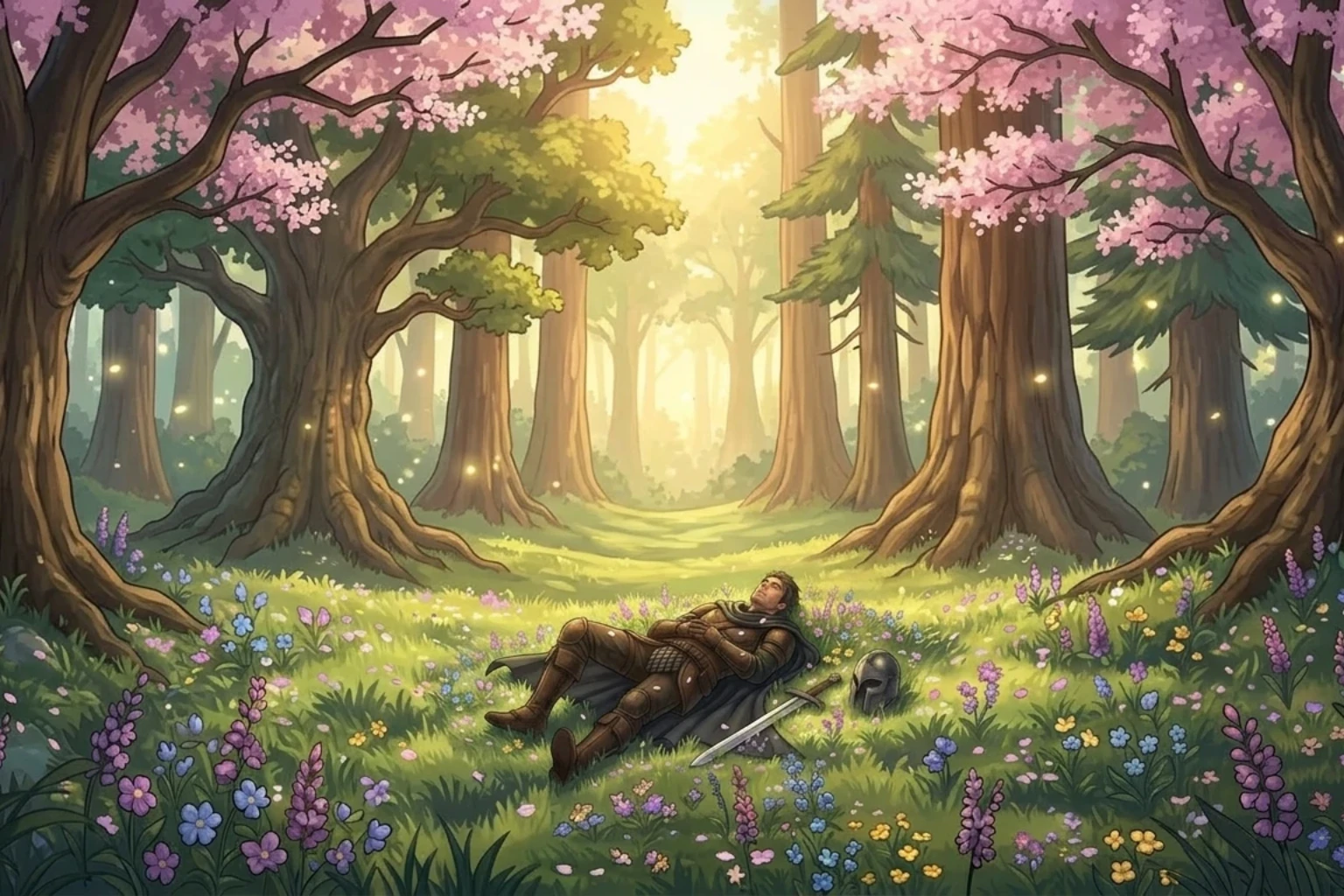
The first days in the grove passed without shape.
The soldier never remembered deciding to stay.
No question was asked of him, and no bargain was offered. The woman—Liora, as he would later come to know her—never spoke of the road beyond the trees or of the storm that had driven him into the forest. She simply moved through the grove as though it had always belonged to her, and in time, he began to move through it beside her.
At first he followed her with the cautious silence of a man who had survived too long by trusting little and observing everything.
He watched where she stepped.
He watched the way birds settled near her without fear.
He watched how the stream seemed somehow clearer where she knelt to fill a small clay vessel with water.
But she never gave him reason to keep his hand near his sword.
She did not ask him who he was.
She did not ask where he had come from.
She did not ask about the old grief he carried like a second cloak.
Instead, she showed him simple things.
Where the stream widened into a quiet pool shaded by smooth stones and blossom branches.
Where the softest moss grew beneath the roots of the oldest trees.
Which berries could be gathered safely from the vines trailing over the banks.
Which paths through the grove stayed dry after rain.
It felt less like being taught and more like being allowed to notice.
The grove itself seemed unwilling to hurry.
Mornings came gently there.
Sunlight never broke through the canopy in harsh beams the way it did in open country. It filtered instead through leaves and petals in soft gold, pooling on the forest floor like warm water. The air held the scent of damp bark, clean earth, and blossoms always just beginning to fall.
At first the soldier woke early out of habit.
The old life had trained him that way.
Years of patrols and marches had taught his body to rise before dawn, before the weather turned, before danger could find him asleep. In the first mornings of the grove he would wake with his breath already tight in his chest, hand half-curled as though reaching for the hilt of a sword that no longer needed holding.
But the forest did not greet him with alarms.
There were no shouted orders.
No distant horns.
No boots splashing through mud outside a camp.
Only the sound of water moving over stone.
Birdsong, soft and layered.
And sometimes the sight of Liora already awake, sitting on the narrow footbridge over the stream with her bare feet tucked beneath her, scattering petals into the current one by one as if watching them drift away answered some private question only she understood.
He never asked what she was doing.
After a time he simply sat nearby.
At first the silence between them felt strange.
Then it became easy.
That was perhaps the first change.
Not a miracle.
Not a revelation.
Just the slow disappearance of strain.
He found that he no longer watched every tree line.
He no longer counted exits from each clearing.
When the breeze moved through branches behind him, he did not always turn.
One morning he realized he had slept through the night.
The knowledge came to him only because it felt so unusual. He had grown used to waking in pieces—once at every imagined sound, once at every old dream, once at every memory sharp enough to drag him back into the darkness of some battlefield or burning village.
But that morning he opened his eyes to warm light already resting on the grove and understood, with quiet confusion, that nothing had dragged him from sleep.
He lay still for a while on the bed of woven reeds and moss Liora had shown him how to make, listening to the forest around him.
No fear waited in his chest.
Only stillness.
He said nothing of it.
Neither did she.
The days continued.
He gathered wood when he saw fallen branches along the grove’s edges. He cleared small stones from the path near the stream without being asked. He repaired one loose board on the bridge with a patience he would not have believed himself capable of months earlier—or whatever counted for months in such a place.
Liora accepted these small acts as naturally as the grove accepted rain.
No gratitude was spoken aloud.
None was needed.
The soldier came to learn her rhythms.
How she paused sometimes beneath the blossom trees with her eyes half-closed, listening to something in the wind he could not hear.
How she knelt beside young shoots pushing through the soil after a rain, touching the leaves lightly as if greeting old friends.
How she smiled at things no one else would have noticed: a fox slipping through the underbrush, a blossom petal caught in a spider’s web, sunlight turning the stream to moving gold.
At first he watched those moments from a distance.
Later he began to see them for himself.
That was another change.
Once, the world had narrowed for him into categories that kept a man alive:
Road.
Fire.
Steel.
Shelter.
Enemy.
Food.
Rain.
Nothing else had seemed to matter.
But the grove kept placing small things in front of him until he began to notice them again.
The smell of clean water.
The warmth of stone after sunlight touched it all afternoon.
The sweetness of fruit gathered at the edge of the clearing.
The feel of soft grass beneath his palm.
The sound of petals landing one by one on the slow-moving surface of the stream.
One day Liora handed him a small piece of fruit split open at the center.
He took it without thinking and bit into it absently, prepared for nothing more than necessity.
Then he stopped.
Liora tilted her head slightly.
The soldier looked at the fruit in his hand.
It was sweet.
Not merely edible.
Not merely enough to quiet hunger.
Sweet.
He stared at it a moment longer than needed, and Liora’s mouth curved in the smallest hint of amusement.
He nearly said something, but found no words large enough for a realization so small.
He ate the rest of it slowly.
The grove changed him in other ways too, though these he noticed only by accident.
One afternoon he crossed the stream by the bridge and glimpsed his reflection in the water below. For a moment he almost did not recognize himself.
He still looked like the same man.
The old scars remained.
The weather-worn skin.
The roughness of long roads and harder years.
But the lines around his eyes no longer looked cut so deeply into him. The hard crease that had lived for years between his brows had softened. His shoulders, once drawn tight as if bracing against a blow that never came, now rested lower beneath his cloak.
He looked less like a man enduring life.
More like one living it.
The thought unsettled him enough that he stepped away from the bridge and did not look into the water again for several days.
Yet the truth of it followed him.
He felt it in his body.
His steps no longer dragged so heavily by evening.
The old ache in one knee—earned during a winter campaign in the eastern hills—bothered him less.
His breath came easier.
Sometimes, walking beside Liora beneath the blossom trees, he even felt something close to lightness in himself.
It did not arrive dramatically.
It came in moments.
A half-laugh escaping him when a squirrel darted across the path with something twice its size in its mouth.
A quiet smile he did not know was there when he watched petals gather against the roots of the bridge.
A morning when he woke and did not immediately remember sorrow.
He still remembered his family, of course.
The loss remained real.
The raid had happened.
The burning had happened.
The empty home had happened.
The grove did not erase any of it.
That was important.
It did not take the grief from him.
It simply loosened its grip.
The memories no longer arrived like knives.
They came instead like distant bells heard through rain—still there, still true, but no longer sharp enough to pierce him every waking hour.
And perhaps because of that, he found himself speaking more.
Not much.
The grove did not invite many words.
But enough.
A question about a tree whose bark shone silver after rain.
A comment about the stream running faster than usual after a warm morning.
Once, as they sat on opposite sides of the footbridge in the late afternoon light, he said quietly, “This place doesn’t feel real.”
Liora looked up from where she had been tracing idle circles on the railing with one fingertip.
“It is real,” she said.
Her voice was soft, almost playful beneath the branches.
The soldier considered that.
Then looked at the drifting petals, the light on the water, the stillness that had settled into his bones.
After a long silence he asked, “Then why does the world outside it feel farther away every day?”
Liora did not answer immediately.
She looked instead toward the deeper trees, where the path curved out of sight.
When she finally spoke, it was with the gentle certainty of someone saying something too simple to argue with.
“Because you are not walking there.”
The soldier lowered his eyes.
There was no riddle in the words.
No hidden lesson.
Only truth.
And strangely, that truth comforted him.
So the days passed.
Or weeks.
Or whatever counted for time in the grove.
Spring never seemed to leave it.
Blossoms drifted endlessly.
The stream remained bright and clear.
The light stayed warm.
And the soldier, who had once entered that forest beneath a storm with nothing left in him but duty and grief, slowly began to feel life return to places inside himself he had long ago thought gone for good.
He did not notice exactly when it happened.
That was the nature of it.
Healing, when it came quietly enough, often felt less like change and more like remembering.


.png)
.png)
.png)