%20(1).png)
I found Fukuhara at seven-fifteen in the morning, which was earlier than I'd planned and later than she'd apparently been there.
The logistics company in the eastern Shita district occupied the ground floor of a warehouse building that had been partially converted to office use — the loading bay still functional at the rear, the front portion fitted out with the modest infrastructure of a company that moved things and tracked the moving of them. The address had taken me most of the previous afternoon to confirm from the contracting agency trace, and I'd arrived at six-fifty to get the position before the working day started.
She was already there when I arrived.
Not inside — outside, standing at the side of the building under the narrow overhang that kept the worst of the rain off the service entrance. She had a coffee in one hand and was looking at her phone with the particular focused attention of someone reading something rather than checking something, and she was positioned in the specific way of someone who had chosen that spot deliberately — sheltered, sightlines in both directions along the building's side, her back to the wall.
I'd seen Osaki check the street before he moved. Fukuhara had chosen her morning coffee position the way a person chose cover.
I noted it and went to the coffee stand across the street.
At seven she went inside. At seven-forty she came back out — this time with a bag over her shoulder, moving with the purposeful walk of someone on an errand rather than a break. She went to the corner, turned north, walked two blocks to a print shop, went in, came out four minutes later with a paper bag, and walked back. I watched the whole circuit from the other side of the street.
She was in her late twenties, as Sayuri had described — compact, quick-moving, with the self-contained quality of someone who had organized their life into a tight perimeter and maintained it carefully. The Higashi ward contracting work had been eighteen months ago. She'd been in the eastern Shita district for eight months, at this employer, and in those eight months she'd apparently developed the habit of arriving early and positioning herself with her back to walls.
Not paranoia. Adaptation.
I spent the morning watching the building. At noon she came out for lunch — a place two streets over, a small counter restaurant, ate alone, read while she ate, checked the street twice on the way there and twice on the way back. At four in the afternoon she left for the day, went directly to a station, took the train two stops east, walked six minutes to a residential building that was newer than most of what surrounded it, went in.
I had a home address.
I didn't approach her. Not today. What I had from the day's observation was confirmation and assessment: alive, functional, located, and operating with the low-level vigilance of someone who knew their environment had been compromised at some point and had adjusted accordingly. The question was whether she'd adjusted because she was still frightened of something current or because the adjustment had become habit after the initial threat had faded.
The file going quiet eight months ago — around the same time she'd started this job — might have been the operation backing off. Or it might have been the file moving to the secondary location.
I didn't know which, and I needed to know before I made contact, because the difference between those two things determined how much risk contact created for her.
I went back to the office at five and called the drop service.
The message I left for Sayuri was short: Fukuhara confirmed, eastern Shita district, employed and located. Assessment: her file going quiet coincides with current job start date. Need to determine whether monitoring discontinued or file relocated. Before contact, I need to know if the secondary location on Temmabashi Street holds current active files or only the moved S-section material.
I put the phone down and thought about how I was going to find that out.
The Temmabashi Street address was in the Higashi ward — not my district, not a location I had the same intelligence network in. Going in the way I'd gone into Motocho Street required preparation I hadn't done for Higashi, and preparation took time I was measuring in the operation's forty-eight-hour accelerated closure window.
There was another way.
I picked up the phone again and called Harlan.
He answered on the third ring. "Seto Repair."
"It's Murphy. I need to know something about the Rindo operation — specifically about their secondary location in the Higashi ward."
A pause. "Murphy," he said, in the tone he used when he was deciding how much involvement he was comfortable with. "I told you last time I couldn't—"
"I'm not asking you to do anything," I said. "I'm asking whether you know anything. The secondary location. Temmabashi Street in the Higashi ward. Has anyone brought you documents from that address for authentication?"
A longer pause.
"Once," he said, finally. "About three months ago. A woman — not one of the two I told you about before. Different person. She brought in a document with the Rindo seal and wanted to know if it was genuine."
"Was it?"
"Yes," he said. "Same seal profile, same wax compound. Genuine Rindo authentication."
"What was the document?"
"I don't know the content," he said. "I authenticated the seal, not the document. But—" He stopped.
"But what?"
"The woman who brought it," he said slowly. "She was frightened. Not the organized kind of frightened, the way people are when they know what they're dealing with. The unorganized kind. Like she'd found something she hadn't been looking for." He paused. "She asked me if a document like this could be used to prove that someone's records had been altered."
I was quiet for a moment. "What did you tell her?"
"I told her that the seal authenticated the document's origin — that it came from Rindo — but that whether the content could prove alteration depended on having something to compare it against. A before and after." He paused. "She seemed to understand that. She left."
"Did you get a name?"
"No," he said. "She paid cash and didn't give one."
"Description?"
He described her. Late twenties. Compact, quick-moving. The description matched well enough.
"Thank you, Harlan," I said.
"Murphy." The careful tone again. "Is this going to come back to me?"
"No," I said. "You authenticated a seal three months ago. That's all you did."
I put the phone down.
Fukuhara Misae had found her own file.
That was what the file going quiet meant — not that the monitoring had stopped and not that the file had been moved. She had somehow gotten access to a document with the Rindo seal, had understood enough of what she was looking at to take it to someone who could authenticate it, and had been living for three months with the knowledge that there was a file on her somewhere, compiled without her knowledge, held by an organization she couldn't identify from the outside.
She'd been waiting for someone to come because she had a piece of the puzzle and no way to use it alone.
I called the drop service again and updated the message.
---
Sayuri called the office at eight the next morning.
Not through the drop service — a direct call, which meant a new clean line, which meant she was burning through her burner inventory faster than she'd planned. I picked up on the second ring.
"I got your messages," she said.
"Fukuhara found her own file," I said. "Or found a document from it. Three months ago she took a Rindo-sealed document to someone for authentication and asked whether it could prove record alteration. She's been sitting on that for three months."
Silence on the line. Then: "How did she get a document from her own file?"
"I don't know yet," I said. "That's one of the things the conversation with her will tell us." I paused. "She's ready to talk to someone. She's been waiting for it. The question is whether we're the right someone."
"The Temmabashi Street location," Sayuri said. "Your message asked about current active files versus moved material."
"Yes."
"I can't tell you with certainty," she said. "When I was inside, the secondary location held overflow from the primary and material that was considered higher sensitivity — files on subjects with more direct exposure to the client's activities, as opposed to the general monitoring files." She paused. "If Fukuhara's file was moved to Temmabashi, it's because her exposure level was reclassified upward. Which would mean the operation considers her more of a risk than the file activity level suggested."
"Which would mean monitoring her more closely," I said. "Not less."
"Yes," she said.
We were both quiet for a moment.
"We need to move on contact," I said. "Both of them. Today, if possible. Tomorrow at the latest."
"I agree," she said. "How do you want to do it?"
"Fukuhara first," I said. "She has something — the document she authenticated. That changes what the conversation looks like. She's not just a subject we're asking to trust us. She's someone with a piece of evidence who's been waiting for context." I paused. "I approach her directly. Today, at her workplace, controlled environment, public enough that she doesn't feel cornered. I tell her enough to establish that I know about the file, about the authentication three months ago, about what the operation is. I give her the choice."
"And Osaki?"
"Osaki is more cautious," I said. "He refused contact once. A direct approach risks him shutting down again. I want you to make the Osaki contact — you know the case from the inside, you can tell him things about his own file that only someone with access could know. That's a different kind of credibility than I have."
A pause. "I've been avoiding direct contact with the subjects," she said. "To protect them from my exposure."
"I know," I said. "But the timeline has moved. The operation is in damage-control mode and Osaki is in an active file. Protecting him from your exposure is less important now than getting him the information that might actually protect him."
Another pause, longer. "You're right," she said. "When?"
"This afternoon for Fukuhara," I said. "I'll call you when I'm done. You take Osaki tonight, or first thing tomorrow if tonight doesn't work."
"And after we've talked to both of them?"
"We meet again," I said. "All four of us, if they're willing. They get to see the full picture and they get to decide what happens next."
Silence on the line.
"Murphy," she said. "If either of them says no — if they look at what we have and decide the risk is too high and they don't want to be part of whatever comes next—"
"Then we respect that," I said. "They're the ones with the most to lose. It's their call."
She was quiet for a moment. "And if both of them say no?"
I thought about that. About the eight sheets in the packet. About the name on the first sheet. About Sekine's sister.
"Then we figure out what two people can do with what we have," I said. "Without them."
"That's a smaller set of options," she said.
"Yes," I said. "It is."
"Alright," she said. "Fukuhara today. Osaki tonight. Call me when you're done."
The line went dead.
---
I found Fukuhara at the print shop.
Not because I'd planned it that way — I'd been heading for the logistics company, intending to approach her on her lunch break, and I'd rounded the corner two streets from the building to find her coming out of the print shop at eleven in the morning with a paper bag, which meant she was on an errand again. I adjusted.
I fell into step beside her.
Not from behind, not rushing to catch up — from the side, the natural collision of two people converging on the same stretch of pavement, and I matched her pace and said her name.
She stopped.
She didn't run. She didn't shout. She stopped and turned and looked at me with the specific expression of someone whose prepared-for moment had arrived and who was rapidly assessing whether it was arriving in the form she'd prepared for.
"Fukuhara Misae," I said. "My name is Murphy. I'm not with the organization that has your file. I'm working against it. I have approximately two minutes before this street gets busy enough that this conversation becomes observable, and I'd like to use them if you're willing."
She looked at me. The assessment was fast and focused. "How do you know about the file," she said. It wasn't a question.
"Because someone who worked inside the system for two years copied eight files before she left," I said. "Yours was one of them. The billing irregularity you reported eighteen months ago, the contract that wasn't renewed, the monitoring that followed. I know what the file says."
"The authentication," she said. "Three months ago. The man at the repair shop."
"Harlan," I said. "He described you. You asked him if a document with that seal could prove record alteration."
Something shifted in her face. Not relief — something more complicated than relief. The expression of someone who had been carrying something alone for a long time and had just found out the weight of it had been noticed.
"Yes," she said.
"Can we talk somewhere?" I said. "Not here."
She looked at the street, at me, at the paper bag in her hand. Then she said: "There's a place two blocks north. A covered seating area outside a noodle stand. Usually quiet before noon."
"Lead the way," I said.
---
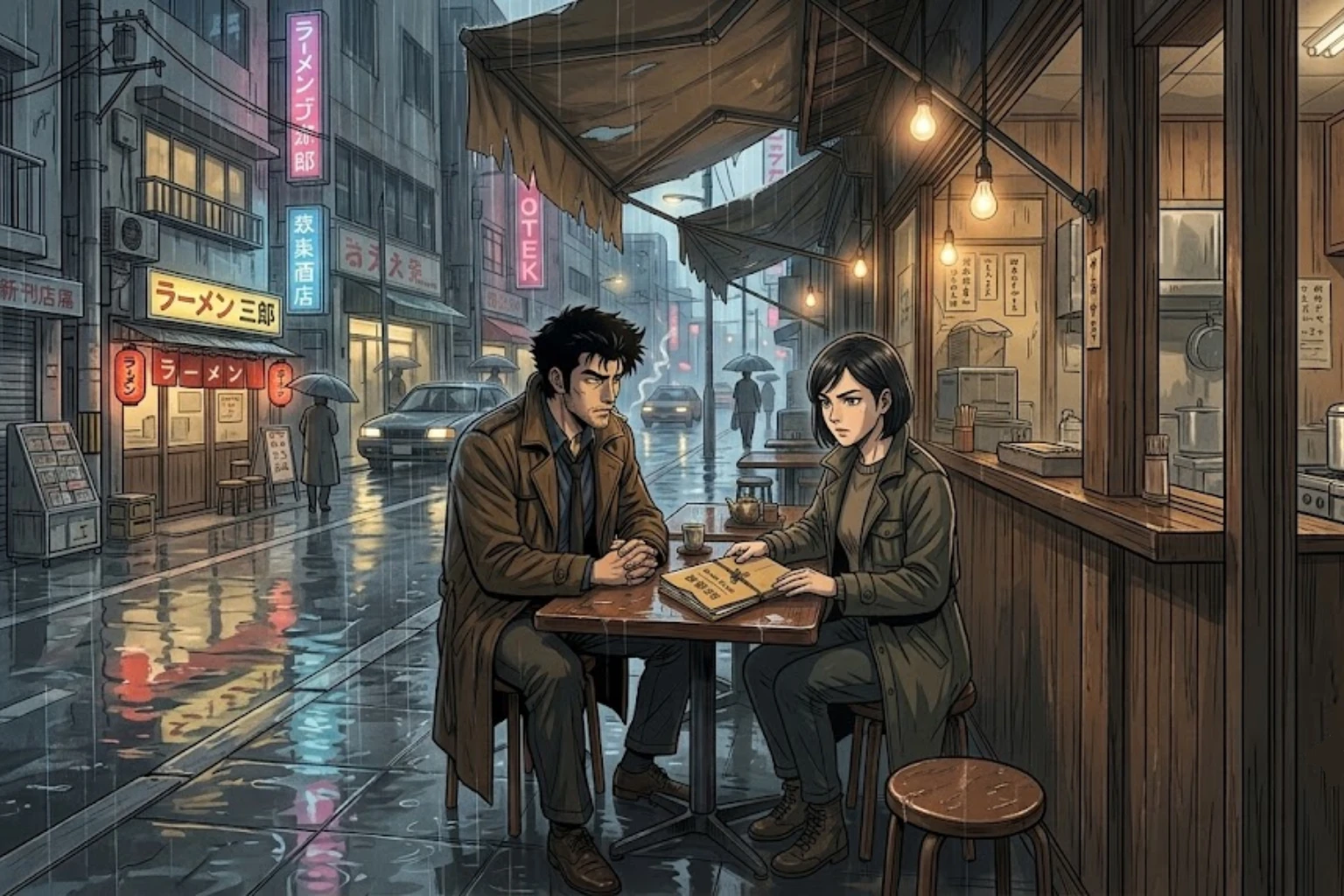
The noodle stand's covered seating area was four tables under a canvas canopy, separated from the street by a low planter that gave the impression of privacy without actually providing much of it. Two of the four tables were empty. We took the one at the far end and I sat with my back to the planter and she sat facing me and the street beyond, which was where I would have sat if I'd been her.
I didn't make her wait.
"The organization is called Rindo Document Custody," I said. "Or it was — it's been through two corporate registrations and two dissolutions and it's still operating. It maintains files on individuals who've come into proximity with information that its client needs to control. Compiled activity records, without the subjects' knowledge or consent. Your file was opened after you reported the billing irregularity to your employer."
She looked at me steadily. "The billing irregularity was real," she said. "It wasn't a miscategorization. It was a deliberate misdirection of funds from a public contract to a private account."
"I believe you," I said.
"The internal review said it was a miscategorization," she said. "My contract wasn't renewed. I told myself to let it go." She looked at the table. "Then three months ago a document turned up."
"How?"
"A former colleague," she said. "Someone who'd been at the same contractor, left before I did. He found it in a set of documents that had been misfiled — paperwork from a storage transfer, a crate of records that ended up at the wrong location. He didn't know what it was. He gave it to me because my name was on it." She paused. "It was a summary document. Three pages. My name at the top, the Rindo seal at the bottom. And in between — everything. The billing concern I'd raised. The internal review. The decision not to renew my contract. And then eighteen months of activity records after that."
"The monitoring."
"Every contract I've taken since," she said. "Every address. Every professional contact. Logged and summarized, going back to the day my contract ended." She met my eyes. "I've been building my life back for eighteen months and someone has been writing it down in a file I didn't know existed."
The noodle stand's canvas canopy moved in the wind. The street beyond the planter was doing its midday thing. I gave her a moment.
"The document you have," I said. "The three pages. Do you still have it?"
"Yes," she said.
"It's evidence," I said. "It corroborates what the copies I'm holding show from inside the system. Yours is a document that came out of the system itself — an original, not a copy. That's a different category of evidence."
She was quiet for a moment. "What are you trying to do with it?"
"That depends partly on you," I said. "I'm going to tell you the full picture — who the client is, what the operation is used for, how many files there are, what we know about the people who've stopped being findable since the operation started. And then I'm going to ask you what you want to do, because you're the one who has the most at stake and you and the other people in those files should be the ones who decide how this goes."
"The other people," she said.
"Eight files were copied," I said. "Three of those individuals have stopped being findable. Two others haven't been contactable safely. One was contacted and declined. That leaves you and one other man — a former civil servant named Osaki, in the Namba district." I paused. "He knows his inquiry was erased. He's frightened. We're talking to him today."
She absorbed this. "You said three people stopped being findable."
"Yes."
"In how long?"
"Eighteen months," I said.
She looked at the table. "The operation has a file on me that's been running for eighteen months," she said. "And three people with files have stopped being findable in the same period."
"Yes," I said. "That's the picture."
She was quiet for a long time. Long enough that the table next to us was taken by two people having a lunch conversation that I registered as background and nothing more. The rain had eased to a drizzle. The canvas canopy dripped at the corners.
"Tell me who the client is," she said.
I told her.
She knew the name. Of course she did — it was the kind of name that registered in civic and professional circles, the register of people who appeared in the financial pages and the official announcements and the industry association reports. She knew it the way you knew a name that was part of the infrastructure of the city's self-governance, that appeared in the context of decisions made about how resources were allocated and contracts were awarded.
The billing irregularity she'd reported eighteen months ago. The public contract with misdirected funds. The client's office had oversight of the agency that had managed the contract.
She'd reported it up a chain that ended with the person who was running the operation that had been monitoring her ever since.
She sat with it for a moment. Then she said: "I need to think about this."
"Of course," I said.
"Not long," she said. "I've been thinking about it for three months, in the sense that I've known something was wrong and I've had a piece of it and I didn't know what to do with the piece. Now I have the rest of the picture." She looked up. "Where do I reach you?"
I wrote the office number on a page from my notebook and gave it to her.
"Tonight," she said. "I'll call you tonight."
"Fukuhara," I said. "Whatever you decide — the document you have, the original with the Rindo seal. Keep it somewhere that isn't your home address. Not because I think something is immediately going to happen, but because the operation is in a phase where it's moving material and adjusting its exposure, and the document is evidence that originated from inside the system. It's the kind of thing they'd want back."
She looked at me. "I know," she said. "It hasn't been at my home address since the day I got it."
She stood, picked up the paper bag from the print shop, and left the seating area without looking back.
I sat at the table for a few minutes longer, watching the street, and then I went to find a telephone.
---
I called Sayuri from a payphone in the Tenma district.
"Fukuhara," I said when she picked up. "She has an original document from her own file — a summary with the Rindo seal, three pages, came out of the system through a misfiled storage transfer three months ago. She's been sitting on it since then. She's thinking about what she wants to do and she'll call me tonight."
Silence. Then: "An original."
"Yes."
"Murphy, an original Rindo document in a subject's possession — that's a different category of evidence from copies made by someone who worked inside the system. Copies can be challenged on provenance. An original that came out through a misfiled transfer has a chain of custody that doesn't run through us."
"I know," I said. "That's why I told her to keep it somewhere safe."
"Did she understand the significance?"
"She understood before I did," I said. "She's been careful with it for three months. She took it to Harlan for authentication — she was already thinking about what it would take to use it."
Another silence, the processing kind. "Osaki tonight," she said.
"Are you ready?"
"I've been ready," she said. "I'm going to tell him what I know about his file. What the inquiry looked like from inside the system before it was altered. What the original record showed before the client changed it." She paused. "I'm the only person who can tell him that. No one else has seen his file."
"That's why it has to be you," I said. "He refused contact before because he didn't know what the contact had to offer. You can offer something specific."
"If he'll listen," she said.
"If he'll listen," I agreed. "Call me when you're done."
I hung up and walked back to the Shita district.
---
Fukuhara called at seven-forty-two.
I was at the office, working through the notes I'd accumulated over the week — not the case notes, the physical ones I kept in my head, but the organizational work of making sure I had a clean record of what had been established and what was still inference and what the gaps were. It was the kind of work you did when you were waiting for something to resolve and needed your hands occupied.
The phone rang and I picked it up and she said: "Murphy."
"Fukuhara," I said. "What did you decide?"
She was quiet for one beat. "I want to understand the options," she said. "Not make a final decision until I hear them. But I'm not stepping back from this."
"All right," I said.
"The three people who stopped being findable," she said. "Are you trying to find them?"
"Yes," I said. "Finding them is part of what comes next, depending on which path we take. If there's a legal filing, or a journalistic investigation, or an official inquiry, finding them becomes a priority for whoever is conducting it." I paused. "We don't have the resources to find them independently. But the right institutional mechanism might."
"The billing irregularity I reported," she said. "The misdirected funds. It was a specific contract — a public infrastructure project in the Higashi ward. Eighteen months ago it was a significant amount of money. If that money went where I think it went based on what I saw in the records, and if there's documentation of where it went—"
"The operation's files might contain that documentation," I said slowly.
"The operation compiled records on everyone who came into proximity with information the client needed to control," she said. "The billing irregularity was the information. I was one person who knew about it. There would have been others — the contractor's finance manager, the project auditor, the agency oversight person who should have caught it. All of them would have files."
I looked at the wall above the desk.
She was right. The file system wasn't just surveillance — it was case management. The client would have opened files on every person who might be a risk to a specific piece of information, and a significant misdirection of public funds on a Higashi ward infrastructure project was exactly the kind of information that warranted comprehensive case management.
"The financial evidence might be in the system itself," I said.
"In someone's file," she said. "Compiled from whatever sources the operation used. If the activity records on those other people documented what they knew about the money—"
"It's inside the Temmabashi Street location," I said. "The secondary location. The higher-sensitivity files."
"Can you get in?" she said.
"Possibly," I said. "But getting into the secondary location while the operation is in damage-control mode is a different risk calculation than getting into Motocho Street was. They're already responding to the external situation. The secondary location will be more carefully managed right now."
"I'm not saying do it tonight," she said. "I'm saying it's part of the picture. When we decide what mechanism to use — journalist, lawyer, official inquiry — we need to know whether the financial evidence exists inside the system and whether it's accessible. Because if it is, that changes what the mechanism can accomplish."
She'd been thinking about this for three months with one piece of the puzzle. She had the rest of it now and she was already three steps ahead.
"Tonight I need you to tell me the options," she said. "All of them. What each one can realistically accomplish and what it costs."
"Can you meet tomorrow morning?" I said. "I want to wait for Osaki's answer before we have that conversation. If he's in, he should be part of it. If he's not, we work with who we have."
A pause. "All right," she said. "Tomorrow. Call me when you know about Osaki."
She hung up.
---
Sayuri called at ten-fifteen.
"Osaki," I said.
"He listened," she said. "I told him what his file contained before the alteration. The original inquiry — the date, the case number, the content of his submission. He confirmed everything. He went very still when I told him what the file said his inquiry had been changed to."
"How did he take it?"
"He took it the way someone takes confirmation of something they already knew but couldn't prove," she said. "Not surprise. Something more like — resolution. The specific relief of being believed about something you'd stopped expecting to be believed about."
I understood that. It was the same thing I'd seen in the way Fukuhara had listened at the noodle stand.
"Did he agree to participate?"
"He didn't say no," she said. "He asked questions. A lot of them. About the operation, about who else was involved, about what participation would mean for him concretely." She paused. "He's frightened. But he's also — he's been living with this for two years, Murphy. Two years of knowing his inquiry was erased and not being able to do anything with that knowledge. He asked me what would happen to his file if we went forward."
"What did you tell him?"
"The truth," she said. "That we don't know exactly, that it depends on the mechanism we use, that the goal is to get the files into a framework where they can be examined by people with the authority to act on what they contain." She paused. "He said he needed to sleep on it. He'd call me tomorrow."
"That's not a no," I said.
"It's not a no," she agreed. "He knows his file is active. He knows the operation is currently in a response phase. He knows that sitting on it is not actually a safe choice even though it feels like one." She was quiet for a moment. "He'll call tomorrow."
"Fukuhara is in," I said. "Conditionally — she wants to hear the full options before she commits fully. But she's not stepping back. And she has something else."
I told Sayuri about the billing irregularity, the Higashi ward infrastructure project, the probability that comprehensive files on every person who knew about the misdirected funds existed somewhere in the system.
Silence on the line.
"The financial evidence," Sayuri said slowly. "Murphy, if the operation compiled files on the auditors and the finance managers and the oversight people — everyone who might have known about the irregularity—"
"Then the files themselves contain the documentation of what the client was covering up," I said. "Not just the surveillance. The crime."
"Temmabashi Street," she said.
"Temmabashi Street," I agreed. "The higher-sensitivity files."
"Getting into Temmabashi while the operation is in response mode—"
"Is a significant risk," I said. "I know. We don't decide that tonight. Tomorrow, when Osaki calls and we know whether we have two or three people at the table, we meet with Fukuhara and we lay out the full options and we let them make the call. All of it — journalist, lawyer, prefecture insider, what Temmabashi might hold, what it would take to get to it. They're the ones whose lives are in the files. They get to decide the risk level."
Sayuri was quiet for a moment.
"That includes the risk level for you," she said.
"Yes," I said.
"And for me."
"Yes," I said. "For both of us too. We're in this picture. We've been in it since Kuroame. But it's their picture first."
The line was quiet for a few seconds. Outside, the rain had stopped for the first time all week, and the absence of it was loud in its own way — the city settling into the specific silence of a night that had lost its background sound and hadn't decided yet what to replace it with.
"Murphy," Sayuri said.
"Yes."
"When this started — the handoff at Kuroame — I told you I needed someone who wouldn't take what I gave them to the police. Someone who operated outside official channels." She paused. "I didn't think about what came after the holding phase. I was focused on keeping the packet safe long enough to figure out the next step."
"And now?"
"Now the next step is other people making decisions about their own lives," she said. "Which is what it should have been from the beginning. I was inside the system for two years. I copied eight files. I chose which eight." Another pause. "I made a lot of decisions about other people's situations without being able to ask them first."
"You were trying to help them," I said.
"Yes," she said. "That's what I told myself. It's still what I believe." She was quiet for a moment. "But tomorrow they get to tell me if I got it right."
"Tomorrow," I agreed.
I put the phone down.
The office was quiet around me. The desk, the filing cabinet, the window facing the alley. The positional details all correct, no one having been in since I'd last checked.
I thought about Fukuhara saying she'd been building her life back for eighteen months and someone had been writing it down. I thought about Osaki checking the street before he moved, twice, every time. I thought about Sekine's sister, who had found Sayuri's name and wanted something to give.
I thought about the Temmabashi Street building and what it might hold.
Not tonight. Tonight was for what had been decided and what still needed deciding. Tomorrow was for the room with four people in it and the full picture laid out between them and the question of what they were going to do with it.
I locked the office and walked home in the first dry air the city had offered all week.
The streets were the streets. The Shita district was itself. Nothing was resolved and the next step was the people most affected by it deciding what the next step was.
That was how it should work.
It was also the part of the job where you found out what kind of people you were dealing with, and from everything I'd seen in the last five days — Sayuri in the cold storage room, Fukuhara already three steps ahead at the noodle stand, Osaki checking the street and still getting up and going to work — I had a reasonable sense of what kind they were.
The kind that had been waiting for someone to take them seriously.
The packet was on the bathroom door. Eight sheets of cream stock from inside a system that documented the lives of people who hadn't consented to be documented. Tomorrow those people would look at what those eight sheets said about them and decide what to do about it.
That was their call.
It had always been their call.
It just took this long to give it back to them.


.png)
.png)
.png)