%20(1).png)
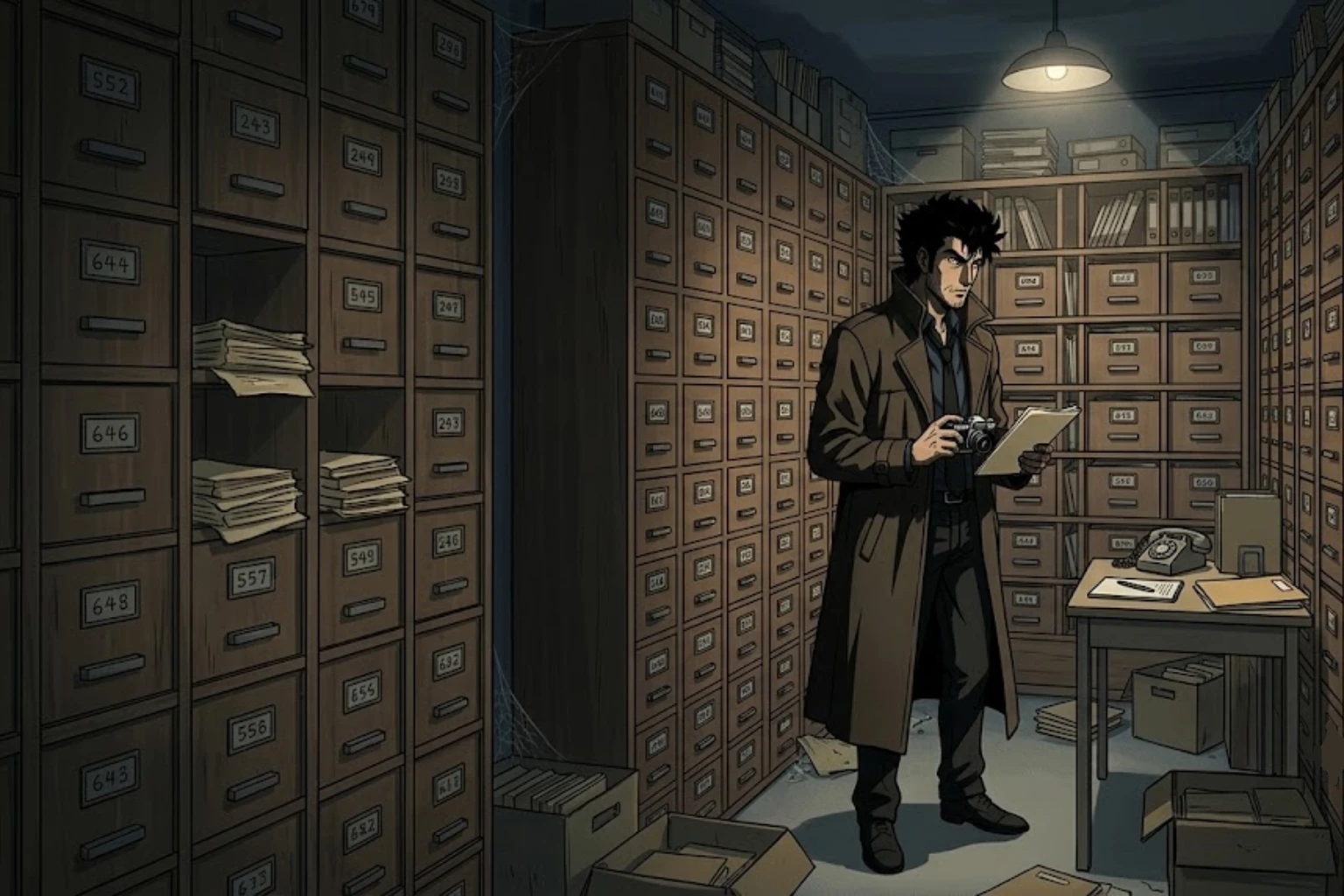
I went back to Motocho Street the next morning, and I went earlier than anyone would expect and from a direction that wasn't the obvious one.
The obvious approach was from the south, where the street connected to the main Shita district arterial and where there was foot traffic consistent enough to move through without being notable. I came from the north instead, through a service lane that ran behind the building and connected to Motocho at the far end, and I spent twenty minutes in the service lane before I moved, watching the back of the building for the specific kind of stillness that meant nobody was watching back.
The building's rear had a service entrance — a steel door, older than the rest of the building's fitting-out, with a lock that had been upgraded at some point but not recently. The upgrade was a barrel lock, standard commercial grade, the kind that locksmiths stocked in quantity and that required a specific key profile that was not, in practice, very specific. I had the right tool for it in the inside pocket of my coat, where I kept the tools that were professionally useful and legally ambiguous. I'd been carrying them for nine years and had needed them perhaps thirty times, and each time I needed them I was grateful I had them and careful about what I was grateful for.
The lock took forty seconds. The door opened inward without protest, which meant the hinges were maintained, which meant someone came in this way regularly enough to care about the hinges.
Inside: a ground-floor service corridor, institutional linoleum, a bare bulb in a cage fitting mounted on the ceiling. Ahead of me, a stairwell. To my right, the back of the office supply shop's storage area, visible through a half-open door — shelves of stock, the smell of paper and cardboard. No one there.
I went to the stairwell and up.
The building was the kind that had been split into tenancies without a great deal of thought for the resulting layout — the stairwell served all four floors, with a landing at each one and a door from the landing into whatever occupied that floor. First floor: the office supply shop, the door marked with the shop's name on a plastic card slotted into a holder. Second floor: a door with no marking, a padlock on a hasp, closed. Third floor: a door with a frosted glass panel set into its upper half, the glass catching the limited light from the stairwell's single window and giving nothing back.
I stood on the third-floor landing and listened.
The building was quiet in the way of buildings before the working day started — not the silence of a building with no one in it, but the settled quiet of a building where no one was moving yet. Below me I could hear the faint sound of the office supply shop's front being opened — the owner arriving for the day, which meant I had a fixed point for when the building's ground-floor activity began. The third floor had no sound through the door that I could hear.
The third-floor door's lock was a keyed handle, not a deadbolt, and the frame showed the marks of a door that was used regularly — wear on the plate, the paint around the handle slightly dull from contact. Not a door that was rarely opened.
I opened it.
---
The third floor was one large space, divided by a low partition that ran roughly through the center of the floor and created two areas without fully separating them. The front half — the side with the frosted-glass window I'd observed from the street — was set up as an office in the minimal sense: a desk, a telephone, two chairs, a filing cabinet. The furniture was functional and mismatched, the kind of assortment that accumulates in a working space rather than being chosen for it. The desk had nothing on it. The telephone was a standard line unit with no identifying marks.
The back half was what mattered.
Past the low partition, filling the rear two-thirds of the floor space, were the cabinets.
Not filing cabinets in the standard office sense — although there were two of those along the left wall. The main storage was a system of custom-built wooden cabinets that ran floor to ceiling along the back wall and the right wall, fitted with small drawers of uniform size, each drawer labeled with a code in black ink on a white card. The codes were alphanumeric — a letter prefix followed by six digits — and they were sequential along each row, which meant the system was organized and the organization had been maintained over time. There were several hundred drawers. Possibly more than a thousand.
I stood in front of the nearest section and looked at the labels.
The letter prefix on this section was R. The numbers ran from R-001001 to what I could see of the sequence. I pulled the nearest drawer.
Inside: a folded document, thin, the paper a cream stock that was heavier than standard office paper. I unfolded it carefully.
A personnel summary. Not an employment record — not the kind a company maintained on its own staff. This was a compiled document: name at the top, followed by a date of birth, a residential address, a workplace, and then a series of dated entries in the body of the document. Each entry was short, two or three lines, and each one described a transaction or an interaction. A financial transfer on one date. A meeting recorded on another. A property inquiry. A legal consultation. Items that individually were unremarkable and that together constituted a detailed picture of a person's activities over what appeared to be several years.
The person named at the top of the document was not a public figure. The name meant nothing to me. Below the name, in small type, a code: R-001001.
I refolded the document and replaced it.
I pulled three more drawers at random, from different sections of the cabinet system. All four followed the same format — the personnel summary, the compiled activity entries, the code. Different names, different codes, different letter prefixes. The section I was in was R. The section to the right was S. I could see T and U beyond that.
I did a rough count of the sections and the drawers per section.
Somewhere between fifteen hundred and two thousand individual files in this room.
I stood in the middle of it and thought about what Sayuri Shiranami had said. People missing. Official records saying they'd never existed. The kind of missing where the filing system said they were never there to begin with. And Harlan: personnel records of people who didn't know they were being documented.
This was the filing system.
This was what Rindo had been. What Keisen had continued. What was still being maintained, fourteen months after Keisen had filed its simplified closure claiming no clients and no outstanding obligations.
I thought about the scale of it. Fifteen hundred files, minimum. Each one a compiled record of a private individual's activities, maintained without their knowledge, organized and cross-referenced and stored in a custom cabinet system in a third-floor office on Motocho Street in the Shita district.
The question was who. Who was in the files. What the criteria were for being documented. What the files were used for, and by whom.
I went to the standard filing cabinets on the left wall. These were locked — a different lock from the drawer system, a four-drawer unit with a central bar lock running through the drawer handles. This lock was better than the building's service entrance and the third-floor door. Someone had thought about securing these specifically.
I looked at the lock and at the time I had and at what I could reasonably accomplish, and decided that the bar lock was going to take longer than I wanted to spend on it and that the drawer system had already given me what I needed to understand the basic shape of the operation. I could come back for the filing cabinets.
I went to the desk instead.
The desk had one drawer, which was unlocked, which meant either it held nothing sensitive or whoever used the desk had a different theory about security than I did. Inside the drawer: a pen, a small notepad with nothing written on it beyond some phone numbers on the first page, a box of paper clips, and a folder.
The folder held three sheets of paper. The top sheet was a printed list — columns of codes, the same alphanumeric format as the cabinet labels, with a date beside each code and a status notation. The status notations were abbreviated: ACT for active, SUS for suspended, CLO for closed. Most of the codes on the list were ACT. Twelve were CLO. Three were SUS.
I looked at the CLO codes and at the dates beside them. The most recent closure date was eight months ago. The earliest was two years ago.
Twelve closed files in what appeared to be a system of several hundred active ones.
I thought about Sayuri: three people who had stopped being findable in the last eighteen months.
Not twelve. Three. Which meant CLO didn't necessarily mean what I was afraid it meant. It might mean the subject had moved out of range, or the documentation on them had been transferred to another system, or the client who'd commissioned their file had ended the service. A document custody firm maintained records on behalf of clients — the clients commissioned the files, not the firm. CLO might be a client instruction to close.
Might be.
I photographed the list with the small camera I carried for exactly this kind of work — a compact unit, no flash, the kind that produced usable images in low light without announcing itself. I photographed the top page of the notepad, which showed the phone numbers. I photographed two of the personnel summary documents I'd pulled from the drawers, refolding them carefully after.
Then I heard the door at the bottom of the stairwell.
Not the service entrance — the front entrance, the one on Motocho Street. The sound of a street door opening and the corresponding shift in the building's ambient noise, the brief intrusion of outside sound and then the door closing and the building returning to its interior quiet. Followed by footsteps on the stairs.
Not the office supply shop owner. The shop's door was on the ground floor, accessed directly from the street. These footsteps were on the stairwell, coming up.
I put the folder back in the desk drawer exactly as I'd found it. Closed the drawer. Moved to the partition between the front and back halves of the room and went to the back half, into the cabinet system. The cabinets ran floor to ceiling on three walls and the space between the back wall and the final row of cabinets was approximately two feet wide — a service passage for accessing the rear of the drawer units. I went into the service passage and stood against the back wall and did not move.
The footsteps reached the third floor landing.
A key in the lock — a proper key, smooth, no hesitation. The door opened.
One person, from the sound of the footsteps on the linoleum. They came into the front half of the room and I heard the sound of a coat being removed and placed over the back of the chair, the specific double-tap of a bag or briefcase being set on the desk surface. Then the sound of the desk drawer opening.
I breathed in through my nose, slow and controlled, and out the same way. The service passage behind the cabinets smelled of wood and old paper and the accumulated dust of a space that was cleaned infrequently and used mainly for the cabinets rather than for standing in. It was not a comfortable space. I was not there to be comfortable.
The person at the desk was doing something with the folder — I could hear the papers being handled. Then the telephone receiver being lifted.
A call being placed. A pause while it connected.
Then a voice — male, middle-aged by the register, speaking in the flat professional tone of someone conducting a routine transaction.
"It's me," he said. "The Motocho inventory." A pause while the other end responded. "Fourteen new entries since Tuesday. Seven in the R section, four in the T section, three transfers in from the secondary location." Another pause. "No. The S-series closure is complete. The documentation has been moved." A shorter pause. "I'm aware of the timeline. I'll have the summary ready by Thursday." The last pause was longer. "That's not my concern. The concern is the active files. If the external situation requires accelerated closure on any of the current actives, I need forty-eight hours notice minimum to process the paperwork correctly."
The call ended. The receiver went down.
I stood in the service passage and held what I'd just heard against what I already knew.
External situation. Accelerated closure. Forty-eight hours to process the paperwork.
The S-series closure. I'd seen the S-section labels on the cabinets — the section adjacent to the R-section I'd been examining. The S-series closure was complete, documentation moved. Sometime between my observation yesterday and this morning, a section of files had been closed and the physical documents relocated.
Because of the external situation.
Because of me.
I was the external situation. My office had been searched two days ago. I'd been tailed yesterday. Whoever was running this operation had been tracking me since the night of the Kuroame handoff, and whatever they'd concluded from that tracking had prompted them to accelerate a closure process in the files that were most relevant to whatever Sayuri Shiranami had copied.
The S-series. Sayuri. It was not a subtle filing convention.
I didn't move. The man at the desk was still there — I could hear him working, the occasional sound of paper, once the desk drawer opening and closing again. He was doing what he'd come to do, which was the routine work of maintaining a records operation, and he was going to be there for a while.
I had learned something valuable by being in the service passage. I had also given up my exit for an indefinite period, which was the cost of the information, and it was a cost I was in the process of paying whether I'd agreed to it or not.
I settled my weight and waited.
---
Forty minutes.
That was how long I stood in the service passage before the man at the desk finished what he was doing, replaced whatever he'd been working on, put his coat back on, and left. I counted the time by the intervals between sounds — the desk work, two more brief phone calls that I listened to and filed, the sounds of someone wrapping up a morning's work before the day got further along.
The second call had been shorter than the first. A confirmation of a delivery time — not a delivery of goods, a delivery of information. A summary document going to an address he didn't state on the call, the delivery method described as the usual channel, the recipient identified only as the office.
The third floor had a client. A single client, from the sound of it — everything flowed toward the office, via the usual channel, on a regular schedule. Rindo and Keisen hadn't been running a general document custody service with multiple clients. They'd been running a dedicated operation for one.
The door opened and closed and the footsteps went down the stairs and I heard the front entrance open and close at street level.
I waited another three minutes. Then I came out of the service passage.
The room was as it had been when I arrived, plus the evidence of forty minutes of someone working at the desk, which was not visible evidence — the desk was clear, the drawer closed, nothing left on the surface. The man had come, done his work, and left without leaving a trace of himself, which was either professional habit or the trained behavior of someone who understood that the space they worked in was not supposed to announce itself.
I went to the S-section of the cabinet system.
The S-section drawers were empty. All of them. Every drawer I checked — and I checked twenty, from different parts of the section — pulled out to show a bare interior, the cream stock documents that should have been there gone. Removed cleanly, no torn edges, no missed documents at the back of the drawer. Someone had emptied the S-section systematically and had done it recently enough that there was no accumulated dust in the drawer interiors where the documents had been.
Sayuri's file. Whatever Rindo had compiled on her during the two years she'd worked for the operation — if that was what the files represented, if the subjects were people connected to the organization rather than random individuals — was gone.
Or whatever the S-section had been. I was inferring from the filing convention, and filing conventions weren't always what they appeared to be.
I photographed the empty drawers anyway. Then I went back to the desk and checked that I'd left it as I'd found it, went back to the service passage to confirm I hadn't left any trace of being there, and went to the door.
The stairwell was empty.
I went down to the service entrance, let myself out, and relocked the door behind me.
The service lane was empty. The morning was further along now than when I'd gone in — closer to nine than to seven, the city having committed to its daytime operation while I was standing in a cabinet passage listening to someone describe the logistics of a records closure.
I went north through the service lane and didn't stop moving until I was four blocks from Motocho Street, at which point I went into a coffee stand and ordered something and sat at the counter and wrote down everything I'd heard in the order I'd heard it while it was still exact in my memory.
The fourteen new entries since Tuesday. The seven in R-section, four in T-section, three transfers from the secondary location. The S-series closure complete, documentation moved. The forty-eight hours needed for accelerated closure on current actives. The summary going to the office via the usual channel by Thursday.
I looked at what I'd written.
A secondary location. The man on the phone had mentioned it — three transfers in from the secondary location. The Motocho Street office was not the only physical site. There was at least one other location where files were held, and material was moving between them.
And a client — singular, from everything I'd heard. The office. Everything flowed to the office.
I drank the coffee. It was not as good as the coffee stand from the previous morning, but it was hot and I'd been standing in a cabinet passage for forty minutes and had developed an unqualified appreciation for hot.
I thought about the S-section.
Sayuri's file was the reasonable inference. She'd worked for the operation for two years. She'd left four months ago with copies of documents. The operation had been tracking the situation — the external situation, the man had called it — since at least the night of the Kuroame handoff, and possibly before that, during the three months she'd spent looking for the right operator to hand the packet to. When the external situation developed — when I appeared — they'd moved the S-section files. The documentation that was most relevant to whoever had become the threat got moved to the secondary location or destroyed or both.
This was damage control. The operation had been running clean for years, invisible in the paper record, maintaining files on people for a single client, and now someone had the copies and had found someone to help with them, and the response was to accelerate closures and move sensitive files.
They were worried.
Not panicked — the man on the phone had been calm, professional, routine. But they were responding, and the response was the move-and-close pattern of an organization that had a protocol for when its operational security was threatened.
I needed to know who the client was.
The office. Everything went to the office. Not a description — a designation, the kind of shorthand that you used when you only had one client and didn't need to specify.
The phone numbers on the notepad in the desk drawer. I'd photographed them. Two numbers, handwritten, no names beside them. One of them was likely the number the man had called this morning. The other was something else — possibly the secondary location, possibly the client's office.
I needed to run those numbers.
I also needed to find out what the S-section had actually been, because I was inferring and I didn't like inferring when the inference was load-bearing. I needed to know whether the S-section was Sayuri's file or something else entirely, because if it was something else the picture I was building had a significant gap in it.
What I had was: an address, a voice, a description of an operation, and two phone numbers. What I needed was the client.
I paid for the coffee and went out.
---
Running phone numbers without a telecommunications industry contact was slow work. I had a contact — a woman named Igarashi who did billing work for one of the secondary carriers and who had, on four previous occasions, looked up subscriber information for numbers I'd given her in exchange for things she needed that were in my particular area of capability. The exchange rate between us was favorable and the relationship was professional and I tried not to use it more than twice a year because using it more than twice a year would eventually create a pattern in her access logs that she couldn't explain.
I called her from the office.
"It's Murphy," I said.
"I know," she said. "I have caller ID."
"I need two numbers run. Subscriber information."
A pause. "When?"
"Today, if possible. Tomorrow at the latest."
Another pause, longer. "What are you giving me?"
"What do you need?"
She told me. It was information I had — a residential address for someone she was trying to locate for reasons she didn't explain and that I didn't ask about. I gave her the address and the numbers.
"End of day," she said, and hung up.
I put the phone down and looked at the office. The chair was at the correct angle. The filing cabinet was locked correctly. The desk drawer had nothing new in it.
Nobody had been here since yesterday.
I sat at the desk and went through what I had in the order of what it told me.
Rindo, then Keisen: a document custody firm that had dissolved twice on paper and was still operating. The Motocho Street office: a physical records operation, fifteen hundred-plus files on private individuals, compiled activity documentation maintained without the subjects' knowledge. A single client: the office, receiving summaries on a regular schedule via the usual channel. A secondary location: unknown address, receiving transferred files when the primary location needed to move material. The S-section: emptied in response to the external situation, which was me.
The packet: eight sheets of copied documents from inside this system. Sayuri Shiranami had been inside the operation for two years, had understood what she was looking at, and had left with copies of what she considered the most important material before she left. The packet was on my bathroom door and I still hadn't opened it, and for the first time since Kuroame I was seriously reconsidering that restraint.
Not because Sayuri had told me I could. She hadn't. But because the S-section documents were gone and whatever they said about the situation from the inside was gone with them, and the eight sheets in the packet might be the only existing copy of whatever the S-section had held on the people who were most exposed by what Rindo and Keisen had been doing.
I was still thinking about that when the telephone rang.
I looked at it. The office telephone rang infrequently — most of the people who had the number used it to leave messages rather than to reach me directly, because I was frequently not there. I picked it up.
Silence on the line. Then: "Murphy."
Sayuri Shiranami's voice. Composed, as it had been at Kuroame, but with something underneath the composure that hadn't been there at Kuroame — not fear exactly, but the quality of someone who had run the calculation and had arrived at an answer they didn't like.
"I've been trying to reach you," I said. "You didn't leave a method."
"I know," she said. "I'm using a different channel. This one is clean but I can only use it once." A pause. "You've been to Motocho Street."
Not a question. She knew, which meant either she was watching the building herself or she had a source who was, and either way the fact that she knew told me she was still operational and still paying attention to the same things I was paying attention to.
"This morning," I said.
"What did you find?"
"The cabinet system. Fifteen hundred files, minimum. Personnel summaries — compiled activity documentation on private individuals who didn't commission the records." I paused. "The S-section was emptied between yesterday and this morning. In response to the external situation."
A silence on the line. Not a processing silence — the silence of someone receiving confirmation of something they already knew but had hoped might not be true.
"They moved the files," she said.
"Yes."
"To the secondary location."
"That's what the man this morning said."
Another silence. Then: "Murphy. I need to tell you something I should have told you at Kuroame, and I didn't tell you because I was following a sequence and the sequence was designed to protect both of us, but the sequence has been overtaken by what's happening." She stopped. "The packet."
"I haven't opened it," I said.
"I know. I told you not to." A pause. "I'm telling you now that you should. Not everything — the first three sheets. Read them tonight. Don't make copies, don't write anything down from them, just read them. Then we need to talk."
"When?"
"Tomorrow morning. Six o'clock. There's a covered market on the east side of the Tenma district — the one on Horie Street, the fish section. Middle stall on the left side. A woman named Asa runs it. Tell her you're there about the standing order and she'll put you somewhere we can talk."
"You'll be there?"
"I'll be there," she said. "Murphy — the client."
"I'm running the phone numbers," I said. "I'll have something by tonight."
"You won't need the numbers," she said. "I know who the client is. That's what the first three sheets will tell you." Another pause. "That's why the S-section files were moved. Not because of you specifically. Because if you're in the picture, and you're asking questions, and you're the kind of person who finds things — the client can't afford to have those files in a location that might become accessible."
"Who is it?" I said.
The line was quiet for a moment that was one beat too long for a technical pause.
"Tomorrow," she said. "Six o'clock. Read the first three sheets tonight."
The line went dead.
I sat with the receiver for a moment before I put it down.
Then I picked it back up and called Igarashi.
"The numbers I gave you this morning," I said when she answered. "Cancel the request."
A pause. "Already?"
"I have another source," I said. "I'll owe you the one."
"You'll owe me more than the one," she said, not unkindly, and the call ended.
I put the receiver down and sat at the desk and looked at the wall.
Tomorrow morning. Six o'clock. Horie Street market. The first three sheets of the packet, tonight.
Whatever was in those sheets was what the operation had moved its files to protect. Whatever the client was, it was something that could not afford to be connected to a records system that documented private individuals without their knowledge, that had files on people who had subsequently stopped being findable, that had been running invisibly behind two dissolved corporate fronts for the better part of a decade.
I locked the office and went back to the apartment.
The coat was on the bathroom door.
I took it down, took the packet from the inner pocket, and sat at the kitchen table with it in front of me.
The wax seal caught the kitchen light. The red of it was the deep red of archive-grade wax from a specialty supplier in the Namba district, sourced by an organization that had officially ceased to exist three years ago and had continued operating anyway. The authentication mark in the seal was the compressed stylized character that Harlan had recognized as Rindo's. Clean impression edges, sharp, recently made.
I broke the seal.
The black kraft paper unfolded to show eight sheets of cream stock, the same heavy paper as the files in the Motocho Street cabinets. Printed, not handwritten — a laser printer, high quality, the kind of output you got from a professional document production setup.
I looked at the top of the first sheet.
A name.
Not a name I recognized immediately. Not a name from the Shita district or from the grey-market professional world I operated in. A name from a different register of the city entirely — the register that appeared in newspaper articles about civic appointments and industry association announcements and the kind of events that were photographed for the financial pages rather than the news section.
I read the first three sheets.
Outside, the rain came down. The city did what it did. The kitchen light was the yellow-white of a functional bulb that had no opinions about what was being read beneath it.
By the time I set the three sheets down my coffee had gone cold and the light outside the window had shifted to the grey of early evening.
I sat at the table and looked at the name on the first sheet.
Three sheets. One name at the top. A compiled record of activity spanning four years. Decisions made, transactions arranged, records altered.
Records altered.
Not records of other people. Records of Rindo's own files, modified after the fact, retroactively, by someone who had access to the system from the client side and had used that access to change what the files said about specific individuals. To close files that should have remained open. To mark certain subjects as relocated or deceased when the system's own documentation showed no such event.
The client hadn't just commissioned the files. The client had been editing them.
I looked at the name again.
Tomorrow at six o'clock, Sayuri Shiranami was going to tell me what she wanted to do with this.
Tonight, I needed to think about what it meant that she'd come to me specifically, through the Nakashima channel, after three months of looking for someone who operated outside official channels and was not going to take what she gave him to the police.
Not to the police.
Not to the press, either. Not to any official body. Just to hold it. Protect it. Until the time is right.
The time was getting closer to right.
I refolded the three sheets and put them back with the others and refolded the kraft paper as neatly as I could over the broken seal. Then I put the packet back in the coat and the coat back on the bathroom door.
Then I sat at the kitchen table for a long while, thinking about a name and what it meant and what kind of person carried a name like that in this city in a year like this one, and what the particular category of trouble was that you found yourself in when you were holding documentation of what that name had done to the files of people who had subsequently stopped being findable.
The rain kept coming.
I kept thinking.
At some point I ate something. Couldn't have told you what.
At ten I checked the locks and went to bed, and for the first time since Kuroame I didn't sleep easily, because the first three sheets of the packet had given me something to think about that was harder to set aside than a sealed document.
A sealed document was just weight.
A name was a different thing entirely.


.png)
.png)
.png)