%20(1).png)
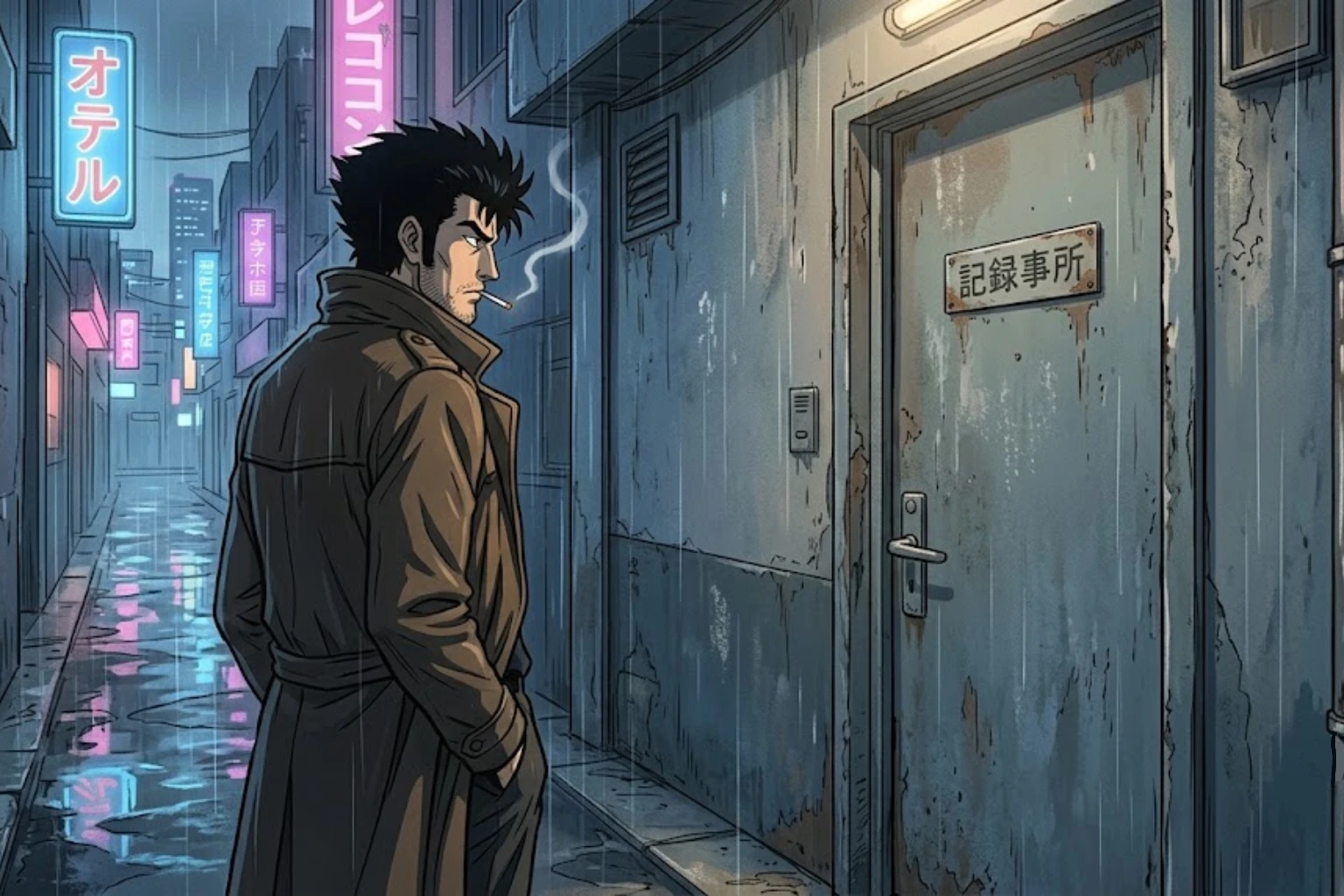
I woke up at five-thirty with the particular certainty of someone whose body had decided that was enough sleep regardless of what the rest of him thought about it.
The apartment was dark and smelled like coffee grounds and rain coming through the window seal I'd been meaning to fix since March. The packet was where I'd left it — bathroom door, inner coat pocket — and the locks were as I'd left them and the street below was doing the five-thirty version of itself, which was delivery vehicles and the early shift of people who worked the kind of jobs that started before the city pretended to wake up.
I made coffee. Stood at the window. Thought about the office search and the man at the tobacco shop and the shape of what Sayuri Shiranami had handed me, which was a problem I couldn't fully see the edges of yet.
The packet was the center of it. The packet was the thing the office search had been looking for, which meant the packet was the thing I needed to understand better than I currently did. Sayuri had told me not to open it. She hadn't told me not to learn what I could from the outside of it, which was a distinction I was going to take seriously because it was the only room I had to work in.
I went and got the coat from the bathroom door and took the packet out and set it on the kitchen table under the light.
In daylight — or what passed for daylight at five-thirty in the Shita district in the rain, which was the grey-amber of a city that hadn't fully committed to morning yet — the packet was less dramatic than it had felt at midnight. Black kraft paper, folded and sealed. The wax was red, deep red, the color of old lacquer rather than fresh sealing wax, which suggested a specific type rather than standard commercial stock. The authentication mark pressed into it was small and dense — a compressed character, as I'd noted the night before, derived from standard kanji but stylized past the point of easy reading, the kind of mark that was designed to be recognizable to people who knew it and illegible to people who didn't.
I studied it for five minutes.
Then I got a piece of paper from the desk drawer and copied it as precisely as I could — the angles of the lines, the proportions, the compressed interior structure. I did it twice, because the first attempt was close and the second was better and I wanted the best version I could produce of a mark I was going to take across the city to someone who dealt in exactly this kind of thing.
I put the packet back in the coat. Put the coat back on the bathroom door. Folded my copy of the mark and put it in my wallet.
By six-fifteen I was out the door.
---
Harlan Seto's shop was on Kureno Street, which was not Ninth Street — Ninth Street was three blocks east and had a fish market that made the whole area smell a specific way in the mornings, which was a useful landmark but not where Harlan was. People who sent you to find Harlan usually said Ninth because they remembered the fish smell and not the actual street, and Harlan had stopped correcting them because the misdirection thinned out the casual traffic and left him with the people who cared enough to find the right address.
I'd found the right address four years ago and had used it six times since.
The shop was called Seto Repair, which was accurate as far as it went. Harlan fixed old registers, dead radios, broken adding machines, anything that had been mechanical and had stopped being mechanical and that someone wanted to be mechanical again. The window display was a rotating cast of equipment in various states of restoration — currently a cash register from the late occupation era and a portable radio with its back panel off and its innards visible, a tangle of components that Harlan was clearly in the middle of something with. The sign said OPEN from seven, but Harlan was always in before seven because he lived above the shop and the distinction between his working hours and his not-working hours had collapsed sometime in the decade he'd been running the place.
I knocked at six-twenty and he opened the door in his shirtsleeves with a cup of tea and the expression of a man who was not surprised to see someone he knew at an unusual hour because unusual hours were the only hours people he knew came to see him.
"Murphy," he said.
"Harlan."
He stepped back and let me in.
The shop smelled like solder and machine oil and the particular age of things that had been built to last and had lasted. Equipment lined the walls on shelving that Harlan had built himself, each piece tagged with a paper label in his small precise handwriting. The counter ran the length of the back wall with his work surface at the center — a cleared space under a magnifying lamp, currently occupied by the radio's removed back panel and a spread of small components. He went behind the counter and set down his tea and looked at me.
"Early," he said.
"I have a question that won't keep," I said.
"They never do." He picked up the tea again. "What is it?"
I took my wallet out and unfolded the copy of the authentication mark and put it on the counter between us.
Harlan looked at it without touching it. His eyes behind the thick glasses moved over the lines with the focus of someone reading rather than looking — registering the structure, the proportions, the specific stylization of the mark.
"Where did you get this?" he said.
"Copy I made. The original is on a wax seal."
"What kind of wax?"
"Red. Deep red. Harder stock than standard commercial sealing wax — the impression edges are sharp, not rounded."
Harlan nodded slowly, still looking at the mark. "Archive-grade," he said. "You can still get it from two suppliers in the city. One is a stationery house in the Higashi ward that sells to law firms and government offices. The other is a specialty supplier in the Namba district that does private orders, minimum quantity, no catalogue." He picked up the paper now, holding it under the magnifying lamp. "The wax narrows the field. The mark narrows it further."
"You recognize it?"
He was quiet for a moment. Not the quiet of not knowing — the quiet of deciding how to say what he knew.
"I've seen this mark twice before," he said. "Both times on documents that came through here not as repair jobs but as — authentication questions. Someone wanted to know if a document was genuine. Both times the seal on the document carried this mark." He set the paper down. "It's a legal archive seal. The kind used by registered document custody firms — companies that hold original records on behalf of clients who need secure long-term storage. Contracts, deeds, personnel records, that kind of thing."
"And the firm?"
Harlan looked at me over the top of his glasses. "Rindo Document Custody. They were registered with the prefectural commerce office, operated for about six years, and then filed dissolution papers approximately three years ago." He paused. "Standard dissolution — debts settled, clients notified, records transferred to an appointed successor custodian, registration closed. As far as the official record is concerned, Rindo Document Custody ceased to exist in the spring of three years ago."
I looked at the copy of the mark on the counter. "And yet."
"And yet," Harlan agreed. "The seal on your document is fresh. You said the wax impression edges are sharp?"
"Clean. No degradation."
"Then it wasn't made three years ago. It was made recently, with a die that is still in someone's possession, being used for a firm that officially no longer exists." He took his glasses off and cleaned them with his shirttail, which was what he did when he was thinking about something he didn't want to say yet. "The two documents I authenticated — the ones that came through here — both had dates within the last eighteen months."
I let that sit for a moment. "What were those documents?"
"I don't know the content," he said. "I was asked about the seal, not about what was inside. That's not my area." He put his glasses back on. "But both of the people who brought them to me were looking at them the way you're looking at yours. Like they'd been handed something they couldn't put down."
"What happened to them?"
Harlan's expression didn't change, exactly. But something in it settled in a way that wasn't comfortable. "The first one I don't know. He came in, asked his question, left. I never saw him again, which is not unusual — most of the people who bring me one-off questions aren't repeat customers." A pause. "The second one I saw again, about a month after she came in with the document question. She came back to ask me something else, and while she was here she mentioned that the man she'd been working with on the matter — her word, the matter — had gone missing." He picked up his tea. "She seemed frightened."
"Was she?"
"She should have been," he said, which was not quite an answer.
I folded the copy of the mark and put it back in my wallet. "Rindo Document Custody. Who ran it?"
"A man named Akaike Shun. He's listed as the sole director on the dissolution papers — I looked at the commerce office registration once, after the second document came through, out of my own curiosity." Harlan set his tea down. "He's not findable in any current business registration. No new firm under his name, no listed address, no professional affiliations that I could locate through public records."
"But Rindo's seal is still active."
"Someone's using it," Harlan said. "Whether that's Akaike or someone who acquired the die after dissolution or something else entirely, I can't tell you." He looked at me with the steady attention of someone who was being careful about how much he involved himself. "What I can tell you, Murphy, is that when something dissolves on paper and keeps operating in practice, it's usually because the dissolution was the point. Not the end of the operation — the cover for its continuation. You stop being registered, you stop being findable, you stop being subject to the oversight that registration requires."
"You go underground with a legal history that says you closed."
"Clean hands," he said. "On paper."
I stood at the counter for a moment. The shop was quiet around us, the equipment on the shelves patient and still, the magnifying lamp throwing a white circle on the work surface. Outside, the Kureno Street morning was getting underway — a vehicle going past, the sound of a shutter going up somewhere down the block.
"The successor custodian," I said. "When Rindo dissolved, the clients were notified and records transferred to an appointed successor. Who was it?"
Harlan shook his head. "That I don't know. It would be in the dissolution filing, but the commerce office records aren't public at that level of detail — you'd need a professional access request or a legal instrument to see the full filing."
Or someone who knew how to look at records that weren't publicly accessible. Which was, among other things, what I did.
"Thank you, Harlan," I said.
"Murphy." He said it in the tone he used when he was going to add something he didn't want to add but had decided to add anyway. "The people who used this seal — whatever Rindo is now, whatever it's doing — the two documents that came through here were records of people. Not property records, not contracts. Personnel records. Names, histories, the kind of thing a firm holds when they're keeping documentation of individuals on behalf of a client."
"And those individuals didn't know their records were being kept."
He looked at me. "That's the reasonable inference," he said. "Yes."
I went to the door. The bell above it was the old mechanical type, a physical clapper that rang when the door moved, and it rang now as I opened it.
"Murphy," Harlan said, one more time.
I stopped.
"Be careful what you pull on," he said. "Some threads, you pull them and the knot gets tighter."
I went out into the rain.
---
I didn't go straight back.
That was a rule I'd been observing since the previous afternoon, when I hadn't been able to confirm or rule out the man at the tobacco shop. You didn't walk a straight line between the thing you'd just done and the place you lived when you had reason to believe someone was interested in your movements. You took the route that gave you information about whether you were being followed, which was not the same as the fastest route and was not the same as a random route — it was the route that gave you the right angles and the right reflective surfaces and the right opportunities to see what was behind you without appearing to look.
I went east on Kureno, which took me away from the apartment, and then north on Akemi, which brought me past the noodle stand that wasn't open yet but had the mirror behind the counter visible through the window if you looked at the right angle. I looked at the right angle.
The street behind me was ordinary morning street. Two people walking in the same direction I'd been going, both moving faster than I was, neither paying attention to me. A man on a bicycle. A woman with an umbrella turned inside out by the wind, struggling with it in the doorway of a building.
I went north another block and then west, which brought me to a covered shopping arcade that ran for three blocks parallel to Mitsuse Street. The arcade was starting to open — the vegetable vendor at the near end was arranging his display, the hardware store two units in was taking down the security screen, the lighting in the arcade was the fluorescent morning kind that made everything look slightly institutional. I walked through it at the pace of someone with nowhere specific to be.
Halfway through the arcade, I stopped at a display of umbrellas outside a dry goods store and spent thirty seconds examining the umbrellas.
The arcade behind me was visible in the curved security mirror mounted at the junction of two of the stalls — the kind of mirror that showed you a fisheye view of the whole intersection. I watched it while I looked at the umbrellas.
A man had come into the arcade behind me. Forty, maybe, in a grey coat, no umbrella. Walking at a consistent pace, not fast, not slow. He looked at the vegetable display as he passed it with the brief, incurious glance of someone in the habit of looking at things without seeing them.
I put down the umbrella I was pretending to consider and moved to the next stall.
In the mirror, the man in the grey coat had slowed. Not stopped. Slowed, the pace reduction small enough to be natural if you weren't looking for it, and then he stopped at a display of kitchen goods and looked at it.
I moved to the end of the arcade and turned north.
Outside the arcade I walked half a block north and then went into a coffee stand — a narrow operation, three stools at a counter, the owner a woman in her sixties who ran it with the economy of someone who had been doing the same thing in the same place for a long time. I sat at the stool nearest the window, ordered a coffee, and watched the arcade entrance.
The man in the grey coat came out of the arcade forty seconds after I'd sat down. He came out and turned north, the direction I'd gone, and walked past the coffee stand without looking in.
I drank the coffee. It was good — the owner knew what she was doing — and I drank it slowly and watched the street and thought about the man in the grey coat.
He was good. Not as good as whoever had done the office search, but good — the pace management in the arcade had been professional, the stop at the kitchen goods display had been natural enough that I would have put it at forty percent coincidence if I hadn't already been suspicious. The fact that he'd come out of the arcade forty seconds after me, heading in my direction, when the arcade had two other exits he could have used, reduced the forty percent to something closer to five.
I was being followed.
Not yesterday's tobacco-shop man — different build, different coat, different movement pattern. Either a handoff or a second operative. Which meant this wasn't one person keeping tabs on me — it was a coordinated operation with resources enough to run multiple people.
Miki had said: high-end assessment work, two months in the district, chain that disappeared fast.
I finished the coffee, left payment on the counter, and went out.
I didn't try to lose the tail. Not yet. Losing a tail told the people running the tail that you'd made them, which they would find out eventually anyway but which gave you more time if they found out later rather than sooner. What I did instead was continue the pattern of a man going about his morning — walk north, then west, making the route longer than it needed to be, giving the tail a workout and getting comfortable with the fact of being watched.
You couldn't always stop being watched. Sometimes you had to work with the condition.
What I was doing on this route was also what I'd told myself I was doing before Harlan: building the picture. Rindo Document Custody. Akaike Shun. A dissolution that was a cover rather than a close. Personnel records of people who didn't know they were being documented. Three people gone in eighteen months. An office search. Two tails in two days.
The picture was getting edges.
---
I went back to the office at nine.
The office was as I'd left it the previous evening — the desk clear, the filing cabinet locked, the window facing the alley with its latch in position. I checked the small positional details I maintained and found them all correct, which meant either no one had been in since I'd noticed the previous search or the person who'd come back had been more careful this time. I preferred the former interpretation.
I sat at the desk and wrote down what I had.
Rindo Document Custody: registered firm, six years of operation, dissolved three years ago. Sole director Akaike Shun, not currently findable in public records. Seal still in active use within the last eighteen months, on documents that appeared to be personnel records of individuals. The seal's wax was archive-grade, traceable to two suppliers. Two people who had brought Rindo-sealed documents to Harlan for authentication in the last eighteen months. One of them had a contact who subsequently went missing.
Sayuri Shiranami: inside the organization for two years, left four months ago with copied documents. Reached me through the Nakashima channel after three months of looking. Professional contact setup — burner phone, drop service relay. Frightened but organized.
The packet: eight sheets approximately. Copied records from a system that wasn't supposed to exist. Sealed with Rindo's mark.
The response: office searched within twelve hours of the handoff. Two days of surveillance, at minimum two operatives. High-end, coordinated, resourced.
I looked at what I'd written.
The successor custodian was the thread I wanted. When Rindo had dissolved, the clients had been notified and the records transferred to an appointed successor — that was standard procedure in a legitimate dissolution, and maintaining the appearance of a legitimate dissolution was the whole point of the exercise. The successor custodian would be named in the dissolution filing at the commerce office.
Getting to the dissolution filing was a professional access problem. The commerce office's public counter handled standard registration inquiries — you could look up whether a firm was registered, get its listed address and director, access the registration date and current status. The dissolution filing itself, with the full details of the wind-down, was a closed record. Not sealed, not classified — just not public counter material. You needed either a professional access credential, which I didn't have in any official sense, or a contact inside the office who could pull the file.
I had the second option. I'd been cultivating it for seven years.
Her name was Eto Fumiko, and she worked in the records division of the commerce office, and she had done me three favors over seven years in exchange for three favors I had done her, which was a balanced ledger and the kind of relationship that could sustain one more transaction if I asked for it carefully and offered the right return.
I picked up the phone.
She answered on the second ring, which meant she was at her desk and not in a meeting, which was the version of Eto Fumiko I could work with.
"Murphy," she said, the same way Miki had said it — acknowledgment rather than greeting. People who dealt with me professionally had learned that I called for reasons, not for conversation.
"I need a dissolution filing," I said. "Rindo Document Custody. Dissolved three years ago, spring."
A pause. Keyboard sounds — she was checking something. "I can see the registration. You want the full dissolution package?"
"The successor custodian appointment specifically. And any listed principals beyond the director of record."
Another pause, longer. More keyboard. "Murphy, this is a closed filing."
"I know. That's why I'm calling you and not the public counter."
She didn't say anything for a moment. This was the calculation she was running — what the request cost her against what she was owed and what I'd give her in return. We'd never discussed the ledger directly. We didn't need to. Seven years was long enough to have a working model of the exchange.
"I'll need a few hours," she said.
"I'll be here."
"And Murphy — whatever you're giving me for this one, I want it before I pull the file. Not after."
This was a change from our usual arrangement, which was simultaneous exchange. It meant the file was in a category she wanted extra security on, which told me something about the file.
"What do you want?" I asked.
"The Imamura warehouse situation," she said. "I know you ran the Imamura skip-trace last year. I know what you found. I need to know where Imamura is now."
The Imamura skip-trace had been eight months ago. A commercial creditor, a missing warehouse operator, a trail I'd followed to a residential address in the Kita district that I'd provided to the creditor and then closed. I still had the address. Eto wanting it told me the commerce office had a separate interest in Imamura that wasn't about the creditor — probably a licensing matter, possibly something more significant.
"I have the address," I said. "Current as of eight months ago, unverified since."
"That's sufficient," she said.
I gave her the address.
She read it back to confirm.
"A few hours," she said, and the call ended.
I put the phone down and looked at what I'd written on the desk.
A few hours was a few hours. I had other things to do with them.
---
The specialty wax supplier in the Namba district was a shop called Kishida Materials, which occupied the ground floor of a narrow building on a street that sold mostly to the trade — printers, bookbinders, restoration specialists, the kind of businesses that needed things you couldn't get at a commercial stationer. The window display was a row of wax blocks in different colors and grades, labeled with small cards that meant something to the people who read them.
I went in at ten-thirty.
The man behind the counter was young, which surprised me, and knew his stock with the thorough ease of someone who had grown up in it. I asked about archive-grade red sealing wax — the deep red, harder stock, the kind that took a clean impression edge.
He showed me two options. One was the standard archival grade, used by law firms and notaries, available in quantity through their regular order system. The other was a custom compound that they produced for specific clients — harder, denser, the impression characteristics more stable under temperature variation.
"The custom compound," I said. "What's the client list like for that?"
He looked at me with the professional wariness of someone who'd been asked about client lists before and had a policy about it. "We don't discuss client accounts," he said.
"I'm not asking for names," I said. "I'm asking about the category of client. Law firms? Private companies? Government offices?"
He considered this, decided it wasn't actually what he'd been trained to refuse. "Mixed," he said. "Law firms use the standard grade mostly. The custom compound goes to clients who need a specific authentication profile. Private firms, mostly. A few individual practitioners — notaries, private archivists."
"Has anyone ordered the custom compound in the last six months who specifically requested the deep red color?"
He was going to say he couldn't discuss that. I could see him getting ready to say it.
"I'm investigating a forgery situation," I said, which was close enough to true. "Documents are being circulated with a seal that's using your compound — I can tell from the impression characteristics. I need to know if the legitimate client is aware their seal profile is being copied or if someone's sourcing the material independently."
This repositioned the question from a client-list inquiry to a fraud investigation, which made him a potential victim rather than a gatekeeper.
He thought about it. "The deep red custom compound," he said. "We have two active clients for that specification. One is a law firm in the Higashi ward that I know is legitimate because I've dealt with their office manager for four years." He paused. "The other account has been inactive for approximately three years. No orders since then."
"What was the account name?"
He hesitated.
"If someone's copying the seal profile," I said, "the inactive account holder should know."
He looked at the counter. Then he said: "Rindo. Rindo Document Custody. They were a regular order account — quarterly, consistent volume. Then the orders stopped."
"Three years ago," I said.
"Around then, yes."
"Did they ever request additional dies? Replacement dies for the authentication stamp?"
He pulled a face that meant he was thinking about whether he could answer that. "We don't make the dies," he said. "We supply the wax. The dies come from the client. We just fill the specification."
"So if someone acquired Rindo's original die after the firm dissolved—"
"They could order the same wax from us without us knowing the account had changed hands," he said. Then he caught up with himself. "If someone were doing that, which I'm not saying they are."
"Understood," I said. "Thank you."
I left Kishida Materials and stood in the rain on the Namba district street and thought about what I now had.
Rindo's die was still in use. Rindo's wax supply could be sourced from Kishida without any new account registration, just an order that matched the old specification. The dissolution had been clean enough to leave the operational infrastructure intact — the die, the wax source, the authentication mark — while removing the firm from the official record.
Clean hands. On paper. Harlan had said it and I was seeing the shape of it now.
Someone had dissolved Rindo deliberately, carefully, and then kept everything working.
The question was what Rindo had been, underneath the legitimate document custody registration. What it had been doing with the personnel records it held. What the filing system was that Sayuri Shiranami had copied from. What names were in the eight sheets of paper sitting in the coat pocket on my bathroom door.
That question was going to have to wait for Eto Fumiko and the dissolution filing.
---
She called at two in the afternoon.
I was back at the office, working through the other things on my desk that didn't have anything to do with Rindo or Sayuri Shiranami, because the work that paid the rent didn't stop because a complicated job had arrived.
"Murphy," she said. "I have your filing."
"The successor custodian."
"Listed as an entity called Keisen Records Management. Address in the Shita district — Motocho Street." She gave me a number. "The filing lists Keisen as a related-party entity, which is a disclosure flag. It means Rindo and Keisen had overlapping ownership or management at the time of dissolution."
"So Rindo dissolved into itself," I said.
"Into a new registration under a different name. Which is legal, if disclosed, which it was. The flag is there." A pause. "Keisen Records Management is also no longer active in the commerce office system. It was deregistered fourteen months ago."
I looked at the wall above my desk. "What happened to Keisen's records?"
"No successor custodian listed in the deregistration," she said. "Keisen filed a simplified closure — a category that doesn't require the full dissolution documentation that Rindo filed. It's used when the firm has no outstanding client obligations."
"Meaning they claimed no clients at closure."
"Meaning they claimed no clients at closure," she confirmed. "Whether that was accurate is not something the commerce office verifies at the simplified closure level."
I wrote down the Motocho Street address.
"One more thing," Eto said. "The Keisen registration listed a director. Different name from Akaike — a woman named Shimazaki Reiko. But the registration address for both Keisen and, I noticed, the original Rindo registration, was the same building."
Same building. Rindo and Keisen, different names, same address, overlapping closures.
"Thank you, Eto," I said.
"We're square," she said. "Don't call me for anything like this for a while."
She hung up.
I looked at the Motocho Street address. Then I looked at the map I kept in the desk drawer, the one of the Shita district with my own annotations on it, and found Motocho Street.
It was six blocks from the office.
Six blocks from where someone had professionally searched my workspace.
Six blocks from where I'd been sitting since seven-fifteen that morning, building a picture of a firm that had dissolved and then dissolved again and was still, by the evidence of the packet on my bathroom door, operating.
I put the map away and put my coat on and went to the window first, the one facing the alley. Nobody in the alley. I went to the door.
Motocho Street was a narrow street, the kind that the district had a lot of — buildings close together, ground floors occupied by small commercial operations, upper floors residential or storage. The address Eto had given me was a four-story building, older construction, the kind that had been built for one purpose and had settled into being used for several. The ground floor had a business that appeared to sell office supplies, currently open, a customer visible inside. The upper floors had windows, some with curtains, some without, the normal visual texture of a building that people used.
The address itself — the specific unit number from the filing — was not the ground floor. It was the third floor, which had a window with a frosted glass insert that suggested an office rather than a residential unit.
I stood on the opposite side of Motocho Street and looked at the building.
The third-floor window was dark.
Which didn't mean anything. Middle of the afternoon, overcast, it was hard to tell from the outside whether a room was in use or not.
I looked at the building entrance — a recessed door between the office supply shop and a narrow stairwell access. No lock visible on the exterior, which meant either the building had a single interior lock at the top of the entry stairs or the tenants had their own.
I looked at the street around the building. Ordinary afternoon street, the kind of ordinary that could be genuine or could be the ordinaries of a street that was being managed. I couldn't tell from here.
I didn't go in. Not today, not without more information, not when I'd been tailed this morning and the address I was looking at was the last known location of the entity that held Sayuri Shiranami's documents before they vanished into a simplified closure with no successor named.
What I did was note the building, note the surrounding addresses, note the street's access points and sightlines and the two coffee shops within visibility distance that would give you a position on the entrance.
Then I walked away.
The picture had edges now.
Rindo, then Keisen, then nothing on paper. An address still standing. A seal still in use. Personnel records of people who hadn't consented to be documented. Three missing. A woman on the run with copies of what the filing system held. And the people who ran it — whoever they were now, whatever they were calling themselves now that Keisen had also closed — running a coordinated surveillance operation in the Shita district, searching offices, following grey-market investigators who'd been handed a packet at midnight.
I walked back to the apartment in the rain.
The coat with the packet was on the bathroom door.
I stood in the kitchen and looked at it through the doorway.
I still wasn't going to open it. That was still Sayuri's call, and she hadn't made it yet.
But I knew considerably more about what was inside it than I had that morning, and knowing it made the waiting more specific, which was the best that day-two of a case like this was going to give you.
I made coffee. Stood at the window. Watched Mitsuse Street do the afternoon version of itself.
The man in the grey coat did not appear.
Which either meant they'd pulled the tail or they'd gotten better at it.
In my experience, when things like that got better rather than pulled, it meant they'd decided they knew enough about your pattern and were now watching the destination rather than the route.
Which meant someone might be watching Motocho Street.
Which meant going back there was going to require more care than I'd given it this afternoon.
Tomorrow, then.
Tonight, the picture. What I had and what I still needed and where the gaps were. The dissolution filings, the Harlan conversation, the wax supplier, the address. Akaike Shun, director of record for Rindo. Shimazaki Reiko, director of record for Keisen. Related-party entities, same building, successive closures.
Someone was going to make a mistake eventually. They always did, when they'd been operating long enough and quietly enough that they'd stopped accounting for the possibility.
I was going to be in the right position when they did.
I sat down at the table with a blank piece of paper and started writing what I had in the order it had come to me, because putting things in order was how you saw where the gaps were, and the gaps were where the next two days lived.
Outside, the rain came down.
The city kept its texture.
The packet sat in the coat on the bathroom door, eight sheets of paper that knew considerably more than I did, waiting for the right moment.
I kept writing.


.png)
.png)
.png)