%20(1).png)
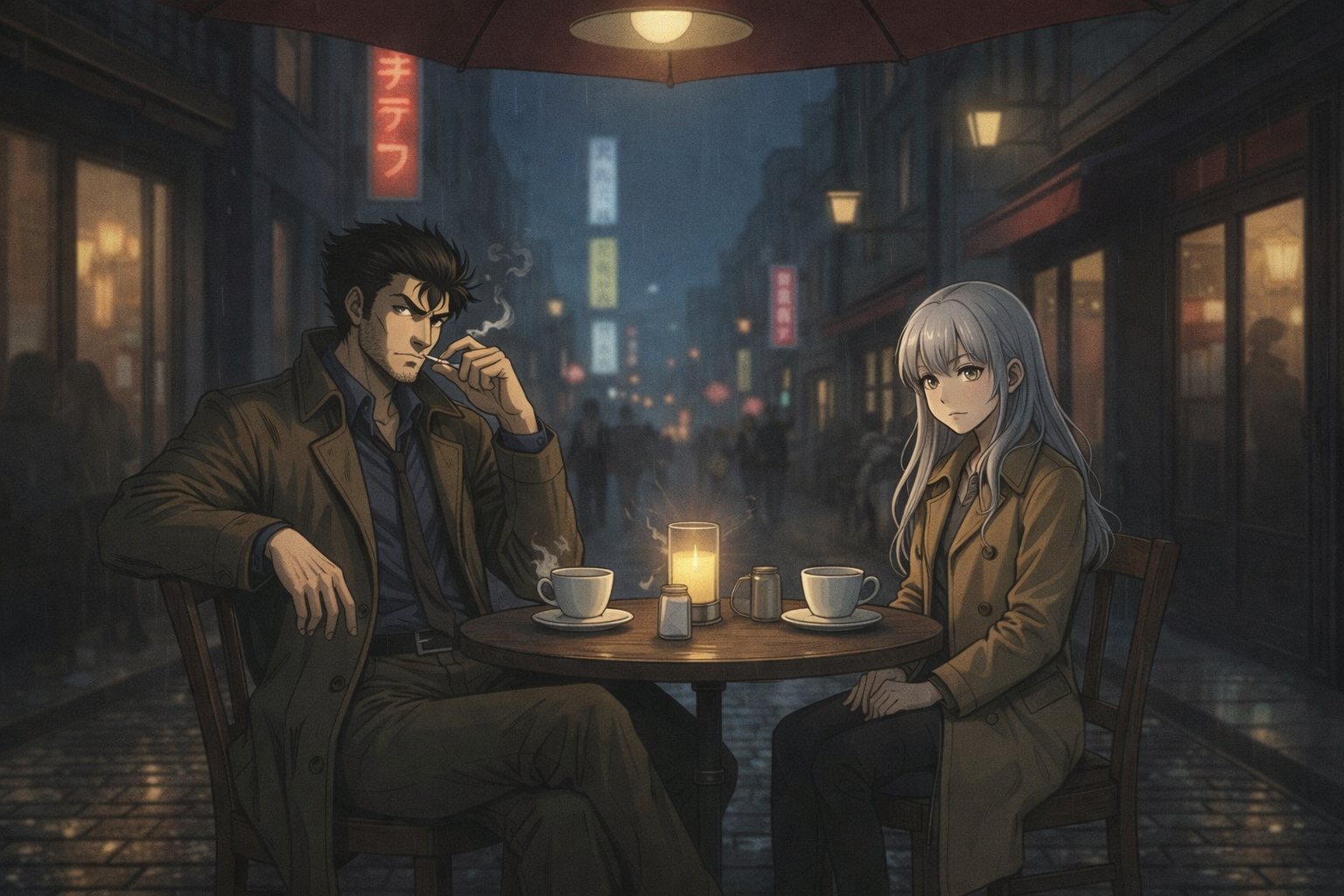
The rain came down the way it always came down in this city — like it had somewhere better to be and hadn't decided yet whether to stay.
I'd been watching the street from under the awning of a closed dry-cleaner for eleven minutes, which was long enough to confirm that nobody had followed me from the station and short enough that I hadn't soaked through my second coat yet. The first coat was at a pawnshop on Denshiro Street. Long story. Every coat I own has a long story.
The café was called Kuroame. Black candy. Somebody's idea of a joke, or somebody's idea of a name that would make the kind of clientele they wanted feel like they'd found the right place. No menu board outside. No sandwich specials chalked on the window. The sign above the door had most of its letters working, which in this part of the Shita district counted as maintained. The rain pooled at the curb in the particular way of a street where the drainage hadn't been serviced since before the redevelopment wars — the city council had promised new pipes three times in four years, which was three more promises than they'd kept — and the streetlight two doors down had been out since Tuesday, which nobody had reported because in the Shita district you learned not to give the city reasons to come look at things.
I crossed the street and went in.
The inside of Kuroame was dim in the way of places that had made a considered decision about lighting. Not broken, not cheap — considered. The overheads were off. The illumination came from low-wattage fixtures on the walls, amber, the color of old photographs, supplemented by candles on the tables: real wax, the slow-burning kind, already well into their lives, the wax pooled and hardened in the rings of previous evenings. The smell was coffee and tobacco and the particular staleness of a room that had been full of people and their concerns for many years and had absorbed all of it. It was not an unpleasant smell. It was the smell of a place that knew what it was.
Seven tables. Four occupied. Nobody looked up when I came in, which was either because the clientele of Kuroame was professionally incurious or because they'd been trained by the establishment's reputation to mind their own business. Both, probably. The bartender — a heavyset man in a collarless shirt with the kind of face that retained no expression because it had considered expression and decided against it — watched me cross the room without moving or speaking. I took the booth in the back, left side, wall at my shoulder and the door in sightline. The seat was cracked vinyl patched with electrical tape. The table was clean. The candle had about two hours left in it.
I didn't order. The bartender didn't come over. This was apparently acceptable.
I'd been given the time — midnight, which it now was — and the location, and nothing else. The name I'd been given was Shiranami. No first name in the message. Just Shiranami, the café, the time, and the suggestion that what was being offered was the kind of job I didn't usually get offered through front-channel brokers. Which was the only reason I was here instead of in my office going through the Yabata skip-trace that had been sitting on my desk for a week.
I'm not licensed. Never have been. The licensing board for private investigators in this city requires a clean record and a relationship with the prefectural police that I have never been able to describe as clean. I'm not a criminal either, or not primarily — I occupy the particular professional category of someone who knows which doors open without a key and which records exist in places that aren't the official filing systems, and I make myself useful to people who need that knowledge and can pay for it. It's not a respectable living. It's a living.
I'd been doing it in this city for nine years. Long enough to know Kuroame without having been here before. Long enough to recognize, when the booth across the room gave up its occupant and someone new came in from the back corridor rather than the front door, that this was the kind of establishment with an arrangement about such things.
She sat down across from me.
Not in the way you sit when you're arriving — in the way you sit when you've been somewhere adjacent and have moved to this specific location because it's the right moment to move. Her coat was a dark charcoal, dry despite the rain outside, which meant she'd been inside long enough for it to dry or she'd come through a covered route. Her hair was black and worn up with the practicality of someone who'd made a decision about it and wasn't thinking about it anymore. She had the kind of face that was composed rather than calm — there's a difference, and the difference is in the eyes, and her eyes were doing something that had nothing to do with calm.
She put her hands on the table, folded, and looked at me.
"You're Trace Murphy," she said.
Not a question. People who turn up at midnight in back-corridor cafés with pre-verified meeting times don't ask questions about identity. They confirm it.
"And you're Shiranami," I said. "No first name in the message."
"Sayuri," she said. "First names weren't relevant until now."
"And now they are?"
"I'm hiring you," she said. "That makes it relevant."
She said it the way someone stated a logistical fact — no performance in it, no softening. I'd dealt with nervous clients, aggressive clients, clients who came in crying and clients who came in furious and clients who didn't know what they felt until the job was done and then felt all of it at once. Sayuri Shiranami was none of those. She was someone who had made a series of decisions before arriving here and had finished making them, and what was left now was the execution.
I respected that. It also made me careful.
"You reached me through the Nakashima channel," I said. "That's not a channel people find casually."
"No," she agreed.
"Which means you either know the right people or you've been looking for someone like me for long enough to find the right people." I watched her. "Which is it?"
She considered this for two seconds, which told me the answer was the second one. "I've been looking," she said. "For three months."
"Three months is a long time to look for a grey-market investigator."
"I needed a specific kind," she said. "Someone who operates outside official channels. Someone who can access records that don't appear in prefectural databases. Someone who is not, under any circumstances, going to take what I give them to the police." She paused. "The Nakashima channel confirmed you were those things. You came to the meeting, which confirmed the rest."
"What rest?"
"That you needed the work," she said. Not unkindly. Just accurately.
I didn't argue with accurate. "What's the job?"
She reached inside her coat and put something on the table between us.
It was a packet. Thin — the kind of thin that meant documents rather than anything physical. Wrapped in black kraft paper, sealed with red wax, and the wax had been stamped with a seal that I didn't recognize — a stylized character, compressed, not standard kanji but something derived from it, the kind of proprietary mark that organizations used when they wanted to authenticate without announcing themselves.
I looked at it. I didn't touch it.
"Contraband," she said. "But not the kind you sell."
"What kind is it?"
"Records," she said. "Copies. Taken from a filing system that is not supposed to exist and that the people who operate it are very interested in keeping undiscovered." She put one finger on the packet, not pushing it toward me, just indicating it. "These are not the originals. The originals are somewhere I can't tell you yet. These are copies I made before — before I had to leave."
"Leave where?"
She looked at me steadily. "That's the part of the job you'll earn as we go."
I leaned back in the booth. The vinyl creaked. Outside I could hear the rain shifting direction, the sound of it against the window changing pitch as the wind came around. Someone at one of the other tables ordered something in a low voice and the bartender moved to fill it without any perceptible increase in animation.
"You want me to hold the packet," I said.
"To protect it," she said. "Until I have the other pieces in place."
"And then?"
"And then the records go where they can do what they were taken to do." She looked at the packet, then back at me. "People are missing, Mr. Murphy. Not wandered-off missing. Not ran-away missing. The kind of missing where the official record says they were never there to begin with." Something moved behind her eyes — controlled, pushed down, but there. "I need someone to hold what proves otherwise."
I looked at the packet on the table. Thin, black-wrapped, red wax. The kind of thing that got people into serious trouble, and I'd been at this long enough to know that serious trouble came in gradations and the packet was indicating a grade I didn't usually handle.
"Who's looking for this?" I asked.
"The people whose filing system it came from."
"That's not an answer."
"It's the honest one," she said. "I don't know exactly who they are. I know what they operate. I know what they're capable of." She paused. "I know three people who knew too much have stopped being findable in the last eighteen months."
I let that sit for a moment.
"You're telling me this is the kind of job where the liability includes disappearing," I said.
"I'm telling you so you can make an informed decision," she said. "I'm not interested in your involvement under false pretenses. That's not good for either of us."
I studied her. The composed face, the steady hands, the coat that had dried because she'd been in here long enough for it to dry, which meant she'd been sitting somewhere in this building for a while before she sat down across from me — thinking, probably, or waiting to see if I'd show, or both. She was frightened. Not in a way she was showing, but in the way of someone who had organized their fear into something functional rather than let it remain something reactive, and that kind of organization took a toll that showed up in other ways. In the set of her jaw. In the slight overcontrol of her hands.
She was frightened and she was here anyway.
That told me more about the job than anything she'd said.
"You're not just a client," I said. "You're in this. Whatever this is."
She didn't answer immediately. Then: "I worked for them. For two years. I didn't know — not everything. Not the scope of it. When I understood what I was looking at, I made copies and I left." She met my eyes. "That was four months ago. I've been managing since then."
"Managing means staying out of sight."
"Managing means staying out of sight and still trying to do something useful with what I know." A pause. "It's harder than it sounds."
"Everything is," I said.
I looked at the packet again. The wax seal, the compressed proprietary mark, the black kraft paper. Records from a filing system that wasn't supposed to exist, copies made by a woman who'd been inside something she'd taken four months to get clear of, and people who were missing in the specific way that meant someone had erased them.
I had a rule about cases like this. The rule was: don't take them, because cases like this had a way of becoming your entire life in ways that interfered with all the other things you'd been doing to keep the lights on.
I'd broken the rule before. The problem with having a rule you break is that eventually you have to admit it's not a rule so much as a preference.
I reached across the table and picked up the packet.
The wax seal was room temperature — the café was warm, the candle had been burning for hours, everything in here was room temperature. I registered this not because it was remarkable but because I registered things. It was the packet's only distinguishing quality beyond its contents, and its contents were why I'd come.
"People die over things like this," I said.
"Yes," she said. "That's why I came to you."
I turned the packet over in my hands. Light. Maybe eight sheets of paper. Whatever was on them had been worth four months of managing and three months of looking for the right grey-market operator to pass them to. I was mildly curious about what was on them and professionally disciplined enough not to open them in a café at midnight with a woman I'd known for six minutes watching me.
"You said three people stopped being findable," I said. "Were they people who had copies, or people who were looking?"
She showed me something — not a smile, not exactly, but the specific expression of a person whose opinion of someone has been adjusted by a question. "Both," she said. "The first was a copy. The second and third were looking for the first."
"Which means the people you're worried about know the copies exist."
"They know copies are possible," she said. "Whether they've confirmed copies are circulating, I don't know. It's been four months and I'm still here, which suggests either they haven't confirmed it or they're taking their time."
"Neither of those is reassuring."
"No," she said. "It isn't."
I put the packet inside my coat, in the inner pocket where I kept the things that needed to stay dry and unobserved. The weight of it was nothing. The weight of what she'd told me was something else, sitting in the middle of my chest in the particular way of a decision made that couldn't be unmade.
"I'll need contact protocol," I said. "Something that doesn't run through the Nakashima channel. If they're looking for connections, that channel is a liability now."
She reached into her coat and put a card on the table. Plain white, a phone number in black ink, nothing else. "Burner," she said. "I cycle them every two weeks. When this one stops working, leave a message at the number on the back — that's a drop service, they'll relay."
I looked at the back of the card. A different number, longer, with an extension. Professional setup. Not improvised.
"You've done this before," I said.
"I've been learning," she said.
"Fast learner."
"Circumstances have been instructive." She stood, smoothing her coat with the particular economy of someone who didn't have gestures to spare. "There are things I can tell you as the job develops. Things I can't tell you yet, not because I don't trust you — I don't trust anyone currently, it's a policy — but because the information is only safe to move in specific sequences. Giving you everything now creates vulnerabilities neither of us can afford."
"That's a careful way to run a job handoff."
"It's the way I've survived four months," she said, without making it sound like a complaint.
I stood too. The booth released me with the sigh of old vinyl. "Where do I find you if the packet becomes urgent? If something moves before you've cycled to the next contact?"
She looked at me for a moment — the composed face, the calculated eyes, the coat that had dried before she sat down.
"You won't find me," she said. "That's by design. If something moves before I make contact, go to ground with the packet. Don't try to use it, don't try to give it to anyone, don't try to understand it." A pause. "And don't underestimate how quickly they move when they decide to."
"You're describing the most uncomfortable holding position in the business," I said.
"I know," she said. "I've been in it for four months." She buttoned the top button of her coat. "I'll find you, Mr. Murphy. When the time is right, I'll find you."
She moved toward the back corridor — the way she'd come in, which was not the front door and which I now registered as the detail I should have fixed on earlier. If she'd come in from the back, she knew the building's layout or had paid someone to show it to her. Either way, she'd been careful before she sat down.
The back corridor took her, and the café settled back into its dim amber ordinary, and the bartender refilled someone's cup at the near table without looking over, and the candle between the empty seats across from mine threw its slow light at the ceiling and the wax ran down the side in the patient way of things that didn't need to hurry.
I stood at the booth for a moment longer.
The card was in my pocket with the packet. The packet was thin and probably eight sheets of documents that were going to complicate my life in ways I hadn't finished calculating yet. The woman who'd handed it to me had been inside something for two years, had spent four months running, and had spent three months finding the right person to give this to, and had ended up here, in the back booth of a café that didn't advertise, handing it to me.
That was either a careful and well-executed plan, or a desperate improvisation that had run out of better options.
Experience had taught me that in this city, at this hour, those two things were usually the same thing.
I turned up my collar and went to the front door.
The rain had made a decision. It was staying.
The street outside Kuroame was empty in the specific way of city streets after midnight — not deserted, because no street in the Shita district was ever truly deserted, but in the middle state where the people who were out had reasons to be out and reasons not to be visible about it, and everyone else was inside with their doors locked and their lights low. I stood under the awning for a moment, watching the rain pattern on the pavement, the way it caught what little light there was and turned the street surface into something that reflected a version of the city back at itself, distorted and shifted by the water.
Somewhere to my left a cab moved through a puddle too fast and sprayed the curb and kept going. Two blocks east, the sound of a steel shutter being pulled down — somebody closing up, later than usual or later than legal, one of those. The ordinary sounds of a city operating at a frequency it didn't broadcast.
I thought about what Sayuri Shiranami had said.
People missing. Official records saying they'd never existed. Copies of documents from a filing system that wasn't supposed to be there. Three people gone in eighteen months — one holding copies, two looking for the first one. And a woman who'd been inside it for two years before she understood what she was inside, and had spent four months since then being very careful and still being here, which was either luck or competence and might have been both.
The packet sat against my ribs inside my coat. Whatever was in it — whatever names, whatever records, whatever the filing system that wasn't supposed to exist had been filing — it was going to determine the shape of the next part of my life in ways I hadn't agreed to yet but had effectively agreed to when I picked it up.
That's how jobs like this worked. You didn't agree to the whole thing at once. You agreed to the first step, and the first step put you in the position where the second step was the only reasonable option, and somewhere around the fourth or fifth step you looked back at the moment in the booth and thought: that's when it started.
This was when it started.
I pulled my collar up against the rain and stepped off the curb and went into it. The Shita district at midnight had the particular quality of a place that kept its secrets in the way of very old walls — not by hiding them exactly, but by being so full of them that any individual secret became part of the texture, indistinguishable from everything else that had been absorbed over the years.
I'd been operating in this texture for nine years.
I knew how to move through it.
What I didn't know — what I had no way of knowing, standing at the curb outside Kuroame with the rain coming down and a packet of documents from a filing system that wasn't supposed to exist pressing against my ribs — was how deep the current one went.
In my experience, the answer to that question was always: further than you think.
I turned up the street and walked north, toward the office and the Yabata skip-trace that was going to sit on my desk a while longer, and behind me the sign above Kuroame's door flickered once in the rain and went on burning.


.png)
.png)
.png)