%20(1).png)
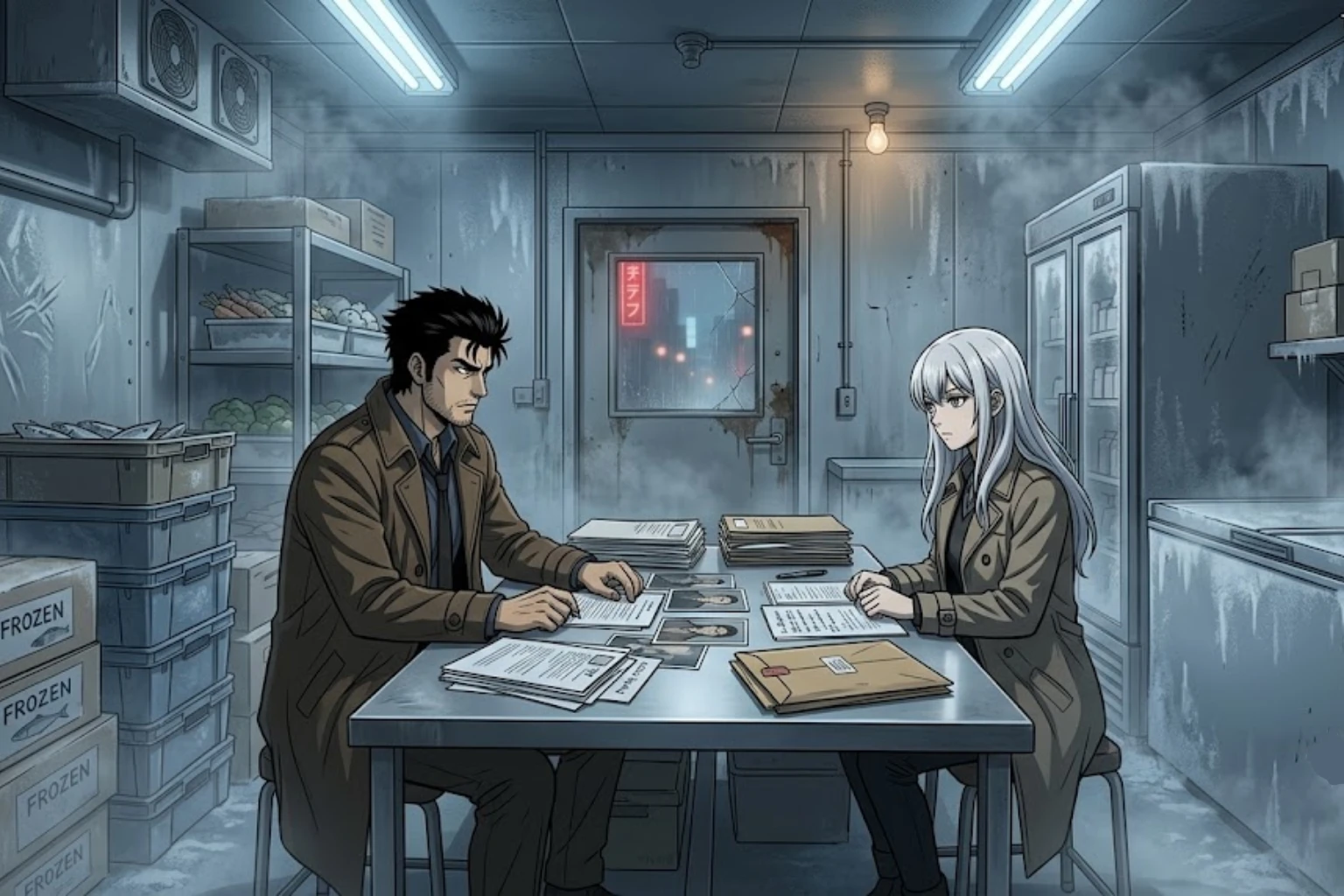
I was at the Horie Street market at five-forty.
Not because I was eager. Because arriving twenty minutes early to a meeting in an unfamiliar location gave you time to read the space before the person you were meeting arrived, and reading the space was the difference between a conversation and a situation. The Tenma district was not my district — I knew it the way I knew the parts of the city I passed through rather than operated in, which was well enough to navigate and not well enough to have reliable intelligence on. The covered market on Horie Street was a working fish market, the kind that supplied restaurants and the better-stocked domestic kitchens rather than the general public, and at five-forty in the morning it was already fully operational in the way of markets that depended on early delivery and had no patience for people who needed daylight to function.
The covered section was a long rectangular space with a corrugated roof that amplified the rain into a continuous metallic undertone. Stalls ran the length of both sides with a wide central aisle, the lighting functional and bright, the smell of salt water and ice and the specific marine cold of fresh fish doing what smells did in enclosed spaces — filling everything, becoming the environment rather than just part of it. The vendors were in operation, the early-morning trade moving through with the purposeful economy of people who knew exactly what they wanted and had somewhere to be after they got it.
The middle stall on the left side was run by a woman who had to be Asa — middle-aged, efficient, with the kind of face that had organized itself around the practical requirements of getting through a great deal of work before most people had breakfast. She had two customers ahead of me and she handled them both with the speed of someone who measured transactions in seconds rather than pleasantries. When I got to the front I told her I was there about the standing order.
She looked at me for one second — the assessing look of someone who had been told to expect a person matching a description and was confirming the description — and then she tilted her head toward the back of the stall without saying anything. I went around the counter and through a door into a narrow room behind the stall that was used for cold storage and prep work, with a stainless steel table along one wall and crates of ice stacked along the other and a single bulb overhead. Cold. Functional. No windows.
I stood in the cold storage room and waited.
At five-fifty-eight, Sayuri Shiranami came through the door.
She looked like someone who had been operating on careful sleep for four months — not exhausted, not diminished, but running on the specific compressed energy of a person who had gotten very efficient about rest because they couldn't afford to treat it as a luxury. Her coat was different from the one she'd worn at Kuroame, darker, the collar turned up. She had a bag over one shoulder, small and flat, the kind that held documents rather than anything personal.
She looked at me and then she looked at the cold storage room and then she looked back at me with an expression that acknowledged the setting without commenting on it.
"Murphy," she said.
"You look like you've been running for four months," I said.
"I have," she said. "How do I look for it?"
"Like you've been getting enough sleep."
Something that was close to a smile moved across her face and disappeared. "Asa's good," she said. "We have twenty minutes before the market gets busy enough that an extra person in the back becomes notable."
"Then let's use them." I moved to the stainless steel table and she came to the other side of it, and we stood facing each other across the cold steel with the ice crates behind her and the door behind me and the fish market's metallic rain sound overhead.
"You read the first three sheets," she said.
"Last night."
"And?"
"A name from the civic register," I said. "Four years of documented activity. Decisions made, transactions arranged." I paused. "Records altered. From the client side. Retroactively."
She nodded. Not confirmation — she already knew. The nod was something else, the acknowledgment of someone who had been carrying a weight alone and had just put one end of it down.
"Tell me the rest," I said. "Everything you know. We have twenty minutes."
She put the bag on the table and unzipped it and took out a folded document — her own notes, from the look of it, handwritten on plain paper, the kind of notes you made when you couldn't afford to keep information anywhere that could be found. She spread it on the table but didn't look at it. She'd been over it enough that she didn't need to.
"I was hired two and a half years ago," she said. "The job title was records coordinator. The firm was called Keisen Records Management, registered in the commerce office, apparently legitimate. The work I was told I'd be doing was standard document custody — receiving client files, cataloguing them, maintaining the system, handling retrieval requests. Document custody is a real industry. There was nothing about the job that looked wrong from the outside."
"When did it start looking wrong from the inside?"
"Gradually," she said. "The first thing I noticed was the client structure. Standard document custody firms have multiple clients — law firms, companies, private individuals who need secure long-term storage. Keisen had one. Everything flowed to one receiving address, one contact, one schedule. That was unusual but not impossible — some firms specialize, work exclusively for a single institutional client. I told myself it was that."
"But it wasn't."
"The second thing I noticed was the file content." She looked at the table, not the notes. "The files weren't the kind of material a client sends to a custody firm for storage. They were compiled records — activity summaries on individuals, the kind of thing you'd produce through surveillance or through access to multiple data sources. Insurance records, financial transaction logs, employment history, movement patterns. Not any one of those things — all of them, aggregated, on each individual."
"Fifteen hundred files, minimum," I said. "I counted the sections."
She looked up. "You got into the cabinet system."
"Yesterday morning."
She absorbed this. "Then you know the scale of it."
"I know the scale of the Motocho Street location. You mentioned a secondary location on the phone. I heard the man at the desk reference it — three transfers in from the secondary location."
"There are two," she said. "Motocho is the primary. The secondary is in the Higashi ward, a commercial building on Temmabashi Street. I was only at the secondary location twice, both times with supervision. The primary was where I worked every day."
Two locations. I added Temmabashi Street to the picture.
"The files," I said. "Who are the subjects? What's the criteria for being documented?"
"That took me longer to understand," she said. "The file codes don't use names — they use the alphanumeric system you saw. The names are only in the files themselves. But over two years of working the system, handling retrieval requests, processing new entries, I built up enough context to see the pattern." She paused. "The subjects are people who have come into proximity with the client. Not employees, not associates — people who have information the client would prefer to manage. Witnesses to things. People who were present at the wrong time. People who raised questions through legitimate channels and then went quiet."
"Went quiet," I said.
"Some of them stopped their inquiries voluntarily," she said. "Some of them didn't appear to stop voluntarily. The file records for those individuals — the ones where the activity logs simply end on a specific date without any documented reason — those are the ones I copied."
I looked at her. "How many files did you copy?"
"Eight," she said. "The ones in the packet. The eight individuals whose files showed the most complete documentation of the pattern — the proximity to the client, the inquiry or the witnessing event, and then the unexplained closure of their activity record." She met my eyes. "Three of those eight have not been findable by any method I've tried in the four months since I left. Three out of eight."
Three out of eight. Not three out of fifteen hundred. Three out of the eight she'd specifically identified as the most concerning cases. That was a different ratio than I'd been working with.
"The client is editing the files directly," I said. "The first three sheets show him accessing the system from the client side and altering records. Closing files on individuals whose own documentation shows no corresponding event."
"I know," she said. "I found two instances of that while I was still inside. That's when I knew I needed to leave." She looked at the notes on the table. "What I couldn't understand, while I was inside, was the mechanism. How the file alterations connected to the individuals becoming unfindable. Whether the alteration was a record of something that had already happened or an instruction for something that was going to happen."
The cold storage room was quiet except for the market sounds overhead. I thought about what she'd said and what the first three sheets had shown and what the man at the Motocho Street desk had said on the phone about accelerated closures and forty-eight hours notice.
"The files aren't just records," I said slowly. "They're active management tools. The client isn't just keeping information on these people — he's using the system to manage what happens to them. The closure notation isn't a record of someone going missing. It's an instruction that precedes it."
Sayuri looked at me steadily. "That's what I believe," she said. "I couldn't prove it from inside the system. The eight files in the packet are the closest thing to proof I could extract. The documentation on those eight individuals — the proximity event, the inquiry, the file alteration, the subsequent untraceability — laid out in sequence, it makes the pattern visible."
"Visible enough for what?" I said. "That's the question we need to answer. You said you hadn't decided what to do with the packet. Neither had I, until last night. Now I've read three sheets and I know the name on them, and the question of what to do with it is more complicated than it was before."
She nodded. "Because of who it is."
"Because of who it is," I confirmed.
The name on the first sheet was not someone from the grey margins of the city. Not a criminal enterprise operator, not a businessman operating in the regulatory gaps, not the kind of person whose exposure would be absorbed by a system already accustomed to managing its own. The name was someone with institutional standing — the kind of standing that meant resources, connections, the ability to apply pressure to official channels, and the demonstrated willingness, based on what the first three sheets documented, to use all of those things in the service of remaining unexposed.
"Walk me through the options," I said. "You've had four months to think about them."
She had. I could see it in the way she answered — not working it out as she spoke but reporting a considered analysis.
"The press," she said. "A journalist with enough independence and enough institutional backing to publish against pressure. The packet gives them the documentation. The story is specific enough to be verifiable and serious enough to be publishable." She paused. "The problem is time. A journalist needs to verify independently before publishing. That takes weeks at minimum. During those weeks, the packet is known to exist and the operation is already in damage-control mode. The secondary location, the S-section files being moved — they're already responding to the threat the packet represents. Weeks of verification time is weeks for them to continue managing their exposure."
"And the people in the active files," I said.
"The people in the active files," she agreed. "If the operation accelerates closures in response to the external situation — in response to me, and now to you — then the time the verification process takes is time those people don't have."
"What's the second option?"
"A lawyer," she said. "Specifically, a lawyer who can file for emergency relief — an injunction, a protective order, something that creates a legal instrument requiring the operation to preserve its records and halt certain activities while an inquiry proceeds." She looked at the table. "The problem with that option is that an injunction requires a petitioner, and a petitioner requires standing, and the people with the most direct standing are the eight individuals whose files I copied. Three of whom are not findable. Two of the remaining five I've been able to locate but not contact safely. One I contacted and who declined to be involved — out of fear, not disbelief." She stopped. "That leaves two who might participate in a legal filing. Two people with standing, one lawyer, a client with institutional resources and demonstrated willingness to use them. That's not a fight the filing survives."
I'd been listening and building the problem in my mind while she talked. "The third option," I said. "Inside the prefecture government. Someone who isn't compromised, who has the authority to open an investigation, and who is far enough from the client's sphere of influence to be insulated from the pressure he can apply."
"That's the option I keep coming back to," she said. "And it's the one I can't solve. I don't know who's clean. I've been running for four months and I haven't been able to identify a single person inside the prefectural system who I'm confident is both reachable and genuinely independent of the client's influence."
"Because his influence runs through the institutions," I said.
"Because his influence runs through the institutions," she said. "That's how someone with his standing maintains a records operation for nearly a decade without it surfacing. Not just by keeping the operation invisible — by being positioned in a way that means the people who might look at it have reasons not to."
The market overhead had gotten louder. The twenty minutes Sayuri had given us was running down. I looked at the notes on the table, at the bag she'd brought, at the woman across the steel table who had been carrying this alone for four months and had spent three of those months finding someone to carry part of it with her.
"There's a fourth option," I said. "Not instead of the others. Before them."
She looked at me.
"The two people from the eight files who are reachable and willing," I said. "You said one declined. But two others you haven't fully assessed. Before we decide where the packet goes, we need to know what those two know. The packet is documentation of a pattern from inside the system — it shows what the files recorded and how they were altered. What it doesn't show is what the subjects of those files actually witnessed. What they saw, what they reported, what happened to them afterward from their own perspective." I paused. "If the documentation from inside the system and the firsthand account from the subjects corroborate each other, any of the three options becomes significantly stronger."
Sayuri was quiet for a moment.
"You want to find them," she said.
"I want to talk to them," I said. "Finding them is the prerequisite."
"Finding people is what you do," she said.
"It's part of what I do," I said. "The other part is knowing when finding them creates a risk for them rather than reducing it. If the operation is in accelerated damage-control mode because of the external situation — because of us — then locating two individuals who are already documented subjects of the operation puts them in the frame at a time when the operation is actively managing its exposure."
"So we need to move quickly," she said.
"We need to move carefully and quickly, which is harder than either one alone," I said. "But yes."
She looked at me for a moment. Something in her expression had shifted during the conversation — not the composure, that was intact, but the quality beneath it. The organized fear that had been doing the work of keeping her functional had been joined by something else. The specific quality of someone who had been alone with a problem for four months and had just, for the first time, genuinely shared it.
"The two reachable individuals," I said. "Tell me what you know about them."
She told me.
The first was a man named Osaki — mid-forties, former civil servant, had filed a formal inquiry through the prefectural housing office approximately two years ago about a property transaction. The inquiry had been acknowledged, assigned a case number, and then the record of the inquiry had been altered in the prefectural database to show it as withdrawn at the petitioner's request. Osaki had not withdrawn the inquiry. He was currently living in the Namba district, employed, apparently functional, but when Sayuri had located him six weeks ago and attempted contact through an intermediary, he'd refused further communication.
"He knows someone got to the record," I said.
"He knows the inquiry disappeared," she said. "Whether he knows how or why — I don't know. He's frightened. He refused contact but he didn't report the contact attempt, which means he's not working with them. He's just trying to stay out of it."
"Staying out of it isn't working for him," I said. "He has a file. The file is active. Whether he participates or not, he's already in the system."
"I know," she said. "That's what makes the conversation difficult."
"Who's the second?"
"A woman named Fukuhara Misae," she said. "Younger — late twenties. She worked for a contractor that did work for several public agencies, including one that the client's office had oversight of. She raised a concern internally about a billing irregularity, was told it was a miscategorization and would be corrected, and then her contract wasn't renewed. That was eighteen months ago." Sayuri paused. "She's been working other contracts since. She's harder to read than Osaki — she filed the internal concern once and when it went nowhere she seems to have moved on. Or she wants to appear to have moved on."
"What does her file show?"
"Activity monitoring up to approximately six months ago," Sayuri said. "The file hasn't been closed — it's still active — but the entries stopped. Either the monitoring was discontinued or the entries stopped being made."
"Or the file was moved to the secondary location when the primary became a concern," I said.
Sayuri looked at me. "When did you say the S-section was emptied?"
"Between my observation on Wednesday and the man's arrival on Thursday morning," I said.
"The S-section," she said slowly. "You said it was adjacent to the R-section."
"Left side. S was immediately to the right of R in the sequence."
"Fukuhara," she said. "F. If the coding is by subject surname initial—"
"Then Fukuhara's file would be in the F-section," I said. "Not the S-section."
She nodded. "The S-section would be surnames beginning with S."
"Which means the S-section wasn't your file," I said. "Or not primarily."
We looked at each other across the table.
"Who do you know," I said, "whose surname begins with S, who has a connection to this case?"
She thought for a moment. Then: "Sekine," she said. "Sekine Taro. He was the second person to go missing. A journalist — not a major publication, a district news sheet, the kind that covers local government and zoning decisions. He'd been asking questions about property transactions in the Higashi ward." She stopped. "He stopped being findable fourteen months ago."
Fourteen months. The same rough period as Keisen's simplified closure. The same period as the S-section files, now moved.
"The operation closes Keisen on paper," I said. "Files a simplified closure claiming no clients. Fourteen months ago. The same time a journalist asking questions about Higashi ward property transactions stops being findable."
"The closure was the cover," she said. "Not just for the operation continuing — for what the operation had just been used for."
We stood with that for a moment.
The market overhead was fully loud now — voices, movement, the sounds of commerce in full operation. Our twenty minutes had become twenty-five and the quality of the noise above us had changed in the way Sayuri had described it would when the market reached capacity.
"We need to go," she said.
"Osaki and Fukuhara," I said. "I'll find them. Not contact — find, first. Confirm current location, assess the situation around them, determine whether contact is safe and what form it should take. Then we decide together."
"How long?"
"Two days for Osaki, if the Namba district address you had six weeks ago is still current. Fukuhara is harder without the current file — I'll need to trace from the last known employment." I paused. "Three days, possibly four."
"The operation is moving," she said. "The accelerated closure process, the files being moved—"
"I know," I said. "I'm not suggesting we wait. I'm telling you the realistic timeline for doing it without creating risk for them by moving too fast." I looked at her. "Three days. If something moves in those three days that changes the calculus, I contact you through the drop service and we reassess."
She folded her notes and put them back in the bag. Zipped it. Put it over her shoulder.
"Murphy," she said. "The client — the name on the first sheet. You recognized it."
"Yes," I said.
"You know what it means to have what we have."
"Yes," I said.
"Most people, when they understood what it meant, would find a way to not have it anymore," she said. Not accusatory — assessing. The same way she'd assessed me at Kuroame when she'd said she knew I needed the work.
"Most people didn't take the job," I said.
She looked at me for a moment.
"No," she said. "They didn't."
She went to the door. Then she stopped.
"Sekine," she said, without turning around. "The journalist. He had a sister. She contacted me two months ago — she'd found my name somehow, I don't know how, someone in his network must have known about me. She wanted to know if I knew anything about what happened to him." A pause. "I told her I was working on it. I didn't have anything to give her yet." Another pause. "When this is done, I want to be able to give her something."
She went out through the door.
I stood in the cold storage room for a moment, listening to the market above and the rain on the corrugated roof, and then I went out through the stall and past Asa, who didn't look up, and out into the Tenma district morning.
---
The walk back from Horie Street took forty minutes because I didn't take the direct route and because I had things to think about that benefited from walking.
The picture was fuller now than it had been twenty-four hours ago.
A name with institutional standing. A records operation running behind two dissolved corporate fronts. Fifteen hundred-plus files on private individuals, maintained without their knowledge, used to manage the people who had come into proximity with information the client needed to control. A journalist who had stopped being findable fourteen months ago at the same time the second corporate front filed its closure paperwork. A property transaction in the Higashi ward at the center of something large enough to warrant all of it.
And Osaki and Fukuhara. Two people still alive, still operational, still documented in a system that was currently in damage-control mode.
The question I'd been turning over since Sayuri left the cold storage room was the one I hadn't asked her directly: why me.
Not why a grey-market investigator — she'd told me that at Kuroame, the specific requirements that had led to the Nakashima channel and three months of looking. Not officially licensed, not connected to any reporting structure that the client could reach, capable of accessing records outside official channels, guaranteed not to take what she gave him to the police.
Those requirements made sense for the holding phase — for keeping the packet safe while Sayuri built the conditions for using it. But the phase had moved. The S-section files were gone. The operation was responding. Three days to find Osaki and Fukuhara and determine whether they could be brought into the picture.
After that, the decision. Journalist, lawyer, inside contact in the prefecture — or some combination. Any of those paths required more than what I did. Any of those paths required people with professional standing in institutions I didn't have standing in.
What I did was find people and move through the city's margins without leaving a trail the official record could follow. That was useful for the next three days. After the three days, it was going to require a different kind of thinking.
I'd been doing this for nine years and I had a reasonably honest accounting of what I was good at. What came after the three days was at the edge of it.
I went to the office. The positional details were all correct. Nobody had been in since yesterday.
I sat at the desk and started building the trace on Osaki.
He was in the Namba district, last confirmed six weeks ago, employed. That was enough to start with. Employment was the most stable anchor for locating someone who wasn't actively hiding — a person who went to work every day created a pattern that was readable if you knew which registers to check. The Namba district had its own texture, its own information network, its own version of the people I knew in the Shita district. Some of them were reachable from here. Some required a trip across the district line.
I picked up the phone and started making calls.
The morning moved. The rain continued. Outside the alley window the city did its daytime thing, indifferent and continuous.
At eleven-thirty, I had a current employer for Osaki and a work address in the southern Namba district. Not a home address — employment was easier to trace than residence for someone who was trying to maintain a low profile. The work address would do for the first step, which was observation rather than contact. Watch the address, confirm the face, assess the environment around him.
I wrote it down and put it in my wallet.
Fukuhara was harder, as I'd told Sayuri it would be. The last employment I had from the packet was a contract that had ended eighteen months ago. Eighteen months was a long time in the contractor economy — someone could have moved through three or four positions since then, and each position would require a separate trace. I started with the contracting agency she'd been registered with and worked forward from there.
By early afternoon I had a probable current position — a contract with a logistics company in the eastern Shita district that had started eight months ago and appeared to be ongoing. No address, just the employer. That was enough for the same first step.
Two targets, two work addresses, three days.
I looked at what I'd built and thought about Sayuri in the cold storage room, telling me about Sekine's sister, and about the phone call I'd overheard at Motocho Street — the man describing accelerated closures, the forty-eight hours needed to process the paperwork correctly.
Forty-eight hours to process. If the operation decided to accelerate a closure on Osaki or Fukuhara while I was running a three-day trace, the timeline stopped being mine.
I picked up the phone and called the drop service number on the back of Sayuri's card.
The service picked up on the second ring. I left a message: the Namba district work address for Osaki, the logistics company in the eastern Shita district for Fukuhara. Not for Sayuri to do anything with — just so she had the same information I had, in case something moved before I could reach her.
Then I put my coat on and went out to the Namba district.
The afternoon was grey and wet and the Namba district at two in the afternoon was the version of itself that operated between the morning rush and the evening one — the commercial middle of the day, foot traffic moderate, the streets doing the maintenance work of a district that was not the Shita but shared its general character. I found the work address without difficulty: a small accounting firm in a building that housed several similar operations, the kind of address that was chosen for its unremarkability rather than its prestige.
I didn't go in. I found a position across the street with a coffee stand that had outdoor seating under a canvas awning, ordered something, and waited.
At three-fifteen, a man came out of the building.
Mid-forties. The photograph in Sayuri's notes had been taken at distance, the quality limited, but the face matched well enough — the build, the way he carried himself, the specific quality of someone who moved through public space with the deliberate unobtrusiveness of a person who had learned, through experience, that being unobtrusive was protective. He went to a convenience store two doors down, bought something, and went back in.
Osaki Yutaka. Alive, employed, moving through a shortened version of his life in the southern Namba district.
I stayed another hour. He came out once more, at four-thirty, on what appeared to be an errand — walked to the end of the block, stopped at a vending machine, returned. Both times he checked the street before he moved. Not obviously, not in a way that would be visible to someone who wasn't looking for it. But he checked.
He was living with the awareness. Not panicked, not broken — just permanently, functionally aware that the world contained something that had reached into his life once and could reach in again.
I left the coffee stand at five and walked back toward the Shita district.
One down. Alive, locatable, intact. Frightened but functional. The question of whether he could be brought into the picture was still open, but at least the picture had him in the right place.
Fukuhara tomorrow.
And then, with both of them located and assessed, the decision that Sayuri and I had agreed to make together.
I stopped at the office on the way home. The positional details were correct. No calls on the answering service.
I went to the apartment. Made something to eat. Checked the coat. Checked the locks.
The packet was in the inner pocket, the seal broken, the eight sheets still folded inside the kraft paper. I took it out and put it on the kitchen table and looked at it while I ate.
Eight files. Three missing people. One name. A records operation that had been running for the better part of a decade, invisible behind two corporate closures, in the service of a single client who had institutional standing in this city and the demonstrated willingness to use that standing in ways that had made people disappear from the official record.
And Sekine's sister, who had found Sayuri's name somehow and wanted something to give.
I put the packet back in the coat.
Outside, the rain was doing what it had been doing all week, which was continuing. The city was doing what it always did, which was the same. In the Namba district, a man who had once filed a legitimate inquiry and been erased for it was checking the street before he moved, living inside the knowledge that something had reached into his life and could again.
In two days, Sayuri Shiranami and I were going to have to decide what to do with what we had. The options she'd laid out in the cold storage room were still the options. Journalist, lawyer, inside contact. None of them clean, none of them safe, all of them requiring things neither of us had fully secured yet.
One thing at a time.
Tomorrow, Fukuhara.
Then the decision.
I went to bed earlier than usual because the day had been long and the next two were going to be longer and I'd learned the same lesson Sayuri had learned about sleep: it wasn't a luxury, it was maintenance, and the difference between someone who survived this kind of work and someone who didn't was usually the accumulation of small correct decisions over time, and getting enough sleep before a difficult day was a small correct decision.
I closed my eyes.
The rain came down.
The city kept its texture.
Somewhere in the Higashi ward, in a building on Temmabashi Street, a secondary location held the files that had been moved in response to the external situation, which was us, and the external situation was getting closer to a resolution it hadn't yet named.


.png)
.png)
.png)