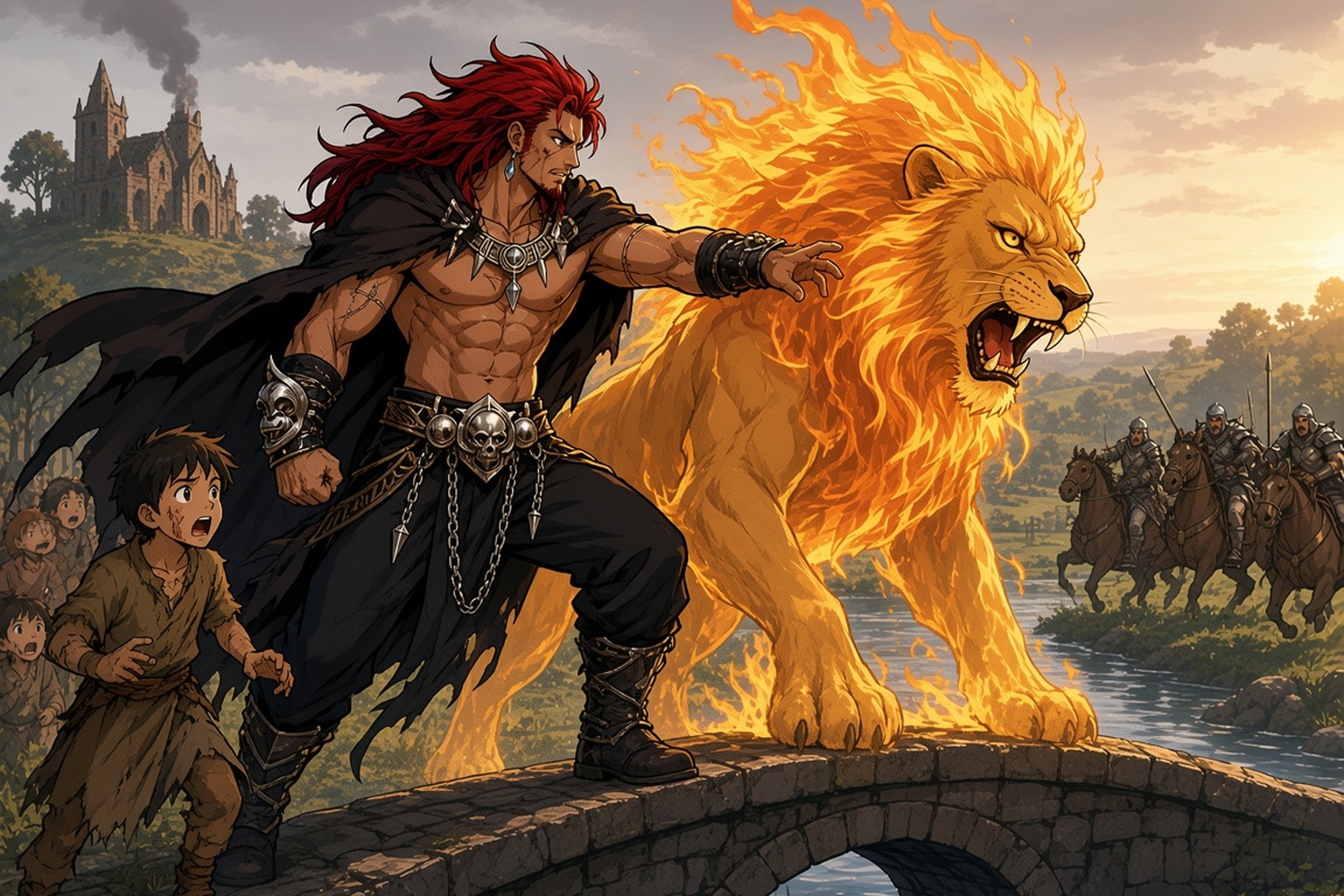
The battlefield at Harrow Pass had gone quiet the way battlefields do—not peaceful, just finished.
Pell carried his water skins between the rows of wounded, stepping over things he'd trained himself not to look at too long. That was how he first saw Thorne standing alone near the tree line, still in his armor, long after the surgeons had packed up their tents and the fires had been lit for the dead.
Pell was eleven, or thereabouts—nobody had ever been certain, least of all him. He'd attached himself to the Vanguard the way smoke attaches itself to a room, drifting in through some crack nobody remembered leaving open.
He fetched water. He ran messages too small for real couriers. He had learned, over two years of camp life, which men to avoid and which men to orbit, and Thorne of the Fangs was the second kind, though Pell could not have said why.
Thorne always lingered after. Pell had seen it before, at two smaller battles that nobody back home would ever hear named.
While other soldiers drank and diced and told each other lies about their own courage, Thorne walked the field alone. He knelt sometimes, touched the ground near men who weren't his own, enemy and ally both, like he was keeping some private accounting that had nothing to do with banners.
"You should eat," Pell said, because it was the kind of thing that let him stand near a man without being told to go away.
Thorne didn't turn. "In a while."
Behind them, torches were coming down from the command tents, a small procession of officers with the particular walk of men carrying bad news they hadn't written themselves. Pell recognized Commander Alric at the center of them, his face arranged into something he probably thought looked like resolve.
"Fang Thorne." Alric stopped a few paces off, and the parchment in his hand had already been read so many times the creases were going soft. "Terms have come from the Margrave's camp. Lord Vane and the council have accepted them. I'm to read the valley provisions to all ranking officers."
Thorne turned then. Pell had never seen him turn that slowly before, like a door swinging on a hinge that didn't want to move.
"Read them."
Alric did. Pell didn't understand all of the words—tariffs, remittances, the surrender of contested grazing lines north of the Harrow—but he understood the shape of what came near the end.
Thorne's whole body changed when he heard it, went rigid in a way armor can't explain. The Varrow Valley. Three villages. Ceded, the parchment said, in exchange for the Margrave's withdrawal from the eastern passes.
The evacuation convoy, already loaded, already moving, would not be diverted to collect them.
"Say that part again," Thorne said.
Alric's throat worked. "The valley was deemed—it says here, outside the scope of the evacuation order. The wagons were already committed to the northern garrisons. There wasn't capacity."
"They're not worth the wagons," Thorne said. It wasn't a question, but Alric flinched as if it had been.
"Thorne, the council—"
"Who told them?" Thorne's voice hadn't risen. That was the worst of it, Pell thought later, that he never once raised his voice.
"Who told the Margrave's men the valley was unguarded. Harrow Pass was won four days ago. The withdrawal route doesn't run anywhere near Varrow. Somebody told them it was open ground and they'd pay nothing for it. Who."
Alric looked like a man being asked to hold a flame in his bare hand. "No one told them anything, Thorne. It's a truce. These things get traded."
"It isn't always someone's fault, it's just—arithmetic. Three villages, maybe four hundred souls, against six months of peace on the eastern border. The lords did the sums."
"No one," Thorne repeated, like he was testing the weight of the word, the way you'd test a bridge board with your boot before trusting it.
"No one ordered it. No one chose it. It simply happened, the way weather happens."
"That's about the shape of it."
Thorne was quiet long enough that Pell thought the conversation was over. Then he reached up, unhurried, and unclasped the small silver fang from his collar—the badge that marked him as one of the order, the thing that let him call his lion when a company needed shielding and nothing else could save them.
He held it a moment in his palm like he was weighing it against something only he could see, and then he closed his fist around it.
"Thorne." Alric's voice had gone careful now, the voice men use on something that might bite. "Don't. You have orders waiting."
"Command wants every Fang recalled to the capital once terms are signed, there's talk of a parade, there's—Thorne, if you walk away from this command now, there's no order on this earth that protects you from what that makes you."
"I know what it makes me."
"Then don't do it."
Thorne looked at him for a long moment, and then past him, toward the dark hills in the east where, Pell understood with a slow cold feeling, the valley must lie.
"Tell Lord Vane I said thank you for the arithmetic," Thorne said. "Tell him I hope it adds up to something, someday, when the wagons come back empty."
He turned and started walking, and it took Pell a full ten heartbeats to realize that he was going to follow.
Nobody stopped him. That was the strange thing Pell turned over later, how easy it had been—easier than stealing bread, easier than slipping past the sentries to watch the surgeons work.
Thorne walked out of the firelight and into the dark toward the eastern hills, and the camp simply let him go, because an army that has just won a battle and signed a truce has no appetite left for chasing down one deserter, not that night.
Pell caught up to him an hour later on the road, breathless, water skins still slung over his shoulder out of pure habit.
Thorne didn't send him back. He didn't say anything at all for a long time, just kept walking with that even, unhurried stride, like a man who had already decided the rest of his life and found the decision lighter than he'd expected.
They made camp near midnight in a dry wash off the road, no fire at first, until Thorne seemed to remember Pell was a child and not a soldier, and built one anyway, small and careful, feeding it with dead scrub so it wouldn't smoke.
"You shouldn't have come," Thorne said at last.
"You didn't tell me to go back."
"I'm telling you now."
Pell didn't move, and after a moment Thorne made a sound that might have been a laugh if it had any humor left in it.
He sat across the fire, took the fang pin out of his pocket, turned it over once in the firelight, and set it down on a flat stone between them like a man laying down a weapon he no longer trusted himself to carry.
"You know what I am," Thorne said. It wasn't quite a question.
"A Fang. You call the lion."
"I called it three times in my life. Twice I lived through it clean." He was looking at the fire, not at Pell.
"There's a rule older than any order the Vanguard ever wrote, boy. The lion shields. It doesn't avenge. It grows with how much the people behind you need it—not with how much you hate the ones in front of you."
"You call it in hate, even once, even a little, and it stops being yours. It turns on the one who called it."
"What happens?" Pell asked, though some part of him already didn't want to know.
"I had a teacher. Kael." Thorne said the name like it cost him something to spend it.
"Best Fang I ever saw, before me. Raised me up from nothing, taught me the calling, taught me where the line was supposed to be. And then his sister was killed by raiders in a border skirmish that wasn't even his fight, and something in him decided the line didn't matter anymore, not for that."
The fire popped. Pell didn't move.
"First his lion's mane went from gold to red. Just the color, nothing else different yet, and I remember thinking, that's strange, I wonder what that means, the way you notice a crack in a wall before you understand the house is coming down."
"Then its roar went silent. You understand? It kept opening its jaws like it was still roaring, still fighting, and no sound came out at all, like something in the world itself had stopped listening to it."
"And last—" Thorne's hand had gone to the fang pin on the stone, not touching it, just hovering. "Last his own eyes went the same red as the mane. And he stopped hearing his own name."
“I called his name. Twice, three times. Nothing. And then he turned, in the middle of a column of his own men, men who'd fought beside him for years, and he went for them like they were the enemy he'd never gotten to kill."
"What did you do?"
"What you do when a man you love is gone and only the shape of him is left wearing his face." Thorne's jaw worked once. "I was the only other Fang on that field. It fell to me."
Pell sat with that a while, the fire small and steady between them. "And you still go out and call it. Even knowing."
"I call it to shield," Thorne said, and for the first time that night something in his voice came close to warmth, close to an old vow being dusted off and found still fitting.
"Not whether you're afraid of the thing inside you. Whether you can be trusted to only ever reach for it on behalf of someone else."
He looked up, finally, and met Pell's eyes across the flame. "I'm not going into that valley to punish anyone. I'm going because four hundred people are about to be left to raiders by men who did arithmetic instead of choosing, and somebody ought to be standing between them and that."
"Even though it's not an order."
"Especially because it's not an order."
Thorne picked up the fang pin at last, and did not pin it back to his collar. He only closed it in his fist, and then, in a motion Pell almost missed, let it fall into the dead grass at the wash's edge, uncovered, unclaimed, a small silver thing the color of nothing in particular once the firelight stopped finding it.
They walked into the valley the next morning.
“The valley's lower village—Maren's village, though Pell didn't learn her name until later—sat in a fold of hills with a river running through the middle of it, and a stone mill bridge that was the only reliable crossing for three miles in either direction.”
Word of the truce had beaten them there by half a day, carried by a terrified trader who'd been turned back from the eastern road by Vanguard pickets with the news that the wagons weren't coming.
By the time Thorne and Pell walked down the last switchback into the village square, the people gathered there had the particular look of folk who had already done all their panicking and arrived, exhausted, at something harder and colder than fear.
"That's a Fang's cloak," someone said, loud enough to be heard, "and no pin on it."
Thorne didn't deny it. He stood in the square and let them look at him, let them take in the absence of the silver badge at his collar, the dust of the road, the sword that marked him for exactly what the Vanguard would now call him if anyone asked.
An old woman pushed through the gathering crowd with the unhurried authority of someone who had buried enough people that she no longer feared saying hard things to the living.
She was thin in the way of someone who ate last after everyone else was fed, and her eyes, when they found Thorne's, had no patience left in them for softening.
"You're a deserter," she said. "I can read a collar same as any soldier. What exactly are you offering us, besides one more sword the Vanguard doesn't want?"
"Maren." A younger man started to step between them, but she waved him off without looking.
"My name's Thorne," he said. "I was Fang to the third company. I left when my command signed away this valley for six months of quiet on a border nobody here will ever see. I'm not offering you the Vanguard. I'm offering you me."
"We had fathers who trusted men like you before," Maren said. "I buried two sons in wars the Vanguard swore would protect this valley. I have no faith left to spend on a uniform, pinned or not."
"I'm not asking for your faith," Thorne said. "I'm asking for three days, and whatever timber and stone you can spare, and I'll show you what one man and one old oath can still hold, before you decide whether to trust any part of it."
Nobody cheered. Nobody welcomed him. But nobody told him to leave either, and in a village with four days until the raiders came, that silence was as close to permission as he was going to get.
He fortified the mill bridge first, because it was the only crossing, and a man who understands sieges understands that you don't spread yourself across every weak point—you choose the one point you can actually hold.
He had the village's few able hands tear planks from the old grain store and drive them crosswise between the bridge's stone pilings, narrowing the crossing to a single file no wider than a cart.
Any force trying to push through would have to come at him two men at a time at most, funneled into range of a single blade and whatever the lion chose to become.
Pell worked alongside him, hauling rope, driving stakes. It was on the second evening, with the light going long and gold over the water, that Pell found himself showing Thorne the chapel.
It was a small building, older than anything else in the village, stone below and timber above, with a root cellar beneath it that had been dug generations back for storing grain through hard winters.
Pell had found the old tunnel himself two summers past, chasing a cat through a gap in the cellar wall, and discovered it ran the length of the low ridge and came out in a scrub-choked culvert on the riverbank, just below the bridge.
"If the children can't get out the front," Pell said, "if it's bad, they can go down through the cellar and come out here. Nobody'd see them from the bridge or the road."
Thorne crouched at the culvert mouth a long moment, running his hand along the old stone, and something in his face eased slightly, the way a man's does when he finds one more card in his hand than he thought he had.
"Good," he said. "That's good, Pell. You've just made this a plan instead of a prayer."
They walked it together three times until Pell could have done it blind, chapel to cellar to culvert to riverbank. Thorne made him say aloud, each time, what he'd do if the chapel caught, if the door jammed, if someone panicked—until the answers came without thinking, the way answers need to come when there's no time left to think them.
It was Maren who found them there the third evening, watching from the chapel steps with her arms folded, and when Thorne straightened from the cellar hatch she didn't retreat the way she had every other time their paths crossed.
"You've a scar," she said, nodding at the old burn mark that ran from his collarbone up the side of his neck, pale and twisted, the kind of scar that only comes from fire held too close for too long. "I've wondered about it since you walked into the square."
"A fire, three years back. Village on the northern border, not mine, not my company's fight at all—we were only passing through on the way to somewhere else."
"A granary caught in the night and took half the street with it before anyone woke." He looked at the chapel roof above them, the old beams, like he was measuring how fast wood like that might burn.
"There was a woman screaming that her daughter was still inside. I went in. Found the girl under a fallen beam, pulled her out, the roof came down behind us before I'd gone ten steps clear."
"Whose child was she?"
"I never learned her name. Never saw the mother again after that night, in all the noise and the smoke—we marched on before dawn."
He touched the scar once, absently, the way men touch old wounds without meaning to. "I think of her sometimes. Wonder if she remembers it at all, being that young. Or if it's only me that carries it now."
Maren was quiet a while, watching him with something that had shifted from suspicion into a harder, more careful kind of attention.
"My sons didn't come home from wars that had names and banners and men like you standing behind them with oaths," she said. "And you walked into a war with no name at all, for people you'd never met, and didn't even wait to be thanked for it."
She looked at the chapel, then at the bridge below, pale stone catching the last of the light. "I don't know yet if that makes you a fool or the first honest soldier I've met in twenty years. Maybe there's no difference."
"Maybe there isn't," Thorne said.
She didn't offer her hand, didn't offer anything so plain as trust. But she stayed a while longer on the chapel steps, watching the river.
When she finally turned to go she said, over her shoulder, not quite to him, "The children trust easier than old women do. See that you're worth what they give you, Fang. I've no more sons left to bury on another man's account."
They came in the gray hour before dawn on the fourth day, and they did not come across the bridge.
Thorne had posted himself there from midnight on, cloak dark against the stone, the bridge narrowed to its single file of planks, and he watched the tree line on the far bank for an hour past when the attack should have come.
The stillness stretched thin and wrong, the kind of quiet that experienced soldiers learn to distrust more than noise.
It was the smell that reached him first—not smoke from the woods, but smoke from behind him, from the village itself. By the time he turned the sky above the chapel roof was already going orange.
Captain Voss had sent his main company fording the river a mile upstream, where the water ran shallow over gravel shoals that no local map had bothered to mark because no one sane forded a river in the dark with horses.
They'd come down on the village from the ridge side, bypassing the bridge Thorne had spent three days fortifying, and set the chapel alight first of anything, a torch to kindling stacked deliberately against its old dry timbers.
Voss was no fool and had learned, from whatever scouts or traitors had sold him the valley's layout, that the chapel was where Thorne would run if fire called him.
It worked. Thorne was off the bridge and sprinting up through the village before he'd finished understanding why, some older instinct than thought driving his legs before his mind caught up to the trap closing around him.
Inside the chapel, Maren had already gotten eleven children down into the cellar by the time the roof beams began to groan overhead, smoke pouring thick along the ceiling, the single door at the chapel's front already catching, flame crawling up its old boards like something patient and glad.
She'd sent Pell down first, thrust the youngest children into his arms two at a time, and when the last child was through the hatch and the fire had found the doorframe fully, she did not follow.
"Go," she told Pell, her voice carrying down into the dark of the cellar, steady in a way that made the children stop crying and simply obey.
"Tunnel to the river, you know the way, don't you dare stop for anything."
And then, because the door was buckling under its own flame and someone had to hold it a moment longer against the men trying to force it, she set her shoulder and her whole weight against it from the inside, bracing with a fallen beam, buying the seconds the children needed to vanish into the cellar dark.
Pell heard the roof go, a great tearing groan and then a crash that shook dust down through the tunnel ceiling above his head, and he did not stop, because she had told him not to stop, and some things a child understands without needing them explained twice.
He led eleven children through stone dark that smelled of old grain and older earth, counting them twice by touch at the narrowest point, and came out at last into the gray pre-dawn light at the culvert mouth below the bridge, blinking, soot-streaked, alive.
Thorne reached the chapel three minutes too late to matter.
He found her beneath the fallen roof beam, the fire mostly burned through and smoldering now rather than raging, and he knew before he'd finished clearing the stone away that there was no world in which she was still breathing.
He knelt there a long moment with her in the gray light, the children's voices distant and small down by the river.
Something in his chest that had held steady through three days of fortifying walls and measuring distances simply broke, quiet and total, like ice giving way beneath a weight it had held far longer than it should have.
That was when the lion came, unbidden, uncalled, rising out of him in a way he had never once let it rise before.
He knew, even as it took shape in the smoke above him, gold going wrong at the edges, that he had not called it to shield anyone. He had only wanted, in that moment, for Captain Voss to suffer exactly what Maren had suffered, and the lion had heard that wanting the way it had never been meant to hear anything from the man who bore it.
Its mane, gold a heartbeat before, drained to the color of a fresh wound.
It opened its jaws in a roar that Thorne felt in his bones and in the ground beneath his feet, and heard nothing, no sound at all, as if the world itself had gone deaf to it.
And when it turned, it did not turn toward the village's edge where Voss's riders were regrouping—it turned on Thorne himself, claws raking down across his shoulders through cloak and mail both, dragging him forward, toward the firelight and the enemy, the way a hand drags a reluctant dog toward a fight it has already decided to lose.
He staggered past a trough of rainwater near the chapel's ruined wall, and in its black still surface, lit red by the dying fire, he saw his own eyes reflected back at him. They were not gold anymore at their center.
They were going the same color as the mane above him, the same color Kael's had gone in that column of his own men, years and a lifetime ago.
He knew exactly what was happening to him. He had narrated this collapse by firelight three nights before, in order, gold to red, roar to silence, eyes last—and here it was, arriving precisely on schedule, as if some part of him had always known this night would come and had simply been waiting to recognize it when it did.
And the worst of it, the thing he would carry longer than any scar, was that some part of him did not want to stop. Some part of him wanted to go to Voss and let the lion finish what grief had already started.
Then, from the riverbank below, small and raw and furious, Pell's voice cut up through the smoke: "Thorne!"
He turned his head before he decided to. That was the thing he noticed, later, turning it over and over—he hadn't chosen to listen, his body had simply obeyed the sound of his own name before his mind caught up, and that meant something in him was still there to be called.
A man fully gone, the way Kael had gone, does not turn his head. Kael hadn't, not once, not for his own name shouted a dozen times across a column of dying men.
Pell stood on the riverbank with eleven soot-streaked children huddled behind him, none of them older than ten, all of them staring up at the smoke-shape above the chapel ruins with the particular wide stillness of children who have already seen too much that night to have any fear left over for new horrors.
"I can still hear you," Thorne said, to no one, to himself, testing the sentence like a man testing a leg he isn't sure will hold his weight. "I can still hear you."
He turned his back on Captain Voss.
The lion fought him for it. Every step back toward the bridge cost him something, claws finding new purchase in his shoulders, its silent roar beating against the inside of his skull like something trying to break out through bone.
He understood, with a clarity that felt almost peaceful in how simple it was, that this was the last choice he would get to make as himself.
He planted his feet on the bridge above the children, between them and the riders now massing at the ridge's edge. He made himself want, with everything left in him that wasn't already red, to shield rather than to avenge.
He made himself think of Pell's voice, of eleven children's faces, of Maren's steady command to not stop for anything, until the wanting beneath his wanting changed shape.
The lion did not go gold again, not all at once. But its claws stopped raking, and its silent roar found sound again, low and terrible and his to command.
Its shifting red-tinged mass settled by degrees into something steadier: a wall of spirit fire across the width of the bridge, narrow where the planks were narrow, impassable where the pilings had been reinforced, exactly the shape he had built this crossing to demand of anyone who tried to force it.
Voss's riders came twice before dawn and broke both times against that wall, horses screaming and wheeling back from flame that gave no heat to touch but burned all the same in whatever place terror lives in a man's chest.
Thorne held the bridge through the gray hour and into the first true light, arms shaking, voice gone to little more than a rasp from the effort of staying himself with every breath.
When the raiders broke entirely with the dawn and scattered back toward the ford, the villagers who had hidden in the hills above came down at last to find Captain Voss himself thrown from his horse in the shallows, pinned under the animal's dead weight, alive, and very much at their mercy.
They dragged Voss up onto the bank in chains the villagers had used for binding cattle, and by midmorning the entire lower village had gathered in the square to decide what came next.
It was Thorne, still gray-faced and trembling faintly from the night's effort, who refused to be the one to decide it.
"I won't choose his fate," he told them, when old Harwick—Maren's grandson, red-eyed and furious in a way that made him look twenty years older than his sixteen years—demanded to know why the man who'd held the bridge wouldn't simply finish what he'd started.
"If I choose it, it's still revenge. Just slower. Just dressed up in robes instead of claws."
"He burned the chapel with my grandmother inside it," Harwick said, and his voice cracked on the last word in a way that made several of the older women look away rather than watch it happen to him in public.
"You held a bridge. You didn't hold her. What good was any of it, if she's still dead and he's still breathing?"
Nobody had an answer for that, least of all Thorne, and he didn't try to offer one.
The argument ran the length of the day and well into the night, the whole village crowded into the square or spilling out from it, voices rising and falling like something with its own weather.
Some wanted Voss burned, the way the chapel had burned, an eye for an eye measured in exactly the currency he'd spent—and it was no small faction that wanted this, old grievance and fresh grief braided together until they were hard to tell apart.
Others, quieter, more frightened, argued that killing the Margrave's captain would only bring the Margrave's full army down on a valley that had no walls, no Vanguard, nothing standing between them and the next raid but one exhausted Fang with no banner and a village full of farmers.
"We can't kill him and we can't just let him walk," said a miller named Oss, somewhere near midnight, when the fire had burned low and tempers had burned lower, worn down by their own heat. "There has to be something between those two that doesn't make liars of all of us."
It was Maren's own words, oddly, that settled it in the end, repeated back by half a dozen people who'd heard her say them over the years—that the cruelest justice was never the quick kind, it was the kind a man had to live inside of, day after day, with his own hands and his own eyes open the whole time.
So they chose the harder thing. Voss would rebuild the chapel, stone by stone, in chains, under guard, through every season until it stood again exactly as it had before.
He would do it under the eyes of the families whose children he had nearly burned alive, who would watch him lift every beam and set every stone with his own hands, and who would say nothing to make it easier for him.
When it was finished, he would be handed over not to the Vanguard, who had already shown what their arithmetic was worth, but to the Margrave's own rivals among the border lords, men who had their own long account to settle with a captain who'd burned villages under a truce flag, and who would try him by whatever laws they kept.
Nobody in that square looked satisfied when the decision was finally spoken aloud and agreed to by weary, raised hands.
Harwick walked away from the fire without a word, his jaw tight, clearly unconvinced that stonework was any kind of payment for what he'd lost.
The ones who'd wanted blood looked ashamed of having wanted it, and the ones who'd argued for mercy looked ashamed of how thin their mercy felt, now that it had a face and a name attached to it and sat chained in the square in front of them.
That was the cost of it, Thorne thought, watching the fire die down to coals. Justice that didn't feed anyone's hunger, that left every person walking home a little emptier than when they'd arrived.
It was still the right thing. It simply wasn't a thing that felt like winning, for anyone, and he understood now, in a way he hadn't fully understood even watching Kael go, that this was precisely the point of the old oath.
The lion's gift was never meant to make men feel avenged. Only to make sure there was still a village left standing, afterward, to argue about what came next.
The scar came a week later, when the fever from that night's effort had finally broken and Thorne could stand without his legs shaking.
It sat directly over his heart, pale and strange, shaped like nothing in particular—not a claw mark, not a burn, just a scar that had simply appeared, as scars from the spirit world are said to do, marking the place where the lion had almost finished eating its way through to the man underneath.
It never fully healed. In low light, in the hour just after dusk, it glowed faintly, a small steady warmth under his shirt that no physician in the valley had any name for and no herb could touch.
"Does it hurt?" Pell asked him, months later, the two of them sitting on the rebuilt mill bridge at dusk, watching the water run gold-black beneath them.
Voss was somewhere up the slope setting stones into the chapel's new foundation with the slow, grinding patience of a man who had years of labor ahead of him and had finally understood it.
The lion was slower to come now, when Thorne called it, and smaller when it came, gold through and through, steady, chastened—like something that had learned its own danger as thoroughly as its bearer had, and had no intention of forgetting it again.
Word of that night had traveled faster than Thorne expected, carried first by a handful of Voss's own retreating riders who couldn't stop talking about the wall of fire that had broken three charges, and then by traders, and then by the kind of exaggeration that turns one exhausted man into a legend within a season.
It reached the Vanguard's capital wrapped in enough shame that Commander Alric himself rode the long road back into the valley to deliver, in person, an offer of reinstatement, full honors, the insignia restored, the desertion quietly struck from every record that mattered.
Thorne had declined without needing to think about it, and Alric had looked, for a moment, almost relieved to be refused, as if some part of him had already known there was no banner left that deserved to claim this particular man.
"Every day," Thorne said now, answering Pell, his hand resting lightly over the place where the scar sat warm beneath his shirt. "It hurts every day. That's how I know I'm still the one holding it."
Pell considered that for a while, swinging his legs over the water, the bridge solid and unhurried beneath them both.
"Maren would've liked that answer, I think."
"I think she would have told me it was about time I earned one," Thorne said, and for the first time in a long while, something in his face came close to a smile, there in the last of the light, on the bridge that had held, and the valley that was, for now, still standing because of it.