%20(1).png)
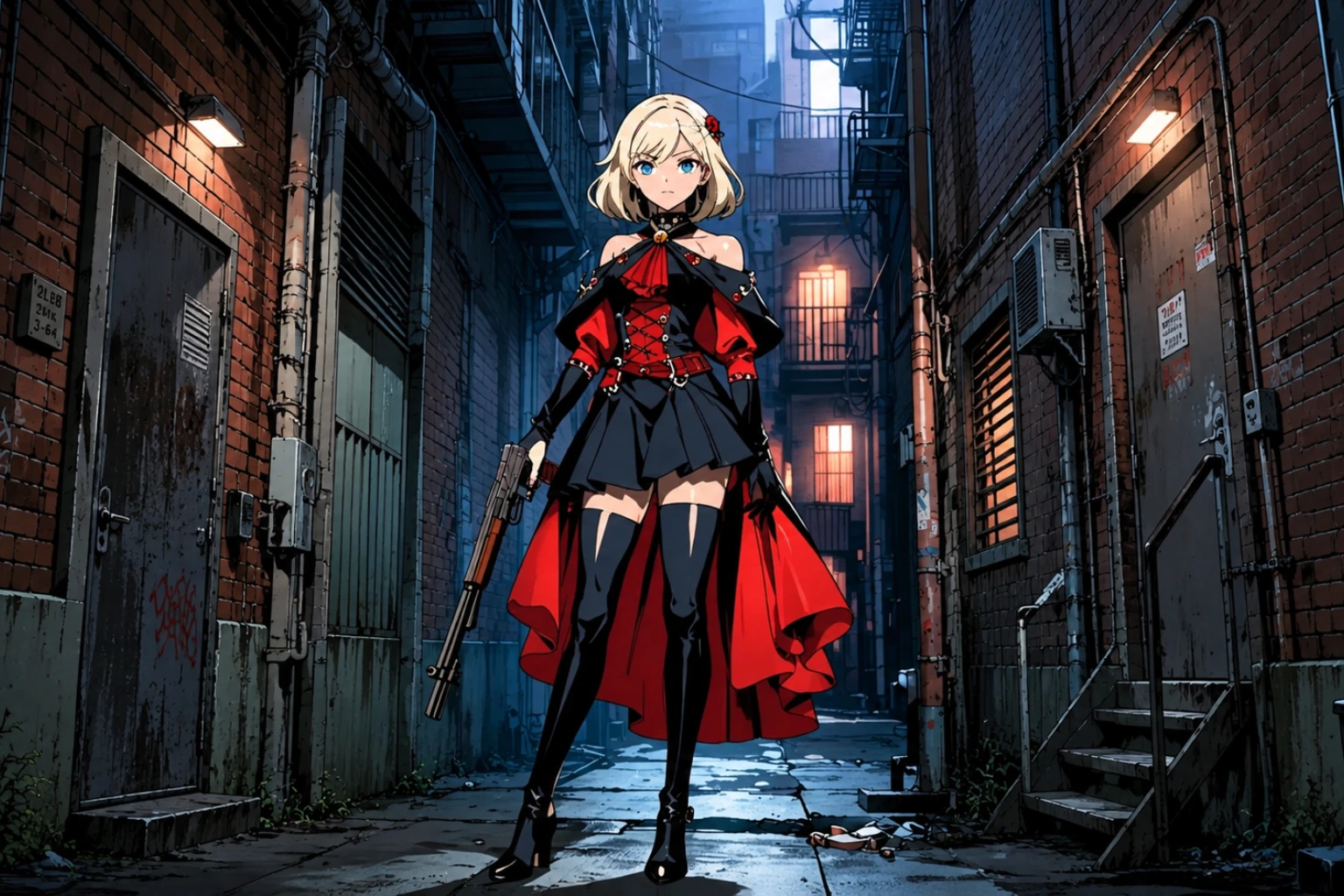
The alley behind Club Shiro smelled like old rain and cooking grease and the particular kind of fear that hadn't quite arrived yet but was on its way.
Saya read all three from the rooftop before she came down.
The delivery rider was young — maybe nineteen, the bike leaned against the wall behind him, still running, the way people left bikes running when they expected to be back in a moment and had not yet understood they weren't. Two men stood between him and the alley exit, not touching him, not yet. Just close enough, positioned well enough, that the geometry of the situation said everything that hadn't been said aloud. One of them had his hand resting on something under his jacket in a way that was meant to be noticed.
The rider was trying not to look at the hand. He was not succeeding.
"You don't have to carry anything," one of the men was saying, in the reasonable tone people used when they wanted something to sound like a choice. "Just this once. Show us you're part of the neighborhood."
"I don't —" the rider started.
"Everybody contributes," the second man said. "That's how it works around here."
Saya stepped off the roof.
She landed at the far end of the alley, eight meters behind them, and the sound of her landing — soft, deliberate — was enough. Both men turned. The rider used the moment to put another step of distance between himself and the closer one.
She stood in the alley mouth and let them look. The cape settled around her in the rain-wet air, black over red, and she kept her hands still at her sides, the revolver visible but down.
"Walk away," she said, "while you still get to choose."
The second one laughed. It was the kind of laugh that was mostly performance — meant to signal to his partner that this was manageable, that what they were looking at was not a problem. She had heard the laugh before. She was patient with it.
He reached under his jacket.
She raised the revolver and shot the drainpipe directly above his head.
The pipe cracked at the joint and a sheet of collected rainwater came down over both of them, immediate and cold, and in the half-second they spent reacting she crossed the distance to the closer man, took his weapon from his jacket pocket with her free hand before he finished his reach, and stepped back.
She held his weapon — a compact thing, nothing complicated — at an angle that made it clear she was holding it rather than using it, and looked at both of them.
"The choice was a moment ago," she said. "This is what comes after that."
The one without a weapon ran first. The one whose weapon she was holding looked at her for a moment longer, calculating, and she let him see that the calculation was going nowhere useful. Then he went.
She turned to the rider, who had pressed himself against the wall with the particular stillness of someone who had been afraid and was now afraid of something different.
"They're gone," she said. She put the confiscated weapon in her cape and kept her own revolver down. "You're all right."
He exhaled. "They — I've seen them before. They wanted me to carry something on my route."
"I know." She had seen this block three times this week. "Has anyone agreed?"
He hesitated. "There's a guy — Hemi, he runs the late deliveries for the club service entrance — he stopped taking the Tennoji alley route. I heard he went somewhere. Nobody saw him after."
"How long ago."
"Twelve days."
She looked at the alley exit. The rain had started again, light and consistent.
"There are others," the rider said. "Cleaners. A night cook from the izakaya on Sango Street. A girl who ran errands for the hostess bars." He said it carefully, watching her face. "People who didn't have anywhere else to be when it happened."
"The service passage under the district," she said.
He stared at her. "You already know."
"I suspected. Now I know." She looked at him — nineteen, scared, still standing in a back alley because his job required it. "Take a different route home. Not the Tennoji alley, not the underpass on the south end. Go around."
"What about you?"
"I'm going around the other way," she said.
The district had a grammar she had spent two years learning.
Not the grammar of the clubs and the neon and the crowds that moved through it after ten — those were surfaces, visible things, the city's face for people who weren't looking at what was behind it. The grammar she knew was the other one: service corridors and loading docks and the narrow stairwells between buildings that existed because maintenance workers needed them, because cleaners needed them, because the people who made a district function at three in the morning needed routes that didn't require them to move through the crowds.
She moved through those routes now.
The bartender at the standing bar on Sango Street saw her come through the kitchen entrance and didn't look up from the glass he was drying. He had done this before. She sat on the edge of the prep counter and waited until the cook had moved to the far end.
"Kanzaki," the bartender said, without her asking. Just the name, into the middle distance.
"Tell me the shape of it."
"He runs legitimate businesses. Real estate, a security company, a couple of the entertainment venues. He doesn't touch anything directly." The bartender put the glass down and picked up another. "The service passage runs under four blocks. Connects to an old storage facility below the Tennoji building. Nobody official knows about it because it was sealed during renovation twelve years ago and he bought the building two years after that."
"Who does his work in the passage?"
"A crew of six, maybe eight. Young guys, some of them are barely older than the delivery kids." He paused. "He tells them it's just logistics. Moving product, moving people who don't want to be found by the wrong people. By the time they understand what they're in, leaving isn't an option."
"And the missing people."
"Held. Not harmed, from what I've heard, but held. Leverage. If anyone who knows about the passage talks, he has someone to point at." The glass went onto the rack. "He's been building that for eight months. The passage, the leverage, the crew. He's careful."
"He knows about me," she said.
"He's been talking about it for two weeks. That Red Veil was going to come eventually and he was ready for it." The bartender finally looked at her. "He wants you to come in. He's set something up."
"I assumed," she said. She stood. "Thank you."
"Don't thank me," he said. "Just make sure he can't take the passage back after."
She moved through the next hour compressed into the shape of two more conversations and one long one.
A night-shift cook near the Tennoji alley worked the exhaust fan by the back door, the only fresh air the kitchen got between eleven and close, and from that spot he'd watched men go in and out of the sealed utility entrance for weeks — always the same door, always after midnight, always careful about who was on the street when they went. He hadn't told anyone. There hadn't been anyone worth telling.
"They walk like they're not supposed to be seen and don't care if they are," he said, wiping his hands on his apron rather than looking at her directly. "That's the part that bothered me. Not sneaking — just not caring." He nodded toward the door without pointing. "Tuesday, Thursday, sometimes Sunday. Never the same number of them twice."
He went back to the fryer before she could ask anything else, which was its own kind of answer.
Then there was the taxi stand.
The taxi stand on the corner of Sango and Third ran three cars deep at this hour, drivers leaning against their doors and not talking to each other, the specific silence of men who had seen the same three blocks every night for years and had stopped needing to comment on them.
She came up the sidewalk instead of the alley this time. Let them see her coming.
The driver at the front of the line was older, a cigarette unlit between two fingers like a habit he was in the middle of not indulging. He watched her approach and didn't move, which she read correctly as a man who had already decided he wasn't going to pretend he hadn't noticed her.
"You're going to ask me about the car," he said, before she'd said anything.
"Which car."
"The one that took the cleaning woman. Wednesday, maybe ten days back. Sedan, dark, no company markings. She didn't call it. I know because I was parked behind where she was standing and nobody radioed a pickup to that corner all night." He turned the cigarette over once. "She got in like she knew she had to."
"Did you see her face."
"Enough of it." He was quiet for a second. "She looked like someone doing math. Like she was deciding whether getting in was worse than not getting in, and she'd already lost the argument before she reached the door."
"Description of the car. Plate, if you have it."
"I don't carry a phone with a good enough camera for that kind of thing to matter, and if I did, I don't think I'd have used it." He said this without apology, just fact. "I have four kids and this corner. I need both of those things to still exist next month."
"I'm not asking you to be a witness," she said. "I'm asking you to be a source. Those aren't the same job."
He considered that. Somewhere behind him, one of the other drivers shifted his weight, listening without turning his head.
"Dark blue, maybe black under these lights. Older model, the kind with real doors, not the newer collapsible kind. Turned north on Third, which doesn't go anywhere useful unless you're heading for the loop that runs behind the Tennoji building." He finally lit the cigarette. "That's the whole of what I've got. And you didn't get it from me."
"I never do," she said.
She found the arcade kid last — a teenager in an oversized jacket sitting behind the closed arcade, who didn't want to talk until she mentioned the passage by name, and then only wanted to describe the sound the door made when it closed — a particular flat clang, twice, always twice, like someone checking it was locked before they walked away.
Nobody talked openly. Nobody said her name. But they spoke to the red cape and the calm face above it, and that was enough.
The sealed utility entrance was on the east wall of the Tennoji alley, behind a stack of pallets that had been arranged to look accidental and weren't. The lock was new, commercial grade, mounted on a door that looked like it hadn't been opened in years but had been opened recently enough that the hinges were clean.
She picked it in ninety seconds and went down.
The passage was long and low and smelled like old concrete and something electrical. Emergency lighting every twenty meters, dim, casting everything in amber. She moved with the wall on her left side and her footsteps as quiet as the floor allowed, which on concrete was not as quiet as she would have preferred but was quiet enough.
She found the cameras at the forty-meter mark.
Three of them, mounted high on the passage walls, angles overlapping. She had expected one. Three meant he was not only watching — he was recording. She stopped moving and stood for a moment in the amber light thinking about what three cameras in a passage meant.
It meant he wanted footage of her in the passage. Specifically her, specifically here, where the missing people had been taken through.
The bartender had said he was careful. A careful man with leverage and recordings and legitimate businesses would not try to fight Red Veil physically. He would try to turn Red Veil into evidence. Put her in the same passage as the missing people and let the footage tell whatever story he wanted told.
She looked at the cameras.
Then she looked at the passage walls. At the emergency lighting. At the junction twenty meters ahead where the passage split — she could see light coming from the right branch, not amber, something brighter. Voices, too quiet to parse but present.
She went left first.
The left branch ran forty meters and ended in a utility room with locked cages along one wall. Four of them. Three occupied — she counted faces through the wire mesh, found Hemi from the delivery routes among them, found two others she didn't know but who had the specific exhausted relief of people who had been waiting in the dark for something to change.
"I'm going to open these," she told them, already at the first lock. "When you're out, I need you to go right, back the way I came, and up to the street. Don't run. Walk. Stay together."
"There are guards," Hemi said.
"There will be fewer of them shortly." She had the first cage open. "Is anyone hurt?"
Nobody was hurt. They were cold and frightened and had been given barely enough food and water, but they were intact, and that meant she still had the room she needed to do this correctly.
She got the cages open and pointed them toward the exit and watched them go and turned back toward the right branch.
The room at the end of it was larger — an old storage space, concrete pillars, the floor clear except for crates along the walls. Six men. Kanzaki at the back of the room, seated, with the entirely too-comfortable posture of a man who had set a stage and was waiting for the performance. Three cameras on tripods, angled inward, red recording lights on.
And between her and all of it, four of the six men moving into positions that had been prepared in advance.
She shot the nearest camera off its tripod.
The recording light on a second camera was still on, so she shot that one too, and the third while the room was still reorienting to the first two shots, and the men were reaching for weapons and she was already moving — not toward them, past the first one on her left, the cape sweeping out behind her and the red silk catching in his peripheral vision on the wrong side while she went right, and she had his weapon out of his hand by the time he tracked the cape.
Two seconds. Two men still between her and the back of the room.
She shot the overhead light and the room went dark except for the ambient glow from the passage behind her.
In the dark she moved where they couldn't. She knew the room; she had mapped it in the two seconds of light before she took it away. Left column, five paces. Right column, three. The crates against the left wall were stacked two high. She went over them and came down on the far side and waited, perfectly still, for the sound of someone moving toward where they thought she was.
The sound came. She put a hand on his shoulder from behind, felt him start to turn, and took him down with her weight and leverage and the fact that he couldn't see and she didn't need to.
The fourth man had gotten to the far wall and found it. She let him find it. He needed to report that Red Veil had been here, had walked through six of them in the dark, had taken every weapon they'd reached for. Fear was useful when it was aimed at the right people.
She walked toward the back of the room where Kanzaki was still seated.
"Light," she said.
He produced one — a phone, held up so the glow reached both of them. His expression was controlled, which she respected professionally while finding it otherwise uninteresting.
"The cameras are gone," he said.
"Yes."
"The footage from the passage still exists. You, in there, at the location where people disappeared."
"The people who disappeared are walking out of your passage right now," she said. "I imagine some of them have phones."
He was quiet for a moment. "This district operates on certain understandings," he said finally. "About who is protected and who is not. I've been providing a service. Management of the parts of this city that the legitimate structures don't reach."
"Fear is the only law these streets understand," she said, giving him the line before he could use it.
He looked at her steadily. "You don't disagree."
"I disagree completely," she said. "Fear is a tool. You've been using it against people who clean your clubs and deliver to your buildings and work every shift that keeps this district running because nobody with power is watching. That's not law. That's convenience." She looked at him the way she looked at locked mechanisms she was about to open. "I've been teaching this district a different lesson for two years. That there's something in the dark that is not afraid of the people they're afraid of. That changes what fear means."
"Then you've been teaching it to the wrong people," he said.
"Then you've been teaching it to the wrong people," she said back, and watched him understand that she had turned his sentence inside out.
She heard voices from the passage — not the workers she'd freed, other voices, coming fast. She had maybe ninety seconds.
She crouched in front of him, which put her at his eye level and also communicated, clearly, that she was not afraid of being at his eye level.
"The workers you held are witnesses," she said. "The weapons your crew had are evidence. The passage itself, which is on your property, through your building, to your storage room, is going to become very difficult to explain." She stood. "The legitimate structures you mentioned are going to have a number of questions for you. I'd think carefully about the answers."
She left him sitting in the dark with his hands in his lap and two unconscious crew members and the specific expression of a man whose careful plan had run in exactly the wrong direction.
She came up through the utility entrance on the alley side at the same time the first police vehicles were arriving at the Tennoji Street end, which meant she had the alley and thirty seconds and she used both.
By the time the lights swept the alley she was on the second floor fire escape, and by the time the second unit arrived she was on the roof, and after that she was simply gone, which was what rooftops were for.
She sat at the east edge of the Tennoji building for a while, watching the district come back to itself. The police were talking to Hemi and the two other workers, who were gesturing toward the passage entrance. Vehicles, more of them. The gradual assembly of consequence.
She did not feel satisfied, exactly. Satisfaction implied something completed, and nothing in this district was ever completed. But it felt like the right shape of an evening — the missing people back in the light, the passage closed, the crew catalogued and visible, Kanzaki in the middle of a series of questions he had not prepared to answer.
It was enough for tonight.
Three days later, someone painted a small red ribbon on the brick wall at the Sango Street entrance to the alley behind Club Shiro. Small, careful, done in the kind of paint that weathered well. A cook at the standing bar left a covered cup by the back step at closing time and did not leave it there again after the first night because it had been taken, which meant it had been found.
The delivery rider started taking the Tennoji route again. He didn't explain why to anyone. He just went that way, in the hours when the streets were quiet and the alleys were dark, and found them clear.
And at the mouth of that alley, at two in the morning on a Thursday with the rain starting again, a figure in black and red stood for a moment with her back to the neon and looked at the district going about its necessary nighttime business — the people who worked while the others slept, the quiet infrastructure of the city, the parts that kept running because someone had to.
She turned up her collar.
She went back to work.


.png)
.png)
.png)