%20(1).png)
Sae had planned the day carefully, the way she planned most things she didn't want to feel too much while doing.
Pack the backdrop stands first, since they came apart easiest. Wrap the studio lights in the same padded cases they'd traveled in decades ago, cases with corners worn soft from handling. Take the framed photographs down from the walls last, because taking them down first would mean spending the whole day working in a room that had already stopped looking like itself.
Say goodbye to Handa-san sometime in the early evening, something short, something that wouldn't make either of them cry in front of the empty walls. Leave the arcade quietly after that. Not forever, necessarily — she hadn't decided that part, not fully — but soon. And without the kind of send-off that would require her to stand still while people looked at her and said kind things she wouldn't know how to receive gracefully.
That was the plan. It lasted until roughly ten in the morning, when the bell over the studio door chimed for the first time that day. An elderly couple walked in holding hands, both of them dressed more formally than the arcade's Saturday foot traffic generally called for.
"We saw the closing notice in the window," the woman said, a little breathless, as though she'd walked faster than her knees strictly approved of to get here. "We were hoping it wasn't too late."
Handa-san emerged from the back room at the sound of the bell, wiping his hands on a cloth that had definitely not needed wiping, and his whole face changed the instant he saw who was standing there.
"Watanabe-san," he said, delighted, setting the cloth down entirely. "Both of you. It's been — what, ten years?"
"Twelve," the woman corrected, primly. "You photographed our granddaughter's shichi-go-san. You cried, if I recall."
"I did not cry."
"You absolutely cried. Behind the camera, very quietly, thinking nobody noticed."
"The lighting was doing something to my eyes that day," Handa-san said, with the wounded dignity of a man who both knew he'd been caught and had no intention of conceding the point, and the woman laughed, delighted, in a way that told Sae this particular argument had been running for at least a decade and both parties enjoyed it far too much to ever let it resolve.
The husband, quieter, had been looking around the studio the whole time, taking in the half-packed boxes, the bare patches on the walls where photographs had already come down. "We got engaged in this room," he said, to no one in particular, though Sae understood he was really saying it to his wife. "Forty-one years ago. Right about there, I think, by the second backdrop."
"Forty-two," his wife said. "You always get the year wrong."
"I get the important part right, which is that it happened."
He turned to Handa-san, and something in his posture straightened, the particular formality of a man about to ask for something that mattered more to him than his voice let on. "We were hoping — if there's still time, if it's not too much trouble on your last day — we'd like to take the same photograph again. The engagement one. The same pose, if you remember it."
"I remember it," Handa-san said, quietly. "I remember most of them, if I'm honest. Sae, can you set the second backdrop back up? The gray one, not the blue."
Sae worked quickly, grateful for the simple, physical task of it, unfolding the gray backdrop stand and locking its legs into place. Handa-san dug through a drawer of old prints he'd been sorting for donation and produced, after a minute of searching, the original photograph. It showed a young couple standing close together, the woman's hand resting lightly on the man's arm, both of them caught mid-laugh at something the camera hadn't recorded the cause of.
"There," he said, setting it on the counter where they could both see it. "Same spot. You were standing just slightly to the left of center, Watanabe-san, because you insisted the light favored your good side."
"I still insist that."
"Your good side has had forty-two years to change its mind about which side that is."
They took their places in front of the backdrop, and Sae watched, adjusting the tripod, as the two elderly bodies arranged themselves into an echo of the young ones in the photograph — the same lean of the woman's shoulder toward her husband, the same light touch of her hand at his arm. But her hand shook slightly now in a way it hadn't in the original, and his back had curved with age in a way that made the mirrored pose require real effort to hold.
"I can't remember if I'm supposed to be smiling or looking serious," the wife said, suddenly nervous in a way she hadn't been a moment earlier. "We were so serious in the original. I don't know why. We were happy. I don't know why we looked so serious."
"We were twenty-two and terrified someone would tell us we were too young," her husband said. "We were trying to look like adults."
"Did it work?"
"No. We look like children playing dress-up. I've always thought so."
"Then let's not look serious this time," she decided, firmly, and something in her face loosened all at once, forty-two years of familiarity rising up to replace the nervous formality of a moment before. She looked up at her husband instead of at the camera, and he looked down at her. Whatever passed between them in that unguarded half-second was so plainly, unmistakably fond that Sae's finger found the shutter almost on its own, capturing it before either of them had remembered to perform anything for the camera at all.
"That's the one," Handa-san said, quietly, checking the screen. "That's exactly the one."
The wife peered at it, delighted, tears gathering unexpectedly at the corners of her eyes. "We look old."
"We are old," her husband said. "We've been old for a while now. I think we look like us, though. More like us than the first one, honestly."
They left twenty minutes later, print in hand, the wife dabbing carefully at her eyes so as not to smudge whatever makeup she'd worn for the occasion. Once the bell had chimed shut behind them, the studio felt different than it had that morning — less like a room being dismantled, and more, briefly, like the room it had always been.
"You didn't tell me people would keep coming," Sae said, once she and Handa-san were alone again, already reassembling the equipment she'd half-packed the day before.
"I didn't know they would." He said it honestly, though something in his tone suggested he wasn't entirely surprised either. "I put a small notice in the window a week ago. Closing today, thank you for forty years. I didn't expect anyone to treat it as an invitation."
"Are you going to keep unpacking things every time the bell rings?"
"Are you going to keep pretending you mind?" He said it gently, without any real edge to it, the particular teasing of a man who had known her long enough to say true things plainly. "You've been smiling since the Watanabes left. You can put the camera down for five minutes, Sae. I can see your face even when you think the equipment is hiding it."
"I don't hide behind the equipment."
"You've hidden behind that camera for six years," Handa-san said, not unkindly, folding a tripod leg closed with the same care he brought to everything. "I've never once seen you in a photograph the whole time you've worked here. Not one. You take everyone else's picture and you've never let anyone take yours."
Sae didn't have a ready answer for that, and busied herself instead with a lens case that didn't actually need closing.
"I'm not saying it to embarrass you," he added, quieter. "I'm saying it because I know you're planning to leave the neighborhood quietly, the same way you've spent six years standing quietly behind a lens instead of in front of one. I understand the impulse better than you'd probably guess. I'm just not sure it's actually served you as well as you think it has."
The two sisters arrived a little after noon, trailing a small, insistent woman in a floral cardigan who was, unmistakably, their mother, based on the specific tone she used to instruct them both on where to stand before anyone had asked her opinion.
"Mika, stand up straight. Nana, stop looking at your phone, we are here for a photograph, not for whatever is happening in that phone." The mother turned to Handa-san with a bright, determined smile. "We used to come here every year. Every single year, from the time they were small until Mika went off to university and decided visiting her mother wasn't worth the train fare anymore."
"That's not what happened," Mika said, flat, clearly repeating a defense she'd offered many times before.
"I didn't say what happened. I said what it felt like."
"Those aren't the same thing."
"They're the same thing to a mother." The woman turned back to Handa-san, entirely unbothered, as though this exchange were simply weather passing through rather than anything worth pausing over. "We saw the notice. I told them we had to come. This studio has every single photograph of them from the time they had no teeth to the time they had opinions. It felt wrong to let it close without one more."
Sae could feel, setting up the backdrop, the particular tension running between the two sisters — a careful, practiced distance, the kind that comes from people who love each other and have simply stopped knowing how to be easy about it. They stood close enough for politeness and no closer.
"Where did we used to stand," Nana asked, quieter than her earlier flatness, looking around the studio properly for the first time since walking in.
Handa-san considered the question with real care, the way he considered most things about people he'd known a long time. "There," he said, pointing to a spot in front of the same gray backdrop the Watanabes had used that morning. "You were always on the left, Nana, because you cried if anyone made you stand on the right, and nobody remembers why anymore, but everyone humored it for about six years running."
"I don't remember that at all."
"You wouldn't. You were four the last time it mattered." He smiled. "Mika stood on the right and complained about it exactly as consistently as Nana insisted on the left. I have photographic evidence going back a decade if either of you doubts my memory."
The sisters exchanged a look — the first genuinely unguarded thing that had passed between them since they'd walked in — and something in it carried the private shorthand of two people who had, once, known each other better than anyone else in the world.
"Left," Nana said, moving toward the spot before she'd fully decided to.
"Right," Mika said, a beat later, following her.
They stood the way children stand for a photograph even in adult bodies, shoulders angled slightly toward each other out of old habit neither of them seemed to consciously choose. Their mother, watching from just outside the frame, went uncharacteristically quiet.
"You used to hold hands," she said, softly. "When you were small. You'd hold hands without anyone telling you to."
Neither sister moved for a moment. Then, slowly, a little stiffly, Nana's hand found Mika's, the way you reach for something you're no longer sure still fits.
"This is ridiculous," Mika said, though she didn't let go.
"Completely ridiculous," Nana agreed, and something in both their faces, caught in the same instant Sae's finger found the shutter, softened into an echo of every childhood photograph stacked in Handa-san's old albums. It wasn't fully resolved, not a clean reconciliation, but a small, real crack of warmth in a distance that had clearly taken years to build and wasn't going to dissolve in one afternoon. Their mother, off to the side, wiped at her eyes with the corner of her cardigan sleeve and pretended, unconvincingly, that she wasn't.
"We should do this more," Nana said, once the shutter had clicked, releasing Mika's hand slowly, almost reluctantly.
"We should," Mika agreed. Neither of them made any specific plan to actually do it, but something in the way they said it, quiet and a little surprised at themselves, suggested the sentence might carry further than most polite things people say and don't mean.
"You saw that," Sae said, once the three of them had gone, printed photograph tucked carefully into the mother's purse. "The way they stood. I knew before they even faced the camera that Nana would take the left."
"You've always known things like that," Handa-san said. "I've watched you do it for years. You know how Mrs. Ito holds her chin when she's actually happy versus when she's performing happiness for her husband's benefit. You know that the Sato boy only smiles for real once his mother stops hovering at the edge of frame. You've spent six years learning this neighborhood down to its bones through a viewfinder, Sae. That's not nothing. That's its own kind of knowing someone, even if you never once let them look back at you the same way."
"That's different from actually knowing people."
"Is it?" He said it without pressing the point further, letting it sit instead, the way he seemed to let most difficult things sit rather than argue them into submission.
The shopkeeper arrived a little before two, a broad, weathered man Sae recognized instantly as Nakamura-san from the tofu shop three doors down. He was trailing a tall, quieter young man who had to be his son, though the resemblance was more in the set of the shoulders than anything either of them said out loud.
"Ryo's home for the weekend," Nakamura-san said, gruffly, by way of explanation, as though the visit required justifying. "He's up in the city now. Some engineering thing. I don't fully understand what he does, but apparently it pays well enough that he can't visit more than twice a year."
"It's not that I can't," Ryo said, quiet, a little tired in the specific way of someone who had had this exact exchange many times before. "Work is just busy."
"Work is always busy. Work will always be busy. Eventually you'll look up and thirty years will have gone by and work will still be busy." Nakamura-san said it without any real heat, more habit than argument, and turned to Handa-san instead. "We took a photograph here when he was a baby. Terrible photograph. He wouldn't stop crying. I think you have it somewhere."
Handa-san did have it, buried in the same drawer of old prints, and it was, indeed, a terrible photograph. An infant mid-wail, red-faced, one small fist raised as though personally offended by the entire enterprise of photography. A considerably younger, considerably less gray Nakamura-san held him at careful arm's length, with the particular helpless panic of a new father who had not yet learned how to hold anything so small without fear of breaking it.
"You look terrified," Ryo said, studying it, something almost fond in his voice despite himself.
"I was terrified. You wouldn't stop screaming and I had no idea what I'd done wrong."
"You probably hadn't done anything wrong. I was a baby. We cry about everything."
"I know that now." Nakamura-san said it gruffly, looking away from the photograph rather than at his son. "I didn't know it then."
They took their places in front of the same backdrop, the tofu shop owner standing with the same careful, slightly awkward posture as in the old photograph. Ryo, no longer an infant, stood beside him rather than in his arms, close enough that their shoulders nearly touched, though neither of them quite found the easy physical warmth that seemed to come naturally to the Watanabes or, however tentatively, to the two sisters.
"Should I smile," Ryo asked, a little stiffly.
"Smile if you want to smile," his father said. "I'm not going to tell you how to hold your own face."
There was a pause, the two of them standing in the particular careful distance of people who loved each other and had never quite learned the vocabulary for saying so directly, and it was Nakamura-san, finally, gruffly, who broke it.
"I kept that terrible photograph on the shop counter for eleven years," he said, not looking at his son, looking instead somewhere just past the camera. "Customers used to ask about it. I told them it was proof that even the worst days pass, if you wait long enough. I wasn't only talking about the crying."
Ryo went very still.
"I didn't know that," he said, quiet.
"There's a great deal you don't know, because I've never been good at saying it plainly." His father's jaw worked for a moment, some old, stubborn reluctance visibly losing ground. "I'm proud of the work you do in the city, even though I don't understand half of it. I just wish the work left more room for you to come home."
"I could come home more," Ryo said, and something in his voice cracked slightly around the admission. "I've just always assumed you'd rather I focus on the job. You never say much when I call."
"I don't say much about anything. That's not the same as not wanting the calls."
It wasn't a resolution, not fully — the words came out stiff and unpracticed, the specific awkwardness of two people rewiring a habit of silence that had taken decades to build. But something in Ryo's shoulders eased at hearing it, and when Sae's finger finally found the shutter, it caught not a posed, careful smile but something rawer and more real. Ryo's face had turned slightly toward his father, surprised and quietly moved, and Nakamura-san's own expression, gruff as ever on its surface, carried underneath it something that looked, unmistakably, like relief.
"That's a good one," Handa-san said, checking the screen. "Better than the crying one, I think, though the crying one has its own charm."
"Keep this one on the shop counter too," Ryo said, and his father, gruffly, without quite managing to look at him while he said it, agreed that he would.
The afternoon carried on that way, in smaller waves between the larger sessions. A retired schoolteacher who'd taught three generations of the arcade's children stopped in for a single quiet portrait and a story about the studio's original owner — Handa-san's own father, who'd apparently once photographed her wedding for free because her family couldn't afford the sitting fee that year. The flower shop owner from across the arcade brought an armful of unsold stems to leave in a vase by the studio window, "so the last customers have something pretty to look at." A group of teenagers, barely old enough to remember the studio from anything but their own school portraits, wandered in on a dare and left forty minutes later with a group photo none of them had planned on taking, laughing too hard at their own poses to hold a straight face through more than two attempts.
Sae moved through all of it with the same quiet, practiced competence she always brought to the camera. Somewhere in the accumulation of the day, she found that Handa-san's earlier words had lodged themselves somewhere she couldn't easily dislodge — the observation that she knew this neighborhood down to its bones, every private tell and old habit and hidden fondness, without ever once having let any of them look back at her the same way.
She thought about it, packing away a light stand between customers, watching the arcade's ordinary Saturday foot traffic pass beyond the window — faces she'd catalogued for years through a viewfinder, without ever quite letting herself become a face they'd catalogued in return.
By late afternoon, the light outside had gone soft and gold, the particular hour Handa-san had always called the best hour for portraits. The studio's schedule board, chalked in his careful handwriting, showed one final appointment remaining: a name Sae didn't recognize, booked for 5:30, the studio's very last scheduled sitting before the doors closed for good.
The appointment never arrived, or rather, it arrived transformed into something neither of them had planned for.
At 5:25, the bell over the door chimed, and the studio, which had emptied out for the first quiet stretch all day, filled instantly and completely. The Watanabes were back again, no longer in their formal engagement clothes; the two sisters stood with their mother trailing behind, visible satisfaction on her face; Nakamura-san and Ryo had returned, the tofu shop owner carrying a tray of something warm wrapped in cloth. The retired schoolteacher was there, and the flower shop owner, and three of the teenagers from earlier, having apparently recruited a fourth, along with a dozen other faces Sae recognized from years behind the counter and the camera both — all of them crowding into a room that had never, in six years, held this many people at once.
"What is this," Sae asked, half-laughing, already reaching instinctively for the camera.
"This," the elder Mrs. Watanabe said, "is us telling you to put that down for once."
"I have an appointment at five-thirty—"
"You had an appointment at five-thirty," Handa-san said, quiet amusement in his voice. "I believe this is it."
"There's no way all of you booked—"
"We coordinated," Nakamura-san said, gruffly, as though coordination were a great imposition he'd suffered through purely out of obligation. "It wasn't difficult. This is a small arcade. News travels."
"You've taken every photograph in this studio for six years," the schoolteacher said, gently, stepping forward. "Every single one of us in this room has a picture you took hanging somewhere in our home. We thought it was time you were in one too."
"I don't—" Sae felt the old, familiar instinct rise in her, the pull toward the camera, toward the safety of the space behind the lens rather than in front of it. "I'm not really good in front of a camera. I don't know how to stand."
"None of us know how to stand," Mika said. "You've seen every single awkward version of us standing badly all day. It's your turn."
"Please," Nana added. "We'd like one with you in it. Both of you."
Sae looked at Handa-san, some last flicker of resistance still holding. He was already setting the camera onto its tripod himself, adjusting the timer with the careful, familiar motions of a man who had done this exact task ten thousand times before — except this time for a frame he intended to actually stand inside.
"Come on," he said, gently. "One more picture. Then we can finally close properly."
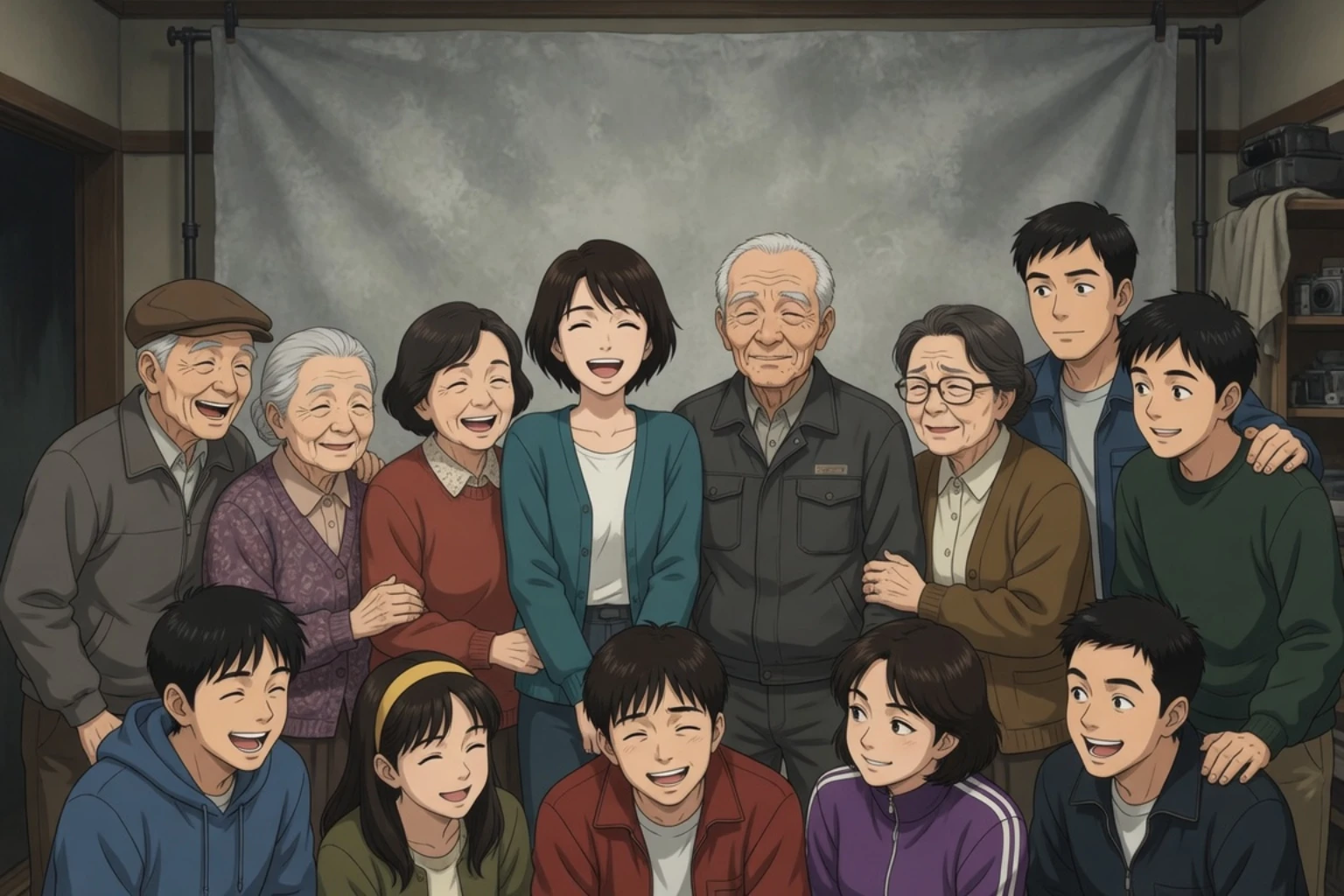
They crowded in together in front of the gray backdrop, far too many bodies for a space designed for two or three at most. The Watanabes stood at one edge, still holding hands; the sisters pressed close on either side of their mother, who had, by now, entirely stopped pretending not to cry; Nakamura-san and Ryo stood shoulder to shoulder near the back; the teenagers crouched in front, already giggling; the schoolteacher and the flower shop owner squeezed in somewhere in the middle. Everyone's arms found shoulders and waists with the easy, unbothered intimacy of people who had known each other, in one configuration or another, for most of their lives.
Handa-san found Sae's spot beside his own, right in the center, and nudged her gently into it before she could second-guess the placement.
"I don't know what to do with my hands," she admitted, laughing despite herself, some of the old discomfort finally beginning to loosen under the sheer, ridiculous warmth of the crowd pressing in around her.
"Nobody in this room knows what to do with their hands," Handa-san said. "Look at the timer instead. It'll go off whether you're ready or not. That's usually when the real picture happens anyway."
The timer counted down. Somewhere near the back, one of the teenagers made a joke that set off a ripple of laughter that hadn't fully died down by the time the shutter actually fired. Nana, mid-laugh, had turned to say something to her sister and was caught in profile instead of facing forward; Nakamura-san's expression came out gruffer than he probably intended, though his hand had found his son's shoulder without either of them seeming to notice; the elder Mr. Watanabe's eyes were closed, mid-blink. And Sae, caught entirely off guard by the shutter's click landing squarely inside a laugh she hadn't planned on having, found her own face, for the first time in six years, actually visible in a photograph taken inside this studio — unguarded, imperfect, undeniably present.
Nobody complained about the flaws once Handa-san turned the screen around to show them. If anything, the imperfection of it seemed to please the room more than a careful, posed version would have. Too many people, too little frame, someone looking the wrong way, someone's eyes shut entirely — and in the middle of all of it, unmistakably, a whole neighborhood's worth of forty years crowded into one single, crooked, entirely real frame.
They left in loose, lingering waves after that, the way people leave a gathering they aren't quite ready to end, each goodbye a little longer than the one before it. At last the bell chimed for the final time that day, and the studio stood empty except for Sae and Handa-san, surrounded by half-packed boxes and bare walls and the low, gold light of an evening that had, somewhere in the last hour, fully arrived.
"You didn't leave quietly after all," Handa-san said, settling into one of the two remaining chairs. He watched Sae process the print of the group photograph as it slid, slowly, out of the small printer they'd kept running the whole crowded final half hour.
"I don't think anyone was going to let me."
"No," he agreed. "I don't think they were."
She held the photograph carefully by its edges while the color finished settling, studying her own face in it with a strange, unfamiliar curiosity. It wasn't the discomfort she'd expected, seeing herself finally caught by the lens she'd spent six years standing safely behind. It was something closer to recognition, as though the woman in the photograph — laughing, imperfect, undeniably part of the crowd around her — was someone she was only now getting the chance to properly meet.
"I don't know where I'm going next," she admitted, quiet, into the settling dark of the emptying studio. "I had a plan. Leave quietly, figure the rest out somewhere else, somewhere nobody already had six years of expectations about who I was."
"Maybe you don't need to leave to find that," Handa-san said, gently. "Or maybe you do, and that's fine too. But I don't think you need to leave quietly anymore, whichever it turns out to be. I think today proved you were never quite as invisible here as you thought you were."
They locked the studio's front door together a little after seven, the last of the daylight gone soft and blue over the arcade's quiet, closing shops. Sae took the final photograph — printed, framed in the same simple black frame the studio had always used for its display pieces — and set it carefully in the front window, facing out toward the arcade. Anyone passing by after dark would see it lit faintly by the streetlamp outside: an entire neighborhood, forty years condensed into one crowded, imperfect frame, an old photographer and his young assistant standing, for once, together in the middle of it rather than behind it.
The arcade settled into its ordinary nighttime quiet around them, shutters coming down one by one along the row of shops, footsteps fading toward homes and dinners and lives that would carry on tomorrow without a studio at their center for the first time in forty years.
Sae stood at the window a moment longer than she needed to, looking at her own face looking back at her, laughing, unguarded, finally, unmistakably seen.
Then she turned off the studio's lights for the last time, and stepped out into the evening, and did not, this time, walk away quietly at all.


.png)
.png)
.png)