A sound.
He hadn't heard that sound in ages, but he knew what it was. The main door. Opening.
Morvane stood.
He couldn't really remember how long it had been since he'd last done that—stood, moved, existed as something other than a shape seated in the dark. Long enough that the motion itself felt foreign in his legs, like a word spoken in a language he hadn't used in years.
The sound did not repeat. It didn't need to.
He had heard it only a handful of times across a span of years he no longer bothered to count, and there was no mistaking the groan of those hinges, far off at the end of the long entrance hall, swinging open after what felt like an age of silence holding them shut.
Dust stirred faintly at his feet as he shifted his weight. It had settled there so long it had forgotten how to be otherwise, and when it rose it hung in the cold air without much conviction, as though it too had only just remembered it was capable of movement.
He looked around the hall he occupied, the one he always occupied, and for a moment allowed himself to actually see it the way it was rather than the way familiarity had worn it down to. Banners hung from the high walls in rags, their colors leached away by time beyond recognizing what house they'd once represented. Somewhere above, lost in a dark his torches no longer reached, the remains of a chandelier hung motionless on chains gone solid with rust.
He did not move toward the sound.
There was no urgency in him. No hunger that needed feeding, no curiosity demanding satisfaction. Whoever had come would find their way to him eventually, the way they always had, the way the fortress itself seemed to arrange things without his needing to interfere.
He stood a while longer anyway, simply because it had been so long since there had been any reason to.
The quiet that had just been broken was not an ordinary quiet. It was the kind that settles over a place that has outlived the need for sound altogether, thick and textured, filling every hall and chamber the way water fills a sunken ship. He had lived inside that particular silence for so long that hearing it crack now felt almost like vertigo.
He thought, briefly and without much interest, of the last time this had happened. He could no longer say how many seasons had passed since then, only that it had been long enough for the dust to return to every surface he'd once cleared of it, long enough for a bird's nest to form and abandon itself twice over in the broken window above his chair. Time did not mean to him what it had apparently once meant to the people who built this place, back when its halls still held voices.
In the years between arrivals, he had developed small habits that had nothing to do with purpose. He walked certain corridors on certain occasions, though nothing compelled him to. He had, once, spent what might have been a full season simply moving a single fallen stone from one end of a collapsed archway to the other, for no reason he could have named even to himself, and then moving it back again. The fortress gave him nothing to measure the hours against except the hours themselves, and he had long since stopped minding that absence.
He passed a window on his way back toward his seat, one of the few still holding glass, warped and discolored by age, and paused there for a moment to look out at the gray country beyond the walls. Nothing moved out there either, as far as he could see. It had been that way for as long as he could remember looking.
Whoever had opened that door below had already changed something simply by doing it. He did not yet know how many of them there were, or what they carried, or what they believed waited for them inside. It did not especially matter. The fortress had a way of answering all such questions eventually, in its own time, without his needing to hurry it along.
Eventually, he turned and walked back toward his seat.
The path was one his feet knew without his attention, past the rusted suits of armor standing sentry in their alcoves, past a kitchen long gone to ash, past a library whose books had fused into solid blocks of pulp no one would ever read again. He passed them the way a man passes the furniture of his own home in the dark, needing no light to know where the walls were.
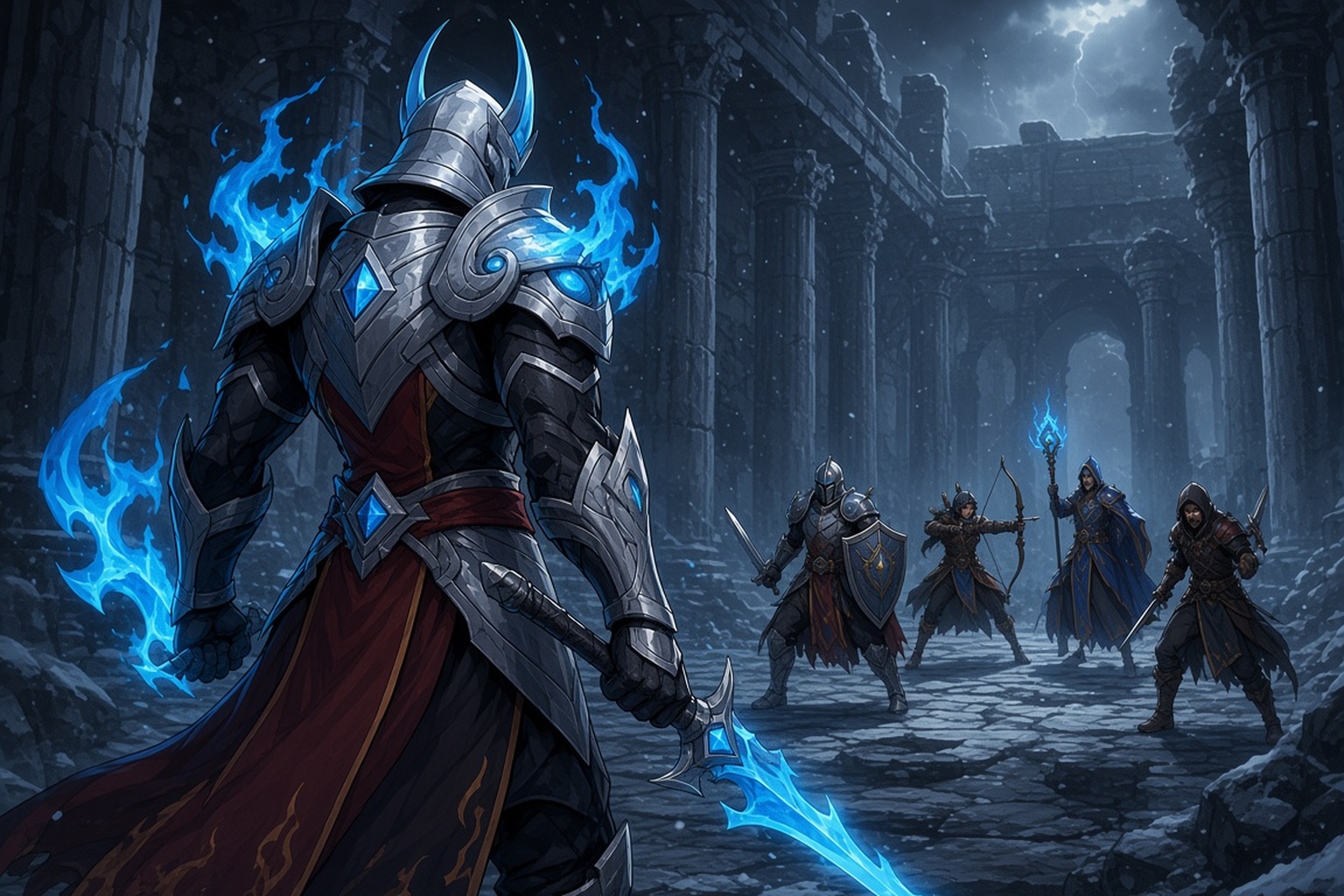
His chair waited for him on its low dais, stone worn smooth in the shape of however many years he had already spent sitting there. He lowered himself into it, and the thin blue flame bound along the edges of his armor settled back into its familiar, patient burn, flickering without heat, without hunger, simply present the way it always was.
He would wait.
They would come to him eventually. They always did.
In the border town of Aldmere, in a tavern whose painted sign had faded past any legible name, four people sat around a table that wobbled on uneven legs.
"I'm just saying," said Tamsin, not looking up from the dagger she was sharpening against a whetstone she kept in a pouch at her belt, "that if nobody who's gone in there has ever come out—not once, in all the years anybody's tried—that's not a mystery anymore. That's a pattern."
"Patterns tell you nobody's tried hard enough," Bram said.
He had the build of a man who solved most problems with the width of his shoulders, and an easy, stubborn confidence Tamsin had learned, across two years of working beside him, wasn't arrogance so much as a refusal to let fear set the terms of anything.
"Or that whoever went in before wasn't equipped the way we are," he went on. "We've got you. We've got Corwin's head for planning. We've got Elenna's charms. It's different this time."
"That's what everyone says right before they vanish forever," Tamsin said. There was no real heat in it. Only the familiar rhythm of an argument they'd circled more than once since the idea had first been raised.
Corwin set down his mug and rubbed at his eyes with the heel of his hand. He was younger than he looked and looked considerably older than he was, the particular weathering of a man who'd spent years making decisions other people's lives depended on.
"We're not walking in blind," he said. "We've brought enough supplies to give us time to explore and find our way back. We've got the old surveyor's charts showing the approach. We're not going in hoping for luck."
"We know that something in there has killed every person who's ever walked through that door," Tamsin said. "That's the whole of what we actually know. Everything past that is guessing."
"It's the only reward left in this kingdom nobody's managed to claim," Elenna said quietly, and the table quieted a little to hear her, as it generally did.
She was the youngest of them, barely into her twenties, the only one who practiced anything resembling true sorcery. Small magics. Careful ones. Warding charms and minor illusions, nothing that could topple a wall, but enough to have kept the four of them alive through two years of lesser, grubbier work.
"The Duke's bounty for proof of what's inside would set us up for the rest of our lives," she said. "Nobody's claimed it because nobody's gone about it properly. We've planned this for months. That has to count for something."
"Famous last words of every fool who's ever made a plan," Tamsin muttered, though she'd already agreed to come, same as the rest of them, weeks ago over another table in another town, when Corwin first unrolled the old parchment and showed them the fortress marked at the furthest edge of the map.
Bram leaned back, chair creaking under him. "What I keep wondering is why nobody's bothered trying in so long, if the reward's that good. Generations, and it's just sitting there."
"Because most people aren't stupid," Tamsin said.
"Present company excluded, apparently."
"Obviously."
Corwin allowed himself a tired smile at that, the first real one of the evening. "People forget," he said. "Something terrible happens enough times that everyone remembers to be afraid. Then a generation passes without anyone testing it, and the fear turns into story."
"The fortress stopped being a real danger to most people a long time ago," he added. "It became a shape on old maps. Nobody tries anymore because nobody remembers it as more than a tale their grandmother told them."
"Not comforting," Tamsin said.
"Wasn't meant to be."
Elenna turned her mug slowly between her palms, watching the candlelight bend across its surface. "My grandmother used to say the fortress swallows silence," she said. "Not people. Silence. That it's been quiet there so long because everything inside that could make noise already stopped, long ago."
She looked up, and something crossed her face that wasn't quite fear and wasn't quite curiosity, but some close cousin of both. "Probably just a way of telling children not to wander too far."
"Cheerful bedtime stories in your family," Bram said.
"You've never met my family."
"I'm extrapolating from the evidence available to me."
The tavern keeper came by to refill their mugs, and Bram made a show of counting out coins he didn't quite have, prompting Tamsin to sigh and cover the difference, as she had more times than either of them cared to tally.
"You're going to owe me a fortune by the time this is done," she said.
"If we come back with the Duke's bounty, I'll owe you considerably less of a fortune."
"If we come back, you'll still owe me the fortune. I'll just be too rich to care."
Corwin laughed despite himself, the sound a little rough from disuse, and even Elenna cracked something close to a smile. It was a small thing, the kind of exchange that had passed between them a hundred times over two years of hard roads, but it settled something in the room all the same, a reminder that whatever waited for them at the end of this particular road, they weren't walking toward it as strangers.
"I mean it, though," Corwin said, quieter now, glancing at each of them in turn. "Any one of you wants to turn back before we leave Aldmere, nobody's going to think less of you for it. This isn't a job like the others."
"If you're trying to talk us out of it," Tamsin said, "you picked a strange time to bring the maps."
"I'm not trying to talk anyone out of anything. I just want it said once, clearly, before we go. So nobody climbs that road thinking they didn't have a choice."
Bram reached over and clasped Corwin's shoulder, the gesture rough and brief but entirely sincere. "We know what we're walking into isn't walking back out," he said. "We talked about that already. We're going anyway. That's the whole of it."
Elenna finally set down her mug, turning the small clay charm she wore at her wrist, a protection ward her mother had given her long before any of this. She didn't believe it did much of anything. She wore it anyway.
"We leave at dawn," Tamsin said. It wasn't a question, and nobody treated it like one.
They left Aldmere behind at first light, the town's chimneys still smoking faintly against a sky the color of a healing bruise.
The road held for the first three days, winding north through farmland that thinned the further they went—fences leaning, fields left fallow more often than worked. Conversation came easy in those early stretches, the kind that fills a road because there's nothing yet to be afraid of.
"If we actually come back with proof," Bram said on the second night, poking at the fire with a stick, "first thing I'm doing is buying out the Hanged Man's entire stock of that spiced red they keep locked up."
"You'll be unconscious after two cups," Tamsin said.
"Two glorious cups."
"I want land," Corwin said, surprising them a little, since he rarely spoke first about anything that wasn't the mission itself. "Somewhere quiet. Somewhere I don't have to read a chart to know where I am."
"You'd be bored in a week," Tamsin said.
"I've earned the right to find out."
Elenna didn't answer right away. When she did, it was softer than the rest. "I just want to stop being the one everyone looks at when something needs explaining that can't be explained," she said. "Just once."
Nobody pushed her on it. They'd learned, over two years, which silences to leave alone.
On the third evening they came across the remains of another camp, long cold, half-buried under seasons of leaf fall. Whoever had made it had left behind a boot, cracked and stiff with age, and a rusted cook pot still sitting where a fire had once burned beneath it. Nobody suggested it belonged to a previous attempt on the fortress, but nobody suggested otherwise either, and they made their own camp a good distance further on that night.
"Could've been anyone," Bram said, more to himself than to the others, as he laid out his bedroll. "Trappers. Lost travelers. Doesn't have to mean anything."
"Didn't say it did," Tamsin said.
"You were thinking it."
"I think a lot of things. Doesn't mean I say all of them."
By the fourth day the road had thinned into a cart track.
On the fifth day they came across a shrine, half-collapsed, set at a crossroads that no longer led anywhere useful. Someone had left offerings there once, judging by the corroded coins scattered at its base, though whatever god it had been built for was no longer legible in the worn stone.
"Somebody used to care about this place," Elenna said, crouching to study the faded carving.
"Somebody used to care about a lot of places that don't matter anymore," Tamsin said, though she left a coin of her own at the base before they moved on, and said nothing when Bram noticed and chose not to comment on it.
They passed the last homestead on the same day, a crooked farmhouse where an old man watched them from his doorway and said nothing, not even when Bram called out a friendly greeting in passing.
"Charming fellow," Bram said, once the farmhouse had vanished behind the treeline.
"Can you blame him?" Tamsin said. "We're walking toward the one place in the kingdom everybody agrees you shouldn't walk toward."
Past that farmhouse, there was nothing. No villages, no farms, only forest giving way slowly to broken hill country, gray stone pushing up through thin soil, wind carrying a bite that didn't belong to the season yet.
By the sixth day the track had vanished into forest altogether, leaving Corwin to navigate by landmarks half-swallowed by growth that seemed determined to erase whatever path had once run through it. The trees grew strange here—stunted, gray-barked, their branches twisted in ways that had nothing to do with wind.
The nights grew long and cold enough that they let the fire burn past what their usual caution allowed. It was around those fires that the small rhythms of the group reasserted themselves—Bram's stories of old jobs gone sideways, reworked over the years into comedy rather than catastrophe; Tamsin needling him about the parts he conveniently left out; Corwin bent over his charts with the particular intensity of a man trying to keep the unknown at a manageable distance.
Elenna mostly listened. She had a way of watching the other three that made it seem as if she were cataloguing them, filing away small truths about each that she might need later, though none of them ever asked her why.
On the seventh night, with weather turning sharp and a scattering of early snow dusting the higher ground, Bram finally asked the question he'd clearly been carrying for a while.
"You ever wonder if we're the last ones who'll bother trying this? Like—after us, word gets around we went in and didn't come back, same as everybody else, and that's just it. Nobody else ever tries again."
"Cheerful thought before bed," Tamsin said.
"I'm serious."
"I know. That's what makes it worse."
Corwin looked up from his charts, the firelight catching the tired lines around his eyes. "We won't be the last," he said. "We're going to be the first to come back with proof. Somebody has to be first. Might as well be us."
"And if we're not?" Elenna asked. Not unkindly. Just honestly, the way she asked most things that mattered.
Nobody answered that. The fire cracked and settled, and somewhere out in the dark something made a call none of them recognized. After a while, they banked the flames and slept, because there was nothing more useful left to say.
The eighth day brought them through a stretch of dead woodland, trees standing bare and gray though the season hadn't turned, the ground beneath them bare of any undergrowth at all, as though something had simply stopped the forest from continuing here. Nobody said much as they crossed it. Even Bram kept his usual commentary to himself.
It was Elenna who finally broke that particular silence, late in the crossing, her voice carrying an odd, careful weight. "Do any of you feel that?" she asked. "Like the air's thinner here. Like something's listening to see if we'll turn back."
"I feel like I want to be out of these trees," Bram said. "Does that count?"
"Close enough," she said, though her eyes lingered on the bare branches a while longer, and she didn't fully relax until the dead wood was behind them.
On the ninth day they crossed into terrain that bore no mark of human presence at all—no trails, no cairns, nothing but Corwin's faded chart to tell them they hadn't already wandered off the edge of anything the kingdom still claimed. The wind carried a particular stillness here, as if even the air had learned to move carefully.
On the tenth, the clouds broke long enough to show it to them for the first time. A dark shape against the northern horizon. A shelf of gray rock. Towers broken in places, walls the color of old bone.
Nobody said anything for a long moment.
"There it is, then," Bram finally said.
"There it is," Tamsin agreed.
They made camp within sight of it that night, and conversation around the fire was thinner than it had been any night prior, each of them privately measuring the shape against everything they'd heard about it over the years, finding the stories had not prepared them for how it actually felt to look at.
"It doesn't look alive," Elenna said eventually. "Most ruins look like something that used to live. This looks like it's just—waiting."
Nobody disagreed with her, and nobody slept particularly well.
The main door stood exactly where the old charts had marked it—a vast archway of black iron and dark stone, tall enough to make the four of them feel smaller than any of them had felt in years of dangerous work.
No guards stood watch. None were needed. The fortress's reputation had done all the guarding anyone could ask of it.
"Well," Bram said, and for once there was no bravado in it at all. "Here it is."
Tamsin ran a hand along the cold iron, feeling for rust and finding none. "Hasn't been touched in a hundred years," she said. "No marks. No scratches. Nothing."
"Maybe nobody who's gone in has ever had the chance to leave one," Corwin said quietly.
Elenna stood a little apart, eyes fixed on the darkness just beyond the threshold, a darkness that seemed to resist the morning light in a way ordinary shadow didn't. "We don't have to do this," she said, surprising even herself.
Bram looked at her, the humor gone from his face entirely. "You scared?"
"Yes," she said. "Aren't you?"
He didn't answer right away. Then he put a hand briefly on her shoulder. "Yeah. Doesn't mean we turn around now."
Corwin checked the straps of his pack one last time, a nervous habit from his first dangerous job years ago. "We've come this far," he said. "I'd rather know than spend the rest of my life wondering."
Tamsin put her shoulder to the door. It groaned on hinges that hadn't turned in longer than any of them could imagine, the sound rolling away into the dark like an announcement.
They stepped through together, torches lit, and the door swung shut behind them, sealing out the last of the morning light.
The outer halls told a story of their own, for anyone left to read it.
Furniture rotted into collapse. Tapestries reduced to colorless rags that crumbled at a touch. Small animal bones scattered in corners, creatures that had wandered in through some gap and never found their way back out.
"This doesn't look like somewhere people get killed," Bram said, crouching beside an overturned table in what might once have been a dining hall. "Looks like somewhere people just left."
"Maybe that's worse," Tamsin said. "If they'd died fighting, there'd be marks. This just looks abandoned."
"Or thoroughly cleaned," Corwin said, and nobody much cared for that thought.
They moved through a gallery lined with rusted suits of armor standing sentry in stone alcoves, helms turned toward the corridor as though still watching for something that had stopped arriving long ago. Elenna lingered at one of them, studying the dented breastplate, the corroded visor.
"These weren't just decoration," she said. "Look at the wear. Someone fought in this. More than once."
"Comforting," Tamsin said.
They passed a library whose shelves had collapsed inward, books fused by damp and time into solid blocks no one would ever read again. Corwin tried, briefly, to pry one loose, but the pages came away in flakes that disintegrated before he could make out so much as a single word.
"Whatever they knew," he said, letting the ruined pages fall, "it's gone with them."
In a smaller chamber beyond it they found a long table set as if for a feast no one had ever eaten, plates and goblets buried under dust so thick they'd lost their shapes beneath it. Bram reached out to touch one and Tamsin caught his wrist before he could.
"Don't," she said. "Just—don't."
He didn't argue.
"Someone lived here," Elenna said softly, running a finger along the edge of a plate without disturbing it. "A long time ago. This wasn't always empty."
"Or someone still does," Tamsin said, and the thought settled over all of them, unwelcome and impossible to shake loose.
Past the feast hall, the corridor opened into a wide courtyard enclosed entirely within the fortress's walls, open to the sky through a gap in the roof far above, where weeds had forced their way up through cracked flagstones to reach what little light fell there. A dry fountain stood at its center, carved in the shape of some winged figure whose face had worn away to nothing.
"This is the first thing in here that's seen daylight in longer than I want to think about," Corwin said, tilting his head back toward the gap above.
Bram walked a slow circle around the fountain's base, frowning at something carved into the stone lip. "There's writing here. Can't make out the words. Looks old enough that it might not even be the same tongue we speak now."
Elenna crouched beside him, tracing the worn letters with two fingers, careful not to press too hard against stone that looked ready to crumble at the wrong touch. "I can't read it either," she admitted. "Whatever this place was for, it wasn't built by anyone keeping records anyone since has bothered to preserve."
"Maybe that's the point," Tamsin said, arms crossed, scanning the surrounding galleries with a soldier's habitual wariness. "Maybe nothing that comes out of here is meant to be understood afterward."
They lingered there longer than strictly necessary, none of them eager to press further into a place that had already shown them this much absence, this much evidence of lives interrupted without explanation. It was Corwin, finally, who broke the pause.
"We didn't come all this way to stand in a courtyard," he said, not unkindly. "Let's keep moving."
Further in, the halls began to change character, growing taller, colder, the ceilings lost to shadow their torches couldn't reach. They passed a chamber whose far wall had partially collapsed, revealing a stairwell descending into deeper dark that none of them volunteered to explore. They passed another, smaller room where someone, at some point, had scratched tally marks into the stone beside the door, dozens of them, stopping abruptly partway through a row.
Corwin stared at that longest of anyone. He said nothing about it, and nobody asked him to.
Twice they heard sounds that might have been settling stone, or might have been something else entirely, and twice they stopped and waited with weapons half-raised until the silence convinced them to keep moving.
"How far do you think this place goes?" Bram asked, his voice lower than it had been.
"Further than I'd like," Corwin admitted, checking his chart, which had long since stopped offering any detail beyond the outer walls.
It was in the fourth great hall they entered, a long gallery with a vaulted ceiling lost in darkness, that they first understood they were no longer alone. There was no roar, no crash of stone. There was simply, at the gallery's far end, a presence that had not been there a moment before and now unmistakably was.
A tall figure in dark armor, utterly still, as though it had been standing there for longer than any of them had been alive and found no urgency in moving now. A thin line of blue flame traced the plates of its armor, flickering without heat, without hunger, like a breath held just short of release.
"Don't move," Corwin breathed, though none of them had moved at all.
The figure did not advance. It simply regarded them across the dark space, and in that regard there was something that stripped the breath from all four of them more thoroughly than any charge could have managed.
"That's it," Tamsin whispered. "That's what's been here."
"Maybe it's a guardian," Bram said, though his certainty had thinned considerably. "Maybe there's a way past it."
Nobody answered, because the figure had begun to walk toward them, unhurried, each footstep ringing against the stone like a verdict being read aloud.
Bram broke first, though it would be unfair to call it cowardice. It was the instinct of a man who had spent his whole life meeting problems head-on, who had never once in two years let danger reach the people beside him without putting his own body in its way first.
He surged forward with a shout, sword already swinging in a wide arc meant to end things in a single stroke, the same stroke that had dropped bandits twice his weight and broken the knees of men who should have known better than to stand against him.
Morvane did not step back. He did not raise a blade to meet it. He simply caught Bram's wrist in one gauntleted hand, mid-swing, and stopped the blow entirely, the way a man might stop a child's arm before it broke something valuable.
Bram froze. For a moment he simply stared at the hand wrapped around his wrist, uncomprehending, as though his body hadn't yet caught up to what his eyes were telling him—that a strike carrying the whole of his considerable weight behind it had been halted without visible effort.
"Let go," Bram said, and there was something close to pleading already creeping into his voice beneath the anger, some part of him already understanding what his strength had just told him.
Morvane did not let go. The blue flame gathered instead, drawing in around the point where their hands met, pulling inward rather than spreading out, and Bram's face twisted with a pain that had nothing to do with his wrist.
It was not his arm that screamed. It was something underneath it, some foundation he had built his entire life upon—the certainty that his body would always be enough, that his strength would always be the thing standing between the people he cared for and whatever threatened them. He felt that certainty hollow out from the inside, like a tree discovered rotten at the core long after it had stopped mattering whether the bark still looked whole.
"No," he said, staring at his own open hand once Morvane released him, flexing fingers that no longer felt like they belonged to him. "No, I've never— I've always been strong enough. I've always—"
He dropped to his knees before he finished the thought, his sword striking the stone beside him, and the sound of it seemed very far away.
"Bram!" Tamsin was already moving, but Corwin's hand closed hard around her arm.
"Wait—"
Morvane looked down at the kneeling man for a moment, without cruelty, without satisfaction, the way one regards a door that has simply finished closing. Then, without haste, he drew a short blade from his side and ended it, the motion unremarkable, economical, over before any of them could fully absorb that it had begun.
Elenna pressed a hand over her mouth. Tamsin wrenched free of Corwin's grip, face white, dagger already in her hand.
"You absolute bastard," she said, voice cracking.
Morvane turned his gaze on her, and for the first time, spoke. His voice was low, carrying neither the cruelty of his actions nor any trace of mercy.
"You're angry," he said.
Tamsin tightened her grip on the dagger. "You killed him."
Morvane regarded her without answering.
Tamsin did not charge.
She had seen what charging bought Bram, and whatever else she was, she had never been a woman who repeated a mistake simply because grief told her to. She backed instead toward one of the broken stone pillars lining the gallery, putting its bulk between herself and Morvane, forcing him to choose a path around it.
"Come on, then," she said, voice tight but steady, circling. "Let's see how patient you really are."
She used the pillar twice more as she worked her way around the gallery's edge, breaking his line of approach, forcing small adjustments in his pace that told her more about how he moved than any direct exchange could have. When she finally came at him, it was not from the front.
She came low and from the side, feinting high first to draw his guard before dropping and driving her dagger beneath it, a move that had ended fights against better-trained men than whatever this was. Her blade slipped between two plates and opened a narrow cut along his forearm. She was already rolling clear before he could answer it.
"Not so untouchable after all," she said, putting distance between them, chest heaving.
Morvane examined the shallow cut without any particular concern, the blue flame along his arm flickering once, brighter, before settling again. "You fight well," he said. "Better than the others."
"Don't sound so surprised."
"I'm not." He started toward her again, and this time his pace had changed, subtly, no longer matching the rhythm she'd spent the last several exchanges learning. "I simply no longer need to guess what you'll do."
She tried the pillar trick again, and found him already there, already positioned to cut off the angle before she'd fully committed to it, as though her earlier successes had taught him everything required to deny her another. She tried a different feint, a different height, and met the same patient correction waiting for her on the other side of it.
It was in that moment—not the moment he caught her, but the moment just before, when she understood that every clever thing she still had left to try, he had already accounted for—that something in her chest went cold in a way no wound ever had. She had built her whole life on being the one who found the gap nobody else saw. There was no gap here. There never had been.
He closed the distance while she was still absorbing that, and his palm found her chest before her dagger could find anywhere useful to go. The blue flame surged there, cold and total, and her scream was not the sound of pain. It was the sound of a woman watching her own instincts, the very thing that had kept her alive through a hundred worse fights than this one, simply stop answering her.
She did not die at once. She sank down against the stone, staring at hands that no longer felt like tools she knew how to use.
"I don't—" she started, and the sentence had nowhere left to go.
Corwin reached her, pulling her back and shielding her with his own body, though he no longer carried any illusions about what that would accomplish. "Run," she whispered, voice hollowed out entirely. "Corwin—run—"
"We're not leaving you."
"You can't help me. Run."
There was nowhere left to run to, and he knew it even as the words left her mouth. He turned instead to face Morvane directly, placing himself between the advancing figure and Elenna, while Tamsin remained slumped against the pillar she'd once used so well, her strength entirely spent, able now only to watch.
"Whatever you are," Corwin said, steadier than he felt, "whatever this place is to you, you don't have to finish this."
Morvane did not answer that, and did not pause this time either. He simply came forward, and Corwin understood, in the space of that single unbroken step, that there would be no further words offered to him, no argument to counter, nothing resembling a conversation he could extend to buy more time.
So he stopped trying to reach the man, if he was a man at all, and turned his attention instead to the only thing still within his power to control.
"Elenna, the side passage," he said, not looking away from Morvane, angling his own body to block the straighter line between them. "Get to the stairwell we passed. Now."
"I'm not leaving you."
"That wasn't a request." He moved sideways as he said it, deliberately, drawing Morvane's attention a half-step further from where she stood, buying her room even as he gave up some of his own. "Go."
Elenna stayed where she was. He saw her hesitate, saw her look toward the passage and then back at him. He hadn't really expected her to go, not after everything, but the attempt mattered to him anyway, the way the whole of his life had always mattered more for the things he tried than the things he actually managed to finish.
He did not swing wildly the way Bram had, nor search for clever angles the way Tamsin had. He used his sword the way he used everything else, carefully, to buy space, to create distance, retreating in a slow arc that kept himself constantly between Morvane and the one person he still had any hope of protecting.
"You don't need to do this to her," he said, trying once more, though he no longer expected an answer. "Whatever this place demands of you, it doesn't need both of us."
Morvane said nothing. He simply closed the distance Corwin kept trying to maintain, patient and unbothered, as though the words had been spoken in a language that held no meaning for him at all.
Corwin's blade found only armor that turned every strike aside before it landed with any weight behind it, Morvane's responses so economical they barely registered as effort. Still he kept coming, kept placing his body in the path of every advance, because retreating further would have meant leaving Elenna exposed, and that was the one calculation he refused to make.
When the blade finally found him, it was clean, and should have ended things at once. It did not. The blue flame crept along the wound slowly, cold rather than searing, and Corwin's cry was not one of agony but of something worse—every plan he'd ever drawn up, every certainty that had carried him across years of dangerous roads, drawn thin and brittle and finally, quietly extinguished.
He looked, in that last moment, toward where Elenna still stood, close enough to see that she hadn't run, and something in his expression might have been relief that at least he'd tried, or grief that trying hadn't been enough. He fell, and did not rise again.
Morvane stood over him only briefly before turning. His attention moved next to where Tamsin still sat slumped against the broken pillar, her breath shallow, her eyes following him without any strength left to do more than that. He crossed to her without hurry, knelt, and the end came for her quietly, without struggle, the last of her resolve already spent long before the blade finished what the flame had started.
Elenna was alone now, and she knew it fully, the way one only knows such things when there is no one left to share the knowing with.
She did not run, though every instinct told her to. Instead she watched him approach, and found that beneath the fear, something else was moving in her as well—the same compulsion that had always made her the one who stayed up late over strange texts, who asked the second question after everyone else had stopped at the first.
"Wait," she said, when he was still several paces distant, and to her faint surprise, he did.
She raised her hands, not in attack, but carefully, and spoke the small words of the only true working she had left in her, a spell meant to bend light rather than banish it, to show things as they were not. The gallery around them flickered, briefly, doubling itself in ghostly layers, every rusted sentinel suddenly standing twice over, every shadow splitting into shapes that did not quite agree with each other.
Morvane paused at that, his head tilting slightly, and for a moment the blue flame along his armor behaved strangely, guttering low and then flaring high again, as though the illusion had disturbed something in it that ordinary steel never could.
"That's new," Elenna whispered, breathless. Her eyes moved from the doubled shadows to the flame along his armor. She had seen it change, but she had no idea what the reaction meant.
Morvane said nothing, but he studied the doubled shadows for a moment longer than she expected. In that pause, Elenna felt something close to a brief, fragile victory—not because she had overcome him, but because, for the first time, she had made him hesitate.
It did not last. The illusion required more of her than she had left to give it, and as it thinned and finally collapsed back into ordinary dark, he resumed his approach exactly where he had left off, unbothered now that the trick had run its course.
"Why?" she asked, falling back toward the cold stone wall as he closed the last of the distance. "Why do you do this? What is this place, to you?"
Morvane stopped a few paces away, and studied her the way he had studied nothing else that day. "It doesn't matter," he said. "Not to you. Not now."
"It matters to me," she said, voice shaking but not breaking. "I want to understand what's happening to us before it finishes happening."
He didn't answer. The flame along his armor burned a little brighter, and she understood, with a clarity that settled over her like cold water, that this was the whole of the answer she would ever receive, and that no spell she knew, no question she asked, was built to reach any further than that.
"You've done this before," she said, not a question. "Many times."
Still nothing, though something in the way he watched her confirmed it more thoroughly than words could have.
She raised her hands a final time, calling up a ward of sudden brilliance meant to blind, the same trick that had saved her twice before against enemies who relied on sight. The light flared between them, and for one brief moment his head turned against the glare, the flame along his arm flickering as it had before.
But he did not stumble. He walked through the light as though it were mist, and his hand closed around her wrist with the same quiet inevitability that had claimed each of her companions before her.
She felt the blue flame reach into her, not burning her skin but reaching for something deeper, some quiet certainty that had always told her she could find the shape of any mystery if she only asked enough questions, stayed curious enough, looked carefully enough at what frightened her. She felt that certainty drawn away from her, slow and complete, and understood in its absence that some things simply did not yield to understanding at all, no matter how carefully one tried to look at them.
She did not scream. She found, somewhere in the very last of herself, enough to simply look at him, to meet whatever it was that looked back from behind that cold and patient presence, and to let that be the final thing she did before the dark closed over her completely.
Morvane stood alone in the gallery for a while after that.
The torches the adventurers had carried still burned low where they'd fallen or been set aside, casting long, unsteady shadows across the four shapes scattered across the stone floor. The silence that followed was different from the one that had preceded the door's opening—heavier, carrying the particular weight of an ending rather than simple absence.
He did not linger over what had happened. There was no triumph in him to savor, no words left worth saying to an empty hall.
He turned, the blue flame along his armor settling back into its low, even burn, and walked back through the darkened corridors the way he always did. Past the rusted sentinels standing watch over nothing. Past the rotted tapestries. Past the long table still set for a feast no one would ever eat.
He passed the small room with its scratched tally marks, the stairwell descending into deeper dark, the library of fused and unreadable pages, all of it exactly as it had been, all of it exactly as it would remain.
He reached the wide stone chair upon its dais and lowered himself into it exactly as he had before, his posture unchanged, his stillness unchanged, as though nothing at all had passed in the hours between.
The fortress grew quiet again, the particular quiet that had held it for longer than any living memory could account for, broken now only by the faint, steady crackle of a flame that consumed no wood and no flesh.
Only resolve.
Morvane settled deeper into the chair, and waited, as he always had, for the sound of the door.