%20(1).png)
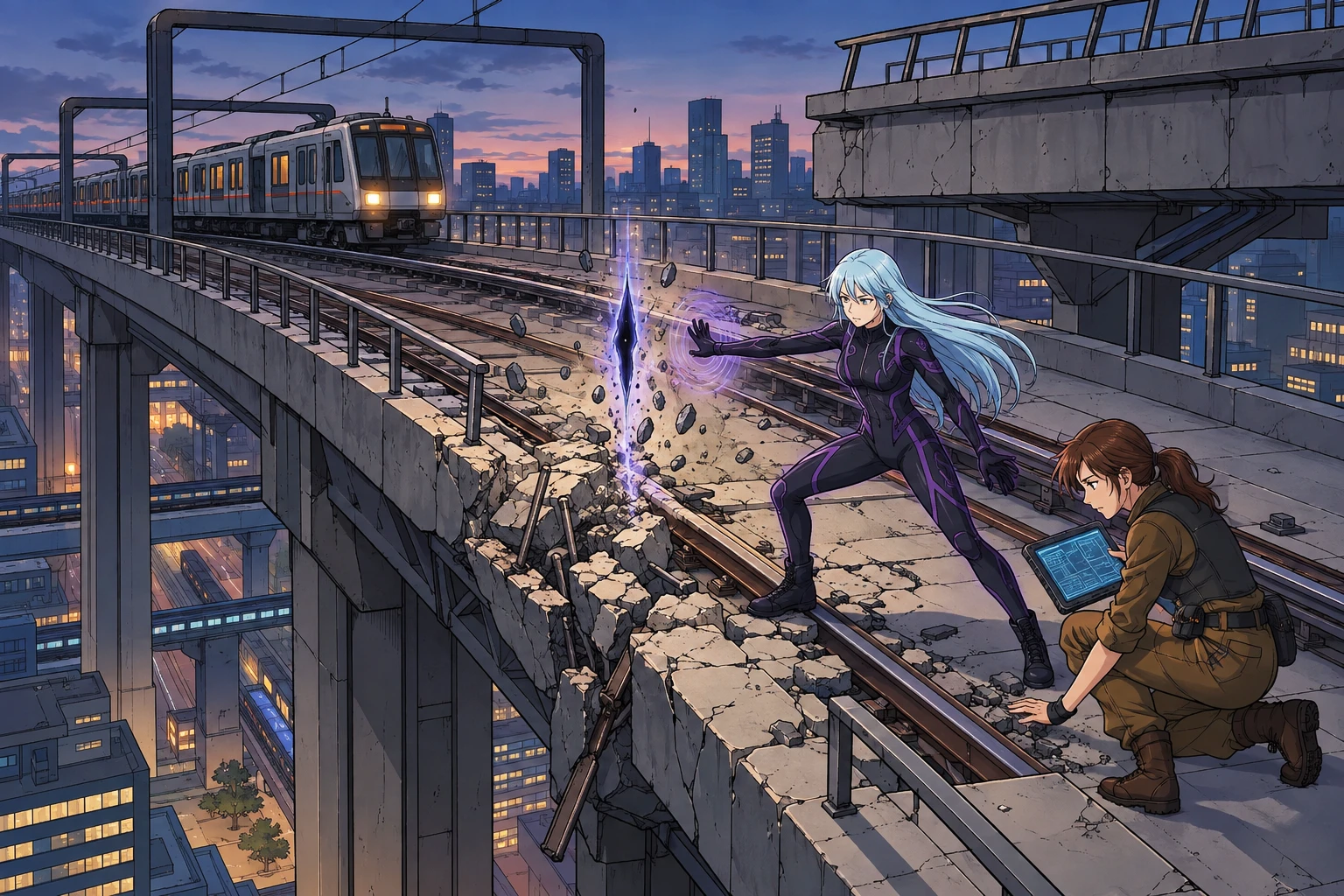
The alarm on Petra Keene's phone was not the kind she recognized. It wasn't the transit authority's usual structural alert, the one that pinged when a strain gauge crept past tolerance. This one came through an emergency channel she'd only seen used twice in eleven years, both times for bridge fires. She was already moving before she finished reading it, keys in one hand, boots half-laced, coffee abandoned on the counter still steaming.
The Aldric Viaduct carried the Meridian Line six stories above the old rail yards, a mile and a half of continuous box girder riding on eleven piers, feeding four platforms that during evening rush held, by her own estimate, upward of three thousand people. She had spent four years of her career keeping that structure honest. She knew its joints the way some people knew the names of their children.
By the time she reached the access ladder at Pier 7, the sky above the viaduct had already gone wrong.
It wasn't a color she could name. It wasn't quite a tear, either, though that was the word that kept surfacing in her mind as she stared up at it — a long vertical seam of not-space hanging above the third span, rippling faintly at its edges like heat over asphalt, except the air around it was cold enough that her breath fogged. The rails beneath it groaned. She felt it through her boots before she heard it, a low structural note she had never felt a viaduct make.
A woman was standing on the parapet above the seam. Just standing there, feet planted on eighteen inches of concrete six stories up, unbothered by the wind or the impossible geometry cracking open the sky beside her. She wore something dark and unornamented, no cape, no insignia, nothing that told a story about her. She was looking up at the rift the way Petra looked at load diagrams — assessing, not marveling.
Petra climbed the rest of the ladder with her heart going hard against her ribs, and shouted up, because shouting was the only tool she had at that distance. "That thing is going to take the span down!"
The woman looked over, unhurried. "It already is," she said. "Come up. I need someone who knows this bridge."
Petra had been on top of the viaduct exactly six times in her career, all during scheduled maintenance windows with a harness crew and a lane closure. She had never been up there with the deck humming underfoot like a plucked string, or with a hole in the sky pulling at the air the way a drain pulls at water.
The woman — Petra would learn her name a few minutes later, though right then she was simply the woman with no fear of heights and no interest in explaining herself — crouched near the rift's lower edge, one hand extended toward it, fingers spread, as though testing the temperature of a stove.
"It's drawing on the pier," the woman said, without turning. "Pier eight. Something about the mass under it. Rifts like anchor points — the more structure, the more they can pull."
"Pull how?" Petra said. "Pull the pier out from under the deck? Pull it sideways? I need to know what kind of failure we're talking about before I can tell you anything useful."
"Down," the woman said. "It's pulling straight down, through the pier, into whatever's under it. Like the ground beneath that footing suddenly weighs eleven times what it should. Give me a second." She tilted her head slightly, the way a person listens for a sound in another room. "Ten more minutes before the footing gives. Maybe twelve."
Petra had already turned to look south, toward Platform Four, where she could see, even from here, the packed crowd waiting on the evening trains, oblivious, checking phones. "There are people on that platform right now. If Pier eight goes, span three comes down on top of them, and span four goes with it because they share a continuity connection over the pier."
"I know," the woman said. "I can hold the pier. I can't hold it forever, and I can't hold the whole bridge, so we need to decide what we're willing to lose before I run out of margin. That's why I need you. I'm Astra. I move mass and force around. I don't know what this bridge is built to survive."
Petra looked at her properly for the first time — not the rift, not the platform, but the woman crouched at the parapet with her hand still extended toward a hole in the world, calm in a way that had nothing to do with recklessness. It was the calm of someone who had run out of adrenaline responses a long time ago and now simply worked the problem.
"Petra Keene," she said. "Structural. I designed the retrofit on pier six, and I know this deck like I know my own spine. Tell me exactly what you mean by hold the pier, because if you mean you're fighting that thing with force, I need numbers, not metaphors."
Astra's mouth curved, not quite a smile. "Fair. I'm not fighting it. I'm giving the load somewhere else to go for a while. Redirecting the pull instead of resisting it head-on — you don't beat a rift by pushing back, you beat it by making sure it isn't pulling on anything that matters. Right now I'm routing most of that downward pull through me instead of through the footing. Think of it as a temporary shoring column made of gravity redirection instead of steel."
"That's — " Petra stopped, recalculating what she'd assumed about the situation. "That's a load path. You're describing a load path."
"I don't know that term."
"It's how force actually travels through a structure to the ground. Every beam, every column, every connection is a link in a chain that carries weight from where it's applied down to something solid enough to hold it. You just told me you're inserting yourself into pier eight's load path as a substitute member. That's — " She almost laughed, except nothing about this was funny. "That's the most useful sentence anyone's said to me all day."
They walked the span together while Astra kept one hand loosely extended toward the rift, not gripping anything visible, but Petra noticed the air around her fingers had a faint shimmer, like a lens flexing. Every few seconds Astra's eyes flicked toward some point in the middle distance that wasn't there, tracking something Petra couldn't see.
"Talk to me about the pier," Astra said. "What's under it. What's it built to carry, what's it not built to carry, what happens on either side if it fails."
Petra pulled up the schematic on her phone as they walked, angling it so Astra could see even though she doubted the woman needed the visual. "Pier eight is a single reinforced concrete column, spread footing, nothing fancy, forty years old with a seismic retrofit jacket from 2004. It carries span three to the north and span four to the south. Those two spans are continuous over the pier — meaning they're structurally one piece, tied together with post-tensioning through the deck. If pier eight fails, both spans lose their middle support at the same time. That's not a local collapse. That's two spans coming down together."
"How much can I ask that pier to hold before it becomes the thing that fails instead of the ground under it?"
"I don't know yet. It wasn't designed for gravitational loading eleven times normal — nobody designs for that. But if you're pulling the rift's draw through yourself and only routing a portion into the pier, that changes the math completely. What fraction is actually reaching the structure right now?"
Astra was quiet for a second, calculating something Petra had no framework for. "Maybe a third. I'm carrying the rest. I can carry more, but not indefinitely — every second I redirect that pull, I'm folding a piece of the distance between here and the rift's other side through myself. It costs. Costs accumulate."
"Costs like what?"
"Like eventually I stop being useful to you," Astra said, flat, not dramatic about it. "I need a number. Give me the worst case. What can that column take before it cracks?"
Petra crouched at the base of the pier, running her palm along the retrofit jacket the way she might read a patient's pulse. "The jacket adds confinement, so it won't shatter outright — it'll go plastic before it goes brittle, which buys us warning. My honest number, no test data to back it, is somewhere around four times its design load before I'd expect visible spalling. Six before I'd expect real trouble. That's not a number I'd bet lives on normally."
"I'm not asking you to bet normally," Astra said. "I'm asking you to bet on this bridge, with me holding two-thirds of the pull somewhere else. Can you get me six?"
"For how long?"
"However long it takes us to get everyone off span three and span four."
Petra looked south again, to the platform, the crowd, the string of lit windows on an incoming train still four minutes out according to the schedule board she could just make out blinking on the platform overhang. "That's not twelve minutes. That's more like twenty, maybe twenty-five, if we're not causing a stampede."
"Then we don't have twenty-five minutes on the pier. We have to give the pier a break at some point, or find it more capacity, or take load off it some other way." Astra straightened, finally looking away from the rift for the first time since Petra had climbed up. "Talk to me about the rest of the bridge. Is there anywhere else this load could go instead of through that single column?"
This was the part of the job Petra loved, on the days when nothing was actively trying to kill three thousand people — the puzzle of it, force finding its way home through steel and concrete, always some path, sometimes more than one, if you were clever about finding it.
"There might be," she said slowly, walking to the parapet and looking down the length of the viaduct in both directions. "This isn't a simple span-to-column system. The deck is continuous over piers six through nine — four spans acting as one long beam, tied together by post-tensioning cables running through the girder. That means load doesn't have to go straight down through pier eight. It can travel sideways through the deck, into the adjacent piers, if we let it."
"Let it how?"
"Right now, the deck's behaving the way it's supposed to — it's stiff, so most of the extra load at pier eight is staying local, going straight down, because that's the shortest path and the deck isn't flexing enough to redistribute it elsewhere. If I could get more of that load to travel horizontally through the girder into piers seven and nine, we'd be sharing the burden across three columns instead of concentrating it on one."
"Can you do that? Physically, right now, with tools?"
"Not with tools, no. Not in the time we have." Petra's mind was already three steps ahead, though, chasing the shape of an idea she didn't like yet. "But you don't need tools if you're already bending the rules of how force moves through a body. If you could open a second point of pull — put some of the drag on the deck itself, out near the mid-span between seven and eight, instead of only at the column — you'd force the deck to act like a beam bridging the load sideways into the neighboring piers, the way it's designed to when one support settles. It's literally what continuous spans are for. They tolerate one support losing capacity by leaning on its neighbors."
Astra considered that with the stillness of someone running a simulation behind her eyes. "You're asking me to split my hold into two anchor points instead of one. Farther from the rift's actual source, weaker contact, more folding on my end. That's not free."
"I'm not asking you to do anything," Petra said. "I'm telling you what the structure can use if you can give it. What you can actually deliver, that's your math, not mine."
That got the closest thing to a real smile Astra had shown yet — brief, sharp at the corners, gone almost as soon as it arrived. "I like that division of labor."
The train that had been scheduled to stop at Platform Four instead got flagged onto a bypass track by a transit controller Petra had woken with a two-word text — emergency, don't ask — that she would apologize for properly later, assuming there was a later. Transit police were already moving the platform crowd back from the edge, though nobody had told them why beyond structural emergency, which was true enough not to be a lie and vague enough not to start a panic.
Astra split her focus, and Petra watched something happen in the air that had no clean physical description — a kind of doubling, a second point along the girder near mid-span where the light seemed to fold inward on itself for an instant, subtle enough that a train passenger glancing up would have called it a trick of dusk.
"How's the pier?" Astra asked, voice tighter now, the strain finally showing at the edges though her stance hadn't changed.
Petra had her palm flat against the concrete, feeling for vibration the way she'd learned to feel for it as an apprentice engineer, before she trusted any sensor over her own hands. "Steady. No cracking sound yet. Girder's taking weight, I can feel it — there's a change in the resonance, lower frequency, like the whole span just got heavier and slower. That's good. That's the load spreading like we wanted."
"Don't celebrate yet," Astra said. "Splitting the hold means I'm folding distance twice instead of once. That's not linear cost. It's worse than double."
"How much worse?"
"Enough that I need you to move faster than you think you can."
Petra didn't argue with that. She keyed her radio, calling the transit controller directly instead of going through dispatch, cutting every formality she normally respected. "This is Keene. I need span three and span four cleared, both platforms, now, not in five minutes. If anyone asks why, tell them structural integrity, tell them anything, just get them off the elevated section and down to street level."
"You're not going to tell me what's actually happening up there?" the controller said.
"I will. After. Move them."
While the platforms emptied — faster than she'd feared, slower than she wanted, that particular agony of watching two hundred people funnel through one stairwell while she did math in her head about seconds and structural fatigue — Petra kept walking the girder, checking the things a visual inspection could actually tell her. Hairline patterns in the paint at the pier cap. The alignment of the retrofit splice, still true, no visible distortion yet. She found herself narrating out loud, half for Astra, half because saying it steadied her hands.
"Splice is still aligned. That's the first place I'd expect distortion if the pier starts rotating instead of just compressing. If I see that connection begin to open unevenly, that's our five-minute warning before something worse than cracking."
"Noted," Astra said. She hadn't moved from her spot near the rift's lower edge, arms down now, no longer extended, though Petra understood by now that the visible gesture had never been the actual mechanism — it was something Astra did the way a conductor's hands did something beyond making a sound, a habit of shape more than function.
"Can I ask you something not about the bridge," Petra said, mostly to keep her own mind from spinning uselessly while she waited for the last stragglers to clear the stairwell.
"You can ask."
"Do you do this a lot? Structures. Not — whatever else you do."
"Not usually structures like this," Astra said. "Usually it's smaller. A collapsing tunnel with three people in it. A ship's hull with a hole where there shouldn't be one. Things I can hold entirely myself without needing anyone else's math." A pause. "This is bigger than what I'm built for alone. That's why you're up here."
"That's not exactly reassuring."
"It wasn't meant to be reassuring. It was meant to be true." Astra glanced sideways at her, something almost curious in it. "You want reassuring, or you want accurate?"
"Accurate," Petra said, after a second. "Always accurate."
"Good. Because accurate is: the pier is going to fail. Not might. Will. I can slow it, spread it, delay it, but I cannot hold gravity at eleven times normal on a forty-year-old column forever, and neither of us should pretend otherwise. What we're actually deciding is not if but how and where."
Petra let that settle instead of flinching from it, because flinching wasn't going to help either of them. "Then let's decide where. If pier eight is going to go no matter what we do, I want to control which direction it fails in, and I want to make sure it takes as little of the rest of the bridge with it as possible."
"That's the conversation I was hoping you'd get to," Astra said.
They crouched together at the pier cap, close enough now that Petra could see the fine strain in Astra's jaw, the kind of controlled exhaustion that didn't show in trembling hands or ragged breath but in something more subtle — a slowness settling into her movements, like a machine running a fraction under load capacity it used to have.
"Here's the shape of it," Petra said, sketching with a finger on the dust-caked concrete rather than pulling out her phone again. "Span three and span four are tied together over pier eight by continuous post-tensioning. If the pier fails and we do nothing, both spans come down together, and that's catastrophic — that's the whole middle of the viaduct gone, plus whatever damage it does to piers seven and nine when four hundred tons of deck slams sideways into them on the way down."
"So we break the tie."
"We can't physically cut post-tensioning cable in the time we have. But there's another way to break the load path between the two spans, and it's uglier, and I want to be honest with you about that before we do it."
"Tell me."
"There's a retrofit splice at mid-span between piers seven and eight — not an expansion joint, a reinforced connection where two sections of the box girder were joined during the retrofit. Under normal loading it's continuous with the rest of the deck, but it's the cleanest place to force a controlled break because I know exactly how the reinforcement and post-tensioning are detailed there.
If we deliberately overload that splice instead of letting the pier fail unpredictably, we can make the deck separate there before the failure runs through the rest of the structure. The piece nearest pier eight comes down — that's the sacrifice. But span four, and the part of span three between piers six and seven, stay isolated from the collapse. They keep standing."
Astra studied the sketch in the dust like it was a diagram she trusted more than words. "How much of the bridge are we losing."
"Maybe ninety feet. One bay. Everything from that joint through pier eight and a short piece of span four beyond it, until it hits the next expansion joint on the far side. Both platforms are already clear, so nothing's under it that matters except the structure itself." Petra hesitated. "It's a section I helped design the retrofit for, for what that's worth. I know exactly how it wants to fail if we push it. I'd rather choose the failure than let the rift choose it."
"What do you mean, how it wants to fail?"
"Every structure has a failure mode it prefers, if you load it wrong on purpose. This section, if we drop the pull straight down through the joint and let the pier take the full brunt without any deck continuity to share it, will fail in flexure at the joint first, then shear at the column base. That means it drops mostly straight down and slightly inward, toward the yard below, not sideways into pier seven or pier nine. If we manage it right, it collapses into the empty rail yard underneath instead of tearing at its neighbors."
"That's what I need," Astra said. "A direction. Give the collapse a direction, and I can help make sure it goes there instead of anywhere else."
"How?"
"The same way I've been holding the pier. If I know the shape you want the failure to take, I can bias the pull — make the rift's draw find the path of least resistance exactly where you tell me it should be, instead of wherever it wants. I'm not strong enough to stop this from happening. I'm strong enough to aim it."
Petra looked at her for a long moment, unsettled less by the physics of it than by how calmly Astra had just described choosing which ninety feet of a bridge would die. "You do understand that's a strange kind of trust you're asking me for."
"It's the same trust you're asking of me," Astra said. "You're telling me where a forty-year-old concrete column wants to break. I have no way to verify that except believing you know your own bridge. I'm telling you I can aim a collapse. You have no way to verify that except believing I know my own strength. We're both operating on faith here, Keene. That's the job."
Petra called it in — not to dispatch this time, but directly to the yard superintendent, warning him to clear the tracks below, the maintenance sheds, anyone doing an evening shift near the base of pier eight. She kept her voice level doing it, though her hands, she noticed once she'd finished, were not level at all.
"Yard's clear in four minutes," she told Astra. "That's the fastest they can do it."
"Then we have four minutes to set this up exactly right, because I don't think I have a fifth minute of margin after that."
"Talk me through what you need from me."
Astra's eyes went distant again, that listening posture. "I need to know the instant the splice starts to open. The actual first movement, not the moment it's obviously failing — the first fraction of an inch. That's when I shift the pull off the pier and onto the splice itself, so the break happens where you want it and not somewhere else the load finds on its own."
"I can feel that," Petra said. "I've felt joints move under load a hundred times. I'll know."
"Then you call it. The second you feel it start, you say now, and I move the pull. Don't wait to be sure. If you wait for certainty, we lose the window."
"That's not how I work," Petra said, half a protest, half just fear finding its way out as an argument. "I don't call things on instinct. I check, I verify, I don't want to be the reason this goes wrong because I trusted a hunch over data."
"You don't have data for this," Astra said, not unkindly. "There's no historical case study for a rift-induced gravitational anomaly on a forty-year-old viaduct. Your instinct right now is the best data available, because it's built out of every joint you've ever stood on that started to move. I need you to trust that the way I trust the pull I can't see with my eyes."
Petra breathed out, long, and put her palm flat against the joint housing, fingers spread the way she imagined — though she'd never asked — Astra's had been spread toward the rift at the very start of this. "Okay," she said. "Okay. I'll call it."
The last four minutes did not feel like four minutes. They felt like the kind of stretched, syrupy time Petra associated with car accidents, the half-second before impact expanding to hold an entire lifetime of small useless thoughts. She was aware of the wind. She was aware of Astra's breathing, shallow now, deliberate, the breathing of someone managing pain by outworking it. She was aware of the low structural groan under her palm, a sound she had heard exactly twice before in her career and both times it had meant something was about to give.
"Yard's clear," the superintendent's voice crackled over her radio.
"Copy," Petra said, and then, to Astra: "Yard's clear. We're doing this."
Astra didn't answer with words. Her whole posture changed instead — settled lower, weight through her heels, hands coming up again, not toward the rift this time but toward the pier and the joint both, splitting her attention into two threads Petra couldn't see but could feel, somehow, as a change in the air pressure around her own skin.
"Talk to me," Astra said, quiet now, all the earlier crispness gone thin with effort. "Tell me what you feel."
"Steady," Petra said, palm still flat on the joint housing. "Steady. Steady — " She caught it before she consciously understood what she was catching, a change in the vibration under her hand, a stutter in the resonance like a held note finally starting to waver. "There. That's it. That's the start."
"Where exactly."
"Right at the housing, north edge. It's opening on the north side first, which means it's going to rotate slightly as it fails, not drop clean. You need to bias the pull toward the north corner of the joint, not the center, or it's going to twist instead of dropping straight."
"North corner. Copy." Something in Astra's voice sharpened even through the strain, the sound of someone incorporating new information in real time without losing her grip on the rest of it. "Now?"
Petra felt the vibration deepen, almost in her teeth, the structural note dropping half an octave in half a second. Every trained instinct in her screamed not yet, verify, check the readout. She overruled it. There was no readout, and waiting for certainty was itself the danger.
"Now," she said.
The change that followed did not look like an explosion, a blast, or anything from the vocabulary of catastrophe Petra had absorbed from disaster footage over the years. Instead, the splice simply seemed to become a hinge.The north corner of the housing crumpled with a sound like a knuckle cracking at enormous scale. The deck beyond it sagged — not violently, but with a terrible, unhurried inevitability, the ninety-foot bay tipping downward as if some enormous unseen hand had finally let go of something it had been holding up out of politeness.
Petra had backed away instinctively, pulling Astra with her by the sleeve without thinking about whether that was an insane thing to do, and Astra let herself be pulled, still holding whatever thread of force she was holding, eyes fixed on the falling section with an intensity that had nothing to do with fear and everything to do with precision.
The girder folded downward at the splice, exactly where the north-corner failure had told it to give. Instead of twisting sideways into pier seven, it dropped nearly straight, rotating slightly inward toward the yard exactly as Petra had predicted and Astra had aimed.Pier eight went with it a half-second later, the column shearing at its base in a burst of concrete dust that rolled outward in a slow gray wave, not upward into anything, not sideways into anything — down, into the cleared rail yard, ninety feet of viaduct settling into a pile of rubble and twisted rebar where nothing living stood.
The rift, no longer anchored to a mass big enough to feed it, guttered like a flame starved of air, and folded itself shut with a soft concussive pop that Petra felt in her sternum more than heard.
For a long moment neither of them moved. The dust rolled and thinned below them. Span four, on the far side of the gap, stood exactly where it had stood an hour ago, its deck level, its joints square, utterly undisturbed, as if the ninety feet beside it had simply never needed to exist.
Astra sat down on the parapet, not gracefully, more like her legs had simply stopped negotiating with the rest of her, and put her head in her hands for a few seconds before straightening again, some private ritual of recovery Petra decided not to interrupt.
"You okay?" Petra asked eventually, because it seemed like the human thing to ask even if she suspected the honest answer wouldn't be yes.
"I will be." Astra looked at the gap where the bay used to be, assessing it the same clinical way she'd assessed the rift at the start. "It went where you said it would go."
"It went where we said it would go," Petra said. "I gave you a direction. You're the one who aimed a falling bridge at an empty rail yard instead of a platform full of people. I couldn't have done that with a hundred engineers and a week of planning."
"I couldn't have done it without knowing where the joint would open first," Astra said. "You gave me the one piece of information that mattered. I would have guessed wrong. I would have biased the pull toward the center, the way it looked like it wanted to go, and it would have twisted into pier seven." She looked at Petra with something that might have been the beginning of respect, offered plainly, without ceremony. "You called that exactly right."
"I've spent eleven years learning what concrete sounds like when it's lying to you," Petra said. "That's all that was. Not magic. Just pattern recognition."
"That's what I do too," Astra said. "People assume it's something else. Force, mostly, when they imagine it — throwing things, breaking things. It's not that. It's knowing where a pull actually wants to go, and convincing it to go somewhere slightly different instead. Same as you and your joint." She exhaled, slow, some of the tension finally leaving her shoulders. "Pattern recognition, with worse consequences for guessing wrong."
Below them, transit police were already moving toward the base of the collapsed section, radios crackling, someone shouting instructions about a perimeter. Far down the platform stairwell, Petra could see the yard superintendent standing at the edge of the rubble with his hands on his hips, staring up at the gap in the sky where the rift had been, at the absence where a rift-shaped hole should have left some visible scar and instead had left nothing but ordinary evening air.
"They're going to want a report," Petra said. "The transit authority. The city. Somebody's going to ask me to explain what happened up here, and 'a dimensional vanguard helped me perform a controlled structural failure to redirect a collapse away from an occupied platform' is not a sentence that survives an incident review."
"Tell them the truth in the parts that matter," Astra said. "The pier had a preexisting vulnerability, it failed under anomalous loading, you identified the failure mode and used it to direct the collapse away from the public. That's all true. It's also all anyone actually needs to hear."
"And the anomalous loading part? The rift?"
"Call it what your instruments will register, if they register anything at all. A localized gravitational anomaly. Nobody's going to argue with a structural engineer about the nature of gravity." A faint, tired amusement crossed her face. "You're better at this than you think. The explaining part, I mean, not just the engineering."
"I don't like leaving things out of a report," Petra admitted. "It feels like lying by omission, even when the omitted part is a hole in reality."
"It's not omission if the load-bearing facts are true," Astra said. "The bridge failed the way you said it would fail. You aimed it the way you meant to aim it. Everything downstream of that is administrative, not structural. You're allowed to let administrative things be someone else's problem."
Petra laughed — a short, disbelieving sound, mostly relief finding an exit it could use. "Is that professional advice from a dimensional vanguard, or personal advice from someone who's clearly filled out an incident report before?"
"Both," Astra said. "I've learned that the second one matters more than people expect."
They stood together a while longer at the parapet, watching the dust finish settling over the rubble of what had been the middle third of span three, the wreckage stark and orderly in its own violent way — a clean drop, mostly vertical, exactly where they had put it. Below, emergency lights were starting to strobe against the yard's corrugated sheds. Somewhere south, on the intact section of the viaduct, a maintenance crew had already begun walking span four's deck with flashlights, checking joints, checking bearings, doing the small careful rituals that told a structure it was still being watched over.
"You'll need to inspect the rest of it," Astra said. "Piers six and seven both took extra load while we were redistributing. Even if nothing shows on the surface, that's stress they weren't designed for."
"I know," Petra said. "I'll be up here every day this week with a strain gauge and probably not enough sleep. That's the part nobody puts in the incident report either — that the bridge doesn't just get to be fine again because the emergency's over. Somebody has to go back and check every connection that took a load it wasn't supposed to take, and keep checking, for months, before anyone can honestly call it safe."
"That sounds like the same job I have," Astra said. "Different scale. Same shape."
"What do you mean?"
"After something like this — a rift, a collapse, a fight, whatever it ends up being — everyone wants to talk about the moment it closed. Nobody wants to talk about the days after, checking whether the closing actually held. Whether something got bent that isn't obvious yet." She looked at Petra directly, and for the first time all evening there was something unguarded in it, not warmth exactly, but a kind of recognition. "You'll do the structural version of that. I do it too, in my own way. Neither of us gets to just walk away once the visible part's over."
Petra considered that, turning it over the way she turned over a stress result she wasn't sure she trusted yet. "Will you be back? If something else happens to this bridge."
"If something happens to this bridge, I don't think either of us gets a choice about being here," Astra said. "But yes. If you'll have someone who moves gravity around instead of a proper contractor."
"I'll take the help," Petra said. "Just — next time, give me more than twelve minutes of warning."
"Next time," Astra said, "I'll try to make sure there isn't a next time. But if there is, I know now who to call before I even land."
She said it simply, without performance, the way she'd said everything else that evening — not a promise dressed up for effect, just a fact laid down like a beam finding its bearing, load transferred, weight settled, somewhere solid enough to hold.
Petra looked out at the gap in the viaduct one more time, at span four standing untouched on the far side of it, lit now by the first floodlights the emergency crews had brought up. Ninety feet gone. Three thousand people who would never know how close they'd come, walking home right now with nothing more urgent on their minds than a delayed train and an inconvenient detour.
That, she thought, was what a load path was for, in the end. Not to prevent every failure. Just to decide, when failure came, exactly where it was allowed to fall.


.png)
.png)
.png)