%20(1).png)
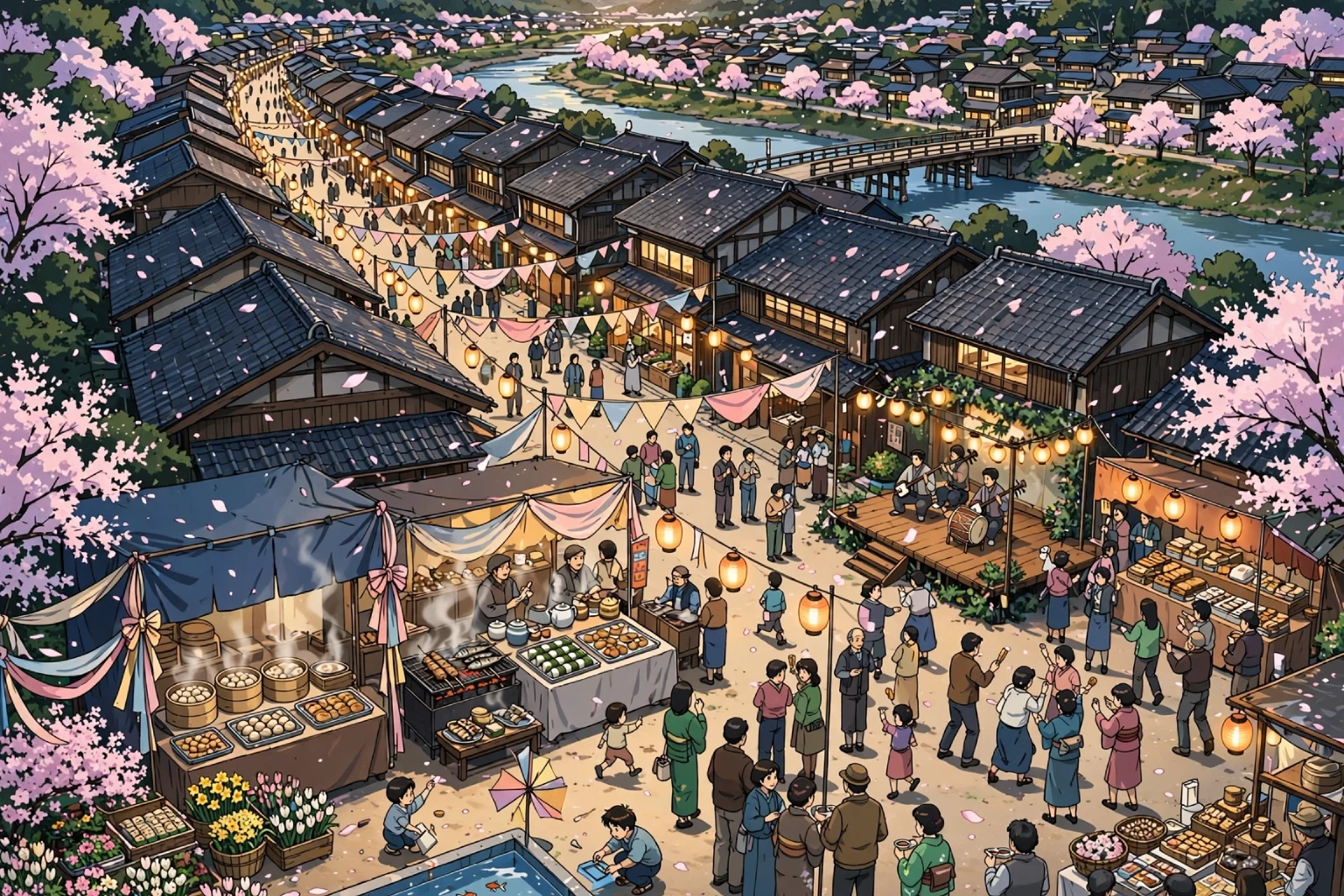
Kuroha reached Hanamori in the late afternoon, four days out from Tsukigane, walking with the specific careful gait of someone whose body had opinions about every step and intended to share them.
She heard the town before she saw its gates properly — not the low percussive knocking of quarry work but something considerably more cheerful, a layered mess of hammering, laughter, an argument in progress, and somewhere beneath it all a stringed instrument working through the same eight bars of a melody for what sounded, from the fourth or fifth repetition, like the twentieth time that afternoon.
The street she walked into was strung end to end with fresh ribbon, red and pale green, tied between the eaves of buildings that hadn't yet finished deciding how much decoration was enough. Half-built lantern frames leaned against a wall in a row, waiting for paper. A cart loaded with cut flowers sat abandoned in the middle of the road while its owner argued with a man over what appeared to be a disputed six feet of stall space, both of them gesturing with the total conviction of people who knew they were right and intended to keep saying so until the other one agreed. Children ran past carrying paper decorations they had clearly made themselves and clearly needed adult help transporting without crushing, judging by how many of them were already crushed. The musician kept playing the same eight bars.
It was, Kuroha thought, exactly the kind of noisy, overfull, thoroughly unremarkable chaos a person could disappear into completely, and she was grateful for it in a way that had less to do with concealment than with the simple fact that nobody in a crowd this busy had the attention to spare for whether a passing traveler was walking a little stiffly.
She was walking a little stiffly. Her side pulled sharply whenever she turned to look at anything, which she was doing rather less than usual as a direct consequence. Her shoulder had a range of motion best described as reluctant. She had eaten enough over the last four days to keep herself upright, but not enough, she suspected, to have actually replaced what the cave had taken from her, and the walk into town had left her with the specific full-body tiredness of someone who had asked more of her legs today than they currently had to give.
One night, she told herself, watching a boy nearly collide with the flower cart and swerve at the last possible second. She would find a bed, eat something proper, and be on the road again by morning.
She did not, at that point, believe this any more than most people believe the first lie they tell themselves on a given day, but she believed it enough to walk into the first inn she found and ask for a room.
---
The inn was small, clean, and run by a woman named Chiyo who had the brisk, unbothered competence of someone who had spent every spring of her adult life hosting festival visitors and had long since stopped being surprised by any of them.
She looked Kuroha over once, in the doorway — the careful posture, the faint stiffness in how she set down her bag — and said nothing about it beyond, "Stairs on the left, mind the third one, it sticks," which Kuroha appreciated more than she said.
"Mountain road," Kuroha offered anyway, because an unexplained limp invited more questions than a vague one. "Loose stone. Took a fall."
"Happens," Chiyo said, in the tone of someone who had heard sixty variations of this exact sentence and had learned that pressing for more never improved the conversation. "There's stew if you want it. Enough for two servings, if you're hungry enough to need both."
Kuroha was hungry enough to need both, which surprised her slightly, and she ate the whole of it at a corner table with the specific dedicated focus of someone eating for a reason rather than pleasure, though by the second bowl the reason and the pleasure had started blurring together in a way she chose not to examine too closely.
The room upstairs was plain and clean — narrow bed, a wash basin, a single window that looked directly down onto the festival street, close enough that the noise of hammering and rehearsal and cheerful arguing drifted up steadily even after dark. She sat by the window for a while before sleeping, watching lantern-frames get carried past below, listening to the same eight bars of music finally, mercifully, resolve into a ninth.
She slept, that night, longer and more completely than she had in longer than she cared to count, and woke the next morning with sun well up and no memory of having dreamed anything at all.
---
Continuing on that morning would have been, she recognized as soon as she tried to sit up, a genuinely foolish idea, and she was self-aware enough to admit this to herself even before her body had finished making the point with considerable insistence.
Chiyo, when asked, recommended the local healer without hesitation, in the tone of someone recommending the one sensible option available. "Down past the second lantern-maker, small house with the blue door. Her name's Otsune. She'll set you right or tell you honestly if she can't."
Otsune turned out to be a compact, weathered woman somewhere past sixty, with hands that moved over Kuroha's ribs and shoulder with brisk professional indifference to any embarrassment either of them might otherwise have felt about the process, and a complete unwillingness to be talked out of a proper examination by anything Kuroha said to minimize it.
"It's mostly healed," Kuroha said, as Otsune pressed, with deliberate care, along a line of bruising that made her breath catch despite her best effort to control it.
"It's mostly not," Otsune said, without looking up. "Ribs are badly bruised, not broken, which is more luck than you deserve given the state of you. Shoulder's strained, not torn, and it'll stay that way if you actually rest it instead of doing whatever it is you clearly intend to do the moment my back is turned." She sat back on her heels and looked at Kuroha properly for the first time. "You're underfed. Dehydrated, or you were recently. Several of these cuts are healing, but slowly, which tells me your body's spending its effort on more than just the cuts." A pause. "What happened to you?"
"Fell," Kuroha said. "On a road."
Otsune looked at her for a long moment with the specific patient skepticism of a healer who had heard a great many travelers describe injuries as falls and had decided, long ago, that most of what people didn't say wasn't actually her business as long as the treatment stayed the same.
"Fine," she said. "Whatever it was. You need a week. Real rest — food, sleep, no walking further than this street, no lifting anything heavier than a teacup." She began wrapping Kuroha's ribs with brisk economy. "If you leave before that, you'll reopen half of this and be worse off in a month than you are now. I've seen it enough times to know exactly how it goes."
Kuroha, who had in fact seen it happen exactly that way to other people on more than one occasion, and who recognized good advice when a stranger with capable hands gave it to her without asking for a story in return, did not argue.
She paid Chiyo for six more nights, with the private, faintly irritated acknowledgment that Otsune had been entirely right and that arguing about it would have accomplished nothing except delaying the inevitable while making her ribs hurt more in the process.
---
The next two days she mostly rested, in the specific way rest looked when done by someone constitutionally unable to sit still for very long without finding something small and useful to observe.
She sat by her window with tea, watching the street below settle into its rhythm of preparation. She walked short distances — to the well, to the corner and back, gradually further as her side allowed it — and returned each time a little steadier than the trip before. She slept in the afternoon, which she almost never did, and woke each time faintly embarrassed about it and unable to argue with how much better she felt afterward. She stretched her shoulder carefully, morning and evening, in small controlled arcs that made her wince and improved, marginally, day by day.
And she watched the town, out of the habit of a lifetime that did not switch off simply because there was, for once, nothing actually wrong.
A crash from the square sent her half out of her chair before she'd fully processed the sound, heart moving faster than the situation warranted, only for the noise to resolve itself into a decorative arch toppling over in the wind, followed by four men laughing and one swearing as they righted it. A lantern near the inn's front step flickered erratically for two evenings running, and she watched it with the specific narrowed attention she reserved for things that behaved strangely, before overhearing the lantern-maker complaining loudly to a neighbor about a bad batch of oil from the eastern supplier. A cloaked figure moved briskly behind a row of stalls one evening, and she tracked its path for a full minute with real interest before it ducked behind a curtain and emerged, moments later, as the musician from the square, evidently hiding from a rehearsal he'd apparently had quite enough of for one day. Raised voices near the well turned out to be two vendors renegotiating table space with the same volume and conviction as the day she'd arrived. A rhythmic tapping against the inn's outer wall, which held her attention for a genuinely uncomfortable ten minutes on her second evening, resolved into a carpenter fixing a loose shutter one board at a time.
By the third day, she noticed something had changed in how she watched all of this. She was no longer waiting for the crash, the flicker, the raised voice to become something else. She simply watched a festival get ready to happen, the way anyone might, and found that she did not miss the vigilance nearly as much as she'd expected to.
---
Her involvement in the actual preparations, when it began, happened entirely without her consent, which she found, on reflection, was rather in keeping with how most things in Hanamori seemed to get done.
She had been sitting on a low wall near the square on her third day, resting after a short walk, when a man balanced precariously atop a ladder called down without preamble, "Hold this, would you?" — and Kuroha, being the only person within reach and evidently looking sturdier than she felt, found herself steadying the ladder's base before she'd fully decided to.
That was, in retrospect, the beginning of it. Someone handed her a stack of paper lanterns to pass upward to a woman on a second ladder. Someone else, seeing her standing near a table already covered in ribbon, simply handed her a bundle and moved on without asking whether she intended to use it. By the end of the afternoon she had, without ever volunteering, sorted three baskets of paper decorations by color, tied a row of low ribbons along a fence at exactly the height a passing child had requested, and organized a disorganized cart of flower bundles into something resembling the arrangement its owner had apparently been attempting for an hour without success.
"I was only resting," she told the flower cart's owner, mildly, holding a bundle of pale spring blossoms she had somehow ended up sorting by stem length.
"You're resting very productively," the woman said, without looking up, and Kuroha found she had no immediately useful response to this.
The work stayed light, by necessity — her shoulder wouldn't have allowed anything more demanding, and she was careful, without announcing it, to choose tasks that didn't ask more of her than she currently had. But there was a particular satisfaction, she admitted privately, in being handed a small disorganized problem and solving it cleanly, the festival equivalent of the kind of quiet competence she rarely got to exercise on anything that didn't also try to kill her.
---
It was during this same stretch of accidental helpfulness that she acquired, without any meaningful say in the matter, a flower on her hat.
The flower vendor — an elderly woman named Ume, sharp-eyed and entirely unbothered by anyone's attempt to maintain personal boundaries — had been watching Kuroha work near her cart for the better part of an hour with the specific assessing look of someone forming an opinion, and eventually set down the bundle she was tying and walked over with a small spray of pale spring blossom in one hand.
"That hat's crooked," Ume said, by way of introduction.
"It does that," Kuroha said.
"It needs help." And before Kuroha could form an objection more substantial than a slightly startled blink, Ume had tucked the little spray of blossom into the hat's brim with the brisk efficiency of someone who had decided the matter was settled and saw no reason to consult anyone else about it.
"That isn't necessary," Kuroha said, reaching up.
"Leave it," Ume said, swatting her hand away with the same brisk efficiency. "It suits you. Better than the crookedness did, at least."
Kuroha considered removing it anyway, weighed the minor effort of doing so against the fact that Ume showed every sign of simply putting it back if she did, and decided, with the specific pragmatism she applied to most low-stakes conflicts, that the flower could stay. It was, she privately conceded over the following days, not unpleasant — a small unnecessary detail she hadn't chosen and found she didn't mind keeping, which was a fairly accurate description of most of her week in Hanamori so far.
---
Her appetite returned before the rest of her did, which she supposed made a certain amount of sense given how thoroughly her body had been asking for exactly that.
She ate hot dumplings from a stall run by a man who refused to let her pay for a second helping, on the grounds that she'd apparently helped his daughter carry lantern frames the previous afternoon and this represented, in his accounting, a debt still owed. She ate grilled river fish, purchased properly this time, sitting on the low wall near the square with grease on her fingers and no particular hurry to finish. She ate sweet rice cakes bought from a stall so popular that she'd had to wait behind six other customers, and decided, upon tasting one, that the wait had been entirely justified. She drank more tea in that week than she generally allowed herself in a month, mostly because Chiyo kept refilling her cup without asking and Kuroha found she lacked the energy, or perhaps simply the inclination, to object.
For the first few days she told herself this was recovery — fuel, necessary, purposeful, the kind of eating a body did when it needed rebuilding rather than pleasure. By the fifth day, sitting by the river with a skewer of grilled vegetables she had bought for no reason beyond the fact that they smelled extraordinary, she admitted to herself, quietly and without much fuss, that she was simply eating something because it tasted good, and that this was, in fact, allowed.
---
The festival opened properly on the fourth evening of her stay, and Hanamori transformed itself, over the course of a single sunset, from a busy town preparing for something into a town fully and completely inside the thing it had been preparing for.
Lanterns came on all down the main street as dusk settled, hundreds of them, red and pale green and warm gold, strung between buildings in patterns that had clearly taken the better part of three days to arrange and looked, lit all at once, entirely worth the effort. Musicians who had spent a week repeating the same eight bars finally played the whole piece through, and then several others, with a confidence that suggested the rehearsal period had, in the end, paid for itself. Flower petals — real ones, scattered by hand from baskets carried by a rotating group of teenagers who took the job with tremendous seriousness — drifted along the main street in intervals, caught by the evening breeze, settling in the gutters and on the shoulders of passersby who mostly didn't notice.
Food stalls did brisk, cheerful business. Children played games at the square's edge with the specific chaotic energy of children who had waited three days for exactly this. Adults drank, and laughed, and danced simple steps in loose informal circles that reformed every time someone new wandered into them. Visitors from neighboring towns filled the square in numbers that made Hanamori's usual population look modest by comparison.
Kuroha moved through all of it quietly, in the specific comfortable anonymity of someone nobody in the crowd had any reason to notice. Nobody here knew what had happened at Tsukigane. Nobody expected anything of her beyond, occasionally, another set of hands to pass a lantern or steady a ladder, which she no longer minded providing. She walked through the noise and the light and the smell of grilled food with her flower still crooked in her hat, and found, somewhere in the middle of the evening, that she had stopped watching the doorways.
---
She tried the ring-toss game on the second night of the festival, mostly because Ume, passing by with an empty flower cart, had looked at the stall and then at Kuroha with an expression that clearly expected her to attempt it.
"It's an easy game," Ume said. "Even for someone who apparently fell down an entire mountain."
"I didn't fall down an entire mountain," Kuroha said, which was, strictly speaking, true.
She lost the first four attempts, badly, her shoulder pulling awkwardly with every throw in a way that sent the rings wide and short in roughly equal measure, and by the fourth miss she was aware of feeling a distinctly petty flicker of annoyance at a game that most of the children around her seemed to be winning without particular effort.
She did not consider, even briefly, using magic to correct her aim. It would have been easy enough, and entirely beside the point of standing at a festival stall throwing wooden rings at wooden pegs for no reason except that it was pleasant to do so badly among strangers who didn't know or care whether she succeeded.
On the fifth attempt, she stopped throwing with the frustrated force she'd used on the previous four, adjusted her stance to favor her uninjured side properly instead of compensating around it, and threw with patience rather than effort, watching the ring's arc rather than willing it toward the peg.
It landed clean.
The stall-keeper, an older man who had clearly watched her first four attempts with polite sympathy, handed over her prize with the specific gravity of someone awarding a much larger achievement: a small wooden bird, roughly carved, painted in cheerful uneven colors that suggested a local artisan working quickly rather than carefully.
"Very impressive," she told the bird, once she'd walked a short distance away, in a tone that acknowledged the object's essential ridiculousness while also, unmistakably, deciding to keep it.
---
The quietest and, she suspected afterward, the most necessary part of her week came on the fifth afternoon, when she walked a short distance out of town to where the river ran beneath a stand of flowering trees, and sat, and did nothing in particular for several hours.
She ate slowly — more sweet rice cakes, purchased on her way out, unhurried this time in a way that had nothing to do with recovery and everything to do with simply enjoying an afternoon. She watched the town from a comfortable distance, close enough to hear the festival's ongoing hum, far enough that none of it required anything of her. Petals from the trees overhead drifted down at intervals and settled on the water and on her sleeves, and she let them.
Nobody was looking for her. She noted this specifically, the way she noted most things, and found that the noting of it produced no particular emotion beyond a quiet, settled kind of ease. Nothing waited in the trees behind her. Nothing tapped against stone somewhere out of sight. She was not concealing anything from anyone in this particular hour, was not preparing for anything, was not owed to any task waiting somewhere down the road.
She could stay here because she was tired, and rest was, in fact, necessary, and she found she did not need to justify the afternoon to herself with any further reasoning than that. It was, she reflected, eating the last of a rice cake with river light moving across the water in front of her, a remarkably simple realization to have taken this many years and one very bad week in a cave to properly arrive at.
She stayed until the light started to go gold, and then she walked back into town, unhurried, her side aching considerably less than it had that morning.
---
The children found her on the sixth day, which she recognized, once it happened, as roughly the correct order of things — she had needed several days of rest before she had anything left over to spare for an audience.
They noticed the flower in her hat first, a cluster of perhaps five of them, ranging from small to nearly grown, clustered at a respectful distance with the specific mixture of curiosity and caution children reserved for adults who looked interesting but hadn't yet proven themselves worth approaching directly.
"Is that a real flower?" the boldest of them asked eventually, from close enough to see and far enough to retreat quickly if the answer displeased her.
"An old woman put it there," Kuroha said. "Against my wishes."
This produced a round of small laughter that seemed to settle something, and the boldest child, encouraged, asked the question Kuroha had been half expecting since the flower first appeared.
"Can you do a trick? You look like someone who does tricks."
"I'm a traveler," Kuroha said, which was the correct first answer, the one she gave everywhere.
"You have a witch hat."
"Travelers can have hats."
"Not with flowers in them like that."
She considered the child's logic, found it reasonably sound, and decided, with her ribs aching considerably less than they had six days prior and her strength returned enough to spare a little of it on something harmless, that one small demonstration would cost her nothing worth protecting.
She held out her palm, and produced, without particular ceremony, a scatter of small warm sparks that drifted upward from her hand like a handful of fireflies released all at once, curling lazily through the evening air before winking out one by one, and the children made the specific collective sound children always made for exactly this, sharp and delighted, before immediately demanding she do it again.
She did it again, once, and declined a third time with the mild firmness of someone who understood that the charm of a small trick lay partly in its restraint, and the children accepted this with only mild grumbling before running off to report the sighting to whichever other children hadn't yet witnessed it, which she suspected meant she'd be doing this at least once more before the festival ended.
She found, walking back toward the inn afterward, that she had enjoyed it rather more than she would have readily admitted to anyone who asked.
---
The final evening of the festival, Kuroha watched most of the proceedings from the inn's narrow balcony, a cup of tea in hand, her shoulder loose enough now that she could lean comfortably against the railing without wincing.
Her appetite had, by this point, thoroughly returned — she'd eaten a full dinner an hour before and was seriously considering a festival pastry despite this, which struck her as reasonably conclusive evidence of recovery. Her side still ached, faintly, when she turned too quickly, but the sharp pulling sensation of the first few days had settled into something considerably more manageable. Her shoulder, tested experimentally against the balcony railing, held weight it wouldn't have tolerated a week ago.
She exchanged a few words, over the course of the evening, with the people who had become, without her particularly intending it, familiar faces. Chiyo brought up an extra pot of tea and stayed to lean against the doorframe for a few minutes, commenting dryly on the volume of the music below. Otsune, passing beneath the balcony on her way home, called up that Kuroha looked considerably less like death than she had a week prior, which Kuroha chose to receive as the professional compliment it was clearly intended as. Ume waved from the street, already dismantling her flower cart for the night, and called something about the hat that Kuroha didn't quite catch over the music and decided not to ask her to repeat. The ring-toss stall-keeper, passing with a stack of prizes for the next day, gave her a small nod of what she was fairly sure was continued, if belated, respect for her fifth attempt.
There was no dramatic farewell in any of it, and she was glad of that. She had been, for one week, a temporary visitor who had quietly become familiar, and that seemed to her the correct and sufficient shape for the whole thing to take.
---
She left three days later, once the festival had properly finished and the town had begun the unglamorous work of taking its decorations back down — ribbons untied, lantern frames stacked for storage, the flower cart wheeled away for the last time, the musicians packing up instruments they would not need again until next spring.
She paid Chiyo her bill, which was reasonable, and collected her few belongings, which had grown by exactly one small carved bird since her arrival.
Otsune examined her once more before she left, pressing carefully along ribs that no longer made her flinch at the touch, and pronounced her fit to travel with the specific reluctant satisfaction of a healer whose advice had, for once, been properly followed. "Don't overdo it in the first week," she said. "And if you fall down another mountain, try to land better."
"I'll take that under advisement," Kuroha said.
Ume met her at the edge of town, adjusting the flower in her hat one final time with the same brisk unconsulted authority she'd shown from the beginning, replacing the slightly wilted original with a fresh spray from that morning's cart. "There," she said. "Better than crooked."
"I appreciate the ongoing intervention," Kuroha said.
"You needed it," Ume said, which Kuroha found she had no real grounds to dispute.
She walked out of Hanamori under clear spring weather, her steps steadier than they'd been on arrival, her side aching only faintly, her shoulder loose and functional, a small wooden bird tucked into her bag beside a spray of fresh flowers she hadn't asked for and had stopped minding entirely. She was not completely healed — some part of her suspected she wouldn't be, fully, for some weeks yet — but she was rested, and fed, and steady enough on her feet that the road ahead looked, for once, like simply a road, rather than a question she needed to be ready to answer.
The flower on her hat survived the morning wind, which was more than she had expected of it, and she decided, walking on, that this seemed like a reasonably good sign to start the day with.
For once, the road ahead asked nothing of her except that she walk it, and she did.


.png)
.png)
.png)