%20(1).png)
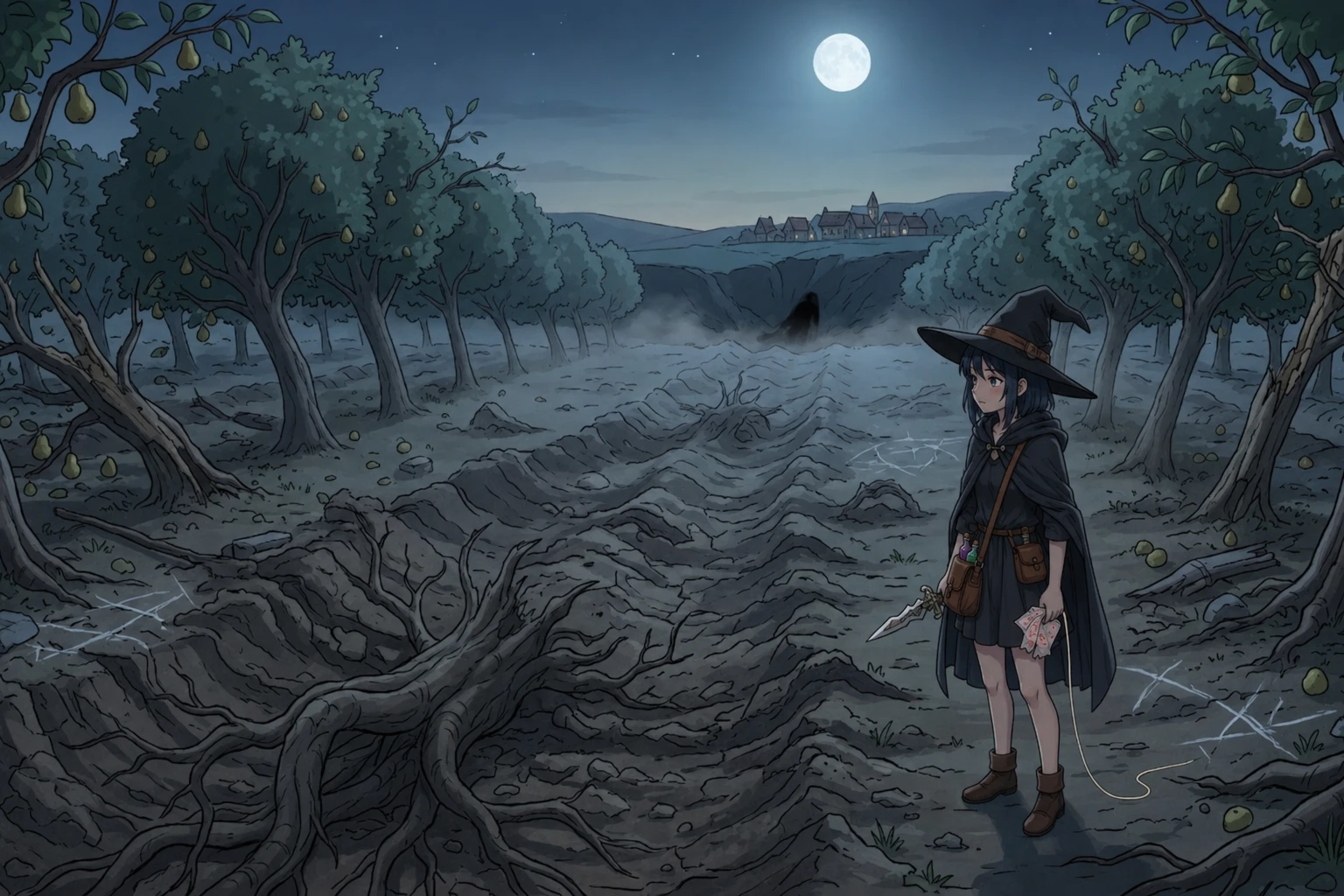
The first thing wrong was the silence.
Not the silence of a quiet place — Kuroha had walked enough countryside to know the difference. A quiet place had texture: insects, wind in specific trees, the small continuous sound of things going about their lives in ways that didn't require attention. This was the other kind. The kind that happened when everything with working instincts had decided, collectively and without discussion, to be somewhere else.
She had come down from the ridge road into the valley mid-morning, following the smell of fruit orchards that the map in her bag had promised were here, and had found them — rows of pear trees running in long lines from the road to the irrigation ditch at the far edge of the valley, the fruit just beginning to come in. Or it should have been. The trees at the outer rows were wrong. Not dead — something stranger than dead. Twisted slightly inward, the way a hand curled when something hurt it, branches bent toward the trunk as if trying to protect themselves from a direction they couldn't name. The fruit on the outward-facing sides was bruised nearly black.
She crouched at the ditch and looked at the water. Still. Clean. Nothing visibly wrong with it.
A crow landed on the ditch wall six feet away, looked at the far bank, and left without making a sound.
She stood, filed everything away, and walked into the village.
The village was called Kakino, which meant persimmon, though it was pears they grew now, and the man she found at the well — middle-aged, with the particular tired expression of someone who had been worrying about the same thing for several weeks — looked at her hat with the usual assessment and then past it, at the road she'd come in on.
"From the ridge?" he said.
"Passing through," Kuroha said. "I came past your outer orchards. What happened to the trees on the eastern rows?"
He pressed his lips together. "Disease," he said, in the tone of someone repeating a conclusion they hadn't fully convinced themselves of. "Or root rot. We've had the soil checked — nothing obvious. It's been moving inward for about a month. Started at the ditch."
"How fast?"
"Row by row. Every few nights, another line of trees." He looked east, toward the orchards, though they weren't visible from where they stood. "If it reaches the middle rows we lose most of the harvest. If it reaches the storehouses—" He didn't finish.
"The storehouses," Kuroha said. "How far are those from the current damage?"
"Eight rows. Maybe nine."
"And the irrigation ditch — do your animals cross it after dark?"
He looked at her more carefully. "No," he said. "They won't go near it after sundown. We thought that was the disease too. Animals sense rot, sometimes, before—" He stopped again, recalibrating. "You don't think it's disease."
"I think your trees are being damaged from underneath," Kuroha said. "Root pressure, not rot. The pattern is consistent with something moving through the subsoil."
"Something," he said.
"Something," she agreed, pleasantly, in the tone that invited no further questions.
He didn't ask further questions. People in farming villages, she had found, were often more practically minded than people in towns — they cared less about the category of problem and more about whether it was going to be solved.
"Is there anything to be done?" he said.
"Probably," Kuroha said. "I'd like to walk the orchard before I say."
He gave her access without asking her name, which she appreciated, and she spent the rest of the day in the trees.
The damage was worse up close. At the outermost rows the trees were barely alive — the twisted inward lean most severe here, the root-ground disturbed in long rippling furrows as if something below had pushed upward in passing and then thought better of it. The soil at the ditch edge was fractured in a pattern that was nothing like rot and nothing like any agricultural problem she had ever seen, and everything like the subsurface passage of something large and directional.
She walked every row twice. She noted the depth of the furrows, the direction of the lean, the spacing between disturbances. She pressed her palm flat to the earth in several places and felt nothing — whatever was down there moved at its own hours, not hers.
At the eighth row she found a dead mole. Then three more, within twenty feet of each other. Then a scatter of earthworms on the surface, which earthworms did not do in dry weather unless driven up by something below they found intolerable.
She knew, by the time the light started going golden, what she was dealing with.
She went back to the road and ate the last of her travel food — rice wrapped in leaf, dried plum — sitting on a stone wall with her bag at her feet, watching the light leave the valley and the village begin to shut itself in for the evening. Lamps came on. A dog barked once and went quiet. The orchard went dark from east to west as the shadow of the ridge rolled over it.
She waited two more hours, until the village was fully still.
Then she took off her hat and put it in her bag, tied her bag to a tree branch at the orchard's edge where she could find it in the dark, and walked into the trees with nothing but what she carried on her person.
The orchard at night was a different place entirely. No wind. No insects. The trees stood in their rows like the pillars of something that had once been a building and forgotten what buildings were for, and the dark between them was absolute in the way that darkness in open country was not — a pressed, specific dark, the dark of a place that had learned to be afraid of itself after sundown.
She moved between the third and fourth rows, stepping lightly, heel-toe, the way she had been taught to move through places where vibration mattered. She carried three things in her hands: a coil of warded thread, a pouch of binding powder, and a short straight blade she used for cutting through things that didn't respond to words. She had other tools at her belt — chalk, a folded charm-paper, a small smooth stone that was not quite a stone — but those were for the setup, and the setup was done.
She had spent the afternoon placing the outer markers. Four of them, at the cardinal edges of the damaged zone, pressed into the ground at the depth she calculated the creature traveled. Thread run between them, barely underground, looped in the specific configuration that would not stop something moving through soil but would register it — a vibration up the line, a signal she would feel through her fingers in the dark.
She held the thread now, coiled loosely, and waited.
For a long time there was nothing.
Then the ground moved.
Not an earthquake — nothing that large or indifferent. A directed movement, a purposeful shifting of soil ten, fifteen feet below her, moving in a line that ran roughly southwest. She felt it through her feet before she felt it through the thread — a deep rolling pressure, the sensation of something massive displacing earth the way a body displaced water, and she was already moving before the thread confirmed it, three steps to the left, light and fast.
The ground where she had been standing erupted.
Not explosively — it folded upward, the soil cracking along a seam and rising in a wave before collapsing back, the way a blanket looked when something moved under it at speed. The furrow it left was two feet wide and ran the length of four tree rows before it stopped and the ground went still again.
She stood ten feet from the end of the furrow and let her breathing settle.
It had felt her. She had known it would, eventually — anything that navigated by vibration would find a person standing still sooner or later. The question was always the interval between feeling and reacting, and how she used it.
She moved again, angling toward the eighth row, toward the far markers. If she could pull it across the binding line she had laid at the orchard's northern edge, she could force a change of direction. Not catch it — nothing below ground could be caught from above — but interrupt its path, redirect the momentum, buy time to set the second configuration.
It found her again in forty seconds.
This time she heard it coming — a low grinding under the soil, moving faster than before, directly toward her, and she ran. Not away from the orchard but across it, parallel to the tree rows, and she was fast enough, almost, almost, and then the ground under her left foot gave way and she went down hard on her side, the thread spilling from her hand, her shoulder hitting the root-ridge of a tree with an impact that knocked the breath out of her completely.
She lay still for two seconds because she had to, and the earth beside her rose and broke and fell back in a wave that passed close enough that she felt the air displacement in her hair.
She got up.
Her shoulder was wrong in the specific way that meant she'd use it anyway and regret it tomorrow, and the thread was gone — not lost, just uncoiled across the ground, useless now. She moved to the tree and pressed her back against it and controlled her breathing and counted.
The creature was below the northern marker line. She had gotten that much, even going down. If she could get the binding chalk down on the soil above it while it was still orienting, she could create the exclusion pattern — not a trap, not a cage, but a direction: a set of boundaries that all pointed the same way, toward the ridge, toward uninhabited ground, away from the storehouses and the village and everything it had been slowly eating toward.
She had one chance at this, with one usable arm, in the dark.
She reached for the chalk.
What followed was less a fight than a conversation conducted in urgency, each move met with a counter she had to read from the earth before it arrived. She laid the first chalk line and the ground erupted and she stepped over it, calmly, and laid the second while soil rained on her from both sides. She set the third at a run, changed direction when the pressure tracked her, doubled back and set the fourth on ground she had already crossed twice, because it was not expecting her there again.
The creature broke surface twice. The first time she saw it only as a mass of moving earth, a shape with no clean edges, dark and enormous, soil-slick and fast. The second time it came up fully at the seventh row and she was ready, the folded charm-paper already lit and thrown, and it struck the thing's flank and the sound it made was nothing she had words for — not animal, not weather, something from a register that existed below both — and it went back under, deeper this time, and the grinding moved north.
It hit the exclusion boundary at the ridge edge and stopped.
She stood at the seventh row in the ruined dark with her shoulder burning and her knees grass-stained and the chalk dust still on her hands and watched the ground at the northern perimeter.
Nothing.
The grinding, distant now. Moving up. Away.
She stayed until she couldn't hear it anymore, and then she stayed a little longer, because things that moved through earth did not always commit to a direction on the first attempt. But the ground remained ground, and the trees stood in their crooked rows, and the silence over the orchard was slowly, carefully, beginning to fill back in with the small sounds of things returning.
A cricket. Then two. Then the distant complaint of a night bird somewhere near the ditch.
She found her hat where the impact had thrown it — four rows back, caught in the low branches of a pear tree, tilted absurdly to the right. She retrieved it. She considered its condition and decided it had survived worse, which was true, and put it on, where it immediately listed to the left.
She collected the outer markers by feel, recoiled the surviving thread, and made her way back through the rows toward the orchard's edge and her bag.
She was at the last row when she heard footsteps.
One person, moving fast, coming from the direction of the village — alerted by the noise, or insomnia, or the particular instinct that some people had for knowing when something was wrong with land they worked. A lamp bobbed between the trees, still twenty yards off.
She stepped behind the last tree and was still.
The man from the well came through the orchard with his lamp held high, moving the way farmers moved through their own land — with authority, even afraid. He walked the seventh row and stopped at the long furrow the creature had left on its final pass, the broken soil still settling, the tree beside it leaning worse than before.
He crouched and looked at it. Pressed a hand to the ground. Looked north, toward the ridge, where the exclusion boundary sat invisible in the dark.
Then he looked at the chalk marks — four of them, in a pattern that would mean nothing to a farmer but had clearly been put there by someone who knew what they were doing, and he looked around at the dark between the trees, and she was sure, for one moment, that he was going to see her.
He didn't.
He stood. He looked at the rearranged irrigation stones at the ditch edge — she had moved those too, in the first hour, setting the initial line — and something moved in his face that she couldn't read from this distance. He stayed for a long moment.
Then he turned and walked back to the village, and she heard his footsteps fade, and the lamp-glow diminished between the trees and was gone.
She counted to a hundred.
Then she shouldered her bag and walked north, away from the village, up toward the ridge road she had come down the morning before. The sky was beginning to grey at its eastern edge — not dawn yet, the hour before dawn, the one that belonged to neither night nor what came after.
She did not look back at the orchard.
She had looked at it long enough.
By the time real morning came to Kakino, Kuroha was already over the ridge and on the far road down into the next valley. Behind her the village would be waking to one ruined field, cracked earth, the irrigation stones rearranged in a circle that nobody had put there, and eight rows of living trees that, given a season to recover, would give fruit again.
The man from the well would have questions. She suspected he was the kind of man who would sit with the questions rather than needing them answered, which was, in her experience, the best kind.
The road went on. The morning came up around her, ordinary and wide, and her shoulder ached in a way that would remind her, for several days, that the thing beneath the orchard had been real and large and had not especially wanted to leave.
She walked until the ache became background, and then she kept walking.
That was usually how it went.


.png)
.png)
.png)